

AAPOD2 Image Archives
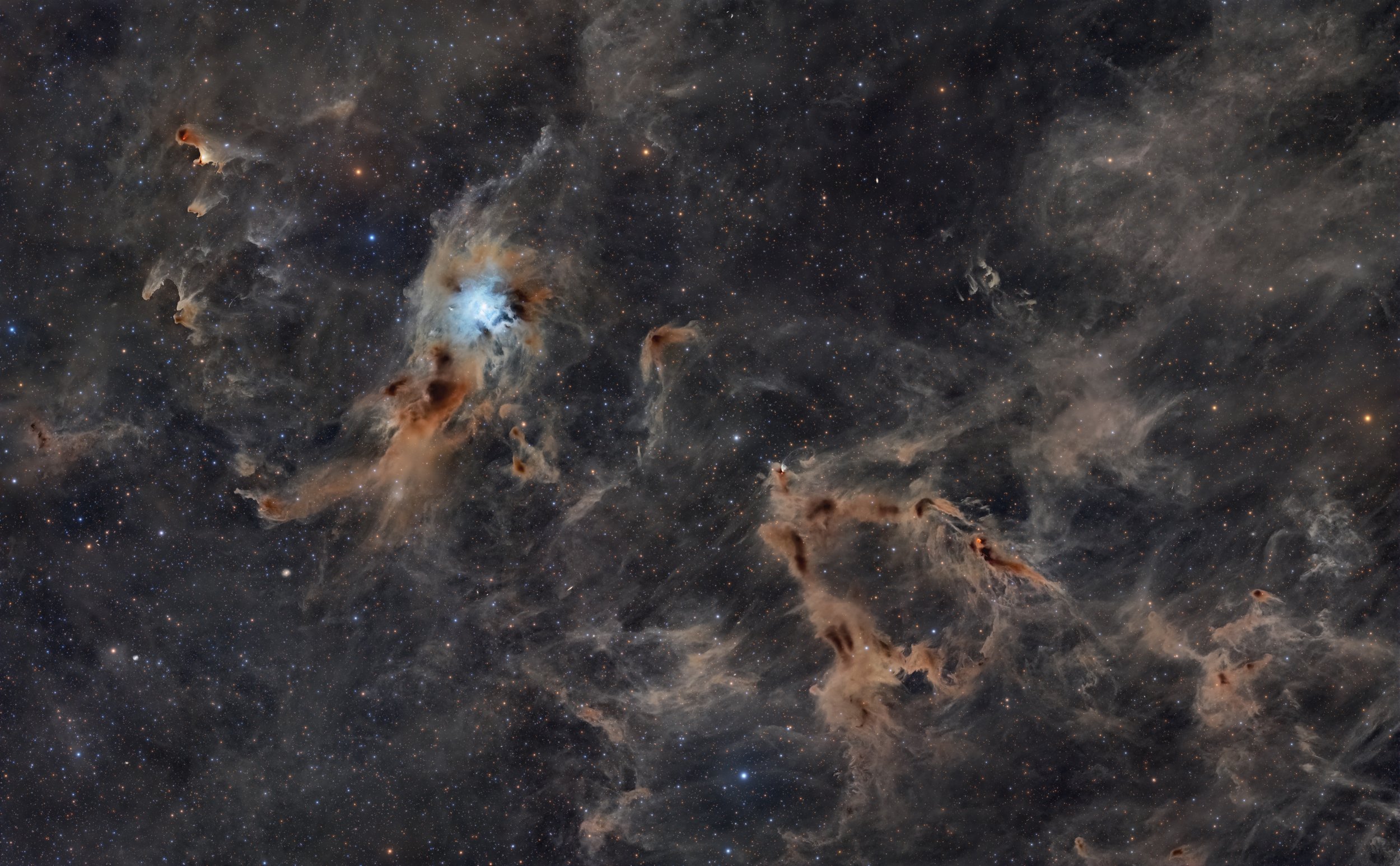
Obsidian jewels of Cepheus and its blue flower
At the heart of this expansive four-panel mosaic lies the Iris Nebula, also cataloged as NGC 7023 or Caldwell 4, glowing with a vivid blue light produced by reflected starlight. This reflection nebula is illuminated primarily by the hot, young star HD 200775, whose radiation scatters off fine interstellar dust grains, giving the Iris its characteristic blue hue. Embedded within the nebula is the sparse open cluster OCL 235, whose stars are still closely linked to the dusty molecular environment from which they formed.
Surrounding the Iris Nebula is an intricate web of faint interstellar dust clouds, often referred to as galactic cirrus. These wispy structures trace cold, diffuse material within the Milky Way and are visible here through a combination of reflected starlight and subtle extinction against the dense star field. With over 81 hours of total integration, this mosaic reveals both the bright core of NGC 7023 and the delicate, large-scale dust flows that connect it to the surrounding interstellar medium, highlighting the complex interplay between stars, dust, and light.
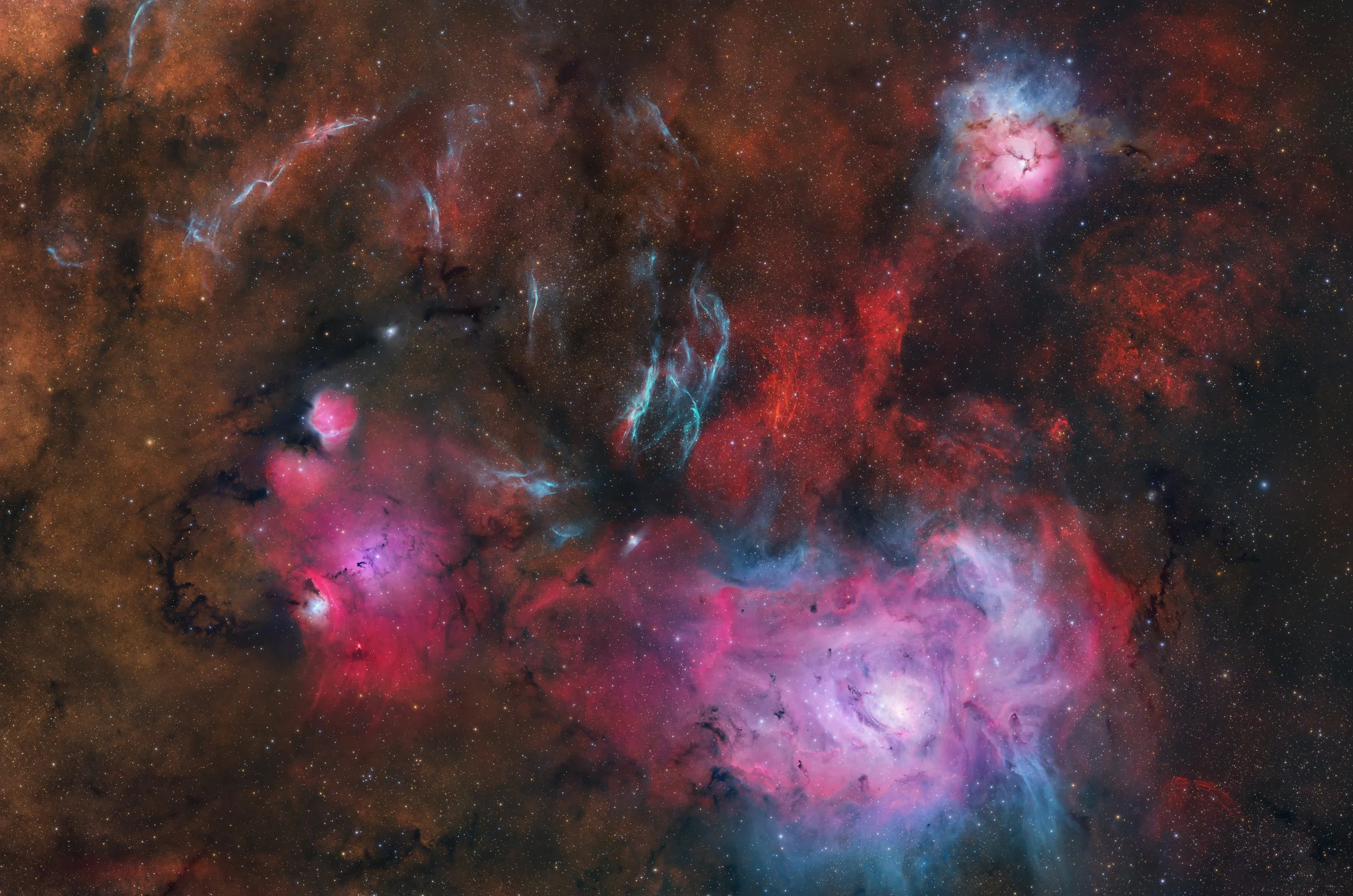
SNR G007.5-01.7 “Taz” Near the Lagoon Nebula
Adjacent to the Lagoon Nebula (M8) lies the faint supernova remnant SNR G007.5-01.7, informally known as “Taz” for its distinctive shape. This remnant consists of delicate O III–rich filaments, the cooling and recombining gas from a massive star’s explosion thousands of years ago. The shock fronts, driven outward into the interstellar medium, excite oxygen atoms, producing the characteristic teal emission captured through narrowband filters. Its low surface brightness and location within a crowded Milky Way field make it a challenging target for deep imaging.
The object’s proximity to the bright emission of M8 often obscures its presence, requiring careful exposure balancing and extended integration time to separate its subtle filaments from background nebulosity. Observations like this provide rare opportunities to study the dynamics of supernova remnants interacting with surrounding molecular clouds in a dense galactic region. Such remnants contribute to the chemical enrichment of the interstellar medium, dispersing heavy elements forged in the progenitor star’s core.