
Obsidian jewels of Cepheus and its blue flower
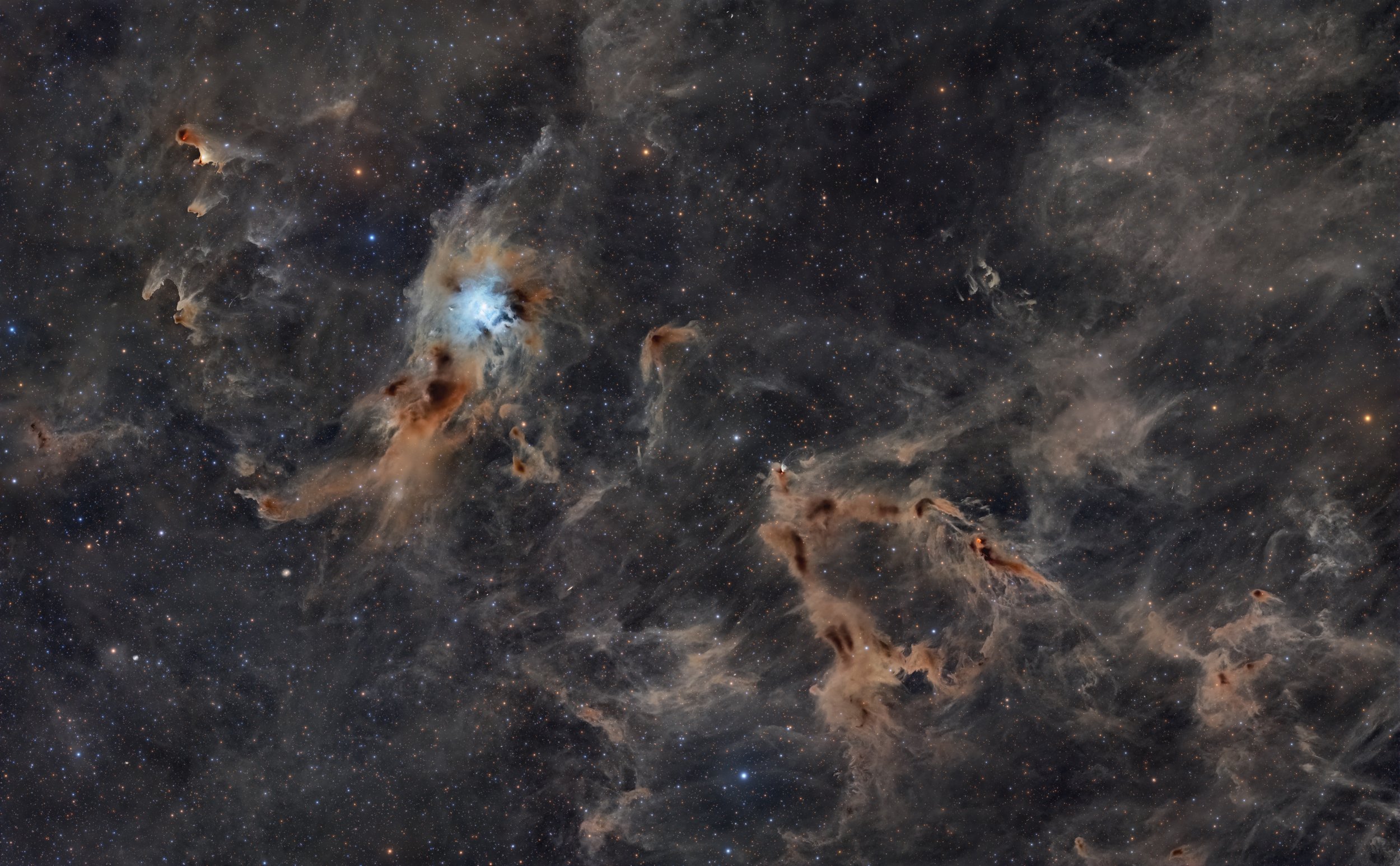
Image Title: Obsidian jewels of Cepheus and its blue flower
Copyright: Team FACT : Louis Leroux, Thibault Rouillée, Cédric de Decker, Cyrille Malo, Vincent Martin, Lucas Thibaud, Maxime Martin, Vincent Flouzat, Clément Piel, Jean-Charles Ripault
Date image was taken: October 01, 2025
Location: France
Data Acquisition Method: Personal Telescope Setup
Description and Details: The constellation Cepheus is known for being particularly rich in emission nebulae, but it also contains many other treasures, such as a multitude of dark nebulae and reflection nebulae, including one iconic object well known to amateur astronomers: the Iris Nebula.
When scanning the image diagonally, three groups of objects stand out :
At the top left lies a region composed of Sh2-136, also known as the Ghost Nebula. It is a reflection nebula (VdB 141) combined with an emission nebula located about 1,500 light-years from Earth in the constellation Cepheus. This complex is in fact a Bok globule, a clump of dust and gas within which star formation can begin. These globules most often lead to the birth of double or multiple star systems.
The “eyes” of the ghost, shown in red, are in fact a low-mass binary stellar system forming within the Bok globule CB230, which produces a Herbig–Haro outflow—this is object HH157.
At the center of the image, shining with a brilliant blue light, lies the so-called Iris Nebula. Also known as NGC 7023 or Caldwell 4, it is a reflection nebula containing the open cluster OCL 235. The nebula was discovered by the German-British astronomer William Herschel in 1794. The high density of interstellar dust and the extensions surrounding the blue-tinted core of the Iris can evoke the full stem of the flower that this nebula represents.
The star illuminating the Iris Nebula is HD 200775, a Herbig Ae/Be star of spectral type BE, located about 1,600 light-years away. Within the core of the Iris, one can find small interesting details such as a tiny white butterfly-shaped nebula on the left of the image below.
Finally, the nebula LBN 468, also known as the Loop of Darkness, is a vast nebulous complex composed of dark dust located about 1,600 light-years from Earth, along with several other gems we will examine below. It consists mainly of interstellar dust and dense molecular clouds, which block or absorb much of the background starlight and make the region appear dark in visible wavelengths. This dense interstellar cloud is giving rise to new stars or already contains young stars in formation. Its apparent diameter is about twice that of the full Moon.
Within LBN 468 lies a compact reflection nebula, Gyulbudaghian's Nebula (also catalogued as GM 1-29), illuminated by the variable star PV Cephei and containing the Herbig–Haro object HH215. This nebula is very small (about 1 to 1.5 arcminutes), and its most remarkable feature is its changing shape and brightness over the span of months or years, caused by jets from the protostar—making it a beautiful example of a variable nebula ! This variable nebula was discovered by the armenian Armen Gyulbudaghian in 1977.
Almost opposite Gyulbudaghian’s Nebula, at the lower right, we find another intriguing object with its vivid orange-red color : another Herbig–Haro object, HH376A.
Total Integration : 81h24min
- Four-panel mosaic
- Luminance : 47h09min
- RGB : 34h15min
- 300-1000mm focal length
- Bortle 4
Name: Louis Leroux
Website or Facebook Profile: http://www.astrobin.com/users/fact/
Share & Credit This AAPOD2 Feature
When you share this image on AstroBin, social media, forums, or your own website, please include a credit to AAPOD2 so viewers can discover where this feature came from.
Support AAPOD2 for free! Use Our AGENA ASTRO Affliate Link
AAPOD2 Title: Obsidian jewels of Cepheus and its blue flower
AAPOD2 Page Link: https://www.aapod2.com/blog/ngc-7023-and-the-surrounding-interstellar-cirrus
Submit Your Photo!