
AAPOD2 Image Archives
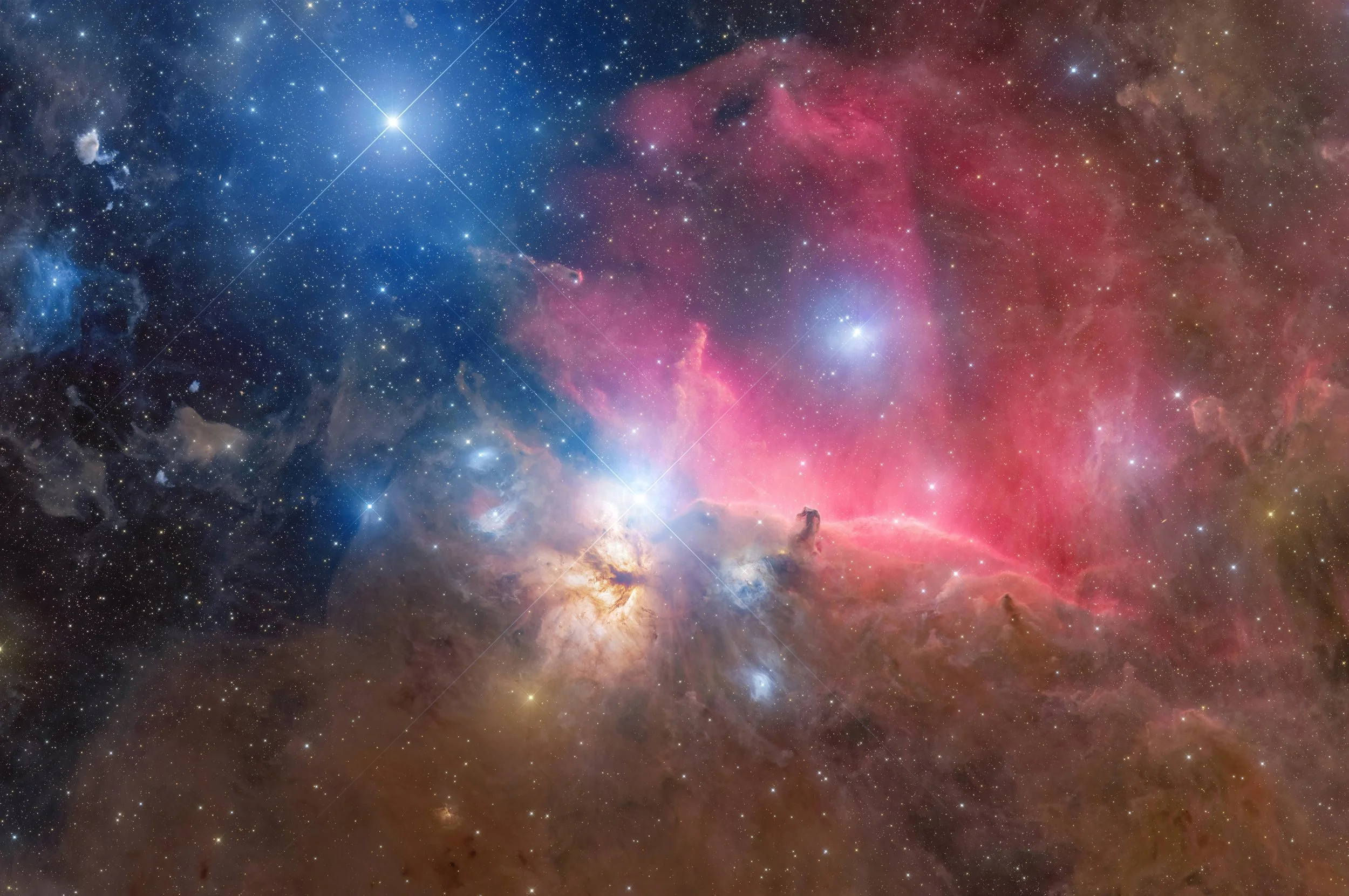
Orion’s Lesser-Known Nebulae in a Single Wide Field
This expansive field in Orion reveals a remarkably dense mix of nebular structures that often sit in the shadow of their more famous neighbors. Dominated by the glowing region around NGC 1990, the scene includes emission and reflection nebulae cataloged as IC 431 and IC 432, the Sharpless object Sh2-277, and several van den Bergh reflection nebulae including VdB 48, 51, and 52. Their soft blues and reds trace the interaction between energetic young stars and the surrounding interstellar medium, where ultraviolet radiation excites hydrogen gas and illuminates nearby dust.
Interwoven through this luminous backdrop is a complex network of Lynds Bright and Dark Nebulae, including LBN 921, 924, 927, 928, 944, 946, 950, 953, 958, 962, 965, and 967, along with dark clouds such as LDN 1614, 1620, 1635, and 1636. These opaque dust lanes carve intricate silhouettes against the glowing gas, marking regions where future stars may eventually form. Captured from Starfront Observatories in Texas, this image highlights the extraordinary depth and diversity of Orion’s lesser-known nebular landscape, where star formation, illumination, and obscuration coexist within a single rich field.
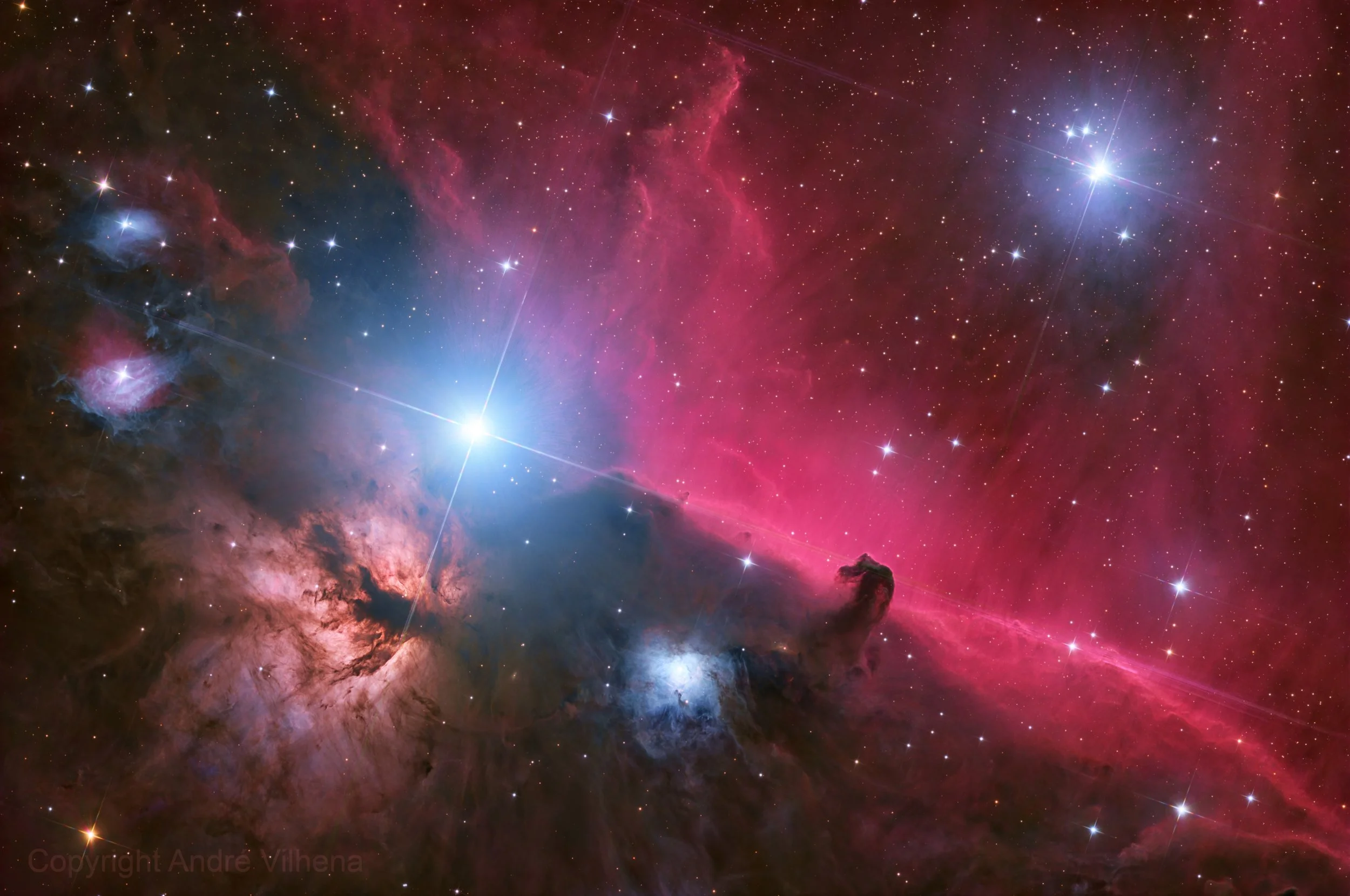
Barnard 33 - The Horsehead Nebula
Silhouetted against the glowing hydrogen backdrop of IC 434, the Horsehead Nebula is a dense pillar of cold molecular gas and dust located in the constellation Orion, roughly 1,300 light-years from Earth. Cataloged as Barnard 33, this iconic dark nebula is shaped by intense ultraviolet radiation from nearby massive stars, which ionizes the surrounding hydrogen and slowly erodes the cloud’s edges. The contrast between the opaque dust and the luminous emission nebula behind it gives the Horsehead its unmistakable profile.
This image combines broadband RGB and luminance data with deep H-alpha exposure to reveal both the subtle dust structures within the nebula and the surrounding emission and reflection regions. The bright star illuminating the scene energizes the hydrogen gas, while embedded blue reflection nebulae trace starlight scattering off fine dust grains. Together, these elements showcase a dynamic stellar nursery where gravity, radiation, and interstellar matter interact on vast scales.
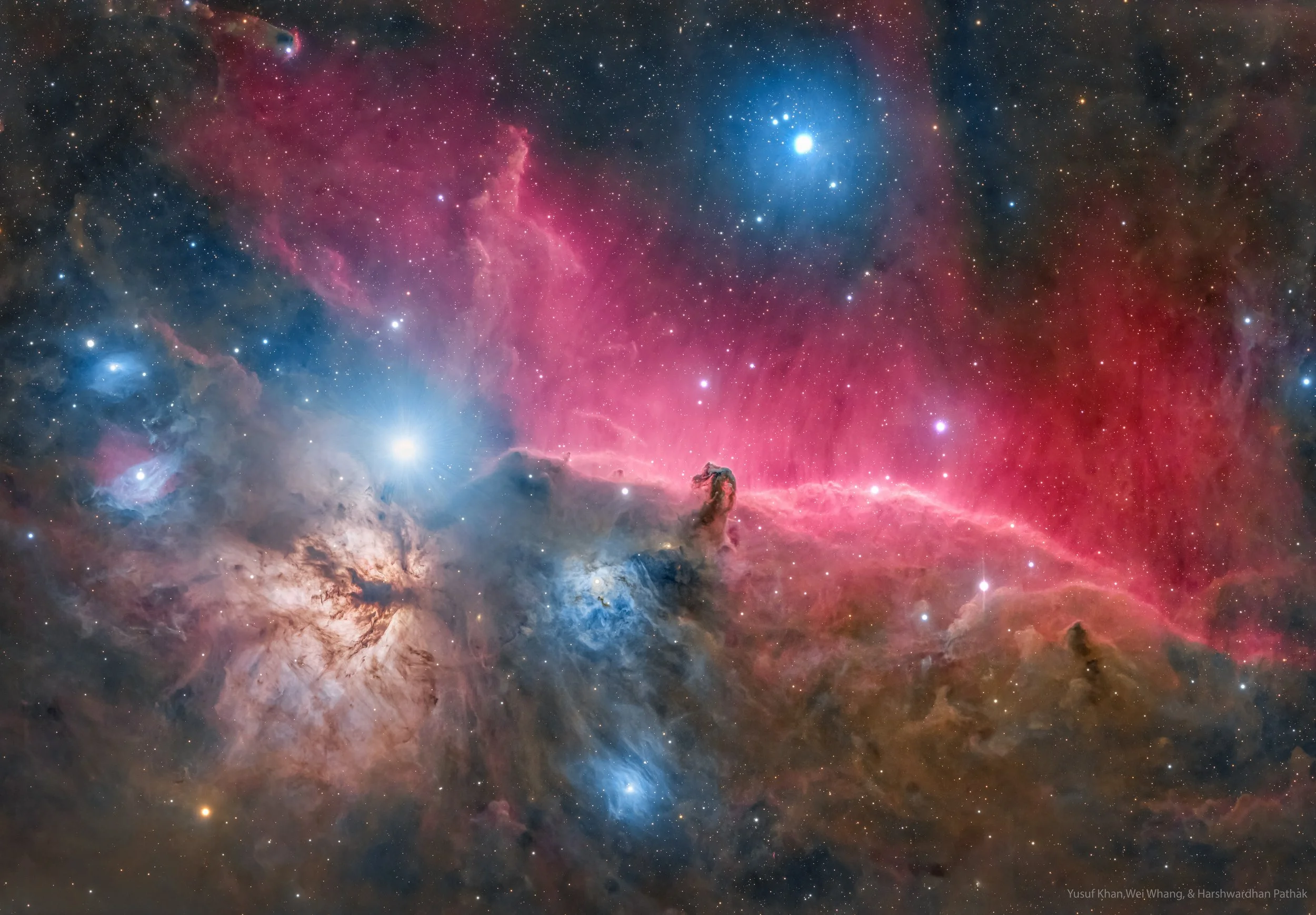
The Horsehead Nebula
The Horsehead Nebula (Barnard 33) is a striking dark nebula located approximately 1,375 light-years away in the constellation Orion. It appears as a distinctive silhouette against the vibrant glow of IC 434, a bright emission nebula illuminated by the nearby star Sigma Orionis. The nebula’s famous horse-like shape is the result of a dense region of cold gas and dust that blocks the background hydrogen-alpha (Hα) light emitted by IC 434.
Revealed in this image is the delicate interface where ionized hydrogen meets dense molecular gas at the Horsehead’s edge. This boundary region, shaped by intense radiation from nearby young stars, is a site of active star formation, adding another dimension to this iconic cosmic landscape.

A Journey on Horseback: Barndar33 Horsehead Nebula
The Horsehead Nebula (Barnard 33), located in the Orion constellation approximately 1,500 light-years away, is a captivating dark nebula renowned for its distinct silhouette resembling a horse's head against the vibrant background of IC 434. This image was captured using the SHO (Sulfur-II, Hydrogen-alpha, Oxygen-III) narrowband palette, offering a unique perspective of this iconic region by mapping specific ionized gases to distinct colors.
The SHO technique highlights Sulfur-II emissions in red, Hydrogen-alpha in green, and Oxygen-III in blue, which provides insights beyond traditional broadband imaging. This method reveals lesser-known details, such as the intricate structures of ionization fronts and shock waves from nearby stellar winds. The blue hues in the image, corresponding to Oxygen-III, often trace the hotter, ionized regions around young, massive stars, while the reddish areas dominated by Sulfur-II can indicate regions of low-energy ionization, often associated with older stellar remnants or slower-moving ionized fronts. The green hydrogen-alpha emissions not only enhance the iconic glow of IC 434 but also bring out subtle textures in the surrounding molecular clouds, offering a deeper understanding of the chemical processes and star formation activities within this complex and beautiful region.