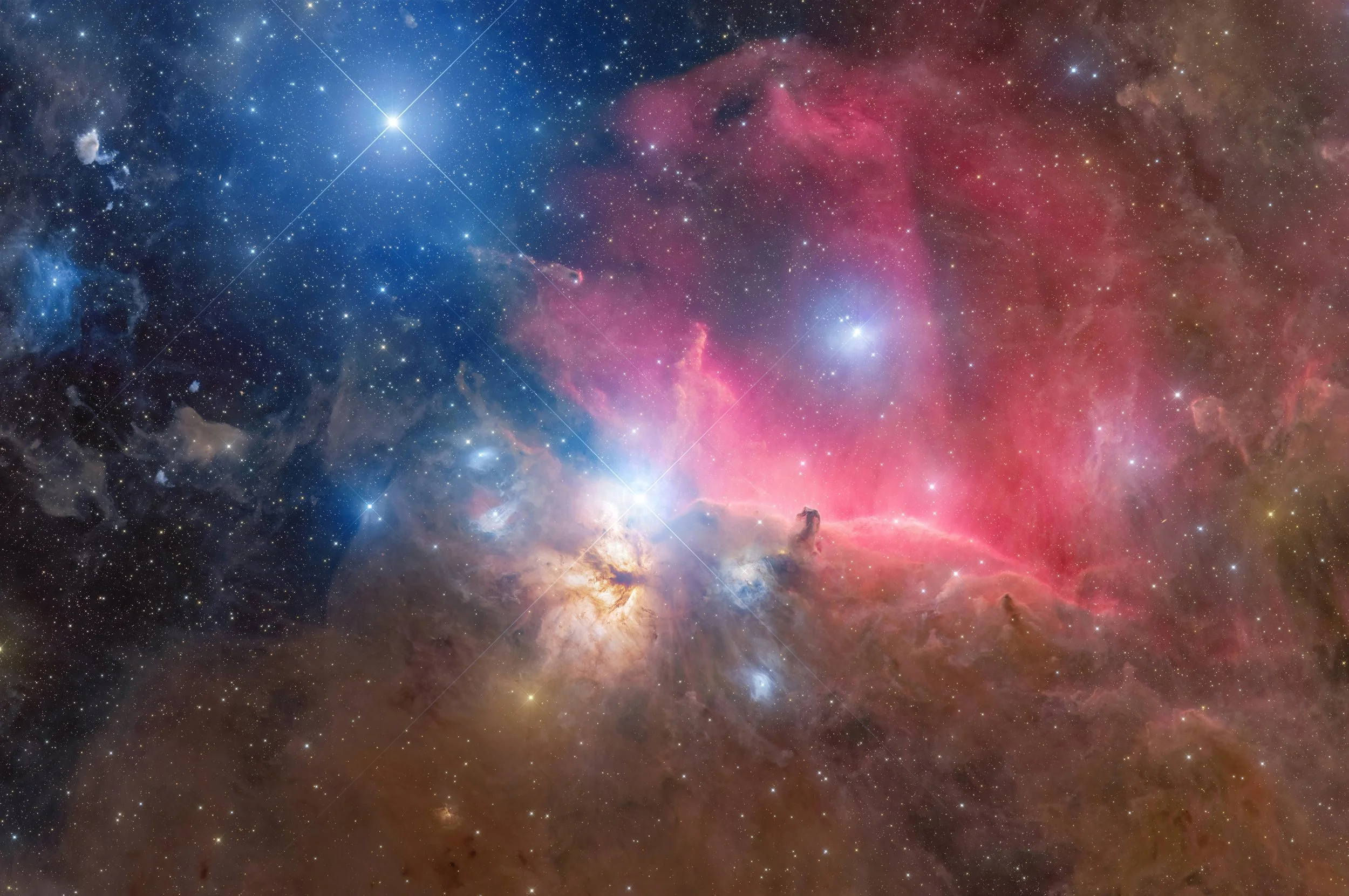
Image Title: The Dark Horse and the Cosmic Flame
Copyright: Landon Behm and Julien De Winter
Date image was taken: December 13, 2025
Location: Starfront Observatories (Texas)
Data Acquisition Method: Personal Telescope Setup
Description and Details: Today,we are inviting you into one of the most popular constellations of the winter sky: Orion, and in particular the region near Orion’s Belt, home to the Horsehead Nebula (Barnard 33) and the Flame Nebula (NGC 2024).
This remarkable field of view captures one of the richest and most visually striking portions of the night sky, where diverse types of nebulae — dark, emission, and reflection — intermingle with young stars and dense molecular clouds. What makes this region truly unique is the juxtaposition of objects that trace multiple stages of star formation: dense molecular pillars like the Horsehead Nebula, glowing stellar nurseries like the Flame Nebula, and dust-scattering reflection nebulae such as NGC 2023 and IC 426. Together, they form a microcosm of a stellar nursery, offering a natural laboratory for studying the lifecycle of stars.
Most of the objects visible in this field belong to the Orion Molecular Cloud Complex, specifically the Orion B cloud, which lies at an average distance of approximately 1,300 to 1,500 light-years from Earth. Despite appearing widely separated on the sky, the major nebulae in this image are physically related and embedded within the same vast star-forming structure. The Orion Molecular Cloud Complex itself extends over several hundred light-years,
The Horsehead Nebula stands out as a dense pillar of cold molecular gas and dust, rising roughly three to four light-years in height. Located at the same distance as the surrounding Orion B cloud, it is silhouetted against the bright hydrogen emission of IC 434. Its iconic shape is sculpted by intense ultraviolet radiation and stellar winds from nearby massive stars, which gradually erode the surrounding material while leaving behind compact, opaque cores.
Nearby lies the Flame Nebula (Fig.2), NGC 2024, an active emission nebula extending approximately ten to fifteen light-years across. It hosts a deeply embedded young star cluster whose energetic radiation ionizes the surrounding hydrogen gas, causing it to glow, while thick foreground dust lanes obscure the central regions and reveal the turbulent structure of the cloud.
We would to highlight IC 426 as well IC 435, another reflection nebula visible in this field, may lie somewhat closer to Earth, with distance estimates ranging from roughly 740 to 1,300 light-years. Although possibly foreground to the main Orion B cloud, it remains visually intertwined with the broader Orion environment. IC 435, illuminated by the star HD 38087, is a particularly bright reflection nebula characterized by symmetrical dust lanes and spans several light-years in extent.
This field also contains a rich assortment of nebulae cataloged as IC, NGC, Sharpless, van den Bergh, and Lynds objects, including IC 431 and IC 432, NGC 1990, Sh2-277, VdB 48, VdB 51, VdB 52, as well as numerous Lynds Bright and Dark Nebulae such as LBN 921, 924, 927, 928, 944, 946, 950, 953, 958, 962, 965, 967 and LDN 1614, 1620, 1635, and 1636. The majority of these clouds are physically connected within the Orion Molecular Cloud Complex and collectively form a massive star-forming region located roughly 1,300 to 1,500 light-years away.
Equipment & integration time
Takahashi Epsilon 180ED
ASI 6200MC
219 × 300s (18h15 total integration)
Name: Julien DE WINTER
Website or Facebook Profile: https://www.astrobin.com/unq1iv/