

AAPOD2 Image Archives
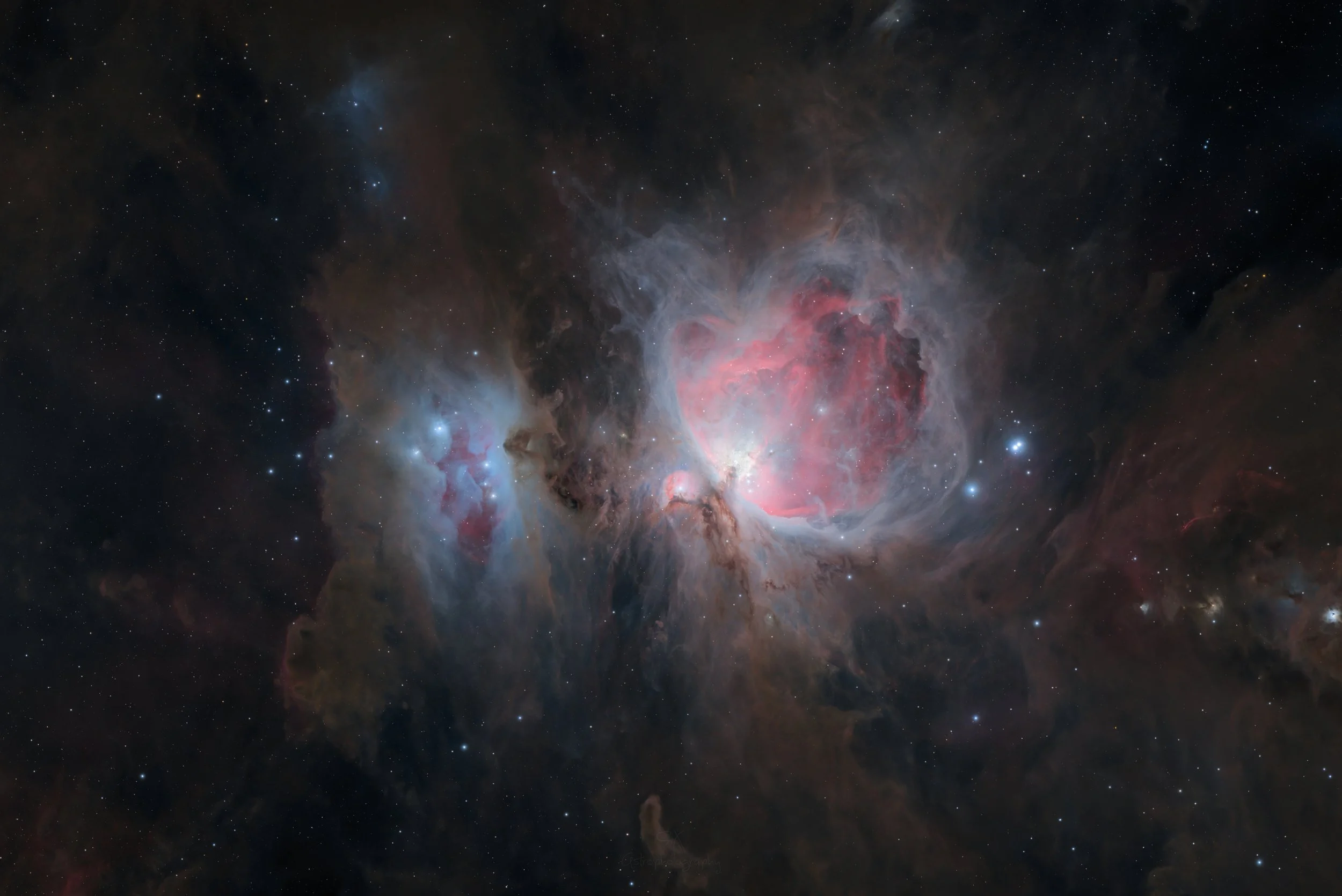
M42 - The Great Nebula in Orion
M42, the Great Nebula in Orion, is the nearest massive star-forming region to Earth at about 1,350 light-years away. This immense cloud of hydrogen, oxygen, and dust is energized by the Trapezium Cluster at its core, where several extremely young and hot stars flood the surrounding gas with ultraviolet radiation. That radiation causes the nebula’s hydrogen to glow red while oxygen and scattered starlight create blue and cyan tones, revealing a layered structure of ionized gas, reflective dust, and darker molecular clouds.
What makes M42 so scientifically important is that it offers a front-row view of how stars are born. Within these luminous curtains are hundreds of protostars and protoplanetary disks, some already sculpted by stellar winds and radiation from their massive neighbors. The sweeping arcs, glowing cavities, and dark filaments seen here trace shock fronts, evaporation flows, and gravity-driven collapse, capturing a moment in the ongoing transformation of cold interstellar matter into a new generation of stars and planetary systems.
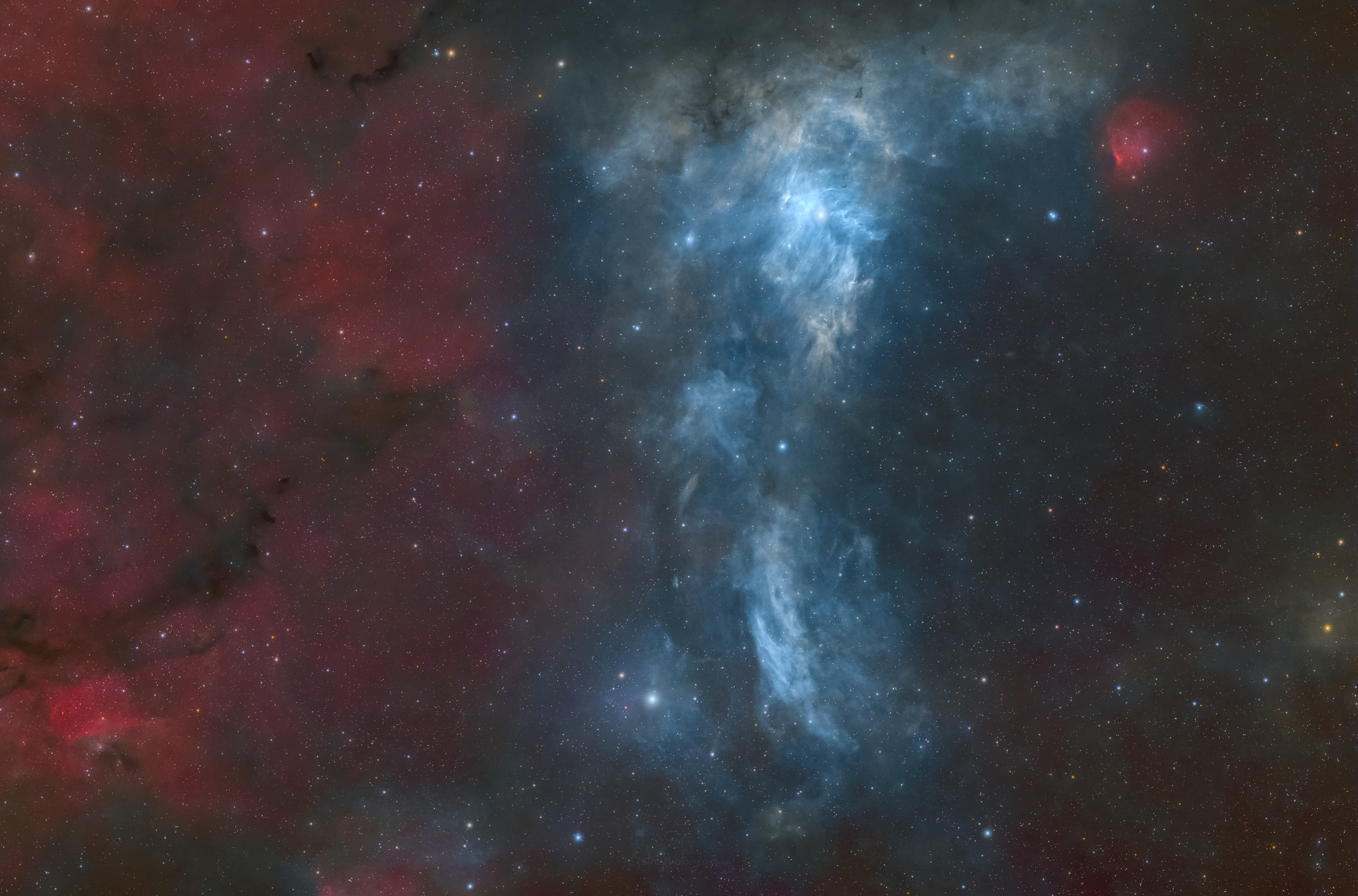
vdB 14 and vdB 15, Blue Reflection Nebulae in Perseus
vdB 14 and vdB 15 are faint reflection nebulae embedded in the Perseus molecular cloud complex, illuminated by nearby hot stars whose blue light is scattered by surrounding interstellar dust. Unlike emission nebulae, their glow is not produced by ionized gas but by dust grains reflecting starlight, giving rise to the delicate blue filaments that dominate the central structure. The surrounding red hydrogen emission traces more distant ionized regions of the Perseus arm, revealing multiple layers of gas and dust along the line of sight.
Captured in HaRGB from Perros-Guirec in Brittany, France, this wide-field composition highlights the contrast between cool reflection nebulosity and warmer hydrogen clouds. Dark dust lanes cut through the field, absorbing background starlight and shaping the nebulae into elongated, wispy forms. Together, vdB 14 and vdB 15 offer a subtle but striking example of how starlight, dust, and ionized gas interact within an active star-forming region of the Milky Way.

The Andromeda Galaxy (M31) in HOO+RGB
Our neighboring spiral, the Andromeda Galaxy (M31), lies about 2.5 million light-years away and dominates this detailed composite image. Captured over seven clear nights in September for a total of more than 27 hours of exposure, the frame combines HOO and RGB data to reveal the galaxy’s structure in striking color. The rich red knots scattered along the spiral arms mark vast H II regions—nebulae of ionized hydrogen where new stars are forming. Dust lanes and bluish star clusters trace Andromeda’s immense disk, while its small companion M110 glows below.
Andromeda is the largest member of the Local Group and is moving toward the Milky Way at over 100 km per second. In roughly four billion years, the two galaxies are expected to merge into a single giant elliptical system. This image, blending natural color with narrowband enhancement, highlights both the galaxy’s familiar beauty and its dynamic role in the ongoing evolution of our galactic neighborhood.