

AAPOD2 Image Archives
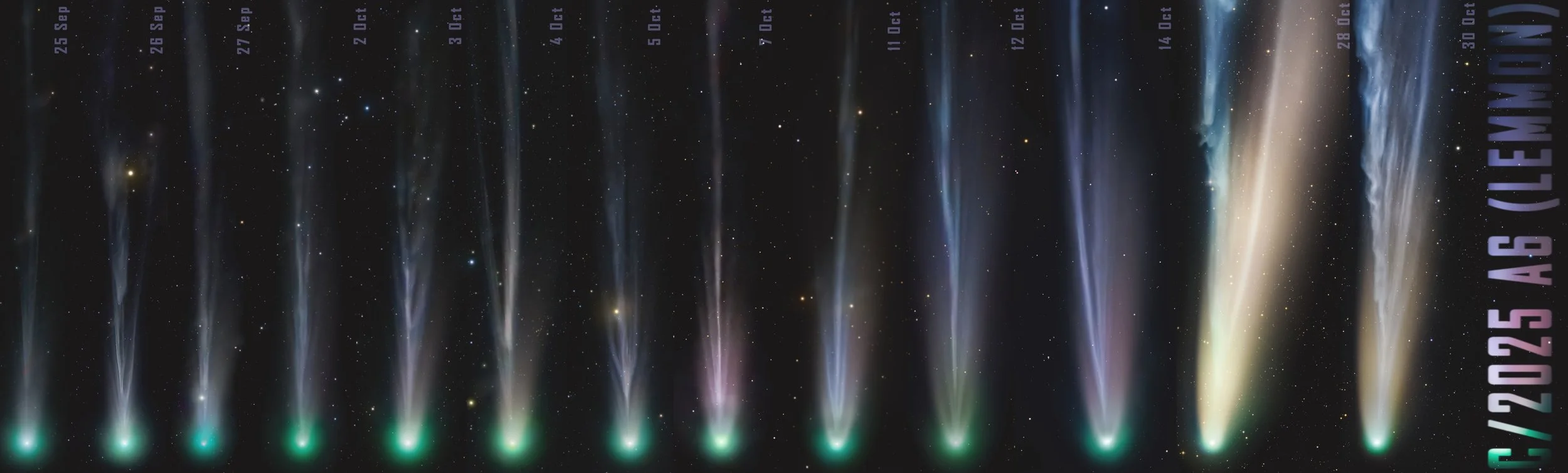
Goodbye Lemmon
Between September 25 and October 30, 2025, this sequence of thirteen images follows the week by week transformation of comet C/2025 A6 Lemmon as it moved deeper into the inner solar system. Each frame captures the growing brightness of the coma along with dramatic changes in the tail as sunlight and the solar wind stripped gas and dust from the nucleus. Subtle streamers early in the series gave way to long, sharply defined ion structures and broader dust fans. The shifting colors across the dates reflect a mix of carbon dominated green emission from the coma and the blue glow of ionized gases driven outward at high speed.
This kind of single frame time lapse is rare because most comets simply do not show so much structural variation over such a short period. Lemmon surprised observers with recurring outbursts that fed new material into the tail and produced those twisting filaments and forked jets seen toward the end of the series. Watching these changes across a month offers a front row view of how dynamic cometary physics can be when a fresh nucleus interacts with the solar wind. It also helps researchers refine dust release models for a comet that has only recently been characterized and continues to deliver surprises.
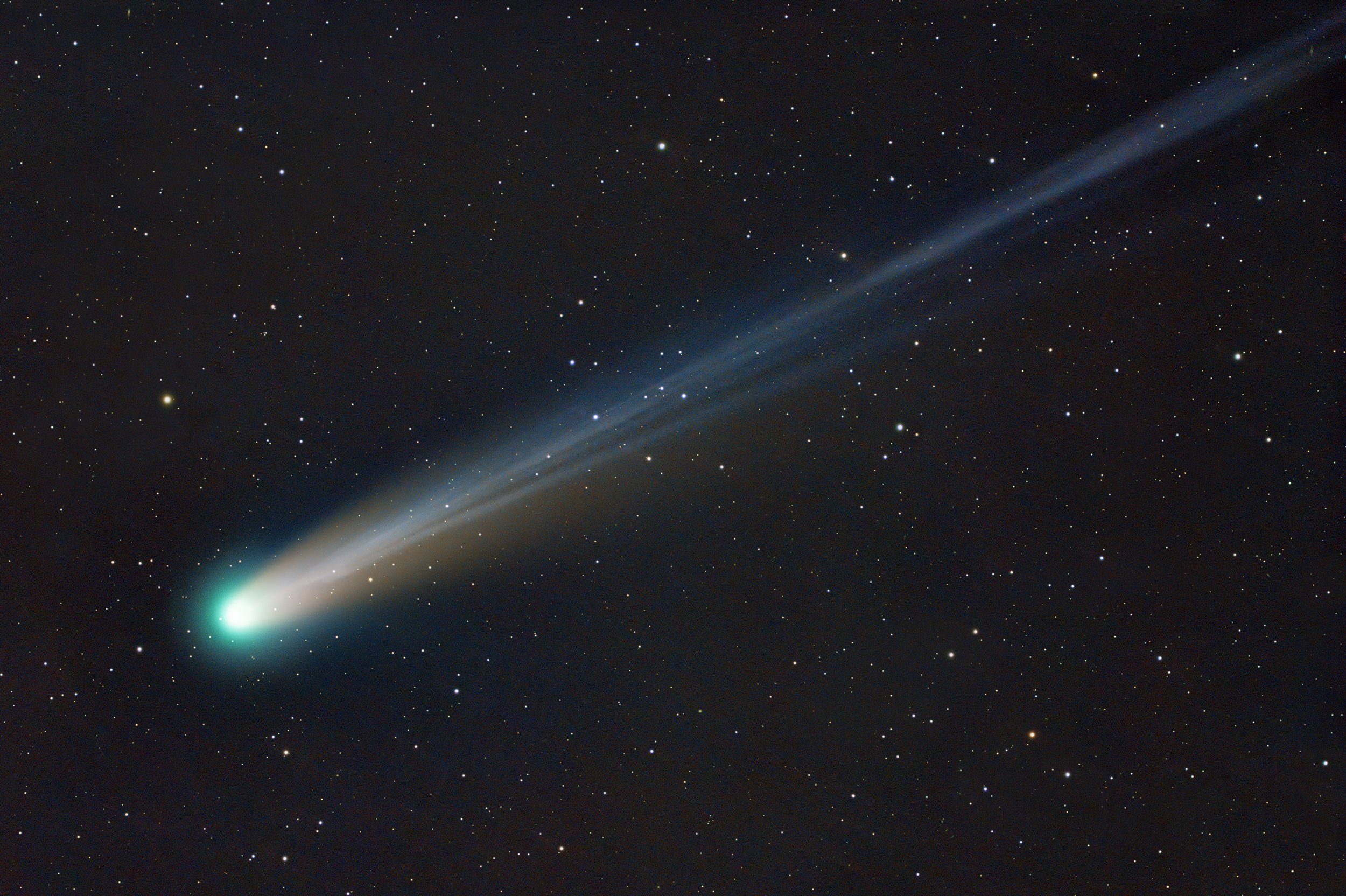
Comet C/2025 A6 (Lemmon) — October 13, 2025
Captured from the Aosta Valley in the western Alps, this image reveals Comet Lemmon streaking through the northern sky, displaying a striking contrast of colors: a vivid green coma and a beautifully extended blue ion tail. The cyan–blue tail, rich in ionized molecules such as CO⁺, forms under the influence of the solar wind, while the green glow arises from diatomic carbon (C₂) fluorescing in sunlight. The complex, braided structure of the tail reflects the comet’s active nucleus as it responds to changing solar conditions.
Discovered on January 3, 2025 by the Mount Lemmon Survey, C/2025 A6 (Lemmon) is now rapidly brightening as it approaches perihelion on November 8, 2025, when it will pass just 0.53 AU from the Sun. Its closest approach to Earth occurs on October 21, at a distance of about 0.60 AU, making it an easily observable comet for northern observers. Currently around magnitude 5–5.7, it may peak between magnitude 3.5 and 4.5, potentially visible to the naked eye under dark alpine skies. With an orbital period of roughly 1,350 years, Comet Lemmon offers a rare glimpse of a visitor from the outer Solar System, its glowing trail marking both its journey and the Sun’s invisible wind.
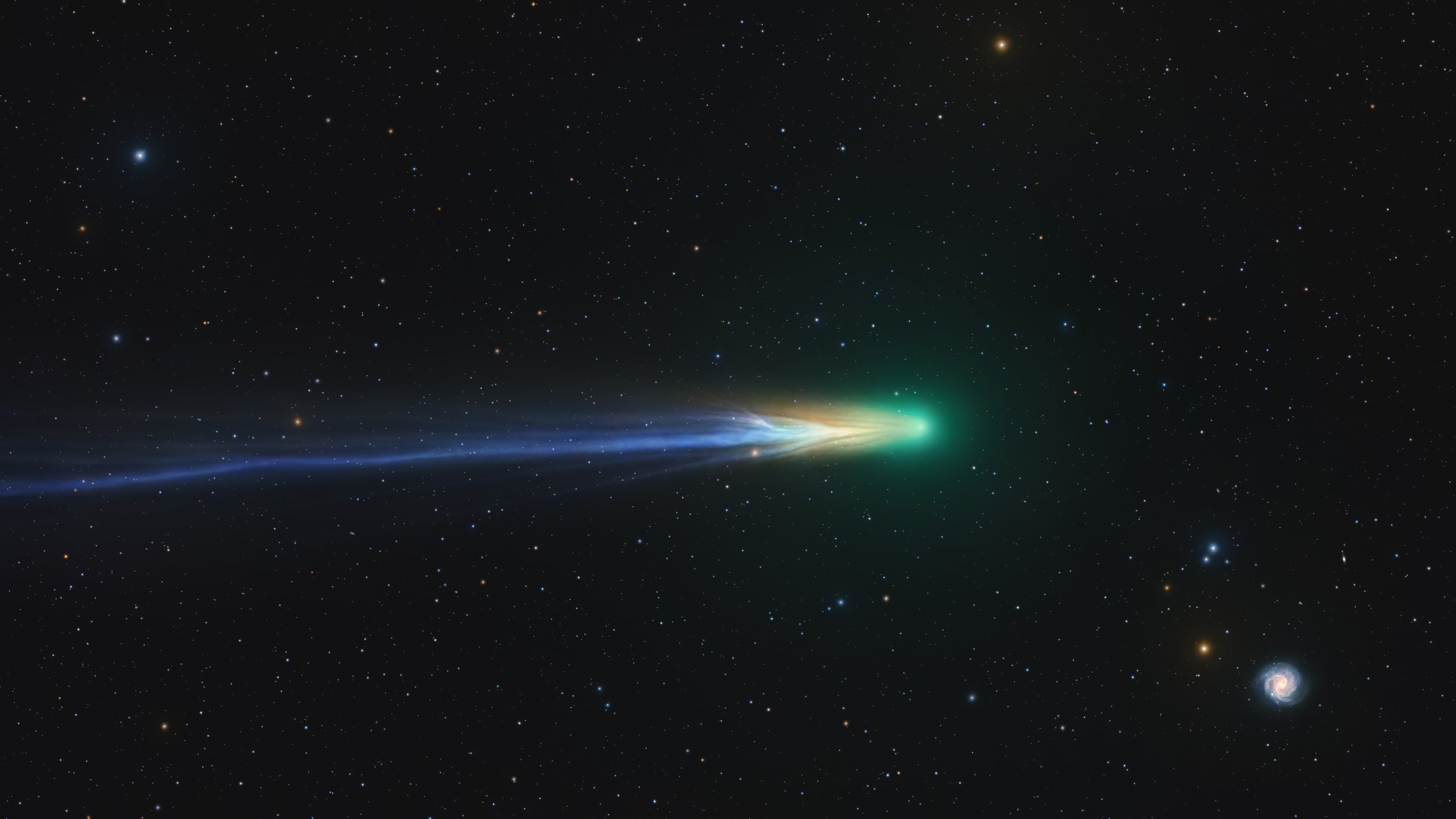
Comet Lemmon Meets NGC 3184
Comet C/2025 A6 (Lemmon) and the spiral galaxy NGC 3184 share this wide-field view captured from Texas. While the comet streaks across the foreground sky, its pale green and blue coma and delicate ion tail trace the effects of solar wind and radiation pressure on volatile gases escaping from its icy nucleus.
In the background, NGC 3184 quietly resides 39.5 million light-years away in Ursa Major. This face-on intermediate spiral galaxy, moving at about 821 km/s relative to the cosmic microwave background, contrasts beautifully with the fleeting visitor from our own Solar System, a rare cosmic alignment of motion and distance captured in a single frame.
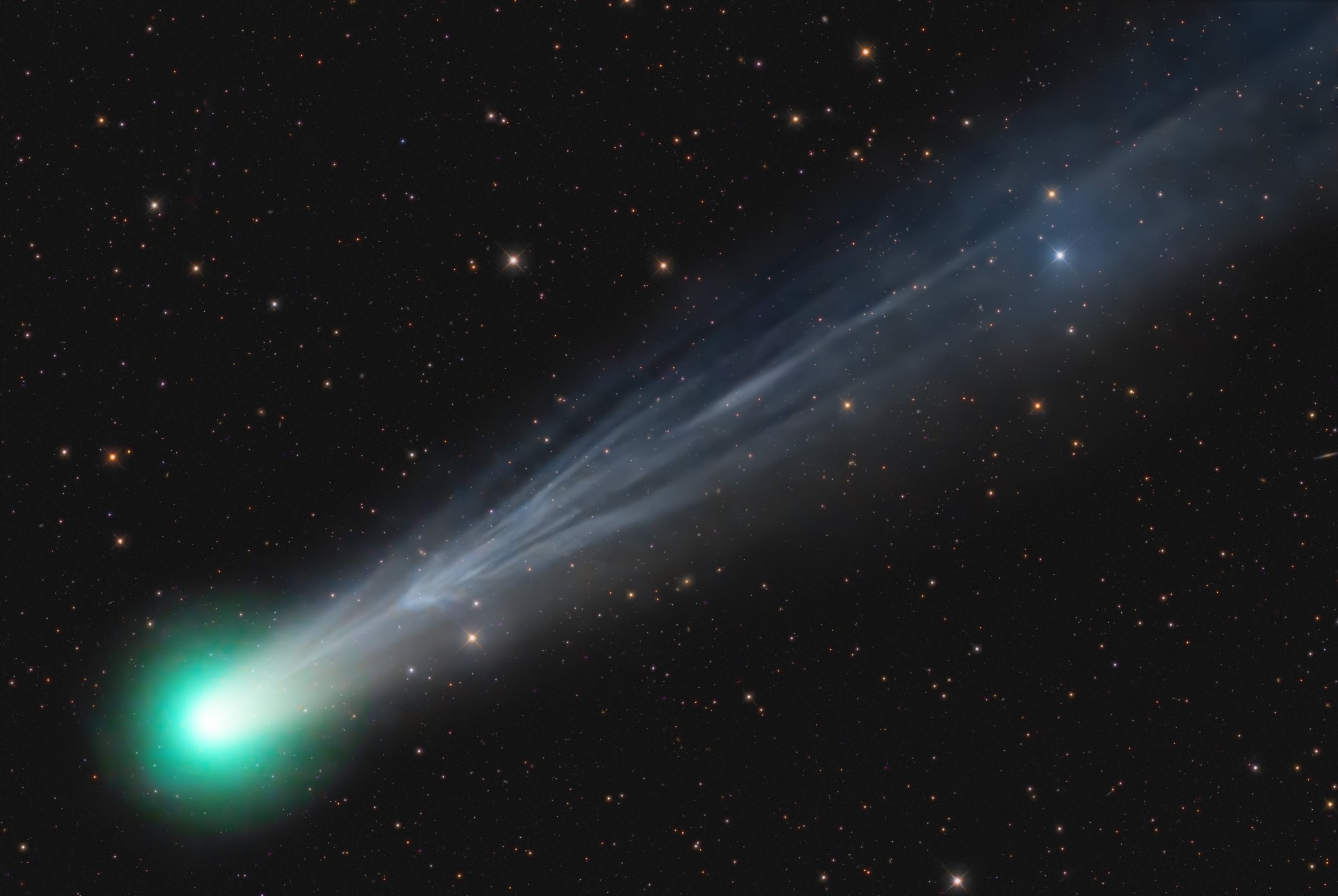
C/2025 A6 Lemmon on September 29, 2025
Comet C/2025 A6 (Lemmon) was imaged on the morning of September 29, 2025, while sweeping across the sky from the Utah Desert Remote Observatory. Even a month before reaching perihelion, the comet displayed a striking appearance with a bright turquoise coma and a remarkably long, filamentary ion tail. Multiple gas jets, sculpted by the pressure of the solar wind, create dynamic structures that extend far into interplanetary space.
This image captures the transient beauty of a comet in motion, offering a rare glimpse into the interaction between a pristine icy body and the Sun’s influence. Technical setup: PlaneWave Delta Rho 500/1500 mm telescope with a ZWO ASI 6200MM camera and Chroma LRGB filters. The final image represents a total of 16 minutes of integration using 2×2 binning.