
AAPOD2 Image Archives
Unveiling the M31 mystery - Introducing Ghost Planetary Nebulae
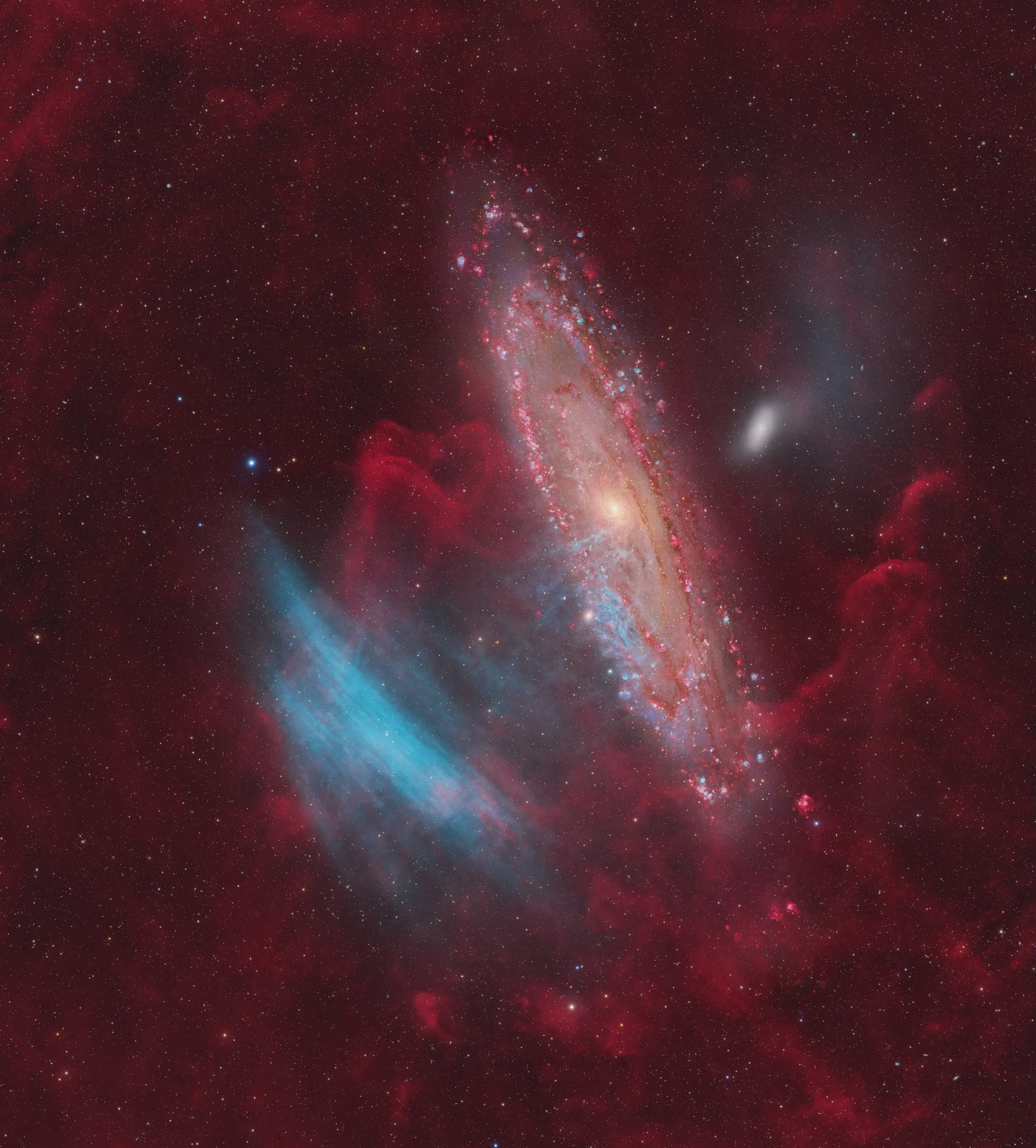
This extraordinary wide-field view of the Andromeda Galaxy (M31) reveals more than just our nearest large galactic neighbor. Cutting across the frame is a strange blue arc—SDSO 1—now recognized as the first member of a new class of celestial objects: Ghost Planetary Nebulae (GPNe). SDSO 1 lies within our own Milky Way and represents a shock wave driven by the remnants of a faint, fast-moving planetary nebula. Though the central star is nearly invisible, its supersonic motion—estimated at Mach 7—creates a glowing bow shock and trailing wake of expelled gas, rendered here in brilliant detail.
What was once thought to be diffuse Hα background is now revealed to be part of a high-velocity interaction. The ghostly tail is composed of material ejected from the nebula, lighting up as it collides with the interstellar medium. Without this interaction, the nebula would remain entirely hidden—its material now too diffuse to detect directly. This image not only highlights Andromeda’s grandeur, but also captures a fleeting and final phase in the life of a star, offering new insights into stellar evolution and galactic archaeology.
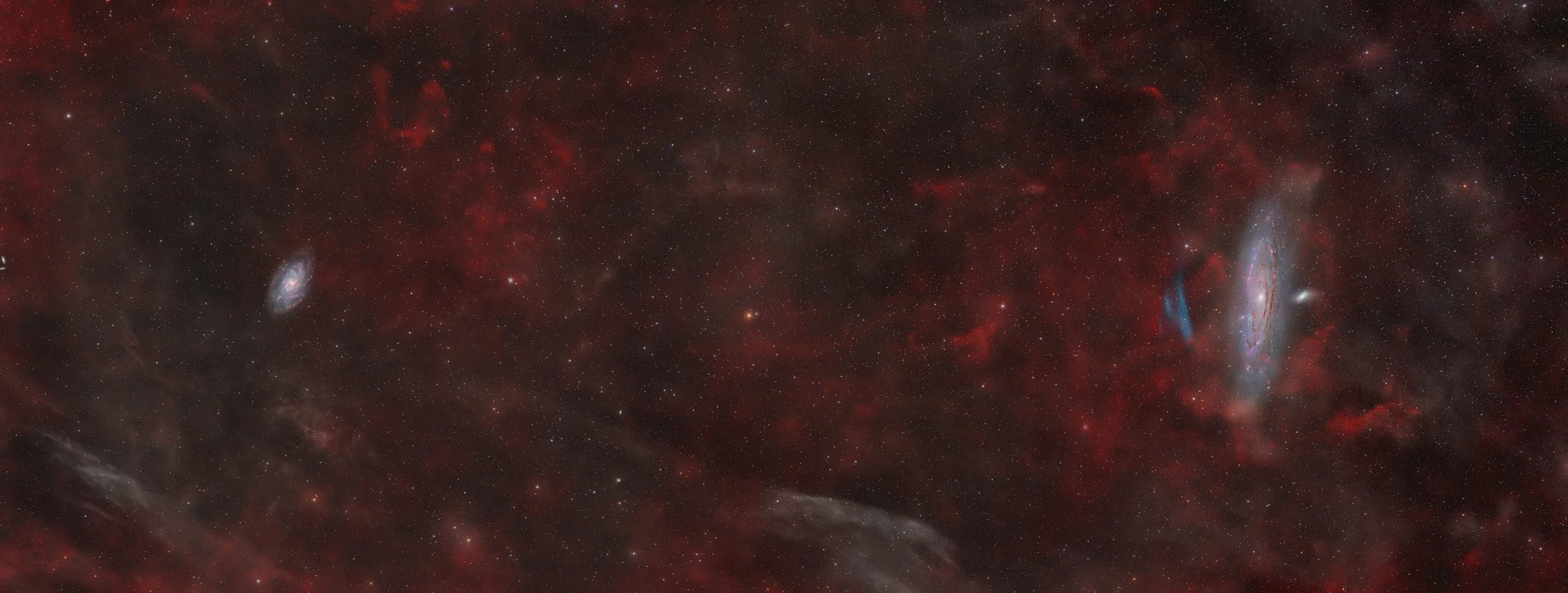
From Triangulum to Andromeda
This captivating deep-space image spans a vast cosmic expanse from the Andromeda Galaxy (M31) to the smaller yet equally enchanting Triangulum Galaxy (M33). This astronomical composition is a mesmerizing blend of multi-spectrum imagery, seamlessly harmonizing hydrogen-alpha (Ha) and doubly ionized oxygen (OIII) emissions with luminance (L), red (R), green (G), and blue (B) channels. In this breathtaking capture, the fiery tendrils of Ha and the ethereal glow of OIII emissions intertwine with the intricate details of stars and dust, creating a celestial astro-photo that not only reveals the grandeur of these neighboring galaxies but also provides a glimpse into the intricate astrophysical processes shaping the universe.
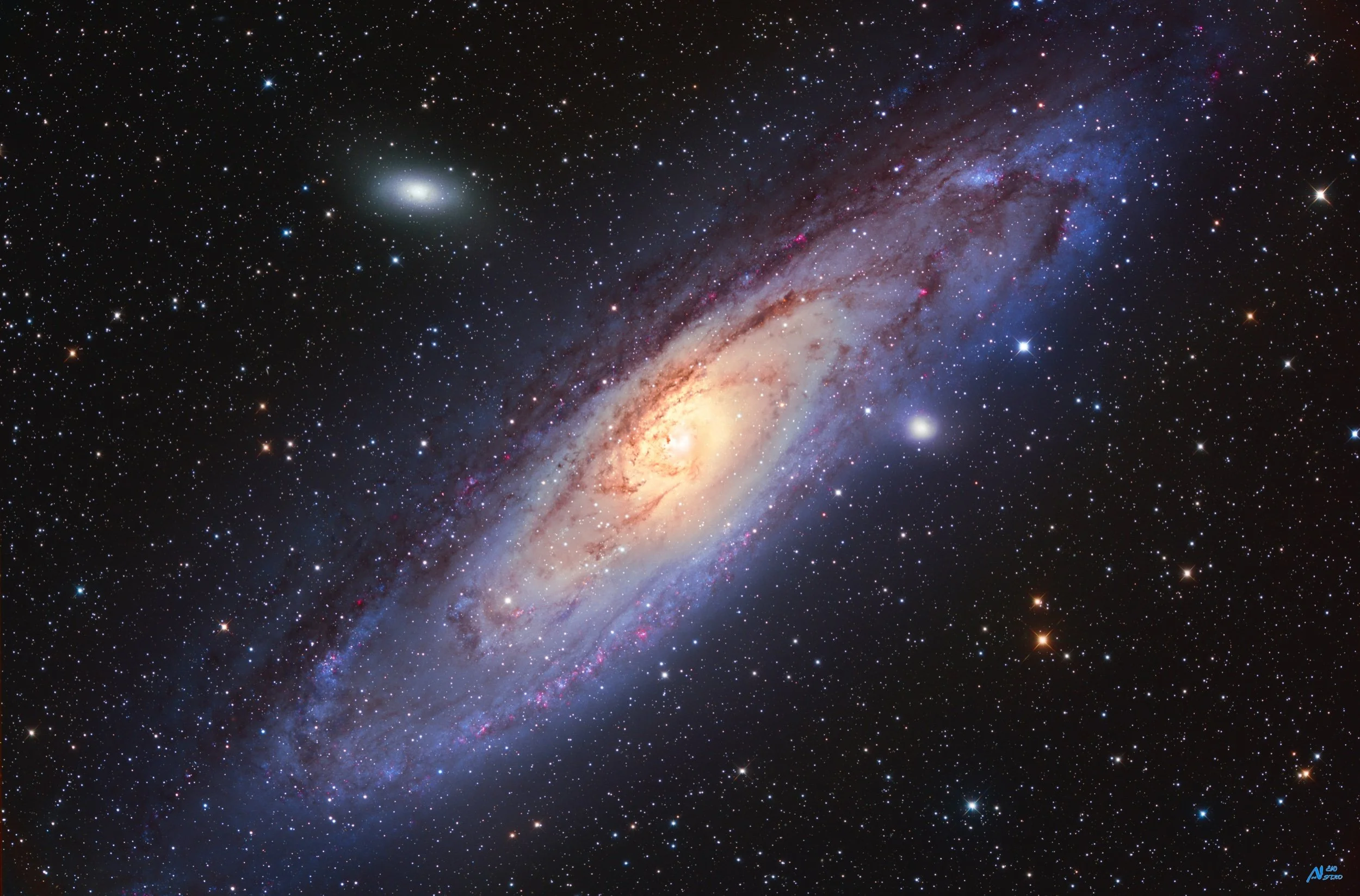
M31
Image Description and Details :
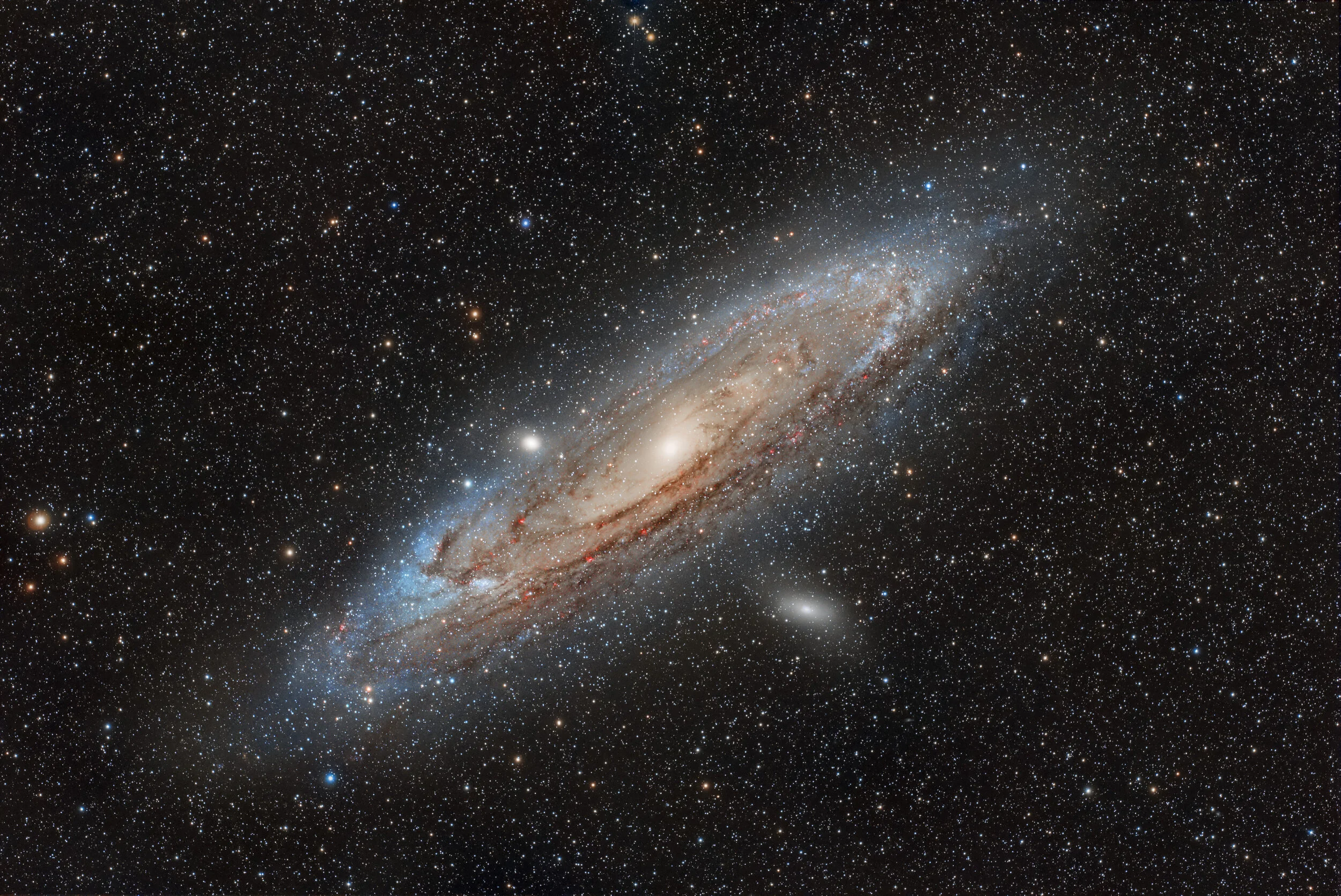
Consisting of 300 billion stars, the Andromeda galaxy M31 is considered the twin sister of our Galaxy. It is accompanied by two much smaller satellite galaxies, M32 and M110. The Andromeda Galaxy is the most distant object that can be seen without an instrument under good skies, at 2.5 million light years.
Image taken in Normandy (France), by Team Newastro; (astronew.fr) , with Tube Newton Skyvision (250-900 f/d 3,6) on Eq8 mount,
ZWo Asi 6200MM camera.
Image in L,r,v,b and Ha. Total exposure time 7 hours.
Copyright: astronew.fr
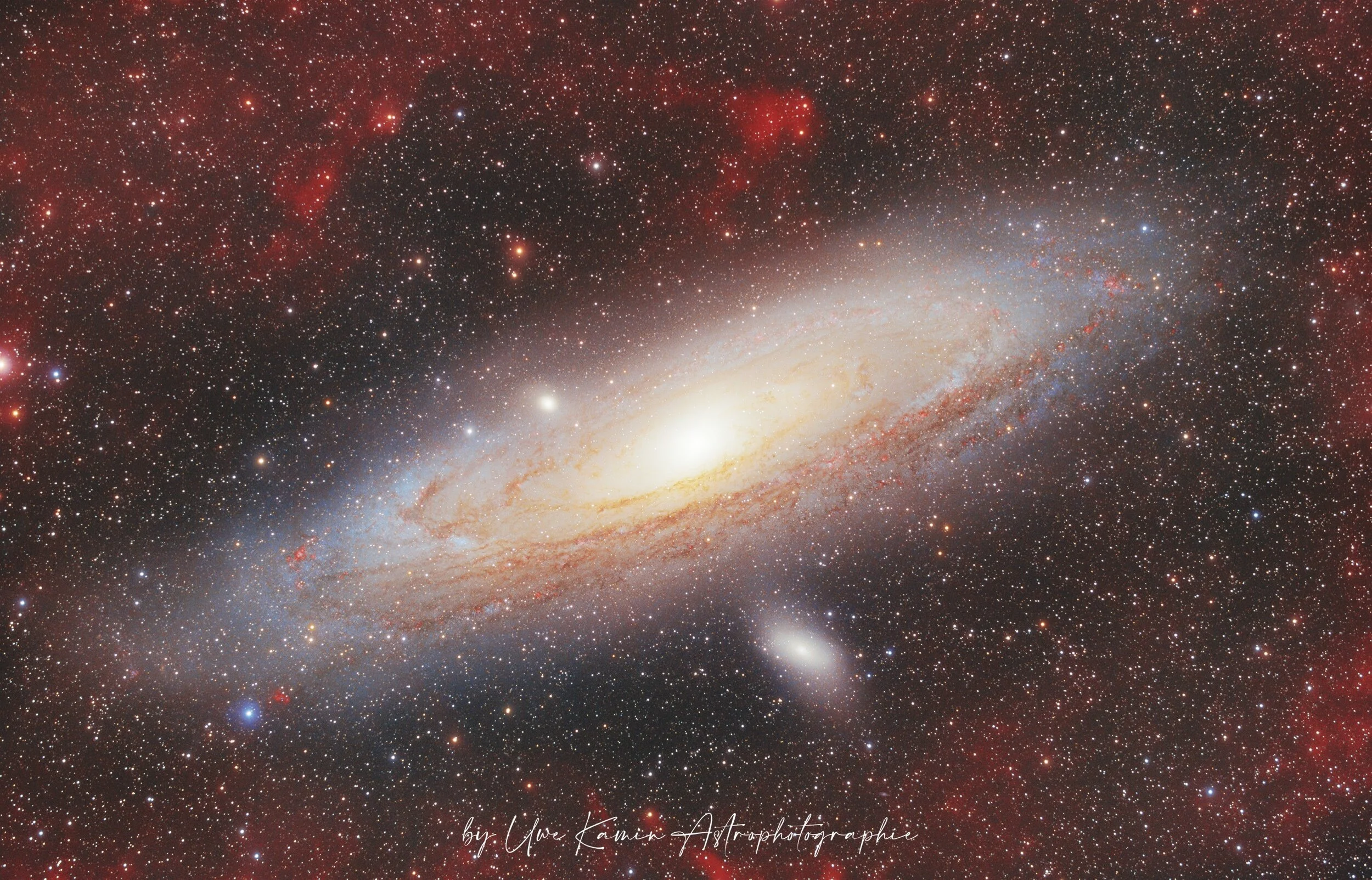
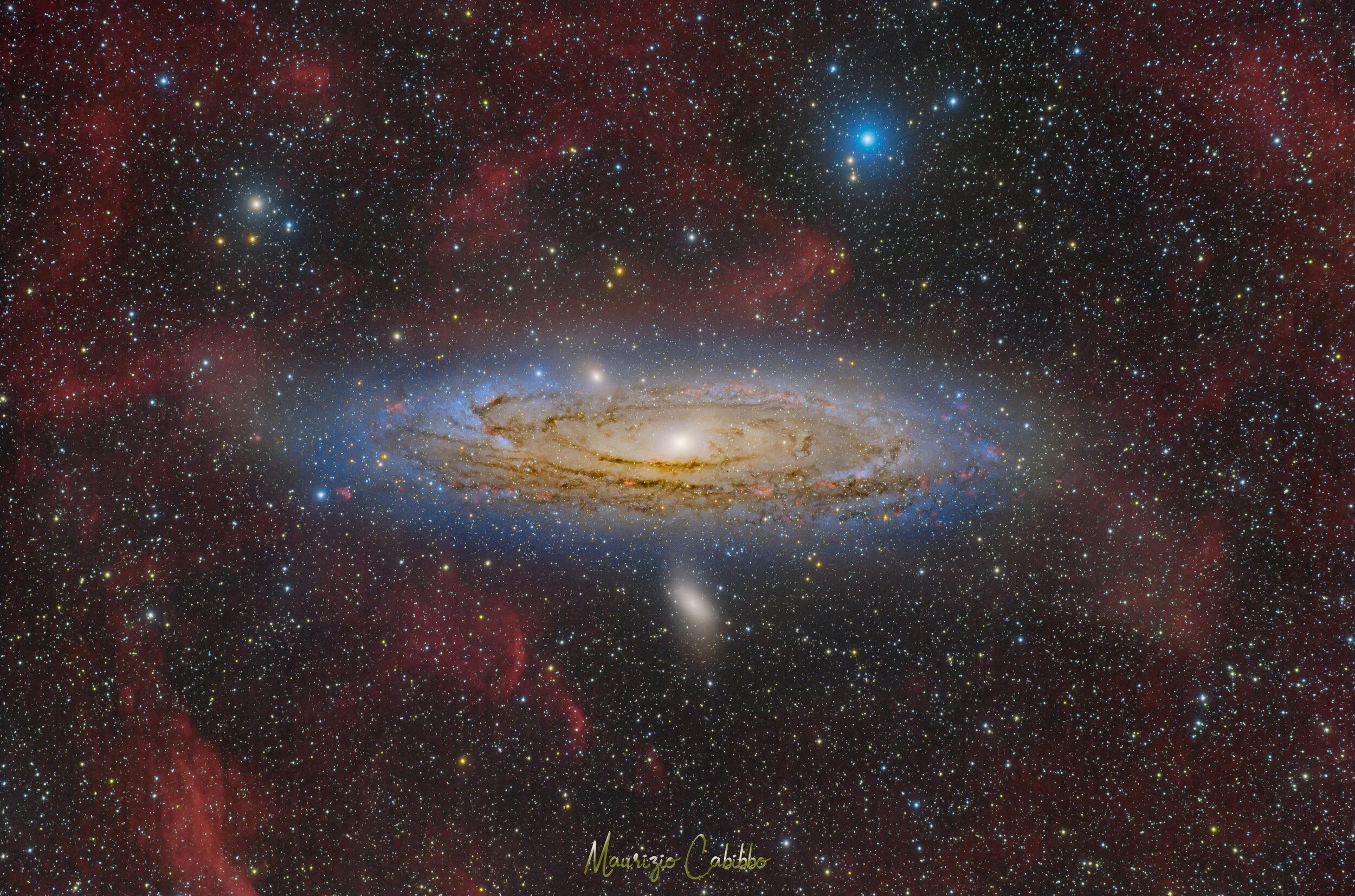
M31 The great Andromeda galaxy in hydrogen dust
Image Description and Details : M31 dans sa robe de soirée. 19H15 d'exposition, dont 6H20 en Ha.
38 Ha de 10 min
65 Luminances de 5 min et 50 poses de 3 min sur chaque canal RVB
Lunette TS 86/464 Quadruplet APO astrographe
Réducteur Televue x0.80
Focale 371mm à F 4.3
Monture EQ6 Pro
Autoguidage Lunette Orion 50mm Guide Scope 163mm
Camera Starshoot Autoguider
Imageur ZWO ASI2600MM Pro
Roue à FiltreZWO 7*36MM
Filtre Baader L, R, V, B ,S2, Ha et O3
Sky Quality 19.95
Magnitude CLASS 5 Bortle
SGP SEQUENCE GENERATOR PRO, SIRIL et UWE ASTRO TOOLS
Copyright: by Uwe Kamin Astrophotographie