
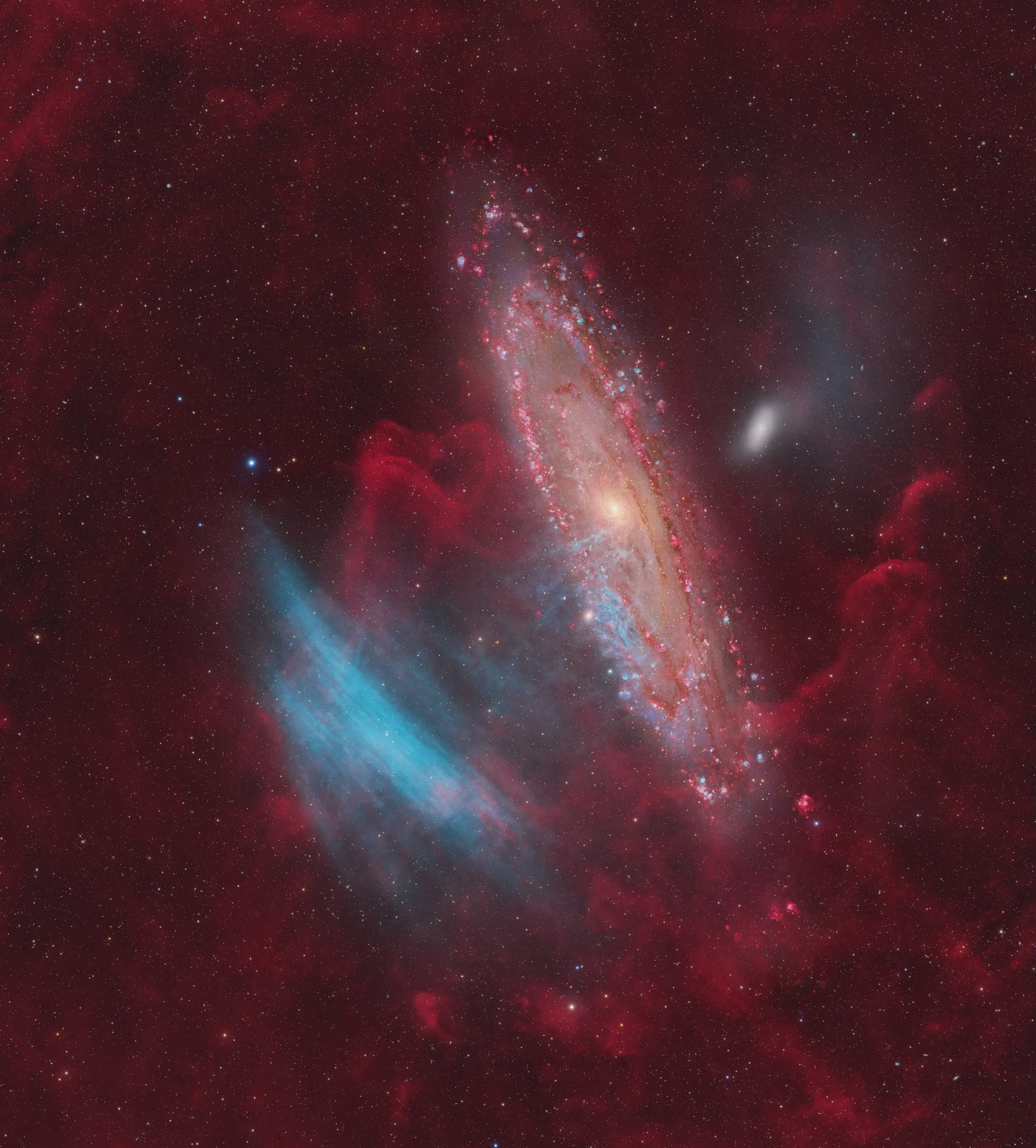
Image Title: Unveiling the M31 mystery - Introducing Ghost Planetary Nebulae
Copyright: Ogle et al.
Collaborators: Dr. Patrick Ogle, Dr. Lewis McCallum, Dr. Alberto Noriega-Crespo, Dr. R. Michael Rich, Dr. Biny Sebastian, Mark Petersen, Tim Schaeffer , Carl Björk, Steeve Body, Tarun Kottary, Patrick Sparkman, Sendhil Chinnasamy, Yann Sainty, Marcel Drechsler, Xavier Strottner
Date image was taken: January 05, 2025
Location: EU and USA
Data Acquisition Method: Remote Observatory (Commercial)
Description and Details: The Andromeda galaxy, also known as Messier 31, is a galaxy in the constellation Andromeda, lying at a distance of roughly 2.5 million lightyears, making it the closest (non-satellite) galaxy to our Milky Way. Its proximity to our Milky Way and sheer size made it invaluable in building our understanding of galaxies and galactic evolution.
Until recently M31 was best known for its large size and brightness in the night sky - that was until the discovery of SDSO 1 in 2021, a massive, seemingly random, patch of [OIII] right next to M31. Amongst amateur astrophotographers and astrophysicists alike, this sparked immense interest and led to various possible explanations for SDSO 1’s origin. While some suggested it being an intergalactic shock between the Milky Way and M31, others favoured a galactic origin, along the line of sight of M31.
Having obtained a new wide and deep image of M31, we present strong evidence that solves this mystery. Putting together many lines of evidence, including identification of the central star, we conclude that SDSO 1 is a shock wave in the Milky Way, driven by an invisible planetary nebula moving at Mach 7 relative to the surrounding gas. In addition to the shock wave, we find that the surrounding waves of Halpha emission are not just ordinary Hα cirrus, but are actually formed from gas that is driven off of the planetary nebula, leaving a trail in its wake and giving crucial information on its age. SDSO1 is the first recognized member of a new class of faded planetary nebulae that we have dubbed, "Ghost planetary nebulae" or GPNe. These GPNe are identified at a very late stage where they are slowing their outward expansion and becoming too tenuous and faint to see if it were not for the shock wave and tail.
Starting in December of 2024, our team, composed of members of the Deep Sky Collective, the Polaris Imaging Group, the initial discoverers Marcel D., Xavier S. and Yann S. and our leading researcher Patrick Ogle came together to solve this mystery.
Name: Tim Schaeffer
Website or Facebook Profile: http://deepskycollective.com/home