
AAPOD2 Image Archives

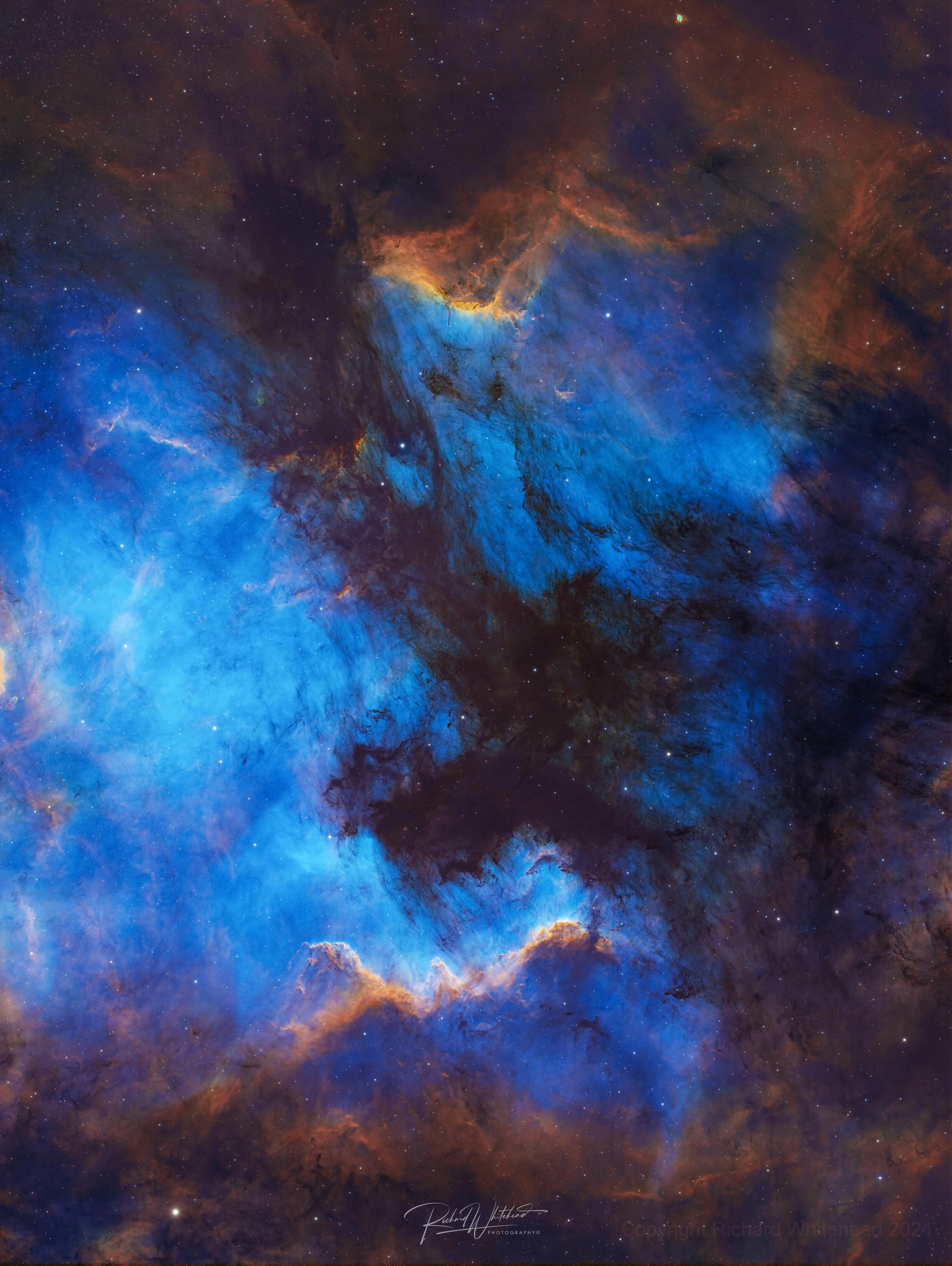
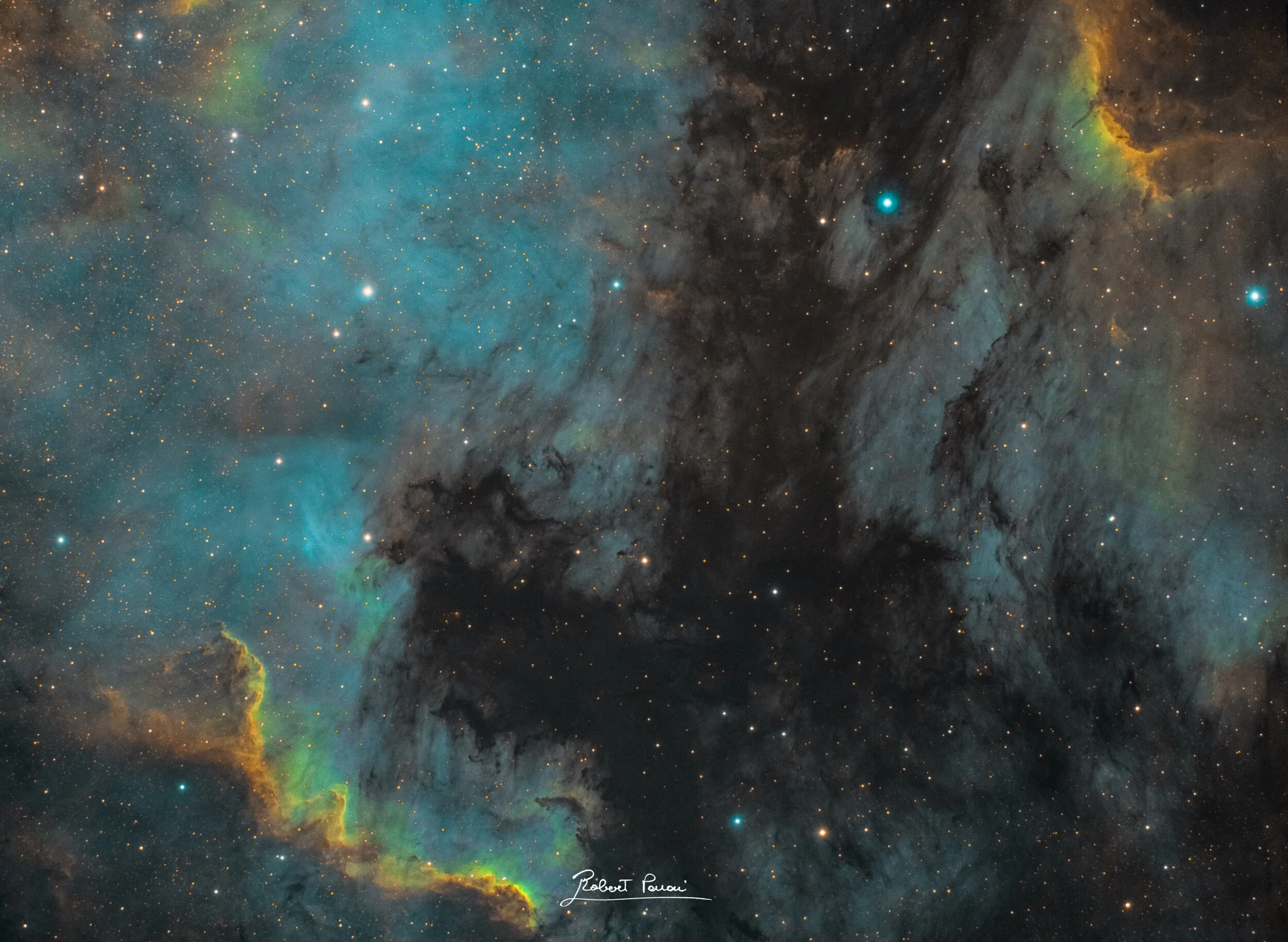
The North America Nebula and the Pelican Nebula in SHO
Drifting in the rich star fields of Cygnus, the North America Nebula (NGC 7000, lower left) and the Pelican Nebula (IC 5070, right) form one of the most striking emission complexes in the northern sky. Separated by a dense band of dark dust, these glowing clouds of hydrogen, sulfur, and oxygen stretch across dozens of light-years, sculpted by stellar winds and ultraviolet radiation from massive, young stars hidden within. The familiar continental outline of NGC 7000 is unmistakable, while the Pelican reveals intricate folds of gas and dust resembling its avian namesake.
Captured here in the SHO Hubble Palette, the false-color mapping highlights regions of ionized gases, with hydrogen in green, sulfur in red, and oxygen in blue. The interplay of bright emission and dark lanes demonstrates both the creative and destructive forces at work, where new stars are born even as radiation hollows out great cavities in the nebulae. Together, they showcase the Cygnus region as one of the most photogenic nurseries of the Milky Way.

Cosmic Pearl
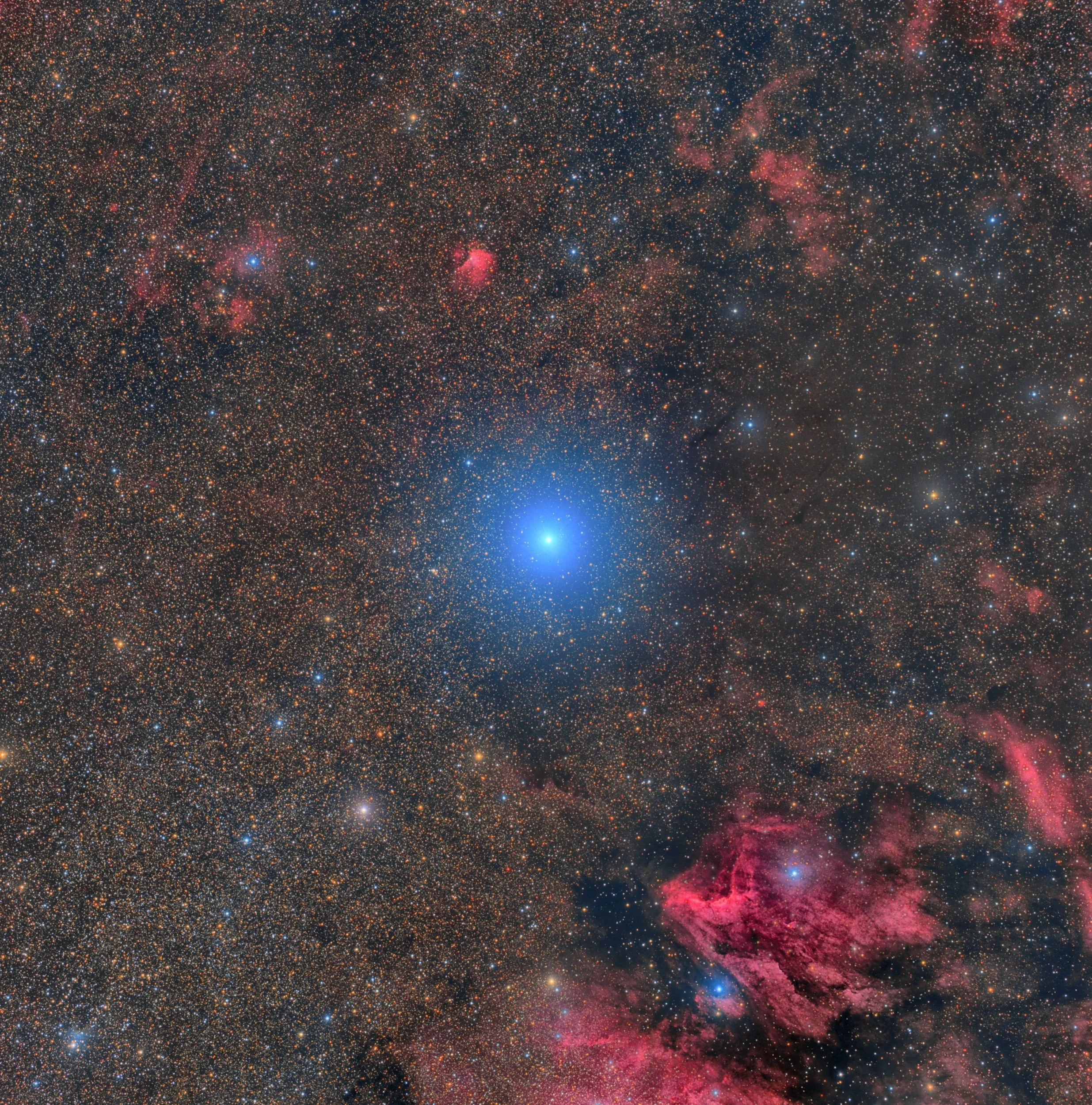
Image Description and Details : Details: Deneb is a first-magnitude star in the constellation of Cygnus, the swan. It is one of the vertices of the asterism known as the Summer Triangle and the "head" of the Northern Cross. It is the brightest star in Cygnus and the 19th brightest star in the night sky, with an average apparent magnitude of +1.25. This area lies in the plane of the Milky Way and is very rich in emission nebulae. Right down you can see NGC 7000/The North America Nebula, IC 5067/The Pelican Nebula, NGC 6989 an open cluster, 57 Cygni, IC 5068. Just a bit below left to Deneb is 55 Cygni and at the bottom left is IC 5076.
Exif : L = 50 x 180 seconds , R = 46 x 180 seconds , G = 46 x 180 seconds , B = 46 x 180 seconds , f/3.6 (with 0.73x focal reducer) , 382 mm
Equipment: FLI PL16083 camera, Takahashi FSQ-106ED telescope, Paramount MX+ mount
Filters: Astrodon LRGB 2GEN
Softwares used: Deep Sky Stacker, PixInsight, Photoshop
Copyright: Diptiman Nandy
From North America to Crescent (Mosaic)
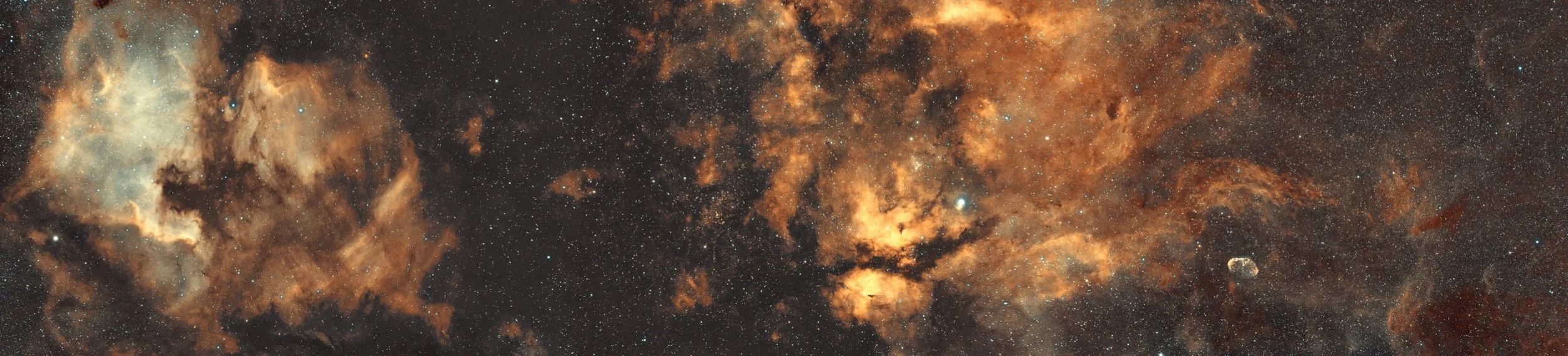
Image Description and Details : Three panel mosaic of the central region of Cygnus constellation. From left to right, in order of appareance, the North America Nebula (NGC 7000), the Pelican Nebula (IC 5070), the Butterfly Nebula (IC 1318), the Crescent Nebula. At the bottom right, some molecular clods and dark nebulae.
Framing was planned with the software NINA, the single subs stacked with DeepSkyStacker, and the panels merged with Astropixelprocessor. Processing with Pixinsight and Photoshop.
Gear and technical data:
Samyang 135 @ f/4
QHY183C
Optolong L-enhance filter
30 subs x 3 panels x 180s
Copyright: Antonio Grizzuti
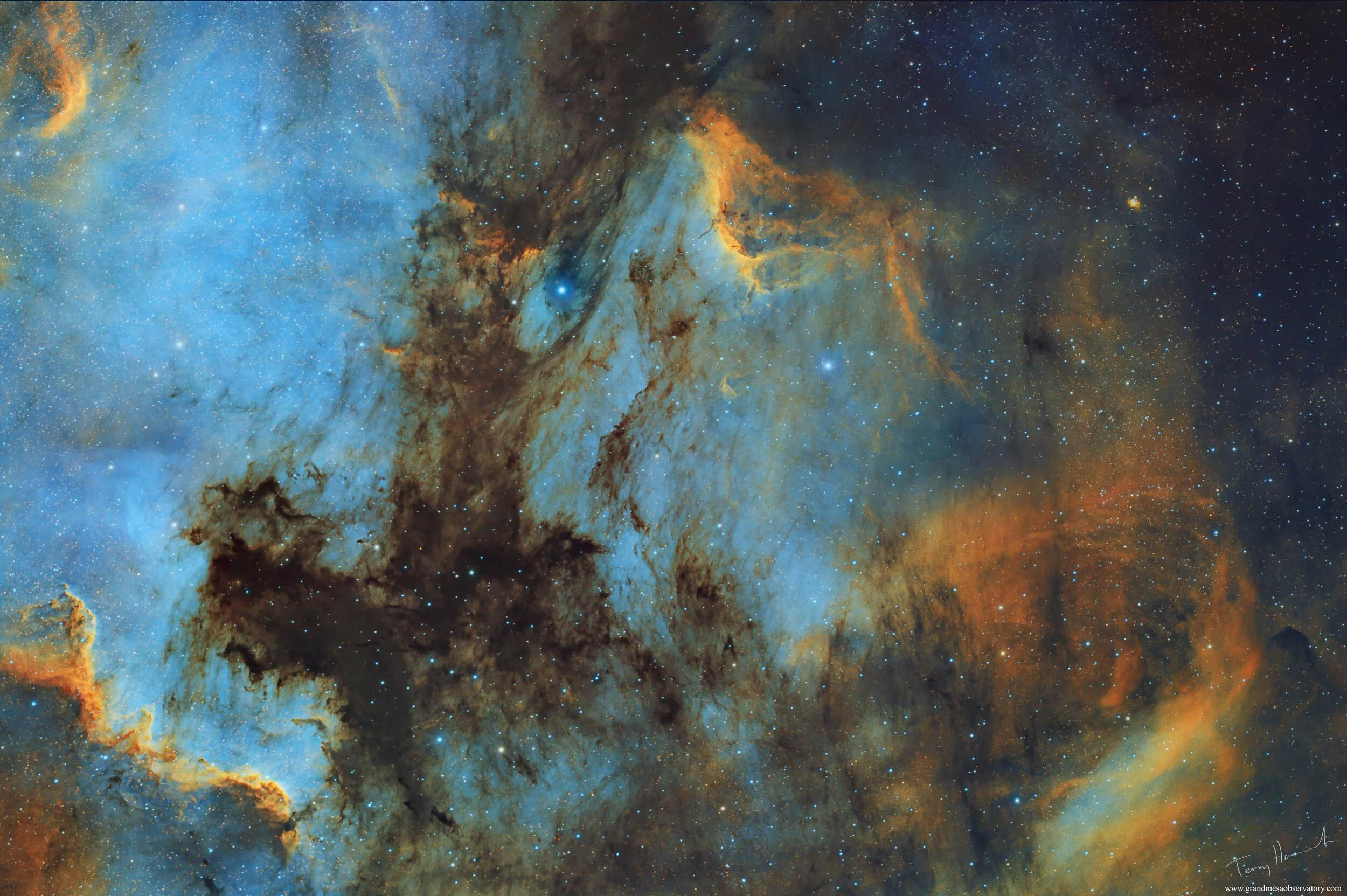
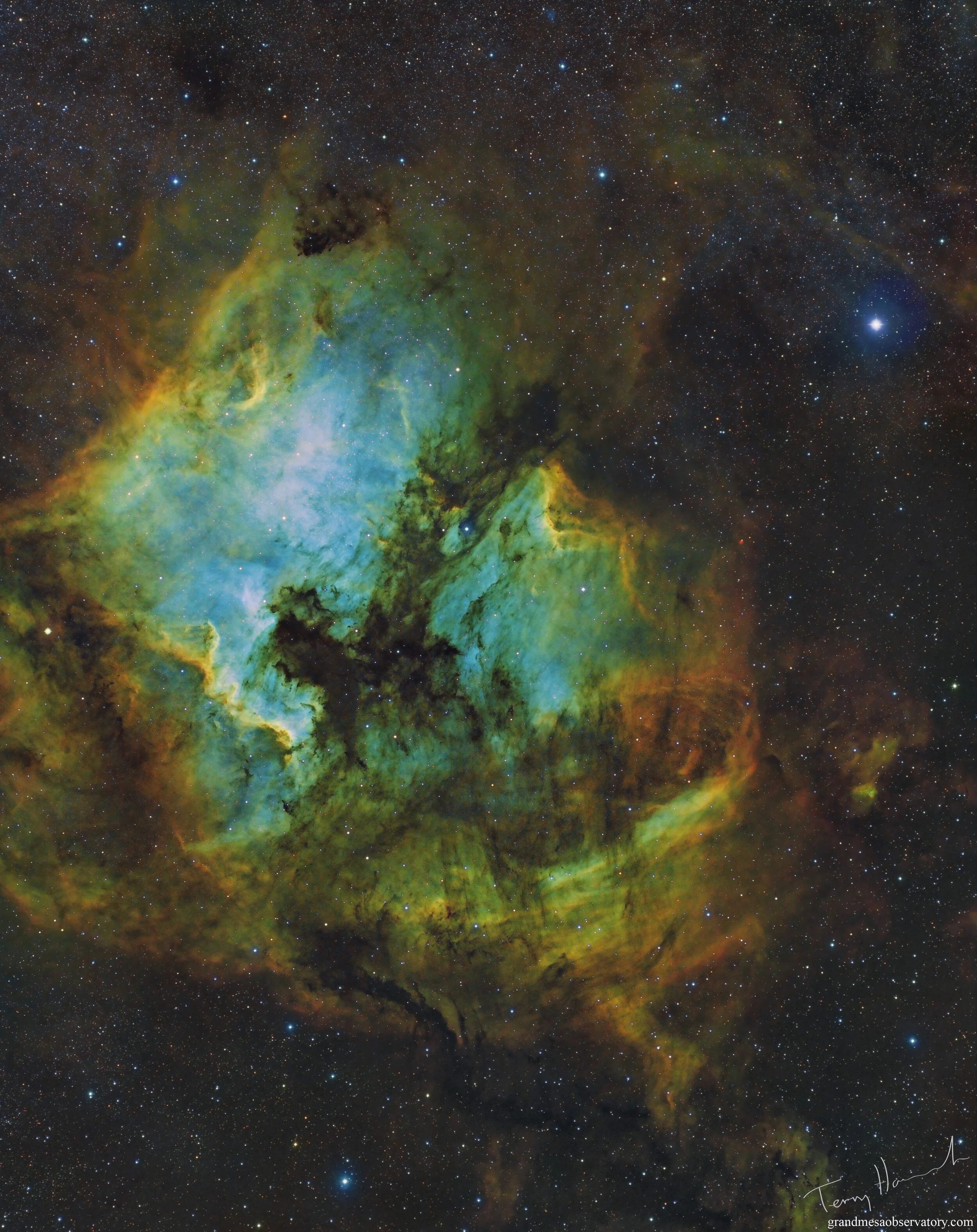
Cosmic Continent The Sequel (SHO)
Image Description and Details :
Several years ago I captured this beautiful region of Sky and called it “The Cosmic Continent”
Here is my latest Hubble Palette (SHO) version, a very wide view of The North America Nebula otherwise known as NGC7000 using data from Grand Mesa Observatory’s System 1a the William Optics Redcat together with a QHY16200A Monochrome CCD, this combination is giving a field of view of approximately 6 x 5 degrees
The William Optics Redcat with QHY16200A and its 7 position filter wheel is now available at Grand Mesa Observatory for subscription, see here for details.
https://grandmesaobservatory.com/equipment
In this Hubble Palette version the H-Alpha is mapped to green, SII is mapped to red and OIII is mapped to the blue channel. I removed the stars using Starnet and replaced them with the naturally colored stars from the broadband image, while the colors in this image are not the true colors, the narrowband filters used in the making of this Hubble Palette image reveal much more of the hidden gasses not visible in a broadband image.
Captured over 7 nights in May and June 2020 for a total acquisition time of 15 hours.
The North America Nebula (NGC 7000 or Caldwell 20) is an emission nebula in the constellation Cygnus that resembles the shape of North America and The Gulf Of Mexico. It lies at a distance of approximately 1800 light years away from us.
This image contains some very interesting areas such as The Cygnus Wall which is representative of Mexico and Central America, the nearby emission objects Pelican Nebula (IC5070) and the faint emission nebula IC5068
Technical Details
Captured and processed by: Terry Hancock
Location: GrandMesaObservatory.com Purdy Mesa, Colorado
May 5th, 20th, 21st, 25th, 29th, 31st, June 8th
HA 240 min 24 x 900 sec
OIII 255 min 25 x 900 sec
SII 225 min 23 x 900 sec
LRGB 180 min 9 x 300 sec
Filters by Chroma
Camera: QHY16200A
Gain 0, Offset 130 Calibrated with Flat, Dark and Bias Frames.
Optics: William Optics Redcat 51 APO @ F4.9
EQ Mount: Paramount MEII
Image Acquisition software Maxim DL6
Pre Processing in Pixinsight
Post Processed in Photoshop CC
Star Removal by Starnet
Copyright Information: Terry Hancock
North American Nebula
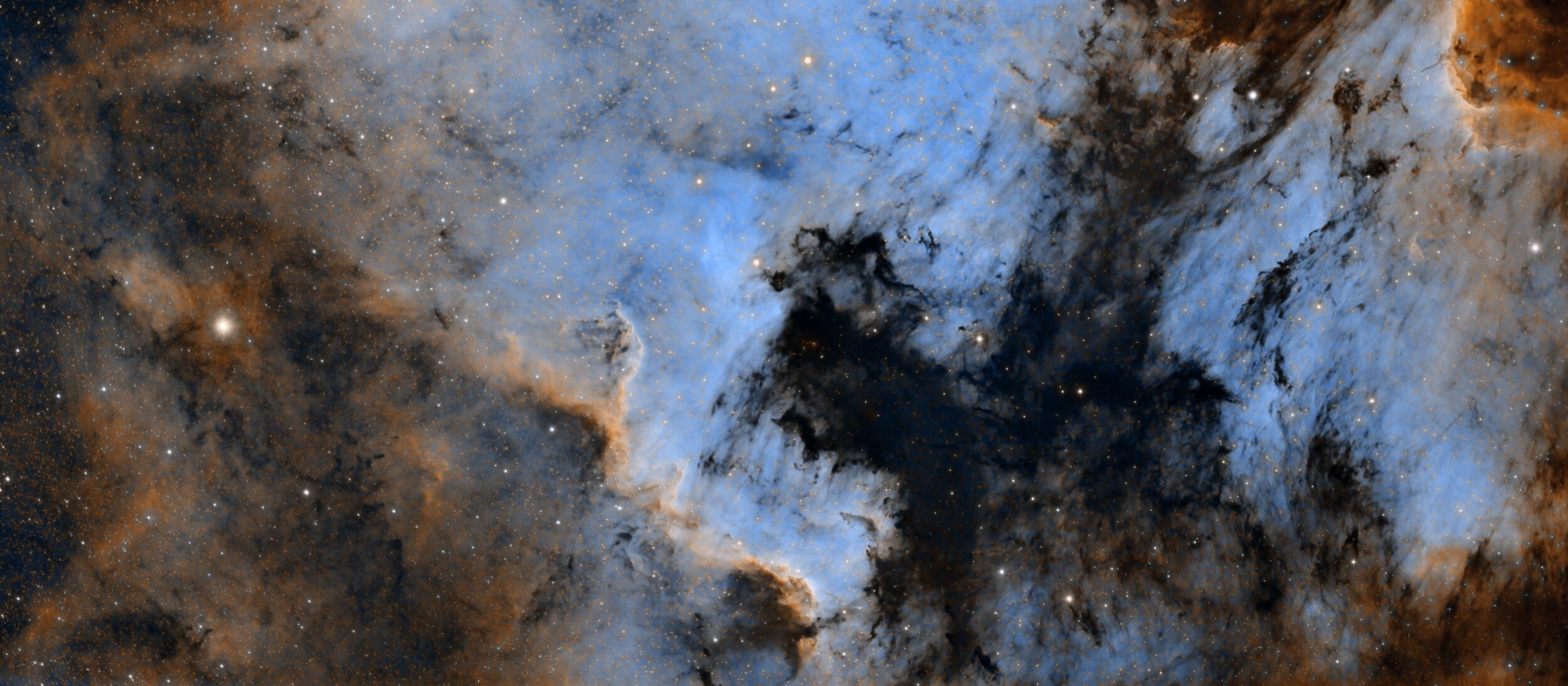
The North American Nebula, aka NGC 7000, is a ionized-hydrogen region in the constellation Cygnus. The nebula is a cloud of interstellar gas ionized from within by young, hot stars. Interstellar dust particles in part of this cloud absorb the light emitted by recombining atoms. The shape of the nebula roughly resembles that of North America, with the dusty region being shaped like the Gulf of Mexico. The North American Nebula is approximately 520 parsecs from the Sun. It has a diameter of about 30 parsecs and a total mass equal to about 4,000 solar masses.
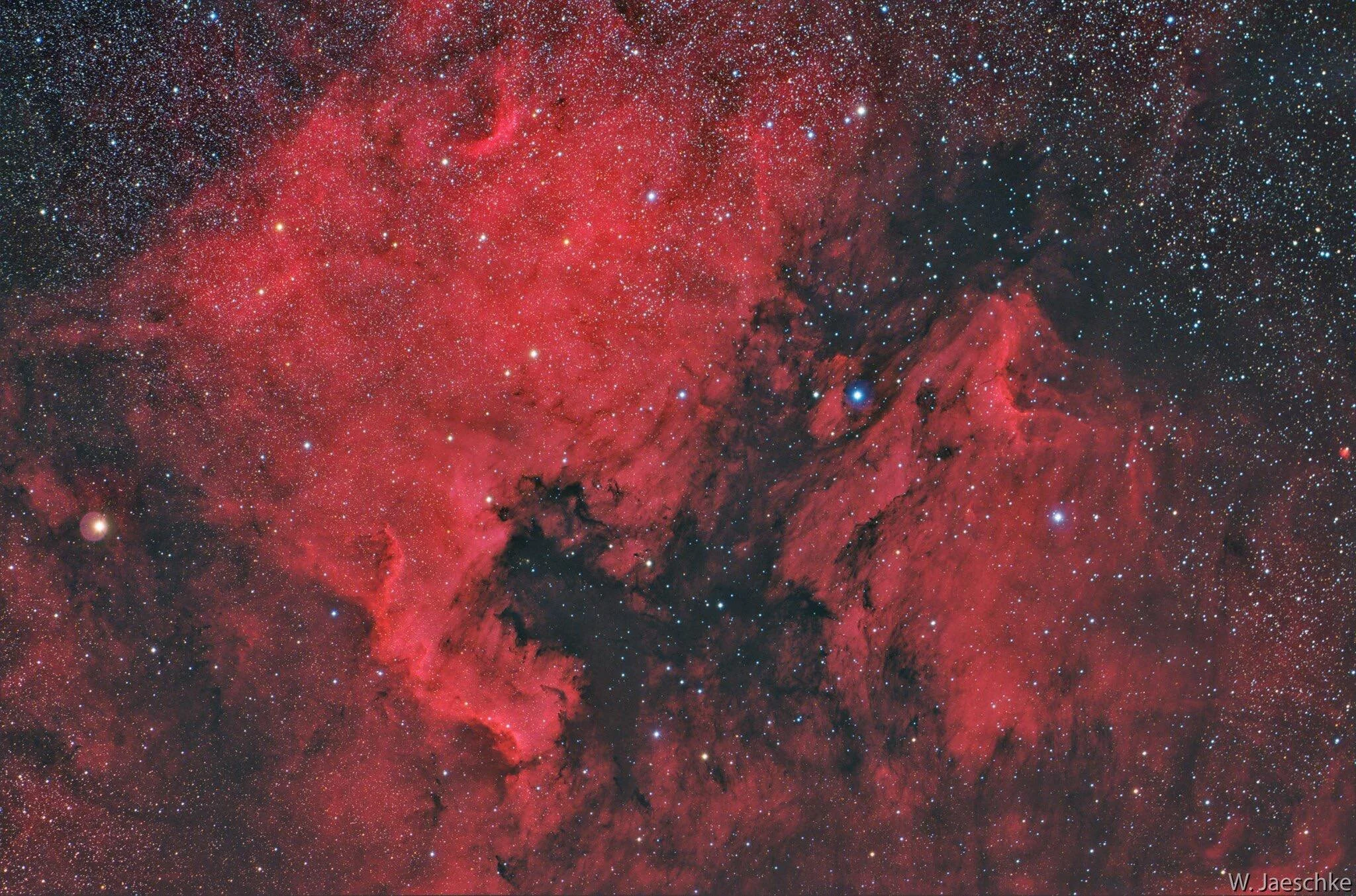
The North American And Pelican Nebulae
The North American And Pelican Nebulae.
Taken with a Takahashi FSQ106 and SBIG 11000m.
45 hours total exposure.
Copyright: Wayne Jaeschke