
The Pleiades in Dust and Hydrogen Light
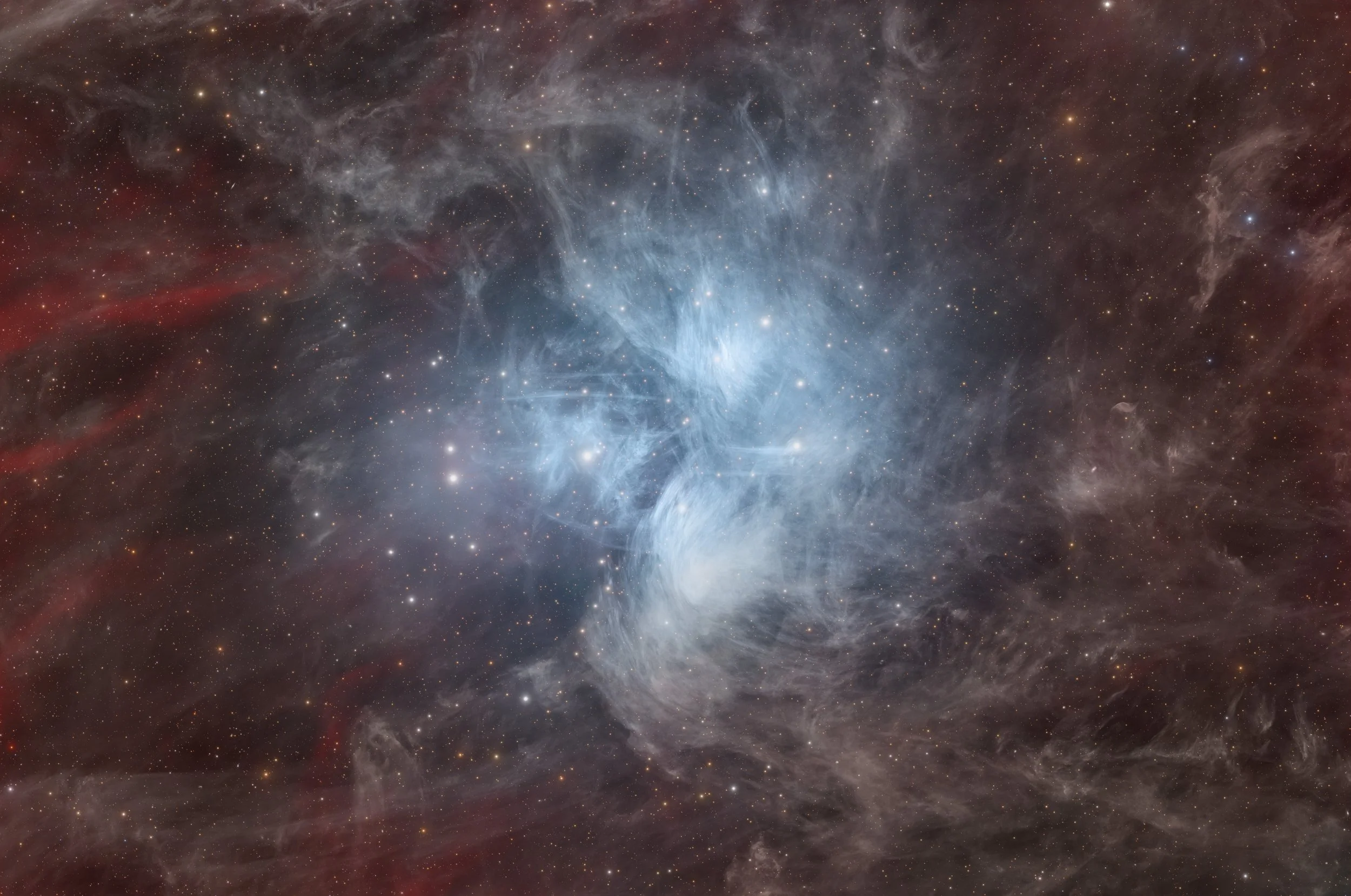
mage Title: The Pleiades
Copyright: Cédric de Decker, Louis LEROUX-GERE, Vincent Martin, Thibault Rouillée, Yann Sainty
Date image was taken: October 29, 2025
Location: Texas, USA and Morocco
Data Acquisition Method: Personal Telescope Setup
Description and Details: One of the main goals of this imaging project was to highlight the very faint amount of Hα present in the background sky. Achieving this required long total exposure times on both of our setups. Another key objective was to emphasize the luminance component in order to reveal the delicate dust clouds and gaseous filaments pervading this region of space. Finally, an [O III] test was conducted on the field — without significant results, except for a small galaxy to the right of M45 that caught our attention: UGC 2816 / LEDA 13557. This galaxy proved particularly interesting, as it exhibits a notable presence of both Hα and [O III] emissions.
Commonly known as M45 or the Seven Sisters, the name Pleiades originates from Greek mythology : the Pleiades are seven sisters, daughters of Atlas and Pleione — Asterope, Merope (or Dryope, or Aero), Electra, Maia, Taygete, Celaeno (or Selene), and Alcyone. That makes nine figures in total, represented at first by the seven brightest stars visible during the earliest “primitive” observations, and later by nine. Many millennia afterward, the keenest eyes would distinguish up to eleven stars with the naked eye.Many civilizations, such as the Hebrews and the Aztecs, referred to the cluster as the “the hen with her chicks,” comparing it to a mother hen surrounded by her young. Others called it Belle Boucane. It has also long been regarded as the patron of sailors and is traditionally associated with the winds. A depiction of this cluster can be found on the Nebra Sky Disk, dated to around -1600 (the Bronze Age). This remarkable artifact represents the oldest known depiction of the celestial vault discovered to date.
Today, roughly 3,000 stars are identified within the cluster, about a dozen of which are visible to the naked eye. It spans about 2°, equivalent to four times the apparent diameter of the Moon, making its stellar density relatively low compared to other open clusters. Its age is estimated at around 100 million years, but it is not expected to survive long on a cosmic scale — it will likely disperse within the next 250 million years due to its low density (this refers to the lifetime of the cluster itself, not of its individual stars). The Pleiades are located approximately 444 light-years from Earth according to the most recent measurements, while older estimates ranged between 430 and 480 light-years.
Name: Vincent Martin
Share & Credit This AAPOD2 Feature
When you share this image on AstroBin, social media, forums, or your own website, please include a credit to AAPOD2 so viewers can discover where this feature came from.
Support AAPOD2 for free! Use Our AGENA ASTRO Affliate Link
AAPOD2 Title: The Pleiades in Dust and Hydrogen Light
AAPOD2 Page Link: https://www.aapod2.com/blog/the-pleiades-in-dust-and-hydrogen-light
Submit Your Photo!