
The Tulip Nebula
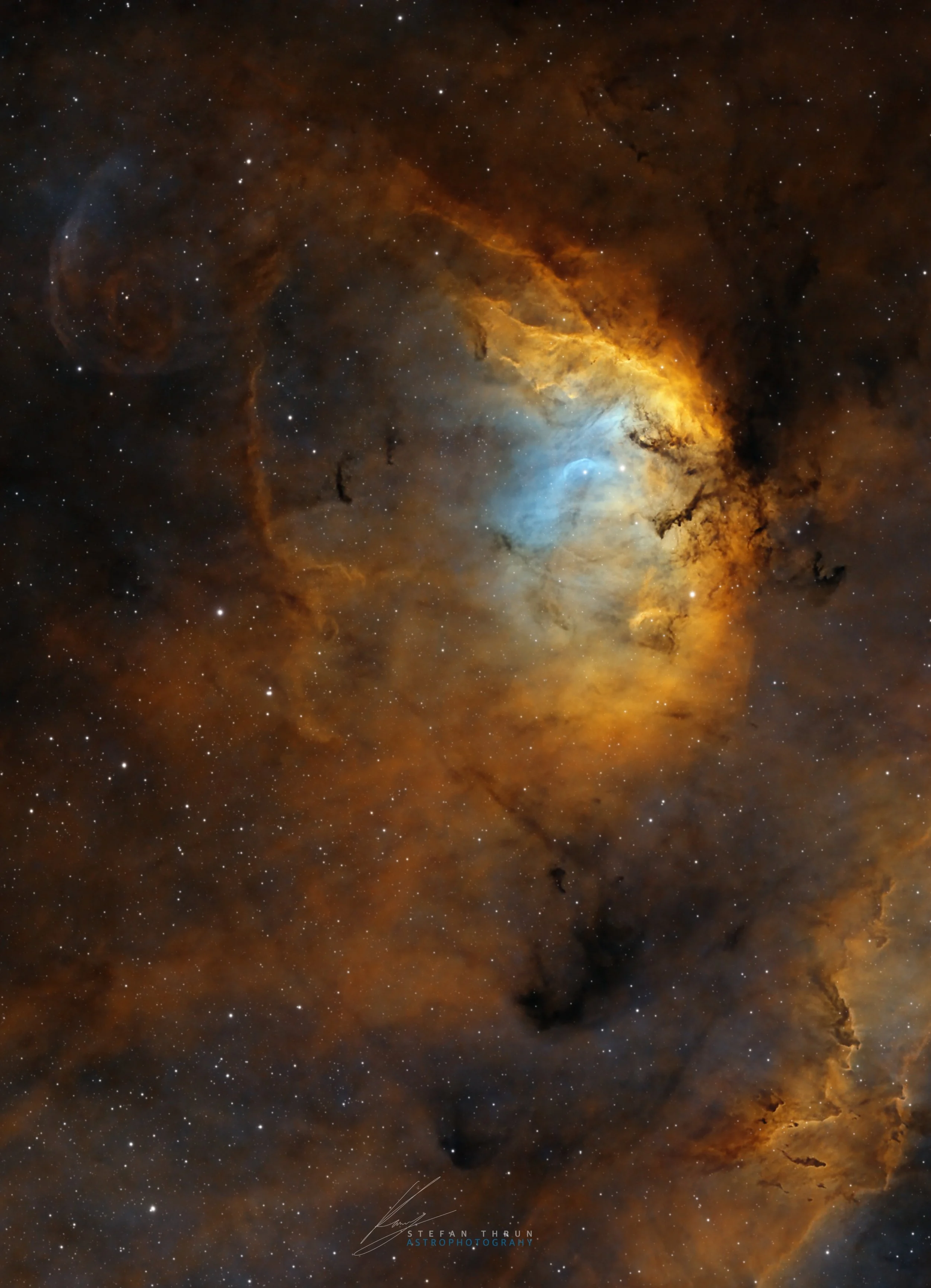
Location: Germany
Image Description and Details: A beautiful object for the classic Hubble palette.
Steward Sharpless added this object to his Sharpless catalog in the Swan in 1959. This emission nebula is about 6000 light years away from us. The two narrow dark clouds are reminiscent of a tulip in front of the red H2 region. Hence the name "Tulip Nebula". Slightly above the tulip on the right is a conspicuous pair of stars, one yellowish and lighter, the other whitish and slightly smaller. At the yellow bright star (HDE 226868) is the X-ray source Cygnus-X1, the first proven black hole, whose detection succeeded in 1972 and Stephen Hawking made a bet with Kip Thorne. The distance of Cygnus X-1 is given as 6197 light years.
Fortunately, I was still able to collect enough light despite the black hole to present this picture to you. ;-)
Clear Skies and stay well
Stefan
Integration Time 27h
Equipment Details: Telescope: 130er Triplet APO f/7 TS Photoline
Camera: ZWO ASI 2600 mm
Baader Filter: Ha 188 x 300 sec., 55 x SII x 300 sec., OIII 85 x 300 sec.,
Mount: EQ6Rpro
GuidingScope: TS Guiding 380mm
GuidingCamera: ZWO ASI 120 mm
Copyright: Stefan "Harry" Thrun
Website or Facebook Profile: https://www.facebook.com/profile.php?id=100078462423469
Share & Credit This AAPOD2 Feature
When you share this image on AstroBin, social media, forums, or your own website, please include a credit to AAPOD2 so viewers can discover where this feature came from.
Support AAPOD2 for free! Use Our AGENA ASTRO Affliate Link
AAPOD2 Title: The Tulip Nebula
AAPOD2 Page Link: https://www.aapod2.com/blog/the-tulip-nebula
Submit Your Photo!