

AAPOD2 Image Archives
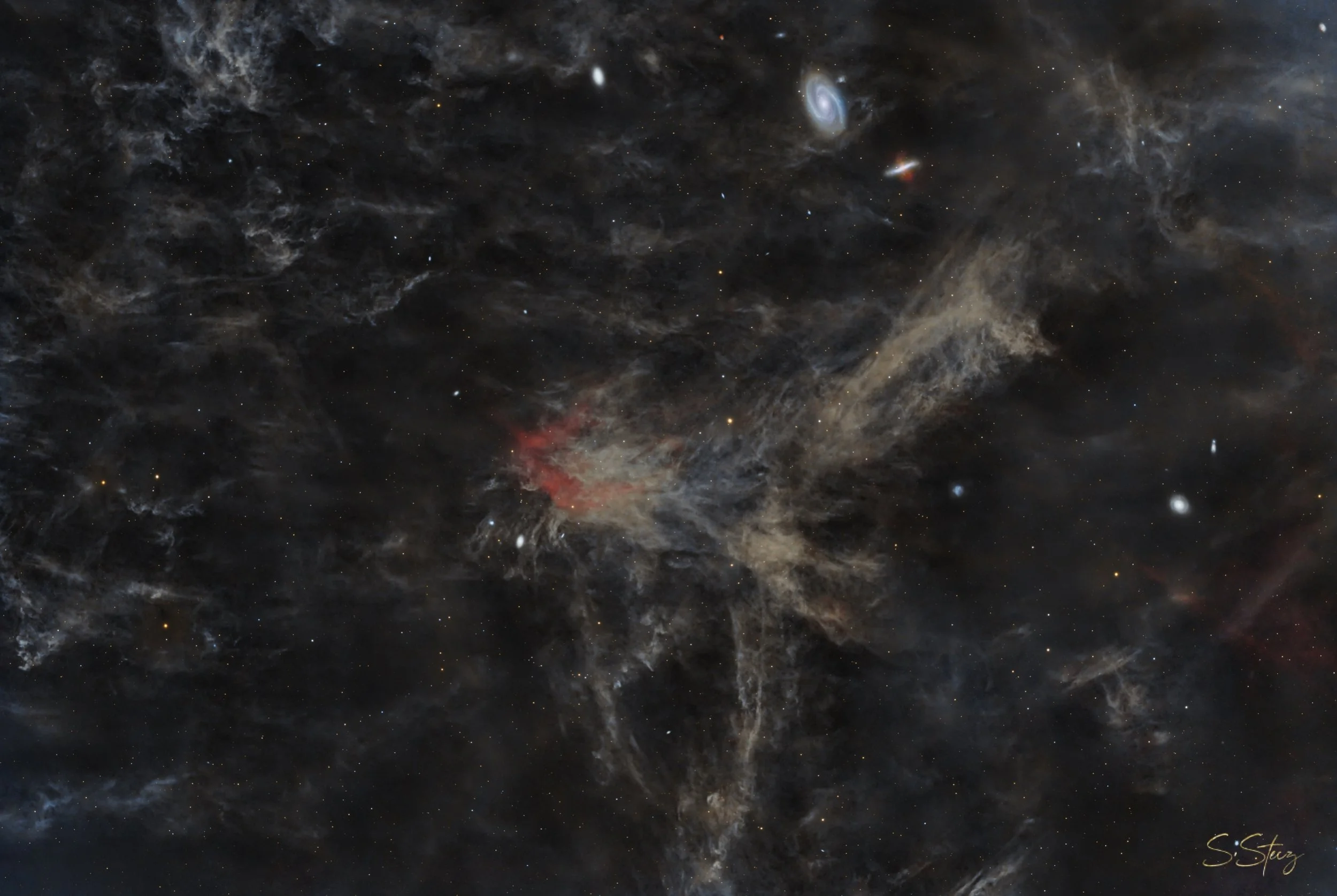
M81 & M82 in a Sea of Galactic Cirrus
This expansive wide-field view showcases the iconic galaxies M81 (top right) and M82 (below it) embedded in a rich tapestry of Integrated Flux Nebula (IFN) — faint, wispy clouds of dust within our own Milky Way, illuminated not by a single star, but by the collective glow of the galaxy itself.
M81, a grand-design spiral galaxy, lies about 12 million light-years away, while M82, its irregular, starburst companion, appears visibly disturbed — the result of a close gravitational encounter with M81. This interaction has triggered intense star formation and galactic winds, visible as red hydrogen filaments extending from M82’s core.
The remarkable depth of this image reveals not only the galaxies but the ghostly IFN structures that fill the space between stars, giving this field a dreamlike quality and a sense of three-dimensionality rarely seen in galactic imaging.
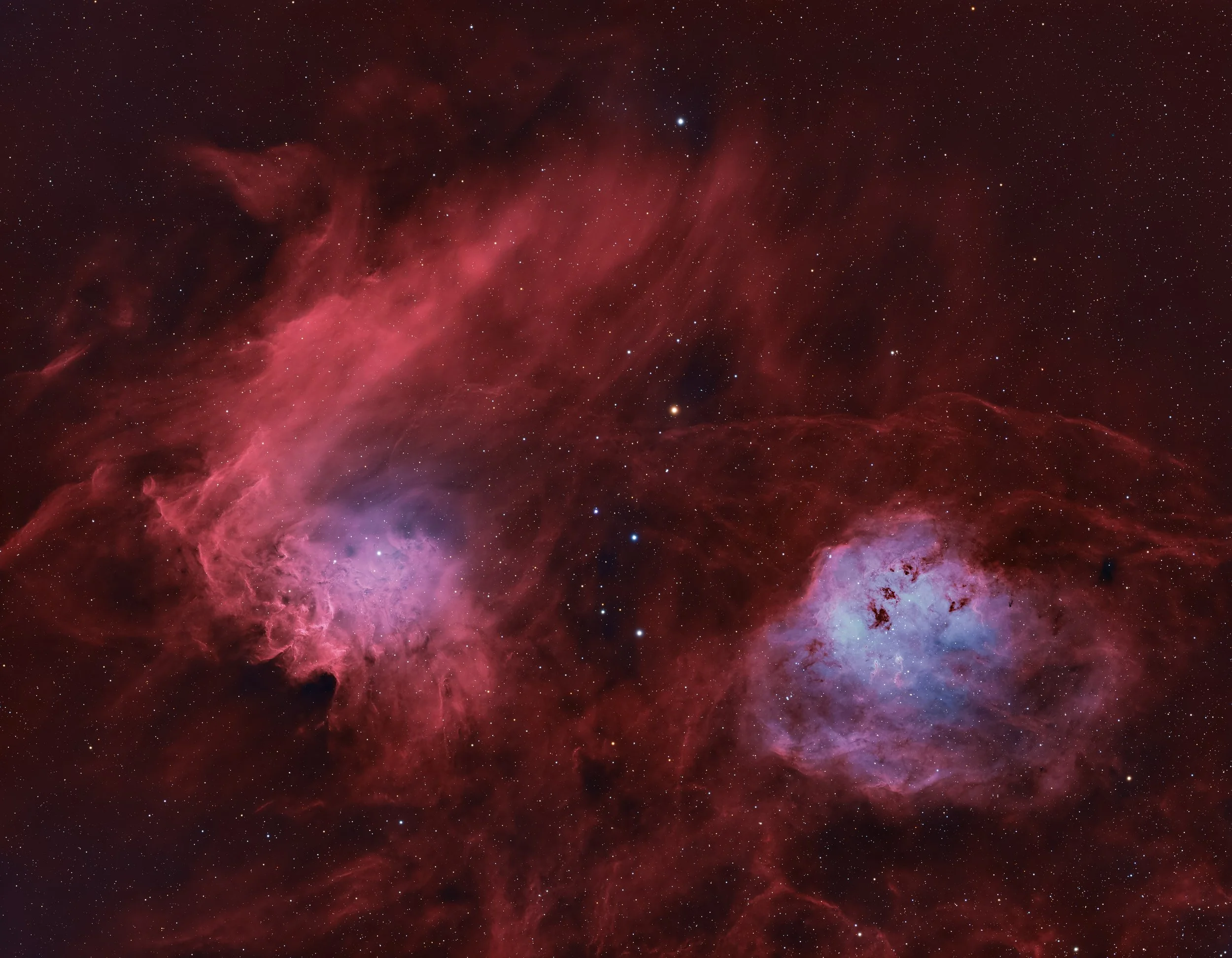
The Flaming Star and Tadpole Nebulae – A Fiery Embrace in Auriga
This vivid, high-resolution mosaic captures the emission nebulae IC 405 (left) and IC 410 (right) in a glowing hydrogen-oxygen blend, revealing sweeping tendrils of interstellar gas in the constellation Auriga. The Flaming Star Nebula (IC 405) surrounds the runaway star AE Aurigae, whose motion and radiation energize the swirling, flame-like hydrogen clouds. To the right, IC 410 hosts the young open cluster NGC 1893, whose hot, newborn stars shape the surrounding gas, including the iconic "Tadpoles" — dark, sinuous pillars of star-forming material.
Rendered in a refined HOO palette with subtle RGB enhancements, this image integrates 80 hours of exposure collected over two months. The long integration allows faint filamentary structures and faint OIII cores to emerge without overwhelming the natural depth. Wisps of hydrogen weave around both nebulae, linking them in a turbulent, star-forming environment that hints at the immense energy and complexity of stellar evolution.
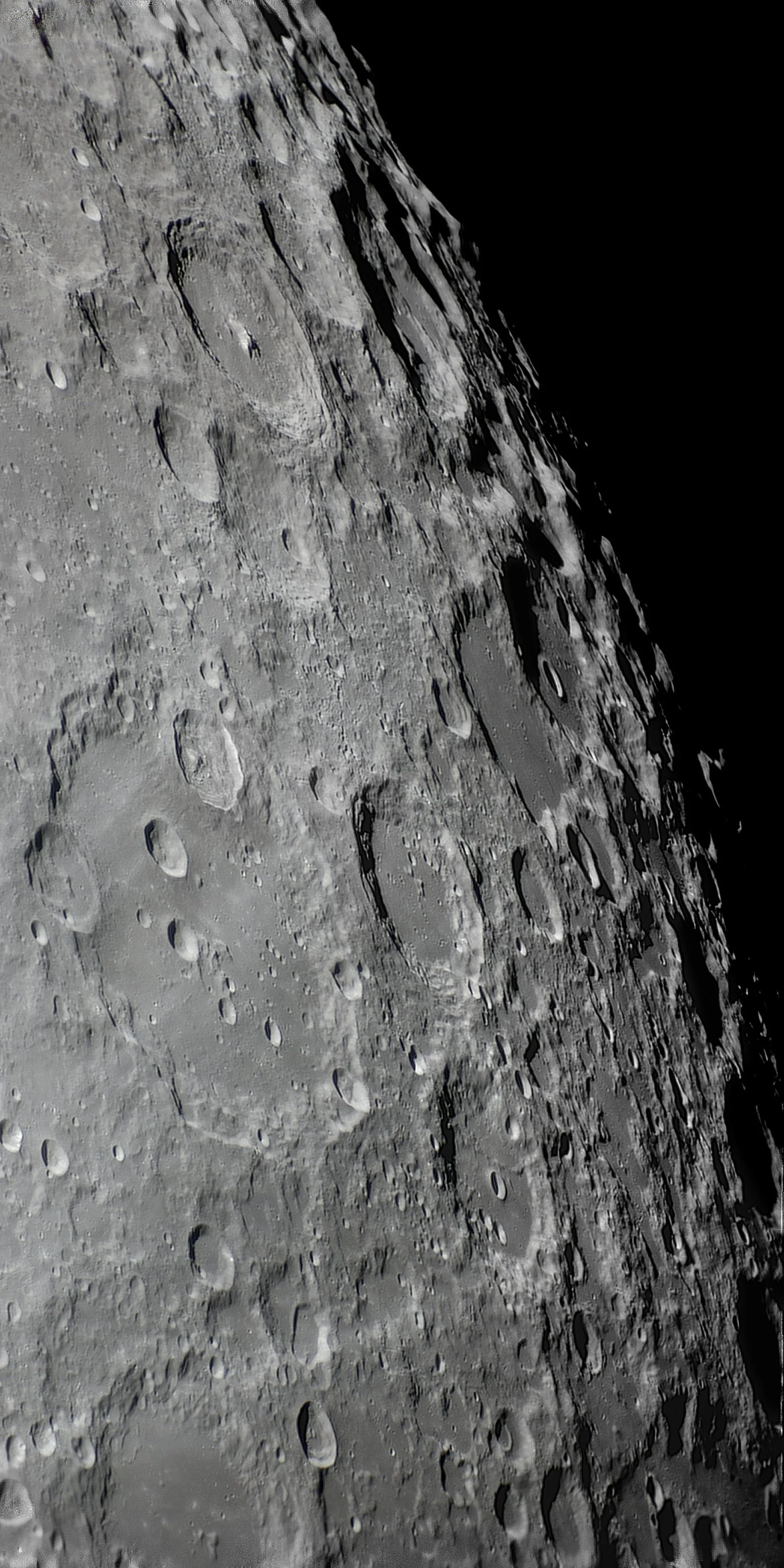
The Lunar Highlands – Earth's Battered Companion
This image captures the most heavily cratered region on the visible side of the Moon: the lunar highlands. Unlike the smoother basalt plains of the lunar maria, the highlands are ancient, rugged terrain, dating back over 4 billion years. Their densely packed craters tell the violent story of the early solar system, when impacts were far more frequent and intense.
Craters of all sizes overlap across the highlands, with sharp rims and long shadows that highlight their depth and age. The sheer density of impacts in this region, visible in stark detail near the Moon’s limb, is a testament to its ancient and unshielded surface. The image’s angle enhances the topography, revealing ridges, ejecta blankets, and the chaotic texture of a surface shaped by billions of years of celestial bombardment.
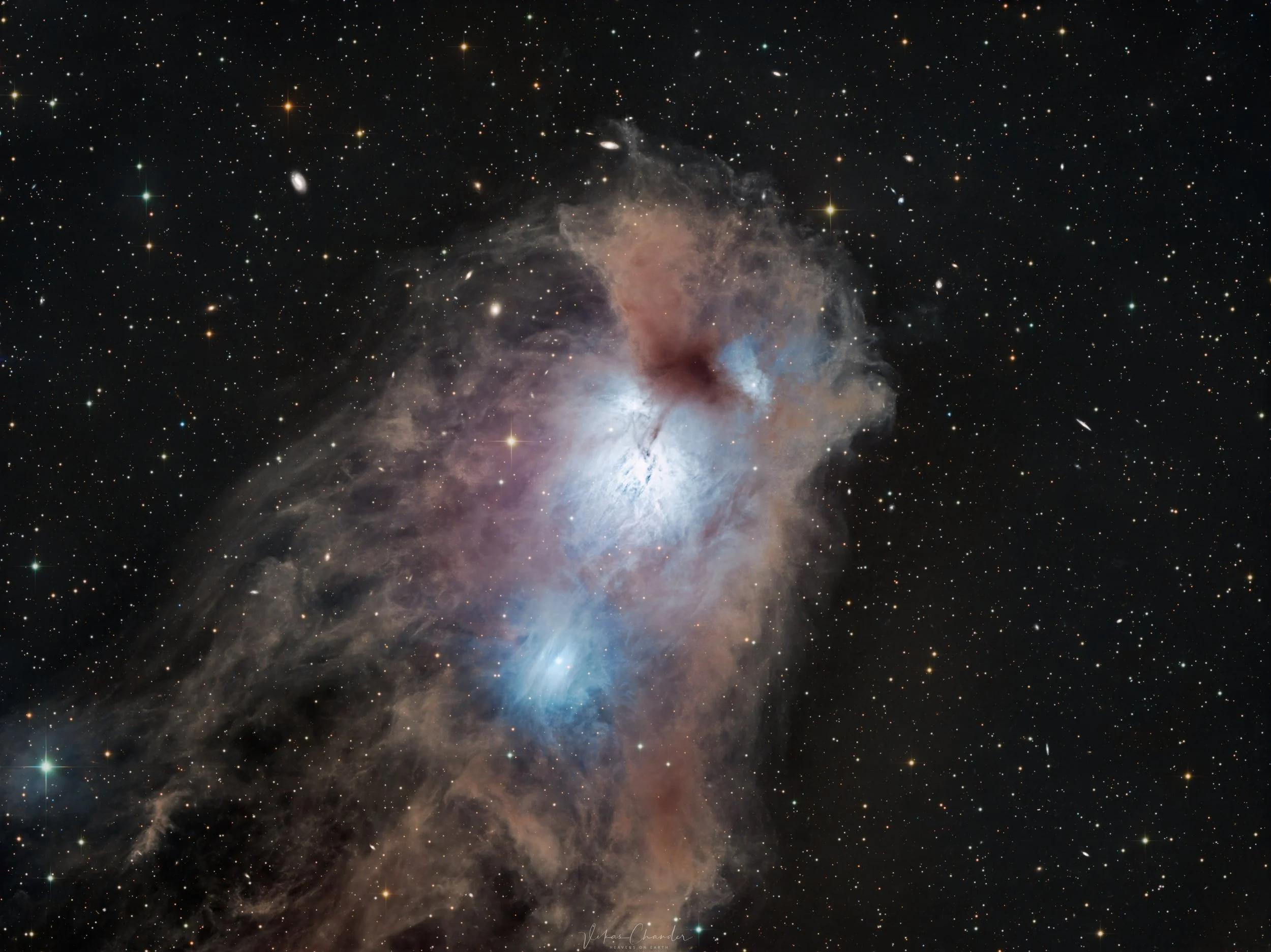
NGC 5367 – Reflection Nebula in Centaurus
NGC 5367 is a stunning blue reflection nebula embedded in a dark cloud complex in the constellation Centaurus, around 2,000 light-years from Earth. Illuminated by young stars still forming within, the nebula’s dusty filaments scatter starlight in vivid hues of blue and purple. The intricate structure of glowing gas and dark obscuring lanes hints at the dynamic processes of star formation underway in this region of space.
In this deep image, the dusty environment is rendered in exquisite detail, with subtle pink and brown tones blending into the background of stars and distant galaxies. The glowing heart of the nebula contrasts sharply with the shadowy dust lanes that appear to ripple outward, giving the scene a three-dimensional feel. This reflection nebula is part of a larger molecular cloud complex, providing a beautiful yet fleeting window into the turbulent nursery of newborn stars.
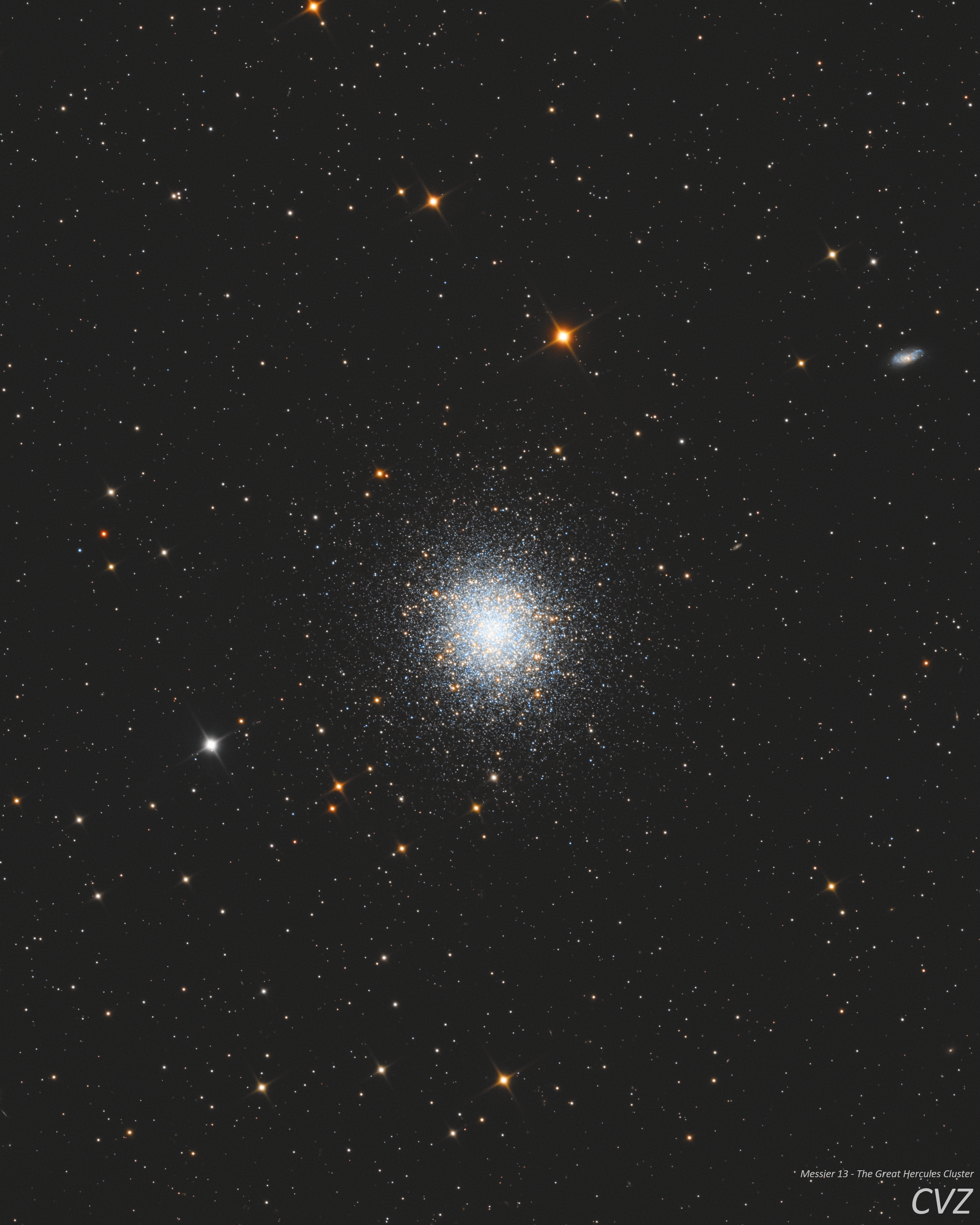
Messier 13 – The Great Hercules Cluster
Messier 13, often called the Great Hercules Cluster, is one of the most prominent and best-known globular clusters in the northern sky. Located about 22,000 light-years from Earth in the constellation Hercules, this ancient stellar swarm contains several hundred thousand stars packed into a sphere roughly 145 light-years in diameter. At the cluster’s dense core, stars are separated by just a fraction of a light-year, creating a glittering core easily visible in amateur telescopes.
This image captures the cluster's brilliance and symmetry, as well as subtle color variations in its aging stellar population. With stars ranging from hot blue stragglers to cooler red giants, M13 offers a glimpse into the early history of our galaxy. Careful exposure and processing bring out both the dense center and the more diffuse outer halo of this remarkable galactic fossil.
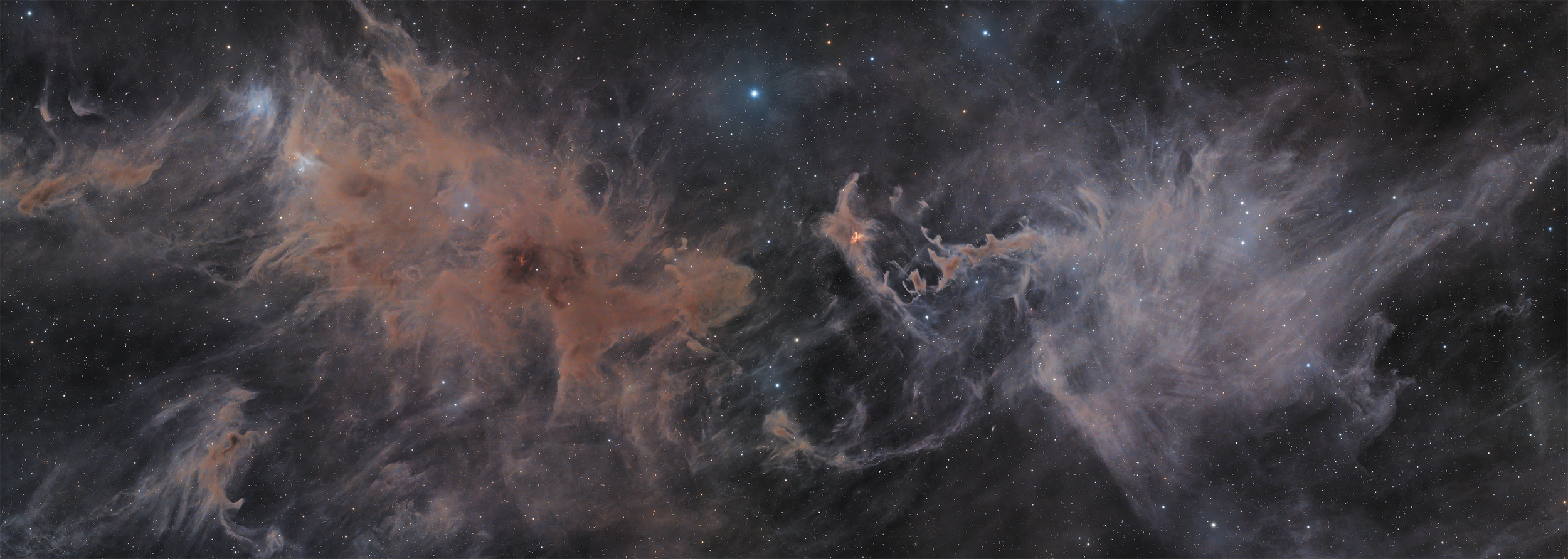
LDN 1228 & LBN 552 – Dark Dust in Cepheus
Nestled within the vast Cepheus Molecular Cloud Complex, LDN 1228 and LBN 552 form a striking scene of interstellar dust and reflection nebulosity just 11 degrees from Polaris. These dense clouds of gas and dust are stellar nurseries, obscuring the background starlight while faintly reflecting the glow of nearby stars. Wisps of darker lanes wind across the frame, hinting at the dynamic structure and turbulence within the complex.
This two-panel mosaic was captured over four nights and comprises 17 hours of total exposure time. Each panel was imaged with 1.5 hours per channel for red, green, and blue, and 4 hours of luminance to reveal the fine structure in the dark nebulae. The careful composition and extended integration highlight the faint, dusty texture of this quiet yet complex region of the northern sky.

Sh2-290 (Abell 31) – A Fading Ghost in Cancer
Sh2-290, also cataloged as Abell 31, is one of the largest planetary nebulae in the night sky, spanning over 16 arcminutes across the constellation Cancer. Estimated to lie about 2,000 light-years from Earth, this ancient remnant of a dying star displays a delicate shell of ionized gas expanding into space, with a mix of red H-alpha emission and bluish OIII glow revealing its layered structure. The central white dwarf—faint and barely visible—illuminates the nebula's ghostly form, offering a glimpse into the Sun’s distant future.
Captured under the skies of Gandhinagar, Gujarat, this image highlights the challenge and reward of imaging such a faint target. Its low surface brightness demands long total exposure time and carefully balanced processing to reveal the subtle structures in the nebula’s extended halo. Despite its size, Abell 31’s soft appearance makes it an elusive gem in astrophotography, requiring both patience and technical precision to fully appreciate its spectral beauty.