
AAPOD2 Image Archives
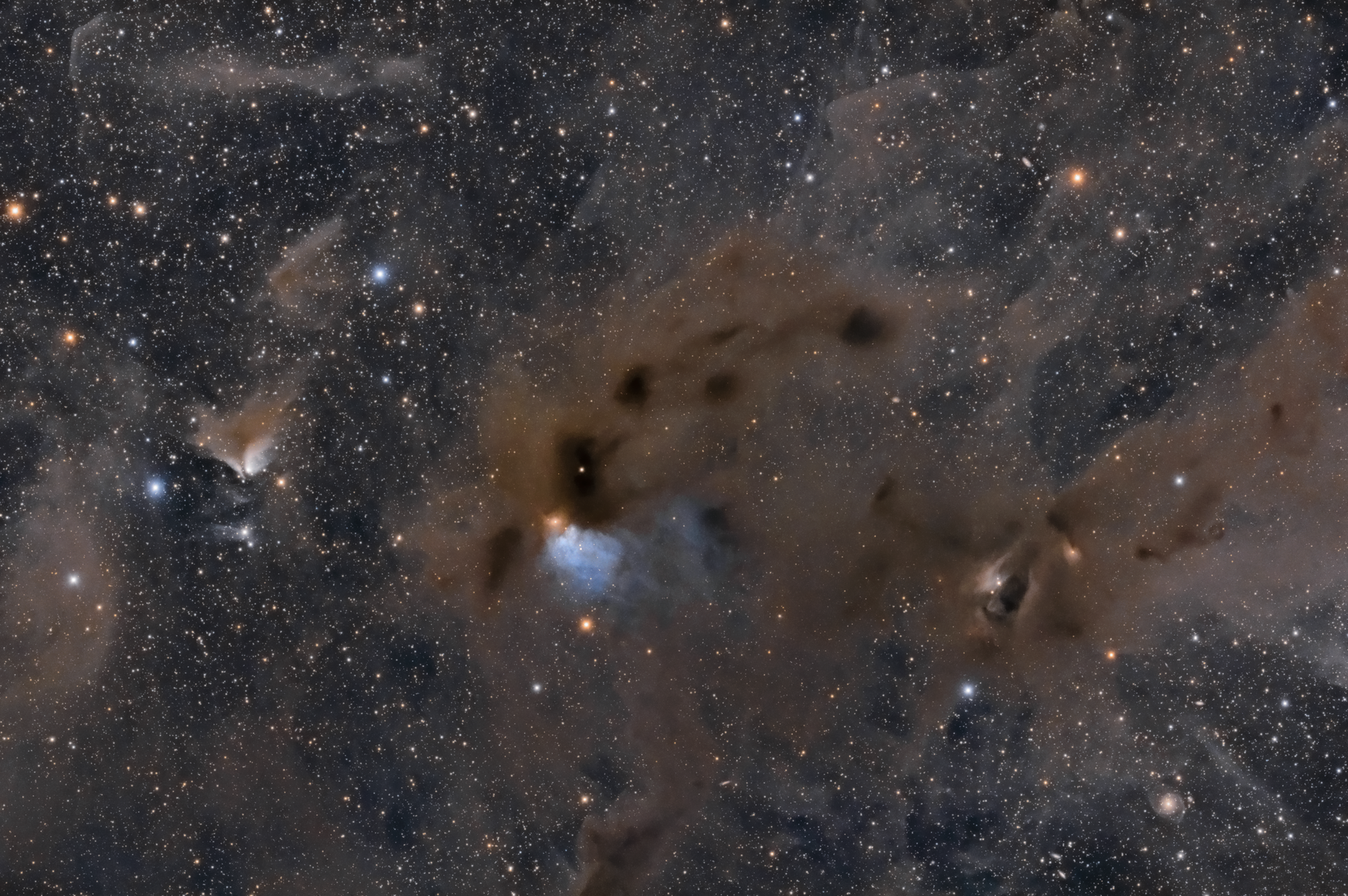
Banard 7 & more
Imaging telescope: Celestron 11" Rowe-Ackermann Schmidt Astrograph
Imaging camera: QHYCCD QHY367C
Mount: Orion Atlas Pro AZ/EQ-G
Guiding:Astromania 60mm Guide Scope & QHYCCD QHY5III178M
Filter:Astronomik L2 UV/IR Cut
Dates:Nov. 29, 2019, Dec. 15, 2019
Frames: 410x60"
Integration: 6.8 hours
Bortle Dark-Sky Scale: 5.00
Mean SQM: 19.68
This is a very interesting area in the Taurus Molecular Cloud featuring many dark and reflection nebulae. The main subject in the center is Barnard 7 (the dark nebula) and LBN 782 (the blue reflection nebula). To the left side is vdB 27, illuminated by RY Tauri, a young variable star. To the right is another reflection nebula illuminated by variable star CW Tauri. Peeking through the dust 186 million light years away is the galaxy IC 359, in the bottom right. All in all, a lot of different things to see here!
Copyright Jarrett Trezzo

Rosebud Nebula - NGC 7129
The young open star cluster NGC 7129 is embedded in the bluish reflection nebula vdB 146. Due to it's shape the reflection nebula is called "Rosebud Nebula" and is located in the constellation Cepheus. The young stars have blown a large, oddly shaped bubble in the molecular cloud that once surrounded them at their birth. The rosy pink color comes from glowing dust grains on the surface of the bubble being heated by the intense light from the young stars within. Also some Herbig-Haro objects can be identified in the reflection nebula. Their shape and pinkish red color is characteristic of glowing hydrogen gas shocked by jets streaming away from newborn stars.
NGC 7142 is an open cluster about 6,200 light-years away. With an estimated age of 4.5 billion years, he is one of the oldest known open clusters.
The fine Halpha filaments on the left side of the image are part of the supernova remnant SNR 110.3 + 11.3.
Scope: ASA 10" Astrograph
Mount: ASA DDM60
Camera: Moravian G3-16200 with Astrodon LRGB and Halpha filters
Total exposure time: ~81h
Copyright: Thomas Henne

Elephant's Trunk Nebula - IC1396
INFO
IC 1396 spans hundreds of light years at distance of about 3000 light years in constellation Cepheus. The famous formation of glowing gases, the "Elephant's Trunk Nebula" can be seen at four o'clock position. This is an active star formation region and it has several massive young stars inside it, coursing the ionization of elements of this emission nebula.
Technical details Processing workflow Image acquisition, MaxiDL v5.07. Stacked and calibrated in CCDStack2. Deconvolution with a CCDStack2 Positive Constraint, 33 iterations, added at 50% weight Color combine in PS CS3 Levels and curves in PS CS3. Imaging optics Tokina AT-x f2.8 camera lens Mount 10-micron 1000 Cameras and filters Imaging camera Apogee Alta U16 and Apogee seven slot filter wheel Guider camera, Lodestar x 2 and an old spotting scope of Meade LX200
Astrodon filters,
5nm H-alpha 3nm S-II and 3nm O-III Total exposure time for all of the four panels
H-alpha, 12 x 600 s, binned 1x1 = 2 h
O-III, 6x 600 s, binned 4x4 = 1 h.
S-II, 3 x 600 s. binned 4x4 = 0,5 h
Copyright: J-P Mets̈avainio

IC1795 - The Fishhead Nebula
IC 1795 - The Fish Head nebula
IC 1795 is an area of gas and dust and also a star forming region in the northern constellation Cassiopeia.
IC 1795 is an extension of the larger Heart nebula or IC 1805.
The brightest part of the nebula has the designation NGC 896 in the New General Catalogue. It is classified separately because it was the first part of IC 1805 to be discovered.
Equipment used:
Eq6 hypertune gen2 by DarkFrame Ltd
AstroTech 106LE with upgraded Moonlite focuser
TSFlat 2" field flattener
Qhyccd QHY183M Coldmos, cooled at - 20°C
7x1.25" Starlight Xpress USB filterwheel
Baader 1.25" filters, 7nm Ha, 8.5nm Oiii and 8nm Sii
Qhyccd QHY5L-IIM guide camera
TS09OAG off axis guider
Qhyccd Polemaster
Software used:
Eqmod, SGP - Sequence Generator Pro, PHD2, Stellarium with stellariumScope, SharpCap for polar alignment
Date: 14.09 to 11.12.2019
Location: Bushey, bortle 6
Total integration time 19 hours
Stacked in AstroPixel Processor and processed in Pixinsight and Photoshop CC 2019
Copyright: Emil Andronic

Sun comparison in Cak and Hydrogen Alpha
Sun in CaK and HA
TS 80ED f/7, Lunt modulo CaK B1200, Lunt LS60THa/B1200, Grasshopper3 GS3-U3-28S4M.
A comparison between FD Cak and H-Alpha taken 1/9/2020. I used a Lunt LS60THa/B1200 and a TS 80ED f/7 with a Grasshopper3 GS3-U3-28S4M.
Copyright: Salvo Lauricella

The Wizard Nebula - NGC 7380
Image data:
Date: 25/10/2019 and 26/10/2019
Site: Albox - Almería - Spain
Image Details: H-Alpha: 24x600" / OIII: 15x600" / SII: 24x600"
Telescope: Teleskop-Service Imaging Star 130mm f/5 - 6-elements Flatfield APO
CCD: ASI1600MMC
CCD Guiding: QHY5L-II
Capture and guiding software: MaxIm DL
Mount: Celestron CGEM
Processing: PixInsight
Bias, Darks and Flats applied
https://www.astrobin.com/m784zo
Copyright: José Francisco del Aguila del Aguila


Cygnus Mosaic
Cygnus mosaic
Image data:
Dates: 21.09.2019, 03.10.2019, 23.10.2019, 26.10.2019
Camera: Canon EOS 6DMod
Lens: Samyang 135/F2@F2
Mount: SkyWatcher Star Adventurer (no guiding)
Exposure: 144x120" ISO 800 (six panels, 24 subframes per panel)
Location: Czech Republic, Stranske
Processing: Astropixel procesor, Adobe PS Creative Cloud
Copyright:
Copyright: Martin Vyhlidal
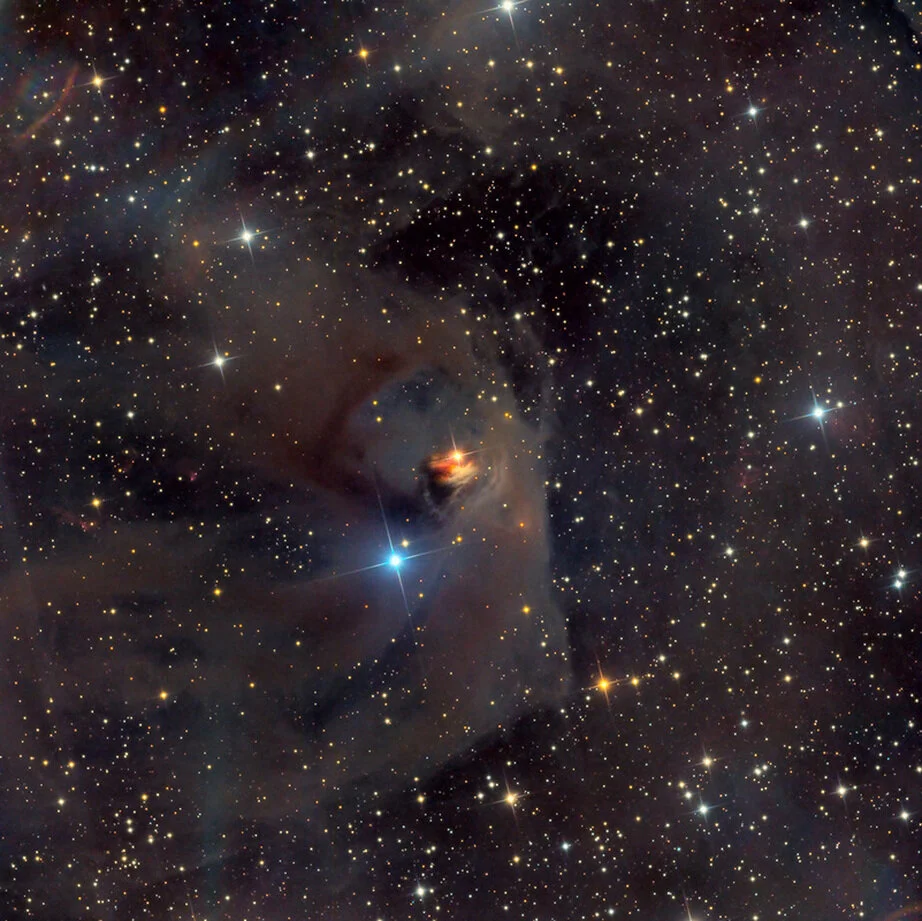
NGC 1555 in Taurus
NGC 1555 in Taurus is also designated as SH2-238 in the Sharpless Catalog. Illuminated by the bright golden star, T Tauri at center, Hind's Variable Nebula is a Herbig–Haro object. NGC 1555 was discovered in 1852 by English astronomer John Russell Hind.
PlaneWave 17" CDK, U16M, Paramount ME, PixInsight 1.8 Acquisition by Bill Snyder at SRO
Copyright: Bill Snyder (Acquisition) and Warren Keller (Processing)
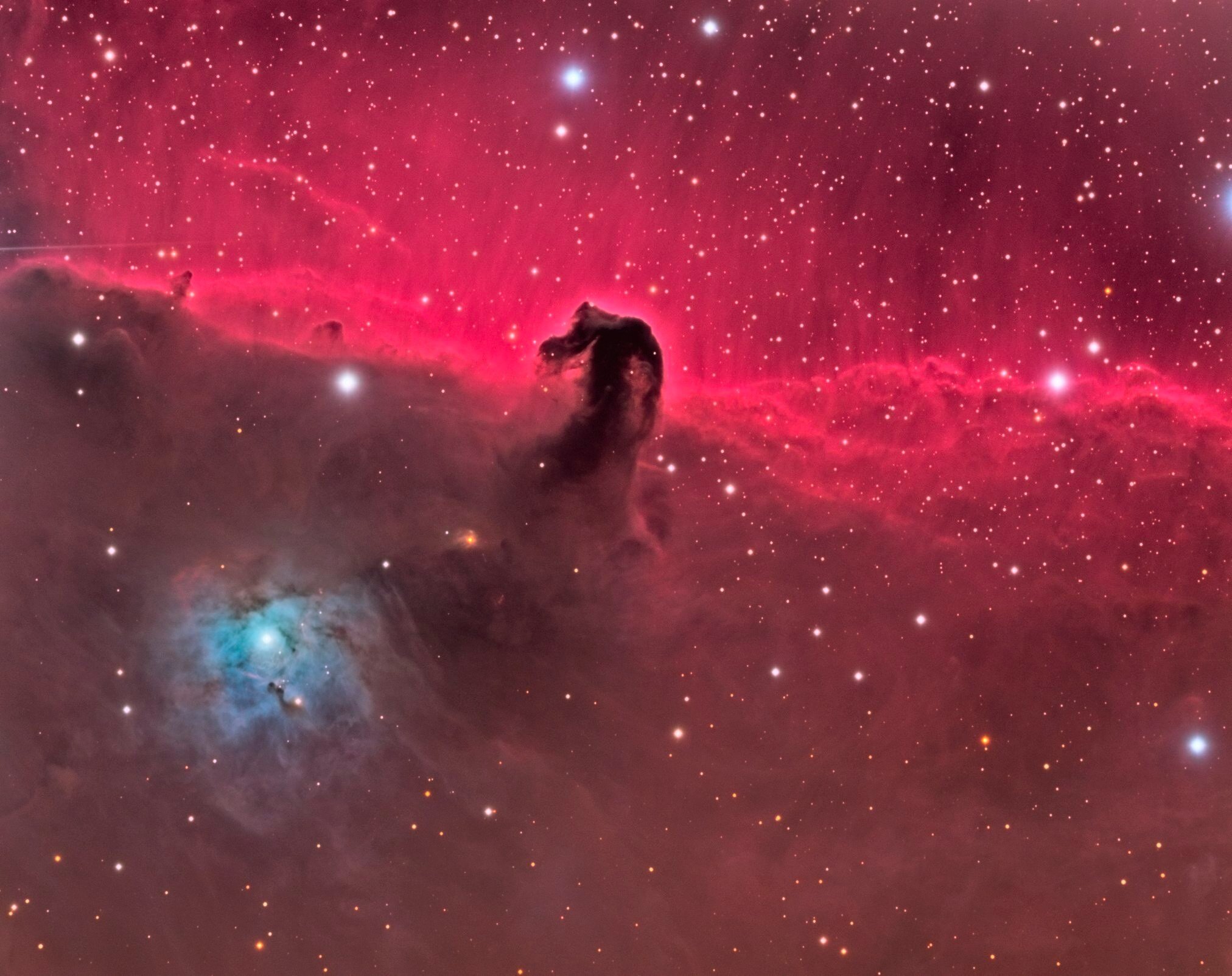
Horsehead Nebula - B33
Horsehead Nebula LRGB, Ha. Taken from PixelSkies, Spain www.pixelskiesastro.com
This target was what got me into Astrophotography many years ago but I could never do it justice in the UK with the light-polluted skies in Birmingham so now living in Spain and running a Remote Telescope Hosting site I have been able to collect better quality data and do it more justice.
Lum 25x900Secs
Red 48x300Secs
Green 19x300Secs
Blue 20x300Secs
Ha 81x1200Secs
40 hours 35 mins in total.
Equipment used:
Telescope: Tec 140 F7
Camera: Xpress Trius SX-694 Mono Cooled to -10C
Image Scale: 0.95
Guiding: OAG
Filters: Astronomik LRGB, Ha
Mount: iOptron CEM60 "Standard" GOTO Centre Balanced Equatorial Mount
Image Acquisition: Voyager
Observatory control: Lunatico Dragonfly
Stacking and Calibrating: Pixinsight
Processing: Pixinsight 1.8
Copyright: David Wills
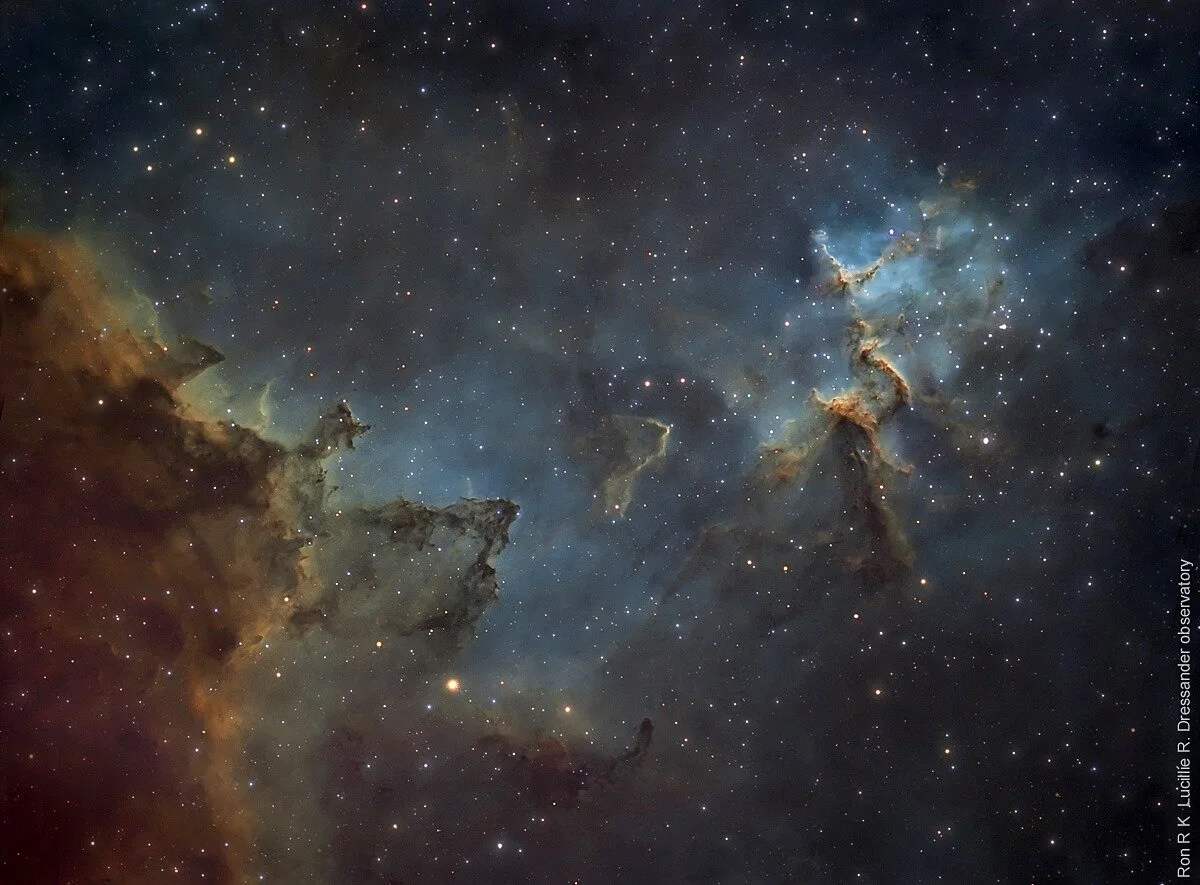
IC 1805 - Center of the Heart
ES152 APO,
ASI1600mm cool
Mach1 mount
290mini guide camera on Orion 80mm guidescope
Captured with SGP post done in PI.ZWO NB filters. S H and O.About 22 hours.
Bortle 6+My front yard in my NexDome Grand Rapids, MI
Copyright: Ron Richards
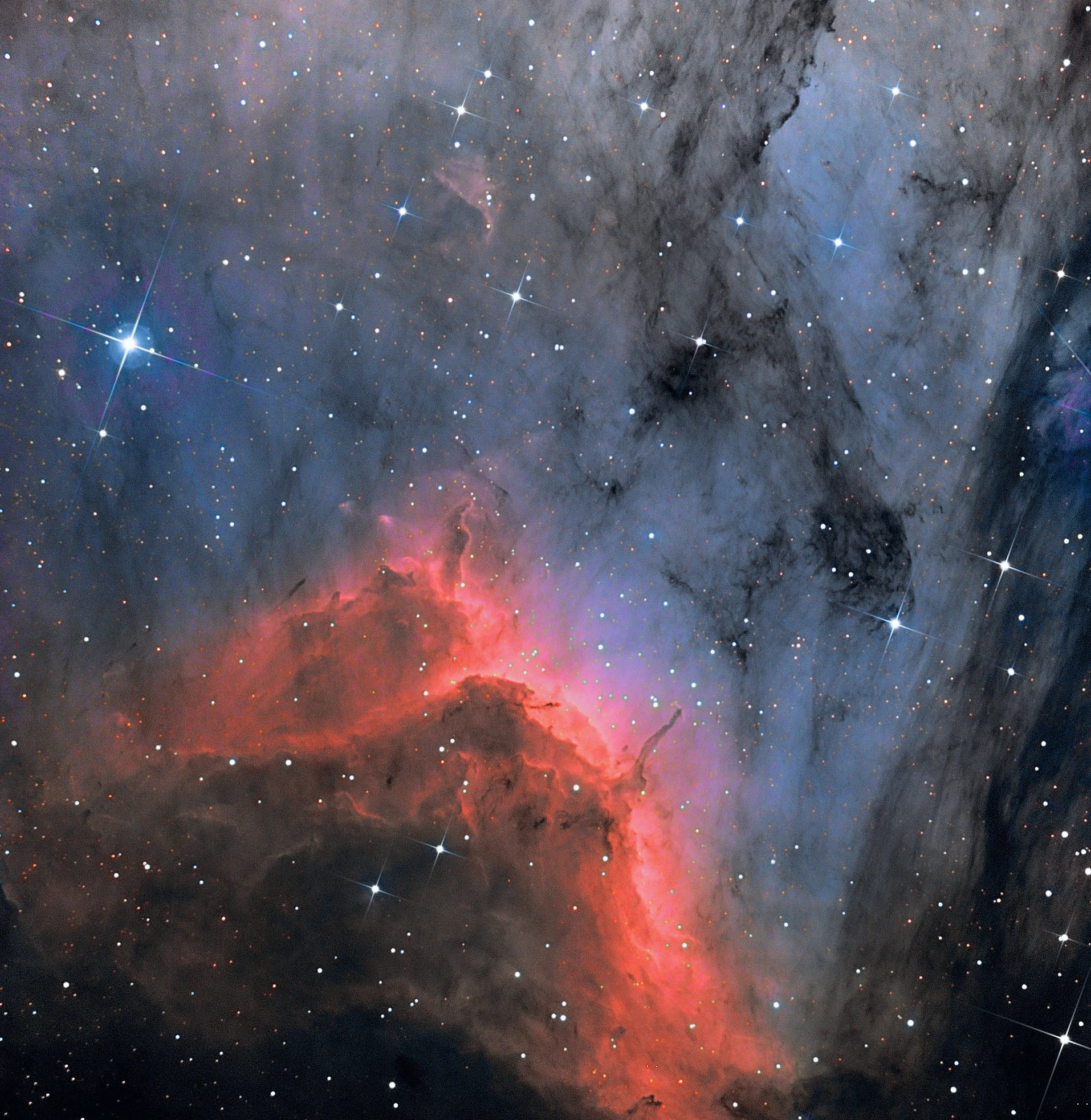
IC 5067
Image Description and Details: MT 300 SkyVision F / D 3.3 Astrograph Telescope Instrument with Paracorr Type 2
Imager CCD camera QSI 540WSG, temperature -15 °, Atik GP guidance
Exposure 16 X1200 sec in H alpha, 5 x 600 sec in RGB
MaxIm DL 5 pre-treatments
MaxIm DL 5 and Photoshop CS3 processing
Conditions SQM 20.92, fairly good transparency, wind 28 km / s
The Pelican Nebula (IC 5067 and IC 5070) is an emission nebula located approximately 2,000 light years from Earth in the constellation Cygnus. It is very wide in the sky, making approximately 2.5 times the diameter of the Moon.
Copyright: Alexandre Cucculelli
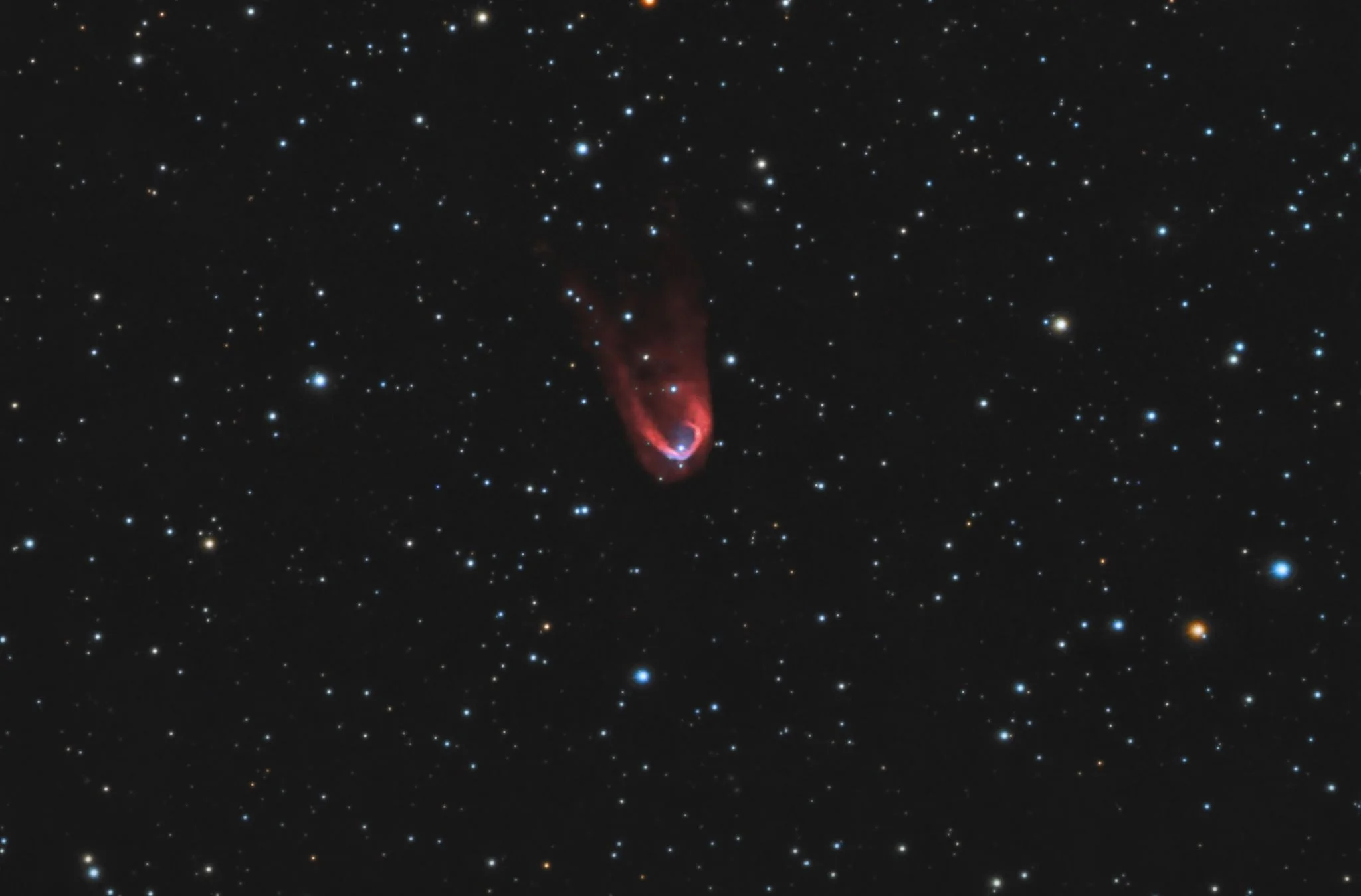
EGB 4
EGB 4 (a nebula discovered by Ellis, Grayson, & Bond in 1984) is NOT a comet, despite it's comet-like appearance. It is an emission nebula surrounding a catacylismic binary star system called BZ Cam in the constellation of Camelopardis.
It has an unusual bow-shock structure as BZ Cam (with it's associated wind) moves through the interstellar medium, similar to the bow wave in front of a ship that is moving through water.
BZ Cam is believed to be a white dwarf star that is accreting mass from an accompanying main-sequence star of 0.3-0.4 solar masses.
It is around 2,500 light years away, and has a space velocity of 125 km/second.
I can only find one previous image of EGB 4 online, a NASA APOD from 2000, so I believe this could be the first amateaur image and thefirst colour image.
Yes it's incredibly faint!
Image capture details:
Astrodon Blue: 15x300"
Astrodon Green: 15x300"
Astrodon Lum: 20x600"
Astrodon Red: 15x300"
Astrodon OIII: 25x1800s bin 2x2
Astrodon Ha: 56x1800s bin 2x2
Total Integration: 48 hours
Captured on my dual rig in Spain.
Scopes: APM TMB LZOS 152 (6" aperture 1200mm focal length)
Cameras: QSI6120wsg8
Mount: 10Micron GM2000 HPS
Copyright Details: Peter Goodhew
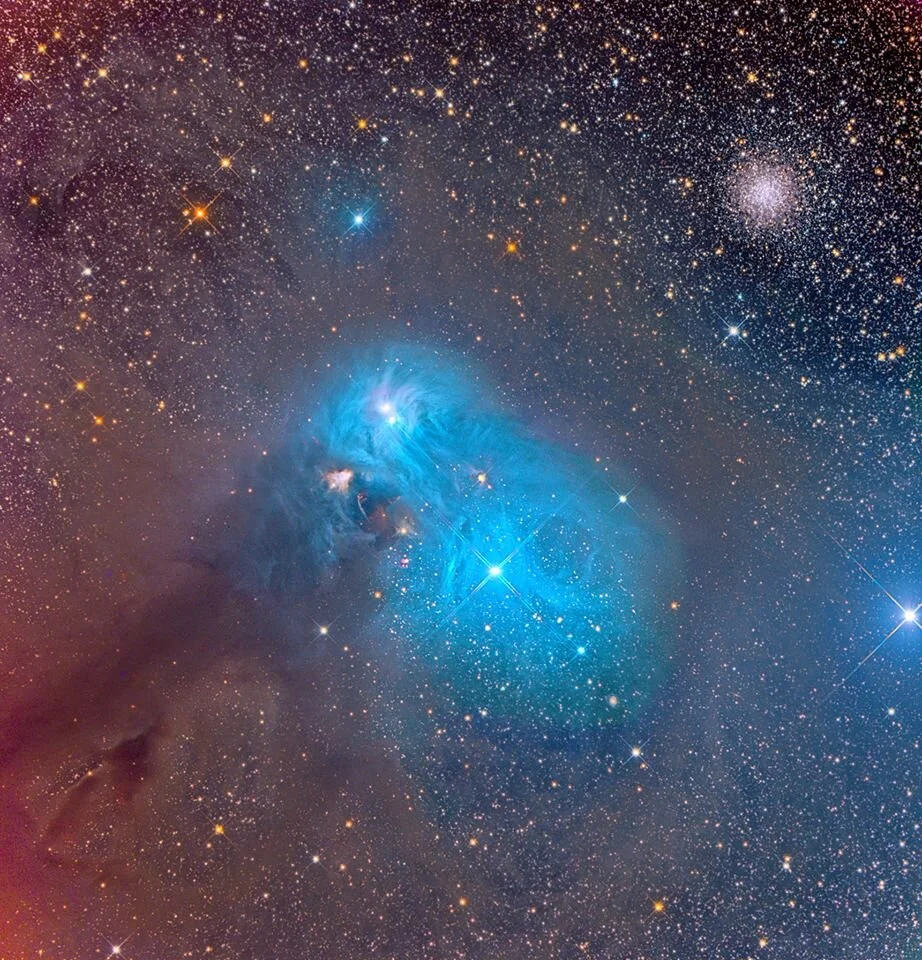
Anteater Nebula - NGC 6726
NGC 6726/6727 and IC 4812 are blue reflection nebulae, where bright stars are embedded in a large cloud of dust which reflects the blue light of the stars. NGC 6729 is a butterfly-shaped emission/reflection object that is a variable nebula, powered by the irregular variable star, R Coronae Australis (R CrA). R CrA was discovered about 100 years ago. HH objects are shown as delicate, small arcs of glowing gas.
20" ASA FLI PROLINE 16803 CCD
3.7 HOURS of LRGB
Chilescope T2 Stacked in PI , Processed n Ps
Copyright: Zhuoqun Wu & Utkarsh mishra
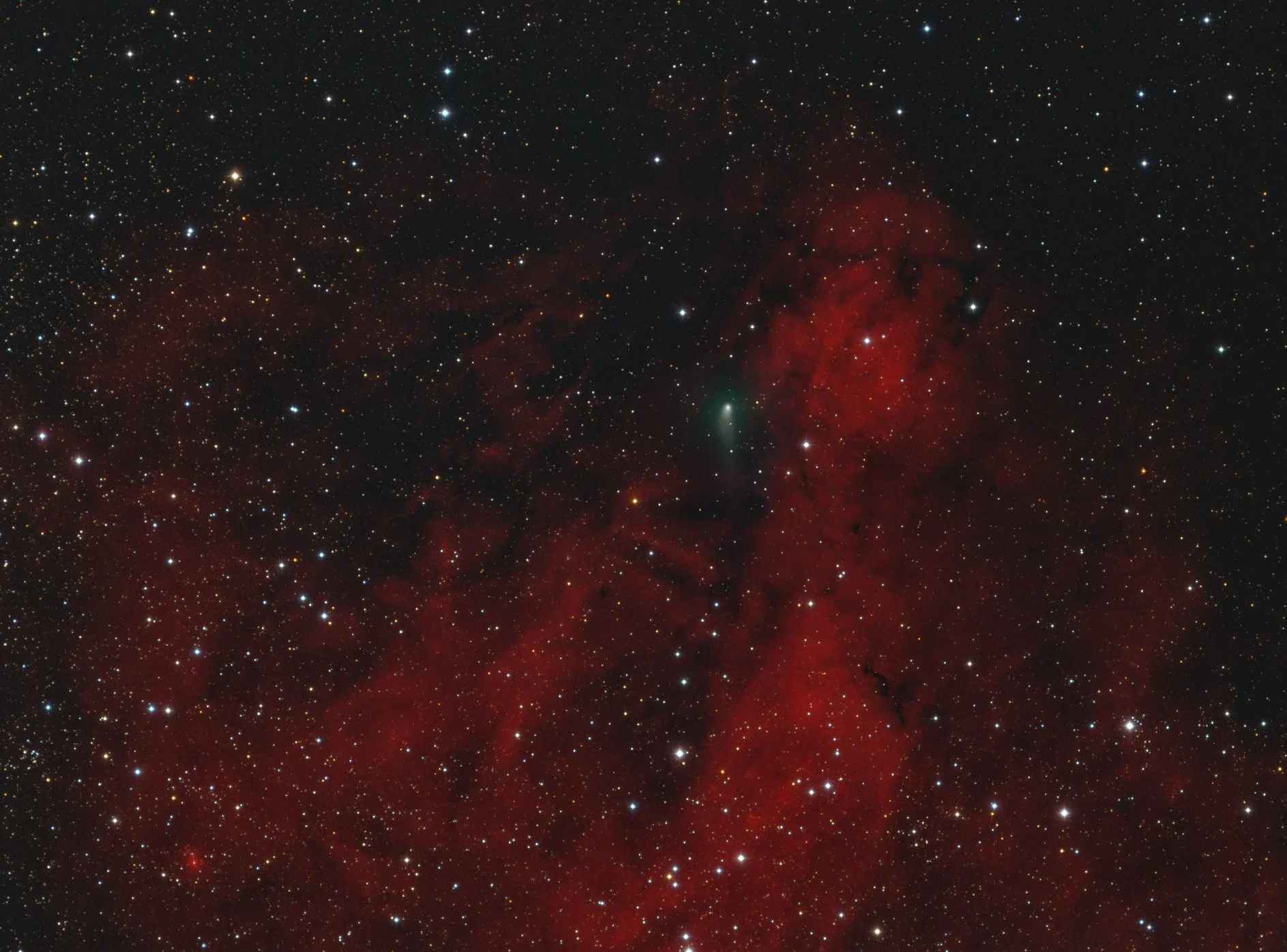
comet c / 2017 T2 Panstarrs
This is the comet c / 2017 T2 Panstarrs, imaged thru its passage of sh2- 205.
Based on the absolute magnitude published for this comet by the British Astronomical Association's Comet Section, it is estimate that it may be around mag 7 at perihelion.
Comet C/2017 T2 (PANSTARRS) will make its closest approach to the Sun, at a distance of 1.61 AU.
From BAA….C/2017 T2 (PANSTARRS) was discovered at 20th magnitude in 2017 September when it was it was 9.3 au from the Sun. It is heading for a perihelion at q=1.6 au in early 2020 May. The comet is currently in conjunction but it was apparently brightening rapidly when last seen in April. It should become visible from the UK in mid July very low in the morning sky as it moves slowly NE in Taurus. By then it will be 3.8 au from the Sun and 4.5 au from the Earth. It moves higher in the sky and will be visible throughout the autumn, winter and spring as a circumpolar object and it remains well placed in Ursa Major at perihelion. Magnitude estimates through the late summer and autumn should help to constrain the lightcurve.
Copyright: Cristina Cellini
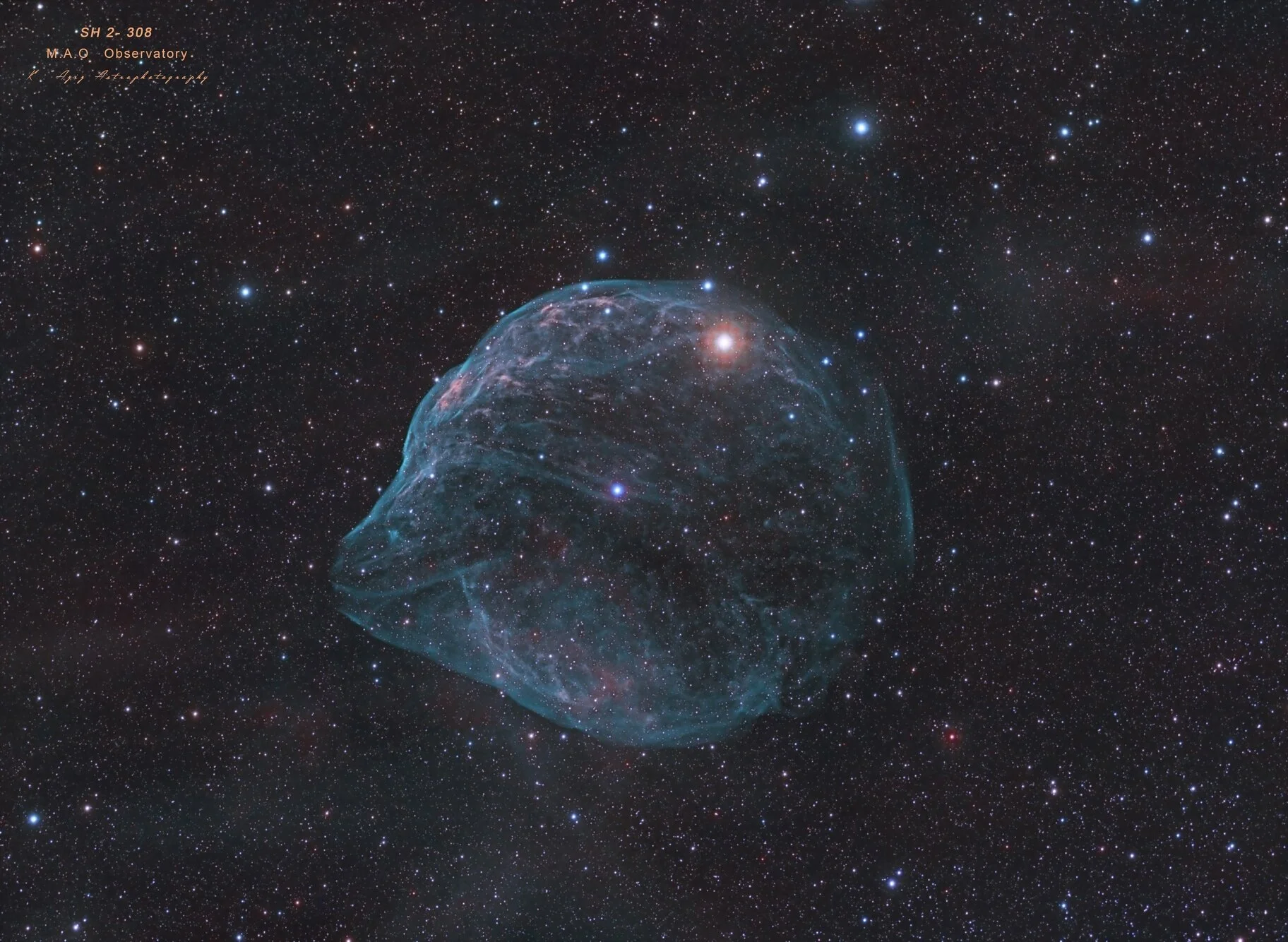
Dolphin Head Nebula -Sh2-308
Image Description and Details : Here is my first object captured in 2020.
This is the dolphin head nebula, Cataloged Sharpless SH 2-308, it is about 5,200 light-years from home towards the constellation of the Big Dog.
The massive star (Wolf-Rayet type) that created the bubble is the bright star located near the center of the nebula.
It generates a powerful radiation which drives out the gas around thus creating a giant bubble.
Technical details :
• TS 102mm F5,1 apo astrograph bezel
• Azeq6gt mount
• Zwo asi 1600 mm cooled pro
• Sampling: 1.47 arcsec / pixel.
Frames:
Astronomik 6nm OIII 36mm: 93x300" -10C
Astronomik HA 6nm 36mm: 17x300" -10C
ZWO B 36mm: 27x60" -10C
ZWO G 36mm: 27x60" -10C
ZWO R 36mm: 27x60" -10C
Integration: 10.5 hours
• DOF: 15x101x0
• Date: January 1 and 2, 2020
• Location: MAO Observatory of Ben Slimane.
Copyright: Aziz Kaeouach

M66
This is an image of M66, also known as NGC3627. It is an intermediate spiral galaxy about 36 million light years away in the constellation Leo. It is a member of the Leo Triplet, which also includes M65 and NGC3628.
Dates: December 14, 2017 - January 17, 2018
Location: Dark Sky New Mexico
Telescope: Planewave CDK-17
Camera: FLI PL16803
Mount: Paramount ME
Luminance: 27x20 minutes (binned 1x1)
Red: 12x15 minutes (binned 1x1)
Green: 12x15 minutes (binned 1x1)
Blue: 12x15 minutes (binned 1x1)
Copyright: Bernard Miller

Messier 82 AKA, the Cigar Galaxy
Messier 82 also known as the Cigar Galaxy or NGC 3034 is a starburst galaxy approximately 12 million light-years away in the constellation Ursa Major.
Imaging telescope or lens: Planewave CDK17
Imaging camera: Finger Lakes Instrumenttaion Proline 16803
Guiding telescope or lens: Planewave CDK17
Guiding camera: Starlight Xpress Lodestar X2
Software: PHD2 PHD 2.6.2, PixInsight 1.8 Pisinsight 1.8
Filters: Chroma Blue, Chroma Green, Chroma Red
Copyright: Seymore Stars
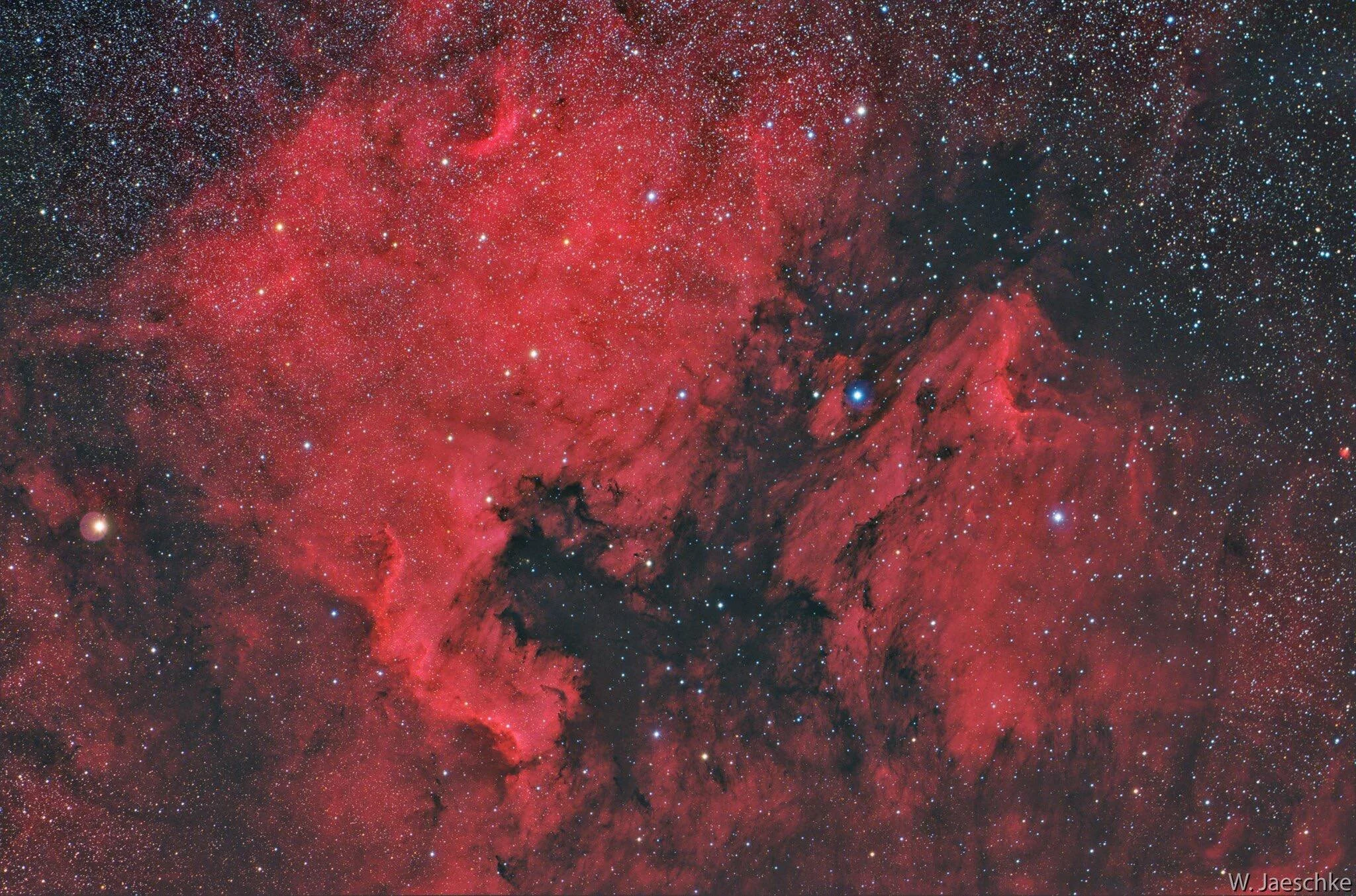
The North American And Pelican Nebulae
The North American And Pelican Nebulae.
Taken with a Takahashi FSQ106 and SBIG 11000m.
45 hours total exposure.
Copyright: Wayne Jaeschke