

AAPOD2 Image Archives
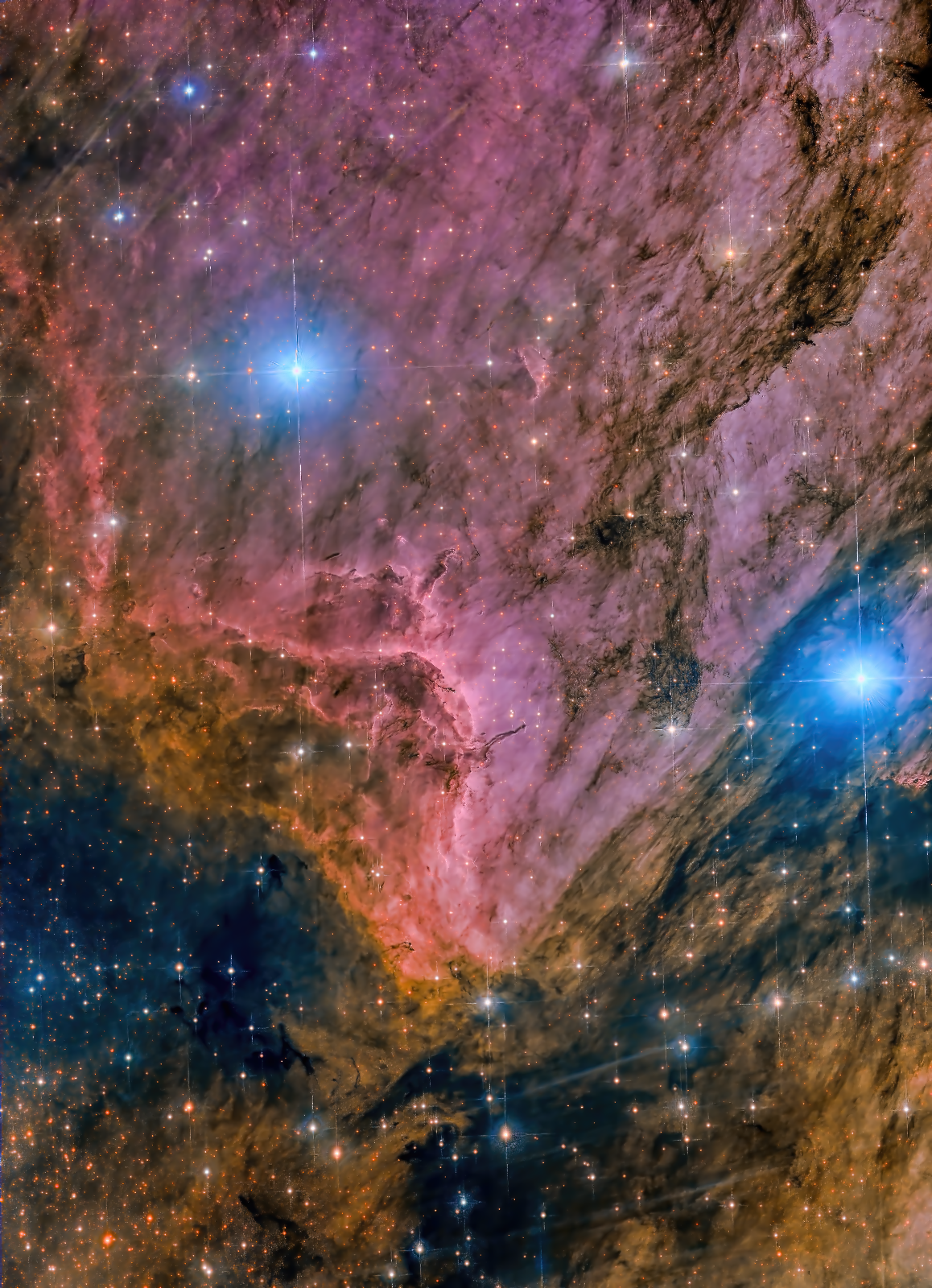
Pelican Nebula and surroundings
Image Description and Details :
Scopes used:
AP175 (DSW, New Mexico) H,S,O;
RCOS 14.5 (DSW, New Mexico) HSO
DreamScope 16 (ATOE, New Mexico) LHRGB
Total exposure (used): 52.7 hours
Image width: almost 1 degree
Tools: PixInsight, Topaz, Skylum, ACDSee, SWT
Copyright: Alex Woronow

M 81 and IFN
Image Description and Details :
Galaxy M 81, located in the Constellation Ursa Major at 12 million AL from the Milky Way. It is a spiral galaxy, relatively modest since its diameter is only 87000 light-years. It is in gravitational interaction with its neighbor M 82.
This picture was taken by Team ARO in South Portugal from 07/03/21 to 12/05/21 in Remote from France.
Equipment used: FSQ 106 on EQ6 Pro mount, ZWO Asi 1600MM camera.
Total exposure time: 25,74H
L=269x2
R=97x2
V=118x2'
B=100x2'
Ha=134x3'
Copyright: Team ARO
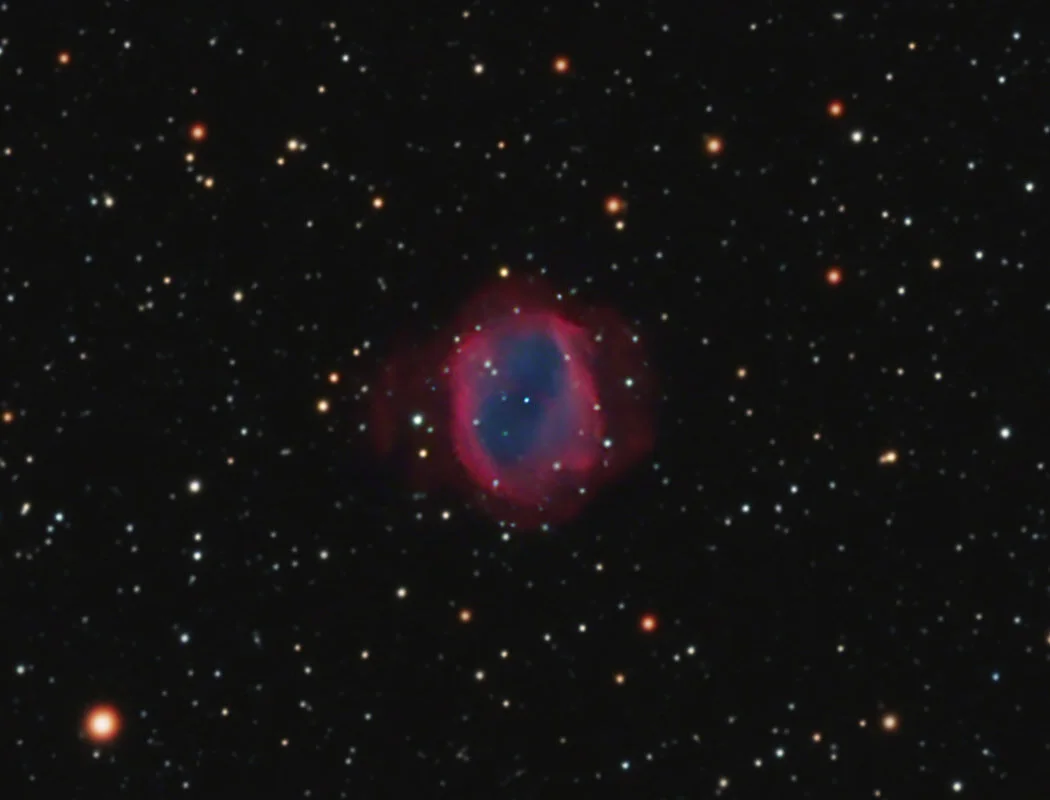
Ngc 6772
NGC 6772 is a small (81 arc seconds) 14th magnitude ancient bipolar planetary nebula in the constellation Aquila. It is approximately 4000 light years from Earth and was discovered by William Herschel on 21 July 1784. I was pleased to manage to capture the rarely-seen outer Ha shell.
Image captured on my remote dual rig at Fregenal de la Sierra in Spain between 21-30 June 2021.
Scopes: APM TMB LZOS 152 Refractors
Cameras: QSI6120wsg8
Mount: 10Micron GM2000 HPS
A total of 42 hours 15 minutes image capture (HaOIIILRGB)
Cooyright: Peter Goodhew
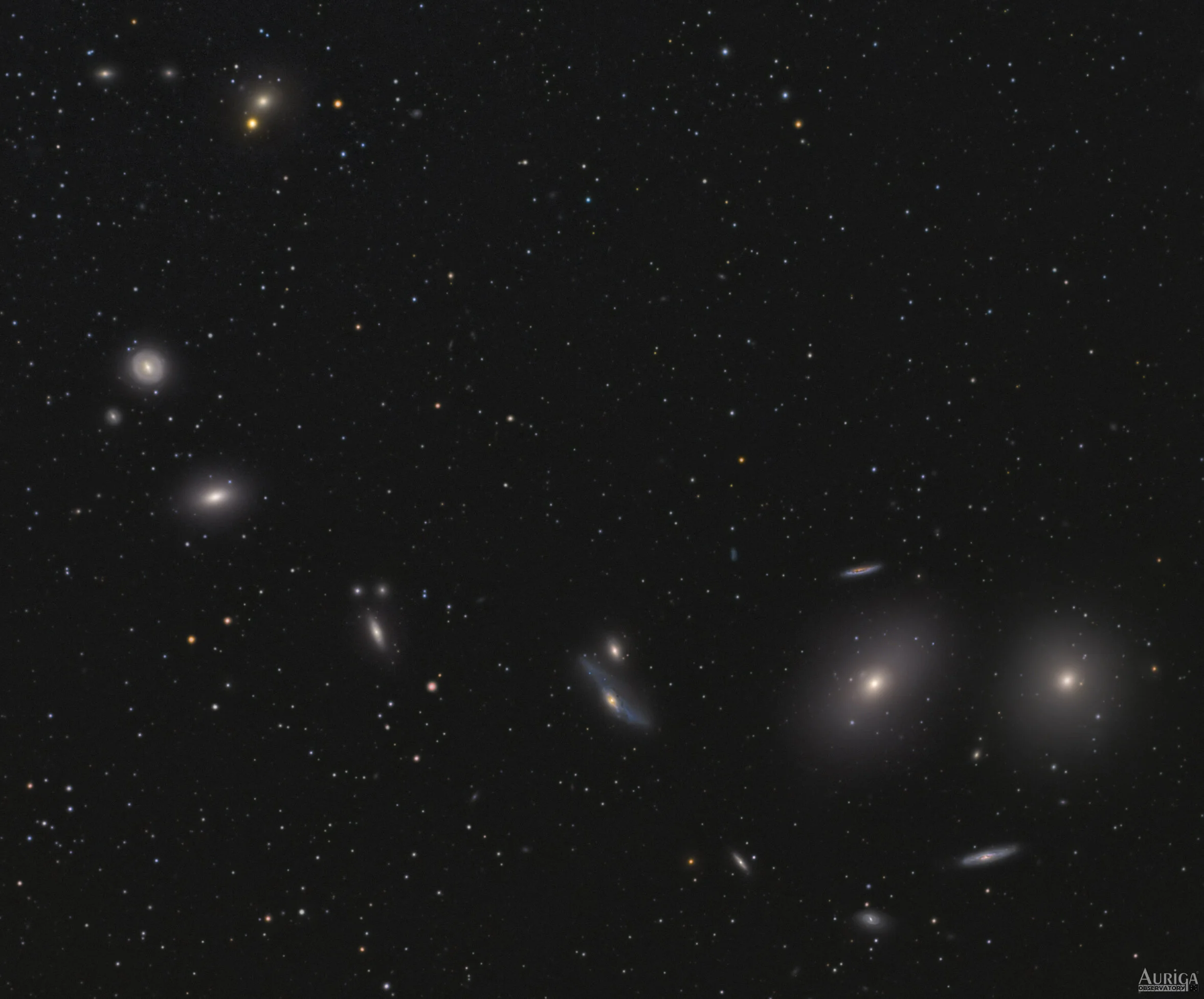
Markarian's Chain
Image Description and Details : SkyWatcher EQ 8 PRO Mount+TS Optics Photoline 80/480 f / 6 Triplet Super Apo - FPL-53+TS-Optics 2 "PHOTOLINE 0.79x Reducer / correctorZWO Optical ASI 1600-MM COOLED+ZWO EFWTelescope Guide: SkyWatcher EvoGuide 50ED+ZWO Optical ASI 290 MMFilters: Astronomik LRGB 1.25 "Type IIc
(Accumulation: 39h.)Locations: "Auriga" Private Observatory, Makeikha, Moscow Region, Russia
Copyright: Sviatoslav Lips
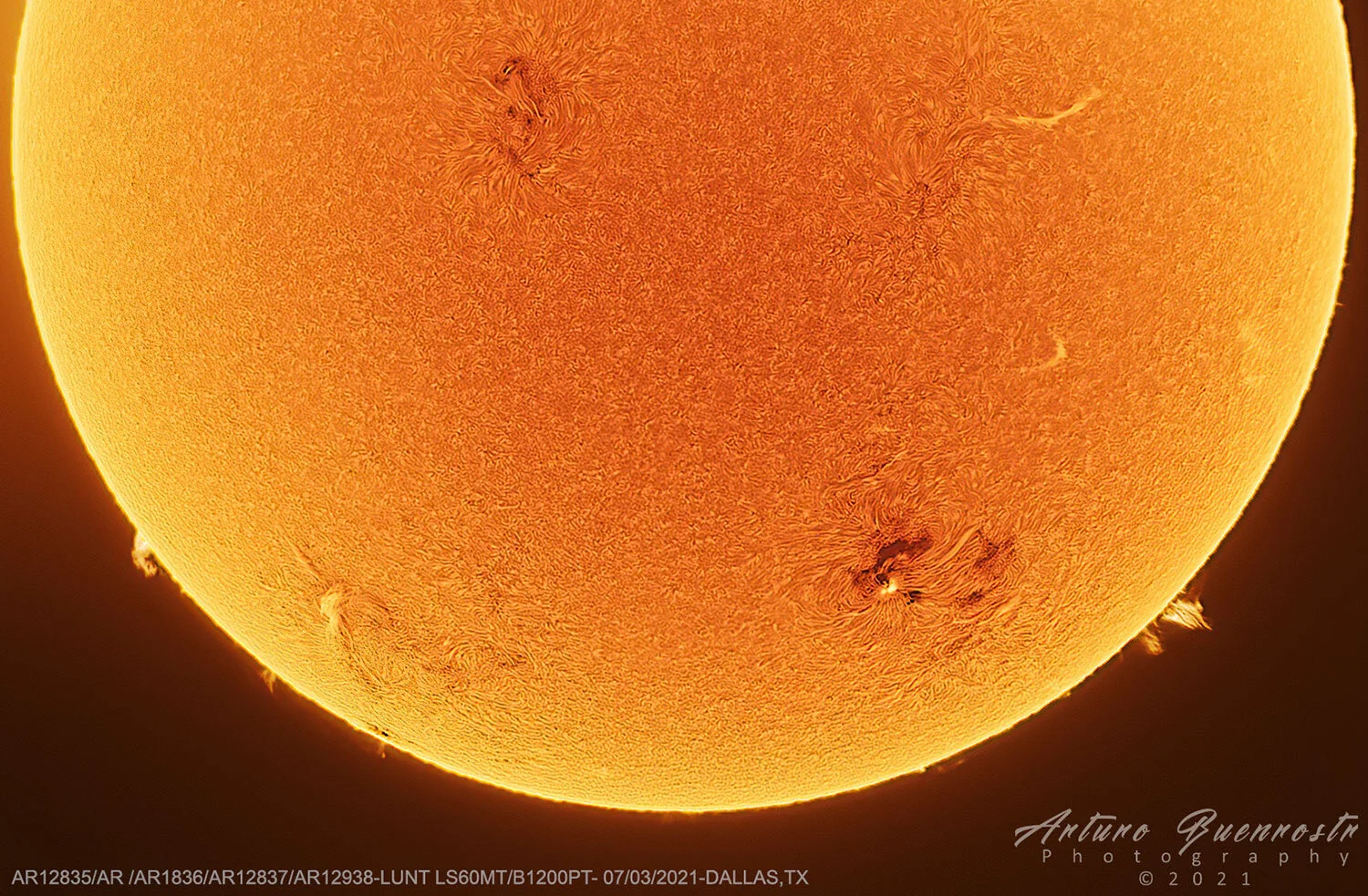
1 minute of Sun
Image Description and Details :
This is one of the most active days of the new solar cycle, weeks with clouds and I only had 5 minutes of sun, and of those minutes here it is in a single photo, one minute of its activity, impressive the details and the beauty that it gives us minute by minute the sun, each look through the telescope, is a new sun, we are going to continue enjoying this new solar cycle, and hopefully it will give us more landscapes like this, I hope you like it.
Mount Skywatcher azeq6.
Camera Zwo asi 178mm
Telescope Lunt 60MT/ B1200PT double stack
Capture Software Firecapture (60 second video recording, I chose 70% of the frames)
Dallas, Tx.
Copyright: Arturo Buenrostro
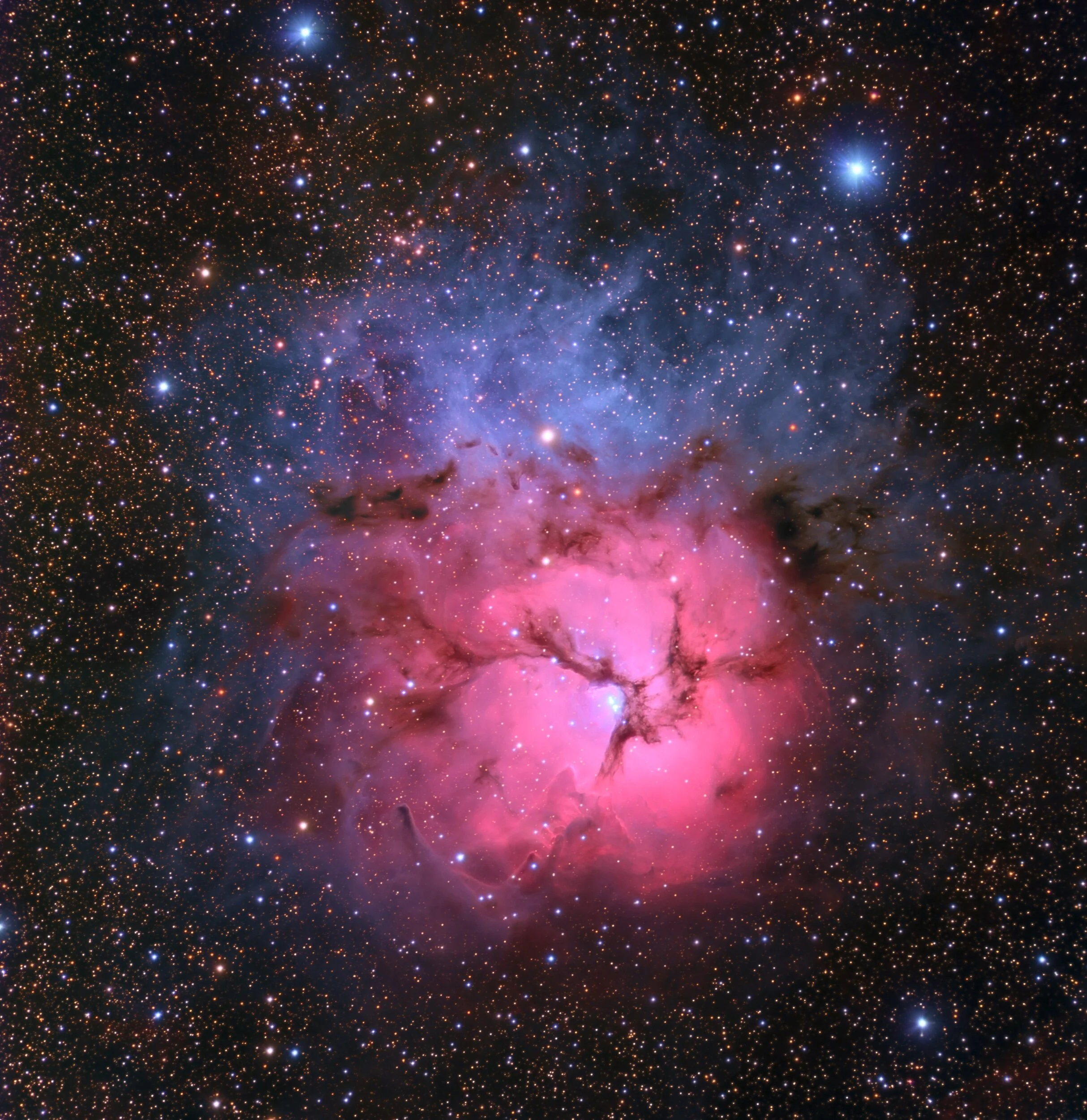
M20 - NGC 6514 - The Trifid Nebula
Image Description and Details :
This is my image of the wonderful and iconic Trifid Nebula. It is about 4100 ly away and is 42 ly across.My 0.54 degree x 0.54 degree field of view, beautifully accommodates it.Capture details:Dates; 2021-04-22 to 2021-05-18Lights: 24.5 hours integrationLum: 32 x 600 secsRed: 23 x 600 secsGreen: 22 x 600 secsBlue: 22 x 600 secsBias: 35Darks: 35Flats: 20 per colour channel per camera changeThere are some very bright foreground stars, which I decided not to reduce too much through Morphological Transformation, as compositionally I feel they add a lot to the image. My image scale and advantageous latitude, which means the object was at a good altitude throughout the imaging runs, plus generally decent seeing meant that good resolution of detail was possible. I was particularly pleased to resolve the stellar jet as imaged by the HST. This is a Herbog-Haro object numbered HH 399.
Copyright: Niall MacNeill

IC 1396
The object called IC 1396, also known as the Elephant Rüsselnebel, is located in the constellation Kepheus and consists of interstellar gas and dust.
The striking dark clouds of dust (globules) are areas where new stars arise. Due to high gravity, the gas is compressed further and further, so the cloud collapses. So-called protosters are emerging, which absorbs more and more gas and dust, until finally nuclear fusion begins and new stars are emerging.
The stars then make the surrounding gas shine.
A total of almost 14 hours of narrowband footage of hydrogen, sulfur and oxygen were taken and processed according to the Hubble color palette.
Hydrogen is green, oxygen is blue and sulphur is red.
This is how the different gases can be presented differently.
Here are some more dates:
- - Skywatcher Newton 200 / 1000
- - PROBABLY 1600 MM
- - Mount: Skywatcher EQ8-R
- - Filter: Ha, S2, O3
- - Guiding: MGEN 2 at Skywatcher Seeker
- - N.I.N.A., APP, Photoshop
- - 90 x 300 Sek (-15°C) - GAIN 139 (Ha)
- - 20 x 600 Sek (-15°C) - GAIN 139 (O3)
- - 35 x 300 Sek (-15°C) - GAIN 139 (S2)
- - Total exposure time: 14 hours
Copyright: Chris K. Fotografie

IC2948 - The Running Chicken Heart
Image Description and Details :
* Image acquisition by: Insight Observatory (Franck Jobard at Deep Sky Chile). * Image processing: Ruben Barbosa 12.5" f/9 Quasar Ritchey Chretien, SBIG STL11000, Losmandy Titan Frames: Ha: 80x600" (13h 20'), OIII: 73x600" (12h 10') This new image shows the Running Chicken Nebula, a cloud of gas and newborn stars that lies around 6500 light-years away from us in the constellation of Centaurus (The Centaur). Officially called IC 2944, or the Lambda Centauri Nebula, its strange nickname comes from the bird-like shape of its brightest region. The star Lambda Centauri itself lies just outside the field of view.
Copyright: Insight Observatory (Franck Jobard) and Ruben Barbosa

NGC 5078/5101
Image Description and Details :
Barred spiral NGC 5101 (top right) and nearly edge-on system NGC 5078 are separated on the sky by about 0.5 degrees or about the apparent width of a full moon. Found within the boundaries of the serpentine constellation Hydra, both are estimated to be around 90 million light-years away and similar in size to our own large Milky Way galaxy. In fact, if they both lie at the same distance their projected separation would be only 800,000 light-years or so. That's easily less than half the distance between the Milky Way and the Andromeda Galaxy. NGC 5078 is interacting with a smaller companion galaxy, cataloged as IC 879, seen just left of the larger galaxy's bright core. Even more distant background galaxies are scattered around the colorful field. Some are even visible right through the face-on disk of NGC 5101. But the prominent spiky stars are in the foreground, well within our own Milky Way.Location/Date – El Sauce, Chile, April 2021Imaging System – Planewave 17” CDK, 10 Micron GM3000, FLI ML16803 Chroma FiltersExposure – LRGB, 15.2 hoursProcessing – Pixinsight
Copyright: Casey Good/Greg Turgeon

NGC 6914 & Propeller Nebula
Image Description and Details :
A cropped & rotated rendition of my 1st attempt of this area. I made more effort to control the stars to better show the nebulosity. NGC 6914 & Propeller Nebula are perhaps the better known targets within the image.The Sadr Region (also known as IC 1318 or the Gamma Cygni Nebula) is the diffuse emission nebula surrounding Sadr (γ Cygni) at the centre of Cygnus's cross. The Sadr Region is one of the surrounding nebulous regions; others include the Butterfly Nebula and the Crescent Nebula (not shown in this image). It contains many dark nebulae in addition to emission diffuse nebulae.Imaging telescope: Takahashi FSQ130EDImaging cameras: FLI ML16200Mounts: Takahashi EM 400 Temma 2Guiding cameras: QHY CCD QHY 5 IIFocal Extender / Reducer: Tak QE 0.73x Software: PHD 2, Astro Pixel Processer, PixInsight , Sequence Generator Pro SGPFilters: Astrodon SII, Ha & OIIIAccessories: ATIK EFW3Original Resolution: 4473 x 3578Dates: Jun 10 - Jun 21, 2021Frames:Astrodon Ha: 36 x 600"Astrodon SII: 30 x 600"Astrodon OIII: 30 x 600"Integration: 16 Hours.
Copyright: Brendan Kinch
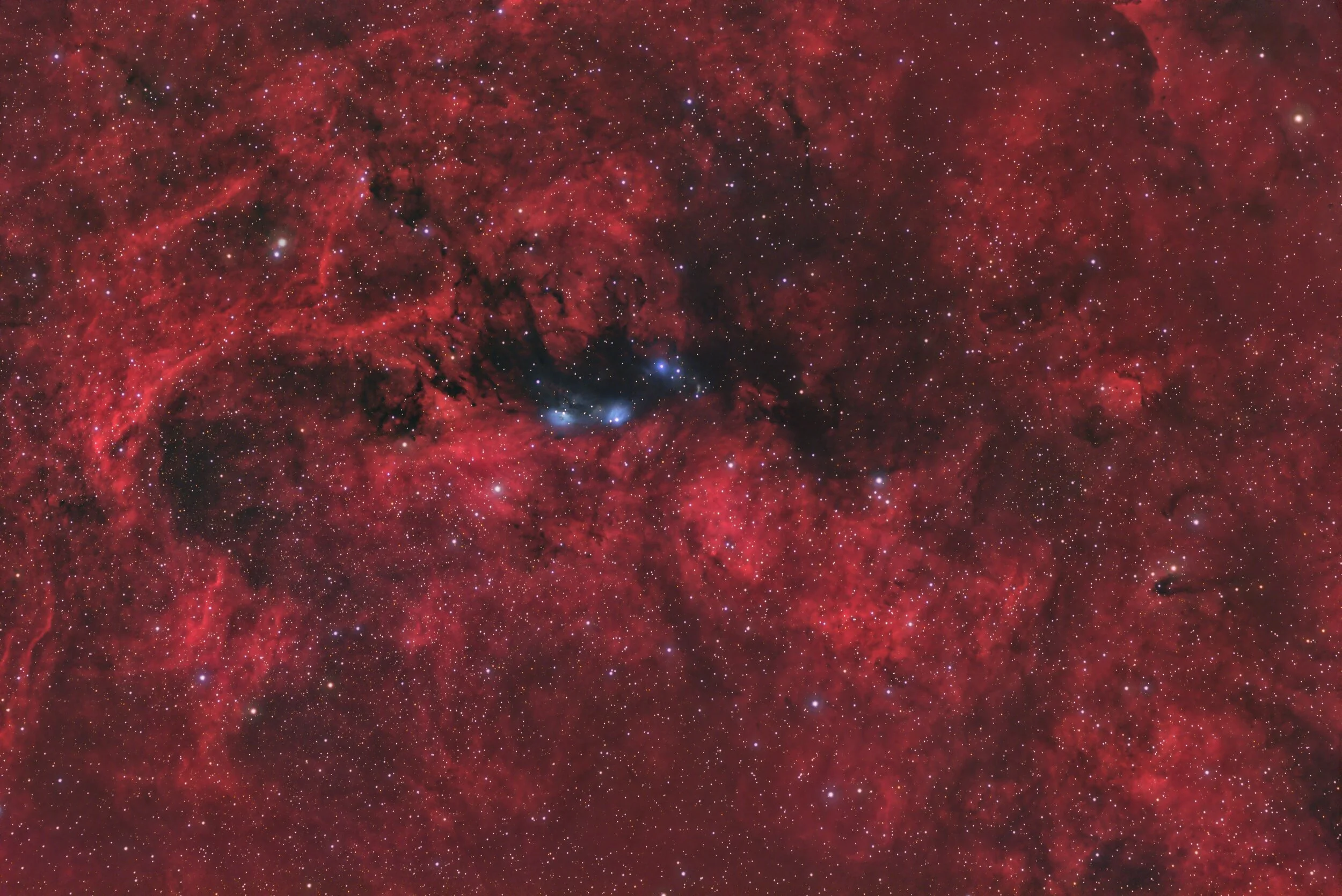
NGC 6914
Image Description and Details :
NGC 6914 itself is the blue reflection nebula near center. It's surrounded by a wonderful field of glowing gas and dust. Located at approximately 6,000 light-years away in the constellation of Cygnus. Imaged from my backyard in Kitchener, Ontario, Canada. This is 8.5 hours of HaRGB data.
Taken with the Esprit 100 triplet refractor, QHY268M camera and Optolong filters. Processing was done in PixInsight.
Copyright: Shawn Nielsen

Dust around LDN1235
Image Description and Details :
The goal of the image was to go deep enough to show the underlaying dust around this already faint target. Multiple processing techniques were needed to be developed in order to be able to pull out the details on the faintest areas.
Telescope: Borg 101ED f/4
Camera: QHYCCD 163M
Mount: SkyWatcher HEQ 5 Rowan Belt Mod
Exposures:
Optolong B 36mm: 44x300" (3h 40') (gain: 174.00) -10C bin 1x1
Optolong G 36mm: 44x300" (3h 40') (gain: 174.00) -10C bin 1x1
Optolong L 36mm: 163x300" (13h 35') (gain: 174.00) -10C bin 1x1
Optolong R 36mm: 48x300" (4h) (gain: 174.00) -10C bin 1x1
Integration Time: 24h 55m
Copyright: Alberto Ibañez
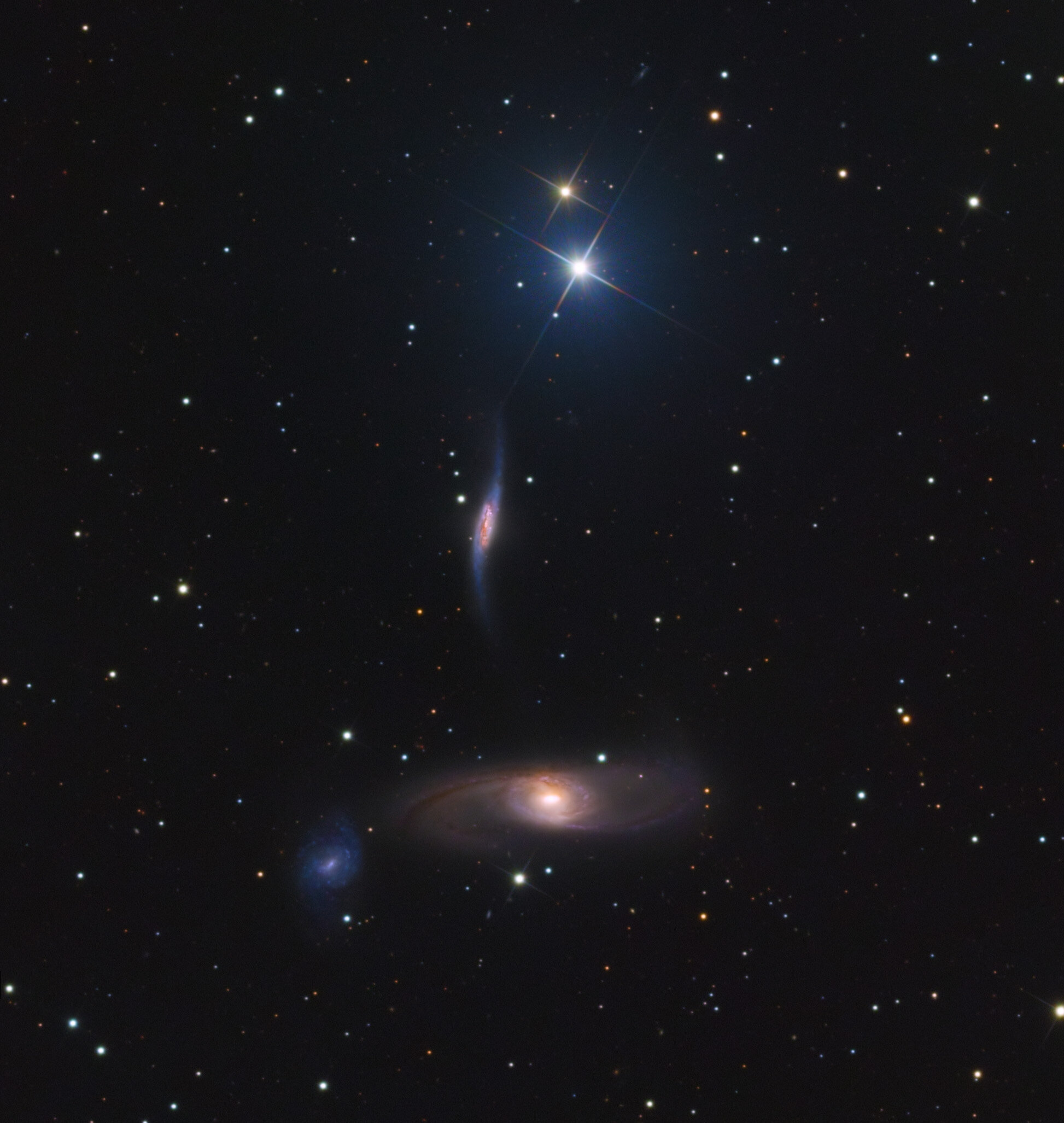

Monkey Head Nebula
A true winter target, not exactly fitting for Summer solstice, today it’s the longest day of the year.
However it’s about time to finish with my last winter images, to make room for the summer nebulae to come, so here it is.
And although the data was gathering digital dust, is was a lot of fun to process in the end, lots of tiny details and vibrant colors.
The Monkey Head Nebula, NGC 2174, is a HII emission nebula in the constellation of Orion. It’s guesstimated to be located at a distance of 6,400 light-years from earth.
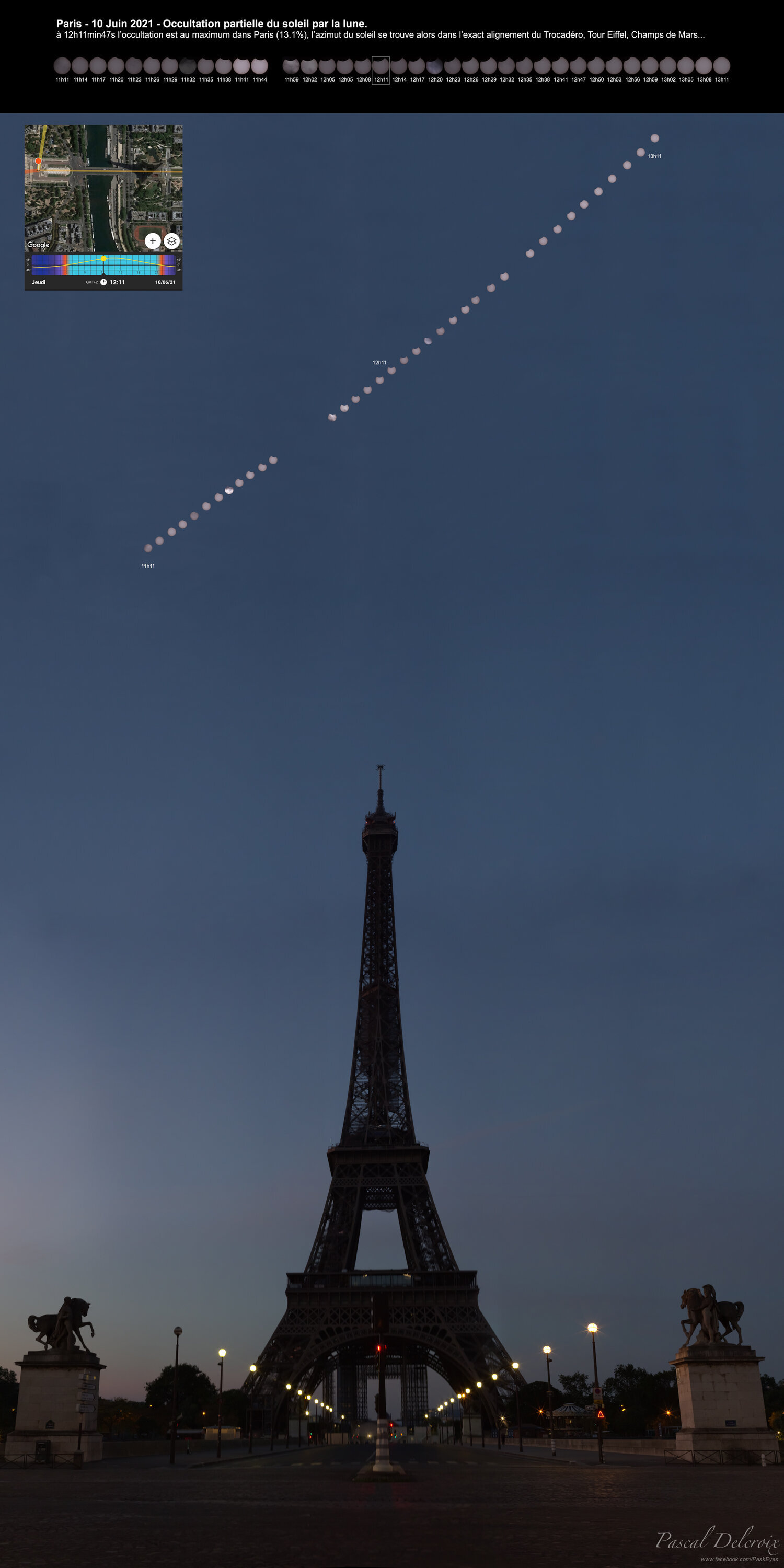
Solar Occultation over Paris with remarkable alignment
Solar occultation on June the 10th, it was very partial in Paris (13%) but I wanted to make that moment unique by looking for a remarkable spot and an ideal frame...
I wanted this photo to be the most scientifically rigorous possible. This is why it need to be mentioned that the shooting is the real one with the exact size and position of the sun over this panorama. I also took the decision to not add false images of the sun to fill the two empty spaces where the sun was fully covered by clouds in Paris.
Few words on the photo : The attached picture is a resized version of 4096pxl to make it transferable, the original photo is about 21000 pixels height for about 1Go (tiff/zip).
Sun was shot with a 200mm lens & solar filter, the background scene shot just before sunrise with a 24mm and also shot with 100mm with 16pictures in panoramic mode (improving resolution). All the course of the sun was also shot with a parallel second DSLR synchronized
Copyright: Pascal Delcroix

Noctilucent clouds over the 45th parallel
Noctilucent clouds over the 45th parallel
This image was taken a few minutes ago from Charente, France. It's the first time I see noctilucent clouds going as high in the sky from where I live. They were covering the sky from the horizon to around an altitude of 70 degrees. As soon as the Sun was continuing its course below the horizon, the clouds at the South East were disappearing, as the ones at the North were becoming more and more visible. In my mind, the image of those subtle draperies will stay forever. Single shot taken with a Canon 6D and a 70-200 2.8 on a tripod.
Copyright: Rémi Boucher-Meunier

NGC 3576
NGC 3576
NGC 3576 is a bright emission nebula, whose popular nickname is "The Statue of Liberty Nebula" because of the distinctive shape in the middle of the nebula. It is approximately 100 light years across and 9000 light-years away from Earth and is located in the Sagittarius arm of our galaxy and a few thousand light-years away from the Eta Carinae nebula. Within the nebula, episodes of star formation are thought to contribute to the complex and suggestive shapes. Powerful winds from the nebula's embedded, young, massive stars shape the looping filaments. It was discovered by William Herschel on 16 March 1834 and the name was first suggested in 2009 by Dr. Steve Mazlin, a member of Star Shadows Remote Observatory (SSRO).
7 hrs each of SHO filters and 30mins each of RGB filters for stars replacement.
Processed in Pixinsight with a final flourish in Photoshop
Copyright: Vikas Chander

Fun with spectroscopy
Image Details:
This image is a comparison of a range of spectra taken of 31 naked eye stars visible from the Southern hemisphere. Spectra were taken with a StarAnalyzer diffraction grating mounted in the filter wheel of my CCD camera on a 12.5" Newtonian telescope. Each spectrum was processed using RSpec software and calibrated for instrument response. The resulting spectra show the black body radiation profile of the various stellar types and their typical spectral line features.The star spectra are ordered according to stellar type, with hot blue stars at the top and cooler red stars towards the bottom. Hot blue stars (O, B, A types) have a light profile heavily skewed towards the left (blue and violet) end of the spectrum given these stars emit the majority of their energy at short wavelengths. They also display the famous Hydrogen Balmer series of absorption lines.In the centre are the F, G and K type stars with their more even light profiles and numerous but fainter absorption lines.Towards the bottom are the cooler M type stars with profiles heavily skewed towards the red and infrared end of the spectrum. They show many broad absorption lines from Titanium Oxide molecules suspended in their atmospheres.At the very bottom are two examples of Wolf-Rayet stars that have unusual spectra with some prominent emission lines.Also visible are a couple of absorption lines in the red, which appear in every single spectrum regardless of spectral type. These are caused by terrestrial oxygen in the Earth's atmosphere.The background image is my deep photo of cometary globules CG 30, CG 31 and CG 38 in Puppis.Date: 29 May, 1 June 2021Exposure: Luminance 0.03s - 3s @ -25CTelescope: Homebuilt 12.5" f/4 Serrurier Truss NewtonianCamera: QSI 683wsg with Lodestar guiderFilters: StarAnalyzer 200 Diffraction GratingTaken from my observatory in Auckland, New Zealand See Less
Copyright: Rolf Olsen

SH2-129 & Ou4
Image Description and Details :
Today I want to show you my most elaborate DeepSky object. And that is SH2-129 & Ou4The Bat and Squid Nebula in the constellation of Cepheus.Ou4 is also called "the flying bat and giant squid nebula". This is the penis-like shape with the special blue-green emissions of double-ionized oxygen atoms. The squid nebula was discovered in 2011 by the French astrophotographer Nicolas Outters and is very faint.Therefore, I took all pictures with a new moon as possible.The entire field is approx. 3 degrees or 6 full moons wide! As a result, I had to make a 4-part mosaic with 6 "f / 4 Newton at 600 mm focal length. So actually a huge object in the night sky.The image processing was then again a challenge. Above all, a picture that was as natural as possible with the "right" colors was important to me. I also like star colors ---------------------------------------------Recording dates: Location: Upper AustriaRecording date: May to June 2021Distance: 2300 light yearsDiameter: 50 light yearsExposure: 122 x 300 sec. For RGB151 x 900 sec. With dual narrowbandTotal: 48 hours Calibration: Darks / Flats / DarkFlatsMount: Skywatcher EQ6-R PROTelescope: TS 6 ″ Newton Carbon 150/600Corrector: Lacerta GPU coma correctorFilters: Astronomik L2 UV-IR Block 2 ″ and Optolong Filter L-eXtreme 2 ″Camera: QHY268c @ Gain 0 at -15 ° CGuiding: ZWO OAG with QHY5III462c and PHD2Heaven: Mag. 21.67Software: APP / Photoshop CC / NHF-sharpen
Copyright: Daniel Nimmervoll
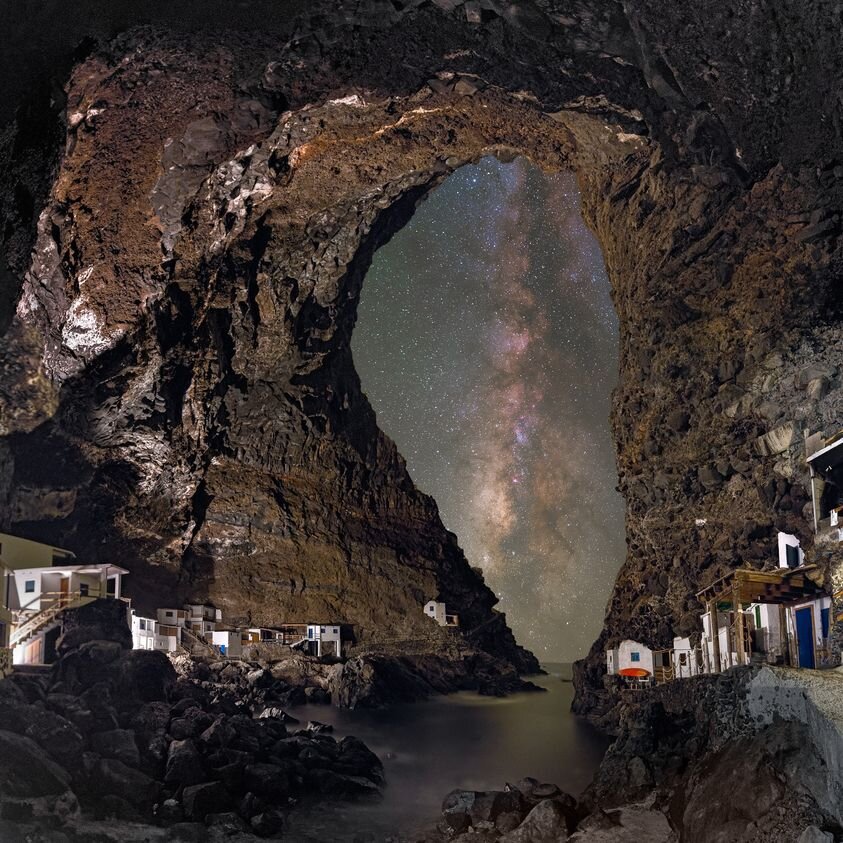
The Smuggler's Cave
Image Description:
What is the creepiest place you ever shot at? For me, it definitely is this cave village which I visited during this year's summer astrophotography trip to the Canary Islands with my buddy Benjamin Barakat
The place was pretty well populated while we scouted it in the afternoon, but it was completely deserted when we arrived in the middle of the night to capture it with the early morning Milky Way.
As we exited out of our car, we were engulfed by pitch black night. Spooky shadows were flying around us, giving off eerie cries. Some sounded like crying babies, while others resembled the coughing of chain smoker with a terrible hangover.
After overcoming our initial shock, we pointed our flashlights into the sky and saw that the shadows were big birds. They did not seem to like our lights though and flew so close to our heads that we felt the flapping of their wings. We quickly dimmed our lights and headed down the trail to the cave. After some research the other day, I found that the birds are relatives of the Albatross, called Cory's Shearwater.
Fortunately, the birds did not follow us into the cave. We set up our cameras and took some test shots. I was completely stunned by how dark the place was. In a three minute exposure at ISO 12'800, only the sky outside the cave confirmed that I had not forgotten to remove my lens cap.
Time to dodge the eerie birds once more. I hiked back to our car to get my low level lights, while my buddy Benjamin found an excuse to wait in the safety of the cave.
Lighting up the place proved to be a tricky task, but after some tinkering with my lights, I found an satisfactory solution and we were finally able to do something productive.
EXIF
Canon EOS Ra
Tamron 15-30mm f/2.8
iOptron SkyTracker Pro
Low Level Lighting
Sky:
Stack of 5 x 60s @ ISO1600
Foreground:
Panorama of 4 panels, each a stack of 5 x 120s @ ISO6400
Copyright: Ralf Rohner