

AAPOD2 Image Archives
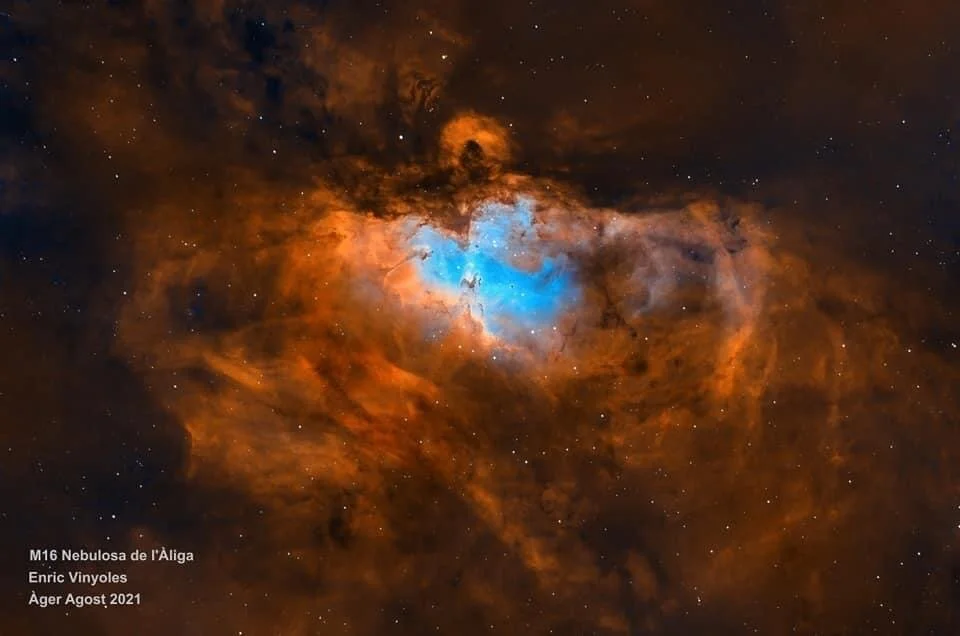
M16 “Eagle Nebula”
M16 from Àger, Lleida. 14 hours in total. 84 x300s Ha 40 x300s OIII 32 x300s SII 30 x60s R, G i B. TS81 telescope camera QHY183M processed at Pixinsight
Copyright: Enric Vinyoles Nicolau

WR-134
WR 134 is a Wolf-Rayet star in Cygnus which is around 6,000 light years distant. It shines at 400,000 times the luminosity of the sun. Intense radiation and stellar winds have created a bubble of gas around the star. In this image the bubble is seen in blue/green doubly ionized oxygen (OIII) light. A large amount of hydrogen (HII) emission is also displayed as the red areas. The star responsible for this is near the center of the bubble and is whiteish. The image was taken with my #Stellarvue SVX 152T refractor and #zwoasi 6200 camera through RGB and HII/OIII filters. The image combines a bit over 47 hours of exposure time. Automation was controlled with a #primalucelab Eagle 4 pro and Voyager Astrophotography Automation software. The image is cropped and rotated for a pleasing view.
COPYRIGHT: Jon Talbot

Venus
Venus images taken on August 15 and 19, 2021. A 1 micron filter has been used.
Very interesting results to be the image of august 19, showing a vertical structure from the southern region.
The false color images are shown only for aesthetic reasons.
Setup:C14 Edge HD, Fornax52 Mountain, ASI 290mono, Barlow Zeiss, IR1000nm
COPYRIGHT: Luigi Morrone
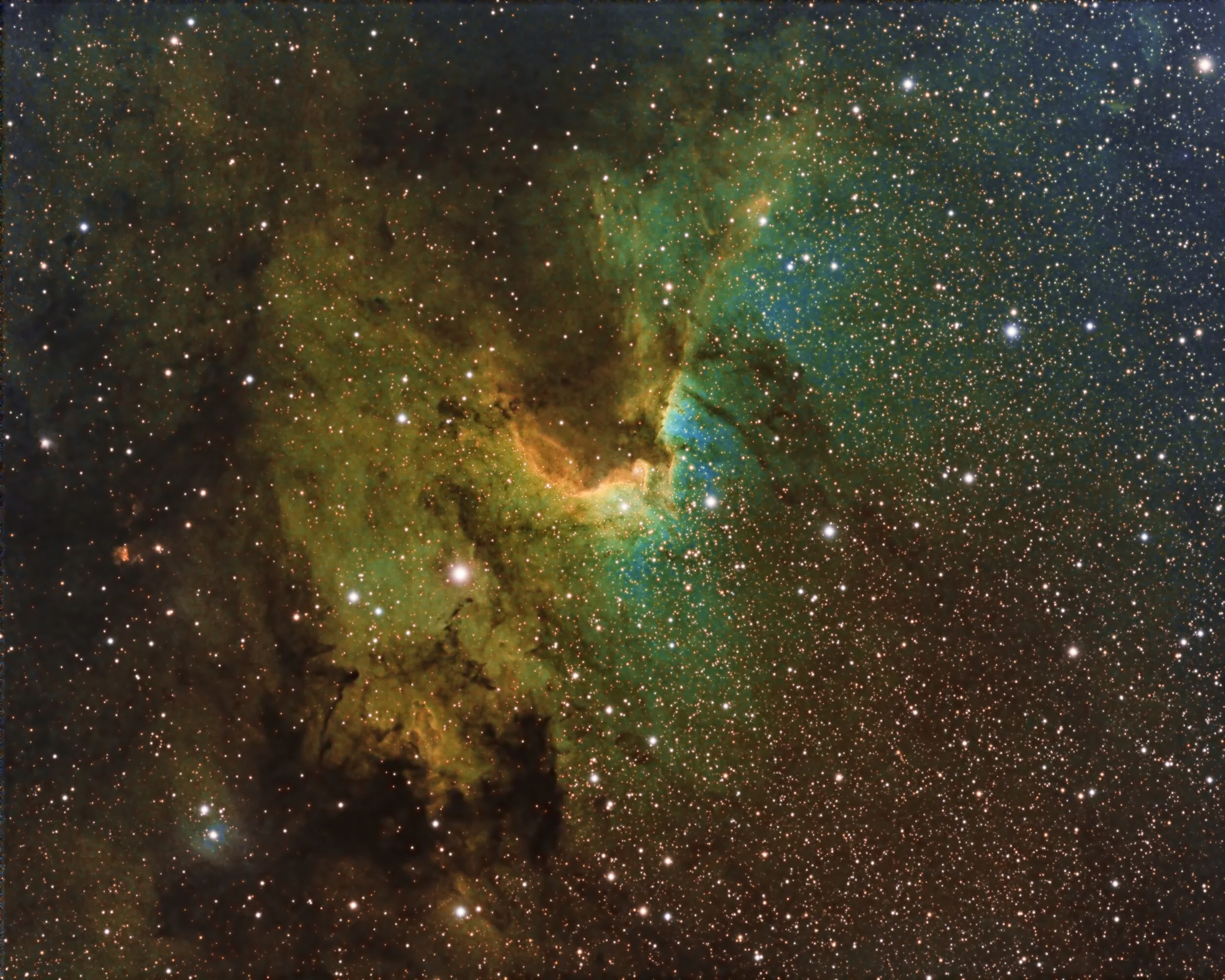
Sh2-155 “The Cave Nebula”
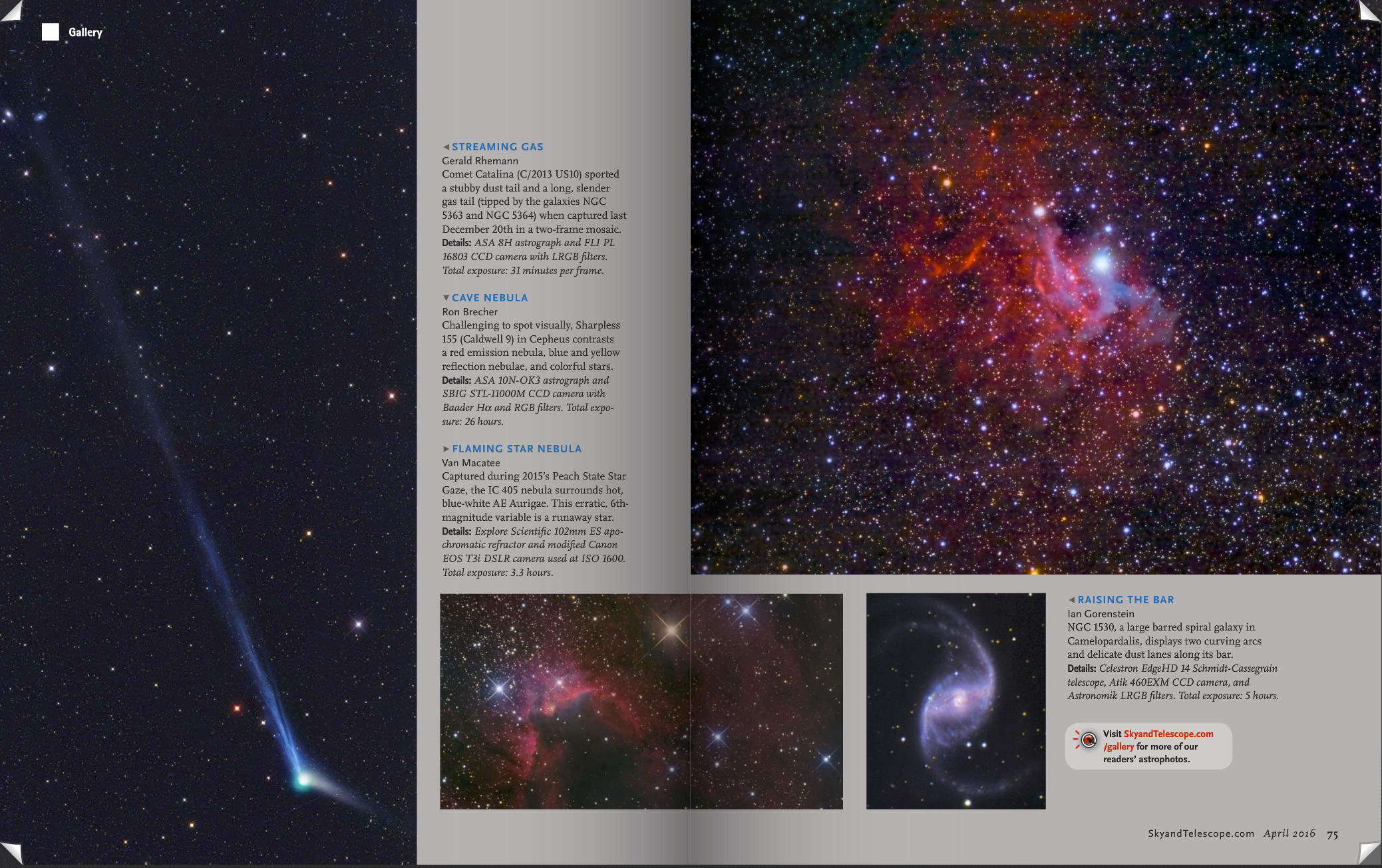
The Cave Nebula lies in the constellation Cepheus about 2,400 light years away, pretty close in cosmic terms. The “cave” has a bright rim ionized by the hot blue-white stars in the vicinity. The main “cave” structure is 10 light years across and is catalogued as Sharpless 155 (Sh2-155) and also as Caldwell 9 (the Caldwell catalogue was compiled by Sir Patrick Moore, and named for his mother’s maiden name). Near the lower left corner of the image is a blue reflection nebula, vdB 155. The Cave Nebula region makes a nice natural colour image, highlighting red emission nebula, blue reflection nebulae, dark nebulae and many colourful stars. I’ve also imaged the Cave Nebula before at higher resolution; that image was publishedin the April 2016 issue of Sky and Telescope.
Tekkies:
Acquisition, focusing, and control of Paramount MXmount, with TheSkyX. Focus with Optec DirectSync motor and controller. Unguided. Automation with CCDCommander. Equipment control with PrimaLuce Labs Eagle 3 Pro computer. All pre-processing and processing in PixInsight. Acquired from my SkyShed in Guelph. Average transparency and seeing. Data acquired March 2-14, 2021 in a mostly moonless sky.
Sky-Watcher Esprit 150 f/7 refractor and QHY 16200-Acamera with Optolong H-alpha, O(III) and S(II) filters
Ha: 49 x 10m = 8hr10m
O3: 47 x 10m = 7hr50m
S2: 45 x 10m = 7hr30m
Total: 23hr30m
Copyright: Ron Brecher

Orion’s Belt
The Belt of Orion or the Belt of Orion is an asterism in the constellation Orion. It contains three bright stars Alnitak, Alnilam and Mintaka.
The Orion Belt is easy to find in the night sky, as it is located on the celestial equator and is part of one of the most prominent stellar patterns in the northern sky, the hourglass-shaped constellation Orion. The asterism and constellation are visible in the northern latitudes from November to February.
This is an image made with an Epsilon 180 ed telescope, on an Atlas mount, Orion, PHP guidance system and a Canon EOS Ra camera.
Data acquisition is 120 images of 60 seconds, plus Bias, Darks and Flats.
Copyright: Cesar Cantu

SNR G 116.9 +00.1
mage Description and Details : I present to you an exotic object that was initially discovered as a planetary nebula but was requalified as a supernova afterglow that occurred over 7,500 years ago.
Located about 10,000 light years from home towards the Cassiopeia constellation, these are the filamentary remnants of a supernova that have a shell shape, part of which is doubly ionized oxygen (in blue) while the rest (in red) is essentially ionized hydrogen.
Technical details :
- Apo Takahashi FSQ 85 at F/D 5.3
- iOptron 60 cem ec mount
- Asi 2600 mm pro
- 6nm astronomik filters
- Acquisition sampling: 1.7 arcsec
- 92 x 600s HA i.e. 15 h 20 min
- 181 x 600s O3 i.e. 30 h 10 min
- 3 x 30 x 60s RGB i.e. 1 h 30 min
- Total integration: 47 h
- DOF: 31/149/25
- Date: August 2021
- Location: HAO4 observatory of Oukaimeden, Morocco.
Copyright: Aziz.K
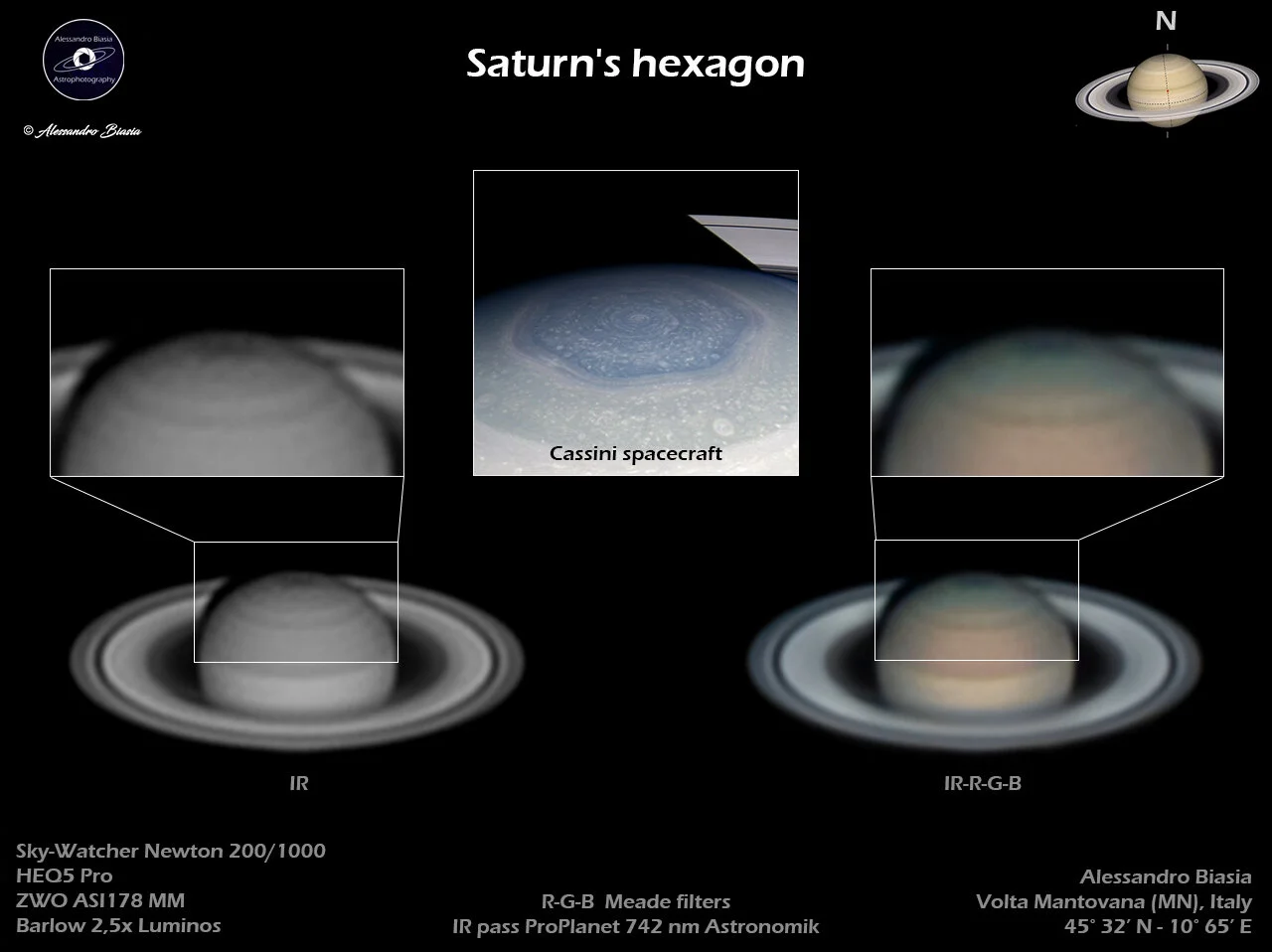
Saturn's Hexagon
Image Description and Details :
Volta Mantovana (MN) - Italy
45°32' N - 10°65' E
05.09.2020
UTC 9:42 pm
Sky-Watcher 200/1000
HEQ5 Pro SynScan
ZWO ASI178 MM
Barlow 2,5x Luminos
IR pass ProPlanet 742 nm Astronomik
R-G-B Meade filters
Copyright: Alessandro Biasia
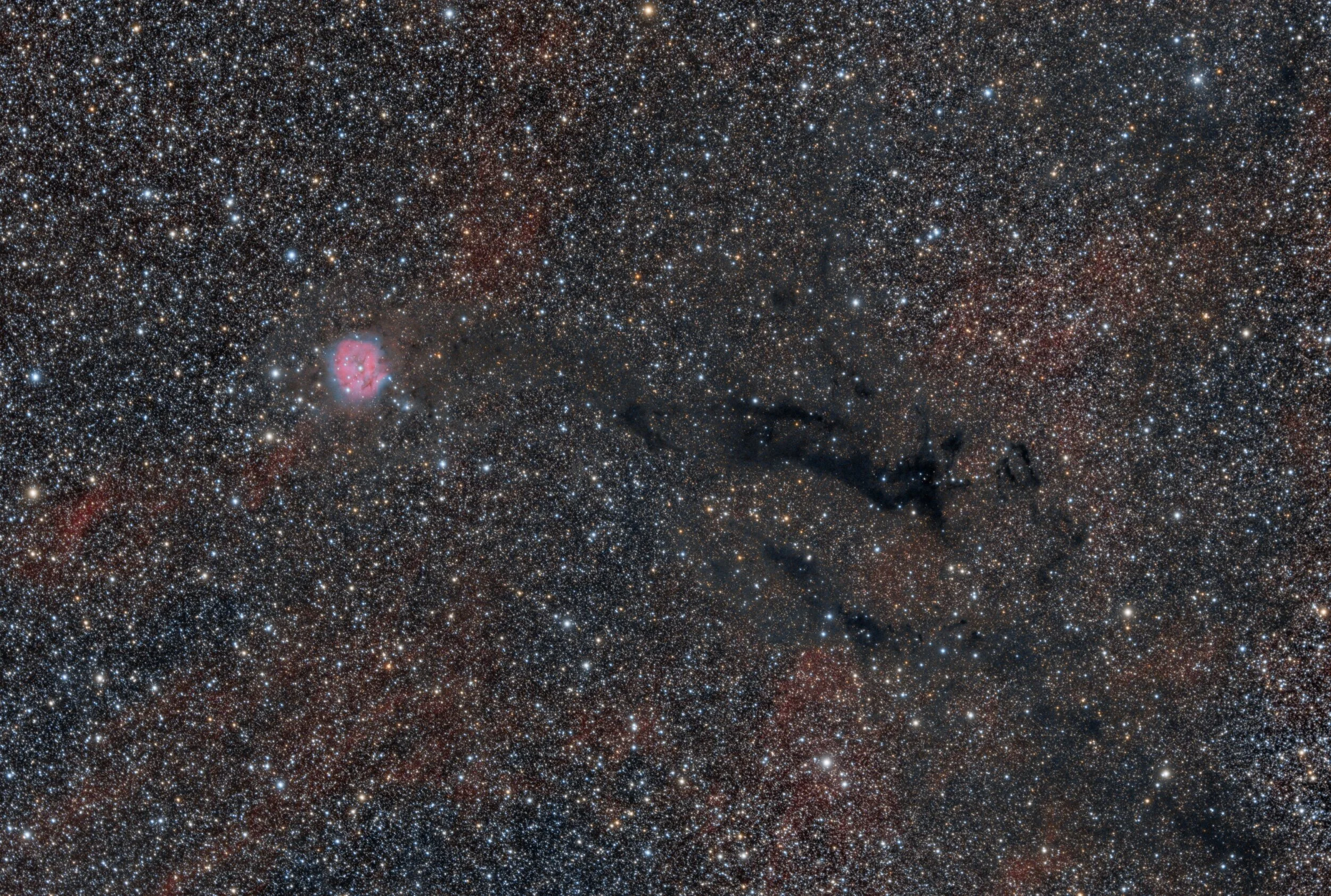
IC514 - The Cocoon Nebula with Lynds LDN1042 Dark Nebula, LDN1035
Imaging telescopes or lenses: TS-Optics 76EDPH
Imaging cameras: ZWO ASI2600MC Pro
Mounts: SkyWatcher AZEQ6 GT
Guiding telescopes or lenses: TS-Optics 76EDPH
Guiding cameras: ZWO ASI 224MC
Software: Adobe Inc Photoshop CC · Pleiades Astrophoto PinInsight 1.8.8-5 (64)
Filters: Optlong L-eXtreme 2" · Hutech NGS1 2''
Dates:Aug. 12, 2021 , Aug. 14, 2021
Frames:
Hutech NGS1 2'': 100x180" (5h) (gain: 100.00) -10C
Optlong L-eXtreme 2": 33x300" (2h 45') (gain: 100.00) -15C
Integration: 7h 45'
Avg. Moon age: 5.09 days
Avg. Moon phase: 27.20%
Temperature: 10.00
Copyright: Arnaud Couillard
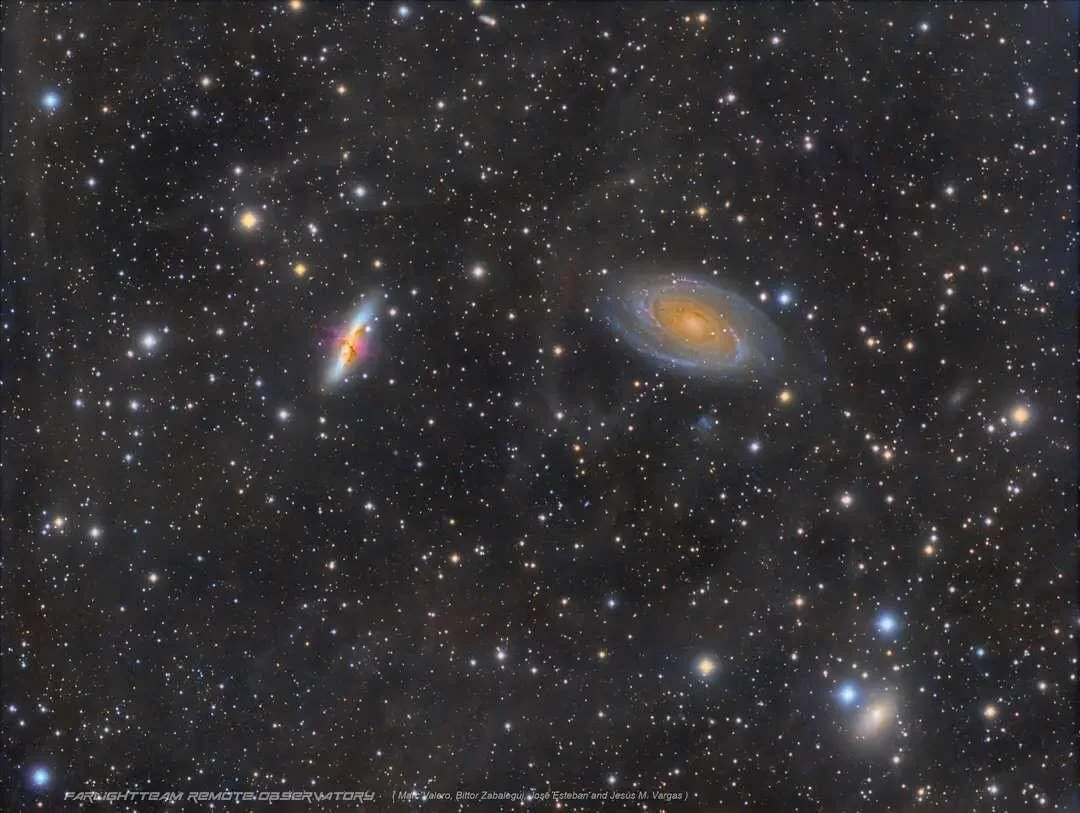
M81 & M82
Well, a first version has already been made with the IFN (Integrated Flux Nebula) processing, clouds of cosmic dust located between the galaxies, specifically this is intergalactic dust that in the background give a somewhat dirty appearance to the image, but they are that, cosmic dust from space, composed of particles smaller than 100 µm.
OBSERVATORY REMOTE FARLIGHTTEAM:
Takahashi FSQ-106 f/5 530mm
CCD QSI 683ws8
Mount 10 Micron 1000
Rotator Pegasus-MGPBox-PowerBox-Armadillo Focuser - Lunatic Zerodew
Voyager software - MountWizar - PixInsight - Adobe PS
Luminance 90 shots of 900 (22`5 hours)
Halfa 56 shots of 900 (14 hours)
Halfa 16 takes of 1200 (5 and a half hours)
RGB 12 shots for each 600 channel (2 hours for each channel in RGB)
Total 48 hours of lights
Darks 60 x900 "+ 60x1200" + 60x600 "
Bias 202
Flats 60xL + 60xHa + 60xR + 60xG + 60xB
Copyright: Jesus Vargas, Marc Valero, Bittor Zabalegui, and José Esteban
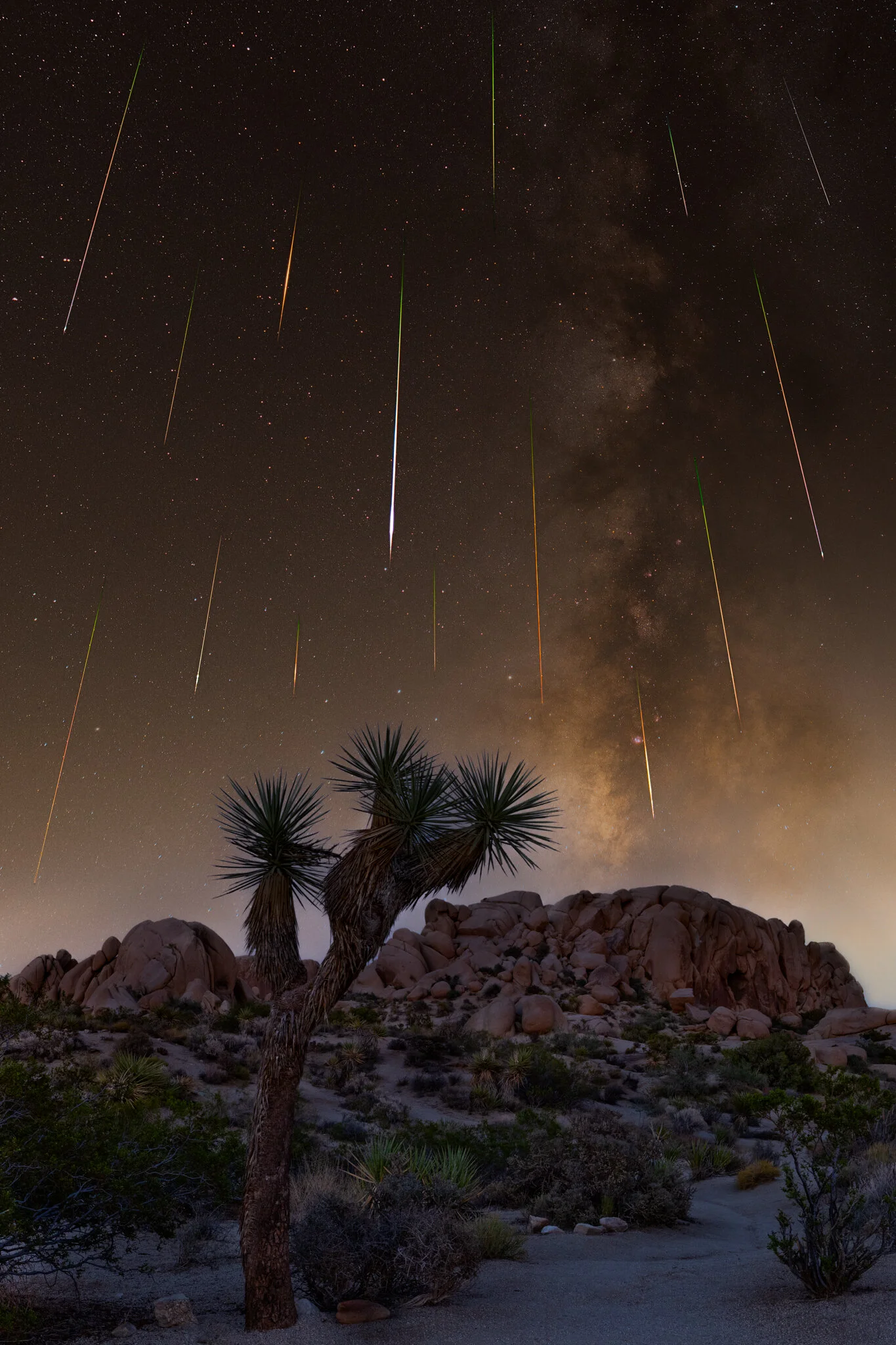
Celestial Fireworks
Image Description and Details : Perseids Meteor Shower is probably the most beautiful of all, because of the Milky Way aligning in south-west direction during this time of the year. This is exactly opposite to the radiant point of these meteors (Perseus Constellation) which is in the north-east sky, and hence the opportunity to see meteors flying over the Milky Way's galactic center! This is a stack of images collected over the nights of August 11th and 12th at Joshua Tree National Park. The lone Joshua Tree in front of the park's Jumbo Rocks area gave me a gorgeous foreground, thanks to Google Maps and an hour of scouting. Although my camera captured only 14 meteors along with a huge Fireball, we could see many more meteors outside the lens' field of view with our naked eyes and every single meteor had people shouting in joy.
The past few months and years have clearly shown the devastating effects of climate change and to add to the long list of consequences, the California wildfires from Climate Change also meant smoky skies for most of the northern part. Clear skies may not be on top of the priority list, but this would mean we can no longer preserve the natural beauty of night sky, thereby affecting the millions of animals and plants that need clear skies to survive at night. It's imperative that we all act immediately with small steps and preserve what nature has created for us having endured a multitude of external factors. Dedicating this post to the brave firefighters @calfire who have been battling to contain one of the biggest wildfires in recent history.
EXIF:
Foreground: Shot under blue-hour, Nikon D850, Sigma 20 mm f1.4 @f9, ISO 400, 60 secs exposure.
Sky: Tracked Milky Way shot at f1.8, ISO 800, 60 seconds exposure
Meteors: Timelapse shots at f1.8, ISO 800, 10 seconds exposure
Copyright: Arjun Raju
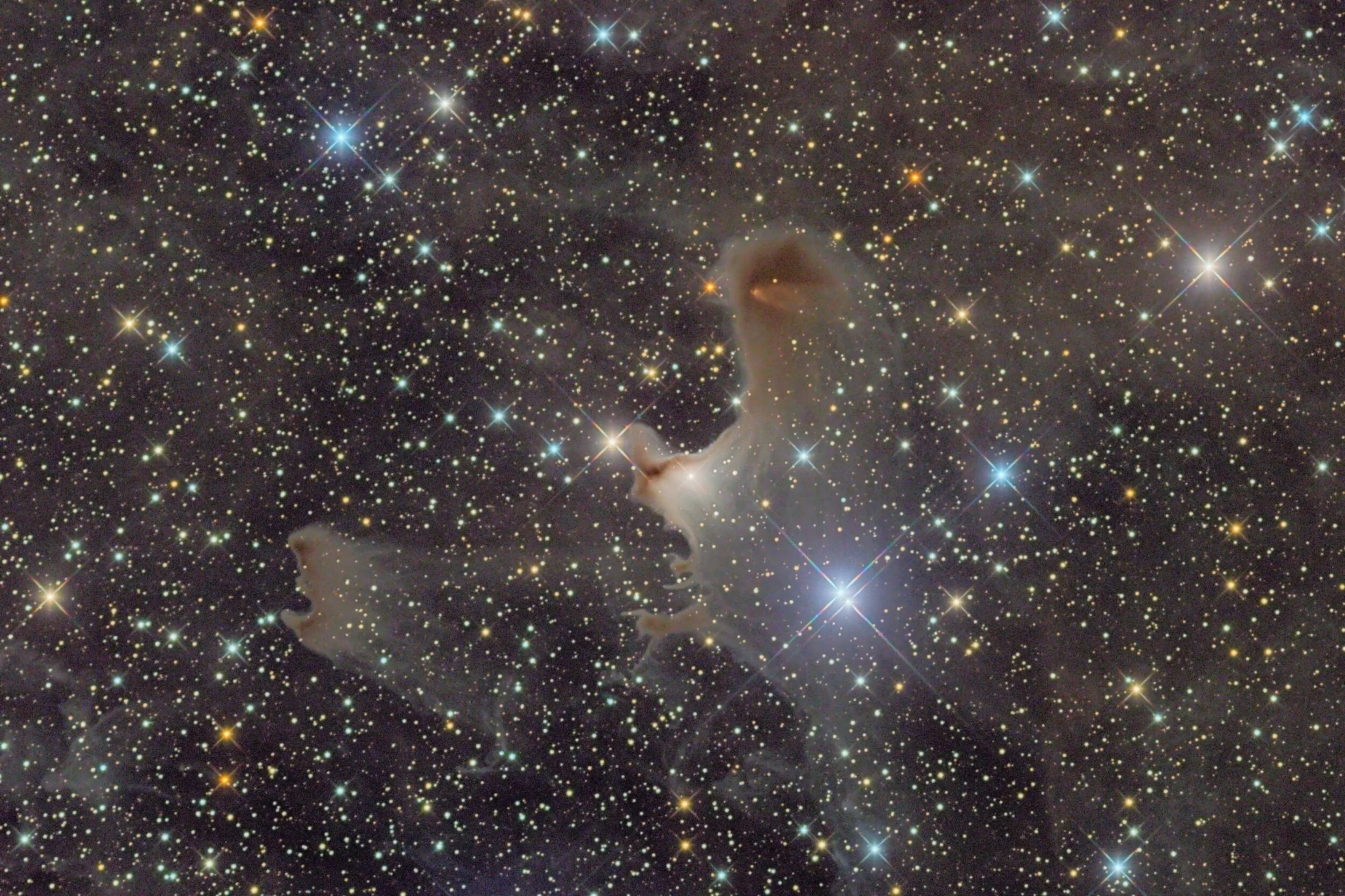
vdB141 - The ghost Nebula in Cepheus
Image Description and Details : Telescope: Artec250 Newtonian f/4 Astrograph
Imaging camera: QSI683 @-30°C
Guiding camera: Lodestar
Corrector: Televue Paracorr 2''
Mount: iOptron CEM120 EC
Acquisition software: Voyager
Astrodon Gen2 filter set
L =27x900s (bin1)
R = 8x1200s (bin1)
G = 9x1200s (bin1)
B = 9x1200s (bin1)
Processed in PixInsight 1.8
Copyright: Flavio Simeone
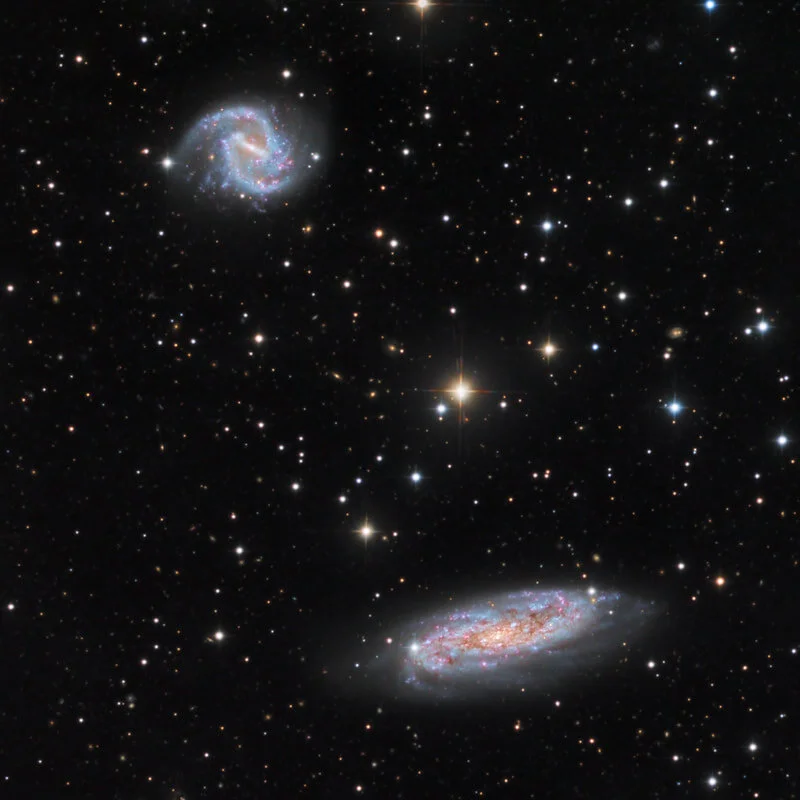
NGC 3511
Image description
Ngc3511 is an intermediate spiral galaxy located 45,000,000 light-years away in the southern constellation of Crater. Appearing at lower-right, it was discovered in 1786 by William Herschel, and is about 70,000 light-years across. At upper-left is the face-on SBc spiral, NGC 3513, gravitationally related to 3511.
Many thanks to my collaborator and friend, Mike Selby, who acquired and calibrated this fine data from Observatorio El Sauce, Chile. I dedicate this image to fellow astrophotographer and friend, Rogelio Bernal Andreo, on the passing of his beloved wife, Ariana. May she go among the imperishable stars!
Copyright: Warren Keller
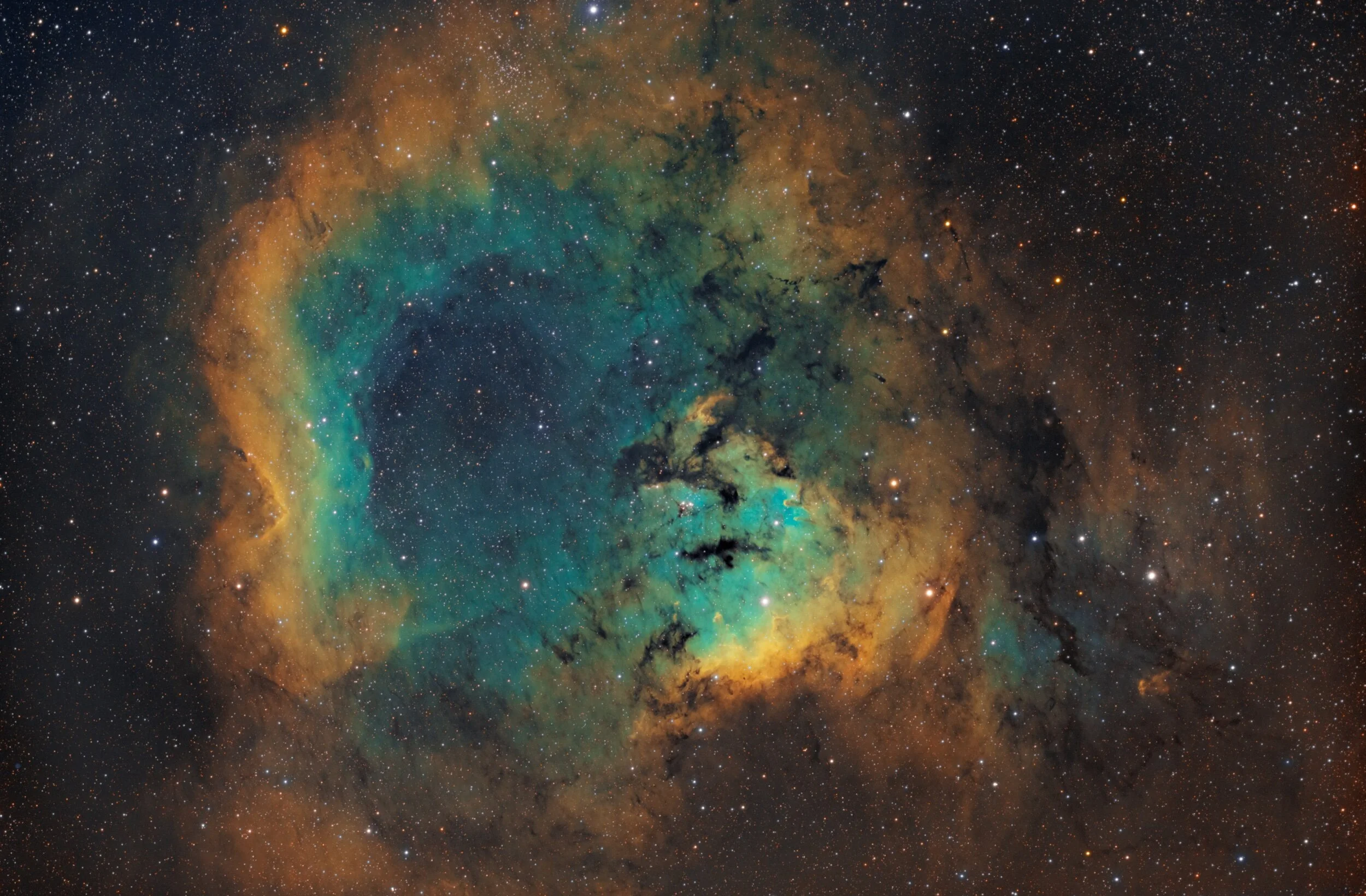
NGC7822 SHO
Image Description and Details :
NGC 7822 is a young star forming complex in the constellation of Cepheus. The complex encompasses the emission region designated Sharpless 171, and the young cluster of stars named Berkeley 59. The complex is believed to be some 800–1000 pc distant, with the younger components aged no more than a few million years. The complex also includes one of the hottest stars discovered within 1 kpc of the Sun, namely BD+66 1673, which is an eclipsing binary system consisting of an O5V that exhibits a surface temperature of nearly 45,000 K and a luminosity about 100,000 times that of the Sun. The star is one of the primary sources illuminating the nebula and shaping the complex's famed pillars of creation-type formations, the elephant trunks.
Détails acquisitions :
HA 105 x 300s
O3 60 x 300s
S2 63 x 300s
soit 19H total
ave la lunette askar400 + red
camera asi264MM
monture ioptron CEM120
Traitement Pixinsight et Photoshop
Copyright: Lamagat Frédéric

Perseids over a 17th century monastery
Image Description and Details :
The image is of the Hanle Monastery under Bortle 1 skies and the Perseids. Hanle monastery is a 17th century gompa of the Drupka lineage of the kagyu school of Tibetan Buddhism located in the Hanle valley of Leh District, Ladakh, India. Hanle lies at an altitude of about 14500ft and is also home to the Indian Astronomical Observatory . The location of the monastery and the observatory is highly sensitive due to its proximity to the disputed Chinese border and access is restricted to a very few. Image was taken on the nights of 10 and 11-Aug-21. A blue hour foreground was first shot and then when the quadrant rose, 20 images of the night sky were stacked with the meteors blended in.
Copyright: Vikas Chander and Dorje Angchuk
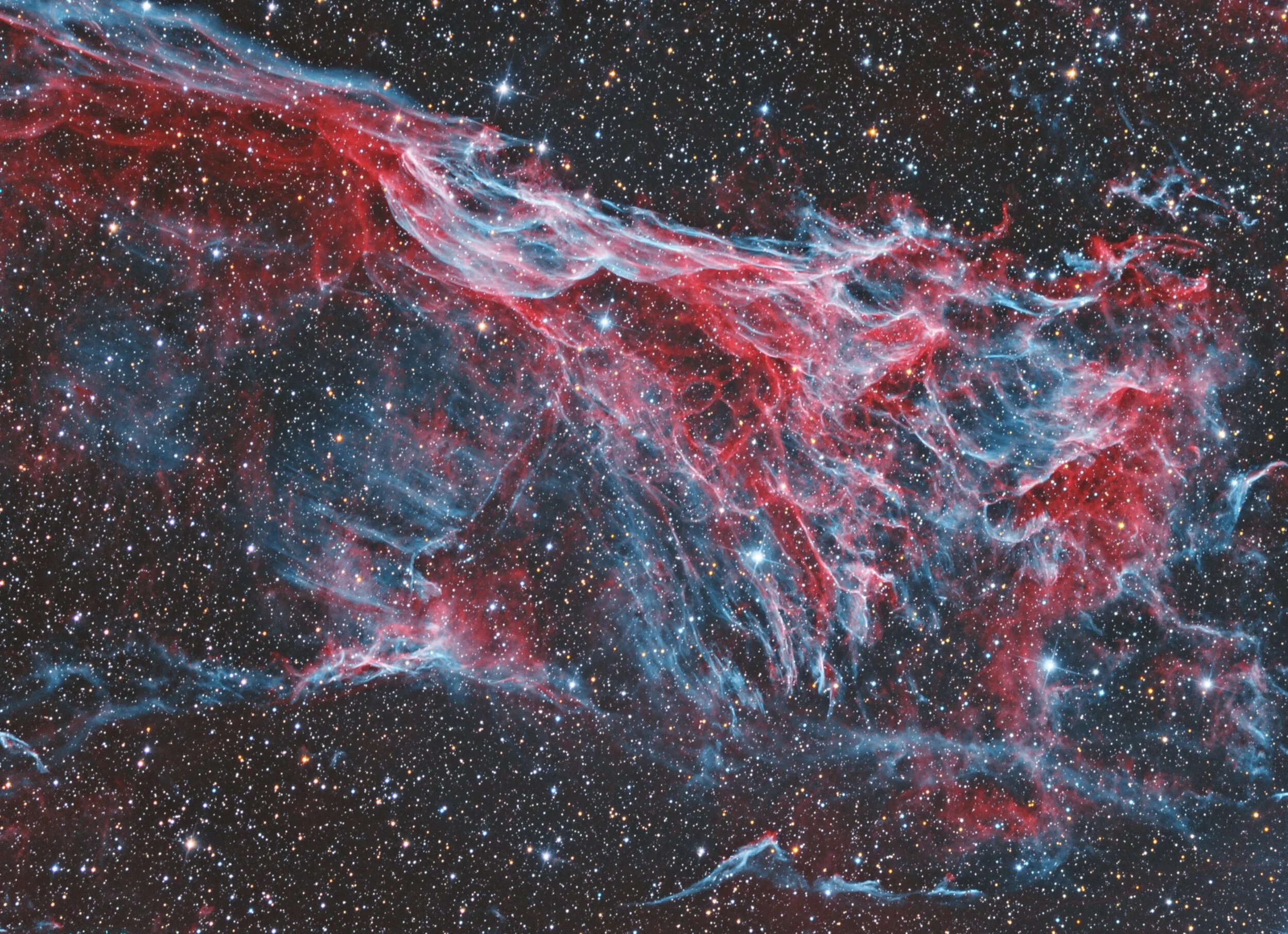
NGC6979- Pickering's Triangle HOORGB
Image Description and Details : Ha : 91 x600". Gain 200. Bin1
[OIII]: 90x600". Gain 200. Bin1
RGB: 40x60". Gain 139. Bin1 (For stars color)
Total integration time: 32h10'
Data acquired on several nights of July and August 2021 from Belmonte and Naharros, Cuenca (Spain)
Equipment: ZWO ASI1600MM. Meade R8 200/1000. EQ6R-PRO.
Guiding: EZG60 + QHY5-L-II
Capture Software: NINA & PHD2
Processed with Pixinsight 1.8.8.7
Copyright: Alejandro López
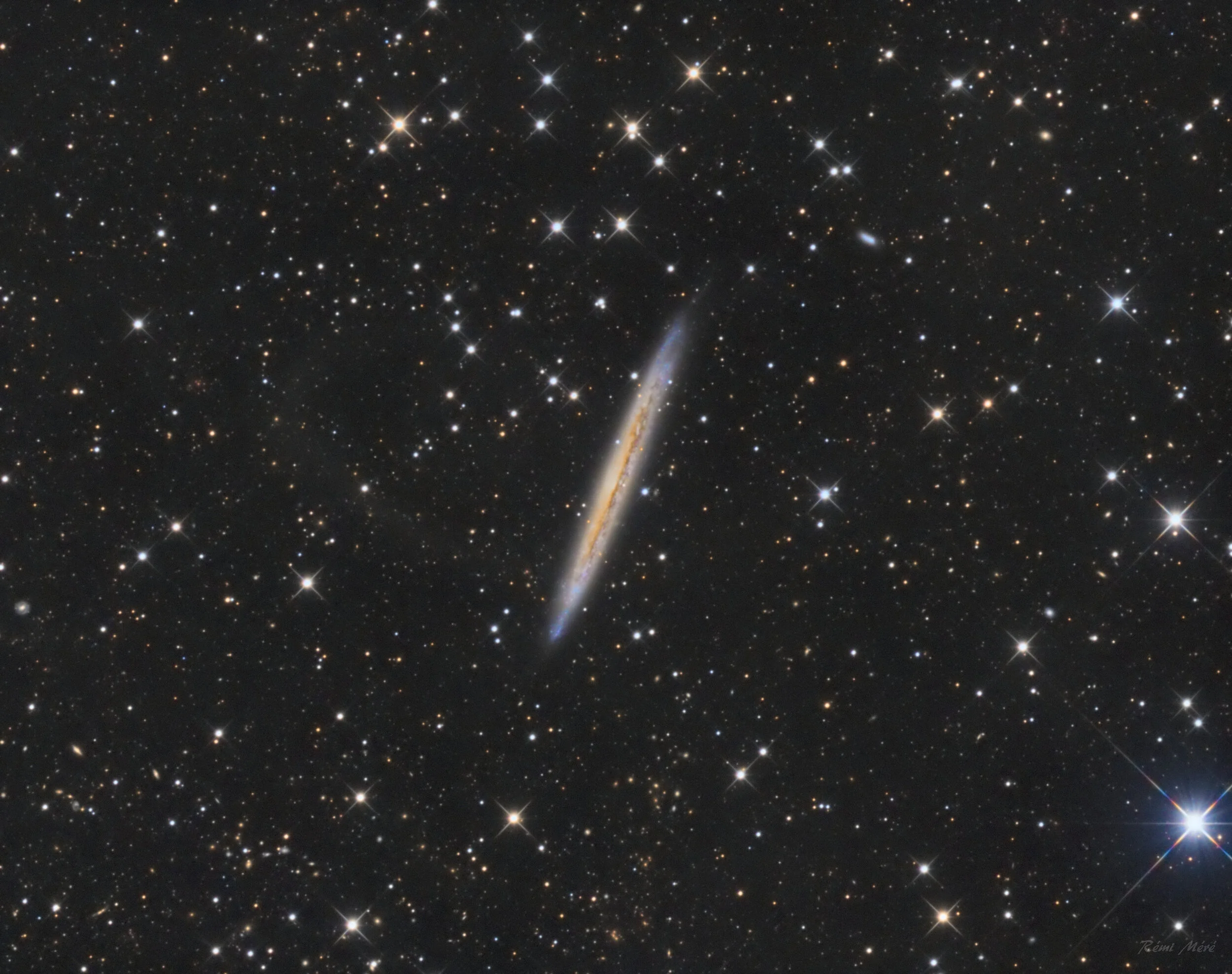
Ngc 5907
Image Description and Details :
A spiral galaxy located in the dragon It has several stellar flows, here on the image I have only captured the left flow the rest of its large loop is very little visible or then some influences by severely pushing the transformation histo. Its stellar fluxes are remnants of dwarf or similar sized galaxies that have been disturbed and extended along its orbit. The galaxy is located 42.4 million light years away.
Atik 460ex et 200/1000 en lrvb sur 21h l..63x900sR..22x300sV..20x300sB..21x300s
Copyright: Rémi Méré
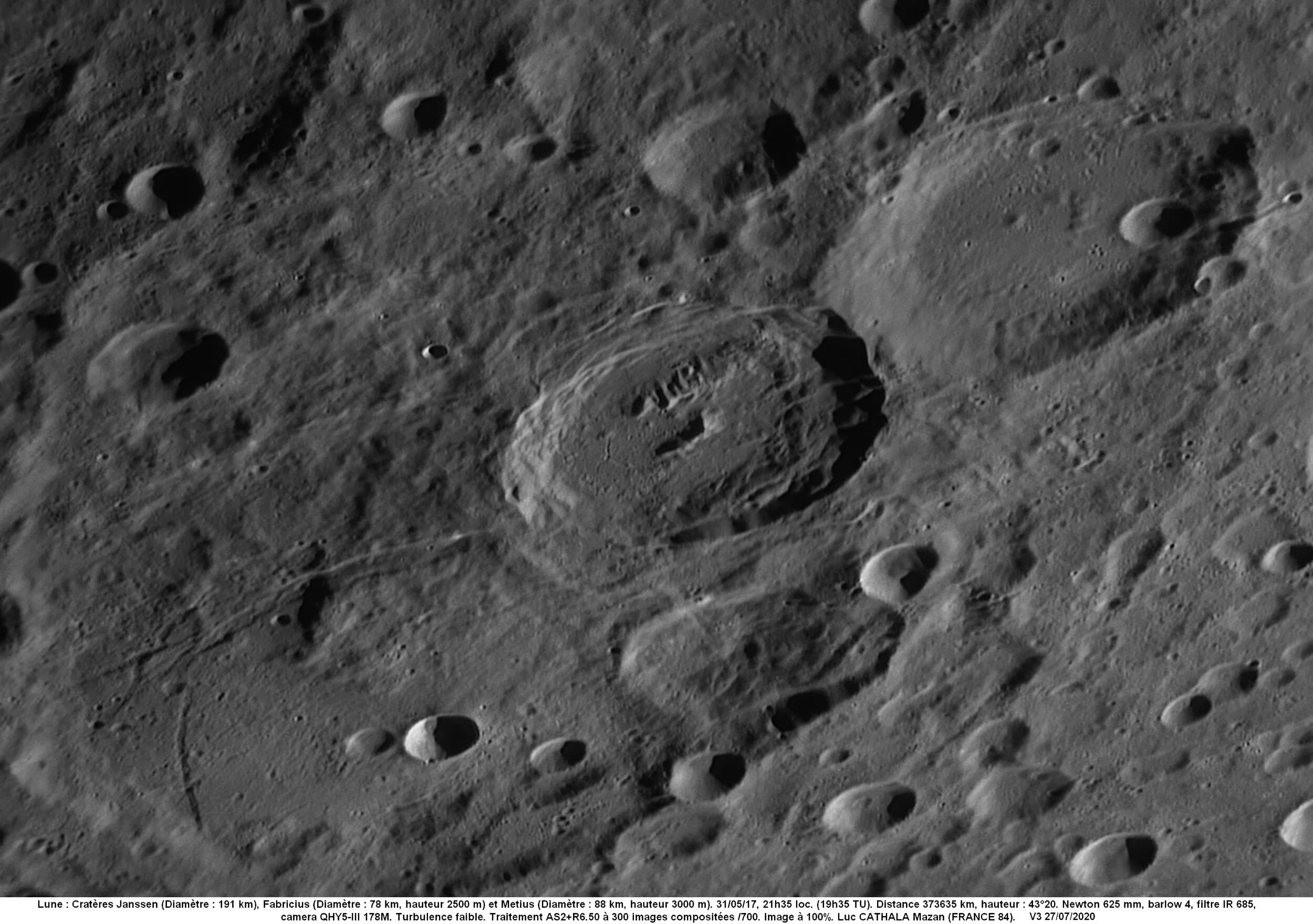
The Janssen Fabricius and Metius
The Janssen Fabricius and Metius trio caught with low turbulence and my Newton 625mm IR685 barlow Televue 4X and QHY5III 178M . Note the three connected valleys in Fabricius.
Copyright: Luc Cathala
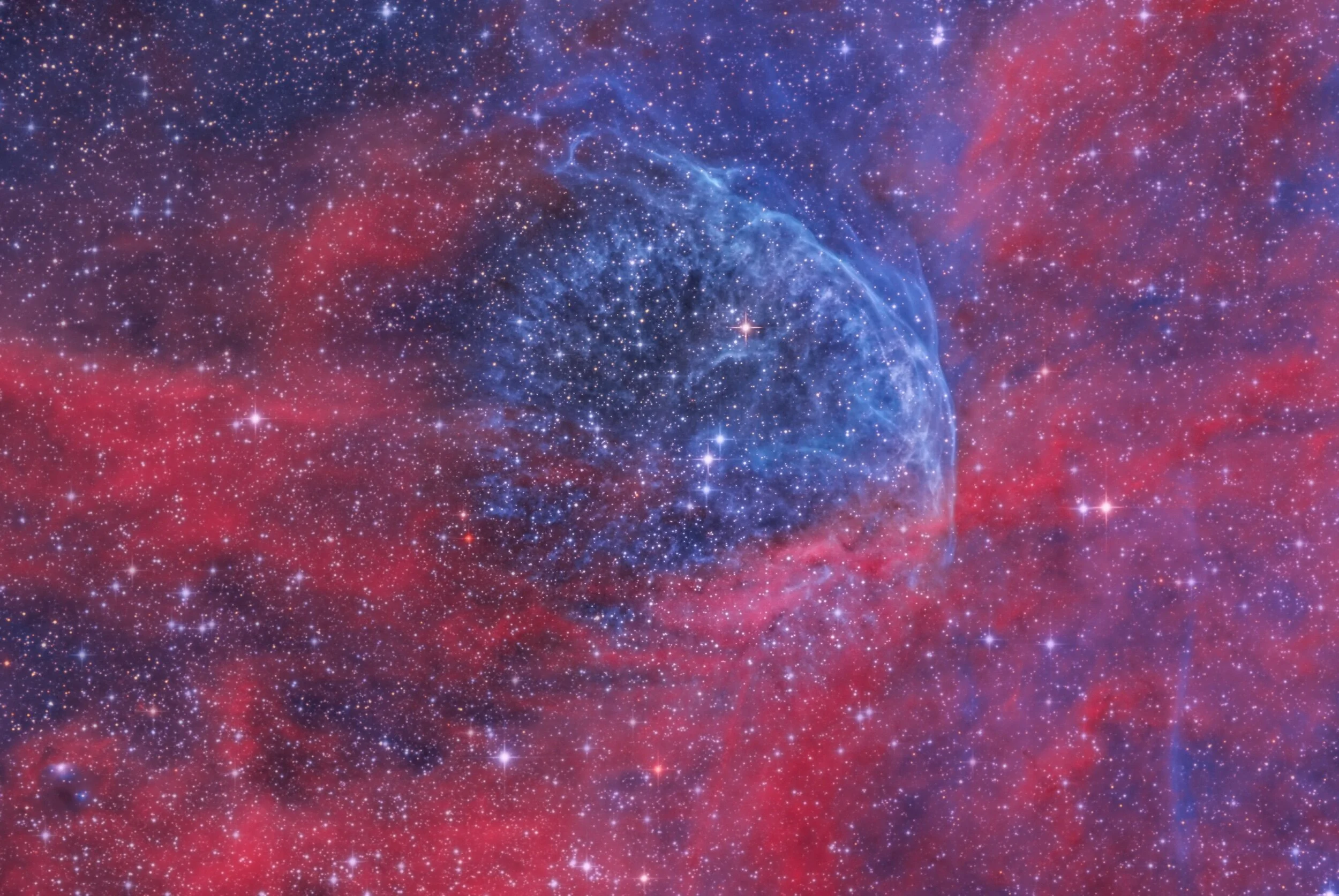
WOLF RAYET 134
WR 134 is a variable Wolf-Rayet star located around 6,000 light years away from Earth in the constellation of Cygnus, surrounded by a faint bubble nebula blown by the intense radiation and fast wind from the star. It is five times the radius of the sun, but due to a temperature over 63,000 K it is 400,000 times as luminous as the Sun.
photo taken from my backyard in Carpentras (Vaucluse) France
Telescop : 10" f/4 TS ONTC Newton
Camera : ZWO ASI 294MM
Mount: iOptron CEM70
Camera autoguiding : ZWO ASI290MM Mini
Explore scientific HR COMA CORRECTOR
Logiciels: Photoshop · Nighttime Imaging ‘N’ Astronomy · PHD2 Guiding · Pixinsight 1.8
Filtres: Antlia 3.5nm OIII 36mm & 3.0nm Ha 36mm
Chroma RGB 36mm
Accessoire: PrimaLuce Sesto Senso 2
Dates:6 juillet 2021 , 7 juillet 2021 , 8 juillet 2021 , 9 juillet 2021 , 14 juillet 2021 , 18 juillet 2021 , 19 juillet 2021 , 20 juillet 2021
Images unitaires:
Antlia 3.0nm Ha 36mm: 155x240" (10h 20') (gain: 120.00) -10C bin 2x2
Antlia 3.0nm Ha 36mm: 49x360" (4h 54') (gain: 120.00) -10C bin 2x2
Antlia 3.5nm OIII 36mm: 72x180" (3h 36') (gain: 120.00) -10C bin 2x2
Antlia 3.5nm OIII 36mm: 120x240" (8h) (gain: 120.00) -10C bin 2x2
Antlia 3.5nm OIII 36mm: 43x360" (4h 18') (gain: 120.00) -10C bin 2x2
Chroma LRVB 36mm: 90x120" (3h) (gain: 120.00) -10C bin 2x2
Intégration: 34h 8'
Darks: ~64
Flats/PLU: ~7
Dark-flats: ~30
Âge de la Lune (moyen): 17.98 jours
Phase de la Lune (moyenne): 32.23%
Echelle d'obscurité de Bortle: 6.00
Centre AD: 20h 10' 22"
Centre DEC: +36° 11' 3"
Échantillonnage: 0,907 arcsec/pixel
Orientation: 1,422 degrés
Rayon du champ: 0,593 degrés
Copyright: Anthony Husson

DWB 111 & LDN 909
Image Description and Details : Commonly known as the propeller nebula the ‘propeller’ shape actually consists of two catalogued parts: DWB 111 & DWB 119.
The DWB catalog was compiled by H. R. Dickel, H. Wendker and J. H. Bieritz cataloging 193 distinct objects as part of their study of H-alpha emission nebula in the Cygnus X region of the sky.
This is part of a much larger complex known as Simeis 57 in Cygnus, discovered in the early 50’s. The distance to the nebula is not known.
DWB 111 is just a small part on the left of this image. There is another very faint OIII object in the frame & I hope I can add further to the image at a later date. LDN 909 refers to the dark area just right of centre.
Imaging telescope: Takahashi FSQ130ED
Imaging cameras: FLI ML16200
Mounts: Takahashi EM 400 Temma 2
Guiding cameras: QHY CCD QHY 5 II
Focal Extender / Reducer: Tak QE 0.73x
Software: PHD 2, Astro Pixel Processer, PixInsight , Sequence Generator Pro SGP
Filters: Astrodon SII, Ha, OIII, + Astrodon RGB
Accessories: ATIK EFW3
Original Resolution: 4416 x 33596
Dates: Jul 18 - Aug 4, 2021
Frames:
Astrodon Ha: 42 x 600"
Astrodon SII: 45 x 600"
Astrodon OIII: 48 x 600"
Astrodon RGB: 3 x 10 x 180"
Integration: 24 Hours.
Copyright: Brendan Kinch
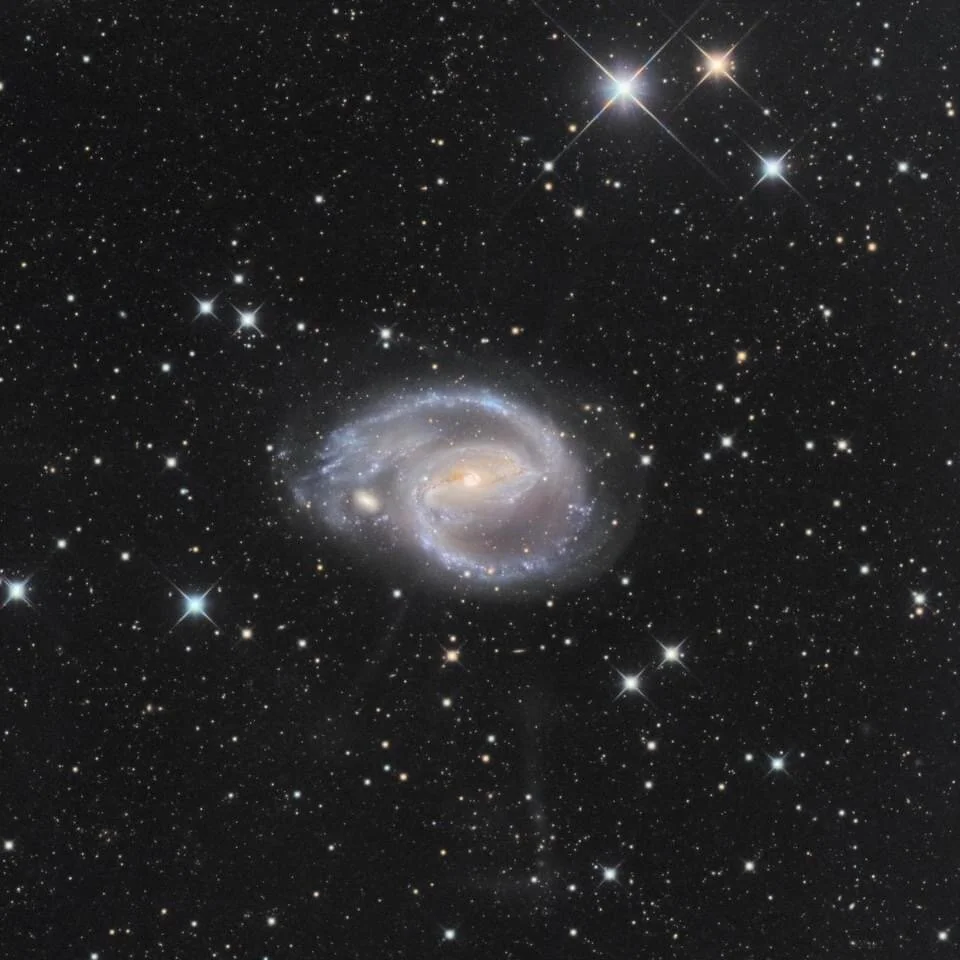
Ngc1097
Enigmatic spiral galaxy NGC 1097 lies about 45 million light-years away in the southern constellation Fornax. The small companion galaxy, just left of center, that seems to be wrapped in its spiral arms, is not NGC 1097's most peculiar feature though. Instead, This very deep exposure shows hints of faint, mysterious jets, most easily seen to extend well beyond the bright arms toward the bottom. In fact, four faint jets are ultimately recognized in optical images of NGC 1097. The jets trace an X centered on the galaxy's nucleus, but could be fossil trails left over from the capture of a much smaller galaxy in the large spiral's ancient past. A Seyfert galaxy, NGC 1097's nucleus also harbors a massive black hole.
Copyright Good Astronomy