

AAPOD2 Image Archives

The Crescent and Soap Bubble
Image Description and Details :Imaging telescopes: Askar FRA400 F5.6 · GSO RC8" Carbon TubeImaging cameras: ZWO ASI294MM Pro · ZWO ASI1600MM ProMounts: iOptron CEM26 · iOptron CEM70Guiding cameras: ZWO ASI174MM mini · ZWO ASI120MM MiniFocal reducers: Askar 0.7x Reducer · Astro Physics CCDT67Software: PHD2 PHD 2 · N.I.N.A. · PixInsightFilters: Antlia Ha 3nm Pro · Antlia Oiii 3nm Pro · Astrodon Ha 3nm · Astrodon OIII 3nmAntlia Ha 3nm Pro: 60x600" (10h)Antlia Oiii 3nm Pro: 60x600" (10h)Astrodon Ha 3nm: 12x1800" (6h)Astrodon Ha 3nm: 60x600" (10h)Astrodon OIII 3nm: 32x1800" (16h)Astrodon OIII 3nm: 60x600" (10h)Integration: 62h
Copyright: Tal Akerman

A Helping Hand
Image Description and Details :
This is the Helping Hand Nebula in Cassiopeia.The blue reflection is as a result of the Cepheid variable star SU Cassiopeia. Vdb 7,8 and 9 are present in this image as well as Ldn 1353, 1355 and 135812 Hours in 120 sub exposuresAsi 2600mc through a Takahashi Epsilon 160
Copyright: Richard Sweeney

M27 Collaboration
Image Description and Details : 3 astrophotographers' collaboration on M27 :
Halpha and Oiii long exposures with Newton 10" and ASI2600mm : 224 x 300s by Mathieu Guinot
Halpha and Oiii long exposures with RC16" and ASI2600mm : 200x300s by Sebastien Kuenlin
RVB long exposures with Newton 10" and ASI2600mm : 90x120s by Mathieu Guinot
Halpha lucky imaging with Newton 12"and Playerone Neptune color II : 5000x2.5s by Stephane Gonzalez
IR - RVB lucky imaging with Newton 12"and Playerone Neptune color II : 40000x500ms by Stephane Gonzalez
The processing of the M27 nebula always presents a certain difficulty and forces choices because of the great difference in luminosity between the core and the extensions on the one hand, and the strong presence of Halpha and Oiii signals on identical zones on the other hand.
These artistic choices have been made with maximum respect for the scientific coherence of the object, although this is not 100% possible: indeed, one obtains a saturated core if one wants to take advantage of the signal on the most distant extensions, or one does not distinguish these if one wants to maintain an unsaturated core. It is therefore necessary to use HDR processing as sparingly as possible, which inevitably alters the object's dynamic range but allows a compromise to highlight the different signals making up the nebula.
In the end we are very happy to present the fruit of this work with the objectives fulfilled:
- to enjoy the details of the short exposures
- to take advantage of the extensions of the long exposures
- to ensure coherence between the levels of detail thanks to the intermediate image taken in long exposure at long focal length
- keep the dynamics of the object as "real" as possible
- not to perceive any artefact or transition linked to the mixing of the three images
Sébastien, Stéphane and Mathieu, November 2021
Copyright: Stephane Gonzalez, Sébastien Kuenlin and Mathieu Guinot

CG4 Cometary Globule in Puppis
Image Description and Details :
Image acquired using the Telescope Live remote imaging platform.Telescope: ASA 500N Newtonian. 500mm aperture, focal length 1900mm, f/3.8CCD Camera: Finger Lake Instruments FLI 16803.Equatorial Mount: ASA DDM85 direct drive.Astrodon LRGB filters.L: 15 x 600sR: 12 x 600sG: 10 x 600sB: 12 x 600sProcessed with Astro Pixel processor, PixInsight and Affinity Photo.
Copyright: Nik Szymanek

The Pillars of Darkness (B22 Region)
Image Description and Details :
This is part of the Taurus Molecular cloud complex apparently located about halfway between the Pleiades and Aldebaran and about ~430 l.y. from here. The shape of the nebula reminds me of a darker version of the Eagle Nebula's Pillars of Creation, leading to my title. Also captured, though only as 6 small smears, is a 70km-wide asteroid called 322 Phaeo (discovered 1891) which was moving through the area at the time. I shot this nebula was shot in Bortle 1 skies over 6 nights at the 2021 Okie-Tex Star Party in Western Oklahoma during early October 2021. Transparency throughout the week was mediocre so only 16 hours of a larger 26 hour total was used for stacking. William Optics Star71-II APO (345mm FL, f/4.9)ZWO ASI1600MM-P at Gain 76 & -10C, ZWO LRGB filtersLum: 316 x 120"(Rx62, Gx56, Bx64) x 120"APT for capture, PixInsight for stacking & processing
Copyright: Brent Newton

Sparkles in the Sun
Image Description and Details :
Solar Activity on October 25, 2887,2890, 2886, I was able to capture the large bulge that was had that day, M1.3 class flashes, we are still in the solar shekel number 25, which according to estimates, could last much less than expected , due to the great activity that has been seen, and that was ahead of the forecasts, for now to enjoy these spectacular solar landscapes, at every moment the sun gives us a different view, to capture it!
Copyright: Arturo Buenrostro

NGC 6752 Globular Cluster in Pavo
Image Description and Details :
NGC 6752 is a globular cluster in the constellation Pavo. It is the fourth-brightest globular cluster in the sky (after Omega Centauri, 47 Tucanae and Messier 22). The cluster lies around 13,000 light-years distant and is one of the closer globular clusters to Earth and has been calculated to be 11.78 billion years old.Telescope 20" Cassegrain f/3 (1500 mm) Camera Moravian G2 8300 monoExposure RGB 4x2min each (total 24min) Software PixInsight Location IAS Hakos Farm, Namibia
Copyright: Herbert Walter

Partial Lunar Eclipse
Image Description and Details :
Celestron C5+Canon 60DExposure time: 2 secondsIso: 800F: 10Focal Lenght: 1250 mm.Process: Lightroom + PixinsightGuillermo Cervantes MosquedaObservatorio Astronómico AltaïrPoncitlán Jalisco México
Copyright: Guillermo Cervantes Mosqueda

The outpost
Image Description:
On a rocky summit of an icy planet sits a remote research outpost. This frozen world orbits a inconspicuous star in a minor arm of a giant barred spiral galaxy.
Named after a mythical creature of an ancient culture that once dominated the planet, this scientific outpost is called the Sphinx. The Spinx is mythicized to have mercilessly killed those who couldn't answer her riddle.
The Sphinx station has a prime view on one of the galaxies major star forming regions, named after another mythological figure, a giant hunter. Not all scientific riddles within the hunter are solved yet, but fortunately the Sphinx hasn't killed any scientists so far.
The thin atmosphere of the planet at this high altitude location contains enough water to form clouds, which shroud the observatory in freezing fog about 40% of the time. If the clouds part, the hunter's giant molecular clouds of ionized hydrogen are lighting up the sky.
I had the opportunity to visit the Sphinx outpost with benjaminbarakat in September for a night of astrophotography. After a sternous night, we were happy that both the planet and the mythical creatures had shown mercy. The hunter had made its appearance and we escaped this stunning place without getting killed by lack of oxygen, the cold or the wrath of the Sphinx.
EXIF
Canon EOS EOS Ra
Canon 24-70mm f/2.8 L ll @ 50mm
iOptron SkyTracker Pro
Sky:
4 panel panorama, each a stack of 7 x 60s @ ISO1600
Foreground:
Panorama of 4x 2s @ ISO400 during blue hour
Copyright: Ralf Rohner

The Fishhead
Image Description and Details :
Located in the constellation Cassiopeia, this magnificent star forming region, surrounded by energized gas and dark dust lanes, is itself located alongside the larger Heart Nebula and is well known for its strong source of radio emissions.
We are star dust.
——————
This image was created with data captured across 7 nights from October to November using a 8” Ritchey–Chrétien reflector telescope and a cooled, monochrome camera with both narrowband and broadband filters.
The Hydrogen Alpha, Oxygen III and Sulphur II emission wavelengths are exceptionally strong in this region and I mapped the colour palette to try and make something truly unique! I belended in RGB stars for good measure. I hope you like it!
30hr 25.5mins total exposure time
120x 300” Sii
105x 300” Ha
117x 300” Oiii
84x 60” R
65x 60” G
82x 60” B
40x Darks
390 Flats/Dark Flats
10/30-31, 11/01-02, 11/05-07/2021
Bortle 6/7
Calgary, AB
|| Setup ||
1624mm Focal Length
TS Optics RC 8” Carbon Fiber @ f8
SHO 3nm, 2”
RGB, 2”
EQ6-R Pro
ASI2600MM-Pro, unity, -15C
EAF
EFW 7x2, 2”
OAG68M
ASI290MM-mini
ASIAir Pro
APP, PI, PS, MLR
2x binning
Copyright: Andrew Lesser

The walking girl in space
Image Description and Details :
Barnard 150, also known as the Hippocampus Nebula, is a dark molecular cloud of dust in the constellation Cepheus located about 1,200 light years away.
This molecular cloud is part of our galaxy and it is one of 182 objects cataloged by astronomer Edward E. Barnard.On the right side of the image, we can see part of the squid nebula (OU4) (red signal).
Copyright: Thomas LELU

SH2-135
Image Description and Details :
SH2-135, a faint emission nebula very often missed by the amateur astrophotographers.There aren't too many photos of this target and most of them are in HaRGB. The Oiii is nearly invisible and I had to stretch the stack as much as I possibly could to highlight the Oiii areas.Equipment used:AZEq6-GTAstroTech 106LE with upgraded Moonlite focuserTSFlat 2" field flattenerASI294MM Pro Cmos camera, cooled at - 15°C8x1.25" ZWO USB filterwheelChroma 3nm 1.25" Ha, Oiii and Sii filtersQhyccd QHY5L-IIM guide cameraOPTICSTAR AR90 F5.5 guidescopeQhyccd PolemasterSoftware used:Eqmod, SGP - Sequence Generator Pro, PHD2, Stellarium with stellariumScope, SharpCap for polar alignmentDate: 15.09 to 25.10.2021Location: Bushey Herts, UK, bortle 7Ha: 80x300sec Bin 2x2, Gain 200 Offset 10Oiii: 52x300sec Bin 2x2, Gain 200 Offset 10Sii: 60x300sec Bin 2x2, Gain 200 Offset 10Total integration time 16 hours Stacked in AstroPixel Processor and processed in Pixinsignt and Photoshop CC 2021
Copyright: Emil Andronic
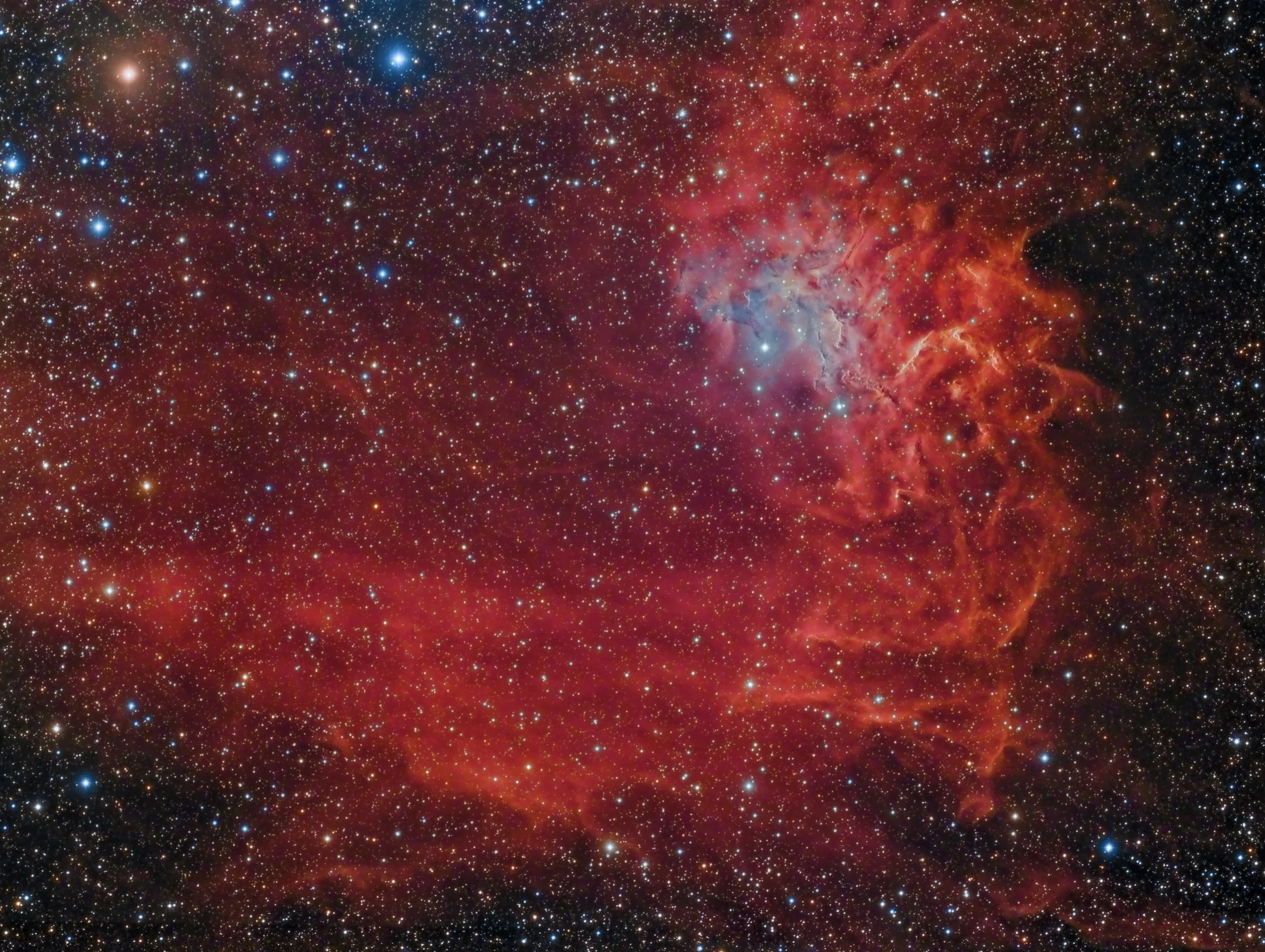
IC 405 - FLAMING STAR NEBULA
Image Description and Details : Telescope: FSQ-106ED
Camera: QSI 583ws
Guide: EZG-60 - ZWO ASI 120 MC
Filters: BAADER LRGB, ASTRONOMIK H-ALPHA
Exposure: 42 x 10 MIN LUM, 11 X 5 MIN RED B2, 11 X 5 MIN GREEN B2, 11 X 5 MIN BLUE B2,10 X 10 MIN H-ALPHA
Software: MAXIM DL, PHOTOSHOP CC, PIXINSIGHT
Location: ESCOBAR DE CAMPOS, LEON (SPAIN)
Copyright: César Blanco
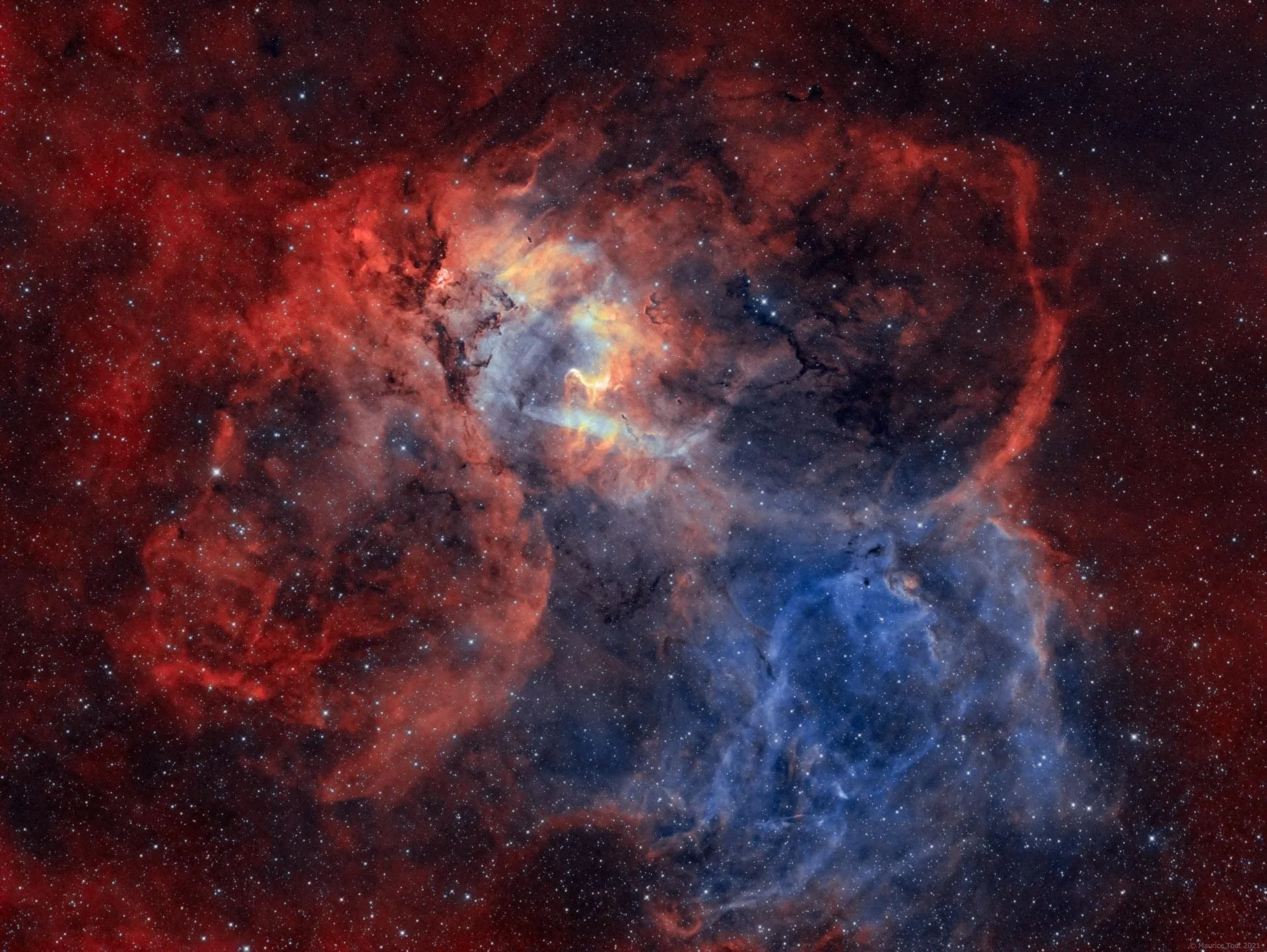
Sh2-132 Lion Nebula
About two weeks ago, I processed a monochrome Hα image of this interesting object on the border of Cepheus and Lacerta. Last Monday the sky unexpectedly cleared. I decided to spend the night on acquiring OIII data to create an Hα-OIII-OIII false colour image, where Hα is assigned to the red channel, OIII to the blue channel and a mix of Hα and OIII to the green channel. Although it stayed clear all night, I only used the images captured before midnight. In the area in the Netherlands where I live, the sky severely brightens from midnight to dawn because horticulturalists are then allowed to ignite assimilation lights. Although the used OIII filter has a bandwidth of only 4nm, the light pollution caused by the glasshouse horticulture severely affects the quality (signal-to-noise ratio) of the images. I'll post a separate message to illustrate the difference in sky quality before and after midnight.
What's striking in (false) colour images of this object, is the conical beam that crosses in front of nebulas in the background. Here this beam has a cyan hue in front of yellow/orange nebulas.
Exposure time: 16 hours, 10 minutes (141x 300" Hα, 53x 300" OIII) | Optics: Takahashi ε-180ED f/2.8 | Camera: ZWO ASI294MM Pro (B 2x2, G 120, T -15 °C) | Acquisition: ZWO ASIair Pro | Filters: Baader Planetarium Ultra-Highspeed | Mount: Astro-Physics Mach1 GTO | Location: Zoetermeer, Netherlands | Date: 27 & 28 October and 8 November 2021
Pre-processing in Astro Pixel Processor, post-processing in Adobe Photoshop.
Copyright: Maurice Toet

The Pacman Nebula (NGC 281)
Image Description and Details :
The Pacman Nebula (NGC 281) is a cosmic cloud of space gas rich in Hydrogen Alpha (red/orange) and Oxygen (blue) located in the constellation Cassiopeia. It gets its name from the classic video game character it resembles. NGC 281 is a rather diffuse red-glowing emission nebula. It includes a small, yet noticeable open star cluster (IC 1590) and some really dynamic dust lanes. The prominent lane of dark dust cutting into this glowing nebula creates the “mouth” of this nebulas shape.The Pacman Nebula contains Bok globules, which are small and isolated dark nebulae containing dense amounts of dust and gas. These collections of cosmic gas and dust are often followed by the formation of new stars.Captured with 14.5 hours of narrowband data under a near full moon and Bortle Class 4 skies near downtown Flagstaff, Arizona.OTA: William Optics GT81 using 0.8x Flat6A-81 reducerMount: Celestron CGX-LCamera: ZWO ASI294MM ProGain: 100Filters:Night 1Chroma 3nm Oiii 900s x 32 = 8hrsNight 2Chroma 5nm Ha 900s x 26 = 6.5hrsCooling Temperature: -10 CelsiusAuto-guiding: ZWO ASI174MM Mini and ZWO M48 OAGControl: ZWO ASIAIR ProCalibrated in Astro Pixel Processor with darks and flatsProcessed in Pixinsight and Lightroom
Copyright: Drew Evans
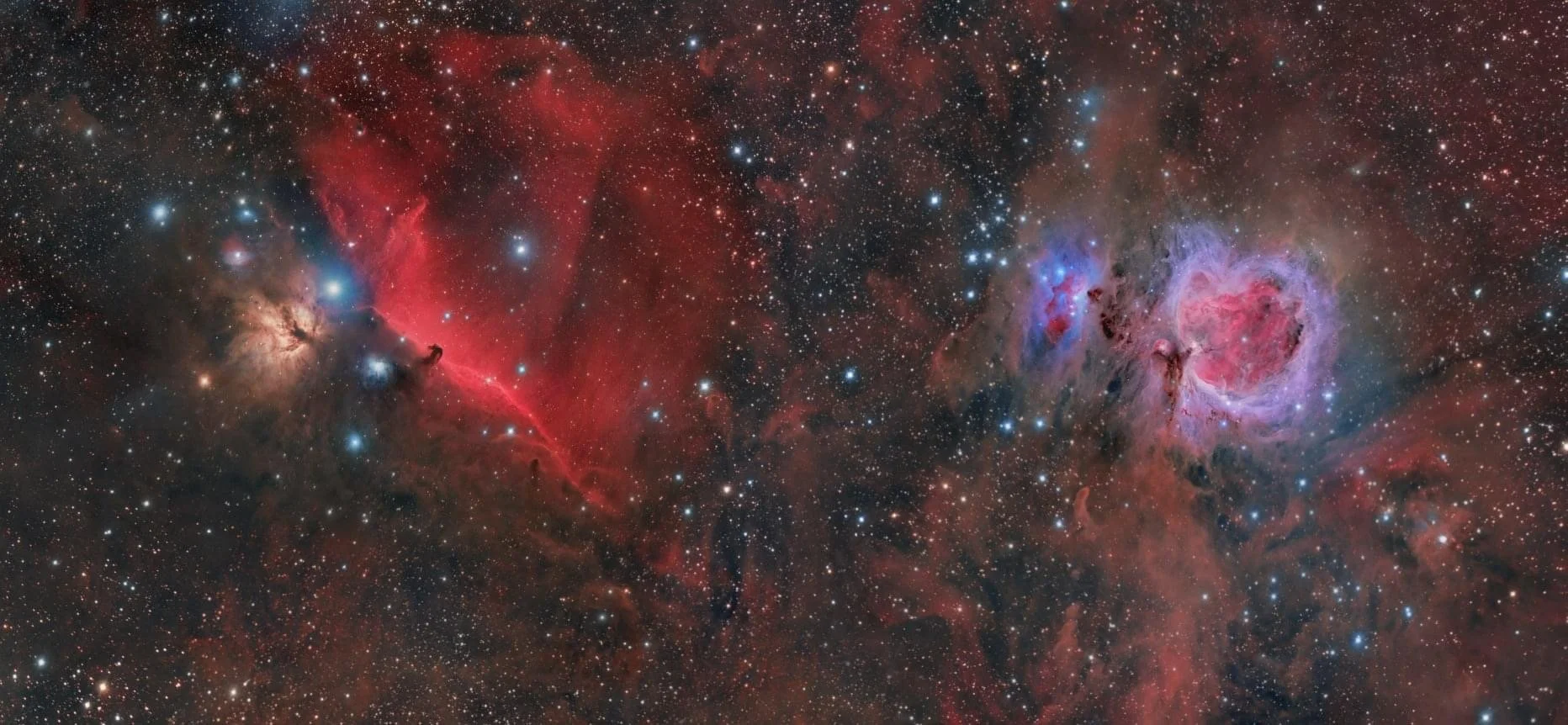
M42 Widefield
2 panel mosaic crop
C 8 Hyperstar
C 14 Hyperstar
Starlight Xpress M25 C
Starlight Xpress 694 C
QHY 247 C
Baader L Booster Filter
Copyright: JP Pecorino
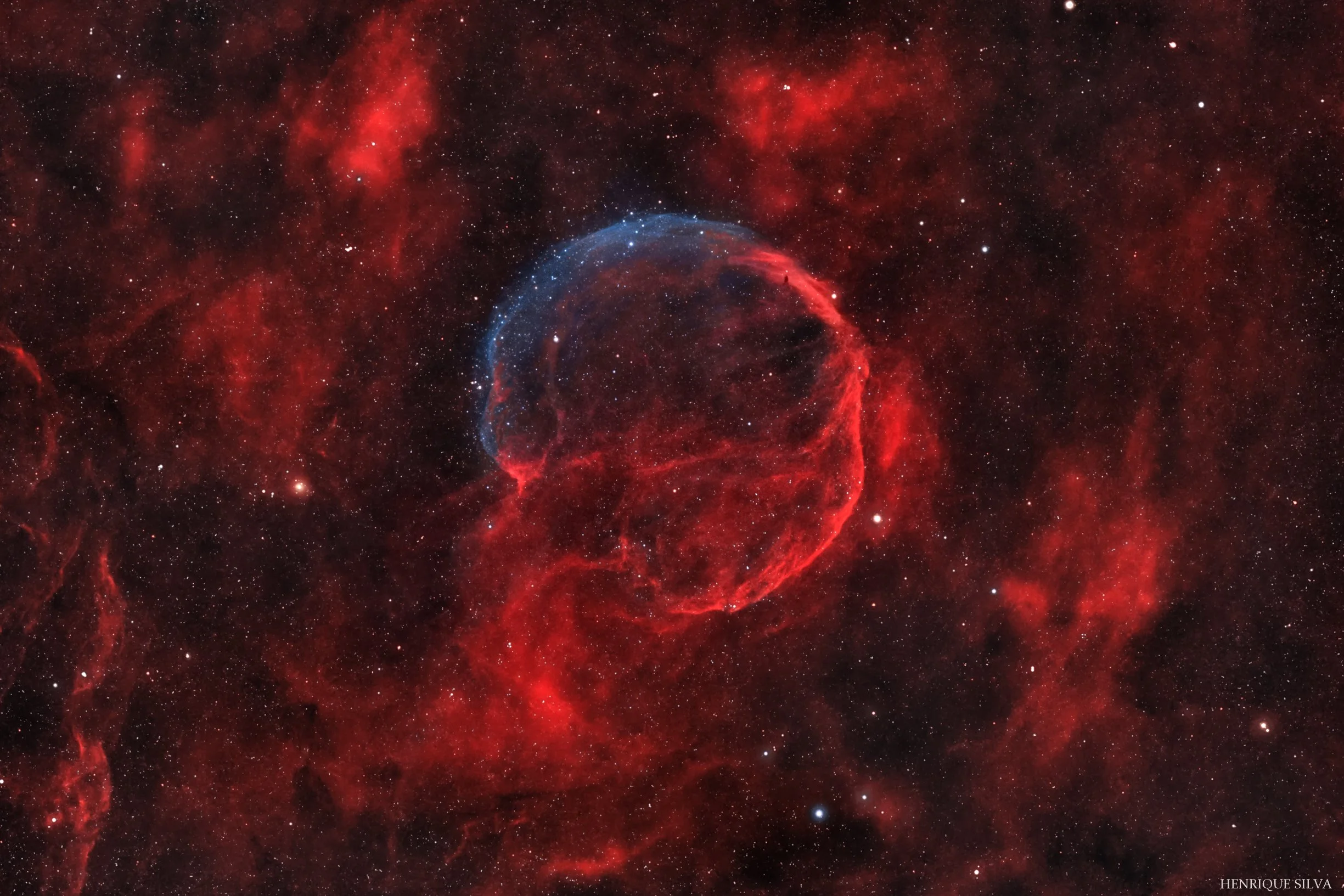
LBN 576 (Abell 85 and CTB 1)
Image Description and Details : LBN 576 (also known as Abell 85 and CTB 1) is a faint supernova remnant lying almost 10,000 light years away.
Very diffuse nebula and challenge target, which required many hours of exposure, around 26 hours to obtain this result. Hope you like it.
Setup:
Mount: Sky-Watcher EQ6-r
Telescope: TS APO 80/500
Capture camera: QHY294MM
Guide camera: ASI 120MM
Filters: Baader CMOS Ha 3.5nm; Baader CMOS OIII 4nm
Frames:
Ha: 115x400s | Gain 1750 | -10ºC
OIII: 120x400s | Gain 1750 | -10ºC
Total Exposure: ~26h
Acquisition: Sharpcap; APT
Edition: PixInsight Core; PS
Location: Sabugo - Portugal | Bortle 6/7
Oct/Nov 2021
Copyright: Henrique Silva
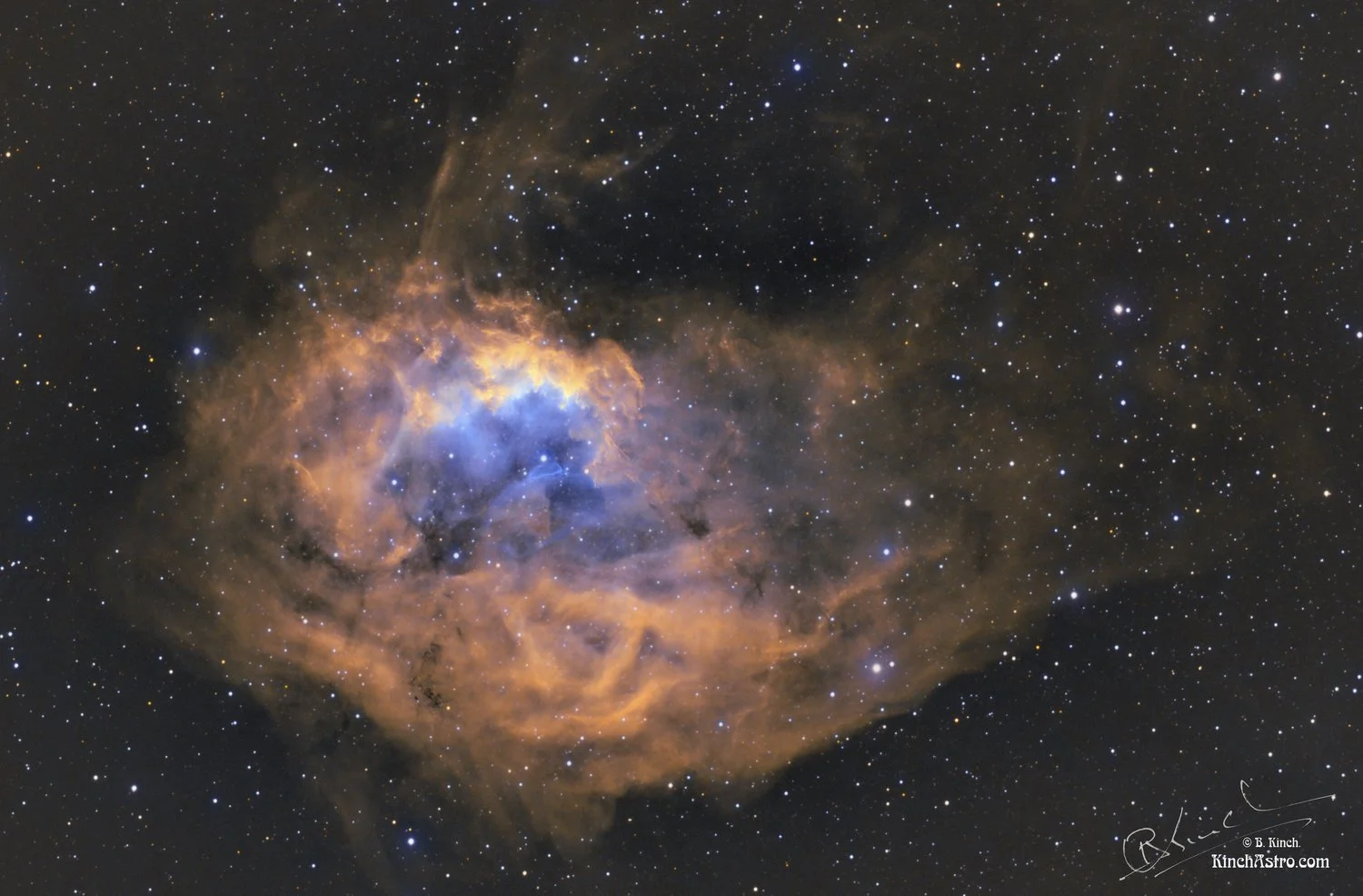
SH2-261 / Lower's Nebula
Image Description and Details :
Lower's nebula (Sh2-261) is found on the outermost edge of our Milkyway between the Orion and Perseus arm. Sh2-261 is a large faint region of predominantly ionized hydrogen. The nebula is named after Harold and Charles Lower who discovered this nebula in 1939.
Embedded within Sh2-261 is LBN 862 and LBN 864. Also there are several dark nebulae in this field.
Imaging telescopes or lenses: Takahashi FSQ130ED
Imaging cameras: QSI 6120i
Mounts: Takahashi EM 400 Temma 2M
Guiding telescopes or lenses: Takahashi FS60CB
Guiding cameras: QHY CCD QHY 5 II
Focal Extender / Reducer: Tak QE 0.73x
Software: PHD 2, Pleiades Astrophoto PixInsight , Astro Pixel Processor (for stacking), Sequence Generator Pro SGP (for capture)
Filters: Astrodon Ha, SII, OIII,
Accessories: Robofocus Focuser, ATIK EFW3
Original Resolution: 3600x 2400
Dates: 3rd Nov - 8th Nov '21
Frames:
Astrodon Ha 18 x 20'
Astrodon SII 24 x 20'
Astrodon OIII 30 x 20'
Total Time: 24 Hours
Center (RA, Dec): (92.351, 15.689)
Center (RA, hms): 06h 09m 24.153s
Center (Dec, dms): +15° 41' 18.668"
Size: 80.7 x 53.8 arcmin
Radius: 0.808 deg
Pixel scale: 1.34 arcsec/pixel
Orientation: Up is 180 degrees E of N
Copyright: Brendan Kinch
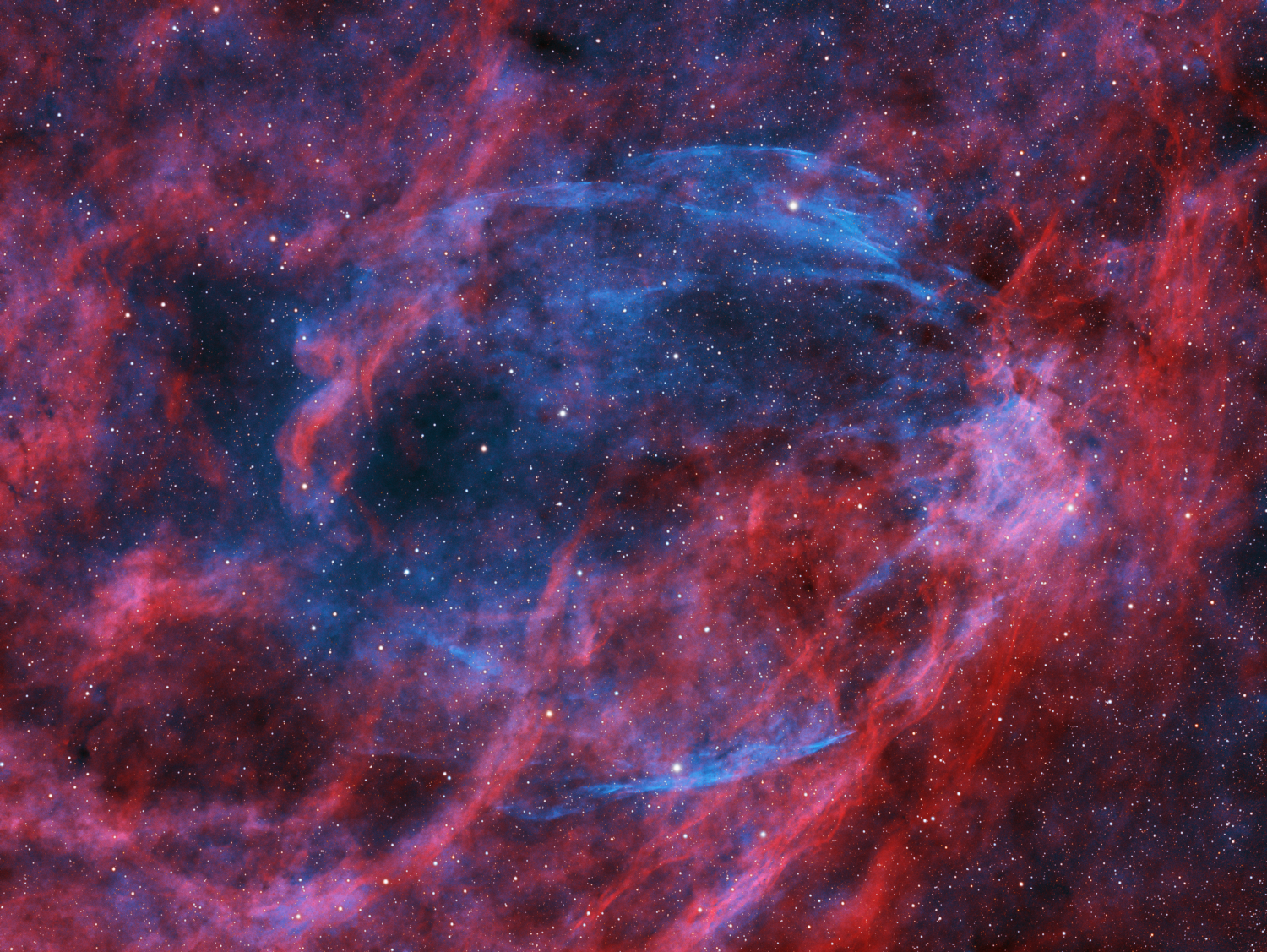
Supernova Remmant W63 (G082.2+05.3)
Image Description and Details :
EQUIPMENT DATA:
Telescope: Borg 101ED f/4
Mount: Skywatcher HEQ5 (Rowan Belt Mod)
Camera: QHYCCD 163M
Filters: Optolong H OIII
Guide Scope: DIY Guidescope 43mm f/3
Guide Camera: QHY 178M
ADQUISITION DATA:
Location: Castillo de Villamalefa
Date: Summer 2021
Resolution: 1.87″/pixel
Guiding Performance: 1” RMS (average)
Exposures: (Gain 174 / Offset 77 / Bin 1×1)
H: 11.25h (137x300s)
O: 26.35h (319x300s)
Sensor Temperature: -10C
20 Flats
20 Darks
Total Integration Time: 38.5h
Copyright: Alberto Ibañez
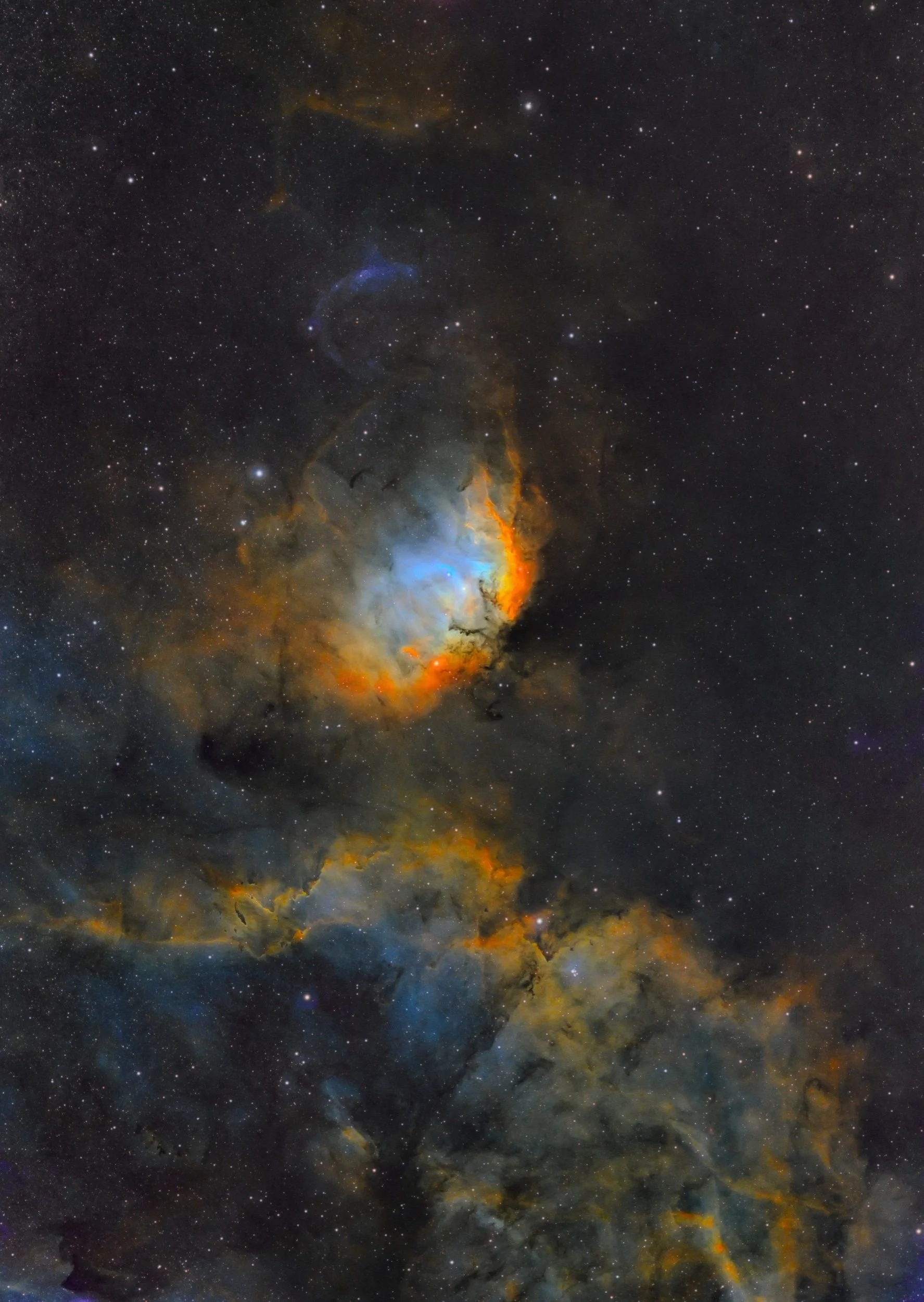
The Tulip
Image Description and Details : This colourful region, located in the constellation Cygnus, has many distinct views of energized gas, all of which give a deep sense of wonder and amazement. The night sky is wonderful, always look up!
We are star dust.
——————
This was captured over 8 nights across June and July, only 3 hours at a time due to our limited darkness on the 51st parallel North.
27hr 47min total exposure time
94x300” Sii
84x300” Ha
119x300” Oiii
31x120” R
32x120” G
28xx120” B
40x Darks
180 Flats/Dark Flats
06/06, 06/25-30, 07/09/2021
Bortle 6/7
Calgary, AB
Setup#1 - SHO
711mm Focal Length
@williamoptics GT102
@williamoptics Flat68iii
@antliafilters SHO 3nm, 2”
@antliafilters RGB, 2”
@skywatcherusa EQ6-R Pro
@zwoasi ASI2600MM-Pro, unity, -10C
@zwoasi EAF
@zwoasi EFW 7x2, 2”
@zwoasi OAG68M
@zwoasi ASI290MM-mini
@zwoasi ASIAir Pro
APP, PI, PS, MLR
Copyright: Andrew Lesser