

AAPOD2 Image Archives
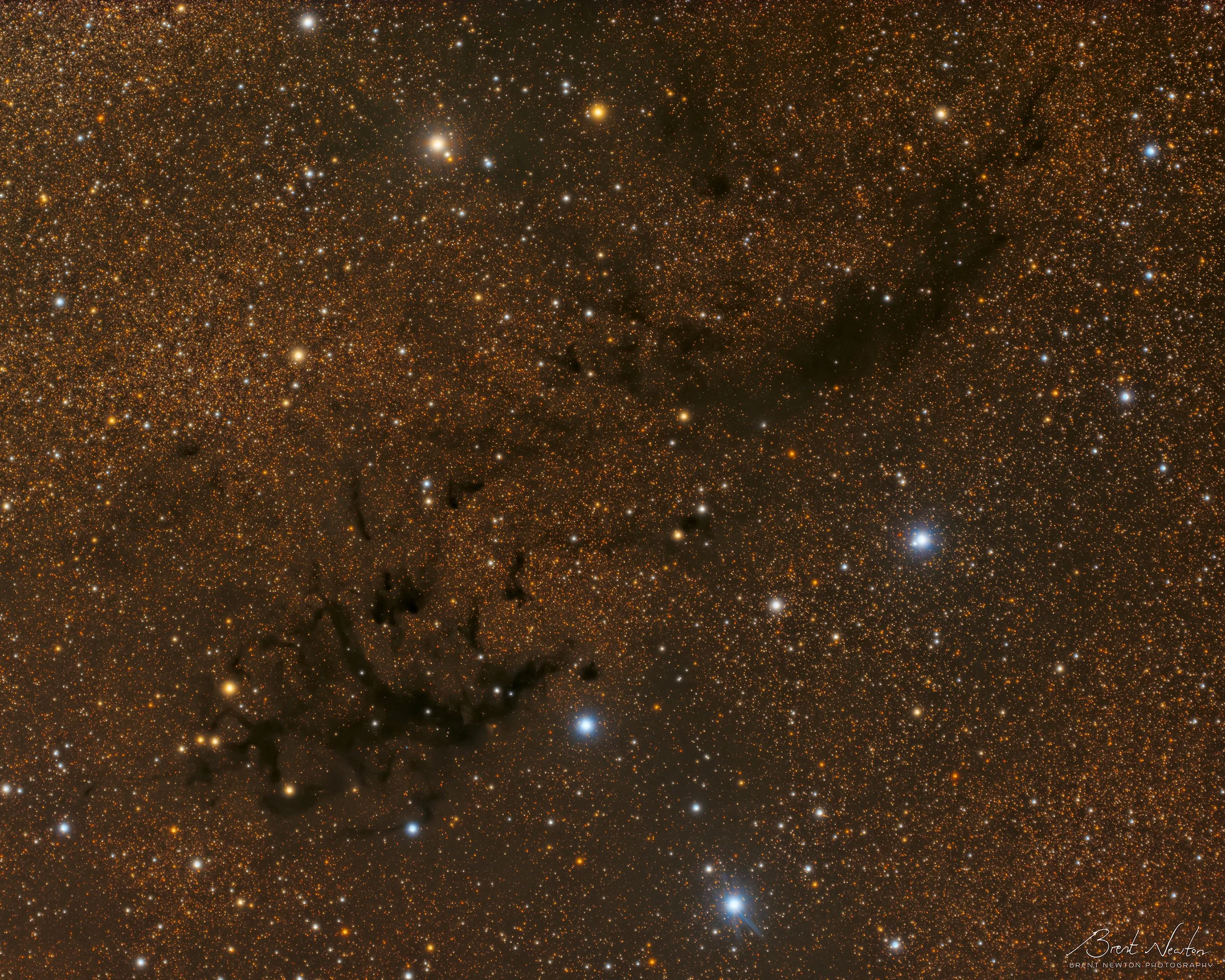
The Reaper (LDN 673, 684)
Image Description and Details :
LDN 673 (lower-left) is a swirling Dark Nebula located within the main band of the Milky Way in Aquila which takes on a tentacle-like appearance. Including the dark nebula LDN 684 in the upper-right, the entire complex appears much like the silhouette of a Reaper from the Mass Effect series. I shot this across 6 nights under the Bortle 1 skies of the 2021 Okie-Tex Star Party totaling 6 hours Luminance (full visible light spectrum for contrast) and 2.3 hours exposure for each Red, Green, and Blue channels. 350mm Focal Length Refractor, ASI1600MM-P, APT for capture, Pixinsight for processing
Copyright: Brent Newton
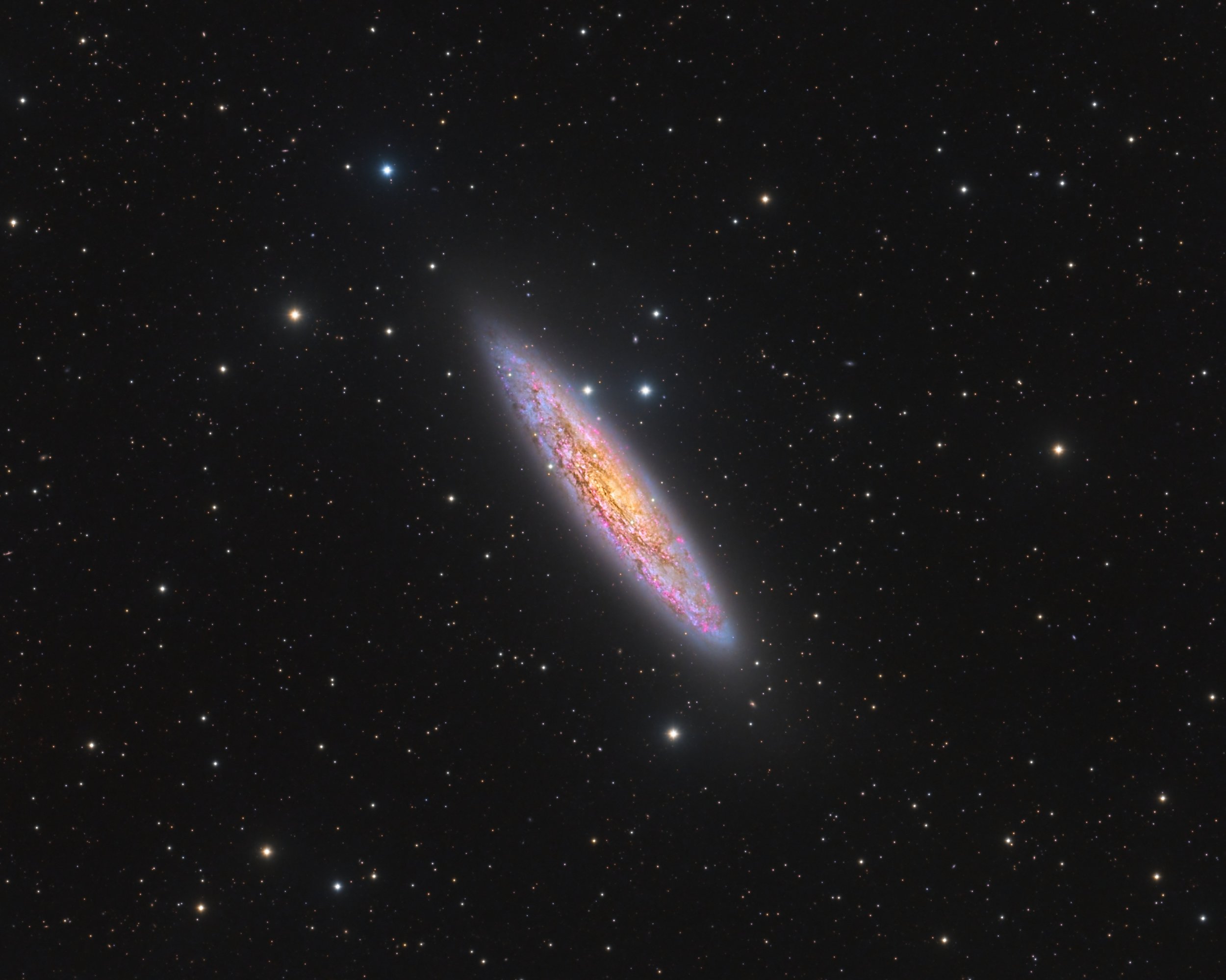
Silver Coin Galaxy
Image Description and Details :
NGC 253 The Sculptor Galaxy. Also known as The Silver Coin or Silver Dollar Galaxy is an intermediate spiral galaxy in the constellation Sculptor. Discovered in 1783 by Caroline Herschel it is one of the brightest galaxies in the night sky. Imaging dates: September 3 to October 3, 2021LRGB - 9 hours 30 minsHa - 4 hoursEquipment list:Takahashi TOA-150 Camera: FLI ML16200Filter: Chroma LRGBSHO 8nmFocuser: FLI AtlasFocal Length: 1100mmFocal Ratio: f/5.0Pixels: 6μmImage Scale: 1.1"Mount: A-P 1600GTO-AELocation: Deep Sky West, Chile
Copyright: Chris Parfett

Catena Davy and Muller?
Image Description and Details :
Some time ago I posted a photo with the Astrobin comment ( http://www.astrobin.com/57641/ ) that I suspected that the alignment of craters near Muller could be a Catena.Seeing this new photo taken a few days ago when the two are present (Muller and Davy) this feeling gets even stronger.Still, I reserve the right to doubt mainly due to the diameter of the craters that appear to form Muller, they are too large for us to imagine a stone block of this size rebounding or even a succession of blocks hitting the Moon after the initial object has been fragmented. .However, not being totally impossible, the suggestion for posteriority remains.Catena, catenae (Chain of Craters) -Name adopted by the UAI to designate a chain of craters on the surface of the moon or a planet. They are the result of the rebound and eject material from the impact that formed the main crater. Davy crater crater is one of the most spectacular crater ridges on the Moon, stretching about 50 km away from the rim of ancient Davy crater.
Copyright: Astroavani
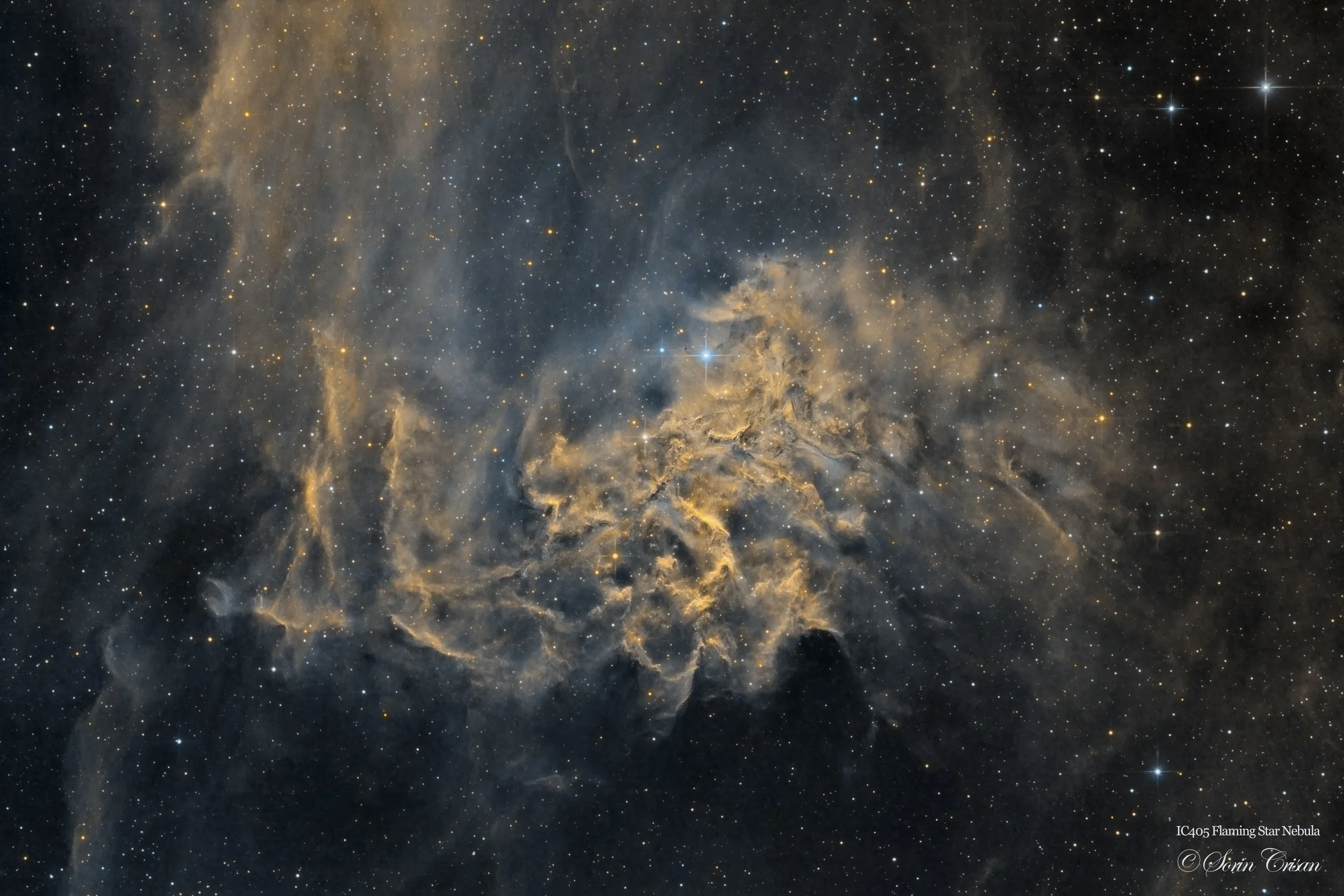
Flaming Star Nebula in SHO
Image Description and Details :
Imaging telescopes or lenses: Skywatcher 130PDSImaging cameras: ZWO ASI294MM ProMounts: Synta Sky-Watcher EQ6-r PROGuiding telescopes or lenses: Artesky 70/400 mmGuiding cameras: ZWO ASI290MM MiniFocal reducers: Sky-Watcher Coma corrector 0.9xSoftware: N.I.N.A. Nighttime Imaging 'N' Astronomy · Astro Pixel Processor · PixInshight · PHD2Filters: Astronomik 31mm 6nm SII Astronomik 6nm SII · Astronomik 31mm 6nm OIII Astronomik 6nm OIII · Astronomik 31mm 6nm Ha Astronomik 6nm HaAccessory: Pegasus power box micro · ZWO Off-Axis Guider · ASI ZWO EAF (Electronic Automatic Focuser) · ZWO 8x 1.25" Filter Wheel (EFW) ZWO 8X EFWDates:24 Nov 2021 , 25 Nov 2021 , 3 Dec 2021Frames:Astronomik 31mm 6nm Ha Astronomik 6nm Ha: 57x300" (4h 45') (gain: 120.00) -10C bin 2x2Astronomik 31mm 6nm OIII Astronomik 6nm OIII: 22x300" (1h 50') (gain: 120.00) -10C bin 2x2Astronomik 31mm 6nm SII Astronomik 6nm SII: 48x300" (4h) (gain: 120.00) -10C bin 2x2Integration: 10h 35'Darks: 30Flats: 20Flat darks: 20Avg. Moon age: 22.72 daysAvg. Moon phase: 49.61%Bortle Dark-Sky Scale: 5.00Mean SQM: 20.25Temperature: -3.67
Copyright: Sorin Crisan
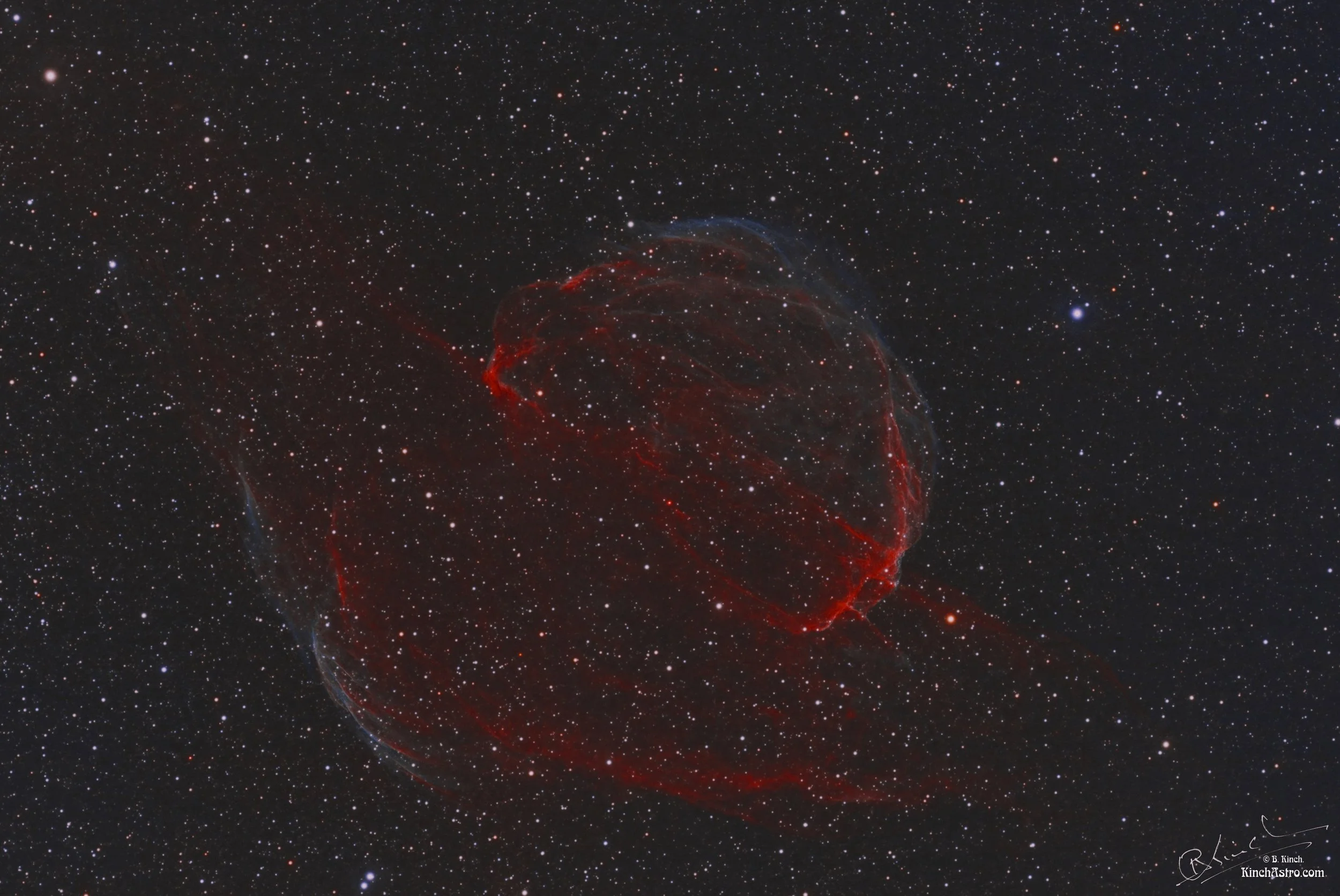
Sh2-224
Image Description and Details :
Sh2-224 is a supernova remnant visible in the constellation of Auriga. It is situated 3.5 ° to SSE of the bright star Capella, the dominant star of the constellation. It is formed by two soft nebulous filaments, the most conspicuous of which is that of the northwest and extends for 20 'x 30' towards the center of the source of radio waves, which has dimensions of 70 'x 75'. The object has an unusual shape, with a shell structure with a radius of about 25 parsec, and is in interaction with a cavity of the interstellar medium at a higher temperature than the surrounding environment, located in the south-western part and of the arch. This conformation suggests that the rest of the supernova in the southwest direction has come into contact with the cavity, first deforming and entering into interaction with this structure, then expanding inside it and creating a wider propagation wave that has emerged from the opposite part, thus creating the arch structure visible in the westernmost part, ie beyond the cavity. The distance of the structure is estimated at about 14,700 light years from the solar system, in a peripheral region of the Arm of Perseus. The X-ray study determined an age of the structure between 13,000 and 24,000 years.Imaging telescopes or lenses: Takahashi FSQ130EDImaging cameras: ASI 2600MM-PMounts: Takahashi EM 400 Temma 2MGuiding telescopes or lenses: Takahashi FS60CBGuiding cameras: QHY CCD QHY 5 IIFocal Extender / Reducer: NoneSoftware: PHD 2, Pleiades Astrophoto PixInsight , Astro Pixel Processor (for stacking), Sequence Generator Pro SGP (for capture)Filters: Astrodon Ha, OIII & RGBAccessories: SeleTEK2/Robofocus Focuser, ATIK EFW3Original Image: 6237 x 4167 Dates: 2nd Dec - 14th Dec '21 Frames: Astrodon Ha 60 x 10' Astrodon OIII 48 x 10' RGB 3 x 15 x 2'Total Time: 19 Hours 30 Mins.Center (RA, Dec): (81.717, 42.933)Center (RA, hms): 05h 26m 51.963sCenter (Dec, dms): +42° 55' 58.987"Size: 85.9 x 57.4 arcminRadius: 0.861 degPixel scale: 1.2 arcsec/pixelOrientation: Up is 270 degrees E of N
Copyright: Brendan Kinch
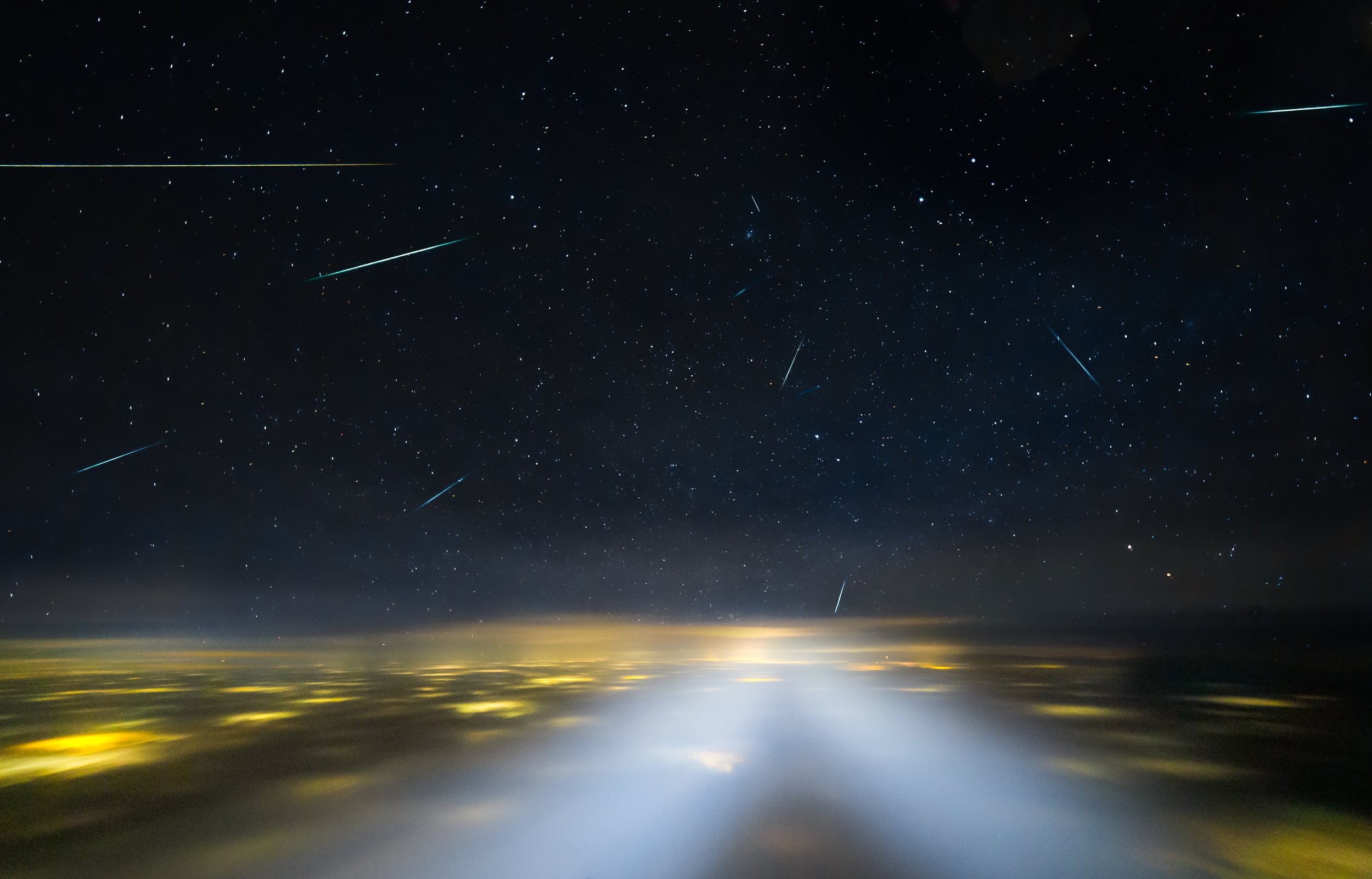
Geminide meteor shower 2021
Image Description and Details :
Here an image of the Geminides meteor shower as seen from the cockpit at an altitude of 40.000’. It was taken yesterday morning on a flight from Denmark back to The Netherlands. Being high above the clouds meant my copilot and I wouldn't be bothered by the thick clouds which covered most of Europe during the peak of this year’s shower. The landing light I switched on for a better composition, to lead the eye towards the constellation of Gemini.The image is a composite of 10 different images, blended together in Photoshop. Taken with a canon 6D an a Samyang 14mm lens.
Copyright: Thomas Röell

Pelican Nebula
I originally publish this nebula image at December 2016. After that, I have shot some very high resolution material from the same area of sky and I decided to upgrade my old image with better data. I'm kind of happy with the result, especially the details in dark nebulae are much sharper now and shows the complex structures of unionized gas and dust. Main reason is the long exposure time used, for H-alpha alone, there are 30 hours of exposures. Total exposure time is around 60 hours.
The dark nebula in the upper part of the photo is the gas bridge splitting visually the Pelican Nebula and the North America nebula so that the they look like two separate nebula. In reality they are actually a one large emission area.
Technical details
Processing work flow
Image acquisition, MaxiDL v5.07.
Stacked and calibrated in CCDStack2.
Deconvolution with a CCDStack2 Positive Constraint, 33 iterations, added at 50% weight
Color combine in PS CS3
Levels and curves in PS CS3.
Imaging optics
Celestron Edge HD 1100 @ f10 with 0,7 focal reducer for Edge HD 1100 telescope
Mount 10-micron 1000
Cameras and filters:
Imaging camera Apogee Alta U16 and Apogee seven slot filter wheel
Guider camera, Lodestar x2 and SXV-AOL
Astrodon filter, 5nm H-alpha
Astrodon filter, 3nm O-III
Astrodon filter, 3nm S-II
Copyright: J-P
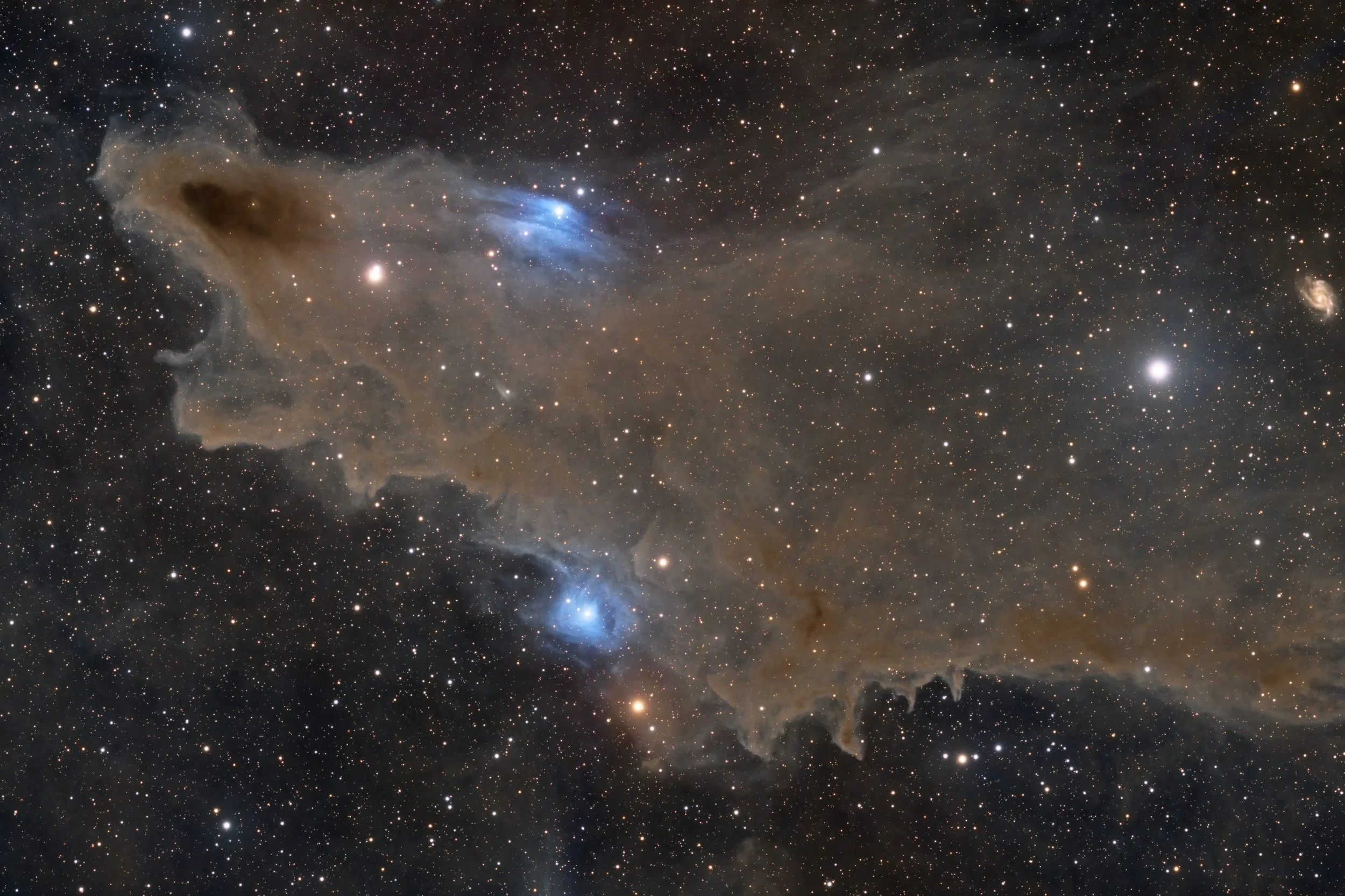
A Shark in Cepheus
Image Description and Details :
The Shark Nebula, a large, faint molecular dust cloud in the constellation Cepheus lies around 650 light years distant. The cloud was nicknamed the Shark Nebula since it looks like a shark in wide field images. Within the molecular cloud are several objects. LDN 1235 is a dark dusty patch near the head of the shark. Two beautiful blue reflection nebula, lit up by hot B8IV stars lie above and below. VdB 150 is the top reflection nebula and VdB 149 is the bottom one. Off near the right edge is the galaxy PGC 67671 lying some 50million light years distant. The image was taken at the Okie Tex Star Party in October of this year.Stellarvue SVX 152 refractor at f8, ZWO ASI 6200 camera riding on a Paramount MyT. Image acquisition controlled by the Voyager. The image is LRGB.Luminance: 435min, Red: 185min, Green: 190min, Blue: 195min for a total of 16hrs 45min. Processing done with
Copyright: Jonathan Talbot

BARNARD'S LOOP WIP
Image Description:
5 Panel mosaic, with faux filler for missing panel
38 X 420 second exposure for each panel
Starlight Xpress M25 C
C 14 Hyperstar
Copyright: JP PECORINO

NGC 6559
When stars form, pandemonium reigns. A textbook case is the star forming region NGC 6559. Visible above are red glowing emission nebulas of hydrogen, blue reflection nebulas of dust, dark absorption nebulas of dust, and the stars that formed from them. The first massive stars formed from the dense gas will emit energetic light and winds that erode, fragment, and sculpt their birthplace. And then they explode. The resulting morass can be as beautiful as it is complex. After tens of millions of years, the dust boils away, the gas gets swept away, and all that is left is a naked open cluster of stars.
Taken from SWOS in El Sauce, Chile
24” PlaneWave CDK (LRGBHA)
Copyright: Mark Hanson
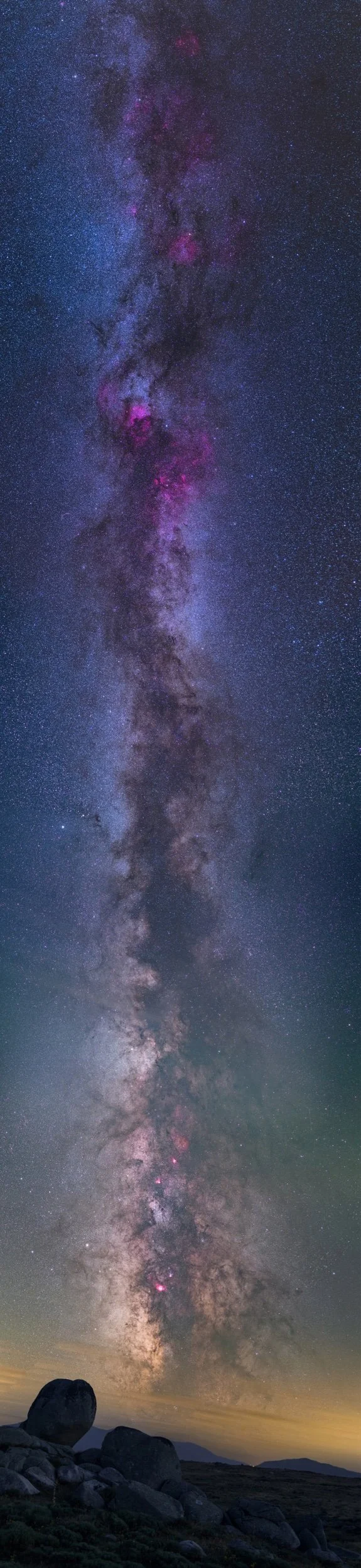
Panoramic view to the stars
Image Description and Details :
Here is a vertical panorama that I made ln august.
It has been shot in Cévennes in France. I choose this location because of the granite rocks which are interesting foreground for my photos. The spot was lost in the middle of nowhere juste next to a very little countryside road, but there were so much cars that takes this road with full headlights…
Initially the panorama was smaller but then I had the idea to combine it with another panorama of the Milky Way with the cygnus region that I had done with the same technique and the same equipment (Canon 6D + Sigma 50mm).
For Pano 1 (Sky + lower part of milkyway) each tilt is a stack of 6 pictures 30sec ISO-3200 f2.8. For the sky part there are 3 row of 3 tiles and one row with 2 tiles. For the foreground it's a row of 3 tiles that has been shot in the blue hour juste before the night with those settings : ISO-1250 | f5.6 | 1/5sec
For Pano 2 each tile is a stack of between 7 and 10 shots. There are 3 row of 3 tiles.
Equipment :
- Canon 6D Astrodon moddified
- Sigma Art 50mm
- Sywatcher Star Adventurer
Processing :
- For each panel (sky & foreground) stacked on Sequator
- Adjust each panel on Photoshop (curve and Camera raw filter)
- Assemble the panoramo on PTGui
- Final adjustments (crop and Camera raw filter) on Photoshop
Copyright: Martin GIRAUD
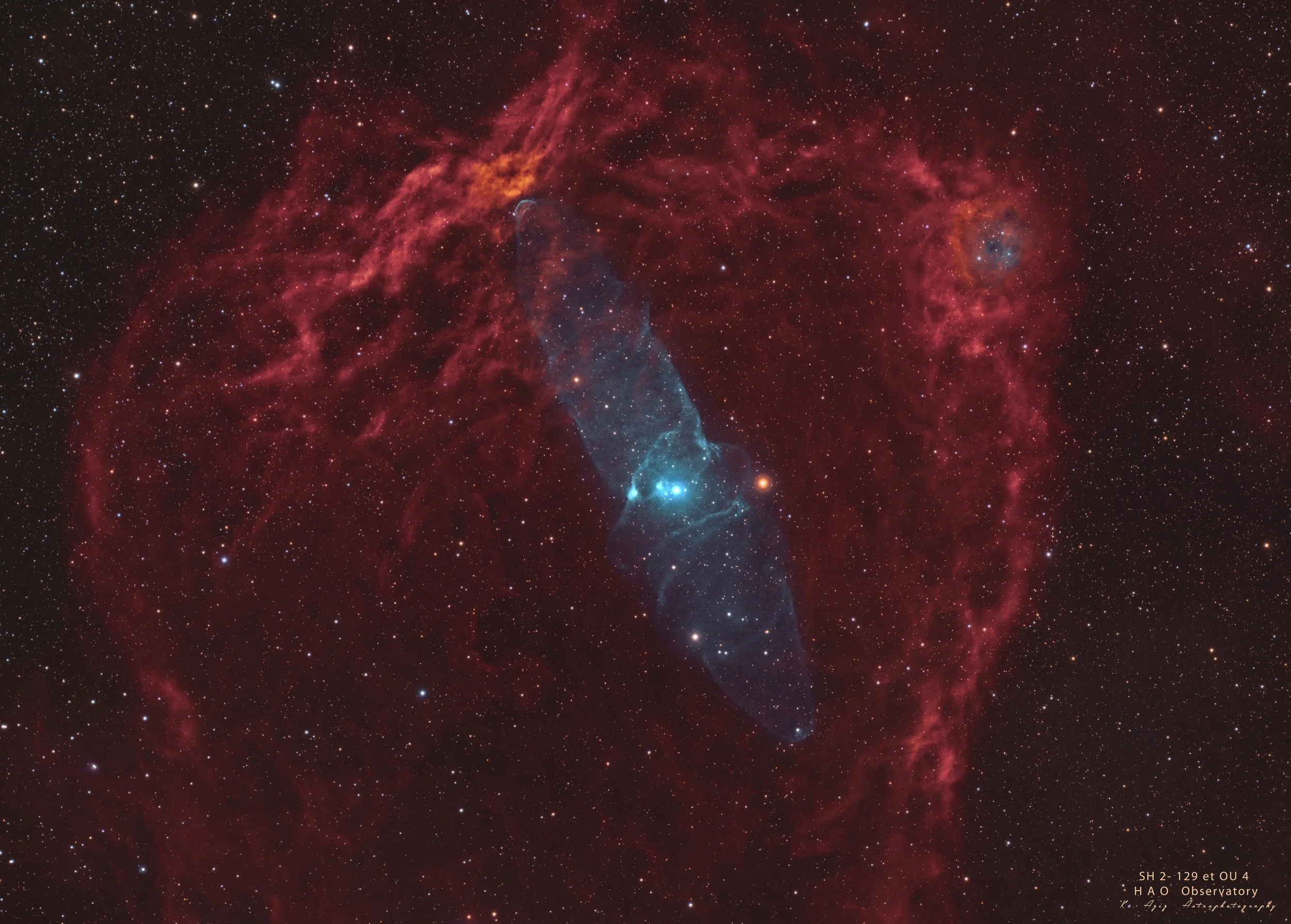
Flying Bat Nebula and Squid Nebula
Image Description and Details :
I present you my last acquisition since the setup HAO_4. these are two nebulae including one (Ou4) discovered by my friend the French astrophotographer Nicolas Outters in June 2011. This is the Giant Squid (in blue/green in the image) which is a bipolar planetary nebula located about 2000 light-years from Earth surrounded by the Flying Bat Nebula (cataloged Sh2-129 in red), both are located in the direction of the cepheus constellation.
Technical details:
- Apo Takahashi FSQ 85 to F/D 5.3
- iOptron 60 cem ec mount
- Asi 2600 mm pro
- Astronomik filters 6nm
- 205x300s HA : 17 h 05 min
- 188x600s O3 : 31 h 20 min
-181x300s S2 : 15 h 05 min
- 3 x 30 x 60s RGB : 1 h 30 min
- Full integration: 49 h 55 min
- DOF: 33/101/25
- Date: October/november 2021
- Location: HAO Observatory, Oukaimeden, Morocco.
Copyright: K. Aziz

M42 and Running Nebula
I Image Description and Details :
Setup: Skywatcher 200/800 + Qhy10 CCD + Optolong L-Pro/ Neq6 rowan Mod / 50mm guide scope + asi 120 mm mini / 36*300s, gain 3 temp -10
Zone: Penne (Italy), bortle class 5/6
Copyright: Mazzocchetti Marco
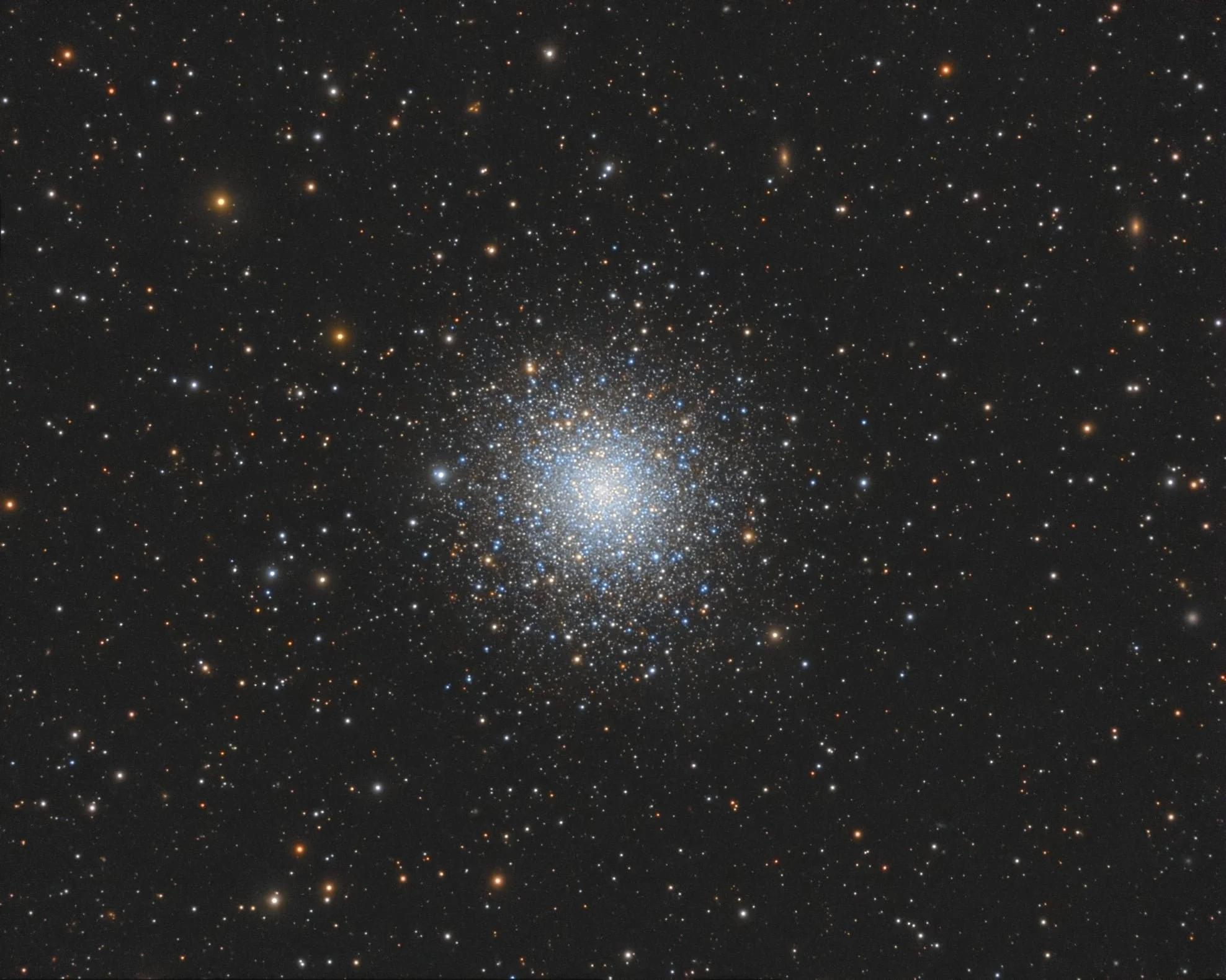
m92
Image Details
Messier 92 (also known M 92, or NGC 6341) is a globular cluster of stars in the northern constellation of Hercules. It was discovered by Johann Elert Bode in 1777, then published in the Jahrbuch during 1779. It was inadvertently rediscovered by Charles Messier in 1781 and added as the 92nd entry in his catalogue. It is about 26,700 light-years away from the Solar System. It is one of the brighter of its sort in apparent magnitude in the northern hemisphere and in its absolute magnitude in the galaxy, but it is often overlooked by amateur astronomers due to angular proximity to bright cluster Messier 13, about 20% closer. It is visible to the naked eye under very good conditions.
This image taken in September 2021.
L-channel - 60 x 150 sec. bin 1x1;
R-channel - 24 x 150 sec. bin 1x1;
G-channel - 24 x 150 sec. bin 1x1;
B-channel - 24 x 150 sec. bin 1x1.
Total integration time about 05:30 hours.
My setup: Telescope 8" Celestron Schmidt-Cassegrain (SCT) CPC800 GPS (XLT) on the equatorial wedge, focal reducer Starizona Night Owl 0.4х, Feq=864mm, camera Starlight Xpress Trius SX694, SX mini filter wheel, filters Astrodon LRGB E-series gen.2 .
Capture and processing software: MaxIm DL6, PHD2, PixInsight, StarTools, Photoshop CC, Zoner photo studio 14.
North at the top.
Copyright: Boris Vladimirovich
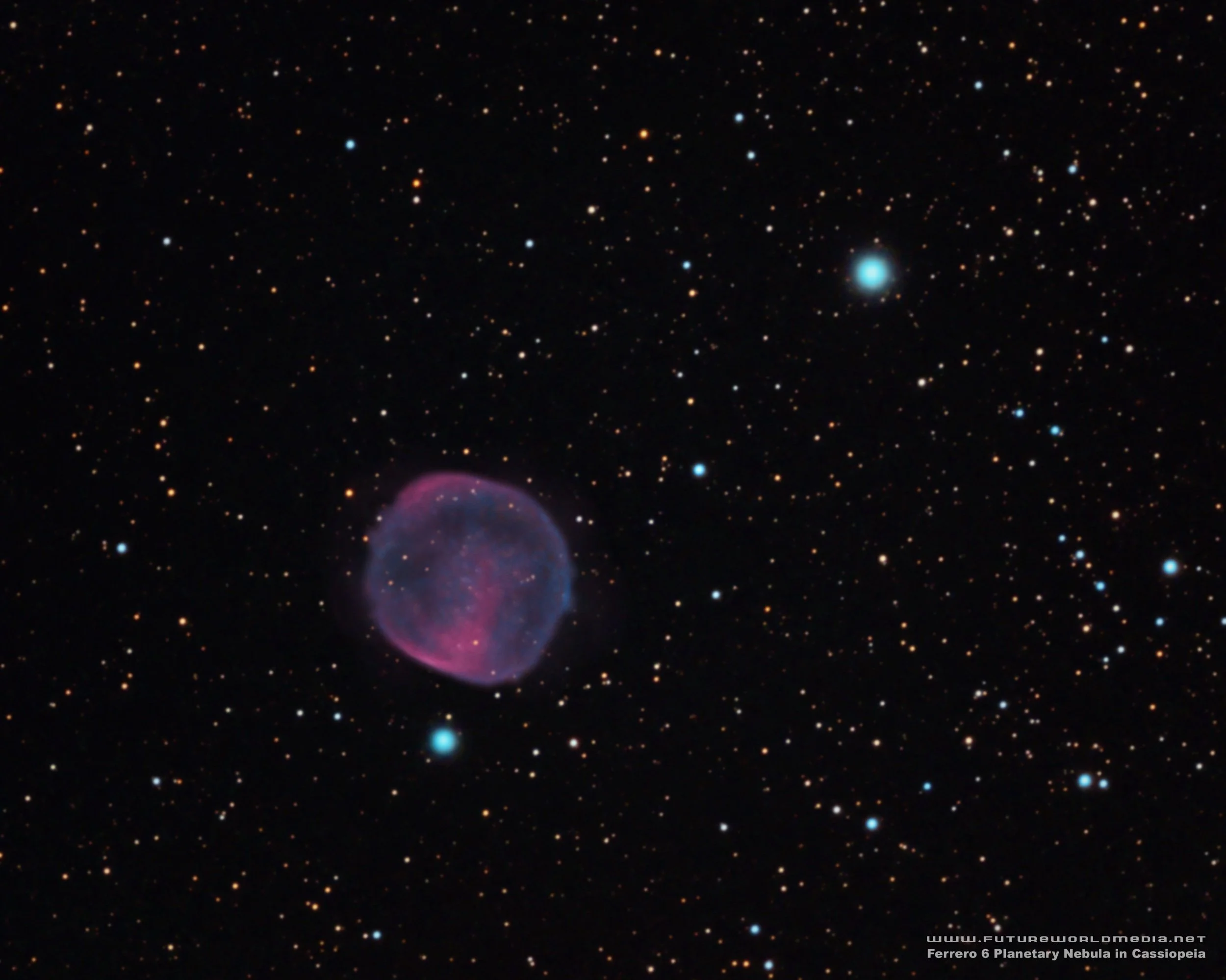
Ferrero 6 (Fe 6) Planetary Nebula
Image Description and Details : I have been capturing Ferrero 6 for two months on my second rig. Typically here in Michigan USA, the autumn has the most amount of clear nights out of the year. Subsequently I planned on a deep space object that was very faint and challenging. Unfortunately this autumn was not typical at all with a major amount of cloudy nights and precipitation, like the rest of this past year here. Even with the amount of integration time I piled on, I really had to massage the data pretty hard. Very few have attempted to capture it, so I thought I would give it a try.
Ferrero 6 (Ferrero 6 • Fe6 • PN G129.6+03.4) Planetary Nebula was discovered as part of the IPHAS survey. It's spectroscopically was confirmed as a true planetary nebula by the professional astronomer Laurence Sabin in September 2011. It has also been independently discovered by the French amateur astronomer Laurent Ferrero in 2013. Its structure consists of a low surface brightness bubble with a size of 3.5 arcminutes, which is accentuated by a thin bright rim on the outside. It is very likely to be an ancient evolved planetary nebula that is interacting with the interstellar medium.
Copyright: Copyright: Douglas J Struble

Thor's Helmet
Image Description and Details :
Popularly called Thor's Helmet, NGC 2359 is a hat-shaped cosmic cloud with wing-like appendages. Heroically sized even for a Norse god, Thor's Helmet is about 30 light-years across. In fact, the cosmic head-covering is more like an interstellar bubble, blown with a fast wind from the bright, massive star near the bubble's center. Known as a Wolf-Rayet star, the central star is an extremely hot giant thought to be in a brief, pre-supernova stage of evolution. NGC 2359 is located about 15,000 light-years away toward the constellation of the Great Overdog. This remarkably sharp image is a mixed cocktail of data from broadband and narrowband filters, capturing not only natural looking stars but details of the nebula's filamentary structures. The star in the center of Thor's Helmet is expected to explode in a spectacular supernova sometime within the next few thousand years.
Location/Date – El Sauce, Chile
Imaging System – Planewave CDK17, FLI ML16803, Chroma HaO3RGB filters, 10 Micron GM3000
Exposure – HORGB, 27.5 hours
Copyright: Good Astronomy

Comet A1 Leonard
Image Description:
C /. A1 Leonard, the first comet discovered by mankind in the year of., has recently become better. According to predictions, it will become the brightest comet of the year, and is expected to reach a level visible to the naked eye next month. Of course, don't expect to compare to last year's new intelligent comet, at best, a little comet that is visible in a binoscope.
Comet Leonard is a long-period comet, previously orbital period of about years. On December, it will fly Venus, most recently only kilometers. On January, next year, it will pass through the close point of this return. Later, it will move further along a double-curved orbit, likely never to return near the Sun again.
This is sometimes the same in life, don't know how many people or things will be seen after first sight?
November,,,,,, Newton reflector + QHY268M Black and White Refrigeration Camera + Ulong 2 LRGB Filter + Eton CEM120 Equator, focal length 1000 mm, f / 4, refrigeration-15°C, 55 Zhang * seconds, accumulates exposure to minutes.
Copyright: Steed Yu
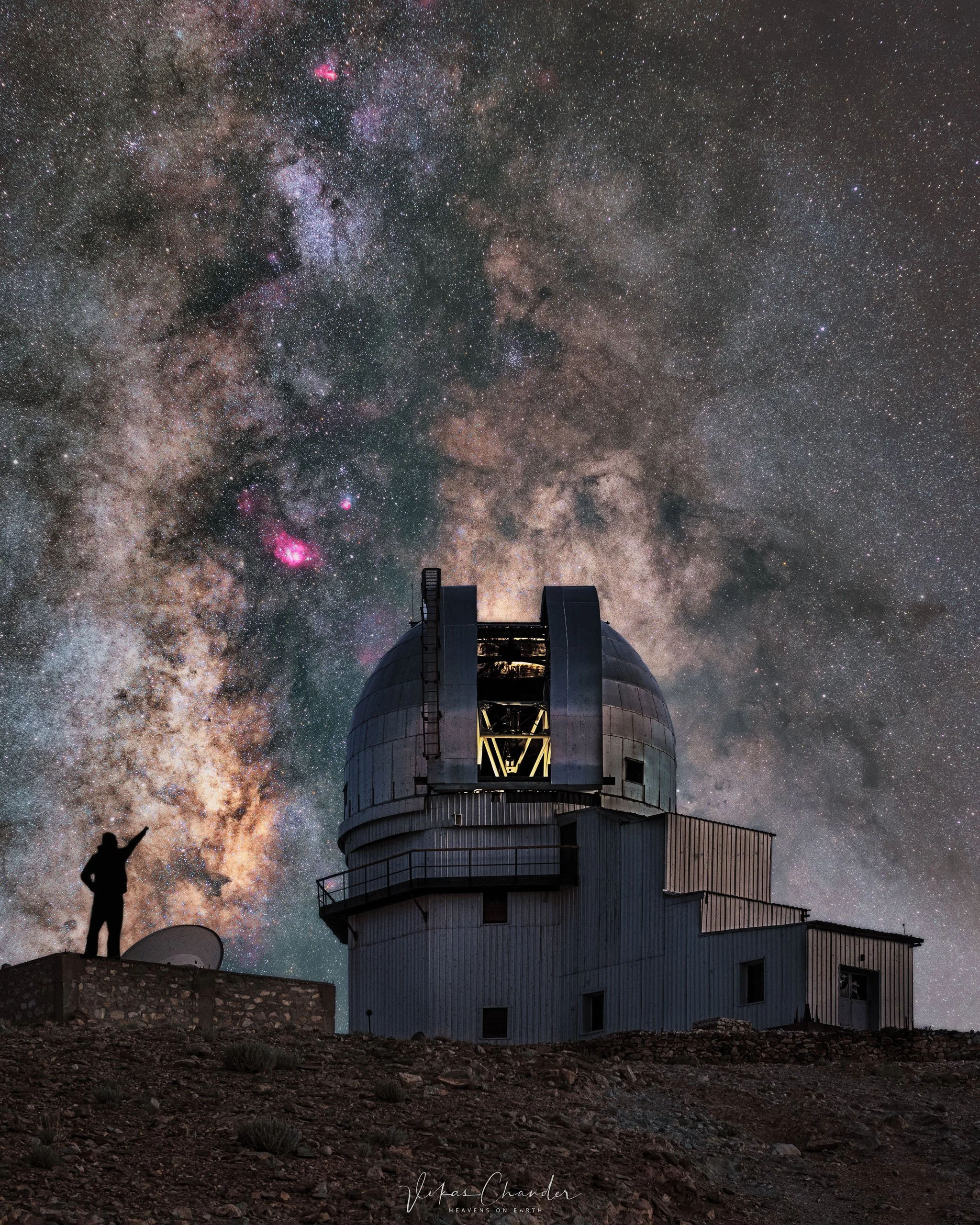
Himalayan Chandra Telescope
Image Description and Details :
The Indian Astronomical Observatory (IAO), located in Hanle near Leh in Ladakh, India, has one of the world's highest sites for optical, infrared and gamma-ray telescopes. It is currently the tenth highest optical telescope in the world, situated at an elevation of 4,500 meters. Accessing the observatory, located near the Chinese border, requires a six hour drive from Leh, the capital city of Ladakh. The location is deemed to be excellent for visible, infrared and millimeter observations throughout the year due to its low temperatures, humidity, and light pollution. The Himalayan Chandra Telescope is a 2 meter optical-infrared telescope named after Nobel laureate Subramaniam Chandrasekhar. It is a modified Ritchey-Chretien system with a primary mirror made to withstand low temperatures. Imaging instruments include a Faint Object Spectrograph, a near infra-red and an optical CCD camera. The telescope is remotely operated via an INSAT-3B satellite link which allows operation even in sub-zero temperatures in winter.Camera – Sony A7iiiLens – Sony 50mm F1.4Tracker – Fornax LighttrackIIForeground – F11 30 secs iso 800Sky – F4 480secs iso 400Software - PixInsight and Photoshop
Copyright: Vikas Chander
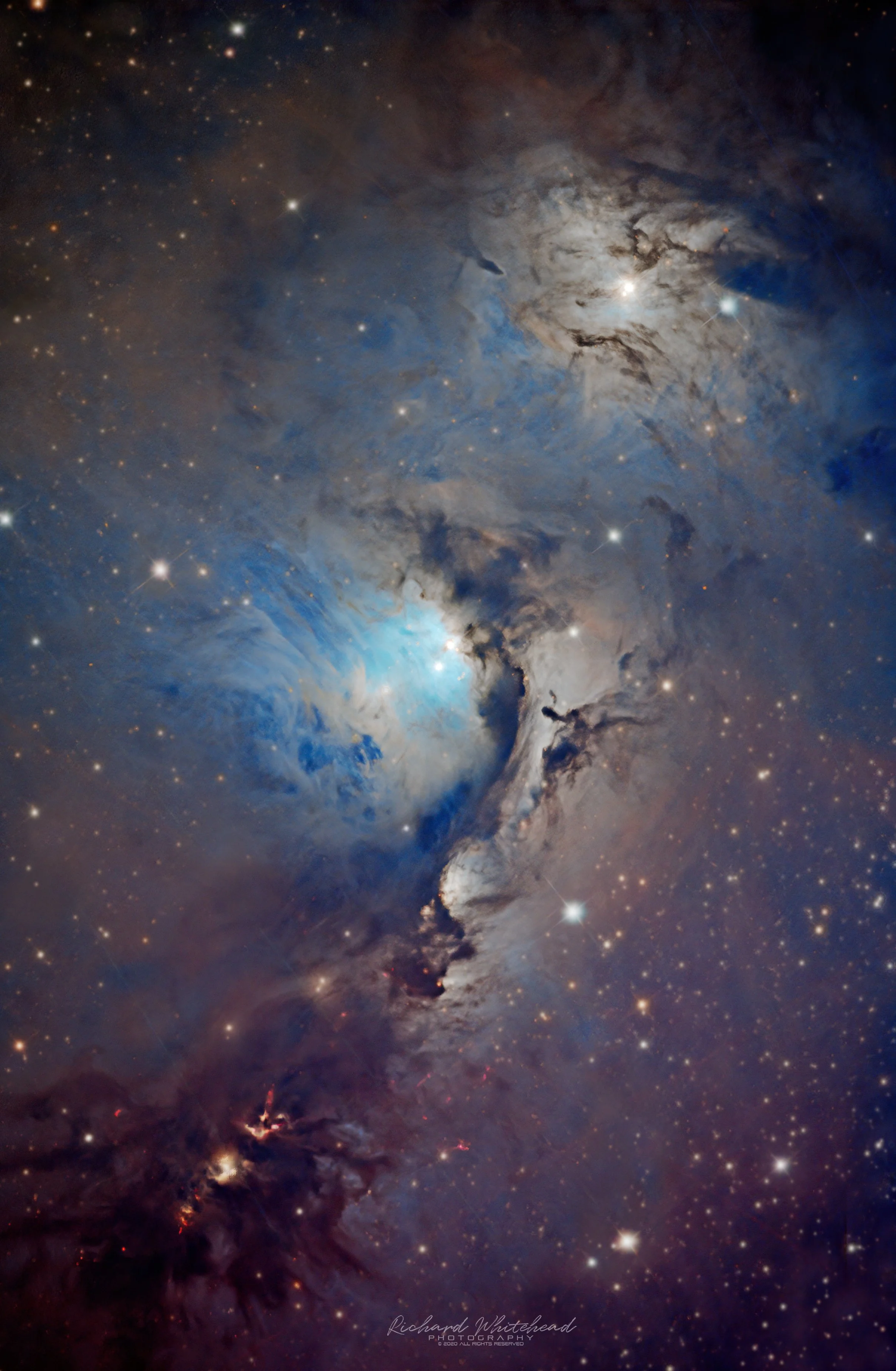
M78
Squarespace <form-submission@squarespace.info>
Sun, Nov 21, 11:45 PM (9 hours ago)
to me
Sent via form submission from
Image Title: M78 -Stellar Birthplace
Upload your image file, please make your file name as unique as possible!: https://drive.google.com/open?id=1wfHP-6MgmX56a8kce4KuHX1mnfhO5BgR
Video Link?:
Date image was taken: 11/12/2021
Image Description and Details : Messier 78 is the other (IMHO) "great" nebula in Orion, sitting just above Orions' belt. M87 and its companion nebulae NGC2064, NGC2967, and NGC2071 are reflection nebulae in the Orion B molecular cloud. Reflection nebulae are where surrounding gas and dust is illuminated by stars.
They are usually blue in color, and for the same reasons our home world skies are blue.
The curvilinear shapes are carved out by the stellar wind of some very energetic stars.
M78 is the bright area in the center of the image, to the right of this there is a swirl of dust that looks just like the eye-wall of a hurricane, and the side lighting gives some 3-D information about the structure.
Lower to the left there is a dark nebula with tendrils and orange/red light peeping through, this is a stellar birthplace and home to 17 Herbig-Haro objects (energetic jets from new born stars)
I shot this image over 6 nights from the New Mexico desert, M78 still being a late riser so this image was shot at low elevation in the early hours of the morning. This is a full-frame image with minimal cropping at 2560mm focal length @ f7.
Tech stuff:
Scope : Planewave CDK14
Mount : Planewave L-350
Camera : ZWO ASI 6200 MM Pro ZWO filter wheel Astronomik filters
24 x 10 min Red
20 x10 min Green
18 x10 min Blue
All unguided. Darks no flats.
Shot as Bin 1 downsampled to Bin 2x2 in Pixinsight
Copyright: Richard Whitehead 2021