

AAPOD2 Image Archives
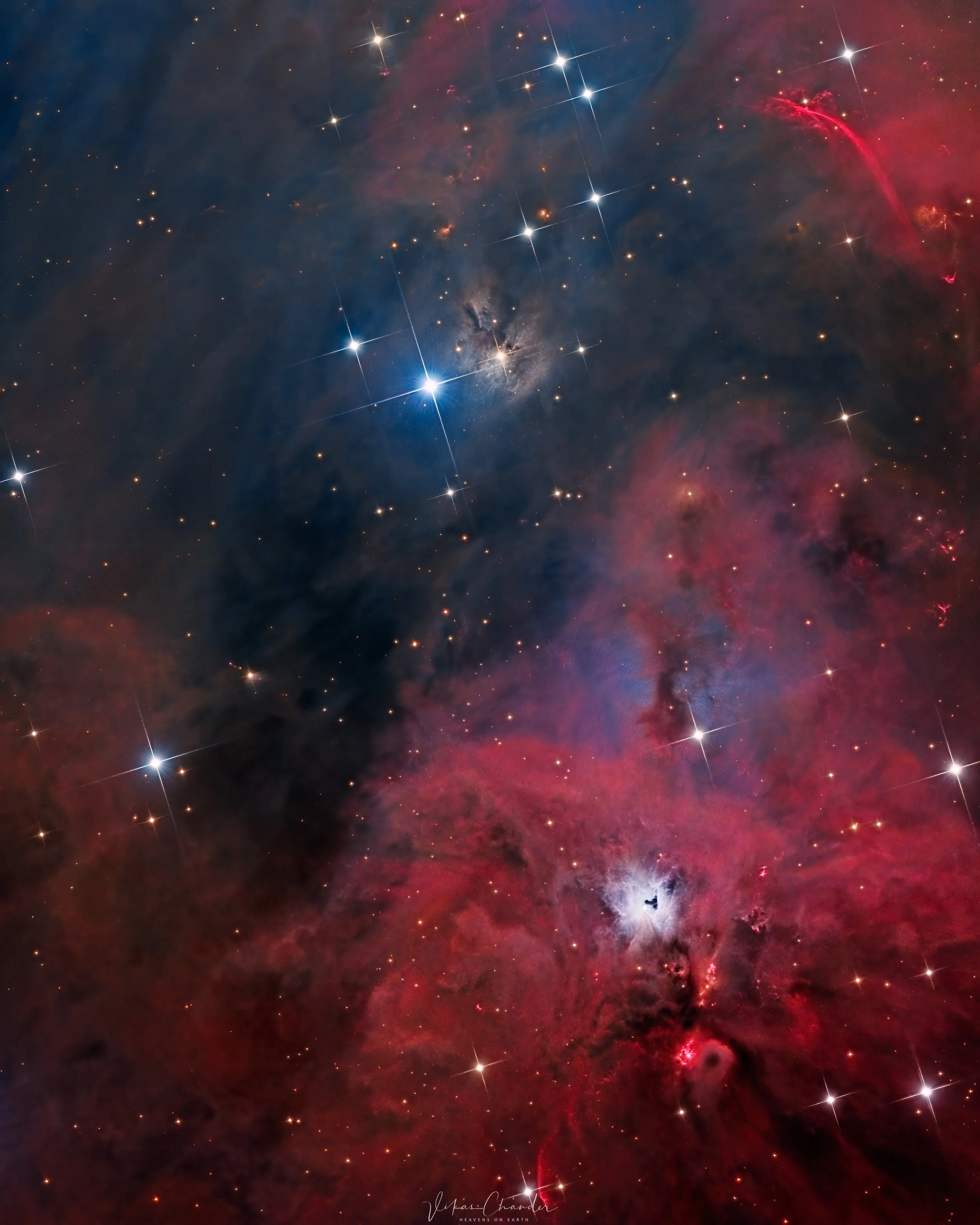
NGC 1999 Reflection Nebula
Image Description and Details :
One of the first images taken after NASA astronauts repaired the Hubble Space Telescope in December 1999, was NGC 1999, a nebula in the constellation Orion. While the Hubble image was much deeper than the image presented here, it nevertheless generated a lot of interest amongst astronomers. NGC 1999 is an example of a reflection nebula. Like fog around a street lamp, a reflection nebula shines only because the light from an embedded source illuminates its dust; the nebula does not emit any visible light of its own. NGC 1999 lies close to the famous Orion Nebula, about 1,500 light-years from Earth, in a region of our Milky Way galaxy where new stars are being formed actively. NGC 1999 was discovered some two centuries ago by Sir William Herschel and his sister Caroline, and was catalogued later in the 19th century as object 1999 in the New General Catalogue.Total Integration 24h40mLum 14x20m=4h40mRed 14x20m=4h40mGreen 14x20m=4h40mBlue 17x20m =5h40mHa = 10x30m=5h00m
Copyright: Vikas Chander

Uranus
Image Description and Details :
After several weeks of a bad weather, the last night i am able to found good seeing conditions. The North Polar region results to be quite bright. The bright pole extends up to - 45°N. No relevant atmospheric activity in its upper layer clouds has been observed. Currently the Ice Giant planet is located about 19.7AU (2.95 bilion km) from the Earth.The false color image is only for aesthetic reasons.Setup: C14 EDGE HD, Fornax52 mount, ASI 290MM, Barlow Zeiss, Baader R+IR610nm.Below some Planet data:Solar Longitude Ls: 44°Declination of Earth De: +52.3°Diameter: 3.6 arc sec Agerola-Amalfitan Coast-Italy
Copyright: Luigi Morrone

Orion Constellation & Barnard loop
Image Description and Details :
Here is my post on this Orion photo and the Barnard loop, I spent the only clear night without a moon to try the samyang 135mm f2, because I wanted to have fun doing astrophotography. I absolutely wanted to shoot the constellation of Orion and the loop of Barnard. It was complicated to image it with a more than hazardous seeing but on 210 shots of 120 seconds I kept only 100 raw. After processing tests, I was happy with my final treatment.
Samyang 135mm at f2.8Canon 6D Iso 1600 Photomax Heq5 pro100 brutes x 120''Copyright: Oliver Globetrotter & P. Bernhard

Abell 30
Image Description and Details :
Abell 30 is a small (127 arc seconds) extremely faint planetary nebula located approximately 5,500 light-years away in the constellation of Cancer. Abell 30 is one of just three known nebulae called born-again planetary nebulae. Very rarely, nuclear reactions within the vicinity of a white dwarf can heat the gases to such high temperatures that the tiny star briefly becomes a red giant once more. This is a very brief phase, lasting a mere 20 years or so. The original nebula is estimated to be around 12,500 years old (which in itself is very brief in astronomical terms). The tiny features in the centre of the bubble are evidence of this re-birth. They are most probably comprised of helium and carbon-rich materials and were ejected around 850 years ago.The Ha signal is a featureless disk. All of the structural detail comes from the OIII signal. Image captured on my remote dual rig at Fregenal de la Sierra in Spain between 14 December 2021 - 9 January 2022.Scopes: APM TMB LZOS 152 Refractors Cameras: QSI6120wsg8Mount: 10Micron GM2000 HPSA total of 102 hours image capture (HaOIIIRGB)
Copyright: Peter Goodhew

Supernova remnant IC443-444
Image Description and Details :
Image captured during 7 nights from bortle 9 backyard. Total exposure time of 38h with individual subframe of 10min for each filter SHO.Also included data from Chandra telescope to enhance the xray area in the center of ic443 where there is a neutron star probably leftover from the supernova.
Copyright: Riccardo Pacini

The Hidden Galaxy
Image Description and Details :
IC 342 or the Hidden Galaxy in the constellation Camelopardalis gets its name due to its location in the dusty areas near the Milky Way galactic equator.This image was obtained thought a Meade LX850 12" telescope with QHY268m camera and Chroma filters.Integration time is 12.50 hours (Lum 53x300", Red 24x300", Green 24x300", Blue 24x300" & Ha 12x600")
Copyright: Fabian Rodriguez Frustaglia

Heart of the Heart Nebula
Image Description and Details :
Our first picture with our remote imaging setup in south Portugal (Alelentejo Remote Observatory managed by the ARO TEAM).
Our team named AstroDarkTeam is a team of two passionate french amateur astronomers : Stephane Rolland and Pascal Gouraud
We have installed our setup in south Portugal (EQ8-R + TOA130) on mid-october 2021 and we have been imaging since end of October 2021.
Our first target is IC1805 an emission nebula and star cluster Melotte 15.
Clouds in this area are sculpted by stellar winds and radiation from massive hot stars in the nebula cluster, Melotte 15 (about 1.5 million years young).
This 15 light-years wide field view includes emission from ionized hydrogen, sulfur, and oxygen atoms.
The Heart Nebula. IC 1805 is located about 7,500 light years away toward the constellation Cassiopeia.
Regarding imaging sessions, We have got some issues with thermal amplitude and humidity.
Some improvements still to be done regarding subframe exposure (moving to 15 or 20 minutes) and better subframe selection.
Regarding processing, we have been unable to integrate LRVB shots to improve star colors, so still to be improved for future pictures.
For a first run, we are quite happy with this result.
Copyright: Pascal Gouraud / AstroDarkTeam
Variable stars in the Pleiades cluster
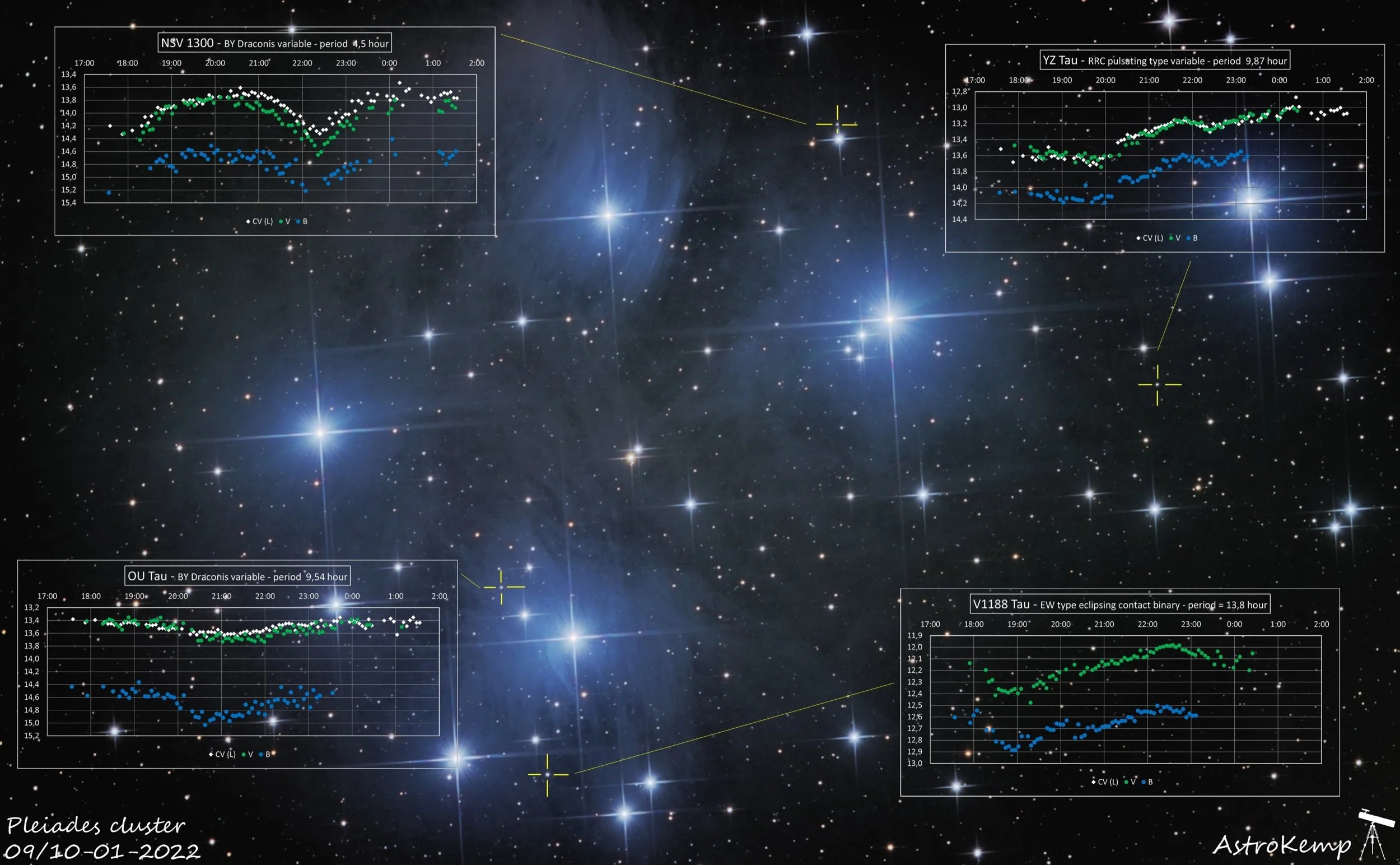
Image Description and Details : There are a lot of variable stars in the Pleiades cluster. About 60 were identified in this view using the AAVSO star charts.
4 of those showed clear variability in my recordings of 9-1-2022
NSV 1300. which is of type BY Draconis variables. These are rotating variables, usually type K or M, so orange/red stars. What you see here are starspots (sunspots on a star) spinning in and out of view. It revolves in 4.5 hours and you see almost 2 laps.
V1188, is an eclipsing binary star with a period of 13.88 hours. It varies between 12.3 and 11.85.
YZ Tau also shows variability. This is an RR Lyrae type variable. with a period of 9 hours. These are pulsating stars that shrink and grow periodically.
Here you can already see a contraction (getting hotter) and expansion (getting colder) of the star.
OU Tau is also a BY type star, a rotating star with a stellar spot on it. It rotates in 9.5 hours. In this case you can already see 1 cautious dip when the starspot rotates in and out of our image
Copyright: Remco Kemperman
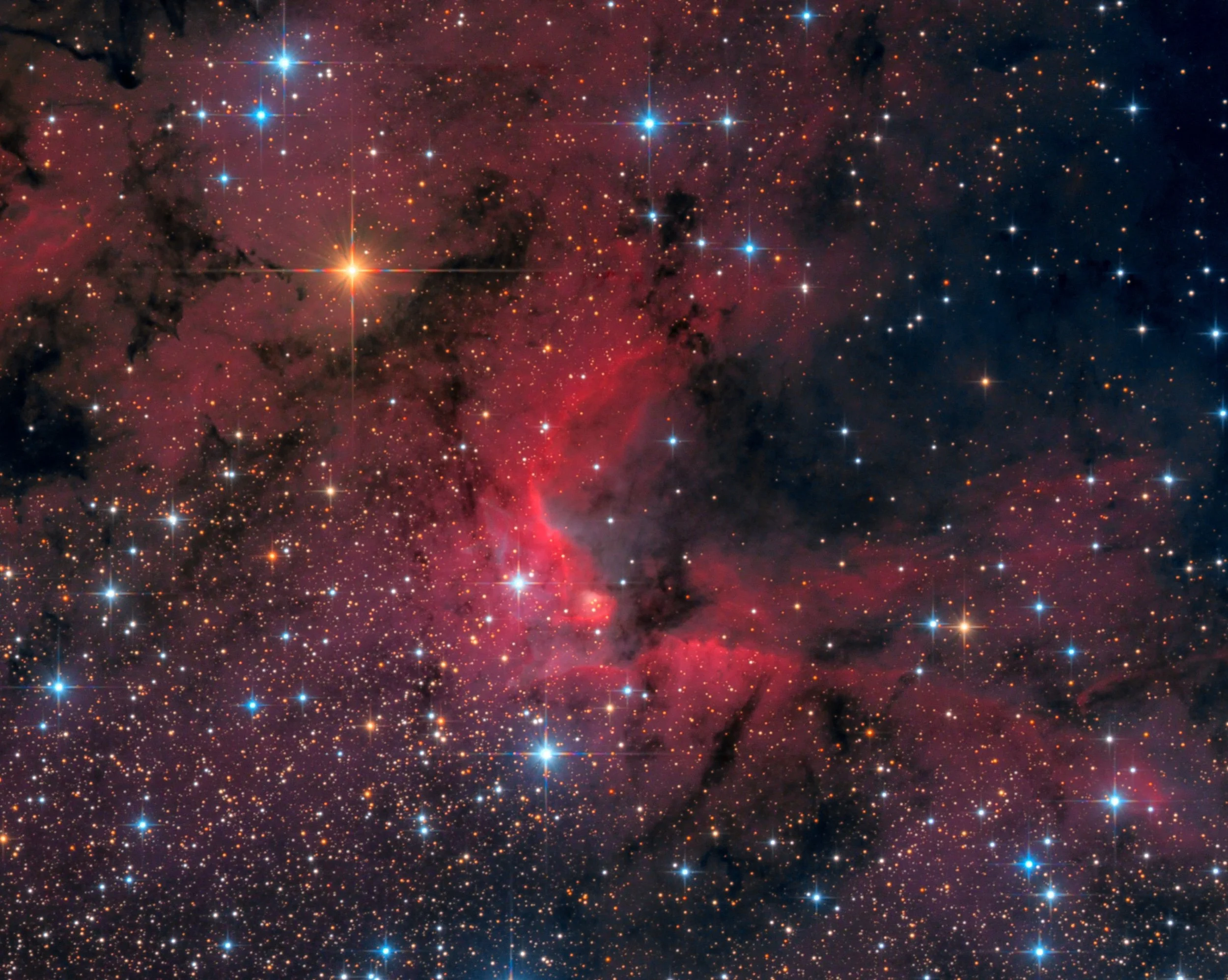
Sh2-155
Image Description and Details :
Sh2-155 (also designated Sharpless 155 or S155) is a diffuse nebula in the constellation Cepheus, within a larger nebula complex containing emission, reflection, and dark nebulosity. It is widely known as the Cave Nebula. Sh2-155 is an ionized H II region with ongoing star formation activity, at an estimated distance of 725 parsecs (2400 light-years) from Earth.
Copyright: Sergiy Vakulenko

Solar Analemma
Image Description and Details :
A year-long project done! Here’s the product of several days of taking photos of the Sun from the same spot at the same time throughout the year and combining these images into one striking photo.
It’s called an analemma, a diagram of the Sun’s position in our sky that varies over the course of the year because of our planet’s tilt and elliptical orbit.
The loops resembling the figure of 8 actually represent the seasons we experience here in the Northern Hemisphere: the narrow loop shows where the Sun is traveling in our sky during the summer months (June-early September), while the bigger loop shows the position of the Sun during the winter months (December-early March).
I took the 43 photos of the Sun that made up this composite image. These were taken every week from January 9 to December 25, 2021, with the Ak Sadeem Observatory as the foreground element. Post-processed in Photoshop 2020.
Equipment used: Canon Ra DSLR, Tamron 14-24mm lens, Baader solar filter. Abu Dhabi, UAE.
Copyright: Aldrin B. Gabuya/Al Sadeem Observatory
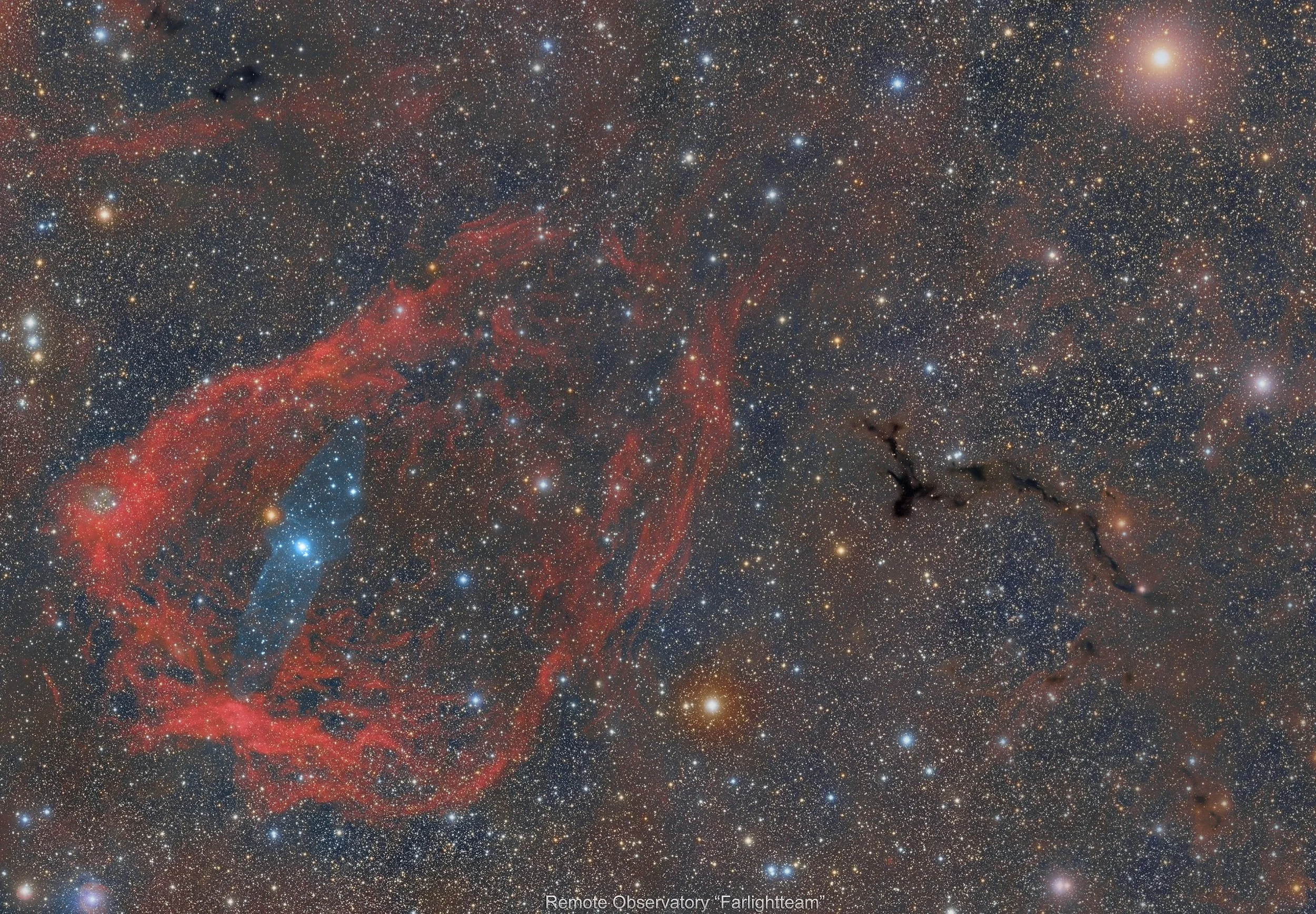
Sh2-129 / OU4 / Barnard 150
Image Description and Details :
This image has been made from 343 hours of exposure through broadband (LRGB) and narrowband (H-alpha & OIII) filters, composed as an 8-panel mosaic. The result covers an area of approximately 3.50° x 5.10° at 2.09 arc''/pixel resolution. Placed on the surroundings of the constellation Cepheus, this area is rich in several DSOs: We can see Sh2-129, also known as the Flying Bat Nebula, a large and faint HII region showed here in its characteristic H-alpha deep red line.
Superposed to Sh2-129 we see the even fainter Ou4 nebula, colloquially the Giant Squid Nebula, discovered in 2011 by Nicolas Outters, a French amateur astronomer. At first identified as a planetary nebula emitting in the OIII blue-green doublet, it would be in fact the largest in apparent size yet identified, extending over one degree (Acker et al. 2012 - arXiv:1206.2477). However, Corradi et al. (2014 - arXiv:1407.4617) describe Ou4 as the result of a bipolar outflow emanating from a massive component of HR 8119, a triple system located 2,300 light-years away, thus about as far as Sh2-129. If confirmed, this would make it a truly perplexing object.
On the right side of this image appears Barnard 150, or Seahorse Nebula, a dark nebula distant 1,500 light-years, composed by three dense star forming cores, part of an elongated molecular cloud complex. Finally, close to the lower-left end we have identified HD 203025, a Be type star surrounded by a diffuse red nebulosity, captured here through the H-alpha filter. It was catalogued according to its colour and morphology as an IR centred nebula by Bodensteiner et al. (2018 - arXiv:1806.01294), resulting from a massive star member of an interacting binary system.
Technical data:
Telescope: Takahashi FSQ106 ED 530mm f/5
CCDs: QSI683 wsg8
Filters: Baader Planetarium -LRGB Ha OIII
Mount: 10Micron GM1000 HPS
Imaging Software: Voyager
Processing Software: Astropixel, Adobe PS, PixInsight
Imaging Data:
8-panel mosaic captured through July 2021 to December 2021
RGB: 170 x 600” (each). Total 84 hours.
Luminance: 280 x 900”. Total 70 hours.
Ha: 316 x 1200”. Total 106 hours.
OIII: 165 x 1800”. Total 83 hours.
Total Project : 343 hours
Copyright: Remote Observatory "FarLightTeam"
Team: José Esteban, Jesús M. Vargas, Bittor Zabalegui, Marc Valero.
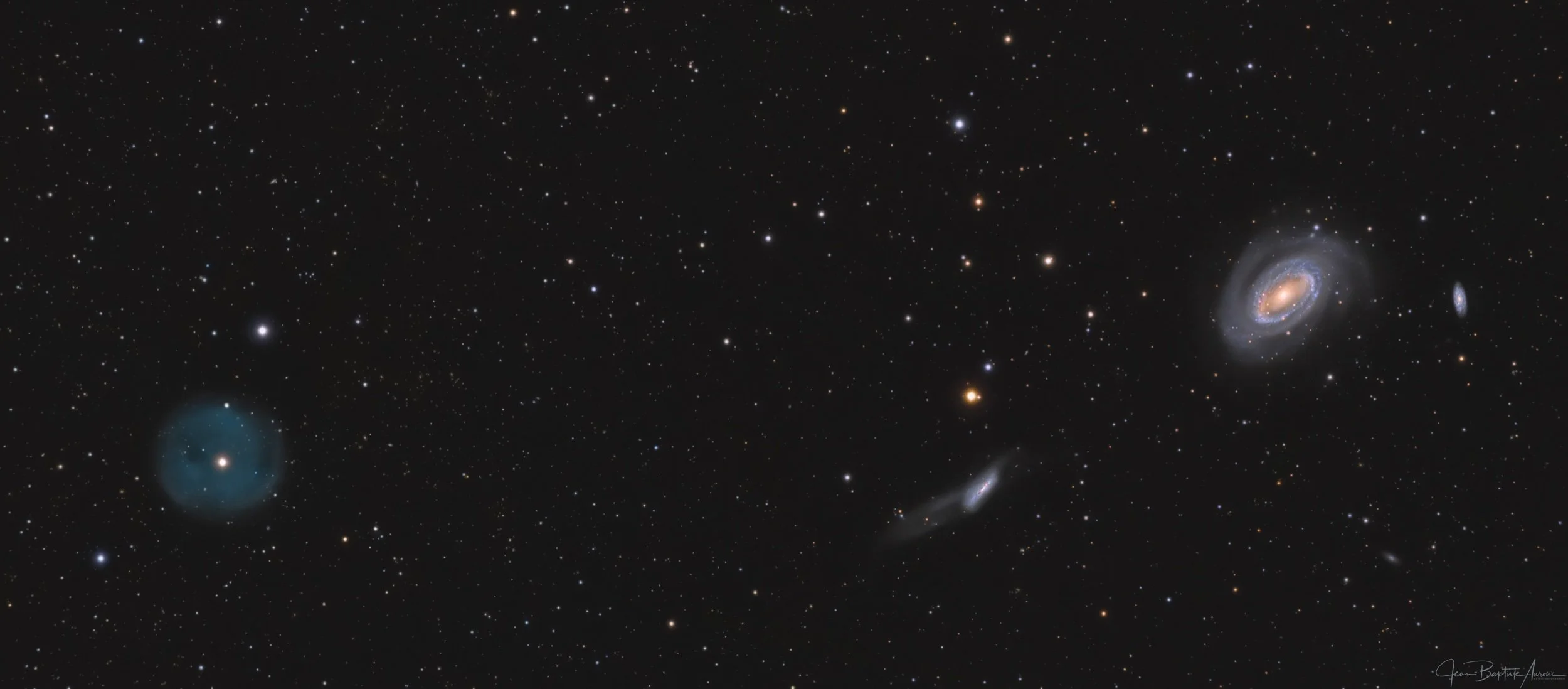
Cosmic perspective : NGC 4725 Group & LoTr 5
Image Description and Details :
Here is a mosaic of 2 images with the main galaxies of the group NGC 4725 (located at about 55 million light-years) and the planetary nebula LoTr5, discovered in 1980 and located "only" at 1650 light-years from us!
The small galaxy NGC 4712, to the right of NGC 4725, is located more than 200 million light-years away.
A beautiful "cosmic perspective" with these different objects!
Mosaic of 2 images in LRGB + OIII. !
The framing of the first image was not intended for a mosaic with the nebula field, so an important part of the final field had to be cropped. The difference in sky quality resulted in a poor homogeneity of the sky background and a difficult connection between the two images, which did not facilitate the processing of this one.
A lot of time spent on processing to achieve a homogeneous result and highlight the nebula.
LRGB+OIII version
TSA102 - AtikOne6.0 - AZEQ6
L : 32 x 600s bin 1
RGB : 72 x 300s bin2
OIII : 18 x 600s bin2
Total : 14h20
Copyright: Jean-Baptiste Auroux
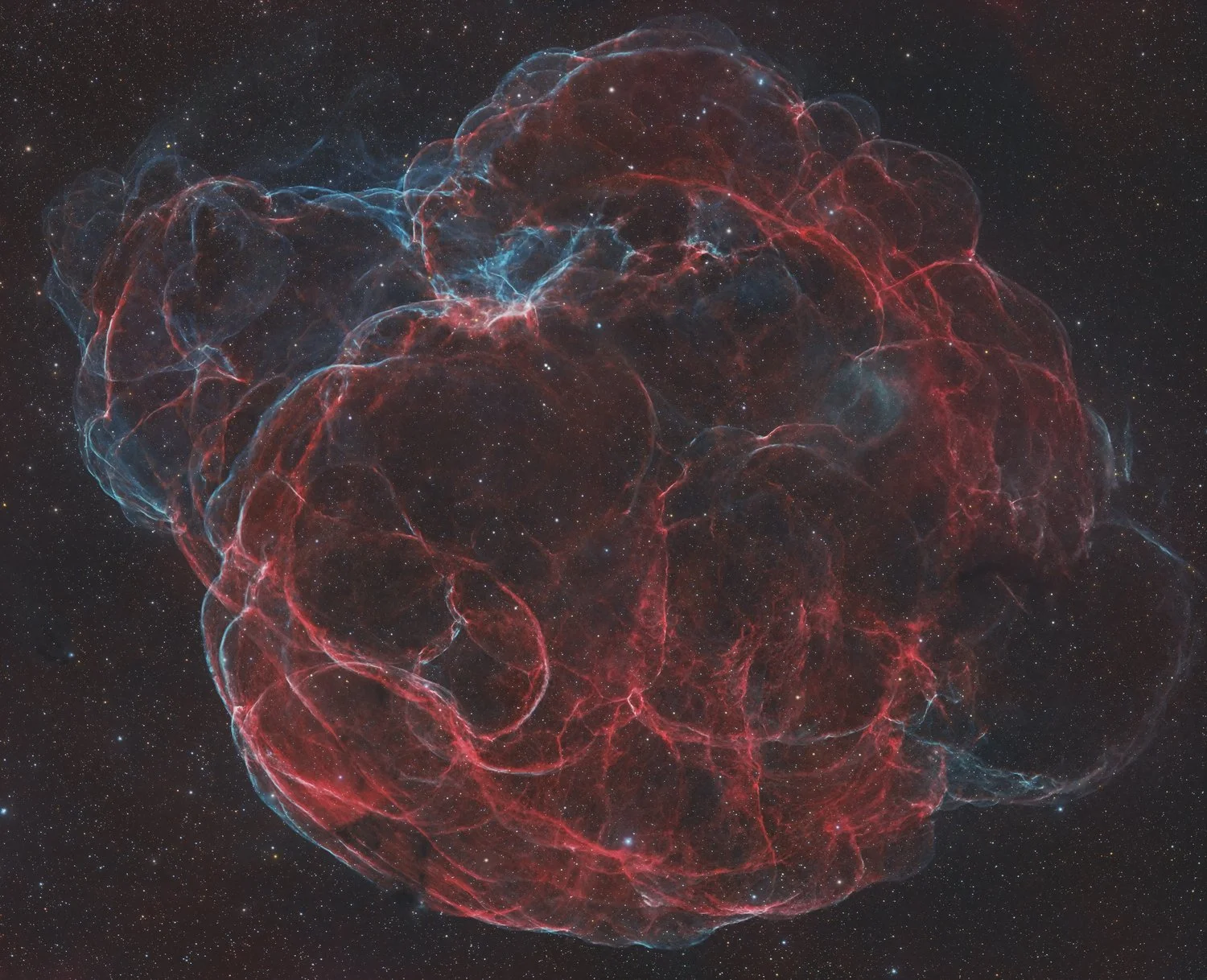
The Spaghetti Nebula -SIMEIS 147- SH2-240
Image Description and Details :
It took me 2 months to acquire enough lights to make anything out of it.
Indeed, I shot 14 winter nights between November and January (5 of which played with my nerves with the fog lifting at nightfall without being able to do anything).
So I shot from the Vosges, I camped in 0 ° C in Alsace, I shot from my astrobro Christope in Moselle, I went south of France to Valensole and I moved on several spots on several nights in this region.A total of 3,600 km of road to acquire the 55 hours of lights retained which consist of:
Tile 1:
Ha -> 71x600 ’’
Oiii -> 78x600 ’’
R G B -> 90x10 '' per filter
Tile 2:Ha -> 94x600 ’’
Oiii -> 78x600 ’’
R G B -> 90x10 '' per filter
While the acquisition was long and complex, so was the processing, I had to work with 400GB of data for a final image of 15 000 x 12 000px.Suffice to say that the PC has smoked!
Once again a big thanks to Christophe who illuminated me with his advices during the processing and gave me invaluable help, thanks also to Nico for his always correct eye!
Technical part:
Takahashi FSQ106 EDX4 with 645-QE super reducerAsi 2600MM Pro
Barilla (Antilla) RGB + H and O 3nm filters
Eq6r-pro
Altaïr 60/225 guide + asi 290mm mini
Sky bortle 3-4
Acquisition: N.I.N.A + Phd2
Processing: Siril + PixInsight + Photoshop
Taken in several parts of France between 2021/11/10 and 2022/01/03
Copyright : Yann SAINTY

IC434 Horsehead nebula
Image Description and Details :
Tak FSQ-106ED F/5SBIG STF-8300M + QHY CFW3 Filter wheelAstrodon L Channel 180sec x 116, 1binAstrodon H-a, R, G,B each Channel 300sec x 50, 1binBias, Dark, Flat processedOrion CT80 + ZWO ASI 120miniFLI Atlas focuserSkywatcher EQ8 mount (with EQ Drive standard4 TCS)
Copyright: Kim Young Dae
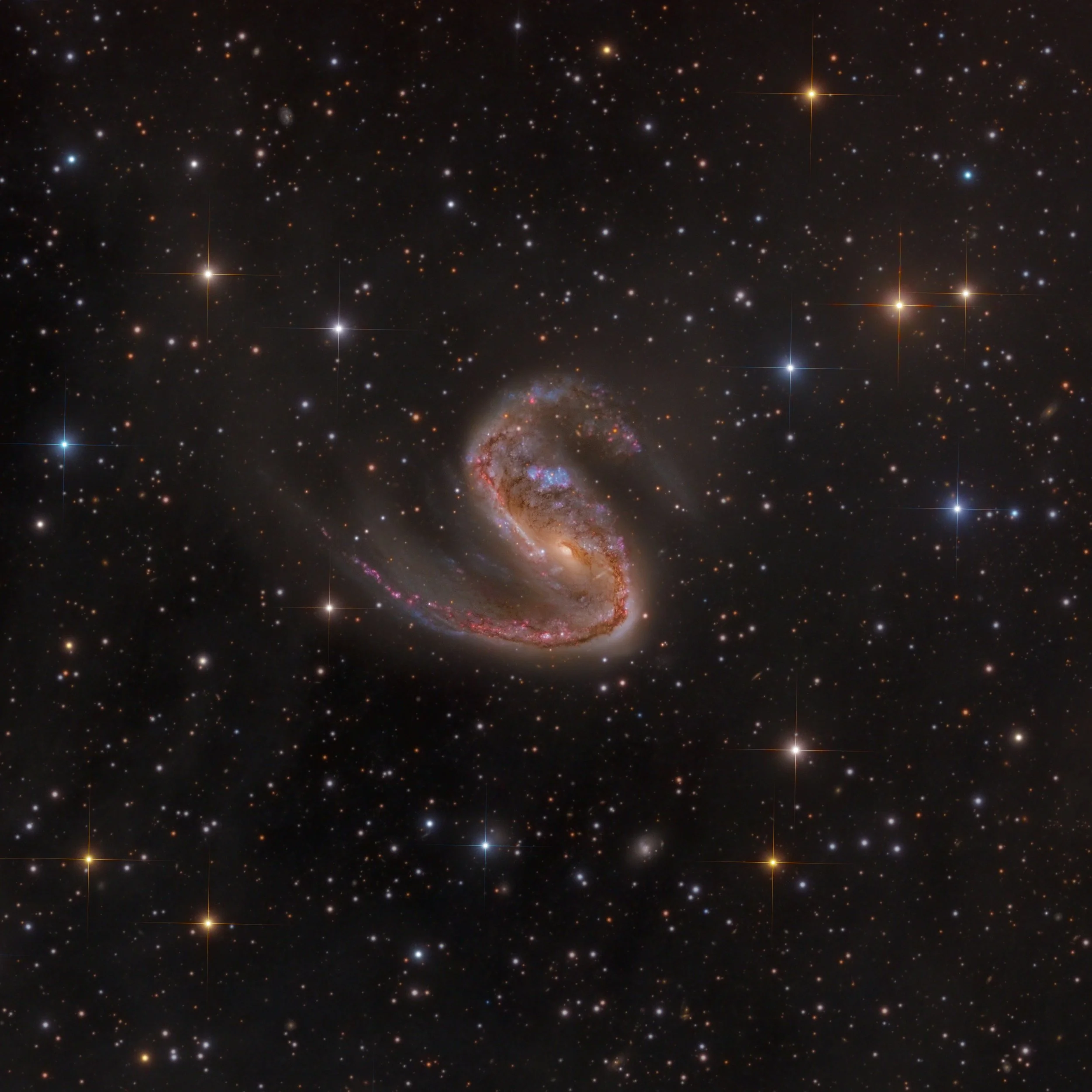
NGC 2442
Image Description and Details :
NGC 2442 is located around 50 million light-years away in the constellation of Volans. The galaxy is 75,000 light-years wide and has quite an peculiar shape featuring two dusty spiral arms extending from a central bar that gives it a hook-like appearance. Given its appearance it is often referred to as “The Meat Hook Galaxy.” The galaxy’s distorted shape is most likely the result of a close encounter with a smaller galaxy some time in the past. A considerable amount of IFN is present in the field proximate to the galaxy and the image shows faint star streams at the ends of the arms of the galaxy.Imaged in LRGB and H alpha OTA CDK 1000 Luminance, RGB and H alpha. Additional RGB RiDK 500.Imaged at Observatorio El Sauce, ChileIntegration time: 47 hoursImage Processing: Mark Hanson and Mike Selby
Copyright: Mark Hanson_Mike Selby
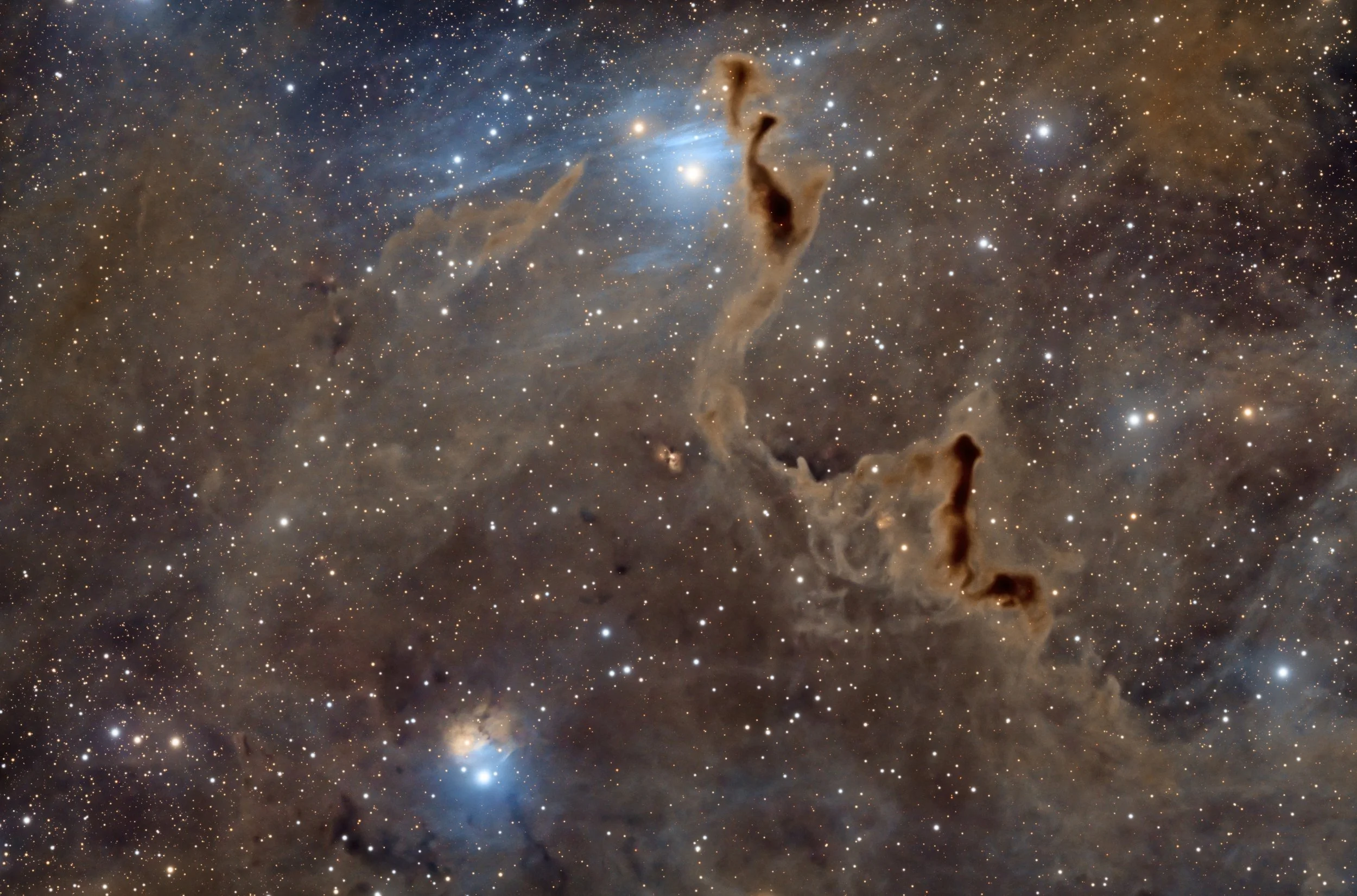
A Helping Hand in Cassiopeia
Image Description and Details :
This image shows a marvelous and busy area in the constellation Cassiopeia. It contains a large amount of dust, several dark nebula and several reflection nebula along with two interesting stars. Near the top center is the star SU Cassiopeiae which is a Cepheid variable at Mag 5.94. SU Cass is a Yellow giant with a spectral class of F5:lb-11. It's 19 times larger than our sun. SU Cass lies 1289 light years distant. Surrounding it is the blue reflection nebula VdB 9 which is lit up by SU Cass. The blue wisps extend quite a ways around this area. The other interesting star in the lower center left is the star RZ Cassiopeiae. RZ Cass is a white A3V main sequence star at mag 6.26. It's an eclipsing variable star which is 219 light years distant. The bluish nebulosity surrounding it is listed as VdB 7. However RZ Cass is apparently not the source to light up VdB 7 but another smaller 11th mag star nearby. Several dark nebula are right of center in the image. The upper part of this nebula looks like an opened hand, hence the nickname (The helping hand). The dark area of the hand, near the top finger is designated as LDN 1357 and below it near the palm, LDN 1355. The long dark area near center right is the dark nebula LDN 1358. Throughout this entire area encompassing the field of view is lots of molecular dust of varying thickness and color. This image was taken under the dark skies of the Okie Tex Star Party in October 2021. It encompasses 14.3 hrs of exposure time using LRGB filters.Scope: Stellarvue SVX 152T, Camera: ZWO ASI 6200mm Pro, Mount: Paramount MyTExposures: Luminance 59@300sec, Red 39@300sec, Green 38@300sec, Blue 36@300secProcessing: PixInsight
Copyright: Jonathan Talbot
Abell 13
Image Description and Details :
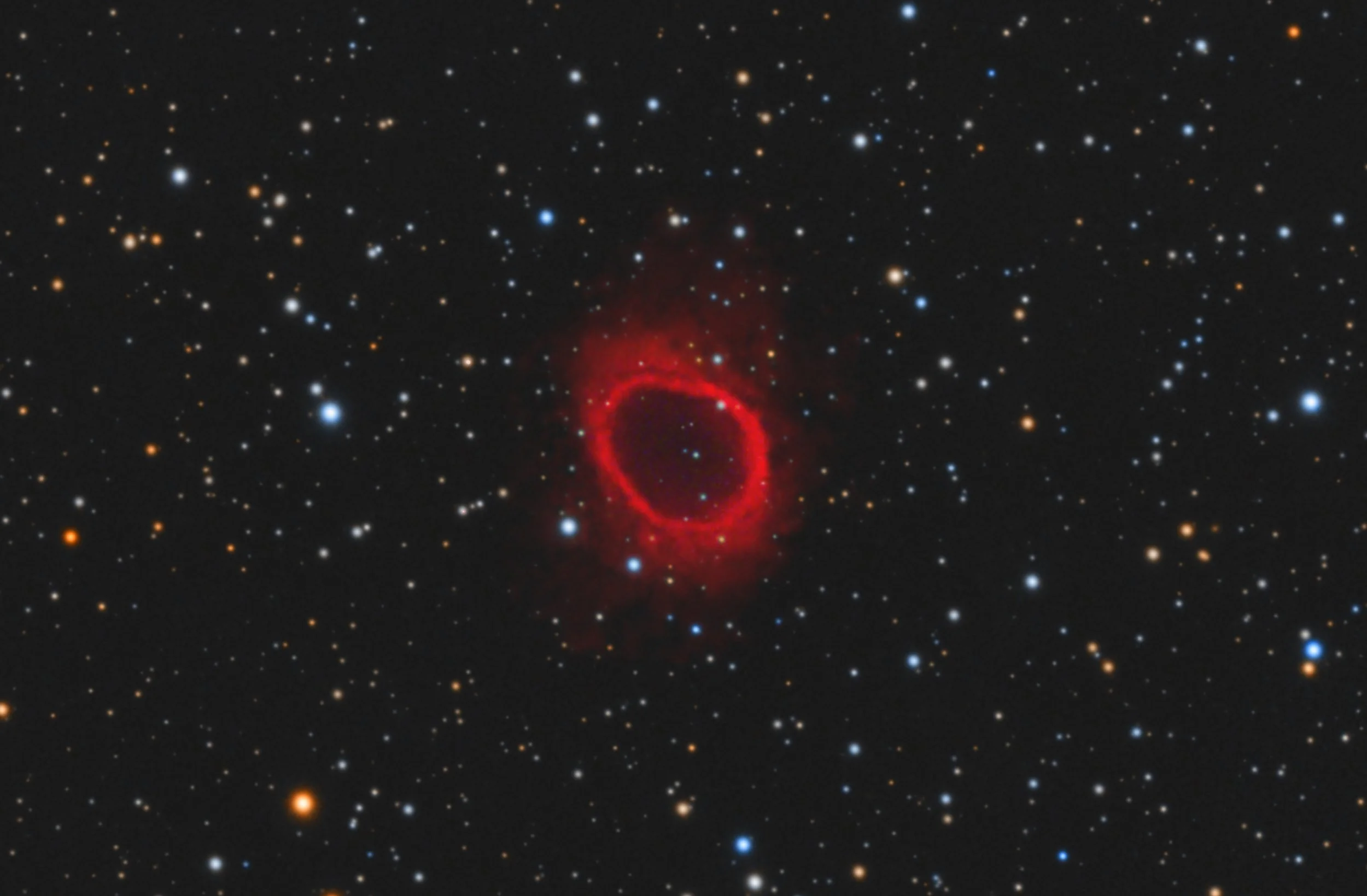
Abell 13 is highly evolved planetary nebula in Orion. It is sometimes known as the Orion Ring Nebula because it's morphology resembles the better known Ring Nebula, M57. However Abell 13 is much fainter at around mag 16. In both cases their oval shape is believed to be a result of them being bipolar nebulae viewed offset from their axis, making their ring structure appear oval. Abell 13 is 2.9 arc minutes in angular size and around 3,500 light years away. It was first catalogued as Abell 9 by George Abell in 1955, but renumbered as Abell 13 in his 1966 paper.
Image captured on my remote dual rig at Fregenal de la Sierra in Spain between 13-29 December 2021.
Scopes: APM TMB LZOS 152 Refractors
Cameras: QSI6120wsg8
Mount: 10Micron GM2000 HPS
A total of 53 hours image capture (HaRGB)
Copyright: Copyright: Peter Goodhew
Stephan's Quintet and NGC 7331
Image Description and Details :
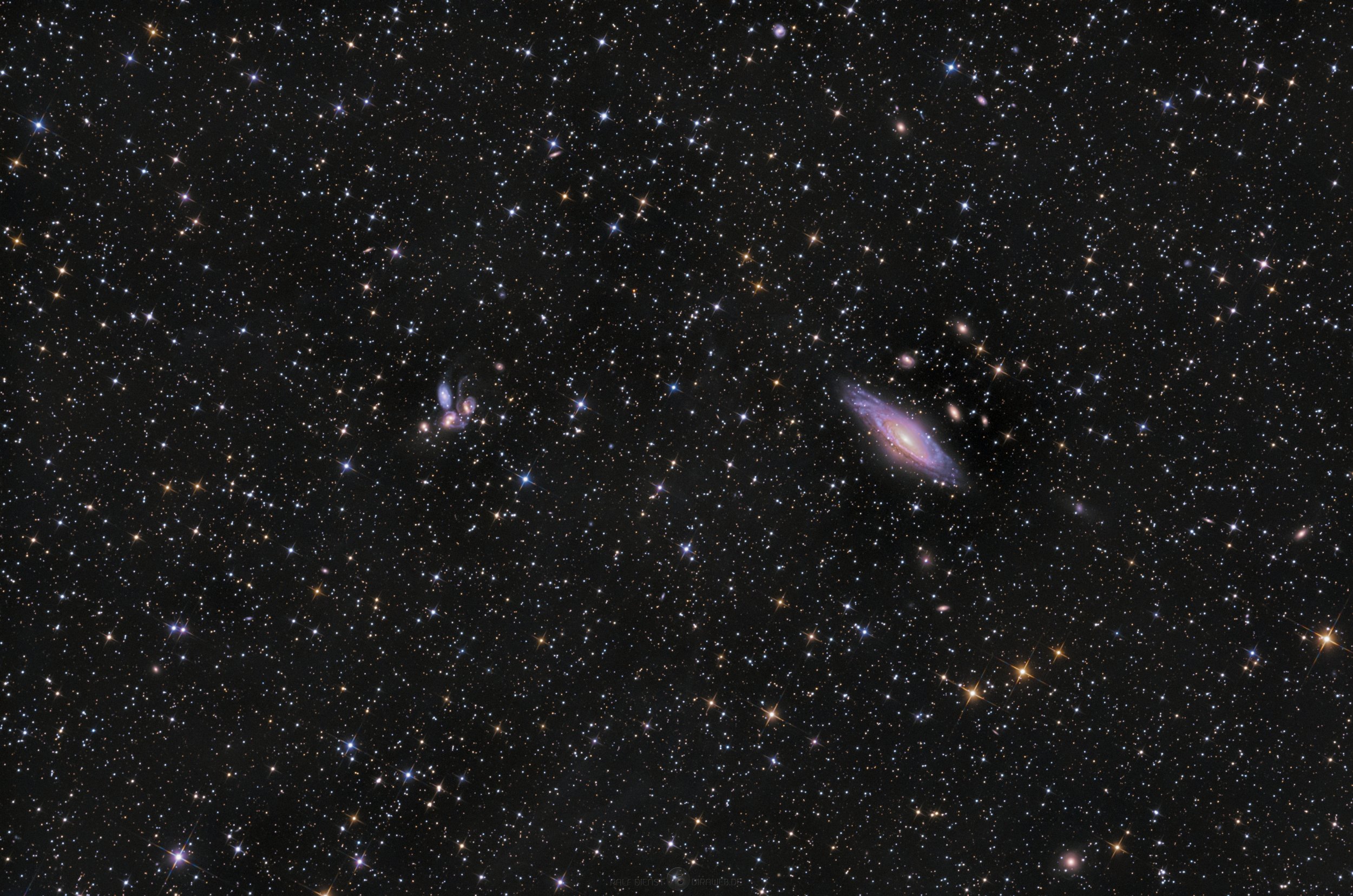
You can find many beautiful galaxies in Pegasus. These two objects are especially beautiful. In september 2021 i took this picture in three nights.Equipment: Newton-Telescope 200/800. Camera ASI2600mcPro. Mount EQ6RPro. Exposure 132 x 300s (11h). Location: Hildesheim, Germany.
Copyright: Ralf Dienst

Full Moons of 2021
Image Description and Details :
I was very lucky to be able to capture all the full moons of 2021. The image represents 12 full moons of 2021 with their popular names, distance from Earth and angular diameter. The centre piece is a mosaic made with strips from all the 12 full moons.All the images were captured with the same camera (Nikon D5600) and lens (Sigma 150-600c) at a same focal length (600mm). The individual moons are a stack of 300 images each.
Copyright: Soumyadeep Mukherjee

LBN923 nebula region
Image Description and Details :
This field is the LBN923 region, the dusty nebulosity in center of this field. NGC1788 is the most prominent blueish bright nebula near to LDN1616 and LDN1615. Locate between Orion and Eridanus, its a beautiful red, blue and brown nebulae region.● Exposure: 32x 300s (L) + 14 x 300s (R) + 14 x 300s (G) + 14 x 300s (B). ● Processing: PixInsight Core 1.8. ● Telescope: Takahashi FSQ-106EDX3 on EM-200Temma2M. Seletek Armadillo / Focusmax. ● Camera: Andor Apogee U16M / AFW-50-7S ( - 20ºC ). Astrodon E-Series genII filters. ● Guiding: FS-60CSV, QHY-5, PHDguiding.
Copyright: Iñaki Lizaso