

AAPOD2 Image Archives
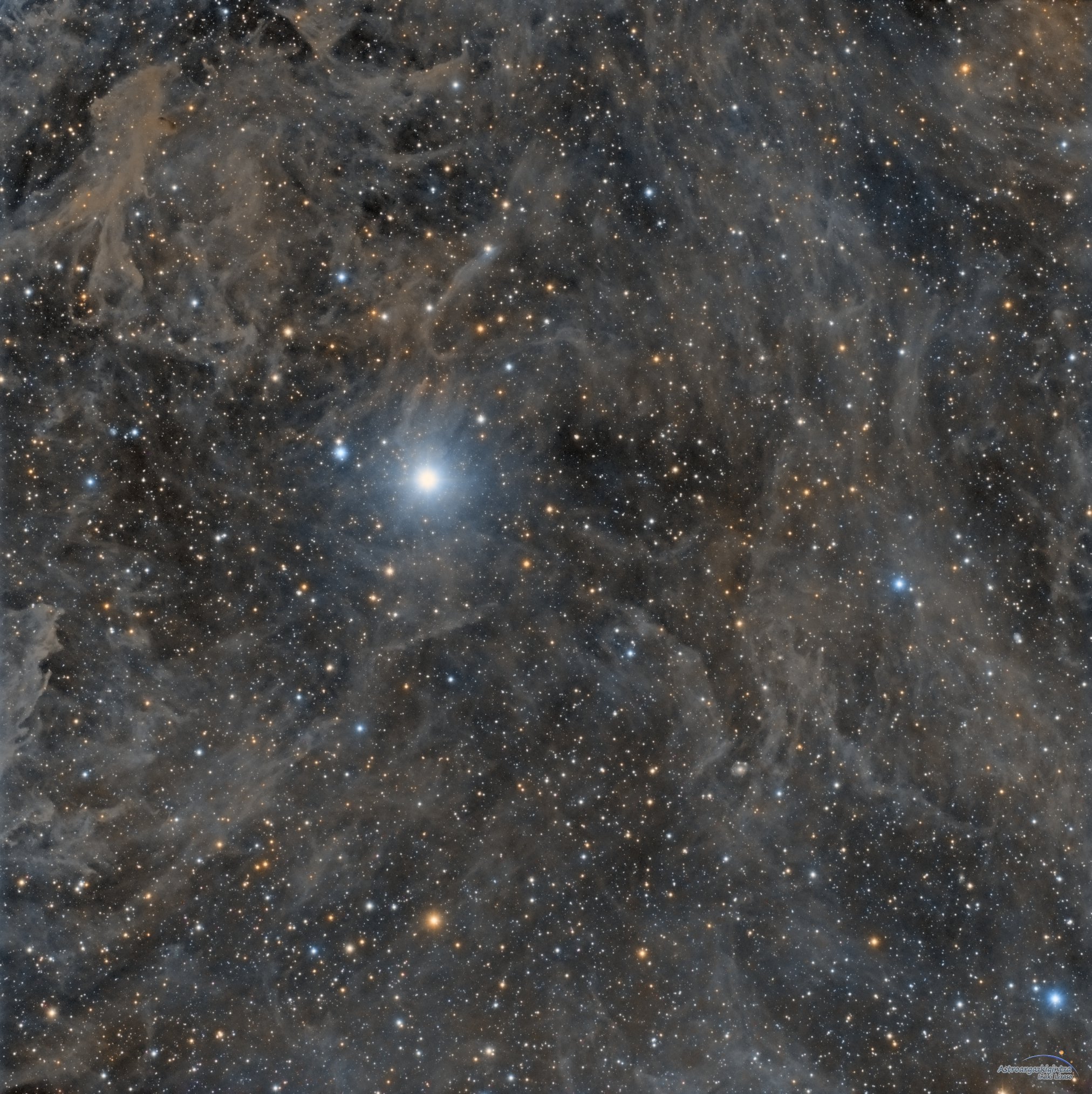
Polaris, Polarissima Borealis and IFN
Image Description and Details : Polaris is a star in the constellation Ursa Minor. Designated α Ursae Minoris and commonly called the Pole Star. The star's position is less than one degree from the north celestial pole, making it the current north pole star. The entire field is full of Integrated Flux Nebula, high-latitude galactic nebulae in the Milky Way composed primarily of dust particles, hydrogen and carbon monoxide, and are illuminated by stars in the Milky Way. NGC 3172 is located 285 million light years away, known as Polarissima Borealis, being the closest NGC object to the North Celestial Pole.
Copyright: Iñaki Lizaso
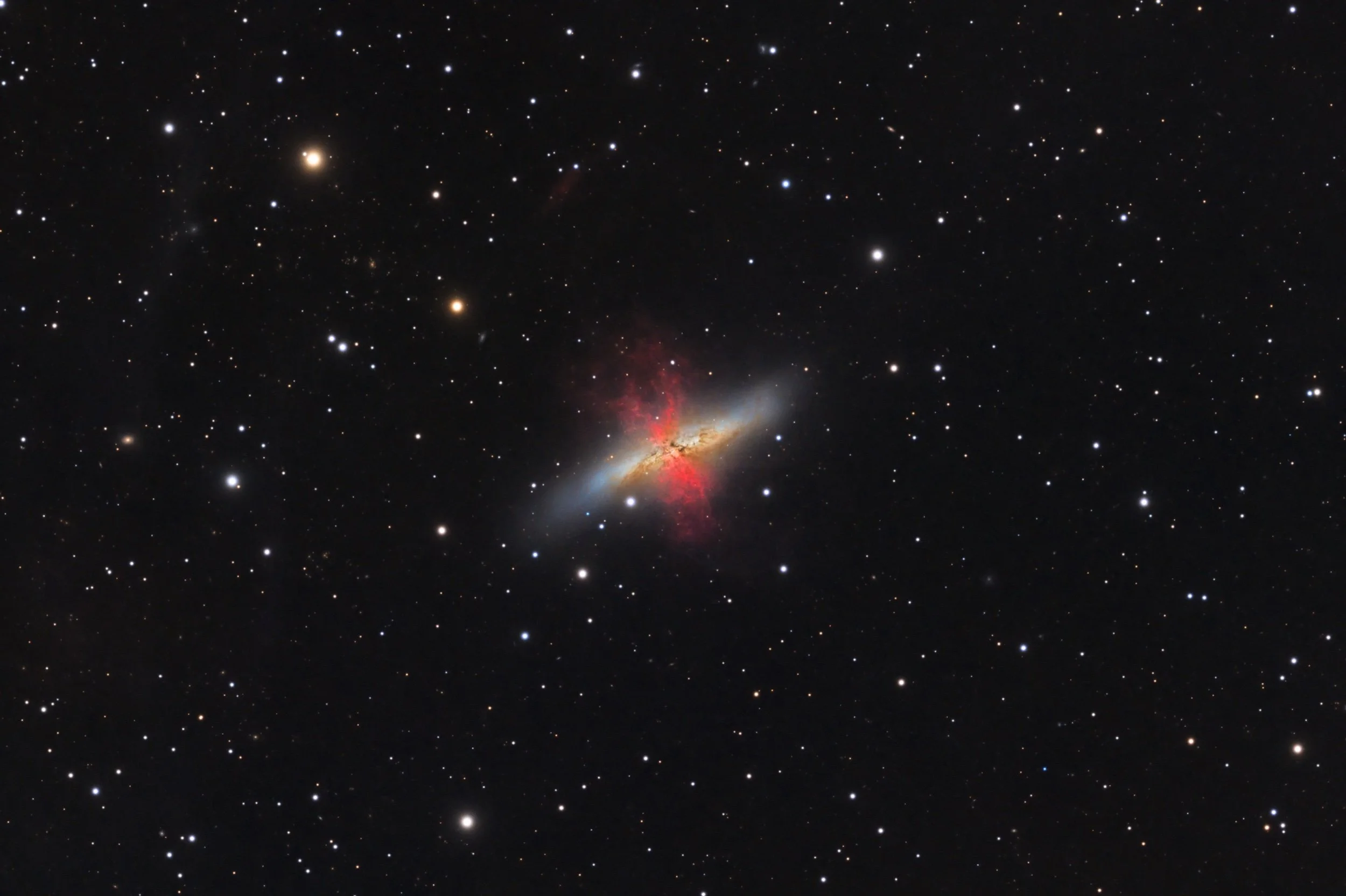
M82
The beautiful starburst galaxy M82 is located in the constellation Ursa Major. It was discovered in 1774 by German Astronomer Johann Elert Bode. Bode also discovered nearby M81, also known as Bodes Galaxy.
M82 is undergoing a huge amount of star formation in its core and due to this massive star formation, emits large amounts of hydrogen gas, seen here in red HII light. A possible theory is that gravitational interactions are occurring with the close neighboring galaxy, M81, and are causing this massive star formation to occur.
Also within the image is a bow shock like feature, called the CAP, which is above M82 and near the top of the image. It's a faint red area of HII emission. This feature was discovered in the late 90's and published in 1999. You can find the paper here. A great discussion about this massive amount of material streaming from M82 can be found here: ap130704.html. There are also a bunch of faint background galaxy clusters in the background and if you look at the high res image you can see them in the background.
M82 is approximately 12 million light years distant and about 1/2 the size of our Milky Way galaxy. M82 shines at an apparent magnitude of 8.4.
The image is a LRGB and Ha composite. I started imaging M82 in April of 2021 and finished in January of 2022. It was shot at 1x1 binning at an image scale of .64 arcsec/pixel. To get a high resolution view of M82, click on the image above.
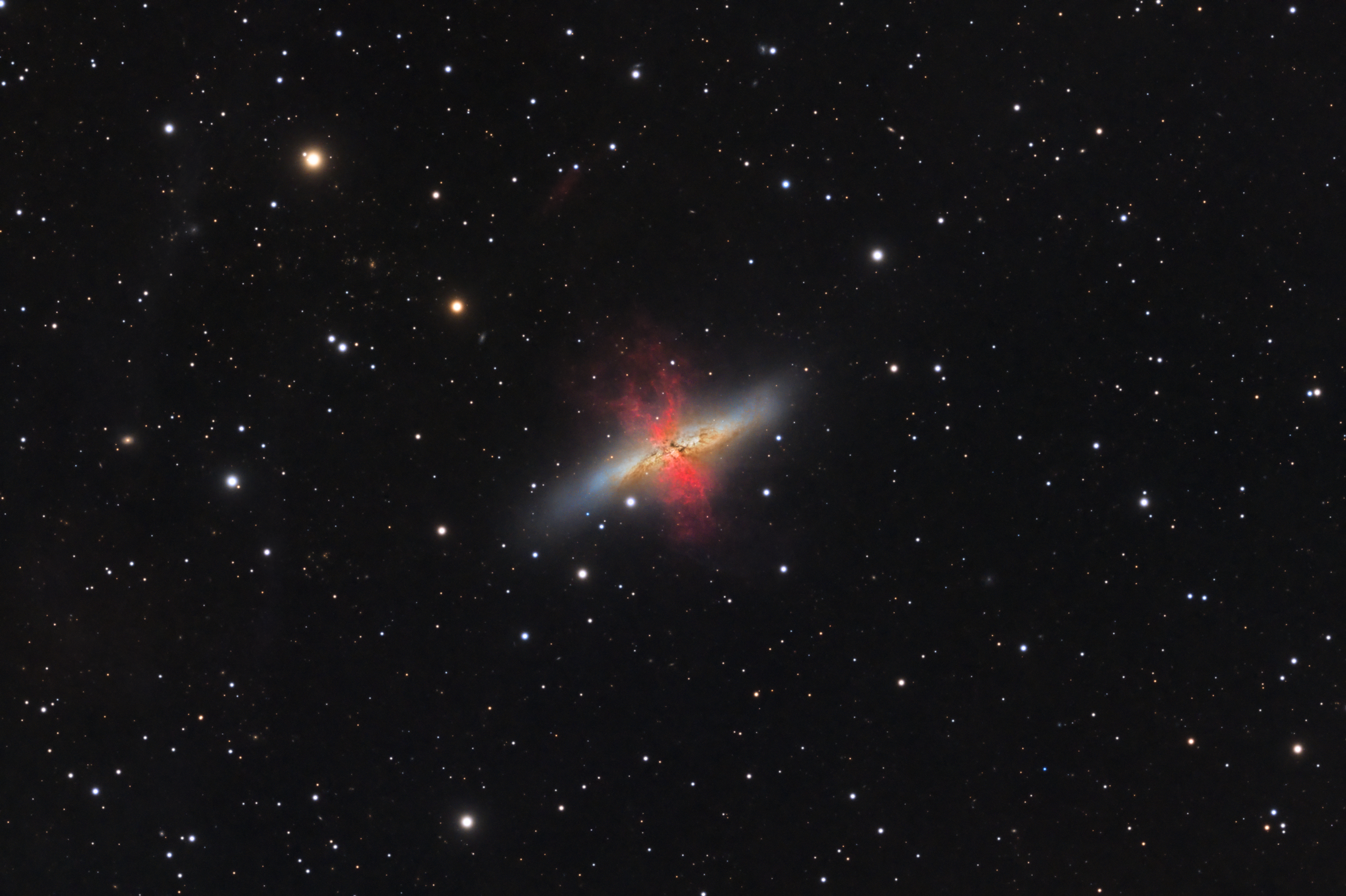
Image Details
Optics : Stellarvue SVX 152T refractor @f8 1200mm FL
Mount: Paramount MYT
Camera: ZWO ASI6200
Filters: Chroma 50mm LRGB, Astrodon 50mm 5nm Ha
Exposure (min): LRGBHa 366:185:200:200:1120 34.5 hrs, 1x1 binning 1/2 frame
Automation Control: The Sky X, Voyager, PrimaluceLab Eagle 4
Guiding: StarlightXpress Lodestar X2
Processing Software: PixInsight, PS CC, Topaz Labs
Location: Stark Bayou Observatory, Ocean Springs, MS
Sky: Typical SQM 19.6-20.1, Bortle 5, Suburban
Date: 25April - 26 May 2021, 14 Nov - 13 Jan 2022
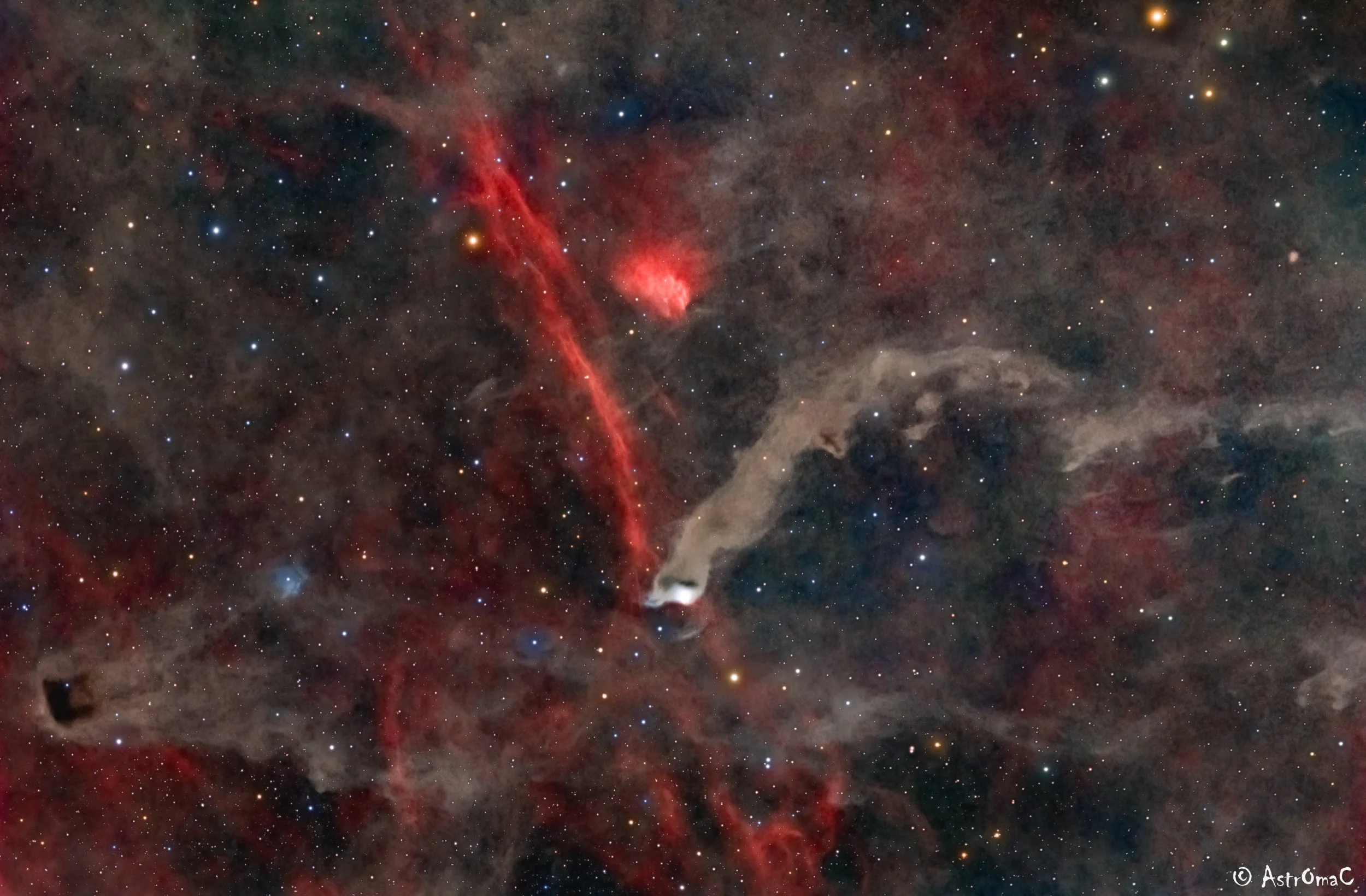
𝗟𝗕𝗡𝟱𝟮𝟴 - 𝗗𝗲𝗛𝘁𝟱 - 𝗩𝗗𝗕𝟭𝟱𝟮 - 𝗟𝗕𝗡𝟱𝟯𝟮 - 𝗦𝗡𝗥 𝟭𝟭𝟬.𝟯 + 𝟭𝟭.𝟯
Image Description and Details : 𝗟𝗕𝗡𝟱𝟮𝟴 - 𝗗𝗲𝗛𝘁𝟱 - 𝗩𝗗𝗕𝟭𝟱𝟮 - 𝗟𝗕𝗡𝟱𝟯𝟮 - 𝗦𝗡𝗥 𝟭𝟭𝟬.𝟯 + 𝟭𝟭.𝟯
🔭 TS-Optics 76EDPH
📷 ZWO ASI2600MM Pro
⚙ SkyWatcher AZEQ6
🔵 Antlia LHaRGB pro 36mm
Antlia B 36mm: 43x180" (2h 9')
Antlia Ha 3.0nm pro 36mm: 43x600" (7h 10')
Antlia L 36mm: 139x180" (6h 57')
Antlia R 36mm: 47x180" (2h 21')
Antlia V 36MM: 48x180" (2h 24')
Intégration:
21h 01'
Copyright: AstrOmac

NGC 3372 Carina Nebula
Image details:
captured a little over 4hrs of data on The Carina Nebula also known as NGC3372 a massive bright nebula located in the constellation Carina. It’s one of the easiest to spot with the naked eye in a dark sky because it’s the size of 4 moons wide - making it a good target to look at through binoculars.
22x 300s Sii
12x 300s Ha
17x 300s Oiii
Total 4hrs 15mins
Equipment
Mount: NEQ6 Hypertuned by Astronomy Academy Perth
Telescope 🔭: Skywatcher 10" Quattro Newt working @F3.62
Coma Corrector: TS-WYNNE 68 (reduces 0.92x confirmed in Nina)
Camera 📷: QHY268M @ Gain 56 Offset 50 on HGM
Filters: ZWO 36mm Filters
Programs: NINA, Pixinsight and Photoshop CC
#aapod2
Copyright: Luke Shepherd

Cederblad 51
Image Description and Details : Cederblad 51 (the central blueish areas) is a reflection nebula in the constellation of Orion. It is part of Sharpless 2-264, which is sometimes referred to as 'Orion's Head'.
Imaging telescope: Takahashi FSQ130ED
Imaging camera: FLI ML16200
Mount: Takahashi EM 400 Temma 2M
Guiding telescope: Takahashi FS60CB
Guiding camera: QHY CCD QHY 5 II
Focal Extender / Reducer: None
Capture Software: Sequence Generator Pro, PHD 2
Processing Software: Astro Pixel Processor, PixInsight, Topaz DeNoise, Photoshop
Filters (50mm): Astrodon RGB & Astrodon Ha (3nm)
Accessories: SeleTEK2 controlling Robofocus Focuser, ATIK EFW3
Original Image (Crop): 2700 x 2400
Dates: 6th Feb - 1st Mar 2022
Frames:
Astrodon Ha 60 x 10'
Astrodon R 75 x 3'
Astrodon G 40 x 3'
Astrodon B 60 x 3'
Total integration = 18 Hours 45 Mins
Copyright: Brendan Kinch
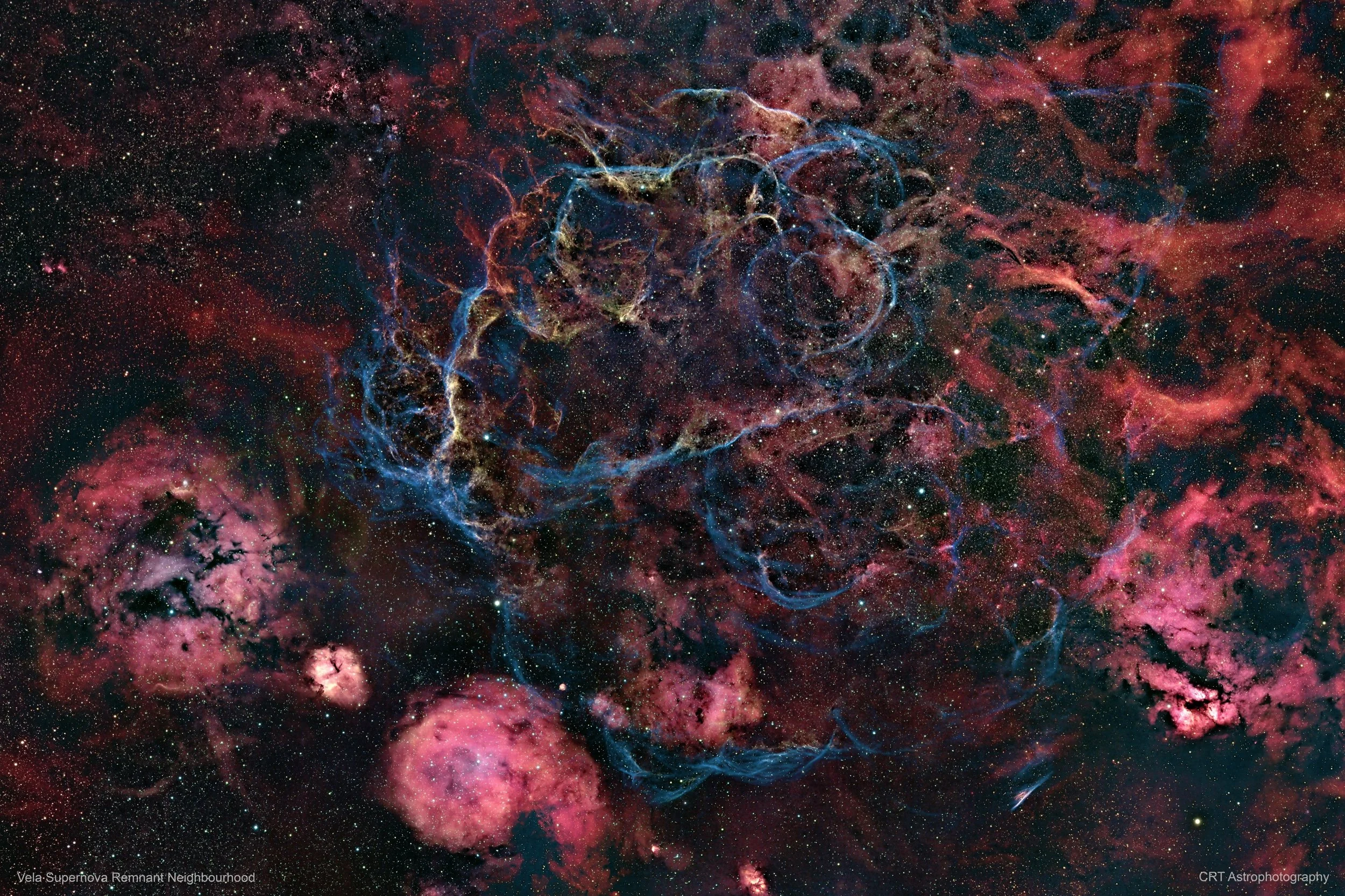
Vela Supernova Remnant Neighbourhood
Image Description and Details :
This is a project that started at the end of January. The original plan was to shoot an 8-panel mosaic around the area of RCW32 (Gum15) and its proximity to the Vela Supernova Remnant. It has since grown to a 26-panel mosaic covering a wider area. The final image is 14998 x 9999 pixels in width and height and includes DSO's like RCW33, RCW27, the double star HIP42884, PK 263+00.1, the Pencil Nebula, RCW38, NGC2626, some open star clusters including NGC2670, NGC2660 and NGC2671 and of course the Vela Supernova Remnant all in the southern constellation of Vela
This has been a long but satisfying project even though I could not use my camera of choice and had to use my backup camera.
826 x 600s subs were shot @-10C spread across 32 nights for a total integration time of almost 138 hrs. PixInsight tone-mapping and colour-masking applied. PTGui used for stitching with LDR blending turned on.
Sharpstar 61EDPH II APO Triplet Refractor
Sharpstar 0.8x Flattener/Reducer
Skywatcher NEQ6 Pro Hypertuned by Astronomy Academy Perth
Primaluce Sesto Senso2 Electronic Focuser
ZWO ASI183MM Pro Cooled Camera
ZWO Off Axis Guider
ZWO ASI290MM Mini Guide Camera
ZWO Electronic Filter Wheel
Antlia 3nm Pro NB 36mm unmounted filters
Rollon rolloff modified shed observatory
Bortle 5
Data acquisition software: NINA Astronomy Software
Processing software: PixInsight and Photoshop CC
Copyright: Carlos Taylor
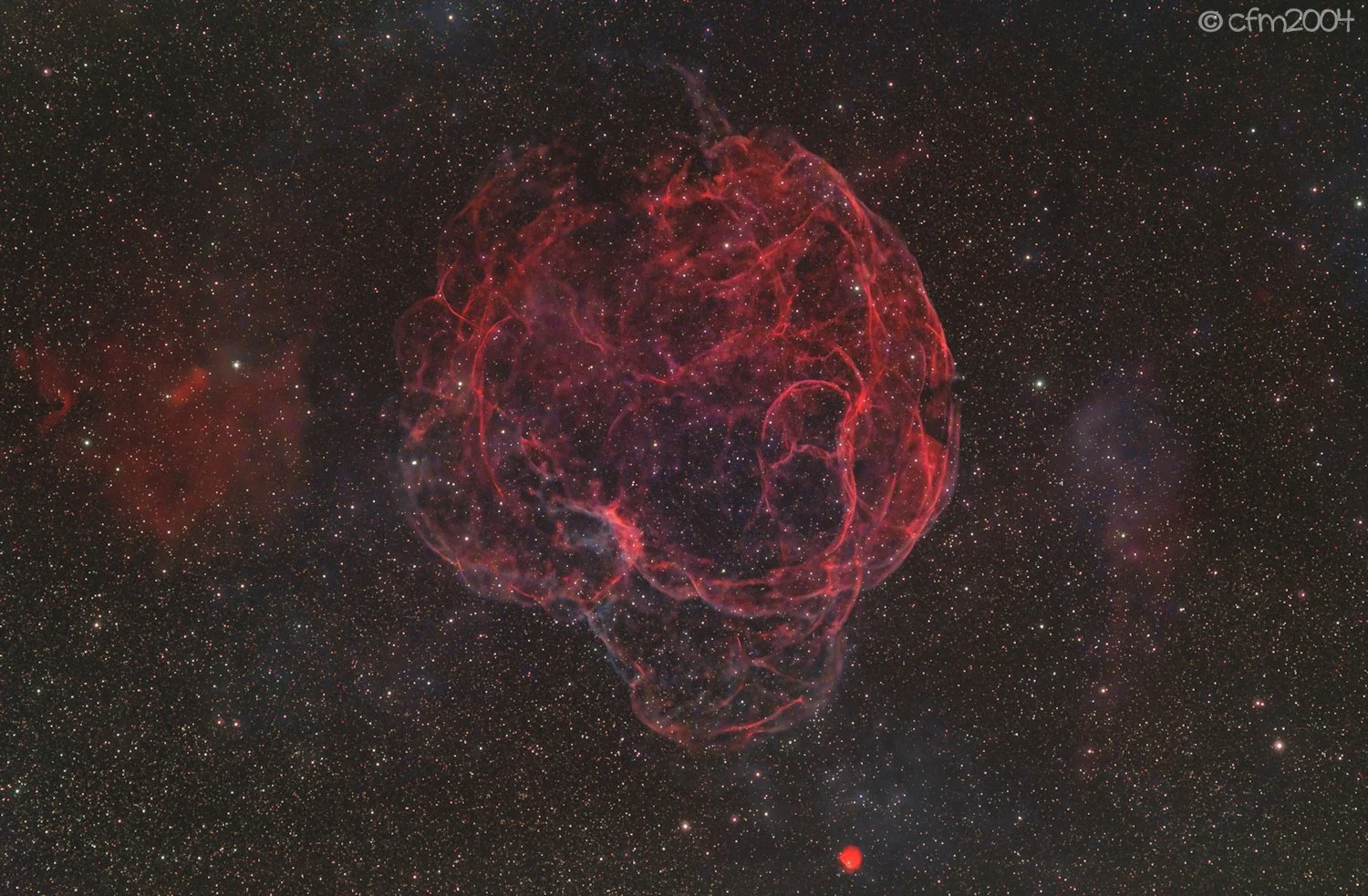
SH2-240 Spaghetti Nebula
Image Description and Details :January/February 2022
Location: San Romualdo - Ravenna (Italy)
Samyang 135mm F/4 on Avalon M1
Celestron OAG with QHY5III 174M
QHY294C cooled -25 - Optlong L-Extreme filter - 111x10' images
ASI294C - Optlong L-Extreme filter 72x5min. images
Acquired with: SharCap - Calibrated with Dark and Flat
Processed with: DeepSkyStacker4, MaximDL5, Astroart8, Startools1.8, Paint Shop Pro2021, plug-in Topaz and Nik.
Copyright: Cristina Cellini and Paolo Baldoni

Flaming Star to Simeis 147
Image Description and Details :
This image shows the area of sky above the constellation of Orion. In the top right, looking like a comma is the Flaming Star Nebula. Just to the left of it is the Tadpole Nebula. If you look at the high resolution image on my website you can see the tadpole shaped structures inside it that give it its name. To the upper left is Sharpless 232 which I always think looks like a person running in a hamster wheel! To the bottom left is the large supernova remnant Simeis 147 aka the Spaghetti Nebula. This is a 16 image mosaic taken at a focal length of 530mm with a 4 inch refractor. 171 hours of light was collected through H-alph, SII and OIII filters.
Copyright: Alistair Symonu
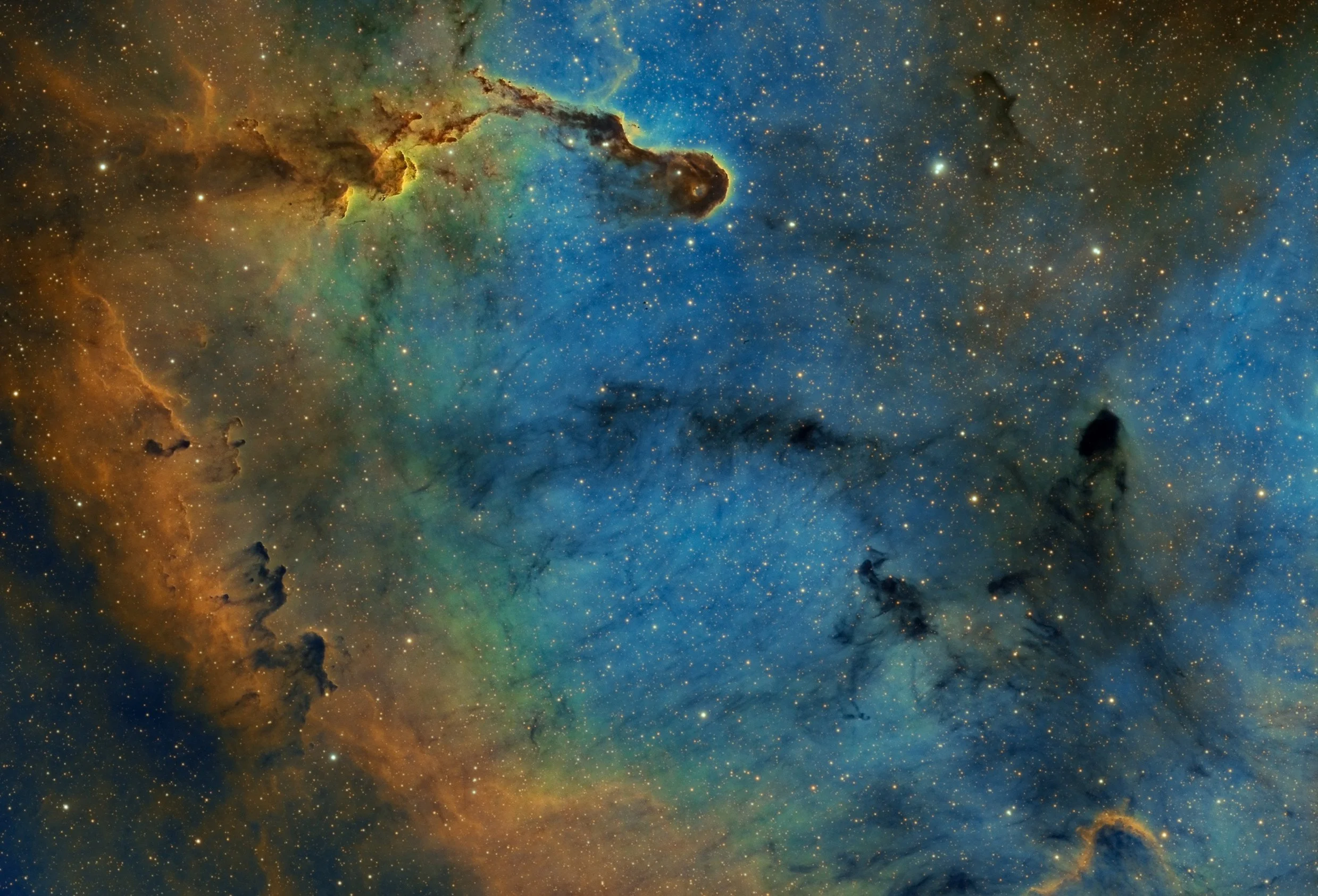
IC1396 The Elephant's Trunk Nebula
Image Description and Details : Imaging Telescopes Or Lenses: Stellarvue SV105-3FT
Imaging Cameras: ZWO ASI294MM Pro
Mounts: Astro-Physics Mach2GTO
Filters: Chroma Ha 31mm 3nm · Chroma OIII 31mm 3nm · Chroma SII 31mm 3nm
Accessories: ZWO ASI OAG
Software: StarKeeper.it Voyager · Pleiades Astrophoto PixInsight 1.8 Ripley · Open Guiding PHD 2.6.2 · StarNet++
Guiding Telescopes Or Lenses: Stellarvue SV105-3FT
Guiding Cameras: ZWO ASI 120MM Mini
Acquisition details
Frames:
Chroma Ha 31mm 3nm: 86x300" (7h 10') bin 2x2
Chroma OIII 31mm 3nm: 100x300" (8h 20') bin 2x2
Chroma SII 31mm 3nm: 130x300" (10h 50') bin 2x2
Integration: 26h 20'
Copyright: Chad Andrist
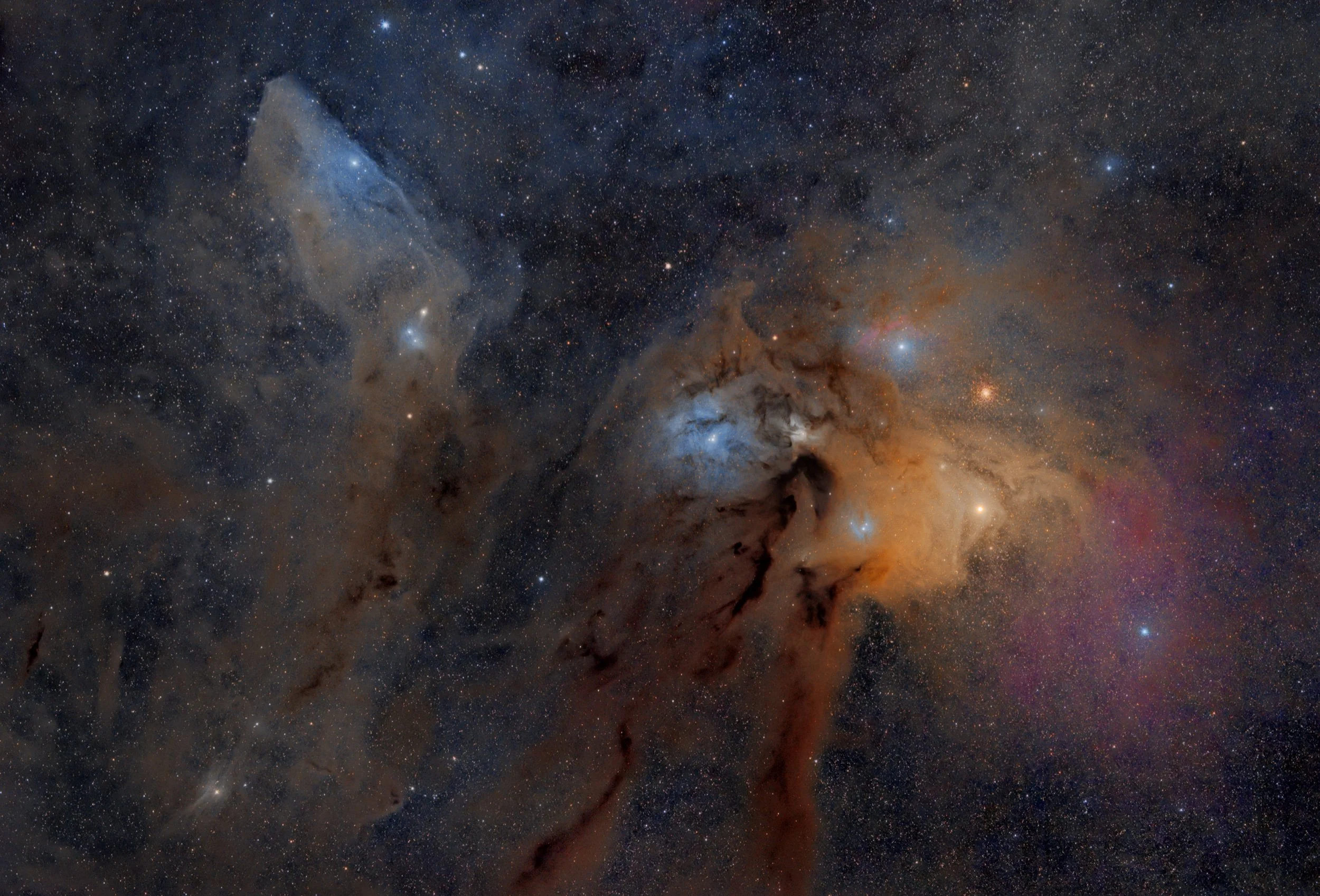
The Antares Rho Ophiuchus Region
Image Description and Details : Equipment:
Stock Nikon Z5 and Stock Nikon D5600
Samyang 135 f2 lens at f2.8
iOptron Skyguider Pro
Sub length: 90, 120 and 135s subs across 11 sessions.
Total Integration time: 9 hours 15mins
Processed in Pixinsight and Photoshop.
Shot under Bortle 1 Skies in Spiti, India.
Copyright: : Shikhar Gupta
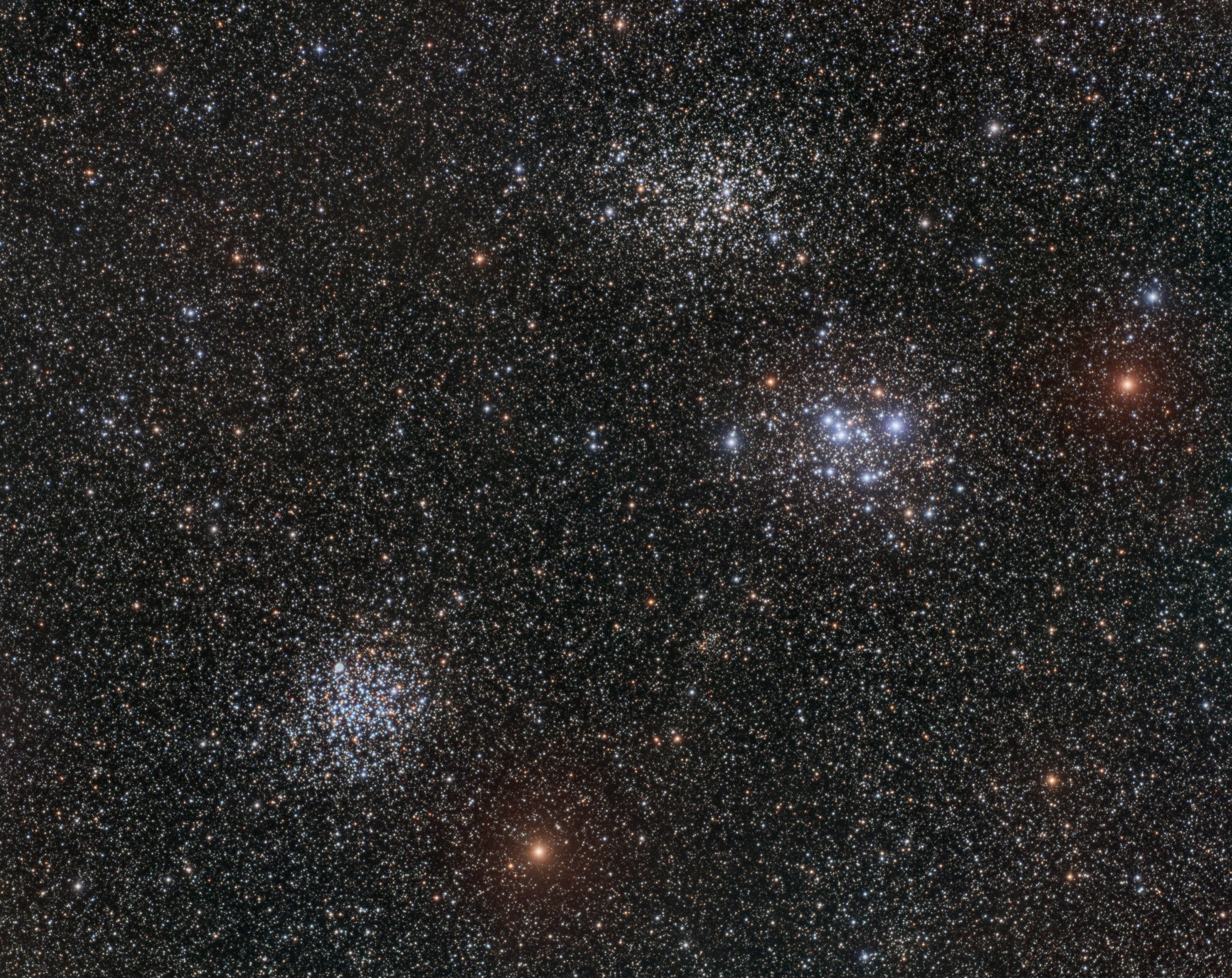
Three Clusters in Puppis
Image Description and Details :
Three open star clusters are seen here in the constellation Puppis, east of the bright star Sirius. To the lower left is Messier 46 or M46, 5000 light years away. M46 has about 500 stars estimated to be about 250+ million years old. The planetary nebula NGC 2438 lies on the northeast edge of M46 (about the 11 o’clock position in the image) but is most likely not part of the cluster.
Just one degree west-northwest of M46 (to the right in the image) lies another open star cluster Messier 47 or M47. M47 is much younger in age, about 78 million years old and is 1600 light years distant. There are also about 500 stars, mostly high temperature giant blue stars, reflecting the cluster’s young age, as well as some red giants.
NGC 2423 is the open cluster just above M47 in the image and is much closer to us. It contains several red giant stars, at least one of which has an orbiting planet discovered in 2007. The distance to that system is about 2500 light years.
Capture info:
Location: Orion’s Belt Remote Observatory, Mayhill NM
Telescope: Takahashi FSQ 106N
Camera: SBIG STXL 16200
Mount: Paramount MX+
Data: RGB 3,2,2.5 hours
Processing: Pixinsight 1.8.8.7
Copyright: Dave Doctor
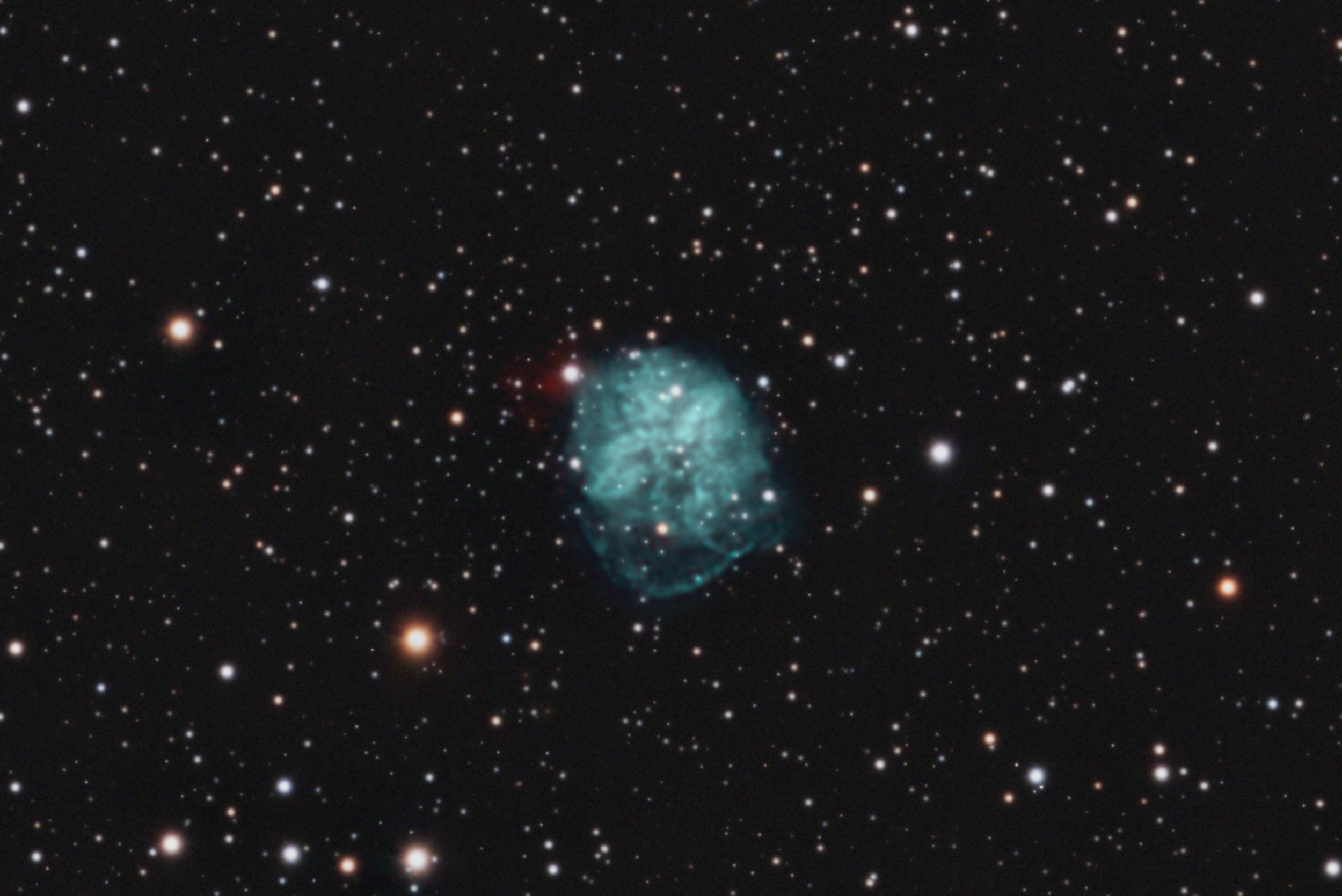
K2-1
Image Description and Details :
K2-1
A very faint and obscure planetary nebula some 3700 light years away in the constellation Auriga.
Initially catalogued as a planetary nebula, was later thought to be misclassified and considered to be either a reflection nebula (LBN 809), an H-II region, and even a galaxy (PGC 16765). However it has recently been rediscovered as a genuine planetary nebula. It has a size of 115x126 arc seconds and is predominantly OIII. The weaker Ha signal has a similar form to the OIII signal. However there's an odd small area of red nebulosity at the top left-hand corner. This is possibly some NII emission which would be captured by the 5nm bandwith of my Ha filter (the spectrum shows that NII is present).
Discovered by Czech astronomer Dr. Luboš Kohoutek in 1962 by visually examining the National Geographic Society-Palomar Observatory Sky Survey prints at the Astronomical Institute in Prague, Czech Republic
It has a mean surface brightness of 24.1 mag/arc sec.
Image captured on my remote dual rig at Fregenal de la Sierra in Spain between 19-23 February 2022.
Scopes: APM TMB LZOS 152 Refractors
Cameras: QSI6120wsg8
Mount: 10Micron GM2000 HPS
A total of 37 hours image capture (HaOIIIRGB)
Copyright: Peter Goodhew
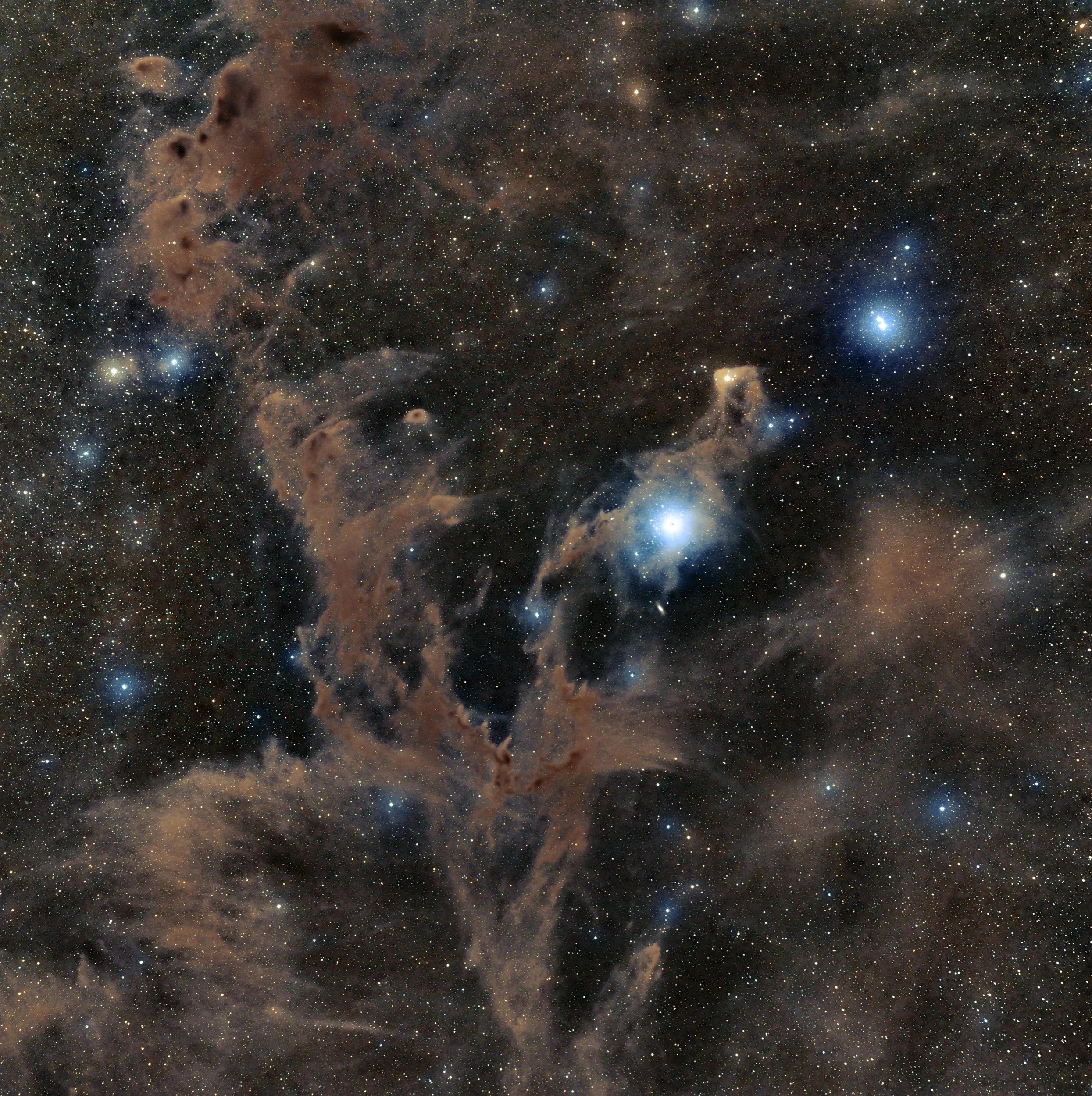
Dark nebulas of Chamaeleon
Image Description and Details :
The dark nebula complex in the constellation of Chamaeleon emits a brown hue in the image due to its strong red and near-infrared colors. The the bright star Beta Chamaeleontis is visible just to the right of center with the dust that surrounds it preferentially reflecting blue light from its primarily blue-white color. Beta Chamaeleontis, latinized from β Chamaeleontis, is the third-brightest star in the southern constellation of Chamaeleon, approximately 298 light years away from sun. The star has five times the mass of the Sun and 2.8 times the Sun's radius.
All of the pictured stars and dust occur in our own Milky Way Galaxy with - but one notable exception: the white spot just below Beta Chamaeleontis is the galaxy IC 3104 which lies far in the distance.
Scope: Takahashi FSQ-106ED
Mount: Paramount MX+
Camera: FLI PL16083
Astrodon Ha (3nm) & OIII (3nm)
Total Integration Time: 1 hrs. 30 min (HA: 5 x 600 sec, OIII: 4 x 600 sec)
Post Processing: Deep Sky Stacker, Pixinsight, Photoshop
Copyright: Basudeb Chakrabarti
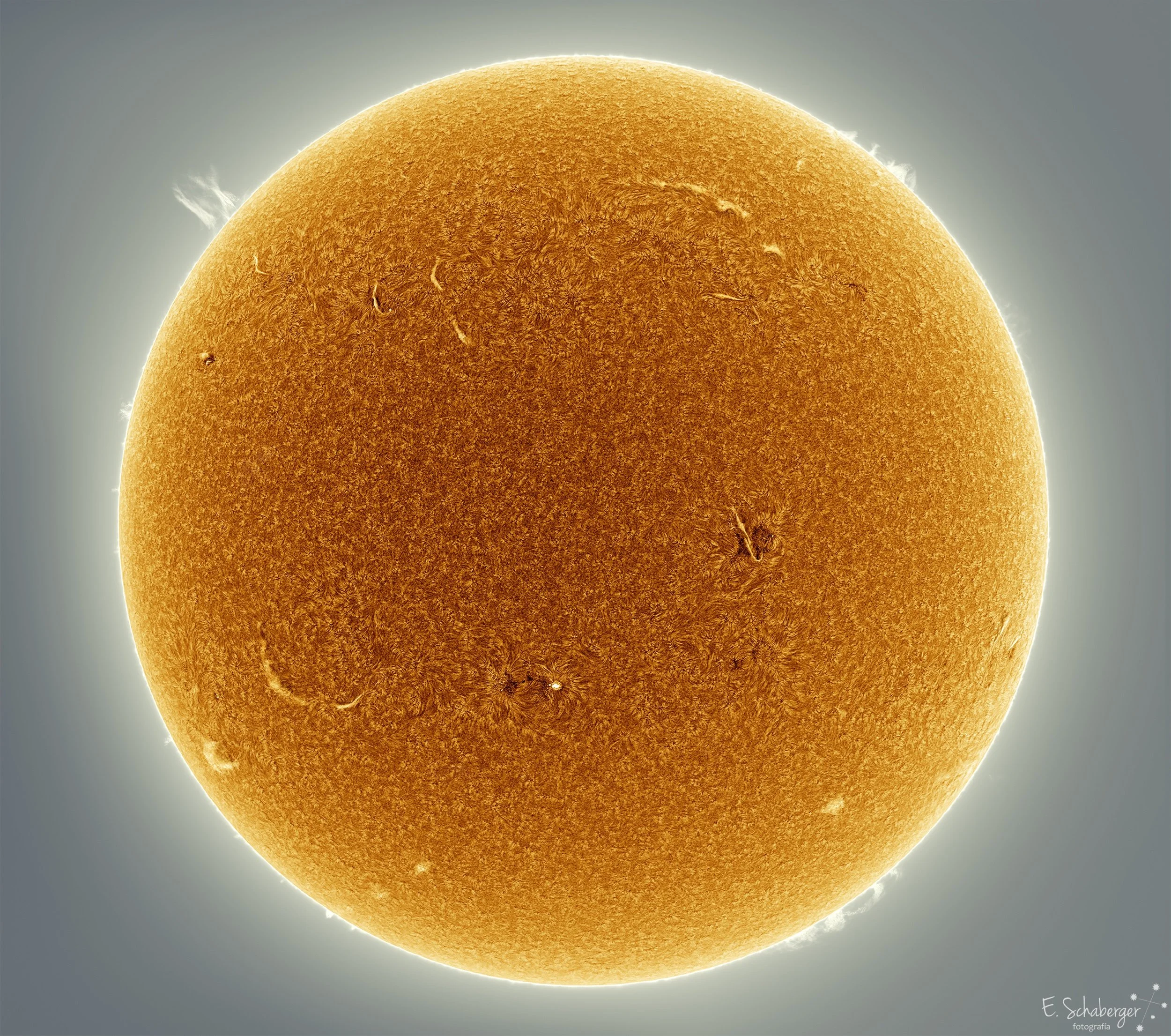
Two towers of plasma in the Sun
Image Description and Details :
This morning, February 18, I photographed this magnificent prominence on the northeast limb of the sun. These two towers of hot plasma rise more than 90,000 km above the sun's surface.
On the solar disk, not many sunspots are seen but many filaments in multiple active regions are very noticeable.
To take this picture I used a Coronado Solarmax II 90mm telescope and a ZWO 183MM camera.
Copyright: Eduardo Schaberger Poupeau
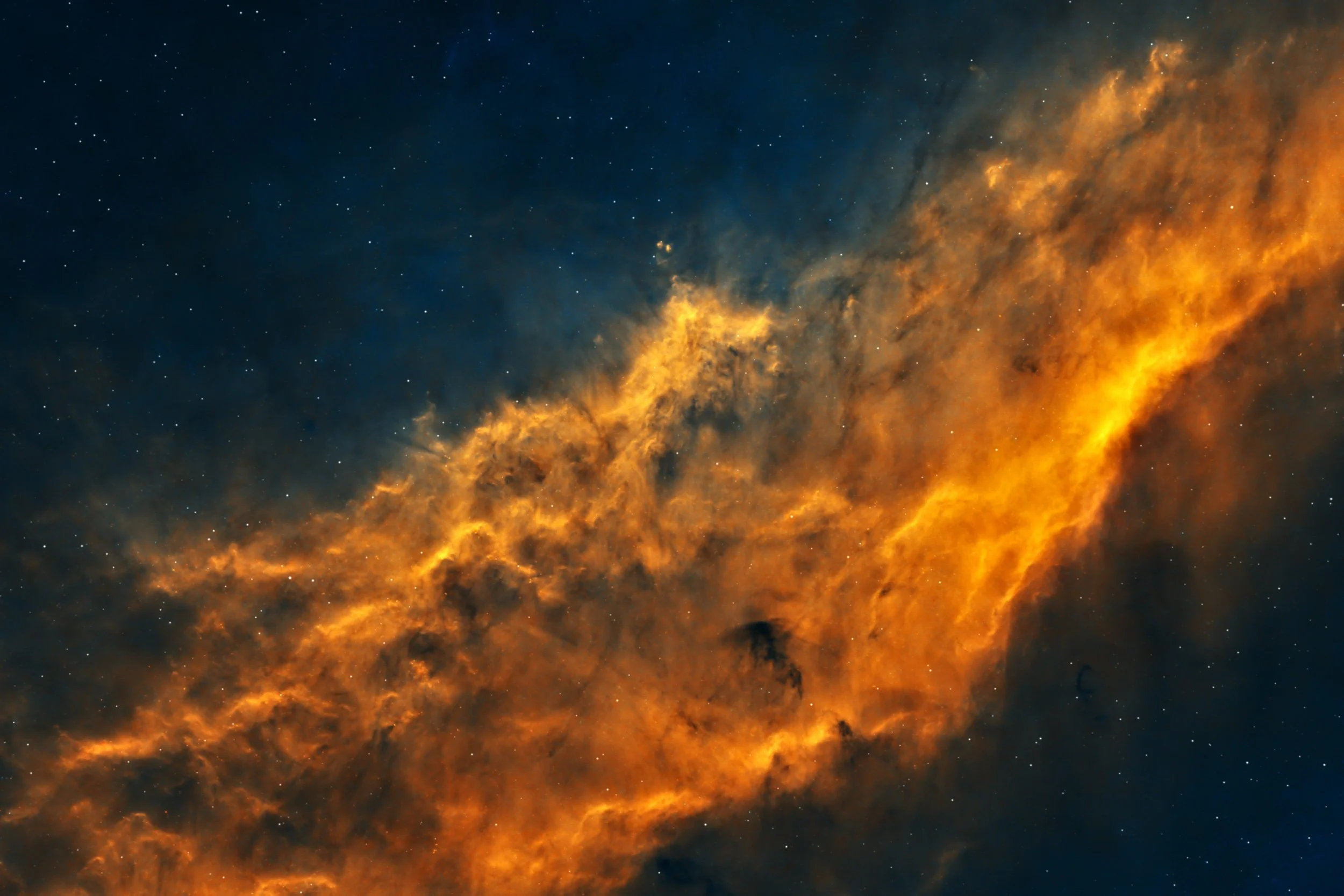
California Nebula NGC 1499 SHO
Image Description and Details : Skywatcher Esprit 120ED Super APO Triplet
ZWO ASI294MM Pro ZWO
Skywatcher AZ EQ6 GT
Chroma OIII 3nm 36mm · Chroma SII 3nm 36mm · Chroma HA 5nm 36mm
N.I.N.A. · Pleiades Astrophoto Pisinsight 1.8
Chroma HA 5nm 36mm: 25x600" (4h 10') (gain: 200.00) -10C bin 1x1
Chroma OIII 3nm 36mm: 20x600" (3h 20') (gain: 200.00) -10C bin 1x1
Chroma SII 3nm 36mm: 20x600" (3h 20') (gain: 200.00) -10C bin 1x1
Integration:
10h 50'
Darks:
50
Copyright: Jose Luis Bedmar

M51 HaLRGB
Image Description and Details :
The Whirlpool Galaxy is a classic spiral galaxy. Known as M51 and NGC 5194, this galaxy may have been the first galaxy for that identified spiral structure. It is located at a distance of 30 million light years from the Sun. Measuring 60,000 light-years across, it is one of the brightest and most beautiful galaxies in the sky. The Whirlpool Galaxy can be seen with good binoculars in the constellation Canes Venatici. The M51 galaxy belongs to the Sc type spiral galaxies and is the main member of a whole group of galaxies. Astronomers suggest that the appearance of the spiral structure of the galaxy M51 is mainly due to the gravitational influence of a small satellite galaxy NGC 5195.
Also in the picture, next to M51, you can see the galaxies IC4277, IC4278 plus many small galaxies in the background.
This image was originally intended to capture an extragalactic hydrogen cloud near M51. However even 22 hours of exposure through the Ha filter gave no hint of it.
Own remote observatory, 50 km from Kiev, Bortle 4 zone. Imaged during February - June 2021. AZ-EQ6 mount, ONTC8 newton, QHY22. Guide - OAG with Lodestar camera.
Astrodon 5nm Ha: 88 x 900s;
Astrodon L: 228 x 300s;
Astrodon R: 40 x 300s;
Astrodon G: 40 x 300s;
Astrodon B: 70 x 300s;
Total exposure - 53 hr.
Captured in SGP, processed in Pixinsight.
Copyright: Sergiy Vakulenko
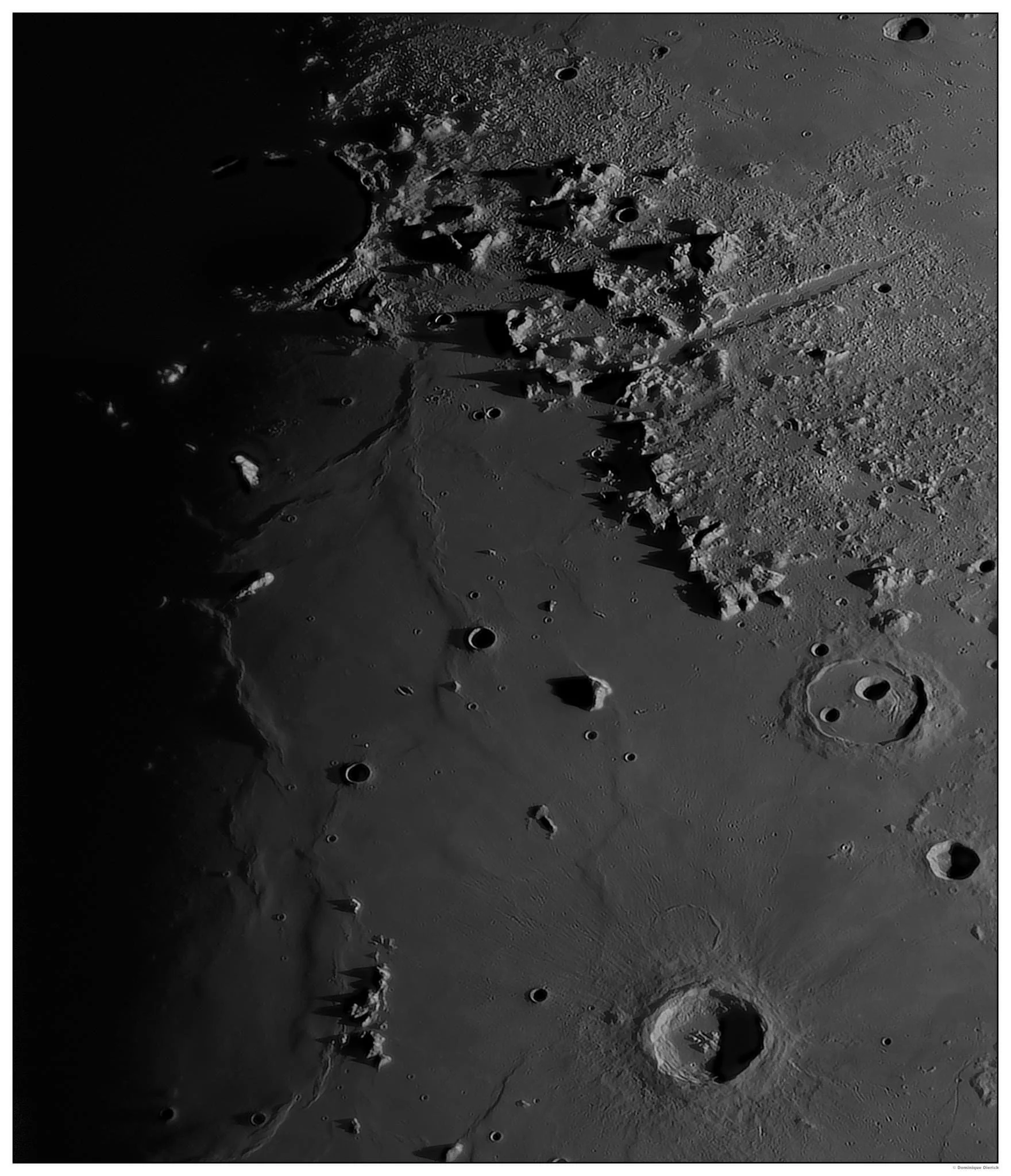
Plato and the lunar Alps
Another sunrise, this time over Plato and the lunar Alps. Mewlon 250CRS, 1.8x barlow, ASI290MM camera.
Another sunrise, this time above Crater Plato and the moon Alps . Mewlon 250CRS, 1.8xbarlow, ASI290MM camera .
Copyright: Dominique Dierick
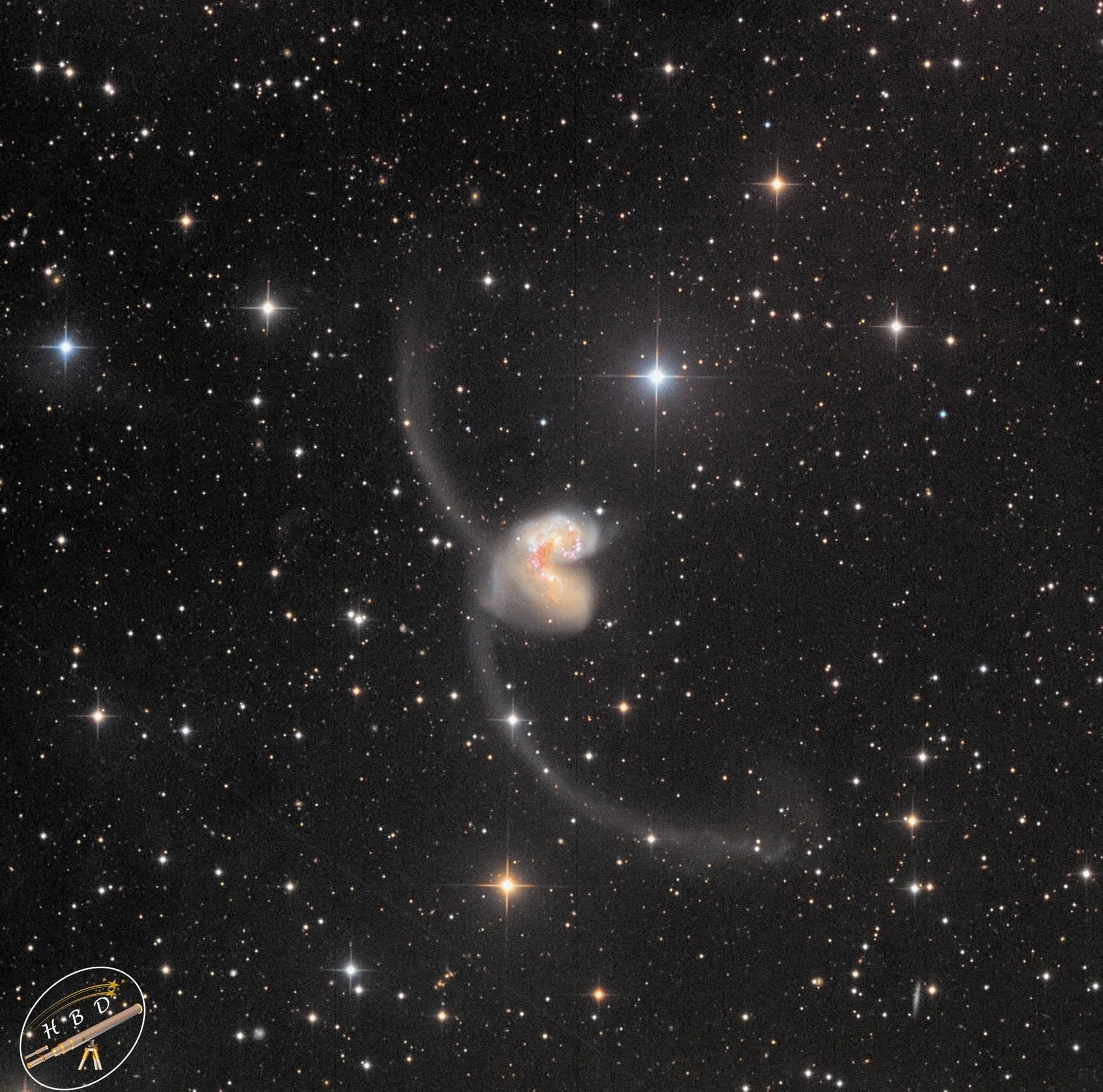
Antennae Galaxies
Image description:
In the constellation of Rabe we see an interesting process, the merger of the galaxies NGC 4038 and 4039. This interaction will cause a rapid star eclipse. The same fate will happen in the distant future when Andromeda Galaxy and Milky Way collide. Here it is in 66 million Lj distance for us just a play in the cosmos.
Setup: Planewave CDK, 60 cm, f 6,5
Kamera FLI PL 9000 mit Filterrad, 3056×3056 px
Processed in LRGB with Fitswork, PixInsight and PS
Copyright: Hans Dorfeldt

NGC 2170 and others
Image Description and Details :
NGC 2170 nebular complex in Monoceros. L Ha RGB exposure for about 21 hours. Scope GSO RC 30 cms, camera Sbig STF8300-AO/8, from my backyard obs at La Colonia, Illapel, Chile. Suburban skies. All exposures at -35°C, all subframes 12 minutes except Ha (16 minutes each). MaxIm, CCDStack2, Photoshop softwares.
Name: Pedro Goles
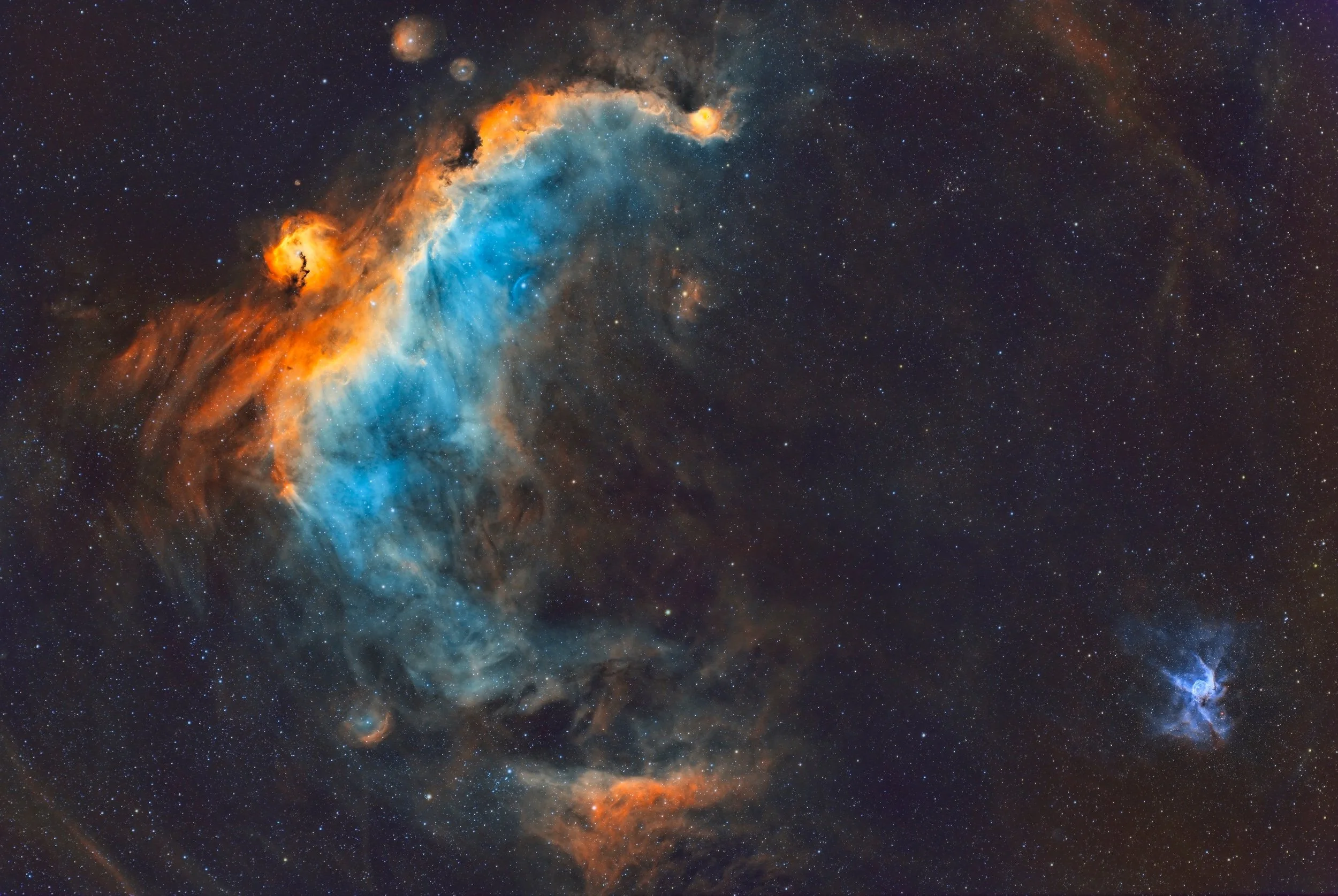
The Giant Vs. The Mighty
Image Description and Details :
This shows the huge Seagull Nebula, and the very small (in comparison) but bright Thor’s Helmet Nebula, in narrowband.
This is an image 2 years in the making. I spent 10 full nights on imaging the Seagull Nebula wide field, as I also wanted to include Thor’s Helmet in the frame. I then added an extra 2 nights worth of data using a larger telescope on Thor’s Helmet only. This allowed me to get a nicer view on that target. All the data acquired was by myself with my own gear.
The Seagull Nebula is known as IC 2177. It is a large nebula that can be found 3,650 light-years away in Monoceros. It is a great target for both broadband and narrowband imaging, and is very close to the much smaller Thor's Helmet Nebula.
If you look closely near the Oxygen gases of the Seagull Nebula, you should be able to spot a bright star with a strange arc-shaped line of gas just above it. This is commonly known as the "Bow shockwave" in IC 2177. It is believed to come from the interaction between the interstellar dust within the nebula, high radiation winds, and gas expelling from the double star system "FN CMa”. The exact origin is still not very clear, but we might learn more about it in the years to come!
Thor’s Helmet is known as NGC 2359. It is a cloud of interstellar gas, although very faint, the colors in the gases really pop when taking long exposure shots with any camera.
This beautiful deep-sky object gets its glow from WR7, a massive Wolf-Rayet star that will soon turn into a supernova.
This is a total of 61 hours of exposure, a record for me as my longest acquisition so far was 48 hours. I captured 99% of the data from the city, Bortle 9. I captured a little bit of the data (half a night) from a Bortle 4 spot in the desert for the OIII in Thor’s Helmet.
Acquisition Info:
Target: The Seagull Nebula and Thor Nebula
Imaged from: Las Vegas Bortle 9 + Nevada Desert Bortle 4 | January/February 2022
Camera: QHY600M
Filters: S+H+O for Seagull wide field, H+O for Thor’s Helmet
Telescope: Meade 70mm APO for Seagull wide field, SVX130 for Thor’s Helmet close up
Time per frame: 600sec
Time total: 61 hours total. 50 hours for the overall image wide field + an additional 11 hours for Thor’s Helmet close up.
Copyright: Antoine & Dalia Grelin