

AAPOD2 Image Archives
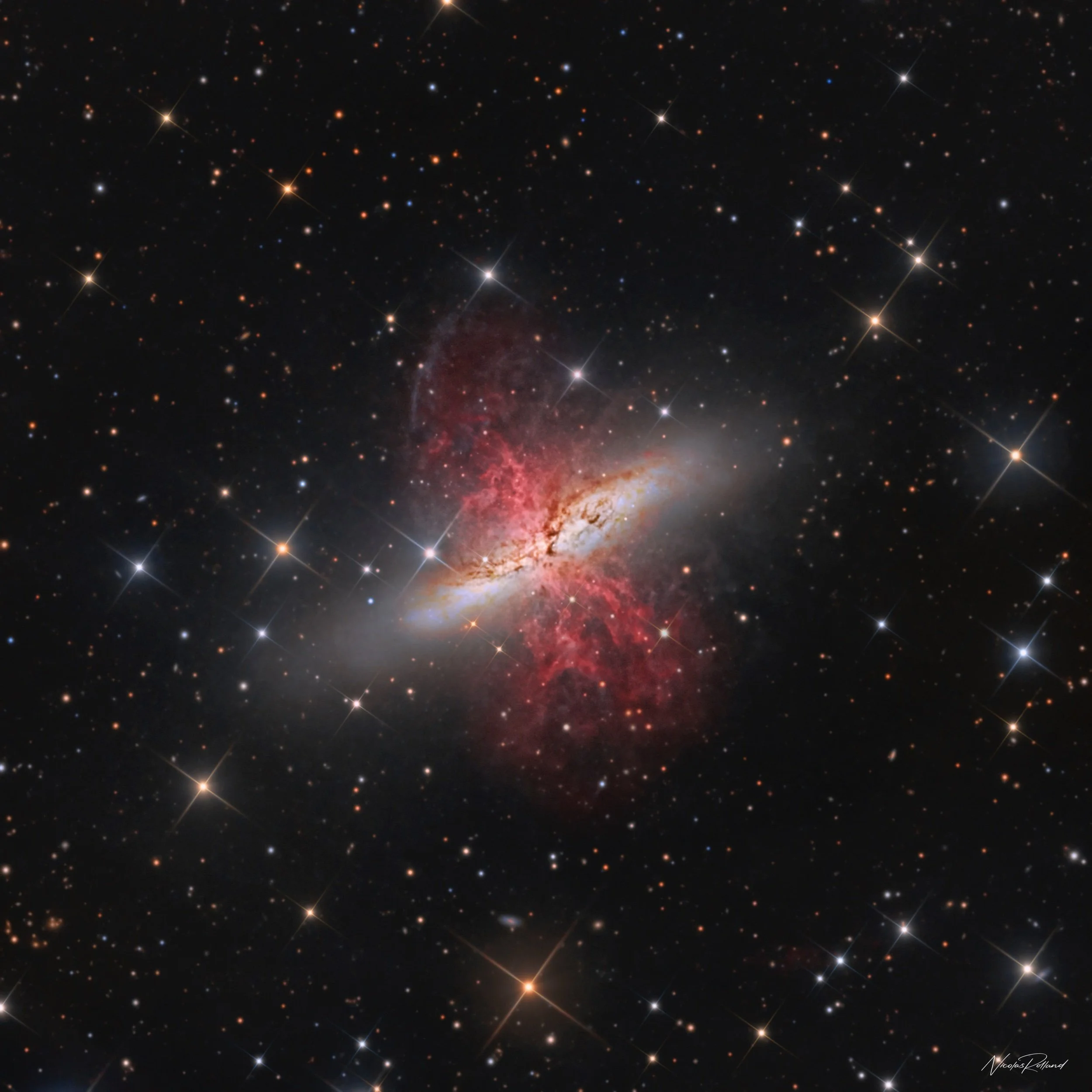
The Cigar Nebula - Messier 82
Image Description and Details : Messier 82 is the very first galaxy I was able to observe with the naked eye with my old telescope: a C9.25 EDGE HD on a Losmandy G11 Gemini mount. This was in early January 2014, when the supernova SN 2014J was visible. It was also the first galaxy I photographed in May 2017. So it was a great pleasure to have been able to process the data of this galaxy from a much more ambitious setup.
Messier 82 (the Cigar Galaxy) is a starburst galaxy, meaning that it has an exceptional rate of star creation compared to most galaxies. It’s located approximately 12 million light-years away in the constellation of Ursa Major. About five times brighter than the Milky Way, the intense star formation activity was triggered by an interaction with the neighboring galaxy M81.
OPTICS Planewave CDK17 @ F/6.8
CAMERA FLI Proline 16803
MOUNT Paramount ME
FILTERS Ha, L, R, G, B
LOCATION Dark Sky New Mexico, Animas, New Mexico, USA
DATE January 2022 & 2017
EXPOSURES 46 hours (L 58 x 1200 sec, R 28 x 900 sec, G 27 x 900 sec, B 28 x 900 sec, Ha 12 x 1800 sec)
PROCESSING SOFTWARE Pixinsight, CCDstack, Photoshop
Copyright: Data acquisition: Bernard MILLER
Processing: Nicolas ROLLAND
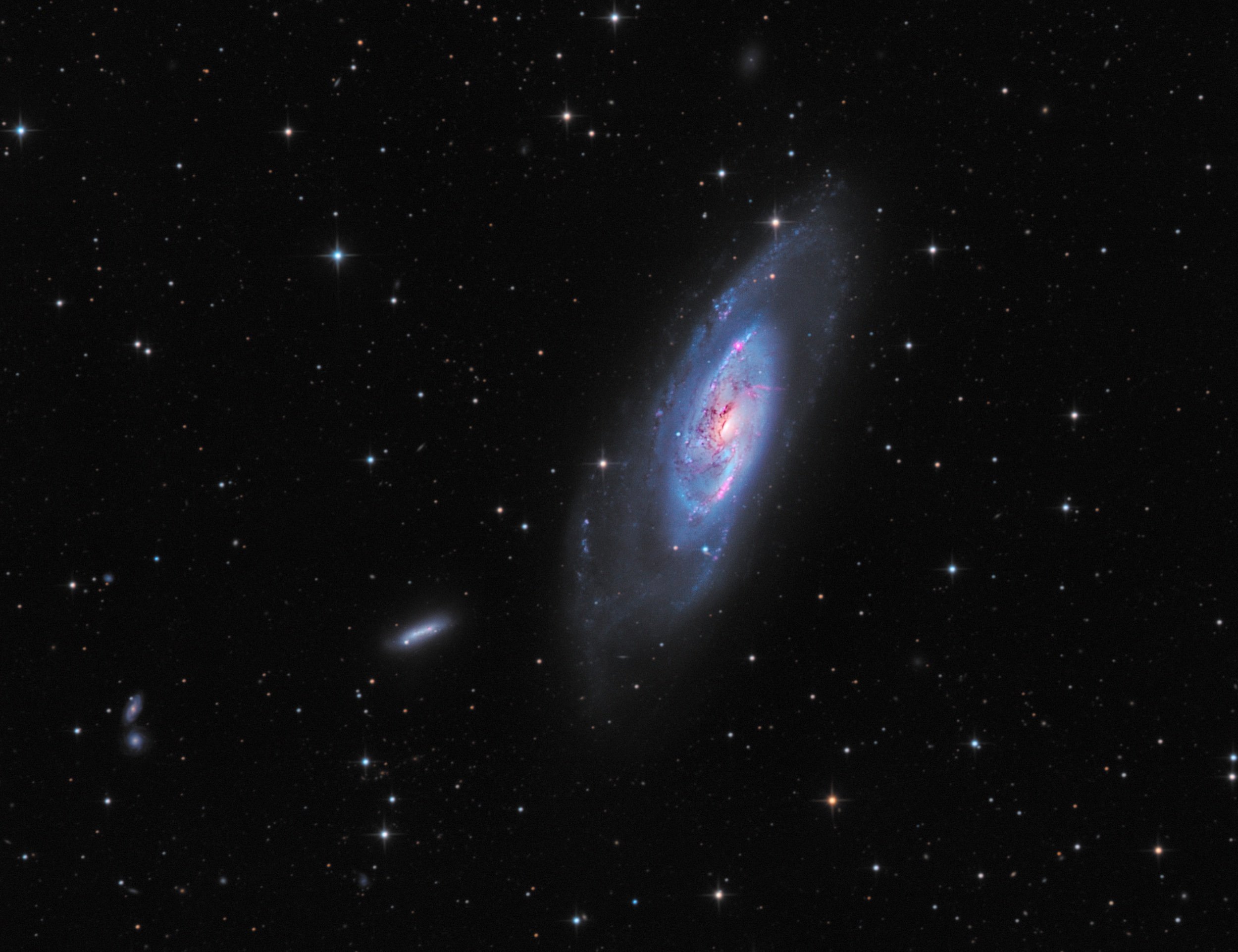
M106
Image Description and Details :
M106 galaxy dominates on this image. Also known as NGC 4258, M106 is about 80,000 light-years across and 23.5 million light-years away, the largest member of the Canes II galaxy group. For a far far away galaxy, the distance to M106 is well-known in part because it can be directly measured by tracking this galaxy's remarkable maser, or microwave laser emission. Very rare but naturally occurring, the maser emission is produced by water molecules in molecular clouds orbiting its active galactic nucleus.
The following galaxies can also be seen in the image - NGC4248 (bright at the left-bottom of the center), UGC7356 (above M106) and a pair of galaxies NGC4231 & NGC4232 (in the lower left corner of the full-size image). Beneath NGC4248 is also a cluster of distant little fuzzy galaxies.
What interesting is that this image reveals one of the two faint hydrogen jets inside M106 (2 o'clock from galaxy center).
Own remote observatory, 50 km from Kiev, Bortle 4 zone. Imaged during March - May 2021. AZ-EQ6 mount, ONTC8 newton, QHY22. Guide - OAG with Lodestar camera.
Astrodon 5nm Ha: 68 x 900s;
Astrodon L: 125 x 300s;
Astrodon R: 40 x 300s;
Astrodon G: 40 x 300s;
Astrodon B: 70 x 300s;
Total exposure - 40 hr.
Captured in SGP, processed in Pixinsight.
Copyright: Sergiy Vakulenko
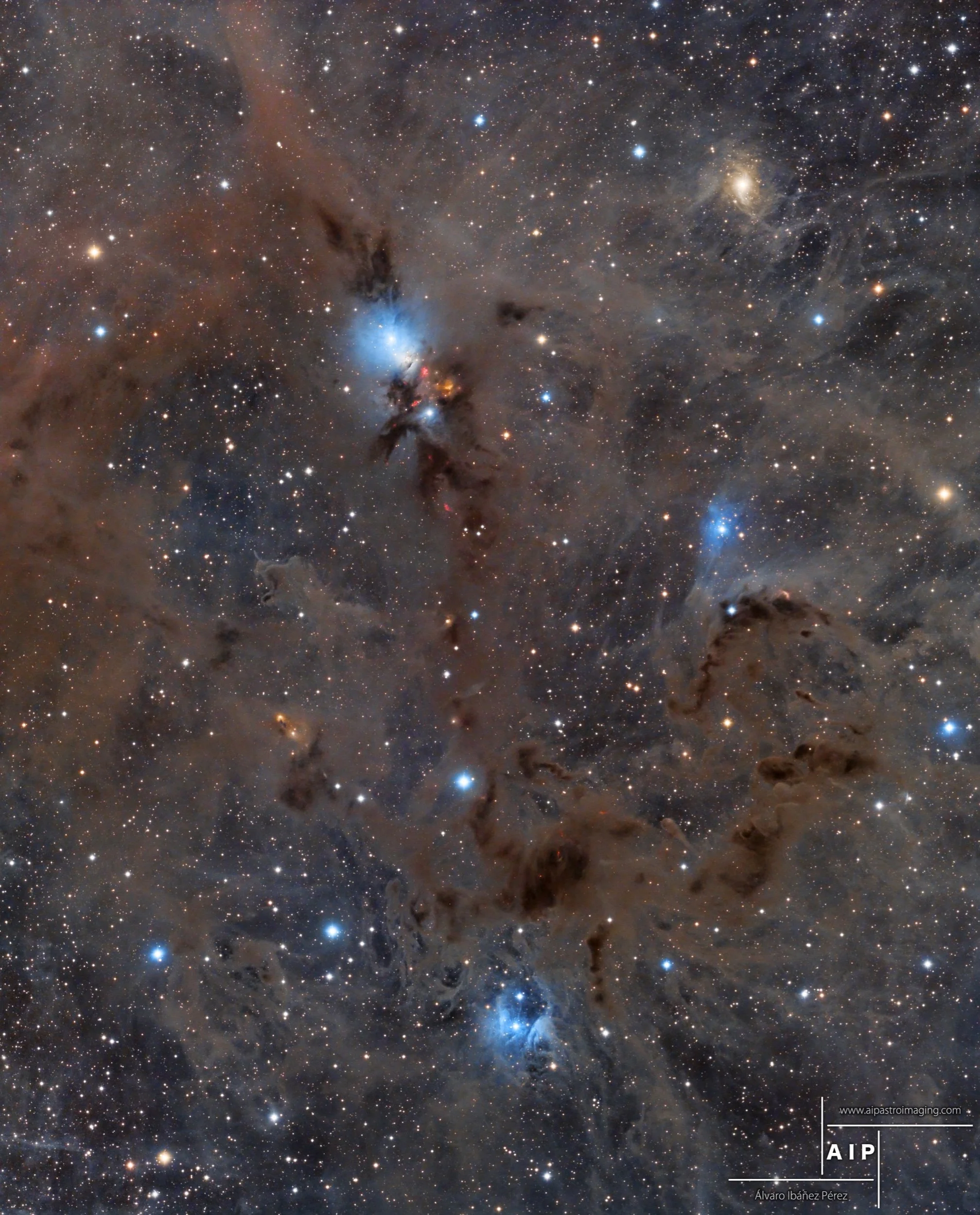
NGC1333
Image Description and Details :
Telescope: Takahashi FSQ106EDX (f/5)
Munt: Takahashi EM400 Temma2
Camera: Atik 16200 mono
Filters: Astrodon Gen2 LRGB I-Series 50,8mm + IDAS LPS
Filter Wheel: SX USB Filter Wheel 5x50,8mm
Guider: Lunático EZG-60 + SXLodestar
Flat panel: RB Focus eXcalibur
Powerbox: RB Focus Balinor Pro
Focus: RoboFocus
Adquisition: N.I.N.A.
Processing: PixInsight Core + Photoshop
Exposure:
L: 90x600s bin1
RGB: 30x300s bin2 each channel
Total: 23h 30min
Captured during 4 nights from Yela, Las Inviernas and Navas de Estena (Spain)
Copyright: Alvaro Ibañez Perez
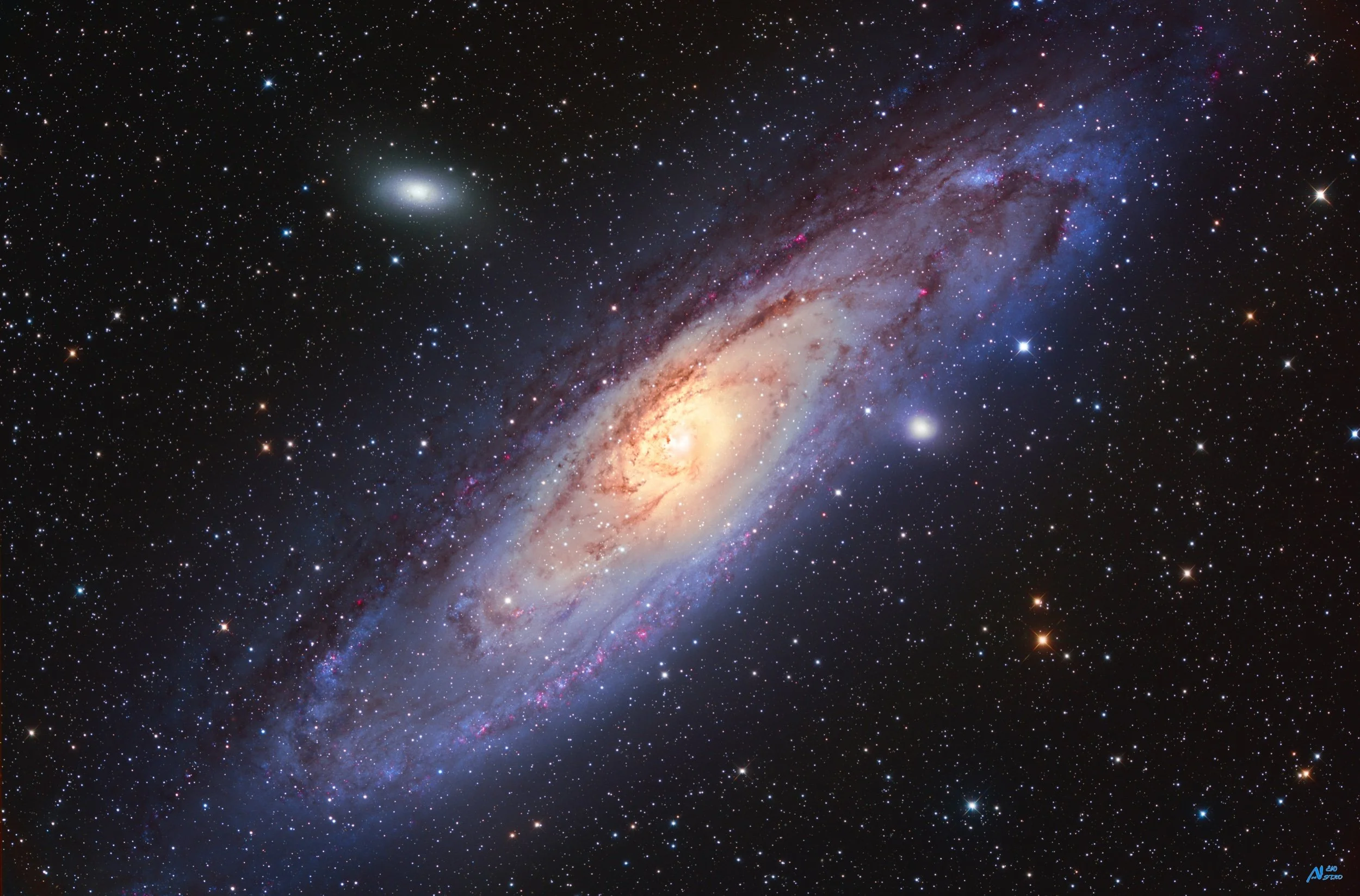
M31
Image Description and Details :
Consisting of 300 billion stars, the Andromeda galaxy M31 is considered the twin sister of our Galaxy. It is accompanied by two much smaller satellite galaxies, M32 and M110. The Andromeda Galaxy is the most distant object that can be seen without an instrument under good skies, at 2.5 million light years.
Image taken in Normandy (France), by Team Newastro; (astronew.fr) , with Tube Newton Skyvision (250-900 f/d 3,6) on Eq8 mount,
ZWo Asi 6200MM camera.
Image in L,r,v,b and Ha. Total exposure time 7 hours.
Copyright: astronew.fr

Bode’s Galaxy
Image Description and Details :
Discovered by the German astronomer Johann Elert Bode in 1774, M81 is one of the brightest galaxies in the night sky. It is located 11.6 million light-years from Earth in the constellation Ursa Major and has an apparent magnitude of 6.9.
This Image was captured over two winters with 4 different telescopes spanning from 8" to 12" for a total of 17 hours of exposure using LRGBHa Filters and a monochrome camera.
Copyright: Matthew Proulx

M35
Image Description and Details :
16" f3.75 Dream Astrograph, FLI Proline 16803, Paramount MEFrames: 55x120" (1h 50')Image aquisition remotly by Cláudio Tenreiro, at Insight Observatory, New Mexico.Image processing: Ruben Barbosa.Messier 35 (M35) is a large open star cluster located in the northern constellation Gemini. The cluster consists of several hundred stars, of which 120 are brighter than magnitude 13. The central region has a density of 6.21 stars per cubic parsec. M35 is The only Messier Object located in Gemini
Copyright: Claúdio Tenreiro / Ruben Barbosa

The Foxy Nebula
Image Description and Details :
In this image of the Cone and Fox fur Nebulas, I've tried to make it as deep as possible within the available time. The Ha stands out all around the FOV and the Oiii shows quite well permeating the image. It was assembled as HOO in a somewhat unusual rendition for this object, one of my favorites.Shot at Barcarena, Portugal (Bortle 7-8), from 18th to 24th January, and processed in PixInsight.Frames:Ha: 150 x 5 minO3: 110 x 5 minRGB: 3 x 20 x 1 minTotal integration: 23 hoursTechnical details:Telescope: TS Optics Triplet APO 800/115Flatenner: TS Optics 3'' 0.79xMount: SW EQ6-R ProCamera: QHYCCD 268MFilters: Baader Ha 8.5nm and Oiii 7.0 nm. Optolong RGB.
Copyright: André Vilhena
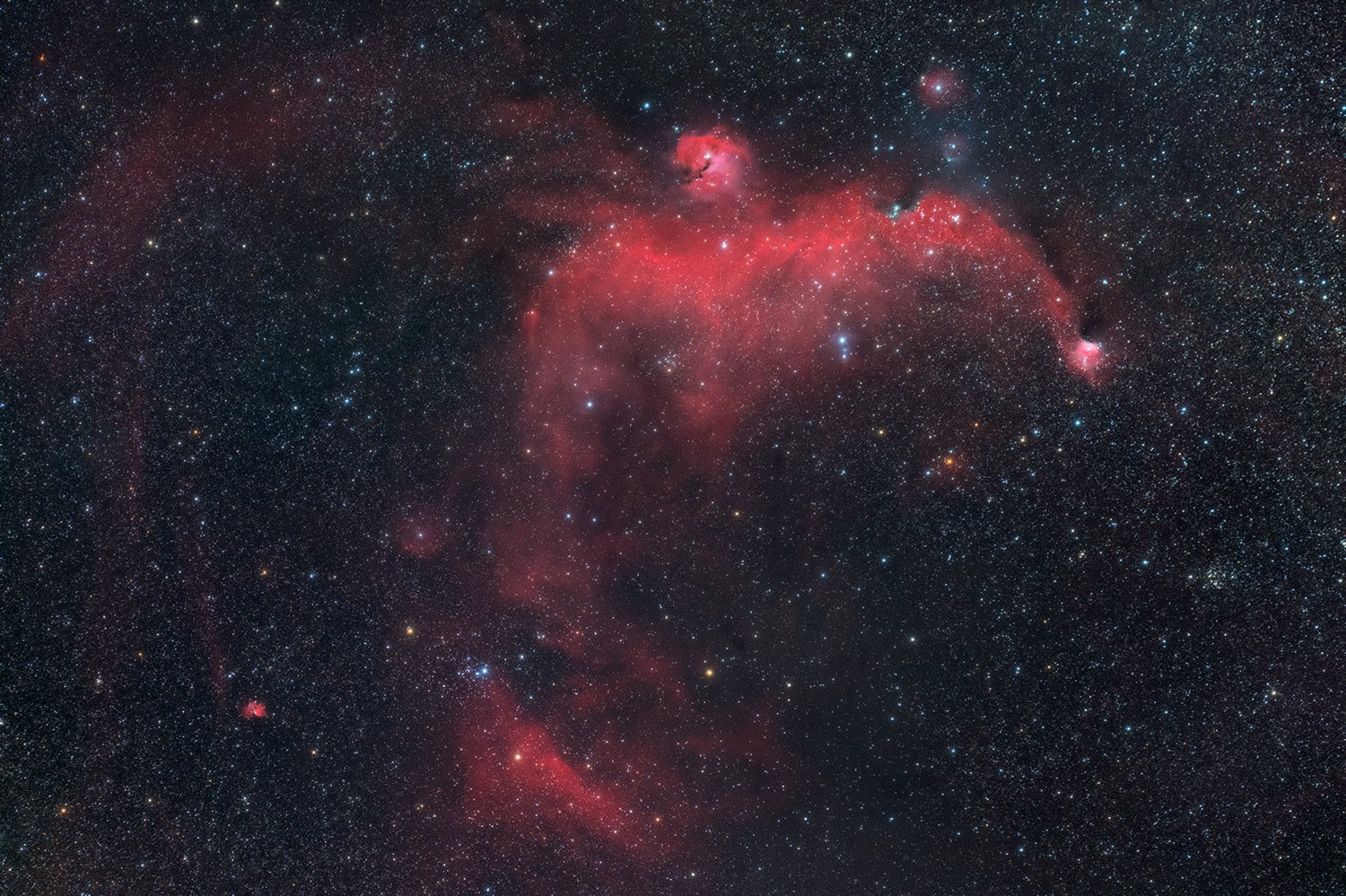
Ic2177
Image Description and Details : The Seagull Nebula (also known as Gum 2 sometimes mistakenly known as IC 2177) is a diffuse nebula visible on the border between the constellations Canis Major and Unicorn.
INSTRUMENTATION:
Tecnosky AG70/350 telescope on AZEQ6 GT mount, self-guide with Artesky 60/240 and ASI290mini telescope, ASI 2400 MC PRO full frame acquisition camera, all controlled by ASI AIR PRO.
ACQUISITION:
8 light of 8 minutes total 1 hour and 4 minutes, integrated with 31 FLAT 31 DARK FLAT and 15 DARK. Sensor temperature -10.
ELABORATION:
Pixinsight and Photoshop.
Location: Polino Terni Umbria Italy
Copyright: Luca Marinelli
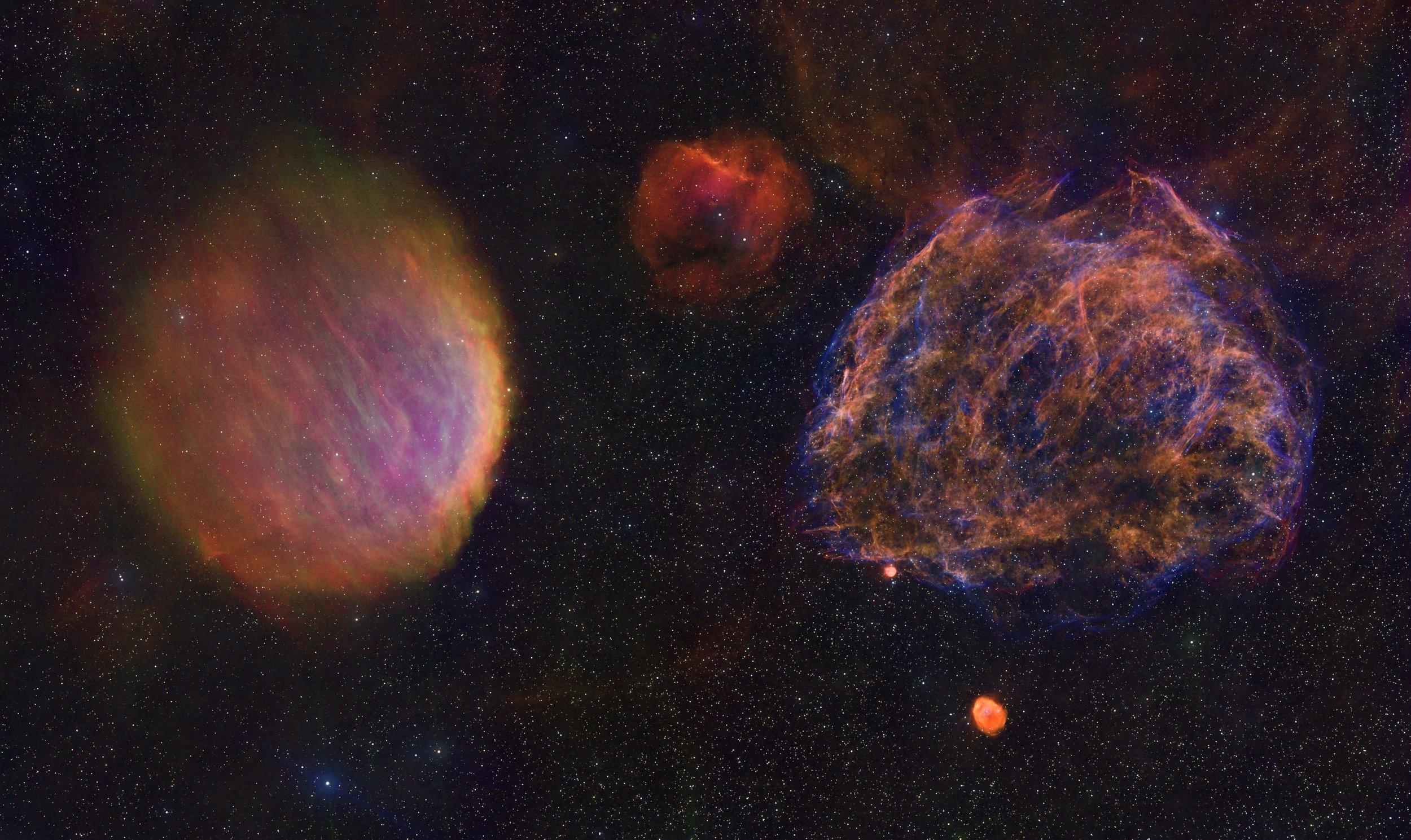
The False Twins : SH2-216 & SH2-221
Image Description and Details : This is a 4 panel mosaic done over multiple nights and requiring more than 120 hours. It was captured from Andalusia in Spain using a AP130GTX refractor on top of a 10Micron mount.
The colour scheme is HSO with added RGB stars. The following frames were captured :
- Ha : 244 X 600s
- OIII : 220 X 600s
- Sii : 220 X 600
- RGB : for each 60 X 180
Copyright: F Drevon
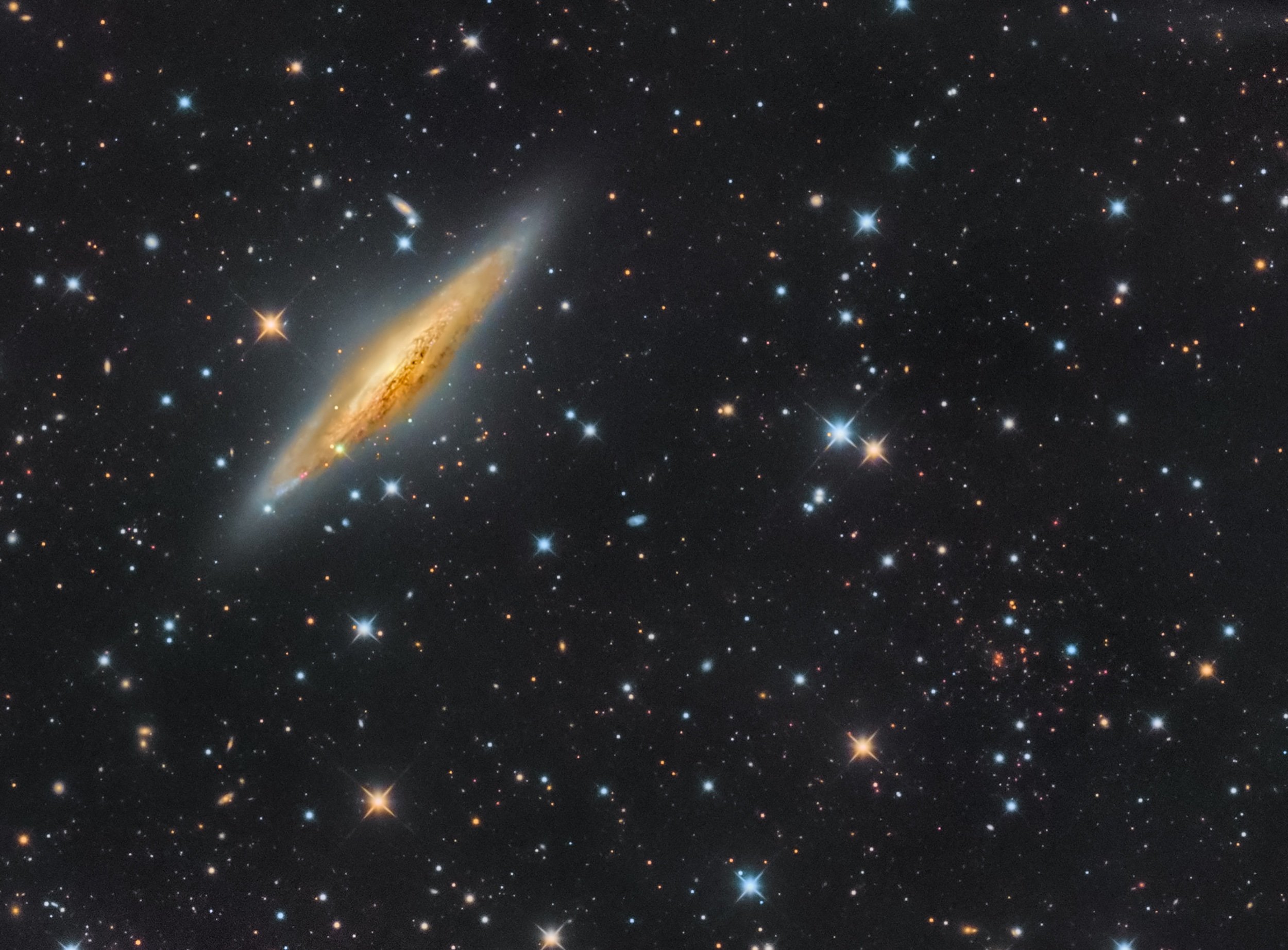
Galaxy NGC 2683
Image Description and Details :
NGC 2683 is a field spiral galaxy in the northern constellation of Lynx. It was nicknamed the "UFO Galaxy" by the Astronaut Memorial Planetarium and Observatory.It was discovered by the astronomer William Herschel on February 5, 1788.
Captured in my private observatory near Kyiv, Ukraine, during Nov-Dec 2020 by 350 mm Newton, SBIG-8300 STT, worked up by PixInsight. Total exposure time is about 30 hours.
Copyright: Edward Popovitch, Ukraine
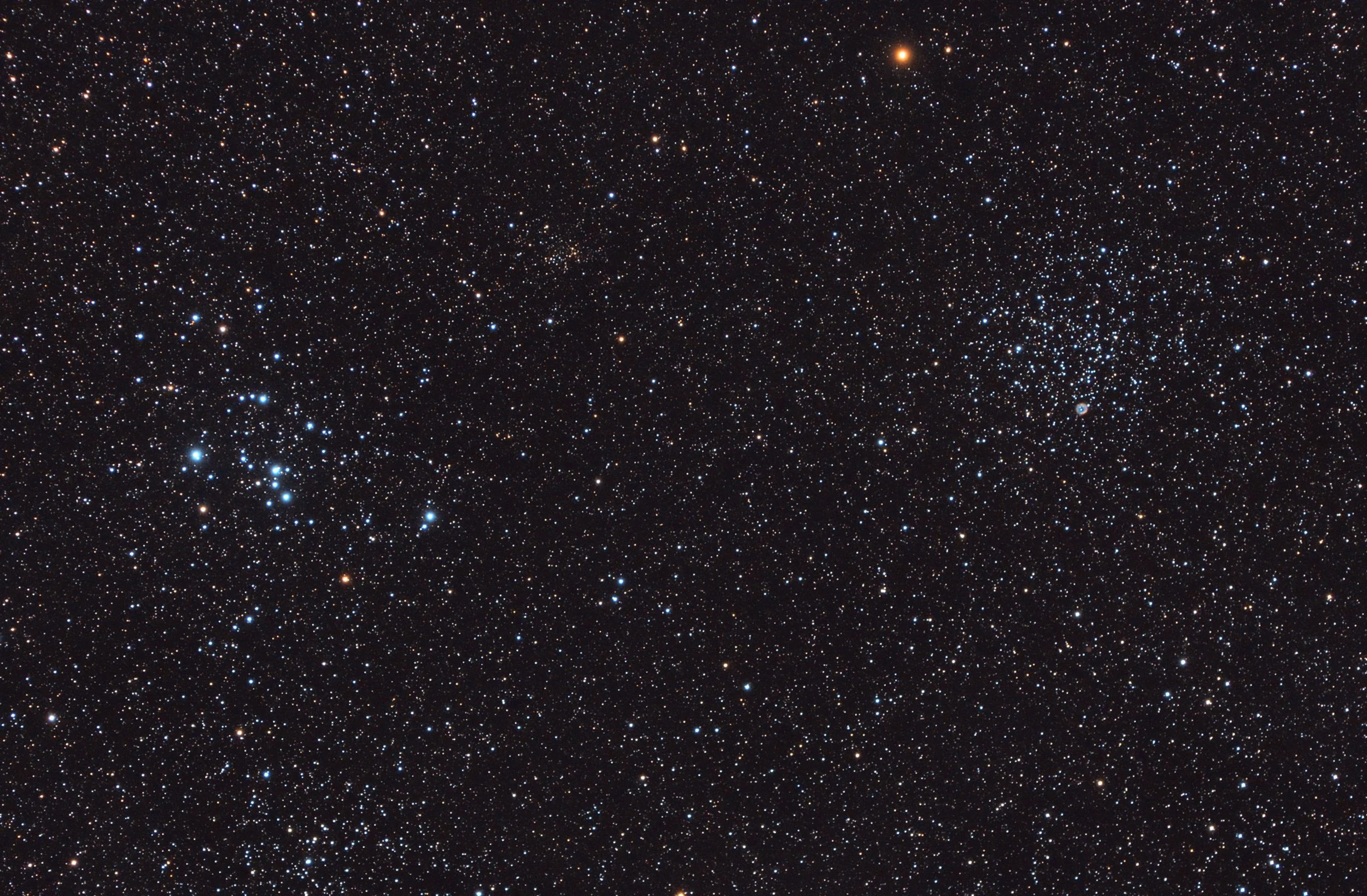
Double cluster in Puppis (M46 and M47) and their little companion NGC 2438 (with particular)
Image Description and Details :
In the direction of the constellation of the Puppis there is this pair of open clusters cataloged by Charles Messier as M46 and M47. On closer inspection, in the direction of M46 there is a very small planetary nebula cataloged as NGC 2438, the remnant of a stellar explosion that left a white dwarf at its center. NGC 2438 is 2900 light years away from us and has an extension of "just" 4.5 light years.
Scope: Skywatcher ED80 reduced @480mm, f6.0
Camera: Qhy168c @-15°C, gain 10, offset 50, with reducer DELUXE Artesky 0.8x and Optolong L_Pro filter
Guide: finderscope Konus 50/180 and Asi224Mc
Mount: Skywatcher Eq6r Pro
Accessories: Zwo EAF
Management system: Raspberry PI4 with Stellarmate OS remotely controlled with Windows 10
Acquisition software: Kstars/Ekos
Frames: 18x300" calibrated with flat, dark and bias
Stacking and post-production softwares: AstroPixelProcessor, Pixinsight and Photoshop
Location: Ferrara (Italy), Bortle 6, SQM 19,22
Copyright: Massimo Di Fusco

M81, M82, & the Integrated Flux Nebula
Image Description and Details :
Bode's Galaxy, the Cigar Galaxy, and the Integrated Flux Nebula January 6 - January 28 2022 Rowe, NM 305mm Riccardi-Honders @ f/3.8 AP1100 GTO AE Mount, Unguided QHY600PH monochrome @-20*CChroma 50mm x 50mm filtersHaLRGB66.3 hours total integration time
Copyright: Jared Willson
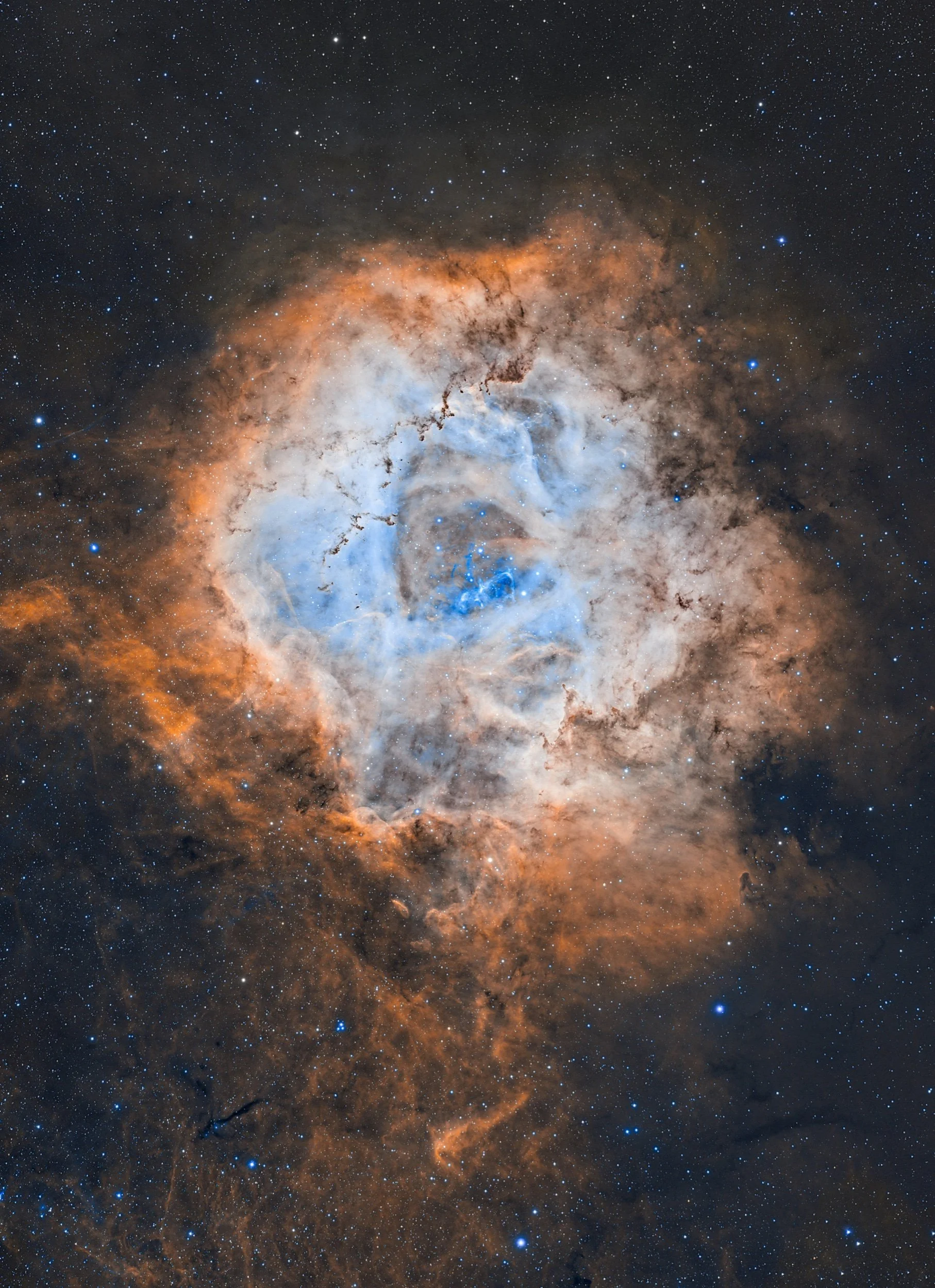
The Rosette Nebula in Bicolor
Image Description and Details : The Rosette Nebula, photographed in bicolor. The HA was taken from the city (Las Vegas Bortle 9), the OIII was taken from the desert (Bortle 4). The total exposure time is 20 hours.
Copyright: Antoine & Dalia Grelin
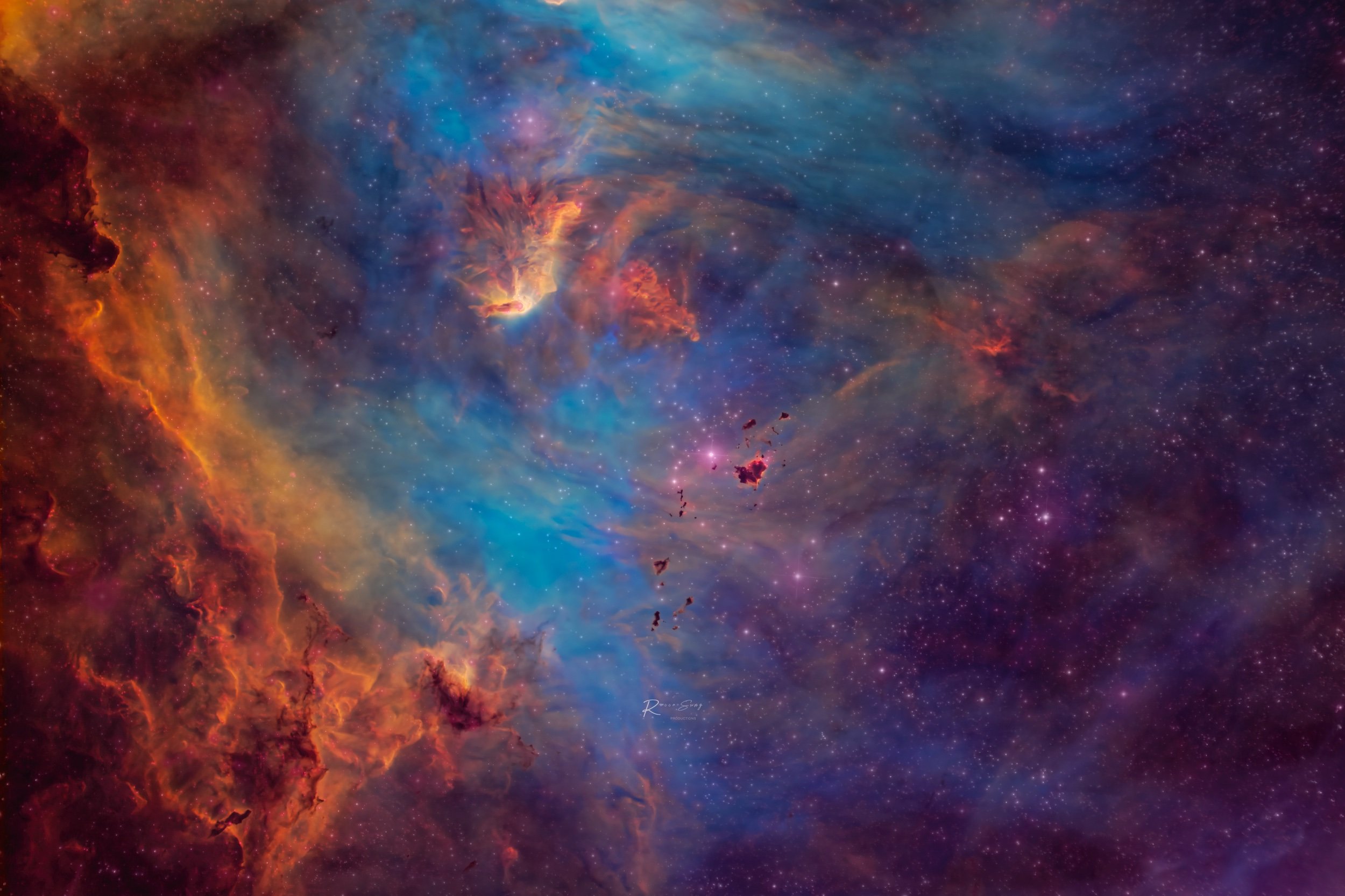
IC2944 The Running Chicken Nebula
Image Description and Details : 1) Telescope : Planewave CDK17, Camera : SBIG SXTL 11002 with AOX, Tracking : Paramount
2) Telescope : Riccardi-Honders 305, Camera : SBIG SXTL 16200, Tracking : Paramount
Location : Observatory EI Sauce, Chile / Australia
Total 44+ hours SHO data by CDK17 and RH305
Image processing : Pixinsight, Photoshop
Copyright: Image captured : Martin Pugh
Image processing : Rocco Sung
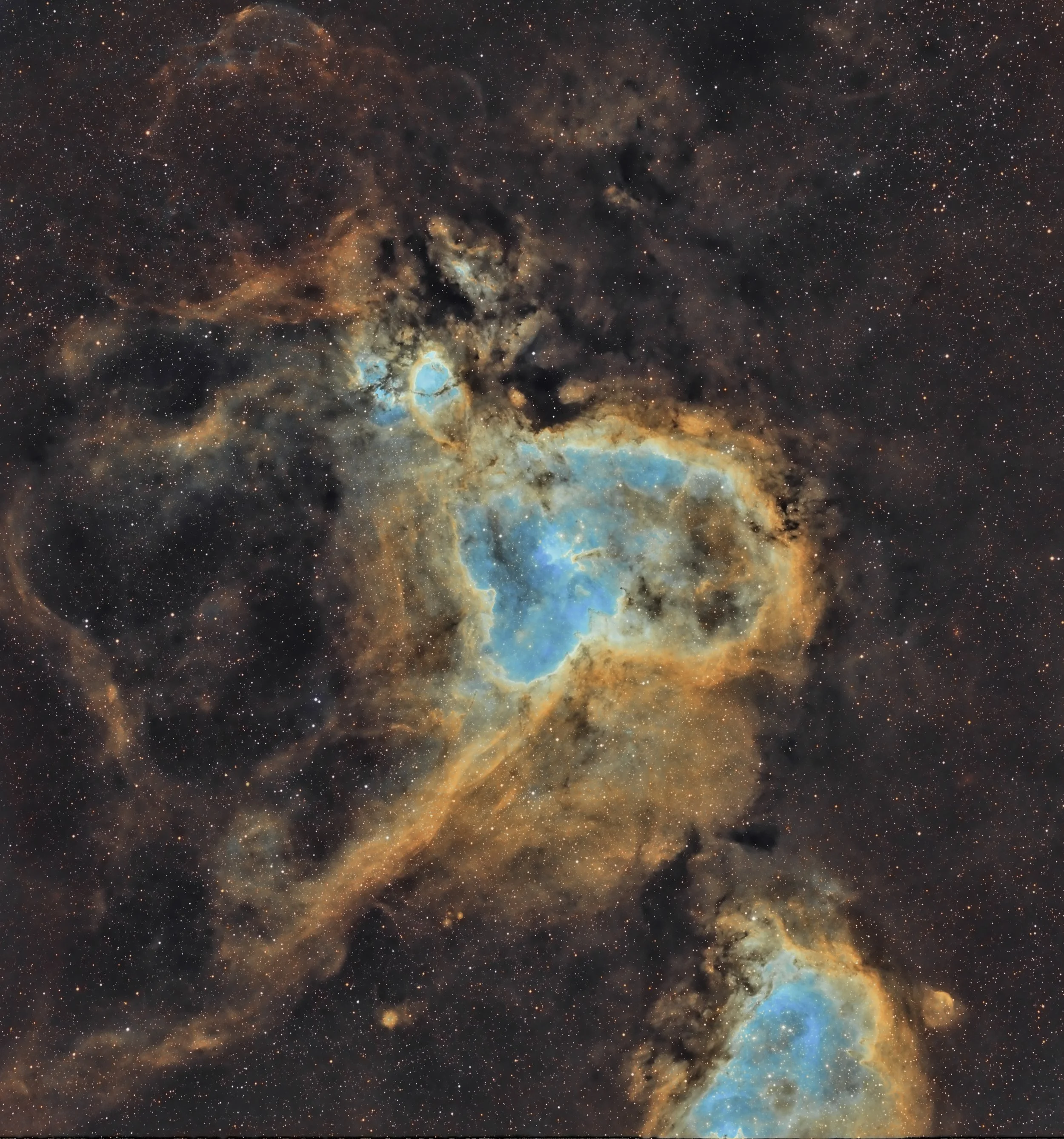
Cassiopeian Heart
Image Description and Details :
Data Acquired from: Telescope live.Location: IC Astronomy Observatory, SpainScope: Takahashi FSQ-106ED (106 mm) F3.6Focal Reducer: 0.73Mount: Paramount MX+Astrodon SHO FiltersTotal Integration Time: 24 hrs. 50 minsProcessing in Deep Sky Stacker, Pixinsight, Photoshop
Copyright: Basudeb Chakrabarti

Jellyfish, Monkey Head, and M35 Star Cluster
Image Description and Details : Here is my latest photo taken night before last in the back yard. It is featuring the Jellyfish in HOO palette , the Monkey Head in SHO palette , and Star Cluster Messier 35 in RGB. The nebulosity was captured using narrowband filters that only let specified wavelengths of Sulfur, Hydrogen, and Oxygen. The stars were captured with color separate filters for Red Blue and Green. I used a Rokinon 135mm camera lens at f/2 and an ASI294MM dedicated monochrome camera.20 x 60 seconds of each L R G B 36 x300 seconds Oiii 24 x 300 seconds Sii 16 x 300 seconds HaShot Flats for all filters this morning and used my darks library. Stacked and Processed with Pixinsight and Photoshop. EZ soft stretch Starnet Automatic Background Extraction Background neutralization Save separates as Tif’s for Photoshop Copy S H and O in to RGB color channels and work levels and curves. Adjust selective colors to reduce green and pull the Hubble gold color forward. Contrast Brightness adjusted Saturation adjusted. Resize down to 2,048 pixels wide. Topaz denoise and upload.I am still learning Pixinsight. I used selective colors in Photoshop to attempt the Hubble palette colors evident in the Monkey Head. Finally I resampled to 2048 pixels wide for sharing as a Jpg and did a topaz denoise. Hope you enjoy it.
Copyright: Abe Jones
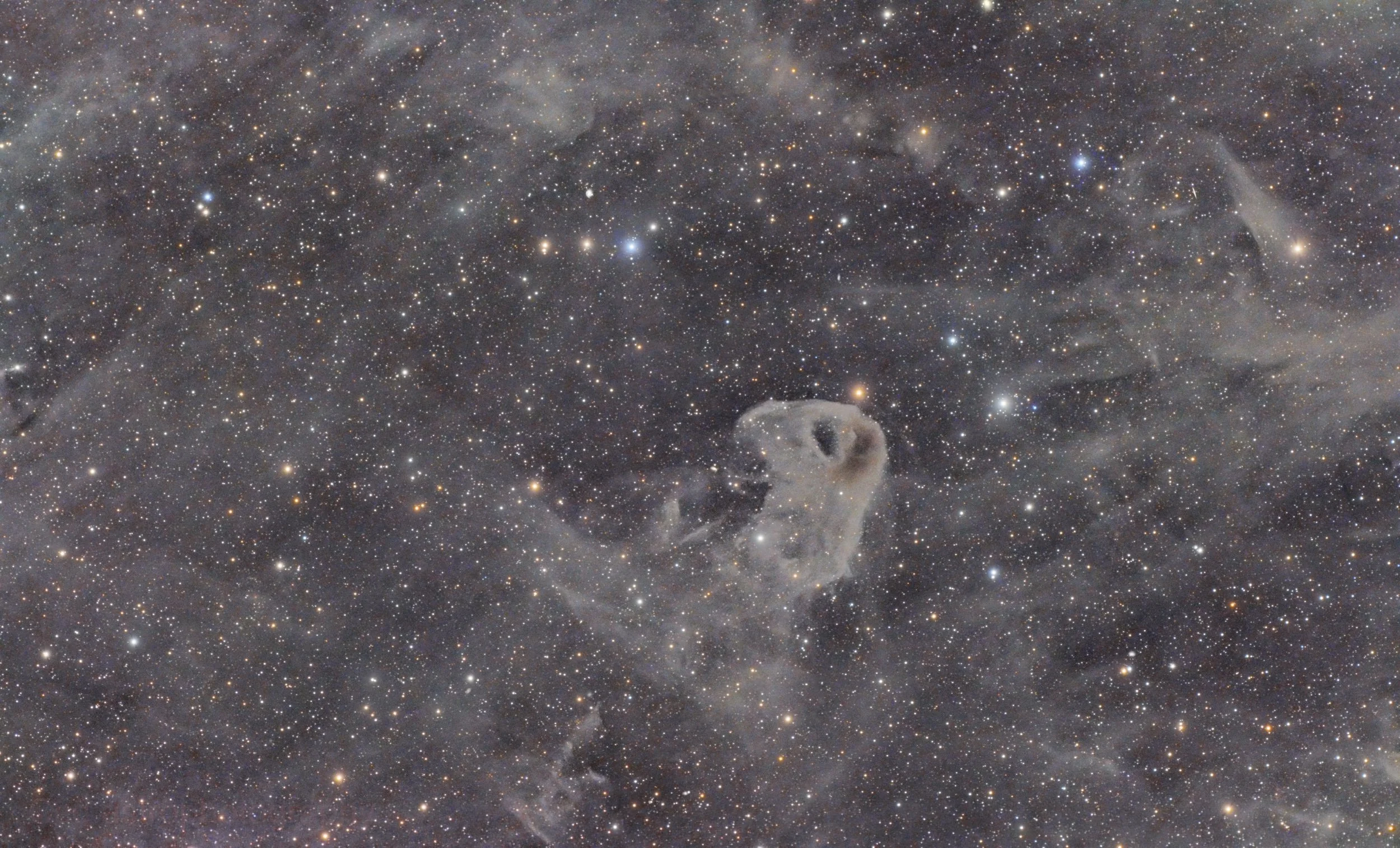
Baby Eagle Nebula
Image Description:
This image contains a small part of a very dusty region in the constellation Taurus.
Main target is Baby Eagle Nebula (Lbn 777) but there is many other small galaxies in the frame so a bit of a zoom will do the trick
The image was done with two cameras and has a total integration time of aprox. 16 hours.
rgb 137 x 180sec with Qhy 268c,high gain mode ( gain 102 offset 76 )
Ha 170 x 180sec with Qhy 268m,high gain mode (gain 56 offset 25 )
Apt for acquisition,alligned and stacked with ccd_stack 2 and processed in Pixinsight.
EQ8_PRO Mount,
Tak FSQ-85EDX f/5.3 telescope ,
SG-4 standalone autoguider and a Borg50 guidescope
from my backyard in Bedfordshire.
Copyright: Cosar Catalin Daniel
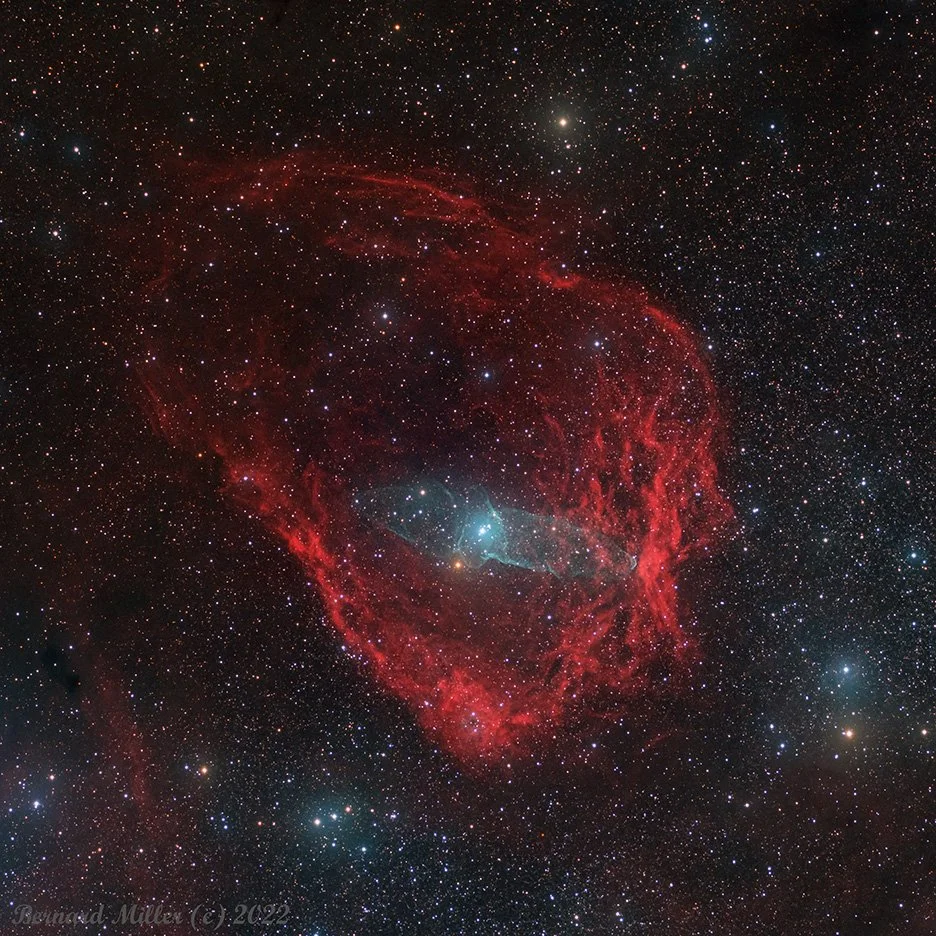
The Flying Bat and Squid Nebulae
Image Details:
Location: Oria, Almeria, Spain
Telescope: Takahashi FSQ-106EDX4
Camera: FLI PL16803
Mount: Paramount MX+
Ha: 10x10 minutes (binned 1x1)
OIII: 80x10 minutes (binned 1x1)
RGB: 8x10 minutes each (binned 1x1)
Copyright 2022 Bernard Miller

ic405/ic410/ngc1931- 3 panels mosaic
Image Description and Details :
3 images are combined (32% original size)image 1 : 3 panels mosaic (taken with e-180/ASI094MC)image 2 and 3 : high resolution images (taken with RC10/SX-H694)Date : 8Dec.2021 -16 Dec.2021Place : Gemini Remote Observatory, Lijiang, Yunnan, ChinaTelescope : Tak e-180 ,Mount : Skywatcher EQ8Camera : ZWO ASI094MC(-10ºC ) ,Filters : Baader Ha,LExposure : panel 1 (ic 405 /upper ) L: 180sx 44 , Ha:900sx 6panel 2 (ic 410/ middle) L: 180sx 42 , Ha:900sx4panel 3 (ic 417/ngc1931 lower) L: 180sx 50 , Ha:900sx6(total~ 10.8hr)Guiding : Borg 50 / asi174 ,Image Processing : PI ,PS-CC
Copyright: Alan Van