

AAPOD2 Image Archives
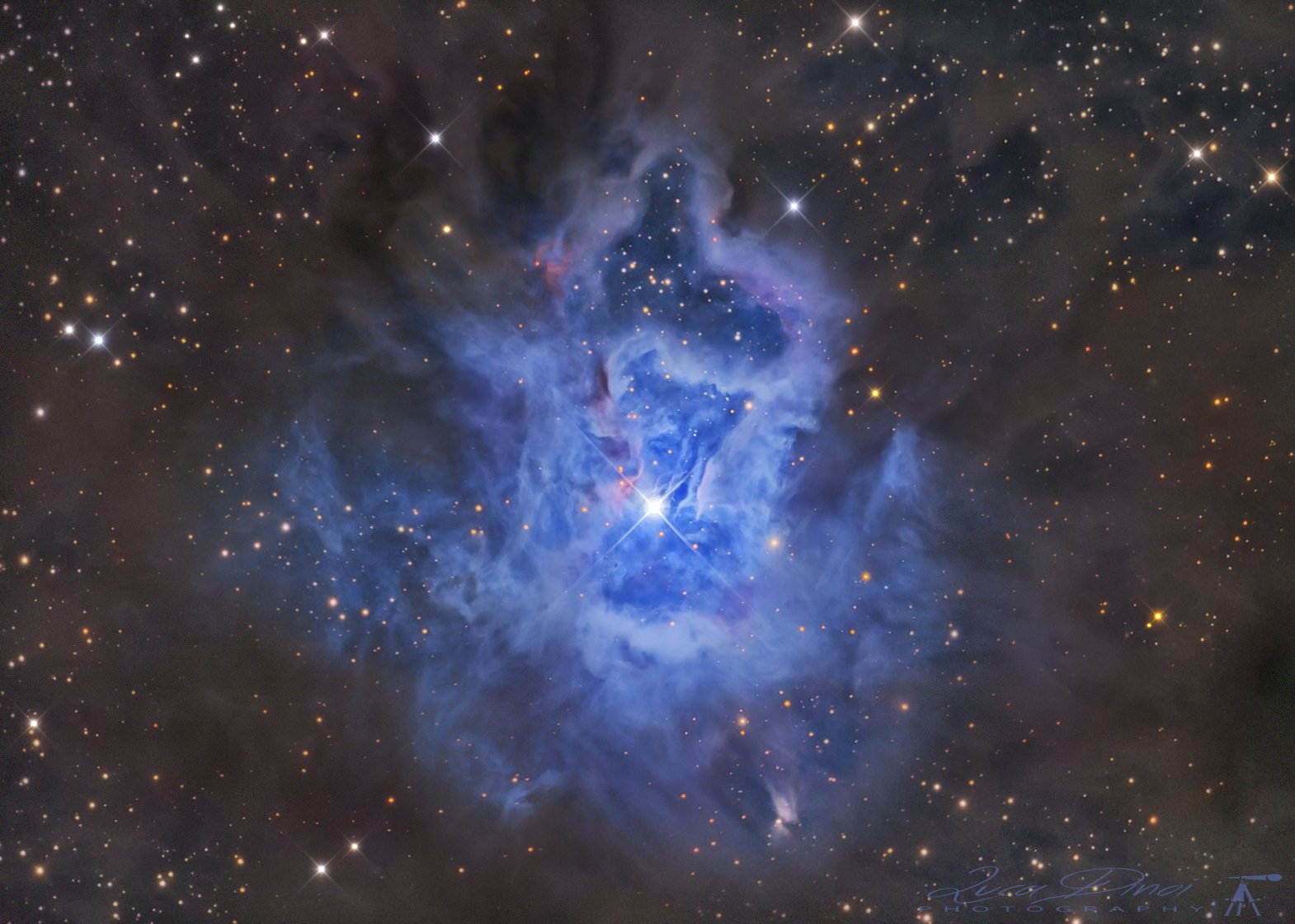
Ngc7023
Image Description and Details : Ngc 7023 IRIS 12 "RC Truss telescope reduced to 1800 Celestron 80/600 guide tube with Asi Zwo 224 chamber Moravian G2 8300 camera with internal wheel Ioptron Cem120 mount Moonlite focuser and 3.5 "electronic rotator. Electronic temperature control and anti-condensation bands Cls ccd, R, G, B, Ha 6nm filters, all Astronomik Shooting data: 61 x 240 ccd cl 39 x 240 R 39 x 240 G 39 x 240 B Processing: Pixinsight, Photoshop, star points, astronomy tools
Copyright: Luca Dinoi
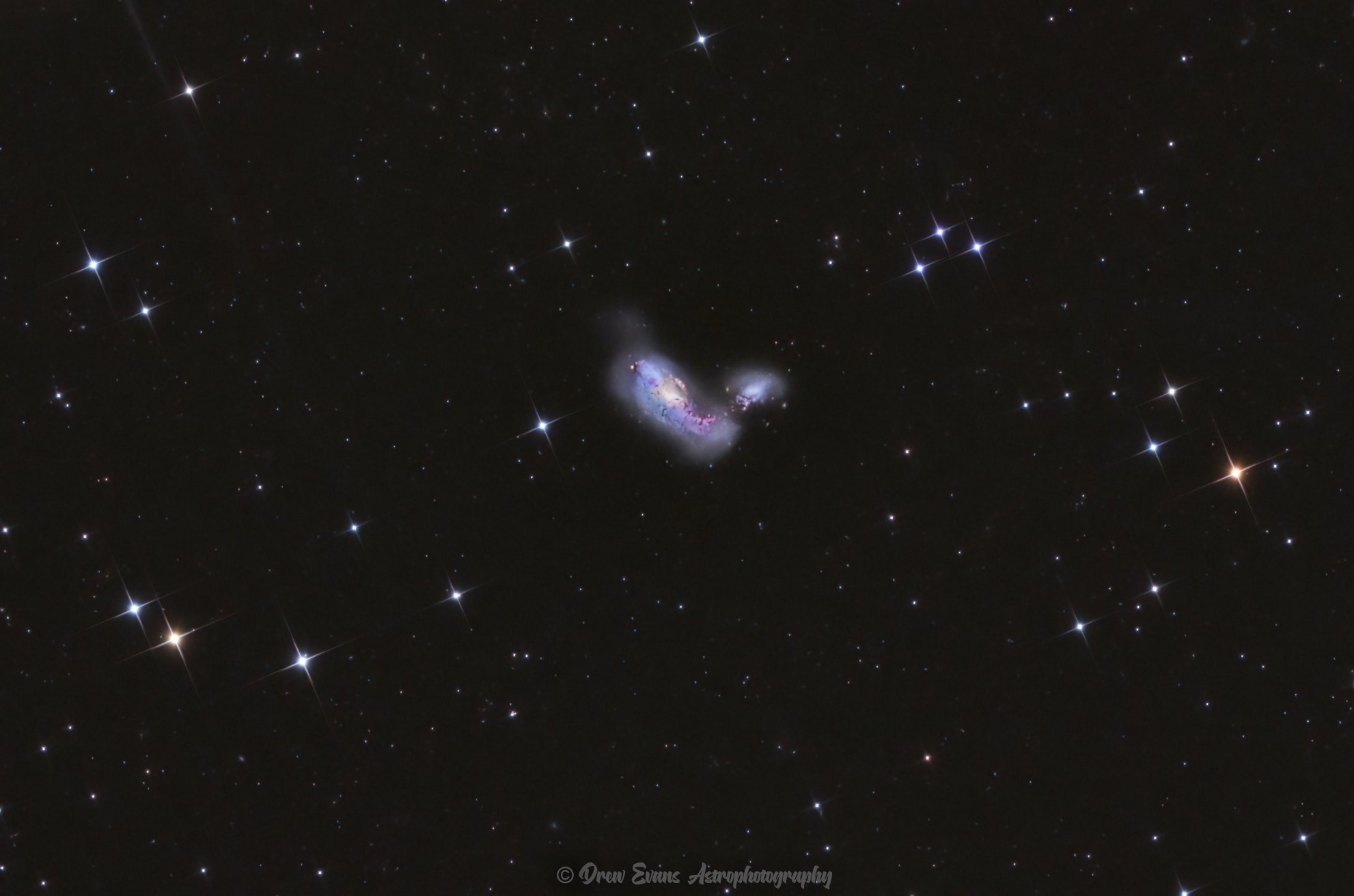
THE COCOON GALAXY (NGC 4490)
Arguably the toughest galaxy I have imaged yet, the Cocoon Galaxy lies some 30 million light-years away in the constellation of Canes Venatici.
This galaxy forms an interacting pair with the smaller irregular galaxy NGC 4485. This system is similar that of the Magellanic Clouds and is surrounded by an enormous hydrogen cloud.
The extreme tidal forces of their interaction have determined the shapes and properties of the two galaxies.
Once a barred spiral galaxy, similar to the Milky Way, the Cocoon Galaxy’s outlying regions have been stretched out, resulting in its nickname of the Cocoon Galaxy. Virtually no trace of its past spiral structure can be seen from our perspective.
OTA: William Optics FLT 132 Triplet Refractor with Flat7A 0.8x Reducer/Flattener
Mount: Celestron CGX-L
Camera: ZWO ASI2400MC Pro
Gain: 158
Cooling Temperature: -10 degrees celsius
Filter: Optolong LPro Filter
Night 1 = 41 x 300s
Night 2 = 40 x 300s
Night 3 = 40 x 300s
Total = 140x x 300s = 11.6 hours
Auto-guiding: ZWO ASI174MM Mini and ZWO M48 OAG-L
Control: ZWO ASIAIR Pro
Calibrated in Astro Pixel Processor with darks and flats
Processed in Pixinsight and Lightroom.
Star refraction spikes added using 1mm clear string in front of objective lens.
Location: Bortle Class 4 skies near downtown Flagstaff, Arizona
Copyright: Drew Evans
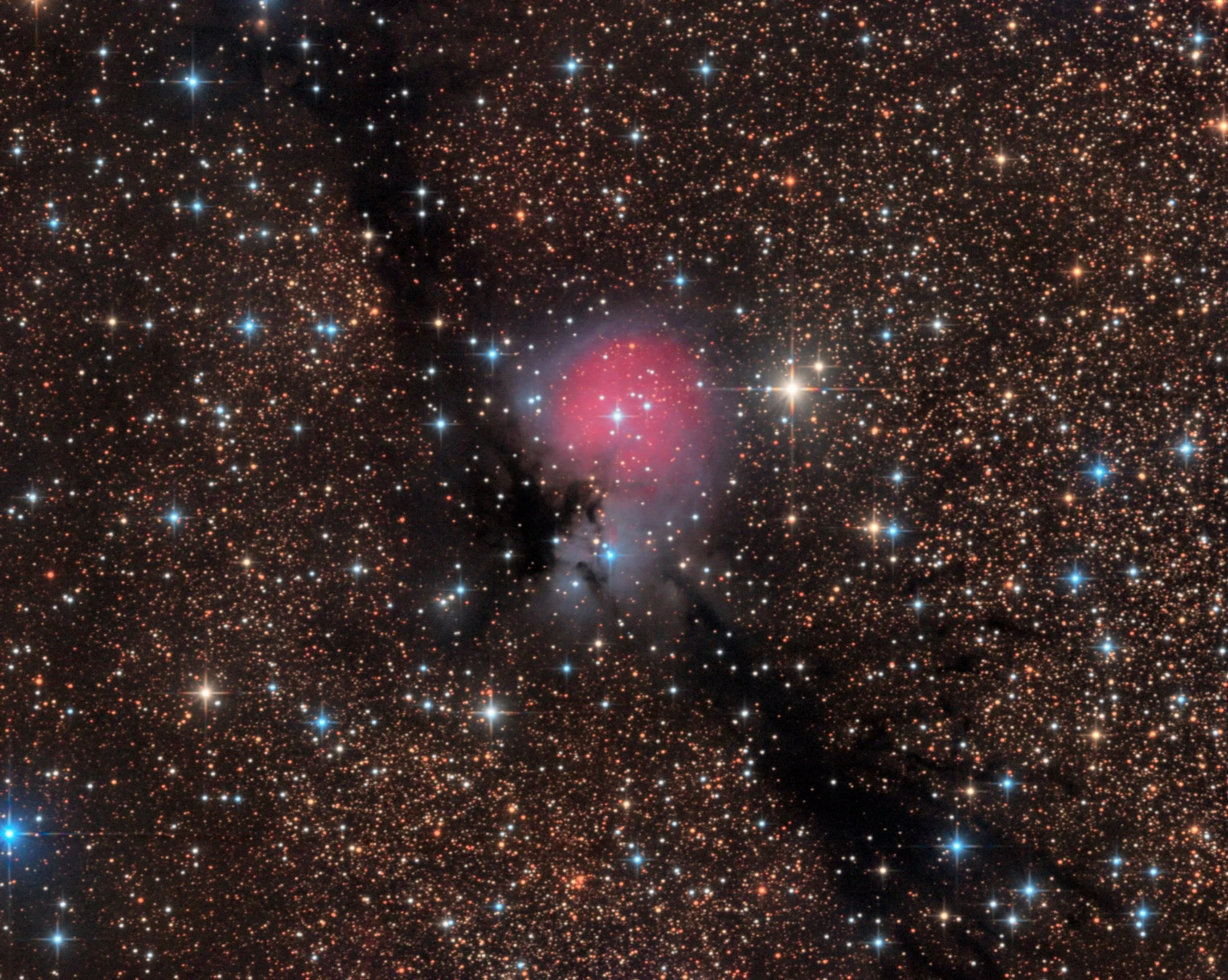
SH2-82
Image Description and Details : Informally known as the 'Little Trifid Nebula', Sh2-82 is a relatively small emission nebula surrounded by a blue reflection nebula. It is embedded in the dark nebula LDN 727 and is the site of some star formation and young stellar objects. Located at a distance of approximately 3600 light years, Sh2-82 is ionized by the star HD 231616, which can be seen near the center.
Own remote observatory, 50 km from Kiev, Bortle 4 zone. Imaged during September 2020 - August 2021. AZ-EQ6 mount, ONTC8 newton, QHY22. Guide - OAG with Lodestar camera.
Astrodon 5nm Ha: 31 x 600s;
Astrodon L: 120 x 300s;
Astrodon R: 53 x 300s;
Astrodon G: 60 x 300s;
Astrodon B: 93 x 300s;
Total exposure - 32 hr.
Captured in SGP, processed in Pixinsight.
Copyright: Sergiy Vakulenko
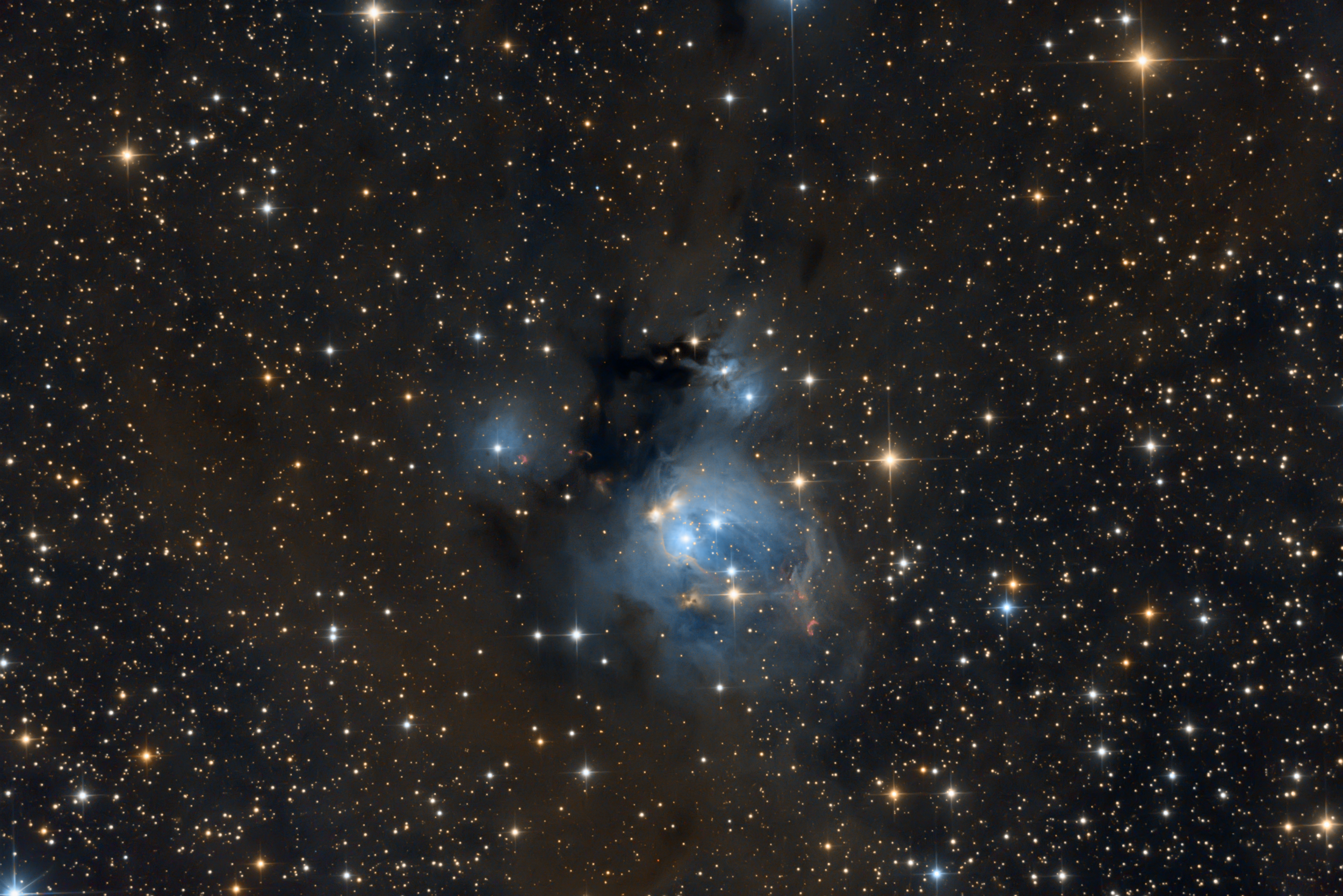
NGC 7129
NGC 7129 is a star forming region and reflection nebula in the constellation Cepheus. It is about 3750 light years away. The stars in this nebula are very young and only 200.000 to 3 million years old. These more than 130 young stars are responsible for illuminating the nebula. The red blobs surrounding the nebula are Herbig Haro objects, which are the result of jets of gas streaming away from the young stars in the nebula.
My current telescope is an ASA 400 16" RC (Ritchey-Chrétien) with a focal length of 3200mm (0.24"/px) on an ASA DDM 100 direct drive german equatorial mount with absolute encoders (load capacity 100kg). For imaging the night sky i use a ZWO ASI 6200 MM Pro camera with a FLI CFW2-7 filter wheel.
Copyright: Patrick Winkler
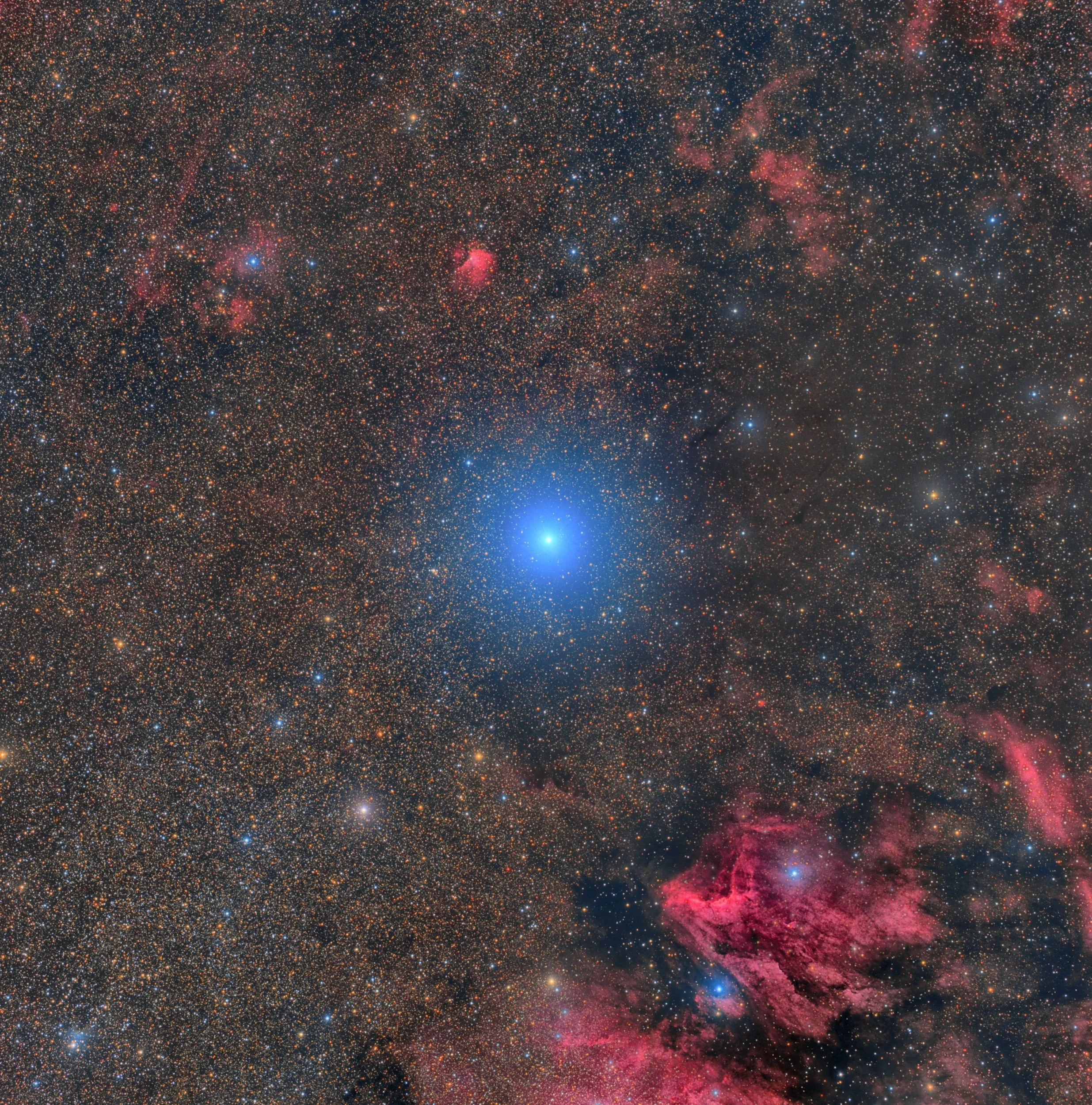
Cosmic Pearl
Image Description and Details : Details: Deneb is a first-magnitude star in the constellation of Cygnus, the swan. It is one of the vertices of the asterism known as the Summer Triangle and the "head" of the Northern Cross. It is the brightest star in Cygnus and the 19th brightest star in the night sky, with an average apparent magnitude of +1.25. This area lies in the plane of the Milky Way and is very rich in emission nebulae. Right down you can see NGC 7000/The North America Nebula, IC 5067/The Pelican Nebula, NGC 6989 an open cluster, 57 Cygni, IC 5068. Just a bit below left to Deneb is 55 Cygni and at the bottom left is IC 5076.
Exif : L = 50 x 180 seconds , R = 46 x 180 seconds , G = 46 x 180 seconds , B = 46 x 180 seconds , f/3.6 (with 0.73x focal reducer) , 382 mm
Equipment: FLI PL16083 camera, Takahashi FSQ-106ED telescope, Paramount MX+ mount
Filters: Astrodon LRGB 2GEN
Softwares used: Deep Sky Stacker, PixInsight, Photoshop
Copyright: Diptiman Nandy
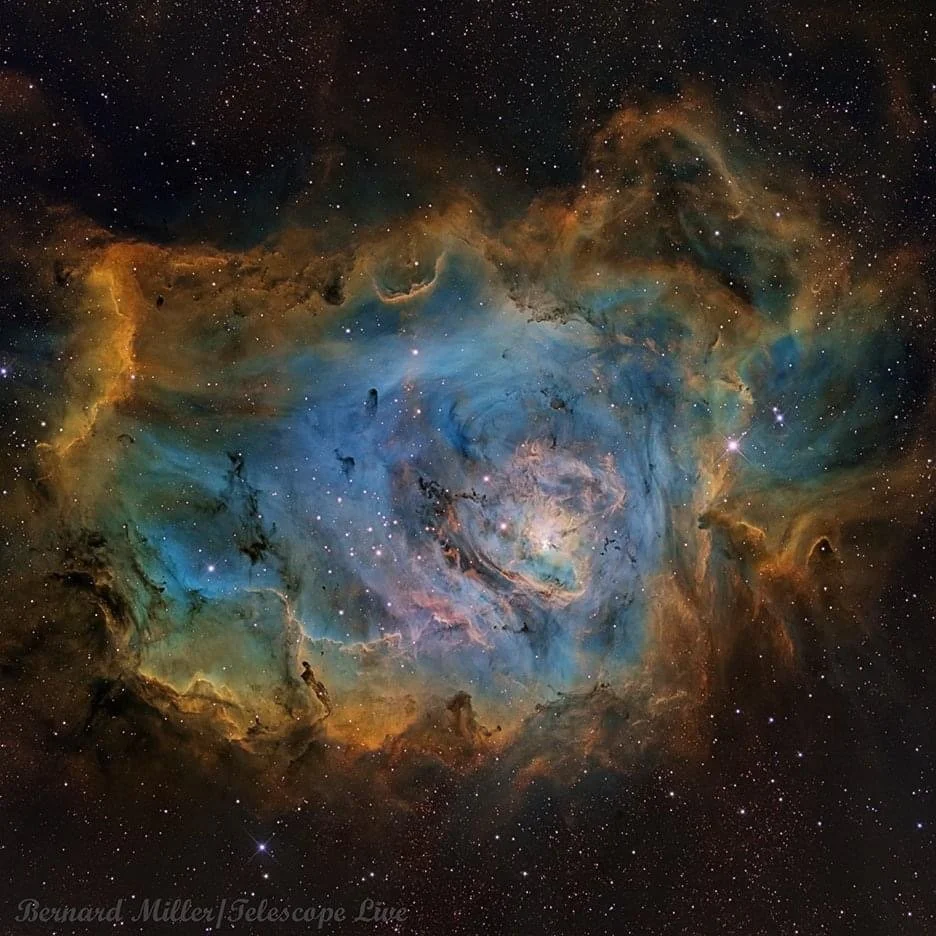
M8
This is an image of M8, also known as the Lagoon Nebula. It is an emission nebula about 4,100 light years away in the constellation Sagittarius. The nebula measures about 110 by 50 light years and has a number of Bok Globules throughout.
May 15, 2022
Location: Rio Hurtado, Chile
Telescope: ASA 500N
Camera: FLI PL 16803
Mount: ASA DDM85
Ha: 6x5 minutes (binned 1x1)
OIII: 6x5 minutes (binned 1x1)
SII: 6x5 minutes (binned 1x1)
Copyright: Bernard Miller
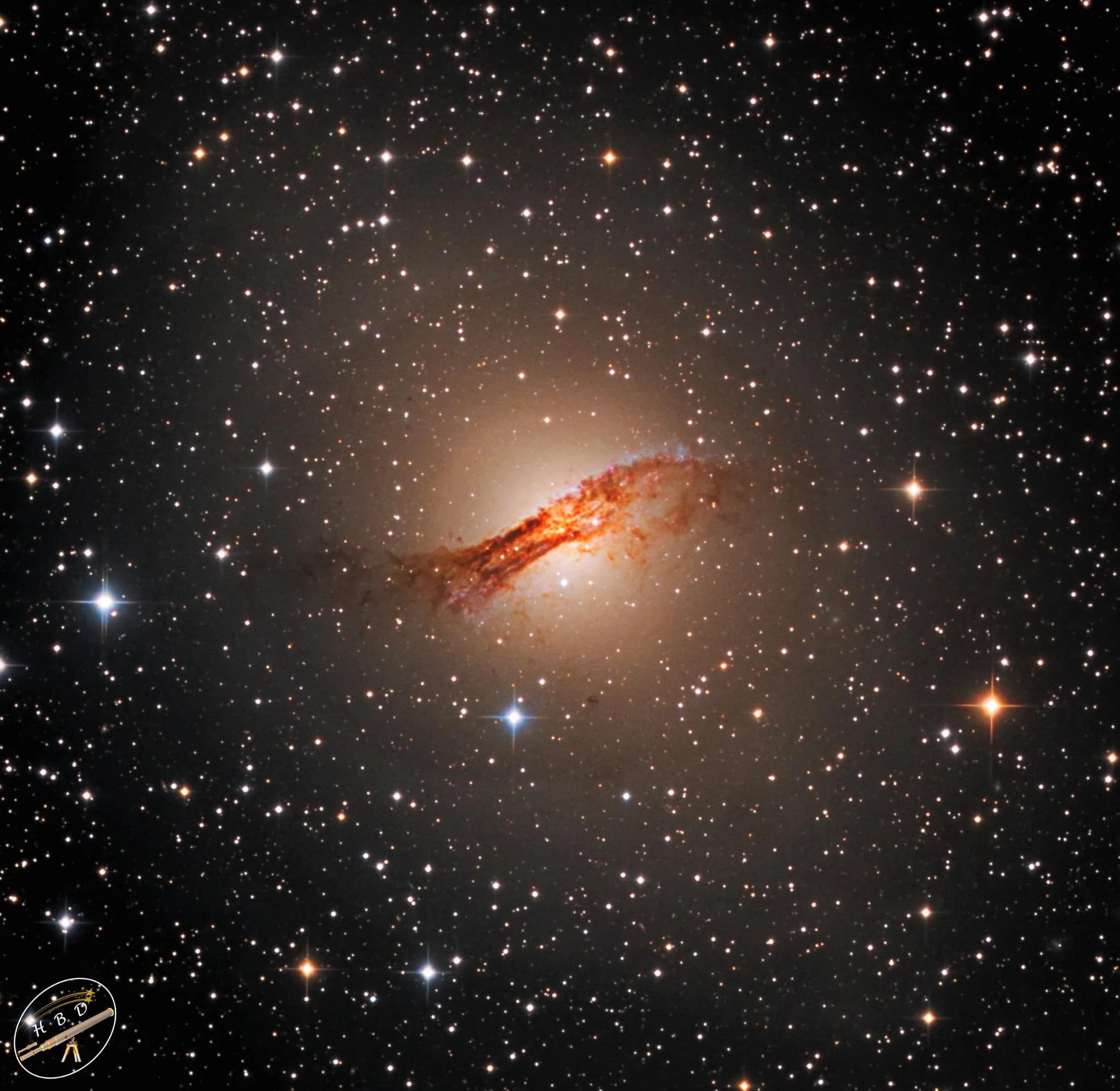
NGC 5128
In the southern constellation Centaurus (Centaur) is the radio galaxy of the same name Centaurus A, catalog NGC 5128. Due to its proximity to about 17 million Lj, it has been intensively investigated and at its core a black hole of about 55 million solar masses was detected. The unusual shape and high star formation is explained by the collision with another galaxy some 100 million years ago.
Setup: Planewave CDK, 60 cm, f 6,5
Kamera FLI PL 9000 mit Filterrad, 3056×3056 px, Bildfeld 32‘x32‘
Belichtung: 50 Einzelaufnahmen von 600s, davon 14xLuminanz und je 12xLRGB
Gesamt 8h 20 min.
Copyright: Hans Dorfeldt
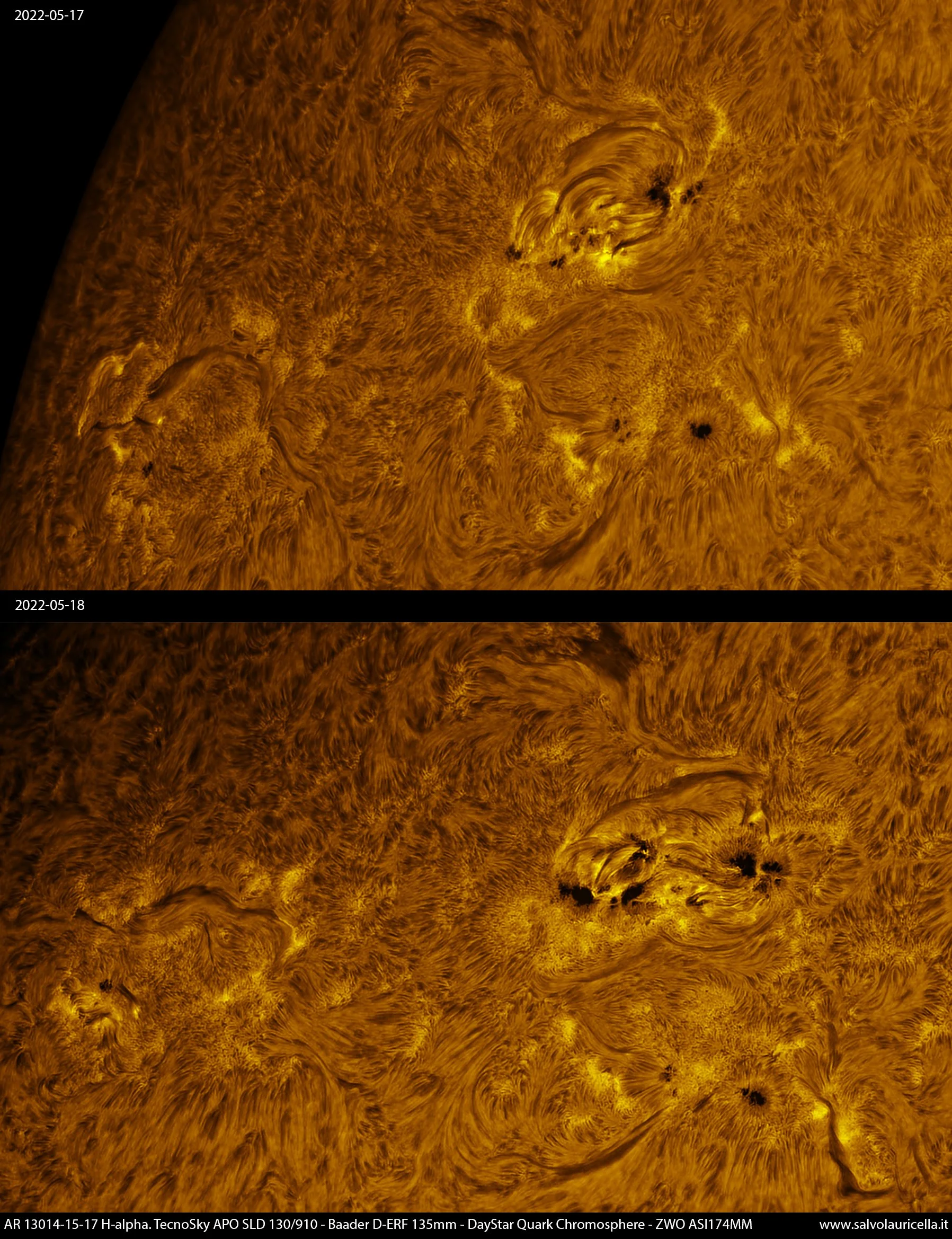
Active regions comparison
Image Description and Details : Active regions in comparison. The images were taken on May 17 and 18, 2022. Setup: apo refractor 130/910, D-ERF 135mm filter, DayStar Quark Chromosphere and ZWO ASI174MM camera.
Copyright:Salvo Lauricella
Sailing
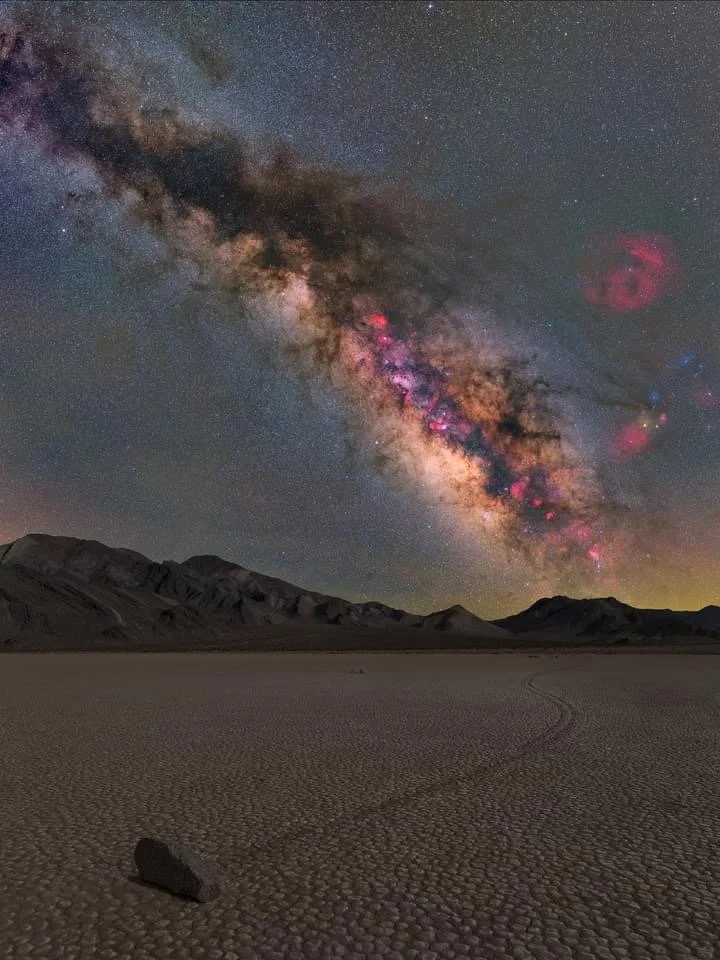
This month, I was able to tick one of the 'most wanted' places off my bucket list: Racetrack Playa in Death Valley National Park.
After being rattled for 27 miles by the gravel and washboard road, I reached the playa around noon, which gave me ample time to scout the place. Fortunately, temperatures were considerably lower than down in Death Valley.
I found that the trails of the sailing rocks were less obvious than I had expected. While they were visible to the naked eye in the afternoon sun, they hardly showed in my photographs. I wasn't worried though, as I was planning to shoot my foregrounds with light of the setting Moon providing more contrast.
When the Moon finally was in position, I noticed that the trails still were very weak. I therefore decided to add some very low illumination with my low level lights. I was glad to have the place to myself, because I had to position the lights at quite a distance to avoid uneven lighting.
EXIF
Canon EOS-R, astro-modified
Sigma 28mm f/1.4
iOptron SkyTracker Pro
AstroHutech IDAS NBZ filter
Sky
2 panel panorama, each a stack of 6x 45s @ ISO1600, unfiltered & 3x 10⁵s @ ISO6400, filtered
Foreground:
Focus stack of 5x 60s @ ISO1600 in moonlight & 5x 30s @ ISO1600 with low level lighting
Copyright: Ralf Rohner
Eclipse Lunar Secuence || May 15 2022
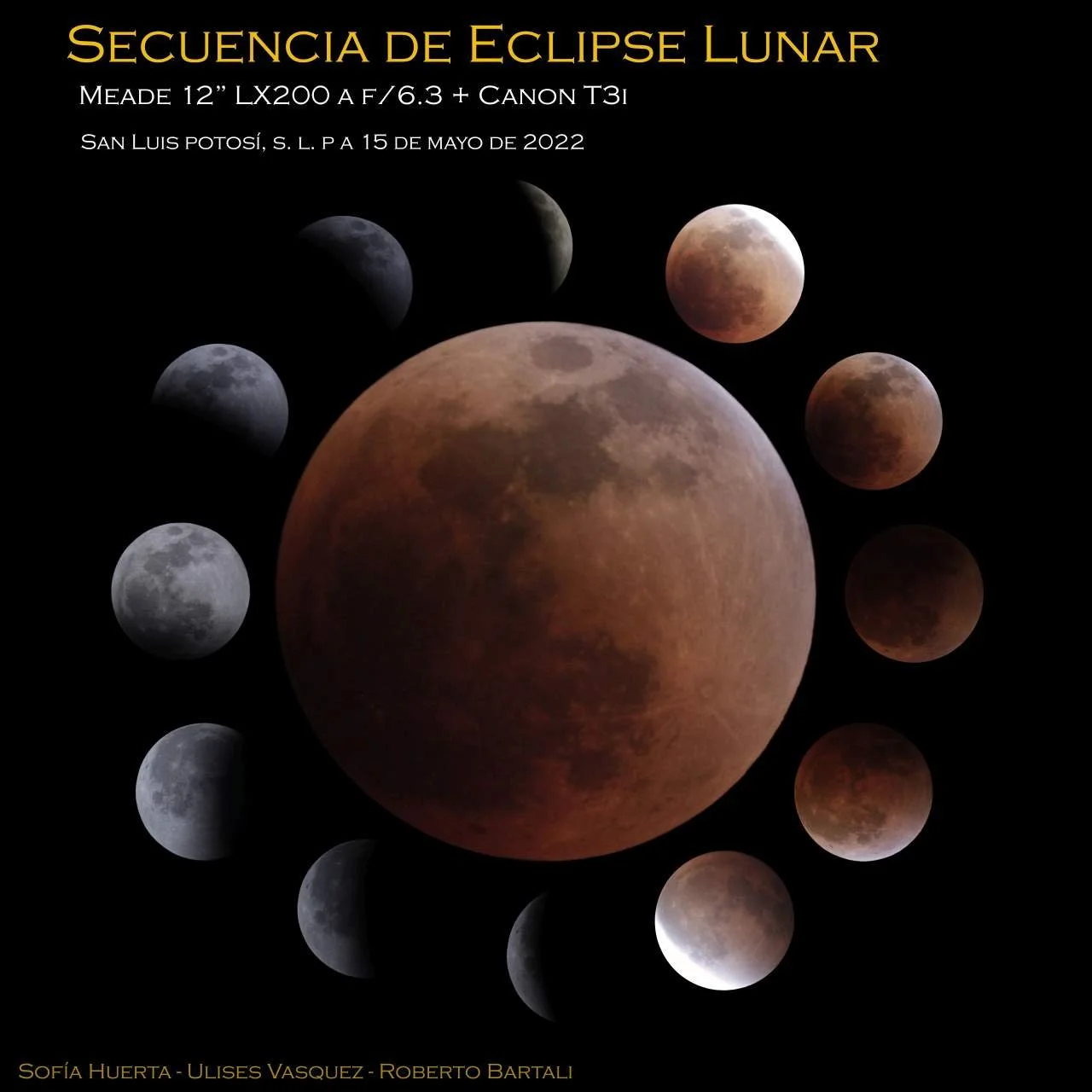
Image Description and Details : Moon Eclipse Secuence
Taken with Meade Lx200 EMC 12" f/6.3 and Canon T3i
Each moon are a composition of 2 images.
By RoberSoul & Gobierno del Estado de San Luis Potosi
Copyright: RoberSoul & Gobierno del Estado de San Luis Potosi
Cygnus from Sharpless 119 to the Veil
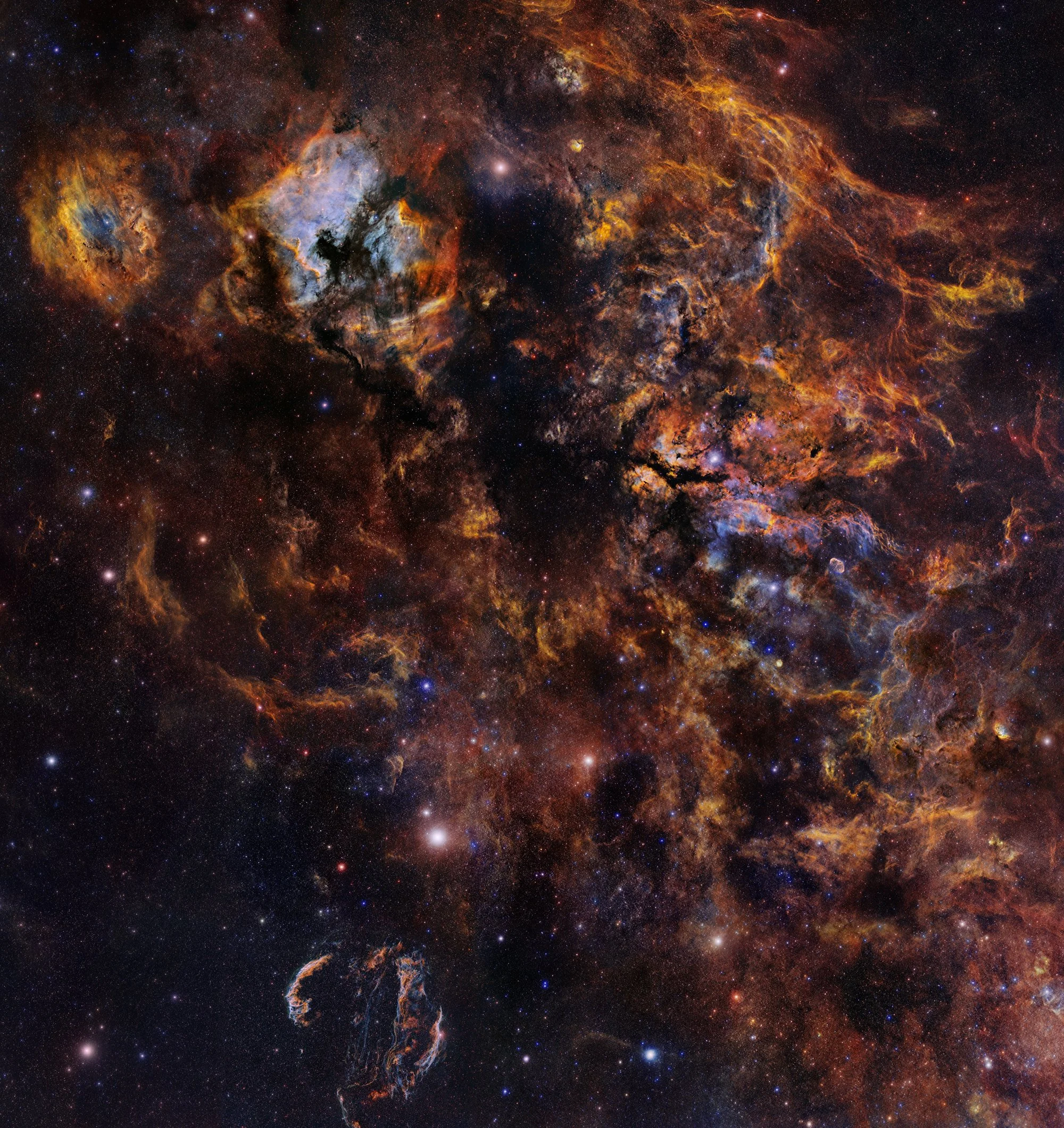
Image Description and Details : I finally finished my high resolution mosaic of all the major nebulosity in the constellation of Cygnus. I started this image 2 years ago and it now has 65 separate images stitched together to cover this large area of sky. There are many famous nebulae in this picture. In the top from left to right are Sharpless 119, North America, Pelican, Butterfly and Crescent. Below right of the Crescent is the rainbow colored Tulip Nebula. At the bottom is the Veil Nebula. In total this is 396 hours of data collection through H-alpha, SII and OIII filters. All images were taken with a 4 inch refractor and a 35mm CCD camera. The full size image is 322 megapixels.
Copyright: Alistair Symon
Rho Ophiuchi & the blue horse head nebula
And we have built the heaven with one hand, and we are the expanders. (Zhariyat 14)
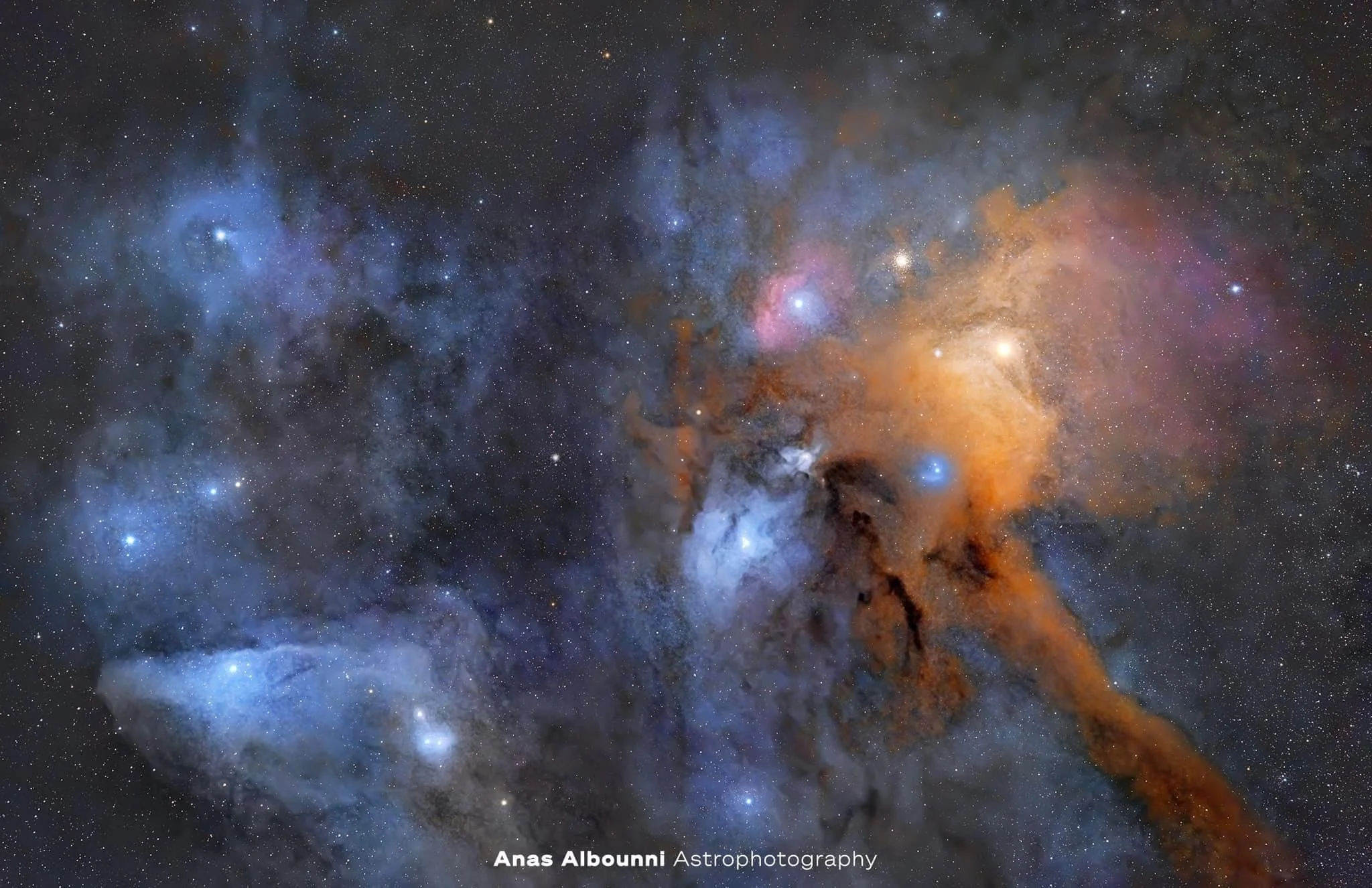
This nebula is one of the most beautiful nebula and the one I loved to me, I tried a lot to photograph it, but the results were not satisfactory, and thank God, God helped me to take this photo that combines the Roh Oviuchi nebula on the right and the blue horse's head nebula on my left.
One of the mose beautiful nebulas and dearest to me, so far i wasn’t successful in capturing it, but alhamdullah i was able to do it properly this time, Rho Ophiuchi on the right, and the blue horse head on the left.
Nikon D810a, Samyang 135mm (Thanks Arun Vijay for lending it to me) 50x180sec iso800, f2, 50 bias, 30 darks, synthetic flat, Captured on APT, stacked on Pixinsight, processed on photoshop. Piggy back guiding on my main scope and mount.
Copyright: Anas Albounni
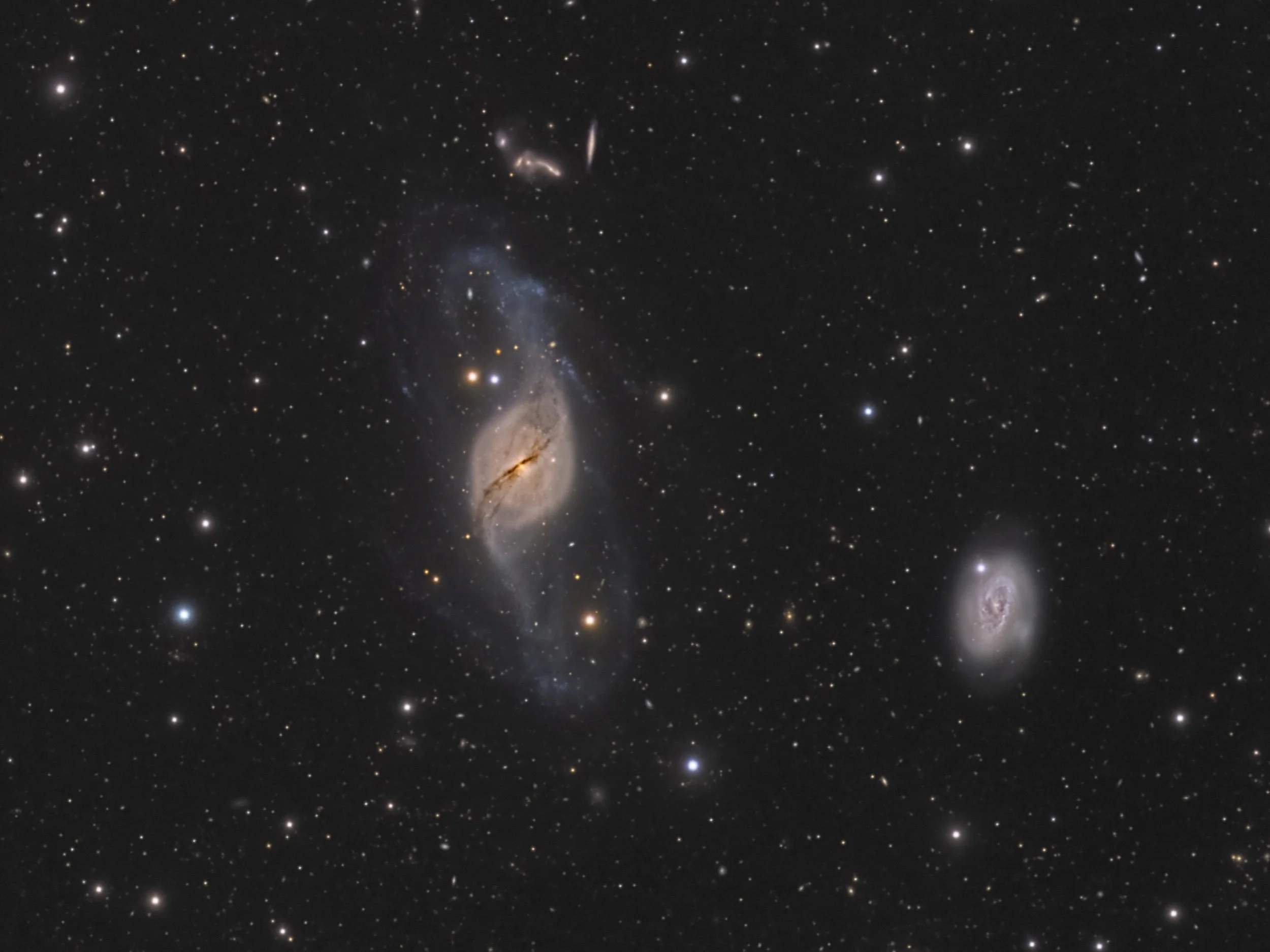
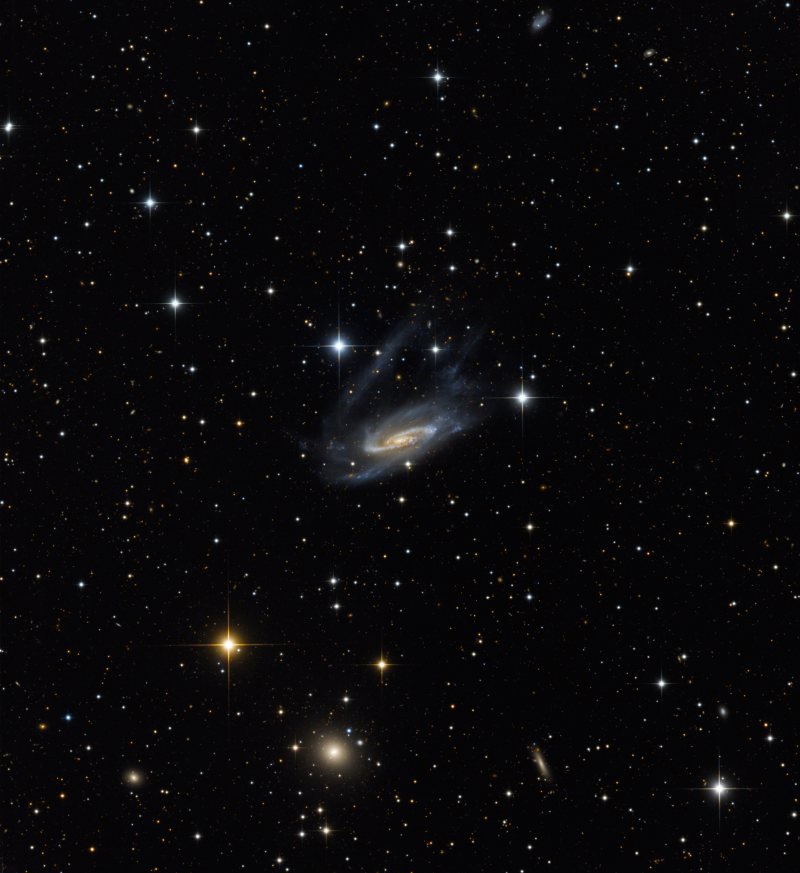
NGC 3718 in Ursa Major
Image Description and Details : NGC 3718 is an 'S' shaped and heavily warped spiral or lenticular galaxy located at a distance of fifty-two million light years in the constellation Ursa Major. The distortion to its shape likely comes from gravitational interactions with another galaxy, possibly with NGC 3729, the spiral galaxy located to the right in this image. Just above NGC 3718 is a cluster of interacting galaxies cataloged as Hickson 56.
The picture was taken on clear nights between 4/20/2022 and 4/28/2022 using a remotely controlled telescope in Rowe, NM. A total of 13 hours of luminance were combined with 3.5 hours each of red, green, and blue data to create the color image. The telescope used was a 305mm Riccardi-Honders astrograph with a focal ratio of f/3.8. The mount was an AP1100GTO AE running unguided using a high precision pointing and tracking model. The camera was a QHY600PH monochrome cooled to -10*C. Filters were Chroma 50mm x 50mm LRGB.
The software used for image capture was NINA. The mount was modeled and controlled by APCC. All calibration and post processing was performed in PixInsight.
Copyright: 2022 Jared Willson
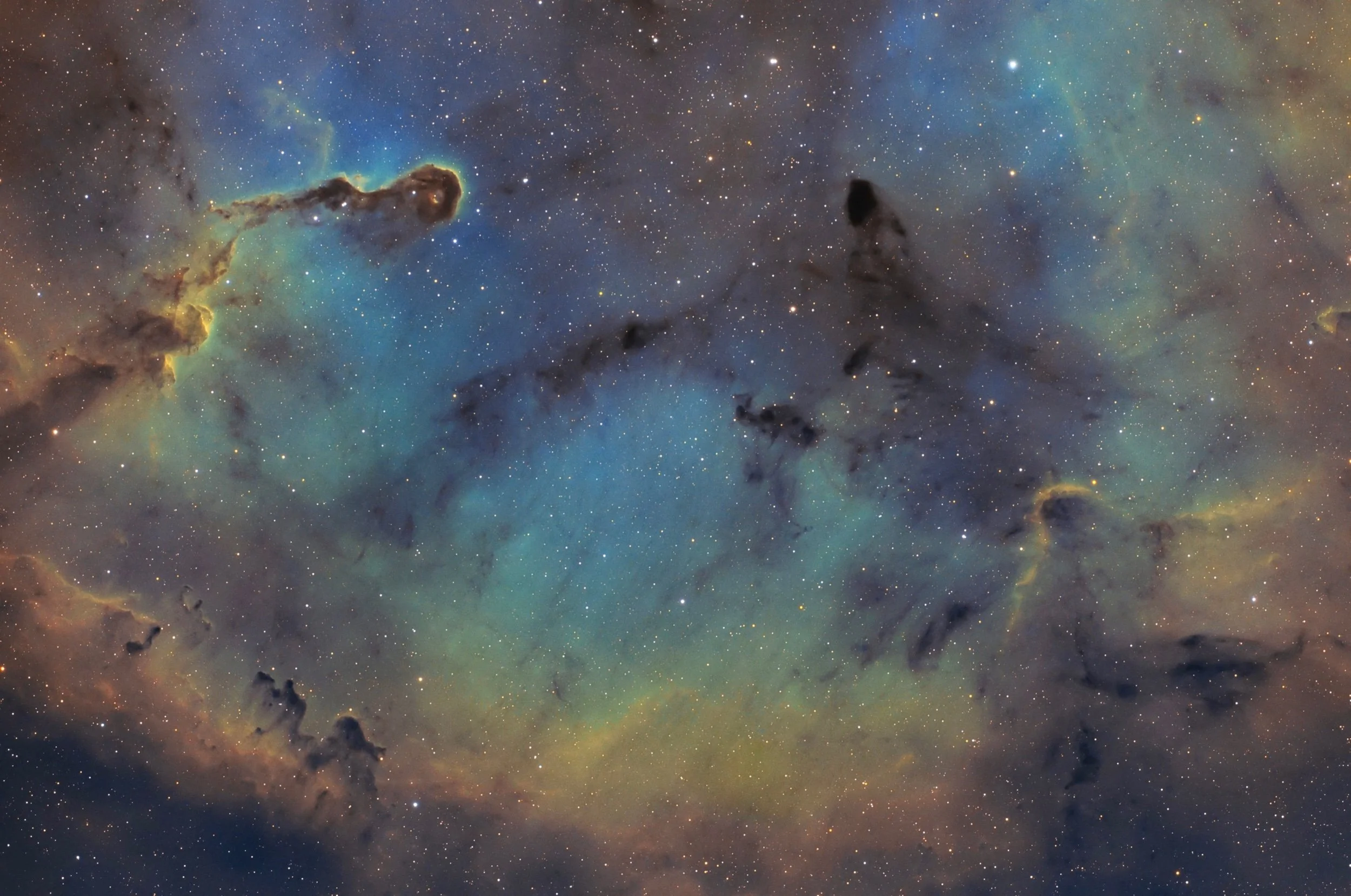
Elephant area
Image Description and Details : Elephant area in Hubble palette. 16 hours total exposure. ZWO 2600MM. Askar 107 APO
Copyright: Dave Dev
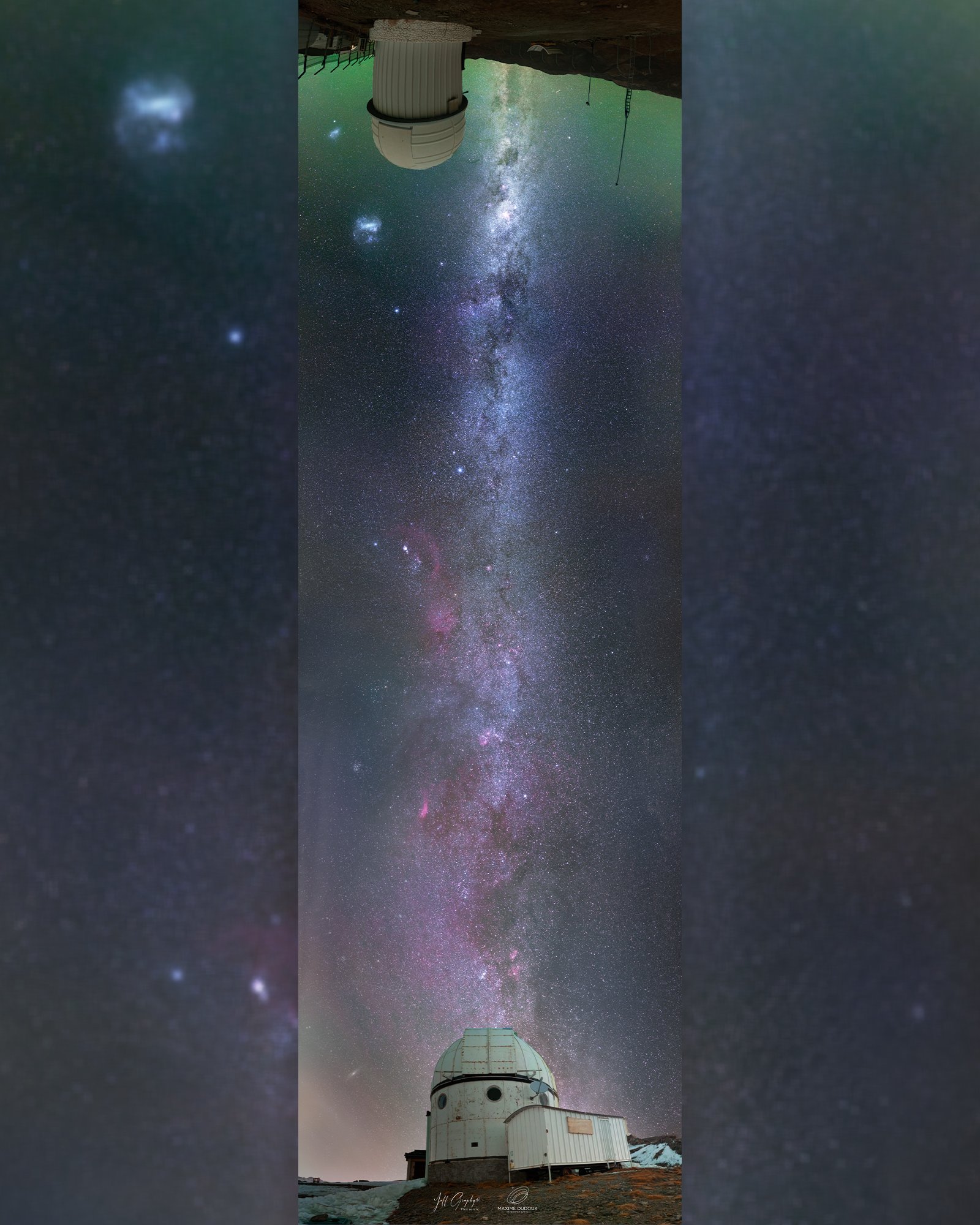
10,000 km galactic bridge between France and Chile
lImage Description and Details : Hello,
With french photographer Maxime Oudoux, we realized a nightscape together. We were 10,000km apart to do it We share with you the result of this important project.
The somewhat crazy idea was to photograph the Obstech observatory - Observatorio El Sauce (in Chile) and the Saint-Véran observatory (located in the French Alps) under the winter part of the Milky Way, on the same date, with very similar hardware (see below), with the same settings and with a 6 hours lag.
You should know that we were separated by 10,000 km!
The difference in sky quality is notable between these two observatories. Indeed, the sky of El Sauce is more stable than that of the observatory of Saint-Véran. Moreover, you will notice a difference in the sky background between these two images showing a darker sky in Chile than in France. Also, the light pollution of Turin is visible on the dome of the T62 of the observatory of Saint-Véran!
EXIFS
For the shots that make up this assembly, the ground was taken with exposure times of 30 seconds and the sky was taken with exposure times of 8 seconds (without tracking mount). The photograph taken by Maxime in Chile was taken with a defiltered Nikon D750 and with a Samyang France 35mm f/1.4 lens on a simple tripod. The photograph taken at the Saint-Véran observatory was taken with a defiltered Canon 6D and with a Samyang 35mm f/1.4 lens on a simple tripod.
Authors :
Places :
- Observatorio El Sauce (in Chile)
- Saint-Véran observatory (located in french Alps)
Copyright: Maxime Oudoux
Jeff Graphy©
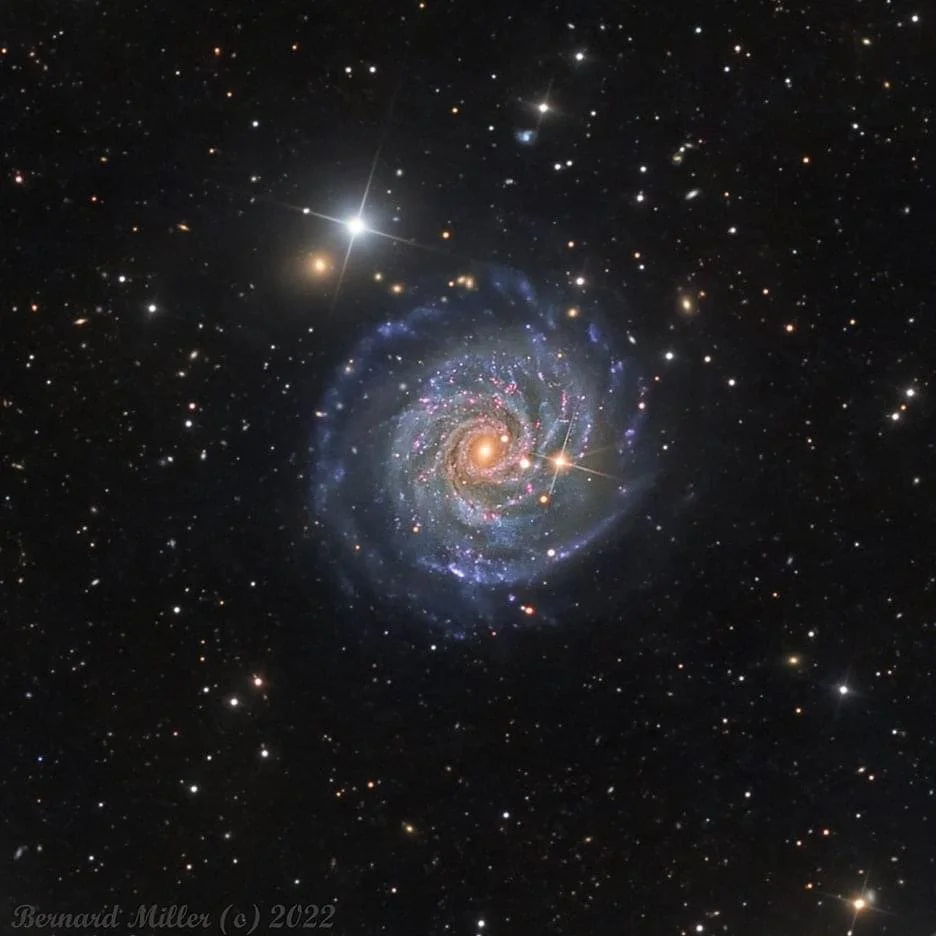
NGC 3344
This is an image of NGC 3344. It is a barred spiral galaxy about 22.5 million light years away in the constellation Leo Minor. This galaxy belongs to the group known as the Leo spur, which is a branch of the Virgo Supercluster. It is a weakly barred spiral galaxy that exhibits rings and moderate to loosely wound spiral arms. There is both an inner and outer ring, with the prominent arms radiating outward from the inner ring and the slightly elliptical bar being situated inside.
March 8 - April 23, 2022
Location: Dark Sky New Mexico
Telescope: Planewave CDK-17
Camera: FLI PL16803
Mount: Paramount ME
Luminance: 27x20 minutes (binned 1x1)
Ha: 18x30 minutes (binned 1x1)
Red: 16x15 minutes (binned 1x1)
Green: 16x15 minutes (binned 1x1)
Blue: 16x15 minutes (binned 1x1
Copyright: Bernard Miller
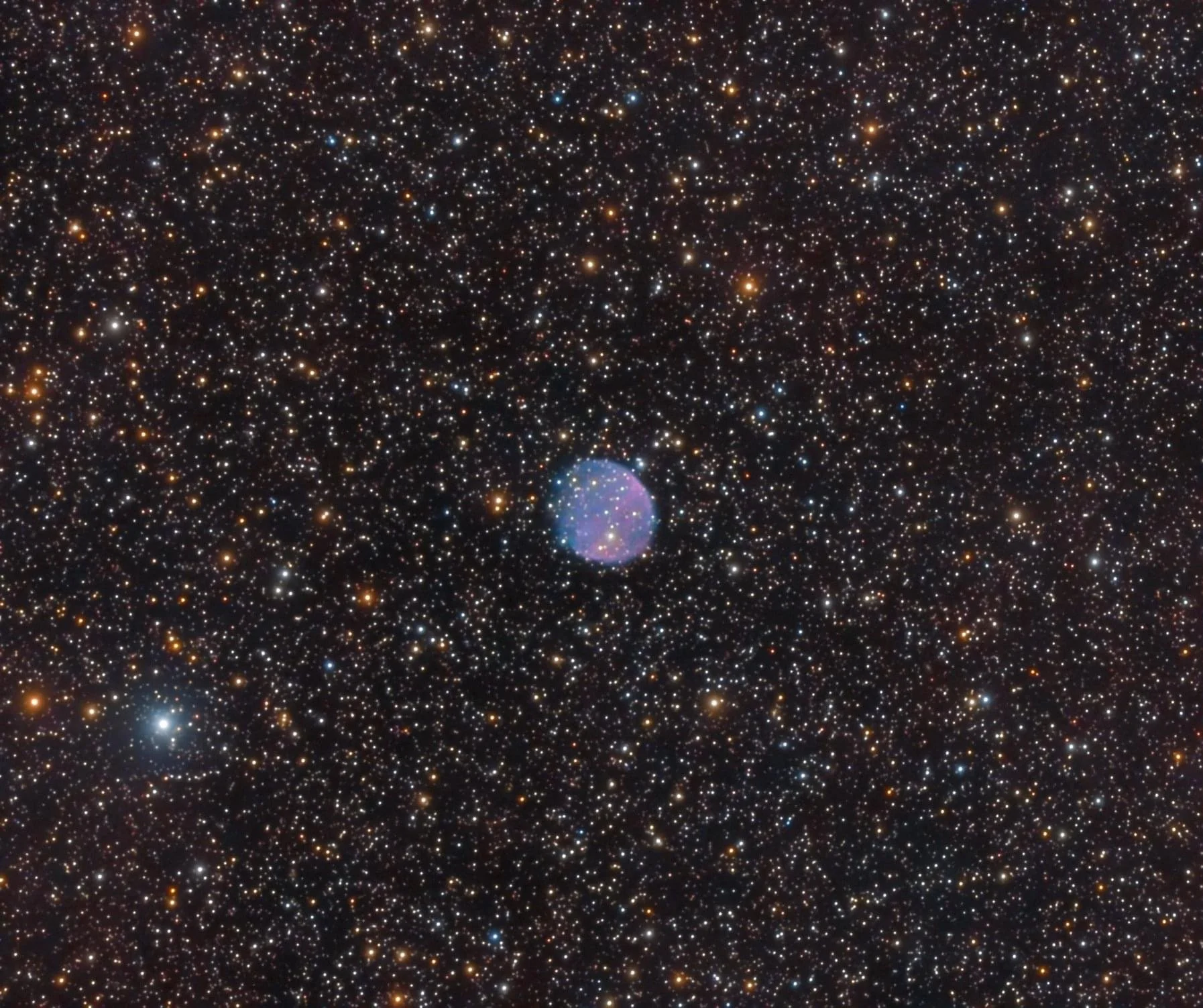
Weinberger 3-1
Weinberger 3-1 (We3-1, PK044+10.1, PN G044.3+10.4) is a planetary nebula in the constellation Hercules.
A nice oval planetary nebula that measures approximately 3 arcminutes. It was discovered in 1978 by Ronald Weinberger.
This image taken over several nights in August 2021.
R-channel - 48 x 150 sec. bin 1x1;
G-channel - 48 x 150 sec. bin 1x1;
B-channel - 48 x 150 sec. bin 1x1;
Ha- 40 x 900 sec. bin 2x2;
OIII- 40 x 900 sec. bin 2x2.
Total integration time about 26 hours.
My setup: Telescope 8" Celestron Schmidt-Cassegrain (SCT) CPC800 GPS (XLT) on the equatorial wedge, focal reducer Starizona Night Owl 0.4х, Feq=864mm, camera Starlight Xpress Trius SX694, SX mini filter wheel, filters Astrodon LRGB E-series gen.2, Astrodon Ha 5nm, Astrodon OIII 3nm.
Capture and processing software: MaxIm DL6, PHD2, PixInsight, StarTools, Photoshop CC, Zoner photo studio 14.
North at the top.
Copyright: Boris
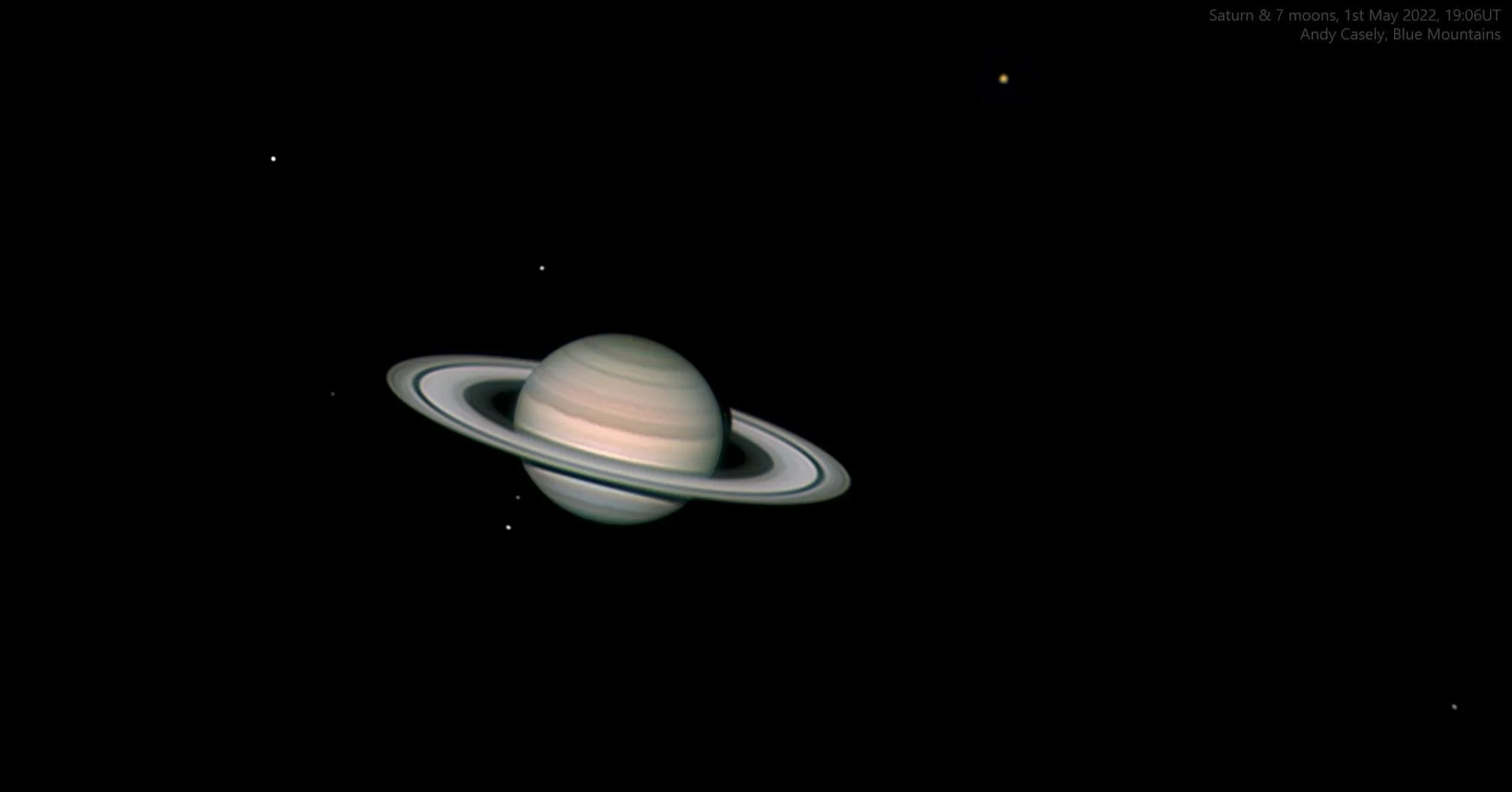
A Saturn family portrait with 7 moons
A Saturn family portrait with 7 moons
Occasionally, the seeing gods are kind - it was sharp this morning! Good data is so much easier to process too. Subtle details on the planet with ripples in belts on both hemispheres, and many moons nearby. Orange fuzzball Titan is at upper right, there's also Enceladus, Dione, Tethys, Rhea & faint Mimas just left of the rings. Iapetus, having completed a very rare transit of Saturn two mornings ago, is farther to the lower right. I've added a labelled version and also a closer view with 'just' six moons.
Celestron C14 @f/22, ZWO ASI290MM, 21mins RGB, red filter only for the smaller icy moons.
Copyright: Andy Casely
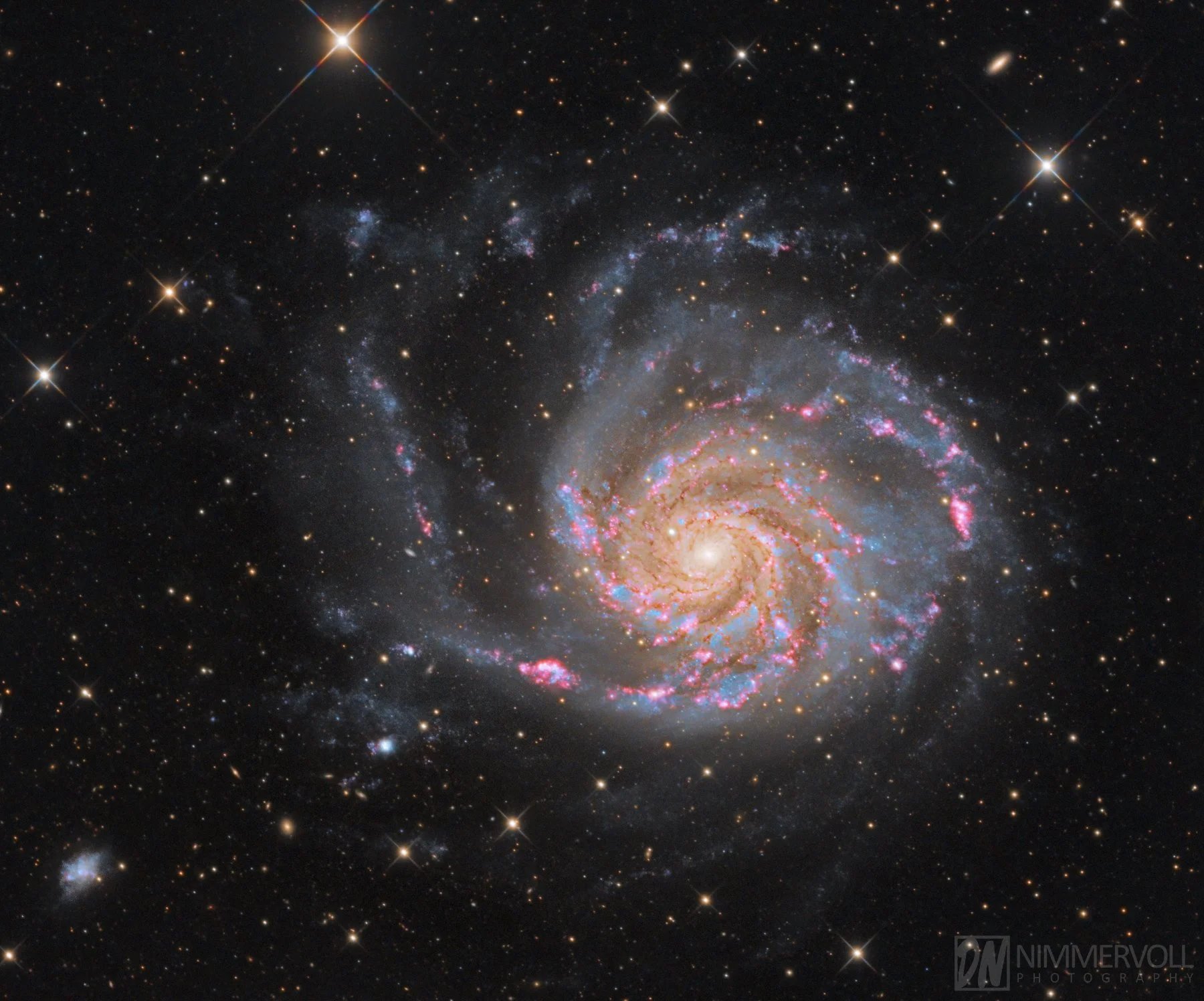
Messier 101
Image Description and Details : Location: Upper Austria
Date taken: April 2022
Distance: 20 million light years
Diameter: 170,000 light years
Exposure: RGB each 40 x 300 sec.
Luminance: 245 x 150 sec.
H-Alpha: 45 x 900 sec
Total: 31.4 hrs
Calibration: BIAS / Flats / DarkFlats
Mount: Skywatcher EQ6-R PRO
Telescope: Lacerta Fotonewton 250/1000
Corrector: Lacerta GPU coma corrector
Filter: Antlia LRGB-V Pro
Antlia 3nm Pro H-Alpha
Camera: QHY268m @ Gain 0 / 56 at -15°C
Guiding: QHY OAG with QHY5III462c and PHD2
Software: APP / Photoshop CC
Copyright: Daniel Nimmervoll