
C 71
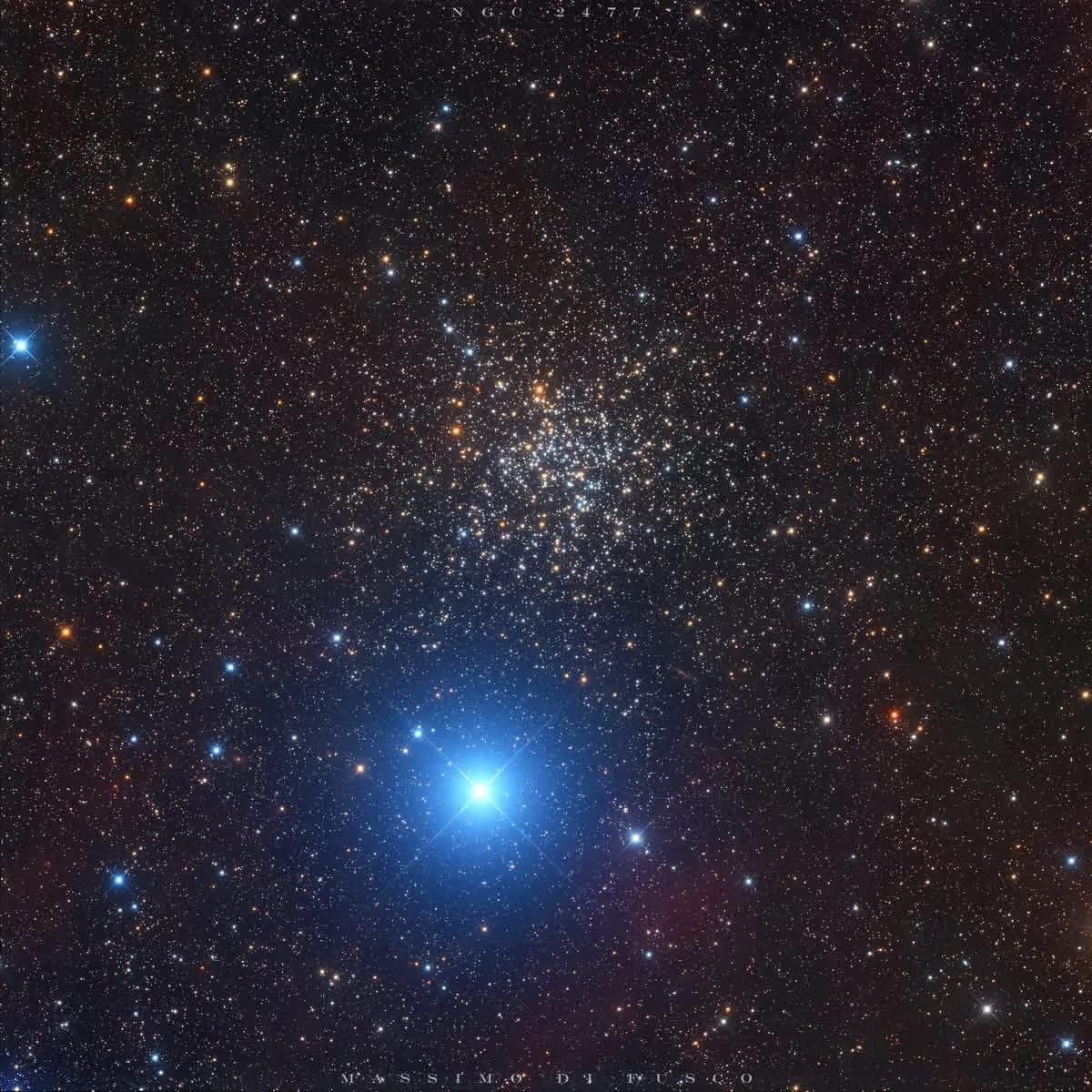
NGC 2477 (also known as C 71) is a brilliant open cluster in the constellation Poppa. It is a very compact object, in appearance most similar to a brilliant globular cluster, unless it is an object inside the Milky Way.
NGC 2477 is a rich and luminous cluster, consisting of a well-nourished star population; its distance is estimated to be around 4000 light years away and is therefore located probably in correspondence to a segment of Orion's Arm heading outward and perhaps intersecting the Perseus Arm.
This is one of the richest open clusters known; according to some estimates the cluster would have over 1900 components, concentrated in a space of 22 light-years in diameter; however, because the object lies in a stretch of the Milky Way, which is rich in stars in the background, it is difficult to determine with accuracy which stars are actual cluster members and which ones aren't. The brightest components are of twelfth magnitude and have a rate of metallicity similar to that of our Sun; its stars would be about 1.3 billion years old, making the cluster twice as old as the Iadias.
The first to note NGC 2477 was Abbot Nicholas Louis de Lacaille, who observed it in 1751 during his stay in Cape Town, South Africa; he described it as a "starless nebula" in his 1755. The first to solve it in stars was James Dunlop, who in 1827 described its seemingly nebular appearance and its almost complete resolution.
Data acquired at Chilescope
ASA Newton 500 @1900mm, f/3.8
ASA DDM85 equatorial mount
FLI PL16803 CCD camera
Astrodon R/G/B filters 3x(2x300")
APP, PixInsight, PS
copyright: Massimo Di Fusco
Share & Credit This AAPOD2 Feature
When you share this image on AstroBin, social media, forums, or your own website, please include a credit to AAPOD2 so viewers can discover where this feature came from.
Support AAPOD2 for free! Use Our AGENA ASTRO Affliate Link
AAPOD2 Title: C 71
AAPOD2 Page Link: https://www.aapod2.com/blog/c-71
Submit Your Photo!