
AAPOD2 Image Archives
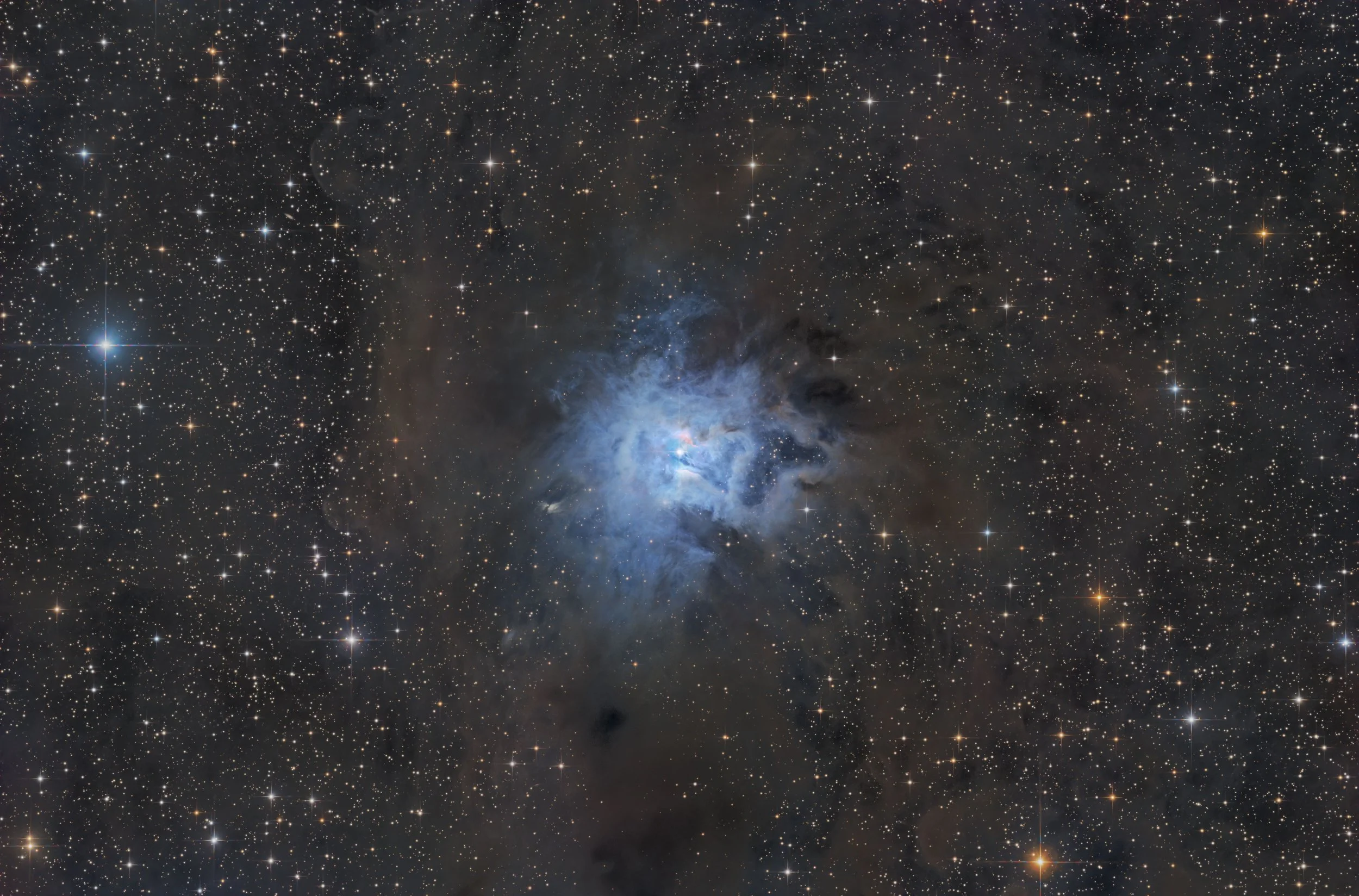
NGC 7023
The Iris Nebula is a wisp of bluish dust nestled within the dark veils of Cepheus.
Illuminated by the star HD 200775, it does not shine of its own accord; rather, it whispers the light, diffusing it like a cosmic secret.
A cold cloud shaped by the physics of grains and photons, it nonetheless appears to our eyes as a celestial flower—fragile, almost shy—suspended between science and dream.
Newtonian 250/1000, Poseidon MM camera, Astronomik Deep Sky LRGB filters—all mounted on an EQ8-R.
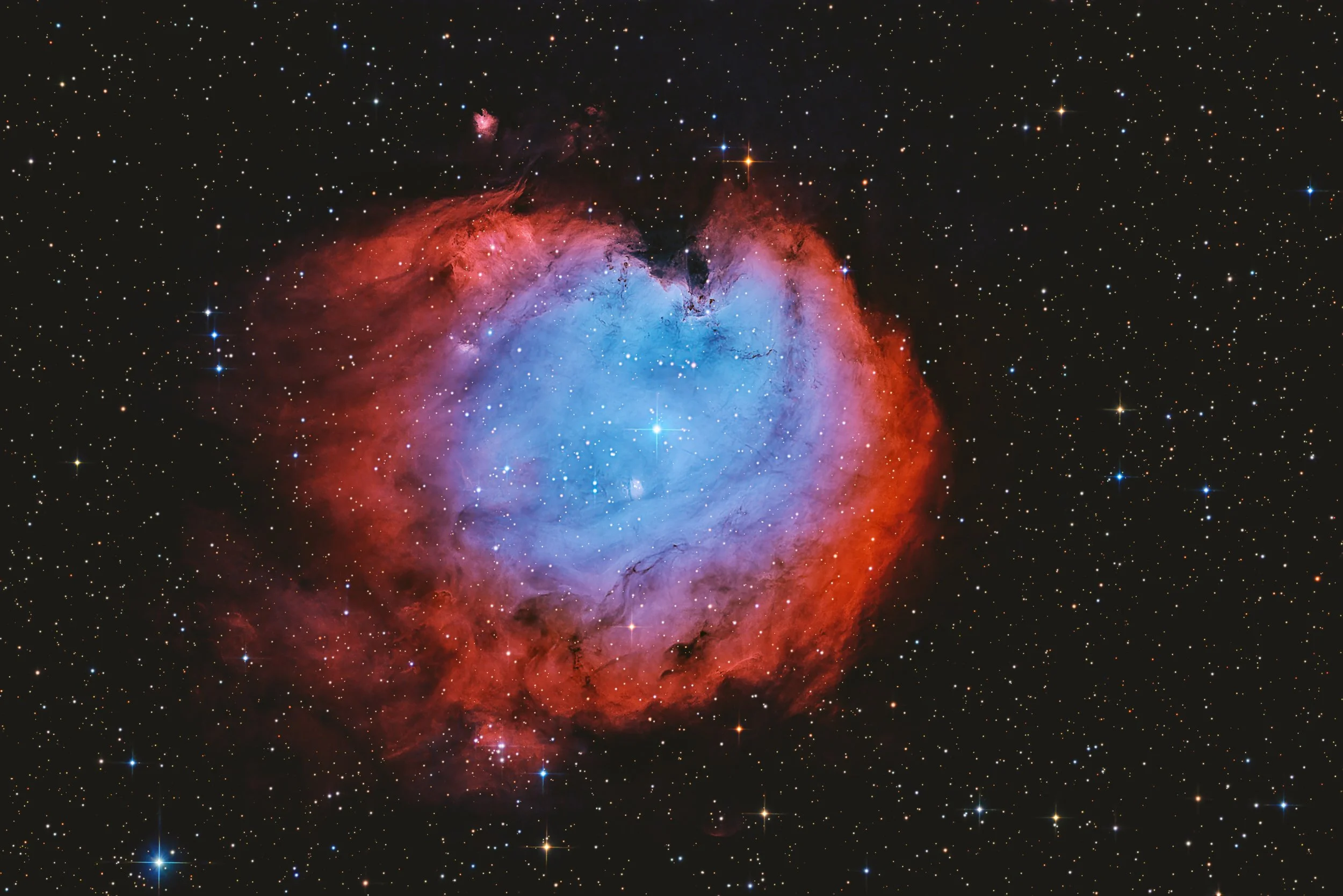
Monkey Head Nebula (NGC 2174)
A vast cloud of gas and dust in Orion where new stars are forming. The glow comes from hot young stars within the nebula that energize the gas, giving us red from hydrogen and bluish tones from oxygen. Its shape looks like a monkey’s face, which is why it is called the Monkey Head.
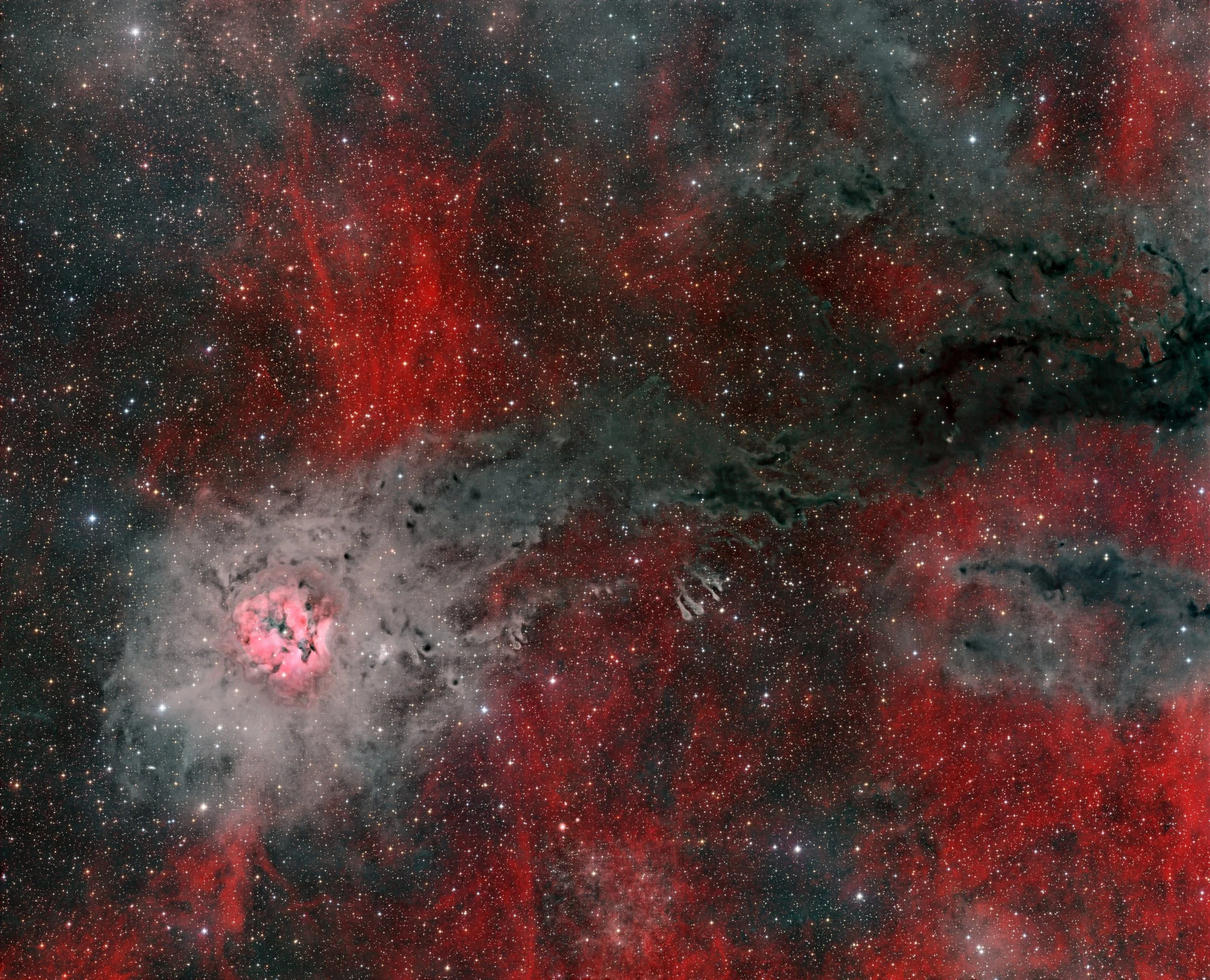
Cocoon Nebula and Tail
The cocoon nebula, also known as IC 5146, is classified as both an emission and reflection nebula. Located in the constellation of Cygnus the Swan it is approximately 4000 light years away from the gravity well. The central star that illuminates the nebulosity was formed approximately 100,000 years ago.
The nebula itself is about 15 light years across. Its location from our vantage point is close to the open star cluster NGC 7209 in Lacerta and open cluster M 39 in Cygnus. The dark lane of dust within the nebulosity is classified as Bernard 168 and is responsible for the “tail”.
This is a region of active star formation with hundreds of young stellar objects being identified; which occurs in both the reflection and emission areas of the nebula. One of the most massive young stars identified is approximately 14 times the mass of our sun.
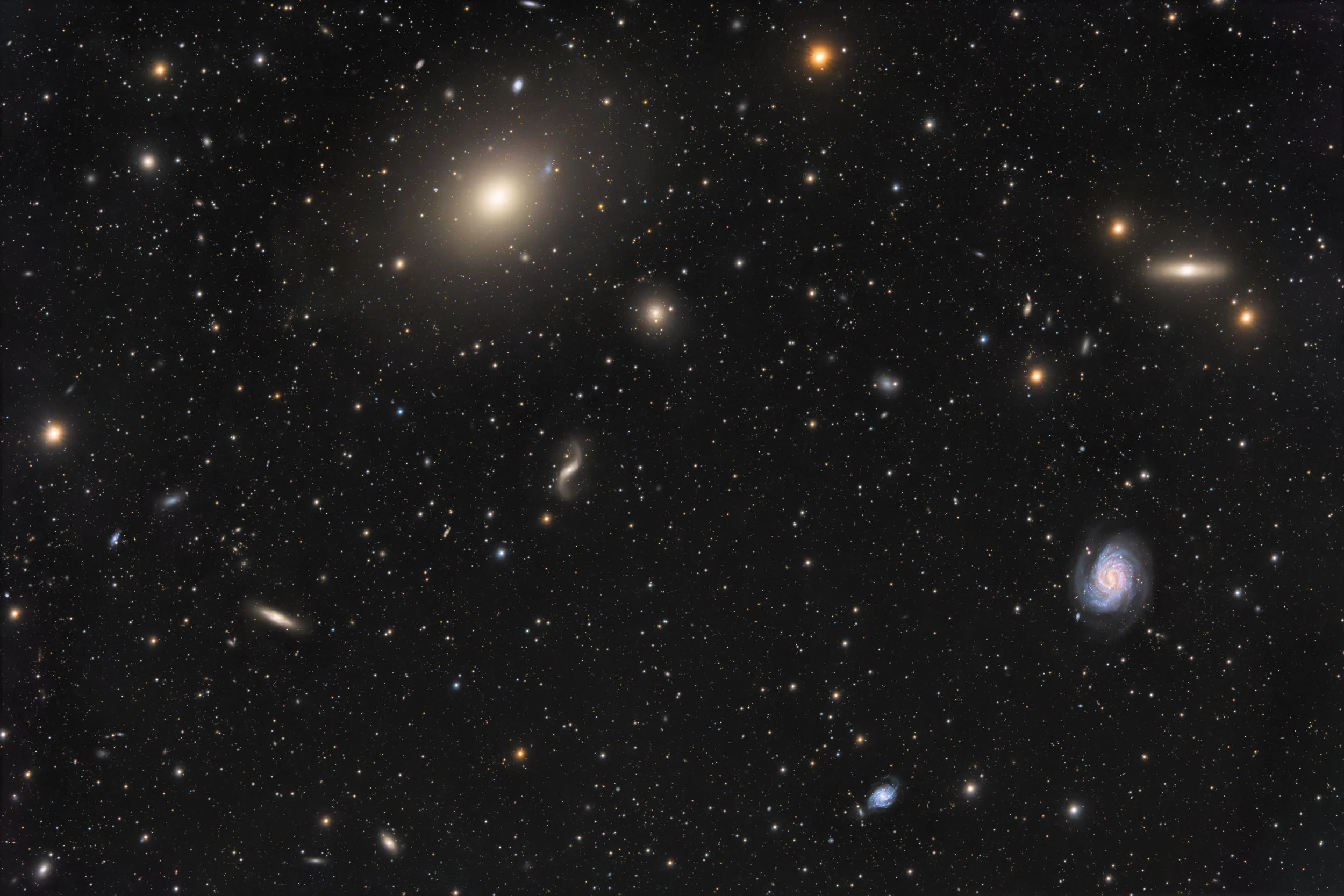
Virgo cluster: South region
The Virgo Galaxy Cluster is the nearest large galaxy cluster to our own Local Group, a vast gathering of more than a thousand galaxies bound together by gravity in the direction of the constellation Virgo. Lying about 55 million light-years away, it forms the heart of the larger Virgo Supercluster and offers one of the clearest nearby views of how galaxies assemble on the grandest scales. Dominated by giant ellipticals such as M87, along with spirals, lenticulars, and countless dwarf galaxies, the cluster reveals a rich variety of galactic forms shaped by both their internal evolution and the intense gravitational environment they inhabit.
Seen in deep wide-field images, the Virgo Cluster becomes a cosmic metropolis where galaxies crowd the frame in every direction, each island universe carrying billions of stars. Interactions between member galaxies, along with the cluster’s immense halo of hot X-ray emitting gas and dark matter, influence how stars form and how galaxies change over time. Streams of stripped material, distorted shapes, and subtle halos around the brightest members all hint at a long history of collisions and mergers. For observers and imagers alike, the Virgo Cluster is both a stunning visual tapestry and a nearby laboratory for exploring the structure and evolution of the universe itself.
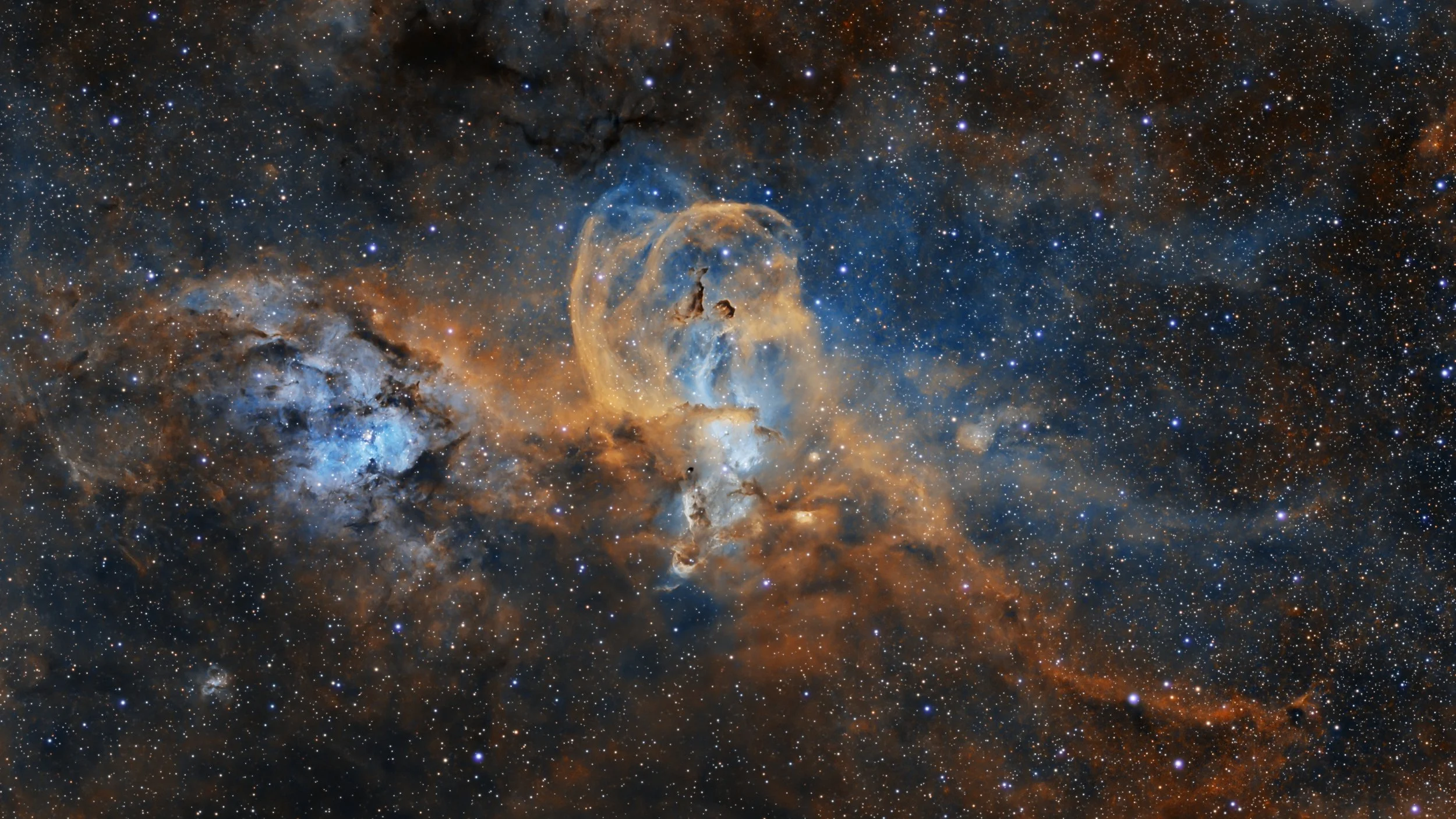
NGC 3576 Statue of Liberty Nebula
Rising in the southern skies of Carina, the Statue of Liberty Nebula is a striking star-forming region whose silhouette has inspired its popular nickname. Cataloged as NGC 3576, this bright emission nebula glows from intense ultraviolet radiation produced by hot, young massive stars embedded within its core. Those energetic stars ionize surrounding hydrogen gas, causing the nebula to shine in rich reds, while darker dust lanes carve dramatic structure through the luminous cloud. Its towering central ridge and flowing arcs of gas create the impression of a robed figure holding a torch, making this celestial landmark one of the most visually evocative nebulae in the southern Milky Way.
Beyond its iconic appearance, NGC 3576 is an active stellar nursery where gravity, radiation, and stellar winds are shaping the next generation of suns. Dense knots of gas and dust are collapsing into protostars, while powerful outflows from newly formed stars sculpt cavities and pillars throughout the region. Located roughly 9,000 light-years away, the nebula offers a vivid glimpse into the complex processes that govern star birth on a galactic scale. In deep images, its intricate filaments and glowing layers reveal both the raw energy and delicate beauty of a region where stars are still emerging from the interstellar dark.
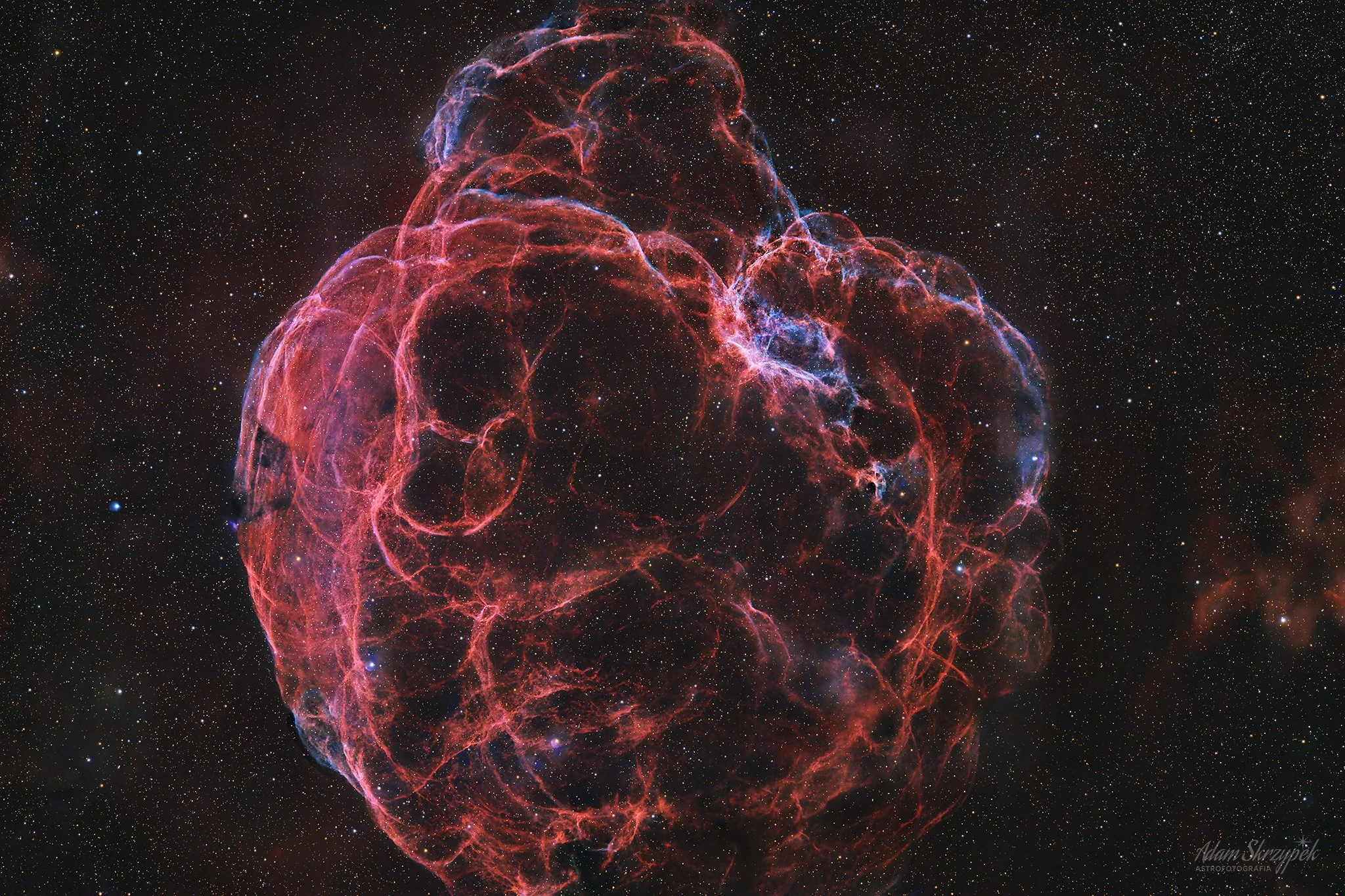
Spaghetti Nebula SH2-240
The Spaghetti Nebula, also known as Simeis 147, is a striking supernova remnant located in the constellation Taurus, about 3,000 light-years from Earth. This nebula is the result of a star that exploded in a violent supernova event, shedding its outer layers into space. The remnants form an intricate web of glowing filaments and gas, stretching across a vast region of the sky. The nebula’s name, "Spaghetti," comes from the long, tangled, and thread-like structure of its filaments, which resemble strands of pasta. These filaments are composed of ionized gas, primarily hydrogen and oxygen, and their brilliant colors reflect the intense radiation emitted as the gas is heated by the shockwaves from the supernova explosion.
The Spaghetti Nebula is an excellent example of the delicate balance between destruction and creation in the universe. The supernova explosion that formed it not only marked the death of a massive star but also enriched the surrounding interstellar medium with heavier elements, which will later go on to form new stars and planets. Scientists study remnants like the Spaghetti Nebula to understand the life cycle of stars and how these cataclysmic events contribute to the cosmic ecosystem. By observing the nebula in multiple wavelengths, including X-rays and radio waves, astronomers can gain a deeper understanding of the mechanisms behind supernovae and their role in shaping the interstellar medium.
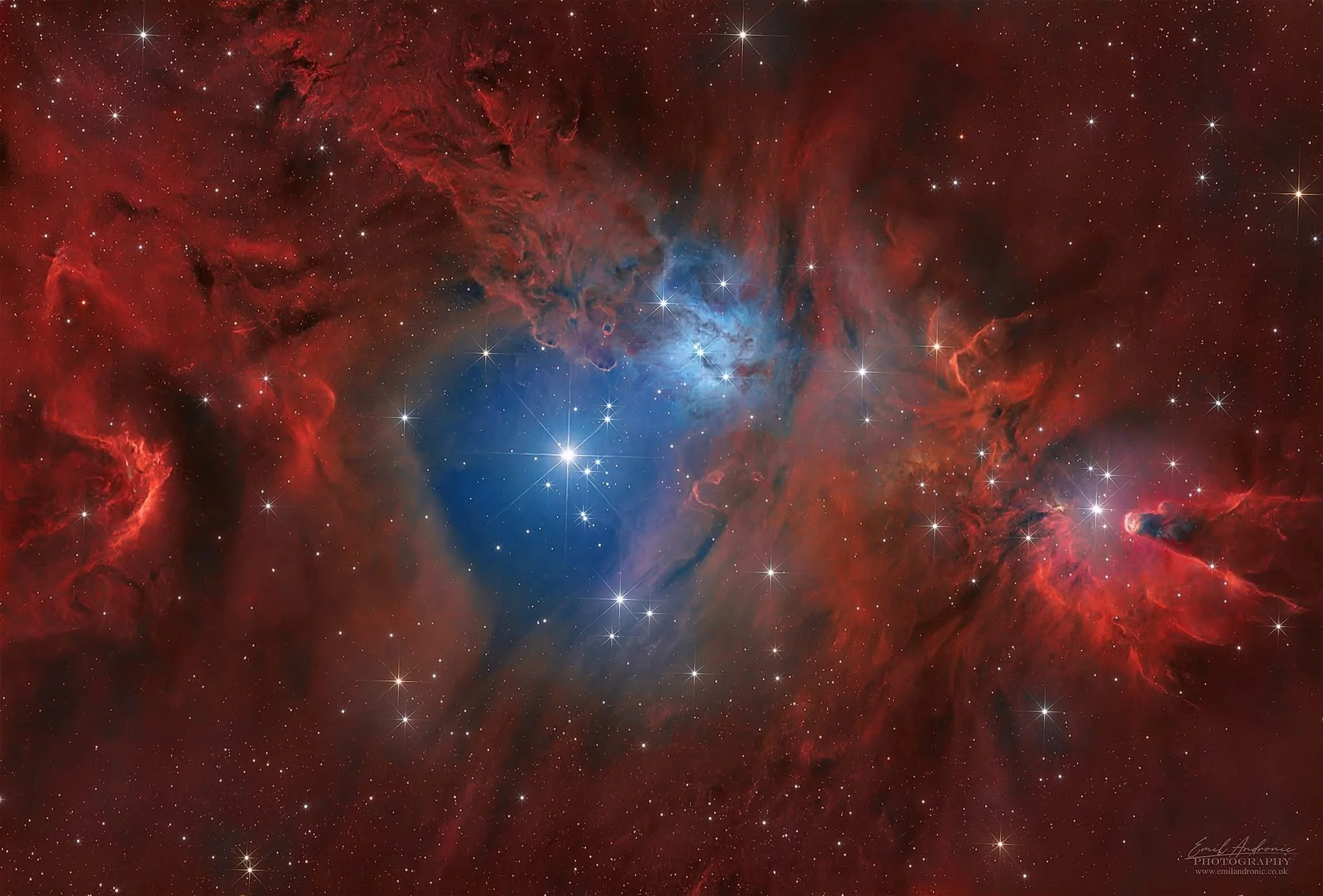
Cone and Fox Fur Nebula
Cone and Fox Fur Nebula
The Cone Nebula and Fox Fur Nebula are two prominent features within a vast star-forming complex officially designated as NGC 2264. Located approximately 2,700 light-years away in the constellation Monoceros (the Unicorn), these nebulae are part of a massive nursery of gas and dust where new stars are being born.
The Cone Nebula is a dark, pillar-like structure of cold molecular hydrogen and dust spanning about 7 light-years in length.
Its conical shape is formed by the erosion of the surrounding gas cloud by intense radiation and stellar winds from young, hot stars.
The Fox Fur Nebula is an emission and reflection nebula named for its intricate, filamentary textures that resemble the head of a red fox stole.
The red areas are caused by hydrogen gas being ionized by ultraviolet radiation from hot, young stars and the blue areas are reflection nebulae created by dust scattering the light from these same stars.
The nebula is heavily influenced by the bright variable star S Monocerotis, which sits nearby and helps illuminate the surrounding gas.
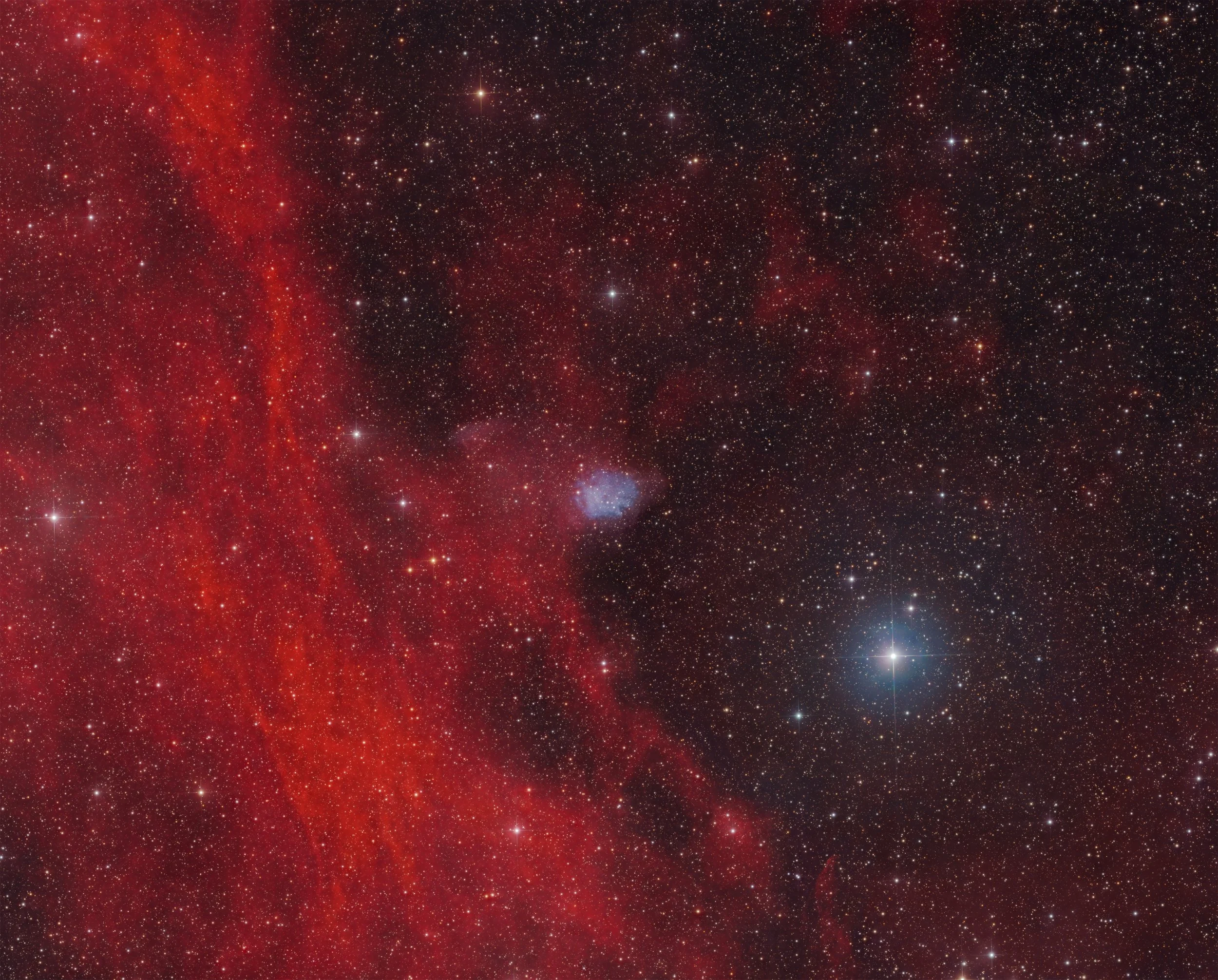
Kyanite Nebula
Shapiro-2, nicknamed the Kyanite Nebula, is a newly discovered planetary nebula in Centaurus. I originally discovered the nebula in 2024 through a wide-field [O III] survey effort of the southern Galactic plane, and it was registered to the HASH PNe database. This image was obtained in collaboration with Mark McComiskey, fully revealing the Kyanite Nebula’s morphology and PN nature for the first time.
The nebula was first identified as a faint ionized oxygen shell, with an associated central star (CSPN), most likely a hot subdwarf from its corrected G magnitude, visible in the Dark Energy Camera Plane Survey. The corresponding Gaia source of the CSPN measured its distance of approximately 2500 parsecs, or ~8150 light-years, from Earth. The Kyanite Nebula spans ~1.8 parsecs, or ~5.9 light-years, extensive for a typical planetary nebula, indicating that it is in the late stages of its evolution. This is in line with its diffuse structure and extremely faint nature. Using equations to model PN expansion from Ogle et al. 2025, and considering typical PNe initial expansion velocities, its age is estimated to be 23000-46000 years.
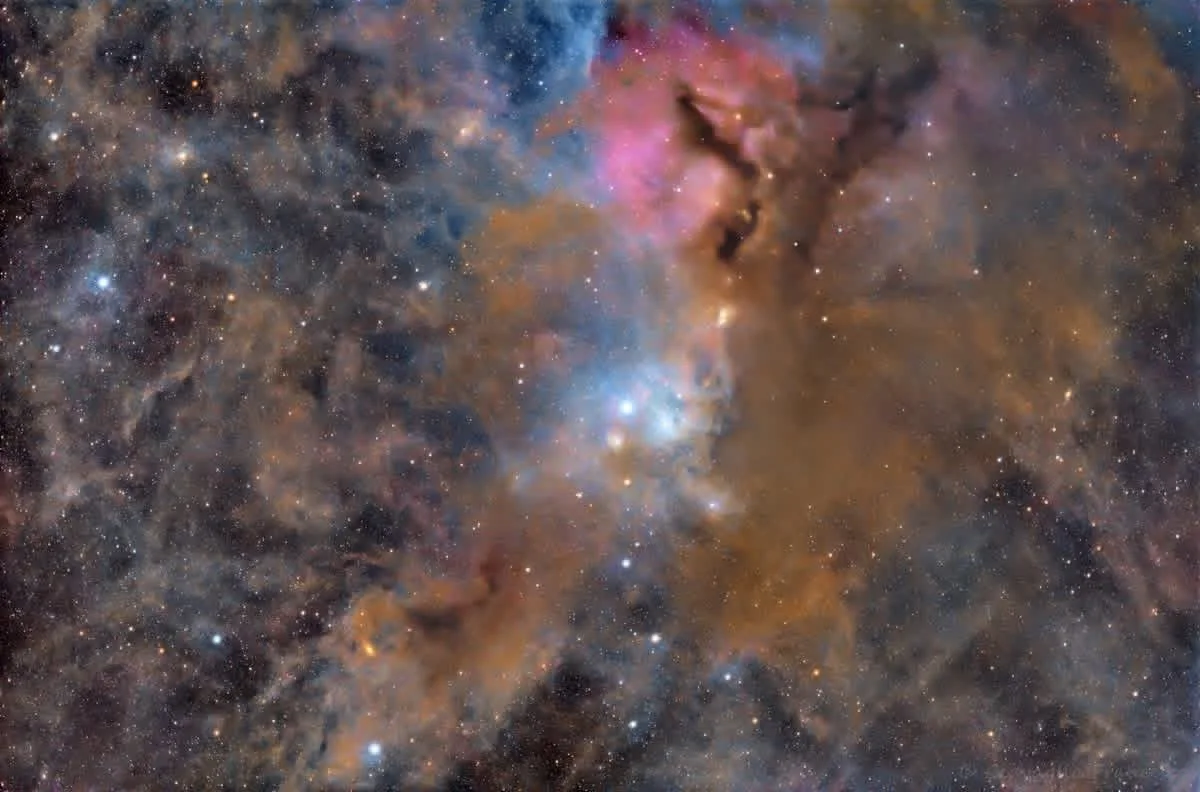
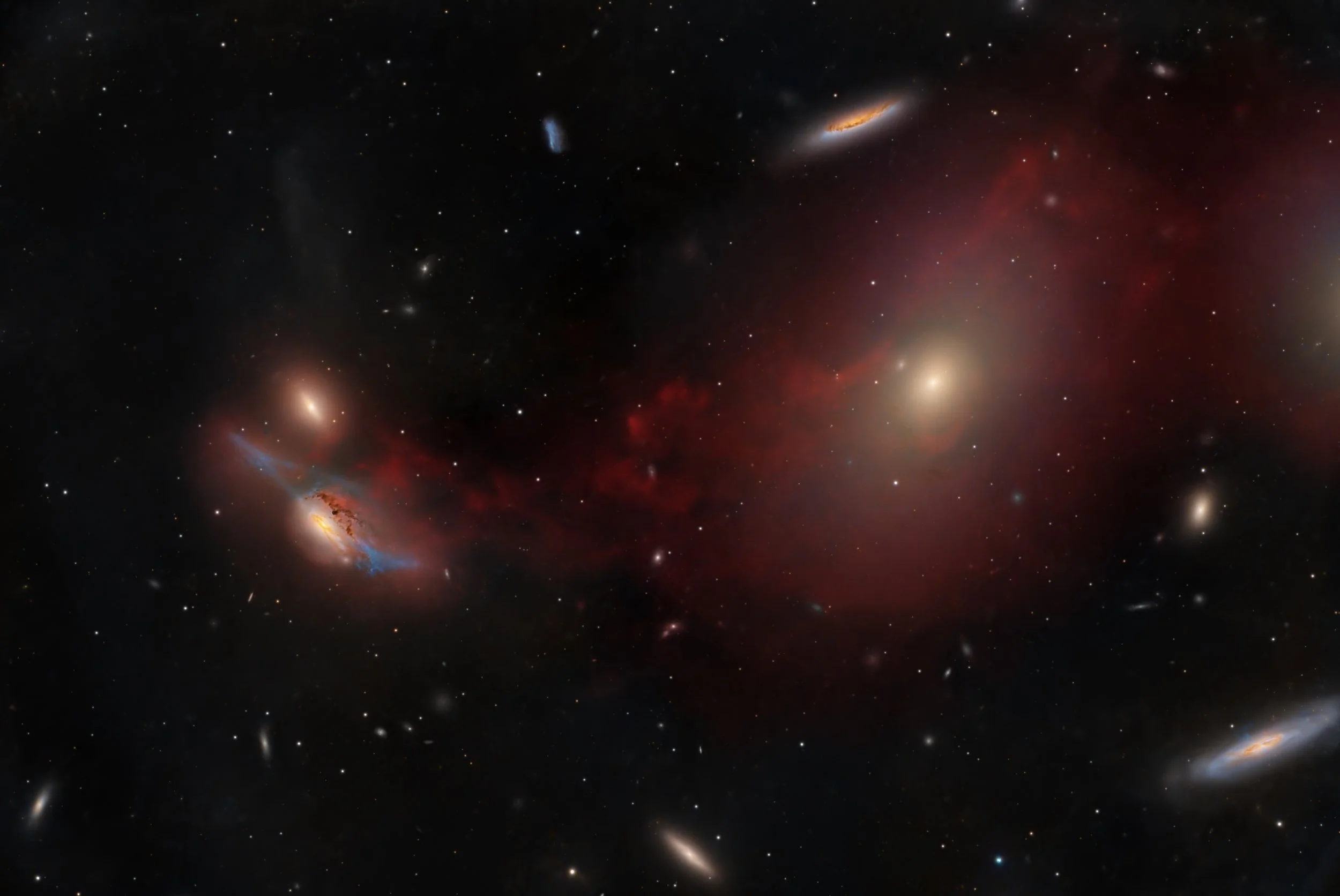
Tidal Scars in Virgo
The intertwined galaxies NGC 4435 and NGC 4438 form one of the most dramatic interacting pairs in the Virgo Cluster. Often called “The Eyes,” their close encounter has left NGC 4438 heavily warped, its once-orderly spiral structure stretched into chaotic lanes of dust and streams of stars. By contrast, NGC 4435 appears more compact and relatively undisturbed, though it too bears subtle signs of gravitational stress. This cosmic interaction, unfolding over millions of years, offers a vivid snapshot of how galaxies evolve through encounters—reshaping their structure, triggering star formation, and redistributing gas and dust.
Hovering nearby in the same crowded cluster environment is Messier 86 (M86), a massive elliptical galaxy plunging through the intracluster medium at high speed. Its motion generates vast streams of hot gas detectable in X-ray wavelengths, evidence of ongoing interactions not just with neighboring galaxies but with the cluster itself. Together, Messier 86 and the “Eyes” galaxies illustrate the dynamic, often violent nature of galaxy clusters, where gravity, motion, and environment combine to sculpt the universe on grand scales.