
Spaghetti Nebula SH2-240
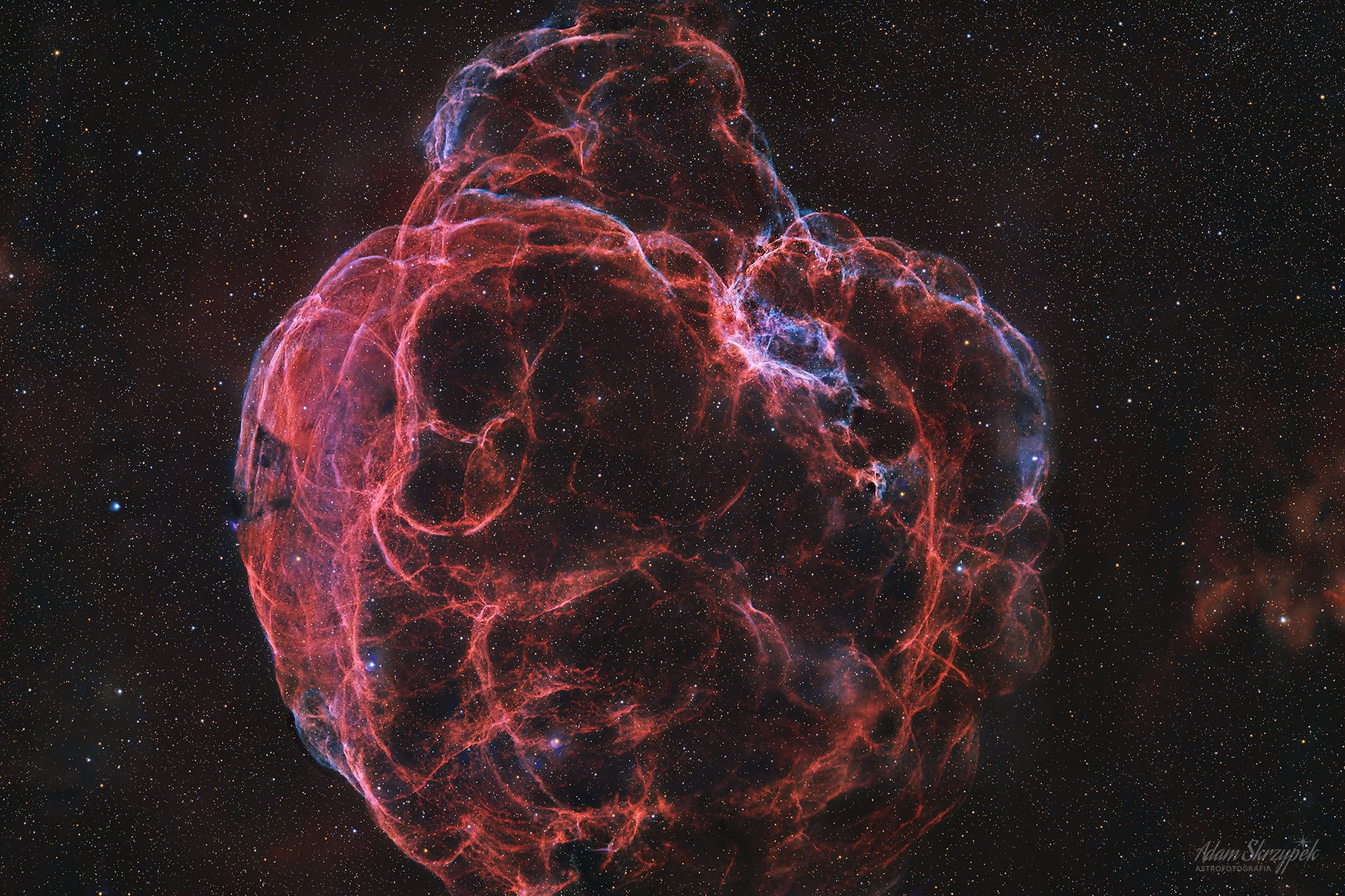
Description and Details: Spaghetti Nebula (Sh2-240), which is incredibly faint and therefore difficult to capture and process. This image consists of 180 exposures of 10 minutes each, giving a total of exactly 30 hours of integration time. I dedicated many winter nights and hours spent at the computer to this photo.
The Spaghetti Nebula, or Sh2-240, is one of the largest and at the same time one of the most difficult-to-observe supernova remnants in our galaxy. Its actual diameter is about 150 light-years, making it significantly larger than many other known remnants of stellar explosions. It barely fit within the frame of a telescope with a 250 mm focal length and an APS-C format camera.
It was formed as a result of the explosion of a massive star, and its age is estimated at around 30,000–50,000 years. During that time, the shock wave has propagated through the interstellar medium, “sweeping up” and heating the gas. It is precisely this interaction with the uneven interstellar medium that gives the nebula its irregular, filamentary appearance. The characteristic filaments that give it its name are regions of ionized gas—mainly hydrogen and oxygen—which glow in red and blue.
Telescope: WO RedCat 51
Camera: ZWO ASI 071 MC Pro
Filter: Optolong L-eXtreme 2"
Mount: iOptron CEM25P
Control: ASI Air Plus
Guiding: ZWO 30mm Mini Guide Scope + ZWO ASI120MM Mini
Stack: 180 frames × 600 seconds, total integration time 30 hours
Stars (RGB): 59 × 20 seconds with Astronomik UV/IR Block filter
Winter 2026, Bortle 4.9
Name: Adam Skrzypek
Share & Credit This AAPOD2 Feature
When you share this image on AstroBin, social media, forums, or your own website, please include a credit to AAPOD2 so viewers can discover where this feature came from.
Support AAPOD2 for free! Use Our AGENA ASTRO Affliate Link
AAPOD2 Title: Spaghetti Nebula SH2-240
AAPOD2 Page Link: https://www.aapod2.com/blog/spaghetti-nebula-sh2-240
Submit Your Photo!