
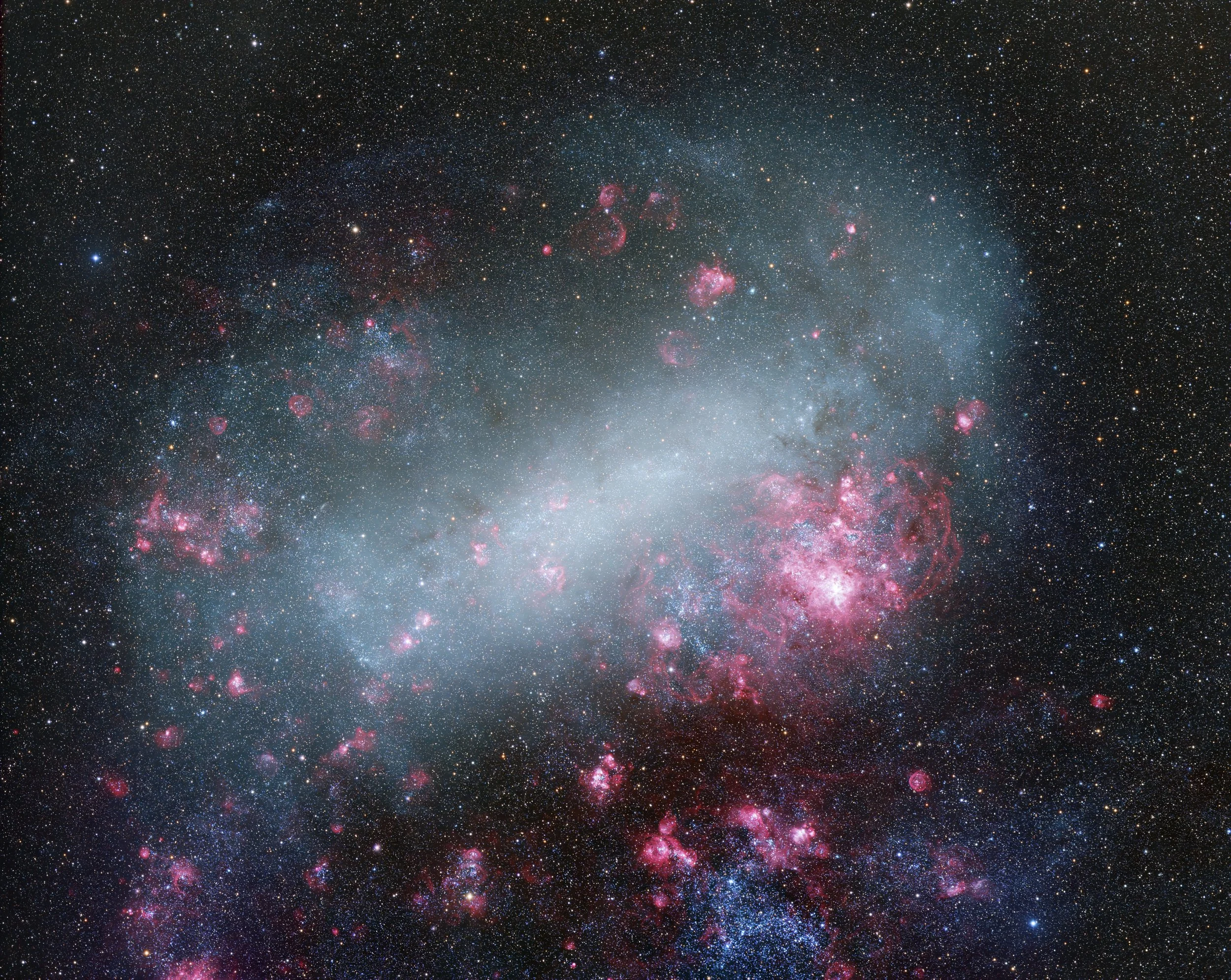
Image Title: Large Magellanic Cloud (LMC)
Copyright: Ph Claudio Antinoro 2025
Date image was taken: October 15, 2021
Location: Chile - Rio Hurtado Valley
Data Acquisition Method: Remote Observatory (Commercial)
Description and Details: The Large Magellanic Cloud (LMC) in HLRGB
Historical and Scientific Context
The Large Magellanic Cloud (LMC) is the brightest and most massive satellite galaxy in our Milky Way, located approximately 163,000 light-years away. Although it was known to the indigenous populations of the Southern Hemisphere since ancient times, its fame in the Western world dates back to the chronicles of the Portuguese navigator Ferdinand Magellan, who described it during his circumnavigation of the Earth in the early 16th century.
Today, the LMC is classified as a dwarf irregular galaxy and represents a true cosmic laboratory, famous for hosting the Tarantula Nebula (NGC 2070), the most active star-forming region in the entire Local Group.
The data set is intentionally undersampled, an ideal choice for a large subject like the LMC.
Workflow and Processing
The process began with stacking in Deep Sky Stacker (DSS), followed by an advanced workflow in PixInsight, with final refinements in GIMP and Darktable.
Linear Phase
Each channel was processed individually in PixInsight. I used StarXTerminator to separate the stars from the nebulae and applied Gradient Correction to eliminate background variations. Next, the BlurXTerminator (BXT) and NoiseXTerminator (NXT) modules were used to achieve thorough cleanup and conservative linear phase deconvolution.
HLRGB and HDR Composition
For the transition to the nonlinear phase, I used Statistical Stretch, paying particular attention to dynamics management. The 300- and 600-second exposures were combined using an HDR technique, while the H-alpha signal was integrated into the red channel using the LRGBCombination module to emphasize the nebulous emissions.
Next, the luminance (L) was merged with the enriched color image (already merged with H-alpha), optimizing sharpness using LocalHistogramEqualization.
Final Refinement
After processing the star-free image, the stars were recombined using the ScreenStars script, which allows for precise control over their appearance and color saturation. The final image was then exported and refined in GIMP and Darktable for final adjustments to the contrast curves and global hue.
Name: CLAUDIO ANTINORO
Website or Facebook Profile: https://www.facebook.com/claudioantinoro