

AAPOD2 Image Archives
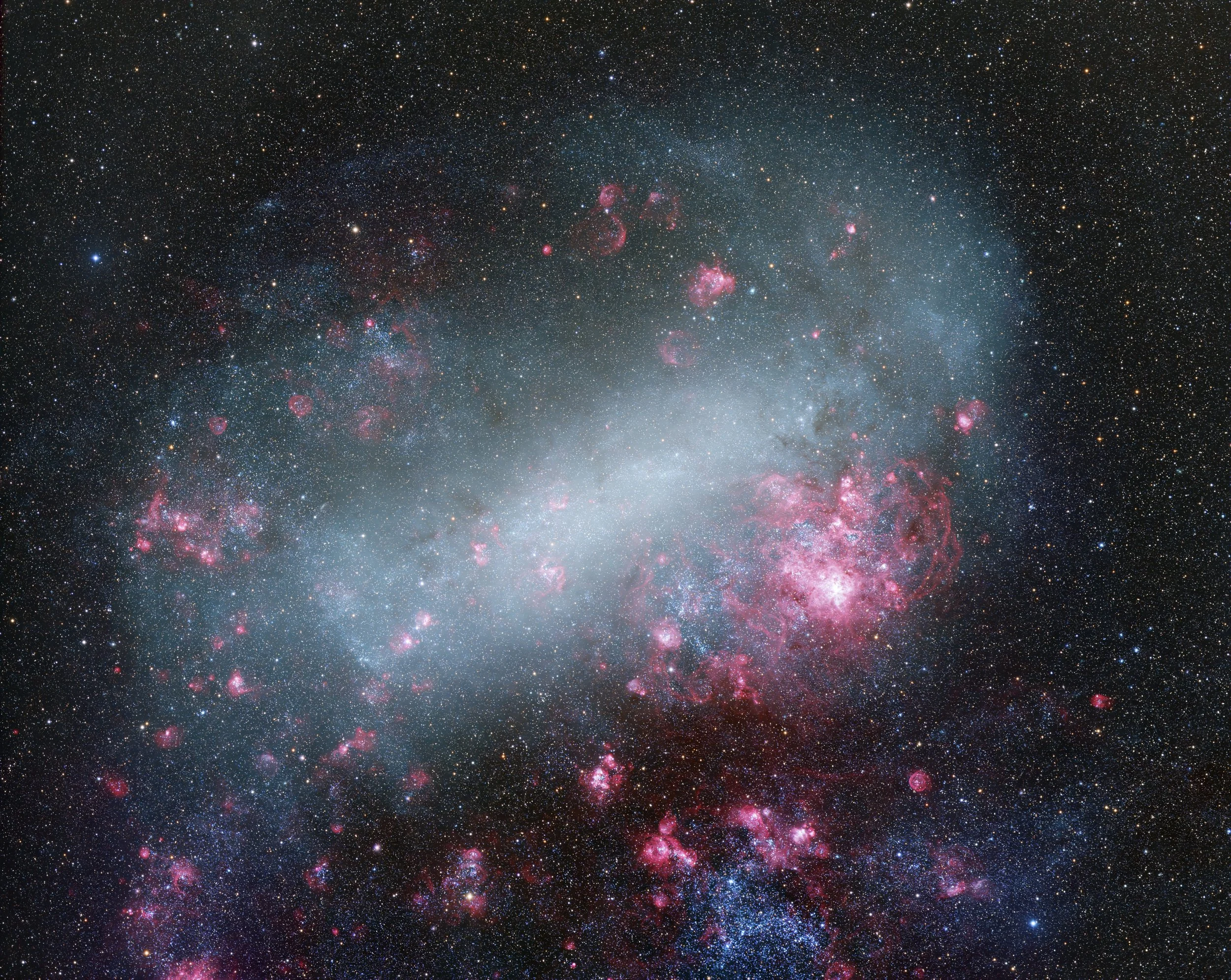
The Large Magellanic Cloud in HLRGB and HDR
Spanning over 14,000 light-years, the Large Magellanic Cloud (LMC) is one of the Milky Way’s closest galactic neighbors, orbiting at a distance of roughly 160,000 light-years. This irregular dwarf galaxy is rich in star-forming regions, the most famous being the bright pink Tarantula Nebula (NGC 2070) seen near the center. Waves of hydrogen emission and intricate dust lanes trace massive stellar nurseries that continue to shape the galaxy’s dynamic structure.
This HLRGB and HDR composition reveals the LMC’s complex interplay of glowing gas, young blue star clusters, and older stellar populations scattered throughout its disk. The careful combination of data layers allows both the bright star-forming regions and the faint galactic halo to be visible in a single image, offering a balanced and detailed portrait of our neighboring galaxy.
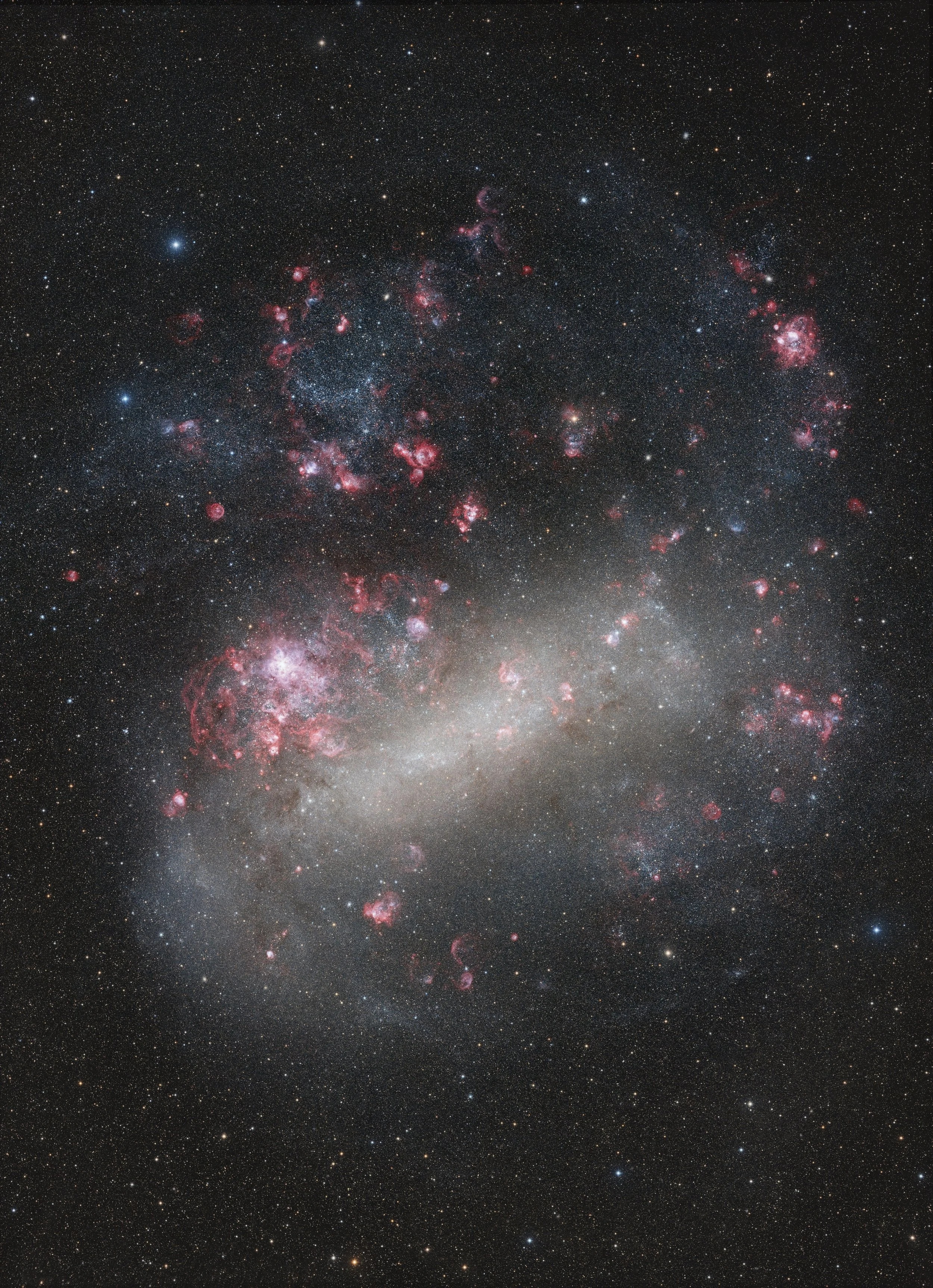
Dusty Cloud -The Large Magellanic Cloud
The Large Magellanic Cloud (LMC), a satellite galaxy of the Milky Way, unfolds in stunning detail in this meticulously crafted two-panel mosaic, captured by the ShaRA team using the T4 telescope at Chilescope. This wide-field image, taken with a 100mm f/2 Nikon lens, showcases the LMC’s sprawling star-forming regions, glowing nebulae, and intricate networks of cosmic dust.
By employing seven different filters (LRGB + Ha, OIII, and SII), the team has revealed both the natural starlight of the LMC and the faint, ionized gas structures sculpted by intense stellar winds and supernova explosions. The Hydrogen-alpha (Ha) regions glow deep red, marking sites of active star birth, while Oxygen-III (OIII) in blues and Sulfur-II (SII) in golds unveil the turbulent interstellar medium shaped by dying stars.
Spanning roughly 14,000 light-years, the LMC is home to some of the most famous celestial objects in the southern sky, including the Tarantula Nebula (NGC 2070)—one of the most active star-forming regions in the Local Group. The mosaic also captures numerous supernova remnants, star clusters, and gaseous filaments, offering a breathtaking glimpse into the life cycle of stars on a galactic scale.
With nearly 32 hours of total exposure time collected over 20 nights, this image represents an extraordinary dedication to astrophotography. The combination of wide-field optics, deep integration, and precise post-processing has resulted in one of the most detailed amateur captures of the LMC, highlighting the galaxy’s beauty and its dynamic role in the cosmic ecosystem.