
M15 Globular Cluster
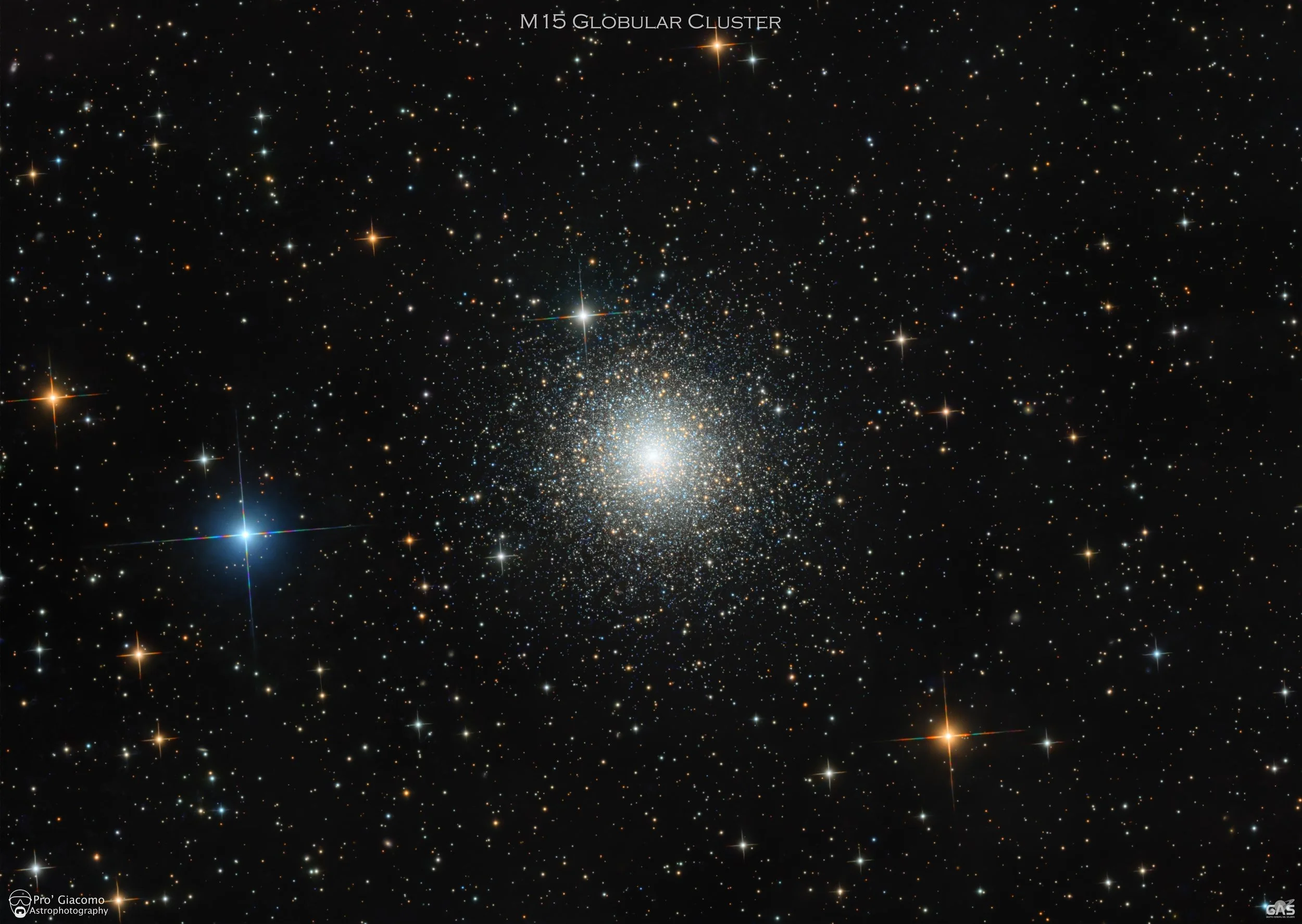
Description and Details: In the constellation Pegasus, approximately 35,000 light-years from Earth, shines M15—a globular cluster that harbors some of the oldest stars in our galaxy. With an estimated age of about 12 billion years, this immense collection of over one hundred thousand stars serves as a testament to the early stages of the Milky Way’s history.
Bound together by gravity, its stars form a nearly spherical structure that becomes increasingly crowded toward the center. M15 is, in fact, one of the densest known globular clusters; its core contains a multitude of stars whose light overlaps to create a nucleus of extraordinary brightness. The hottest stars glow with blue hues, while those with lower surface temperatures take on golden and orange shades.
Hidden among its stars is Pease 1, the first planetary nebula ever discovered within a globular cluster—a shell of gas ejected by a star during the final stages of its evolution. This rare feature adds yet another chapter to the story of this ancient stellar system.
To photograph M15 is to capture light that has traveled for tens of thousands of years, originating from stars born long before the Sun—a fragment of our galaxy’s memory, held within the skies of Pegasus.
Light: 95 x 60 seconds
Filter: Optolong L-Qef
Camera: ZWO Asi 294 mc pro
Telescope: Sky-Watcher Newton 200/1000 PDS (CUSTOM)
Mount: Sky-Watcher Eq 6-r Pro
Acquisition: ZWO Asiair Plus
Software: DSS - Pixinsight – Photoshop
Shots: 18/10/2026
Location: Torricella (TA) ITALY
Sky Bortle: 6
Author: PRO’ GIACOMO.
Copyright: GIACOMO PRO'
Share & Credit This AAPOD2 Feature
When you share this image on AstroBin, social media, forums, or your own website, please include a credit to AAPOD2 so viewers can discover where this feature came from.
Support AAPOD2 for free! Use Our AGENA ASTRO Affliate Link
AAPOD2 Title: M15 Globular Cluster
AAPOD2 Page Link: https://www.aapod2.com/blog/m15-globular-cluster
Submit Your Photo!