
M83
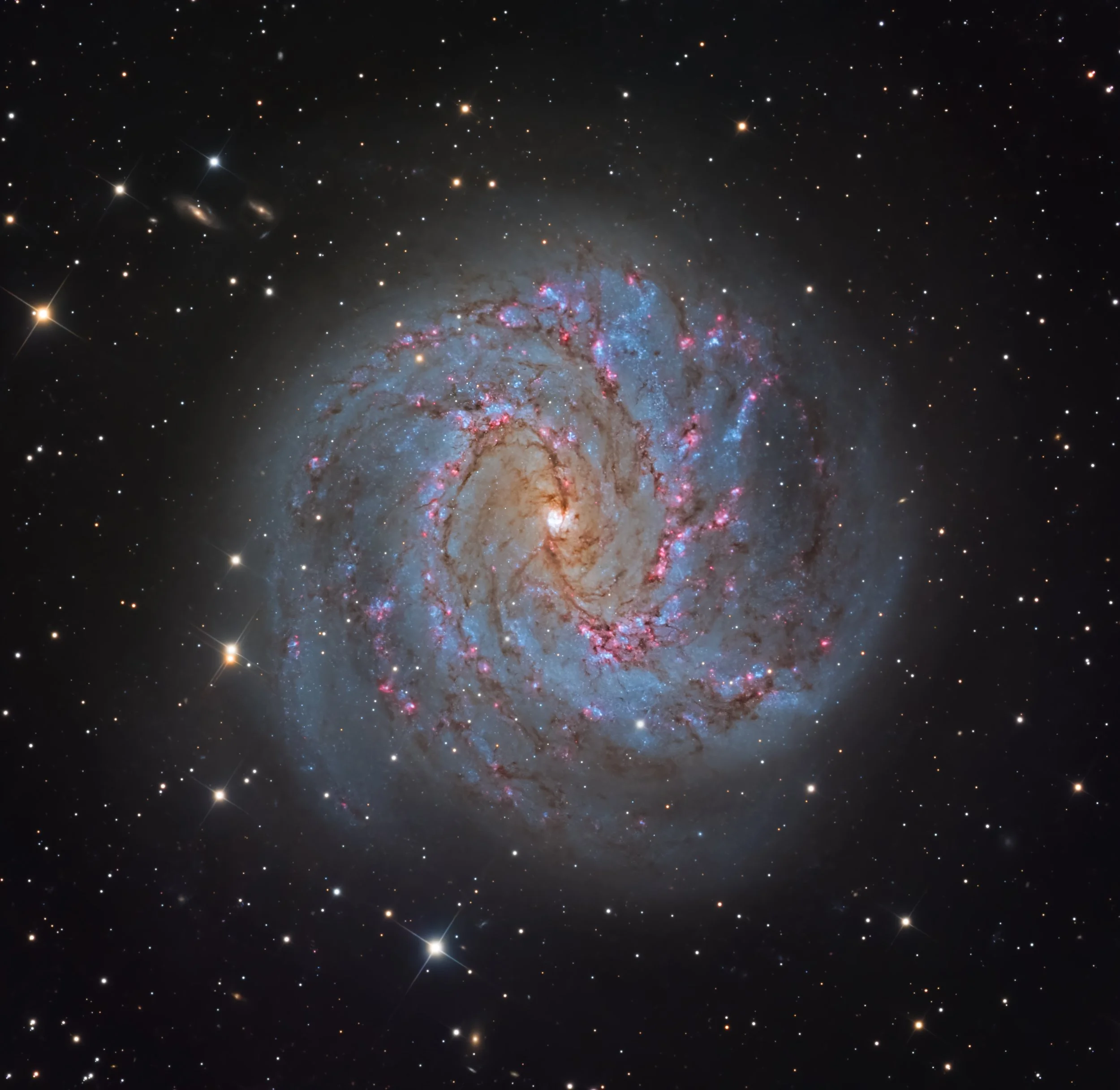
Description and Details: Messier 83 (also known as M83, NGC 5236, or the Southern Pinwheel Galaxy) is a barred spiral galaxy located in the southern constellation Hydra, at a distance of 15.2 million light-years from Earth. Located 30 degrees south of the celestial equator, Messier 83 is the southernmost galaxy listed in Messier’s catalogue. This makes it one of the most difficult Messier objects for northern observers to see, as it never rises very high above the southern horizon.
Until recently, the outer regions of M83 were believed to lack star-forming material. However, on June 16, 2008, NASA’s Galaxy Evolution Explorer detected large numbers of very young, newly formed stars in these areas.
Observations with the Hubble Space Telescope have revealed that the galaxy’s core has a double nucleus, a feature it shares with the Andromeda Galaxy (M31). This does not mean that M83 has two supermassive black holes at its centre, but rather that the central black hole may be surrounded by an orbiting disk of stars, giving the appearance of a dual core. This double nucleus may be the result of a merger with a smaller galaxy that occurred in the distant past; the second nucleus could be the remnant core of the smaller galaxy absorbed by M83.
The Southern Pinwheel Galaxy was discovered by French astronomer Nicolas-Louis de Lacaille on February 23, 1752, at the Cape of Good Hope in South Africa. Lacaille catalogued the object as "Lacaille I.6" and described it as a “small, shapeless nebula.” Charles Messier later included the object in his catalogue on February 17, 1781.
Copyright Massimo Di Fusco
Share & Credit This AAPOD2 Feature
When you share this image on AstroBin, social media, forums, or your own website, please include a credit to AAPOD2 so viewers can discover where this feature came from.
Support AAPOD2 for free! Use Our AGENA ASTRO Affliate Link
AAPOD2 Title: M83
AAPOD2 Page Link: https://www.aapod2.com/blog/m83-2
Submit Your Photo!