
NGC 6729 and the Corona Australis Dust Complex
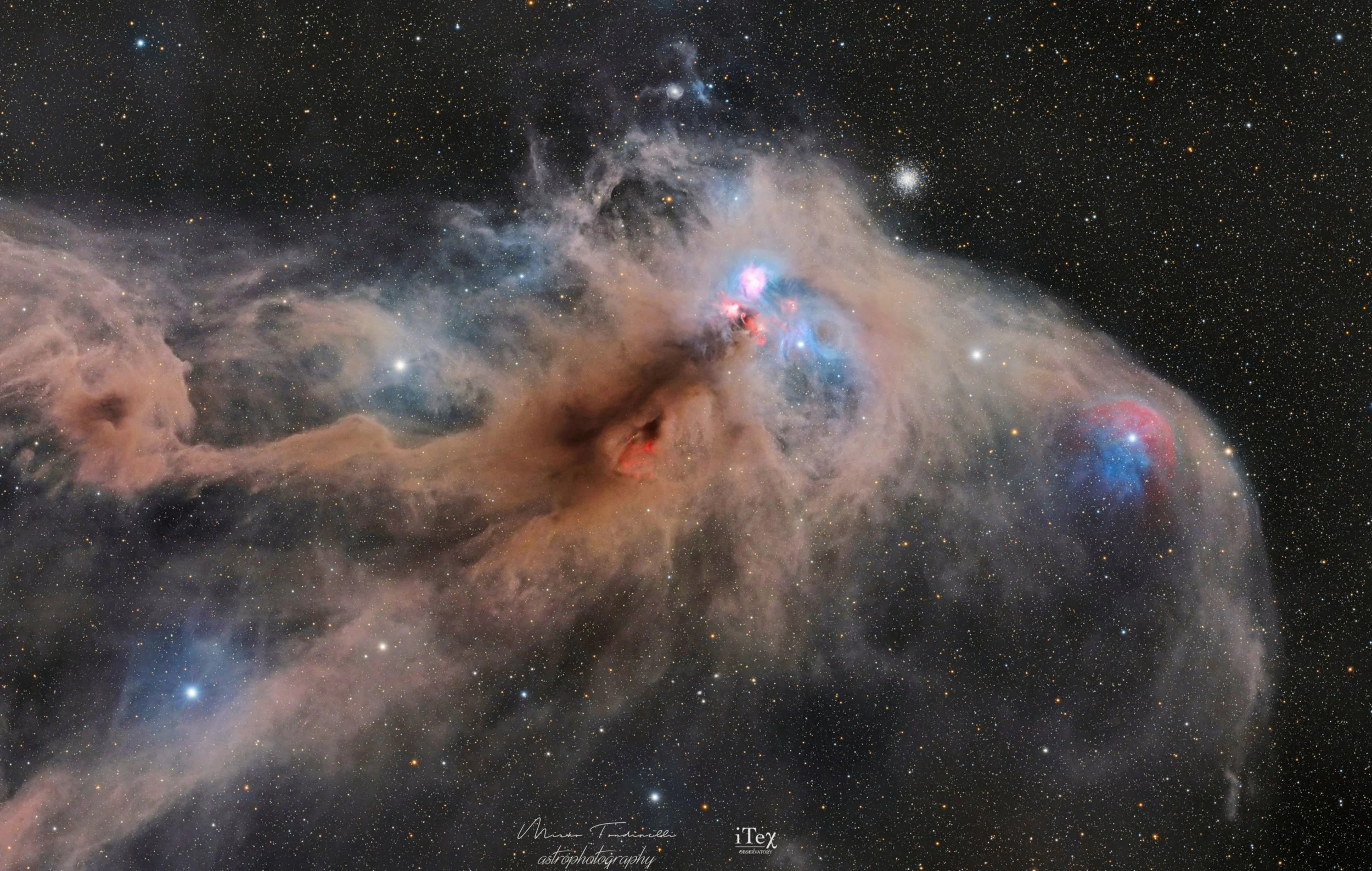
Image Title: NGC 6729 HaLrgb
Copyright: Mirko Tondinelli
Date image was taken: July 28, 2025
Location: Itex observatory Texas
Data Acquisition Method: Personal Telescope Setup
Description and Details: NGC 6729 (also known as C 68) is a reflection nebula visible in the constellation Corona Australis. The nebula is located on the line joining the stars γ Coronae Australis and ε Coronae Australis, both of which are fifth magnitude. The region of sky between the two stars appears heavily obscured by interstellar dust, which is home to several bright nebulae, such as NGC 6726 and NGC 6727. NGC 6729 is the smallest of the group, but is recognizable by its distinctly triangular shape, brighter at one vertex, which gives it a comet-like appearance. Its brightness varies, a characteristic that makes it similar, in addition to its shape, to NGC 2261, the Hubble Variable Nebula. The globular cluster NGC 6723 can also be seen in the same field of view.
Second photo from itex_observatory. The main difficulty with this shot was its low altitude, which never exceeded 24° in the Texas sky. The magnificent sky where our equipment is located helped make this photo possible perfectly. This is my personal processing, following my established workflow.
Image data:
Luminance 118 × 300″ = 9 hours 50′
R 47 × 180″ = 2 hours 21′
G 44 × 180″ = 2 hours 12′
B 43 × 180″ = 2 hours 9′
H 56 × 600″ = 9 hours 20′
Total 25 hours 52′
Thanks again to Optolong Filter Images, who used their filters to create this image.
Name: Mirko Tondinelli
Website or Facebook Profile: https://www.facebook.com/share/1B1oynP5o9/
Share & Credit This AAPOD2 Feature
When you share this image on AstroBin, social media, forums, or your own website, please include a credit to AAPOD2 so viewers can discover where this feature came from.
Support AAPOD2 for free! Use Our AGENA ASTRO Affliate Link
AAPOD2 Title: NGC 6729 and the Corona Australis Dust Complex
AAPOD2 Page Link: https://www.aapod2.com/blog/ngc6729-corona-australis-dust-fields
Submit Your Photo!