
From Bloom (Sh2-170) to Garlic Head (Abell 85)
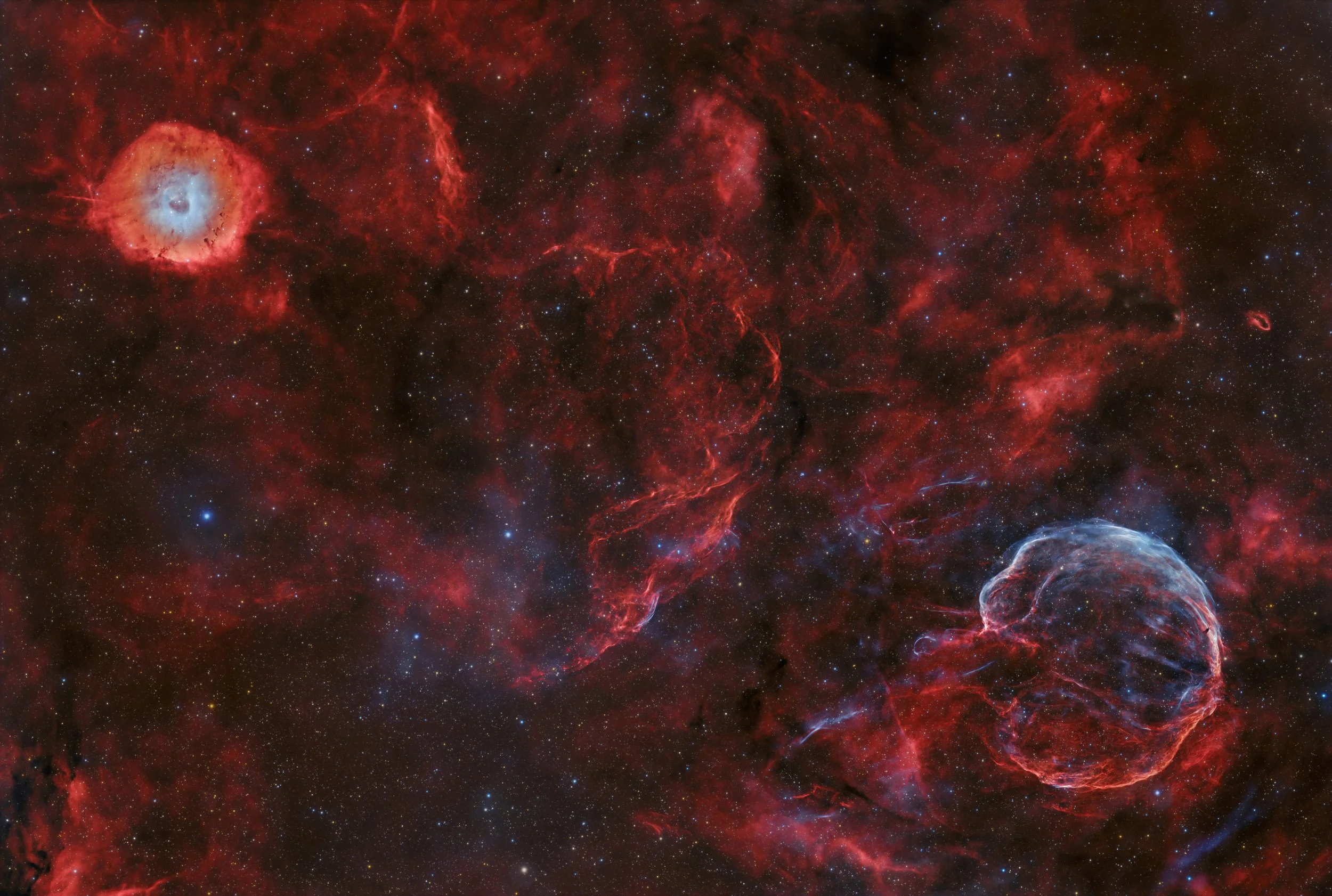
Image Title: From Bloom (Sh2-170 aka The Little Rosette) to Garlic Head (Abell 85 aka CTB 1)
Copyright: Julien De Winter
Date image was taken: August 26, 2025
Location: Belgium
Data Acquisition Method: Personal Telescope Setup
Description and Details: Today, from the Belgian skies, I take you to the constellation Cassiopeia. In this region, the area formed by NGC 7822 and Sh2-170 outlines the famous cosmic question mark. This image focuses on the "dot": Sh2-170, at the top left, a circular emission nebula often nicknamed the Little Rosette.
In contrast, at the bottom right stretches the vast supernova remnant Abell 85 (CTB 1). This filamentary bubble, aged 20,000 to 30,000 years, spans over 100 light-years in diameter. Its structures are particularly faint: the [OIII] filaments, extremely weak, have been revealed here thanks to patient and meticulous processing, highlighting the shockwave of the explosion interacting with the surrounding gas.
Between these two objects, a network of filamentary hydrogen clouds completes the field. So far, I have not been able to determine the origin of this structure, which strongly resembles an SNR.
This scene, composed of Sh2-170 and Abell 85, thus illustrates two opposing facets of stellar evolution: the formation of new stars within a compact nebula, and the violent death of a massive star in a supernova remnant.
Sh2-170 – the Little Rosette
Discovered by Stewart Sharpless in 1959, Sh2-170 is an emission nebula located approximately 7,500 light-years from Earth. It spans nearly 70 light-years, but its circular and compact appearance has earned it the nickname "Little Rosette," in reference to the famous Rosette Nebula in Monoceros. It is a stellar nursery, where new generations of stars are born within clouds of gas and dust.
Abell 85 – CTB 1
Discovered in the mid-20th century, Abell 85 was initially classified as a planetary nebula by George O. Abell in his 1955 catalog, due to its diffuse, ring-like appearance in Hα. However, subsequent radio observations revealed its true nature: a supernova remnant, now known as CTB 1.
Located about 9,000 light-years away, Abell 85 is one of the large supernova remnants visible from Earth. Its brightest filaments are concentrated in the eastern part, where the shockwave encounters a denser interstellar medium, while the western part reveals only extremely faint filaments, whose detection in [OIII] is a true imaging challenge. It took me nearly 27 hours of exposure to bring them out, under a Bortle 4–5 sky.
A magnificent witness to the death of a massive star, Abell 85 reminds us that every cosmic scar preserves the memory of an ancient cataclysm.
Scope : Takahashi 85 ED
Camera : ZWO ASI 2600 MM
Mount : Skywatcher EQ6-R
Blue 36 mm: 88×180,″(4h 24′)
Green 36 mm: 98×180,″(4h 54′)
H-alpha 7nm 36 mm: 195×600,″(32h 30′)
O-III 7nm 36 mm: 160×600,″(26h 40′)
Red 36 mm: 88×180,″(4h 24′)
Acquisition: 72h 52′
Astrobin : https://www.astrobin.com/fgr2vu/
Name: JULIEN DE WINTER
Website or Facebook Profile: https://www.instagram.com/dwj85/
Share & Credit This AAPOD2 Feature
When you share this image on AstroBin, social media, forums, or your own website, please include a credit to AAPOD2 so viewers can discover where this feature came from.
Support AAPOD2 for free! Use Our AGENA ASTRO Affliate Link
AAPOD2 Title: From Bloom (Sh2-170) to Garlic Head (Abell 85)
AAPOD2 Page Link: https://www.aapod2.com/blog/sh2-170-abell-85-widefield
Submit Your Photo!