
SNR G296.5 + 10.0 and New PN discovery LMoBoTo 1
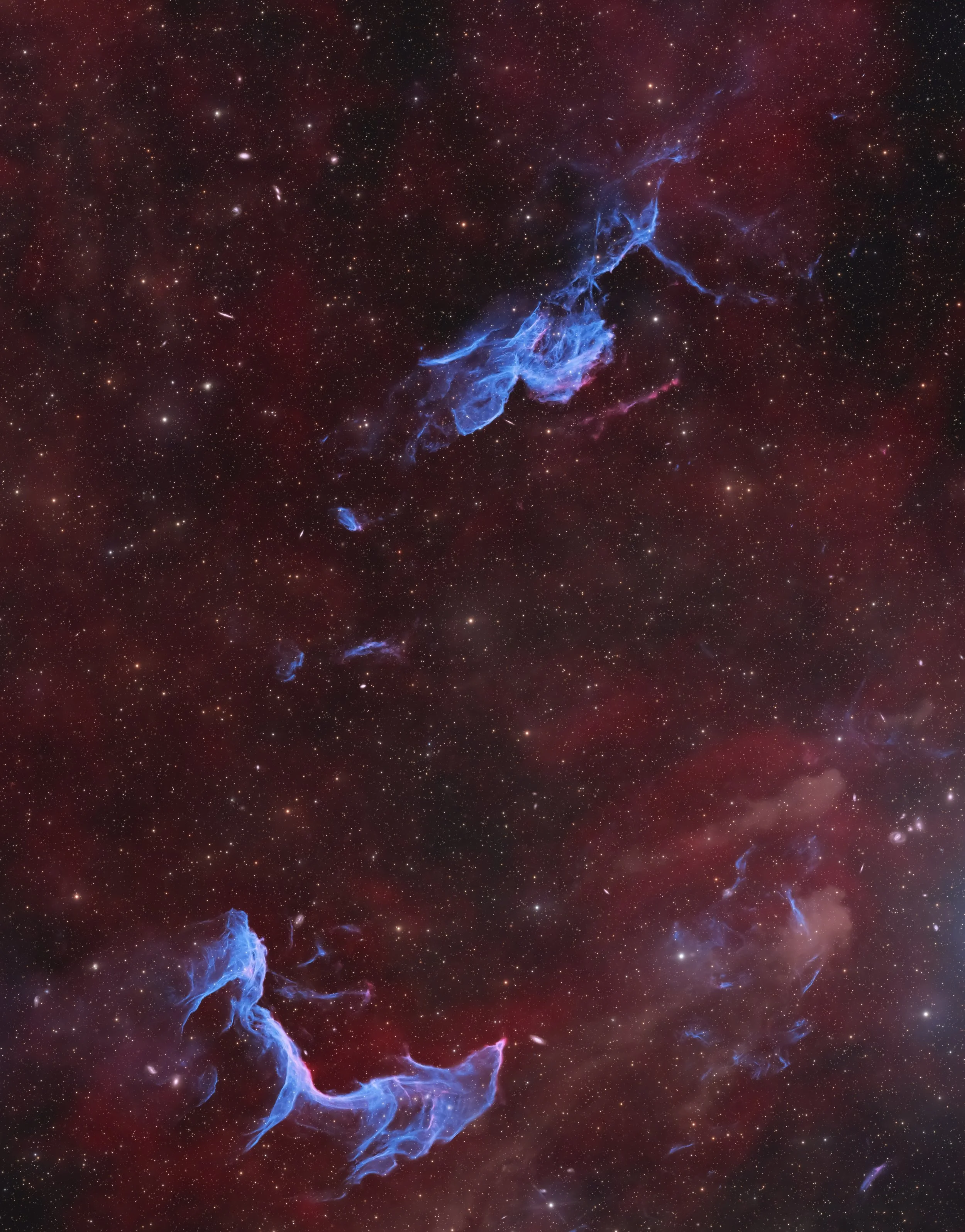
Description and Details: G296.5+10.0, often nicknamed the “Siren Nebula”, is a large and extremely faint supernova remnant located in the southern skies. Shaped by the shockwave of a stellar explosion interacting with the surrounding interstellar medium, its delicate filaments and fragmented shell reveal the violent aftermath of a star that ended its life thousands of years ago.
This image was captured remotely from Deep Sky Chile using an Askar 130SQA refractor, in collaboration with Guillaume Le Mouellic and Eric Tombarel. Beyond the intricate structures of the supernova remnant itself, the field also led to the discovery of a previously unknown planetary nebula, adding an additional layer of scientific and aesthetic interest to this deep southern sky region.
Acquisition details:
* Askar SQA130 refractor
* Pegasus Astro NYX-101 mount
* Player One Astronomy Zeus Mono camera (-20°, Gain 125)
* Antlia Astronomy Filter 50 mm filters
* OIII 3 nm: 21h (130 × 600s)
* Hα 3 nm: 23h (140 × 600s)
* RGB V-Pro: 5h for each channel (60 × 300s each)
The supernova remnant G296.5+10.0 — also known as PKS 1209-51/52 — most likely originated from the explosion of a massive star that underwent gravitational core collapse (“core-collapse supernova”). Current evidence suggests it came from an evolved massive star, probably a red supergiant, or possibly a star that experienced a phase of strongly magnetized stellar winds before exploding.
What makes this object particularly fascinating is that:
it exhibits a very pronounced bilateral structure (“double-shell” appearance),
its magnetic field shows a highly unusual organization,
and it contains a compact central object: 1E 1207.4−5209, a neutron star believed to be the remnant left behind by the explosion.
Radio and polarization studies indicate that:
the remnant is expanding into an environment already shaped by the wind of the progenitor star,
this wind was likely magnetized and rotating,
which could explain the remarkably symmetrical morphology of the remnant.
Current estimates suggest:
a distance of approximately 1.4 to 2.1 kpc (~4,500–7,000 light-years),
and an age of around 14,000 years.
Regarding its exact origin:
it is probably not a thermonuclear Type Ia supernova,
but rather the result of the core-collapse of a massive star.
It is also believed that the magnetic field and stellar winds of the progenitor star prior to the explosion strongly influenced the present appearance of the remnant, making it an excellent laboratory for studying:
the interaction of stellar winds,
galactic magnetic fields,
and the evolution of massive stars before they explode.
For this image, each member of the team produced their own personal processing version, and it was Guillaume Le Mouellic who discovered, while processing his data, the presence of a previously unknown planetary nebula within the wide field of this image.
Copyright: Michael BOUYER
Share & Credit This AAPOD2 Feature
When you share this image on AstroBin, social media, forums, or your own website, please include a credit to AAPOD2 so viewers can discover where this feature came from.
Support AAPOD2 for free! Use Our AGENA ASTRO Affliate Link
AAPOD2 Title: SNR G296.5 + 10.0 and New PN discovery LMoBoTo 1
AAPOD2 Page Link: https://www.aapod2.com/blog/snr-g2965-100-and-new-pn-discovery-lmoboto-1
Submit Your Photo!