
AAPOD2 Image Archives
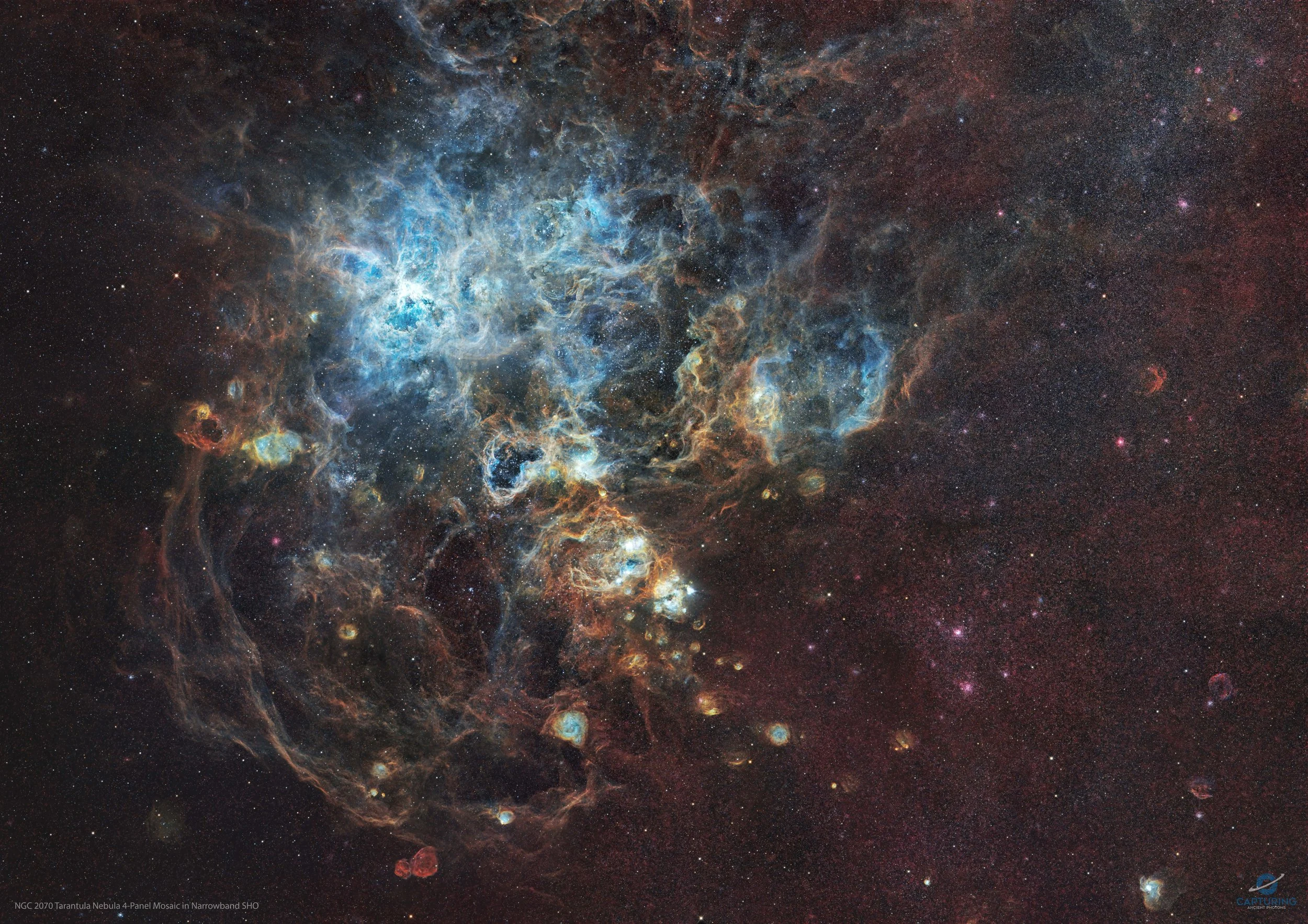
the Tarantula Nebula (NGC 2070, or 30 Doradus)
The Tarantula Nebula, cataloged as NGC 2070 or 30 Doradus, is the most active star forming region in the Local Group. Located in the Large Magellanic Cloud about 160 thousand light years away, it contains immense clouds of ionized hydrogen sculpted by powerful stellar winds and radiation from the massive stars in the central cluster R136. These young stars energize the nebula so intensely that the region outshines entire small galaxies, making it a striking example of how extreme star birth can shape and illuminate the interstellar medium.
Filaments, ridges, and cavities weave throughout the nebula, each tracing the aftermath of past generations of massive stars that have already ended their lives in supernova explosions. Shock fronts from those explosions continue to trigger new waves of star formation, creating a dynamic cycle of collapse and renewal. The Tarantula Nebula offers a rare look at large scale stellar feedback in real time and reveals what conditions may have been like in the early Milky Way when star formation rates were significantly higher.
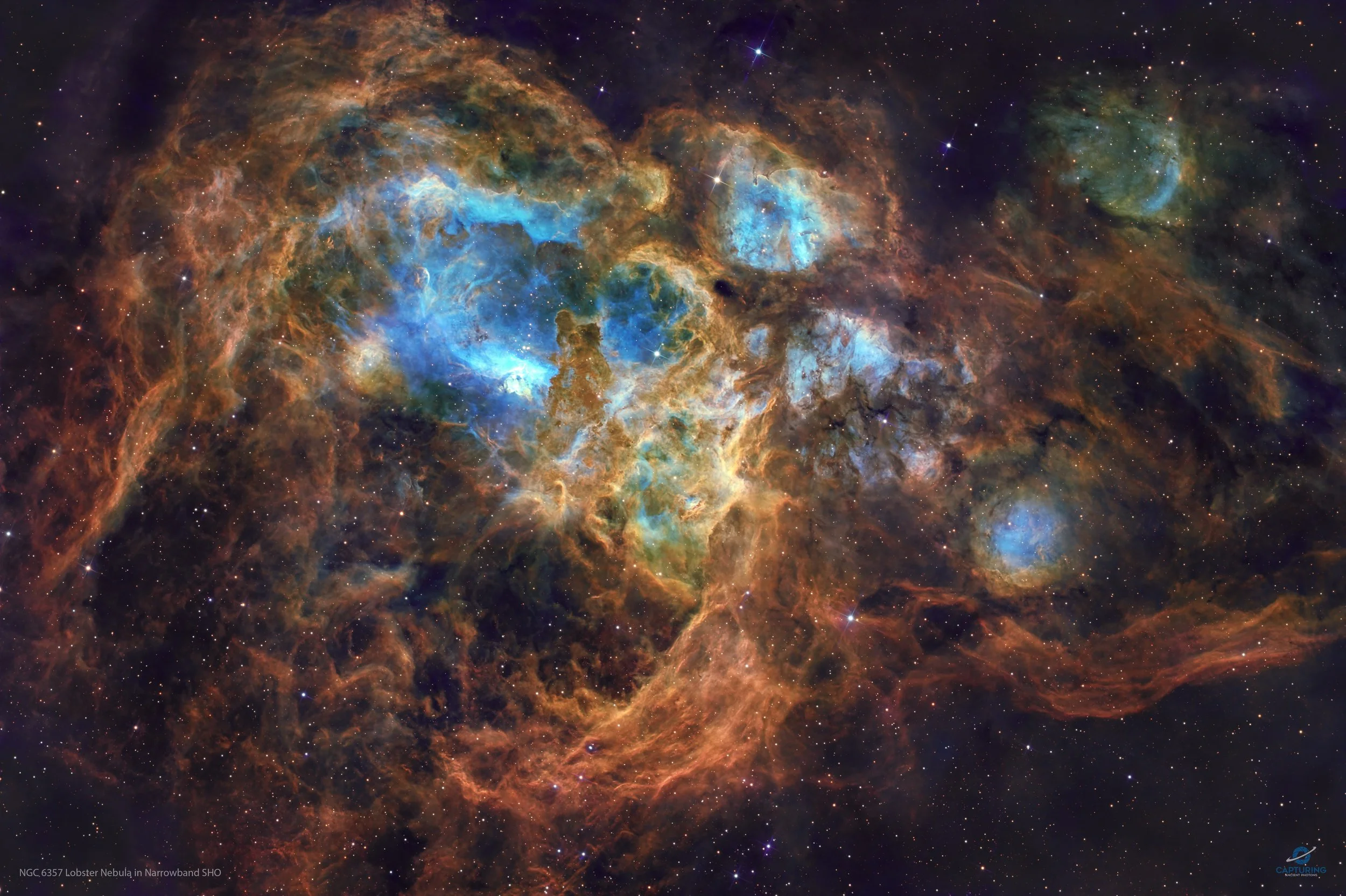
NGC 6357 Lobster Nebula in Narrowband SHO
NGC 6357, the Lobster Nebula, glows with a mix of sculpted ionized gas and newborn stars in the constellation Scorpius. This massive star forming complex contains several young open clusters whose radiation carves the surrounding clouds into intricate cavities and filaments. The brilliant blue regions correspond to doubly ionized oxygen while the warmer gold and copper tones reveal the distributions of hydrogen and sulfur captured in narrowband SHO. These processes highlight the turbulent interplay between stellar winds, radiation pressure, and gravity in one of the Milky Way’s most active nurseries.
Captured from Perth, Western Australia, this field exposes the vast reach of the nebula’s outer tendrils which extend far beyond its bright central cavities. The combination of detailed structure and extreme color contrast gives viewers a clear look at the dynamic environment shaping early stellar evolution. With its dramatic textures and luminous knots, the Lobster Nebula remains one of the most compelling examples of how massive stars reshape the interstellar medium around them.
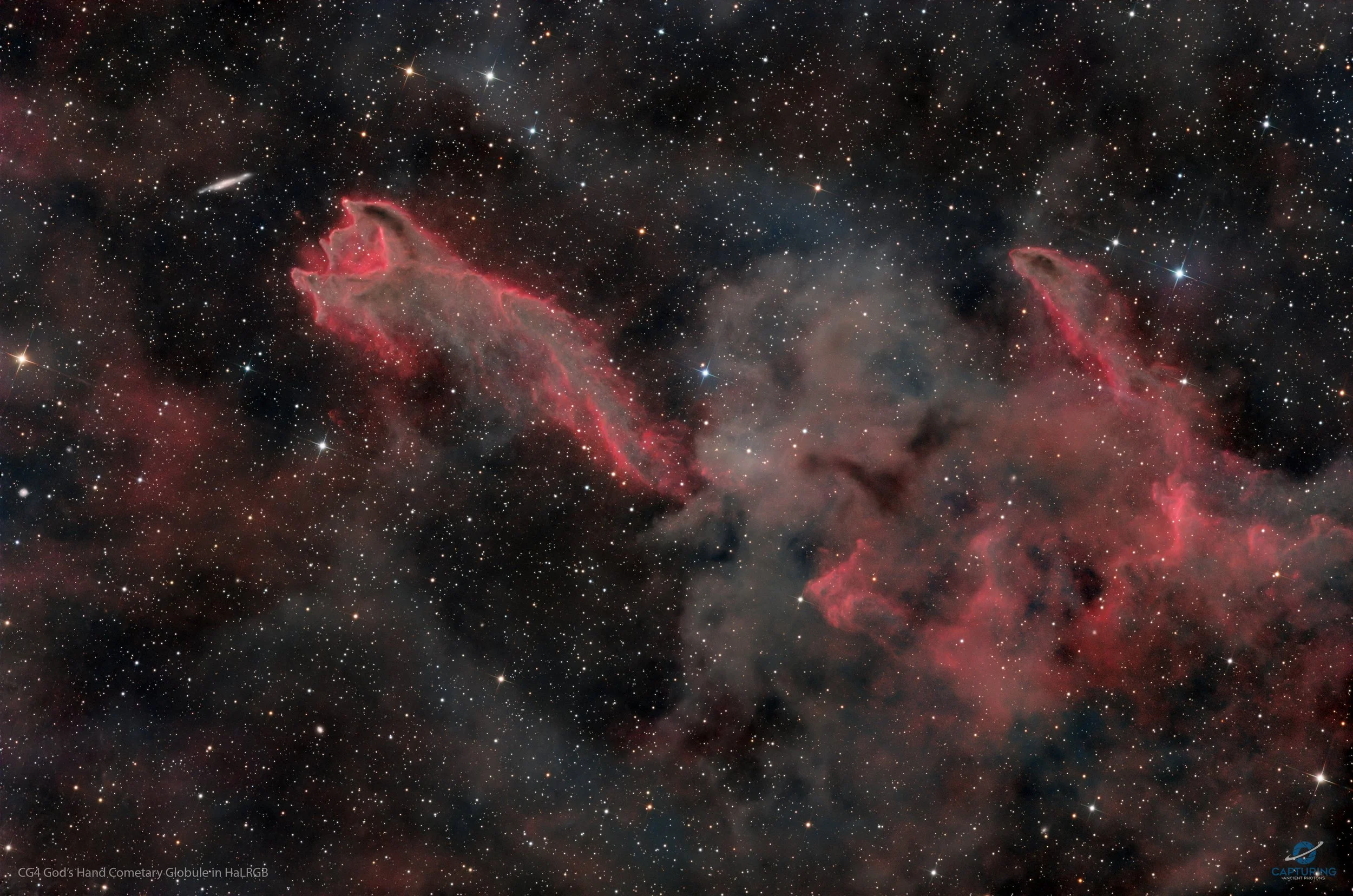
CG4 – The Hand of Creation
In the southern constellation Puppis, about 1,300 light-years away, lies the striking cometary globule CG4, often nicknamed God’s Hand. This peculiar formation of dust and gas appears to reach across space as if grasping toward the small edge-on galaxy seen near its fingertips. The globule’s glowing rim is illuminated by nearby hot stars, while its dense interior—rich in molecular gas—remains dark, concealing the raw material for potential future star formation.
Captured from Perth, Western Australia, this HaLRGB composition reveals the faint red emission of hydrogen gas surrounding the dusty structure. CG4 is part of the broader Gum Nebula complex, a vast region shaped by ancient supernova explosions. Despite its ominous, reaching form, this cosmic hand is a cradle of creation, slowly sculpted by stellar winds and radiation over millions of years.

IC 2169 Dreyer's Nebula in LRGB
IC 2169, often called Dreyer’s Nebula, is a faint reflection nebula nestled within the lesser-known constellation of Monoceros, the Unicorn. This nebula is part of the larger Monoceros R2 molecular cloud complex, a rich region of star formation that stretches across a vast area. Dreyer’s Nebula reflects the light of young, hot stars embedded within the surrounding dark dust, creating a soft glow that varies from blue to subtle shades of gray due to scattered starlight—a characteristic feature of reflection nebulae. Interestingly, IC 2169 lies in close proximity to several other nebulous regions, making it a part of a fascinatingly complex structure in the night sky that requires dark skies and long exposures to fully reveal.
Captured from Perth, Western Australia, a location known for its excellent astronomical seeing conditions, this image benefits from the region's clear skies and minimal light pollution, offering an ideal view of this delicate nebula. Perth’s location in the Southern Hemisphere also provides a unique perspective of celestial objects that are not as easily observable from the Northern Hemisphere, making it a prime location for astrophotography. This nebula’s delicate structure and subtle coloring make it an enchanting subject for astrophotographers aiming to capture fine details in LRGB imaging.
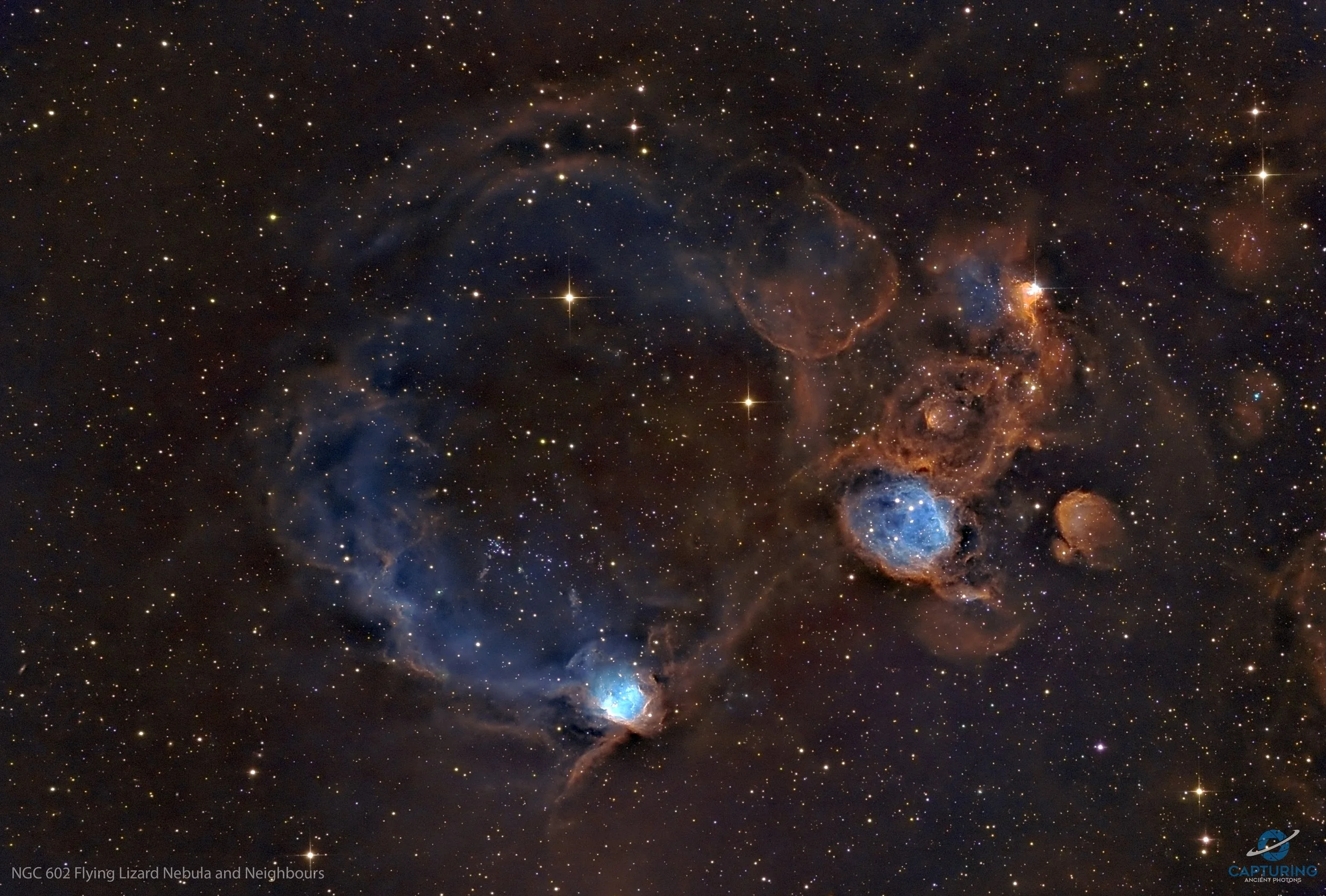
NGC 602 Flying Lizard Nebula and Neighbors
Image Description and Details :
NGC 602 or the Flying Lizard Nebula and its neighbors lie near the outskirts of the Small Magellanic Cloud (SMC) some 200,000 light-years away. 204 x 300s SHO subs shot @-10C spread across 5 nights for a total integration time of about 17hrs Equipment used:Skywatcher 10" f4 Newtonian 250PSkywatcher F4 Aplanatic Coma CorrectorSkywatcher NEQ6 Pro Hypertuned by Astronomy Academy PerthZWO ASI2600MM Pro Cooled CameraPrimaluce Sesto Senso2 Electronic FocuserWilliam Optics Uniguide 50/200mm guidescopeZWO ASI290MM Mini Guide CameraZWO Electronic Filter WheelAntlia Pro 36mm unmounted filtersRollon rolloff modified shed observatoryBortle 5Data acquisition software: NINA Astronomy SoftwareProcessing software: PixInsight and Photoshop CC
Copyright: Capturing Ancient Photons