

AAPOD2 Image Archives
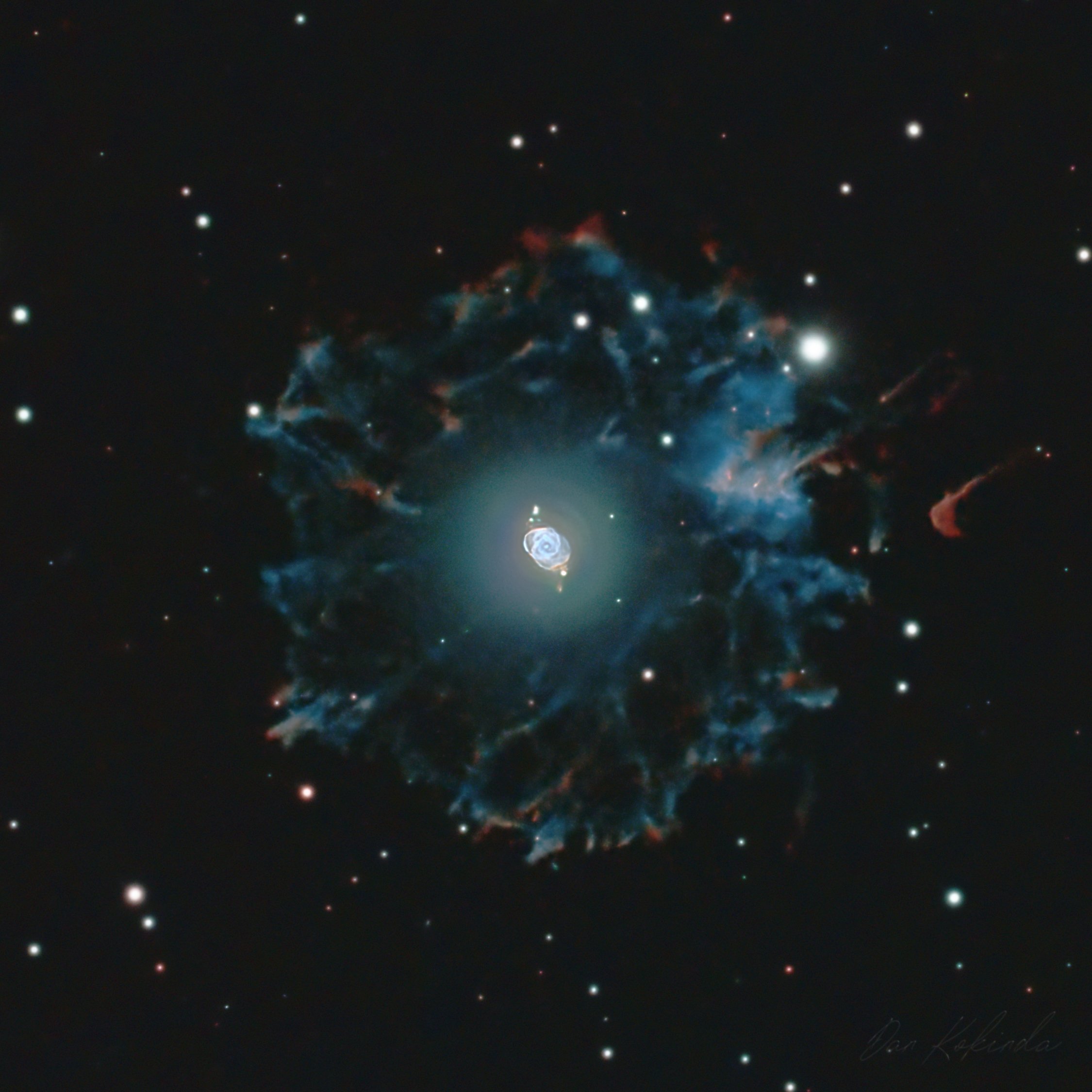
Cat's Eye Nebula
A celestial eye piercing through the cosmic dark. Glistening in the northern constellation of Draco, the Cat's Eye Nebula (NGC 6543) represents one of the most complex planetary nebulae ever discovered. This striking image captures the final, brilliant gasp of a dying solar-mass star shedding its outer layers into space. Photographed by astrophotographer Dan Kokinda over a painstaking 32-hour exposure sequence from Indiana, this remarkable single-exposure-length composition brilliantly balances the blindingly intense, intricate central core with the incredibly faint, surrounding concentric shells of glowing gas.

The Lacerta and the Gecko Nebulae
Sweeping across the constellation Lacerta, this delicate complex of hydrogen emission and faint dust is part of the Sh2-126 region, a large and diffuse nebula illuminated by the ultraviolet radiation of nearby hot stars. The deep red glow is produced by ionized hydrogen, while the pale filaments and soft blue-gray textures trace cooler interstellar dust drifting through the field. These overlapping structures create an intricate tapestry that hints at the slow turbulence shaping the outer layers of our local spiral arm.
Captured from Arcadia, Indiana, this wide field reveals subtle transitions between bright emission, translucent dust, and nearly invisible molecular wisps that are difficult to register under typical midwestern skies. The shapes that resemble a leaping lizard and a curling gecko emerge naturally from the interplay of ionized gas and reflective dust, showing how sculpted and dynamic even faint regions of the Milky Way can be when given enough exposure time and careful processing.

NGC 1333, Barnard 203, Barnard 204: A dusty view of Perseus
Deep in the constellation Perseus, a cosmic tableau unfolds, featuring the star-forming region NGC 1333 and the dark nebulae Barnard 203 and Barnard 204. This stunning view is dominated by rich, dusty filaments that weave through the scene, creating a stark contrast against the faint glow of scattered starlight.
NGC 1333, nestled to the left, teems with youthful stars hidden within veils of gas and dust, their energetic outflows sculpting the surrounding material. Meanwhile, Barnard 203 and 204 cast inky shadows across the image, standing as quiet sentinels in this dynamic environment.
Together, these structures offer a breathtaking glimpse into the interplay of light and shadow, showcasing the raw materials of star formation and the intricate beauty of the cosmos.