

AAPOD2 Image Archives
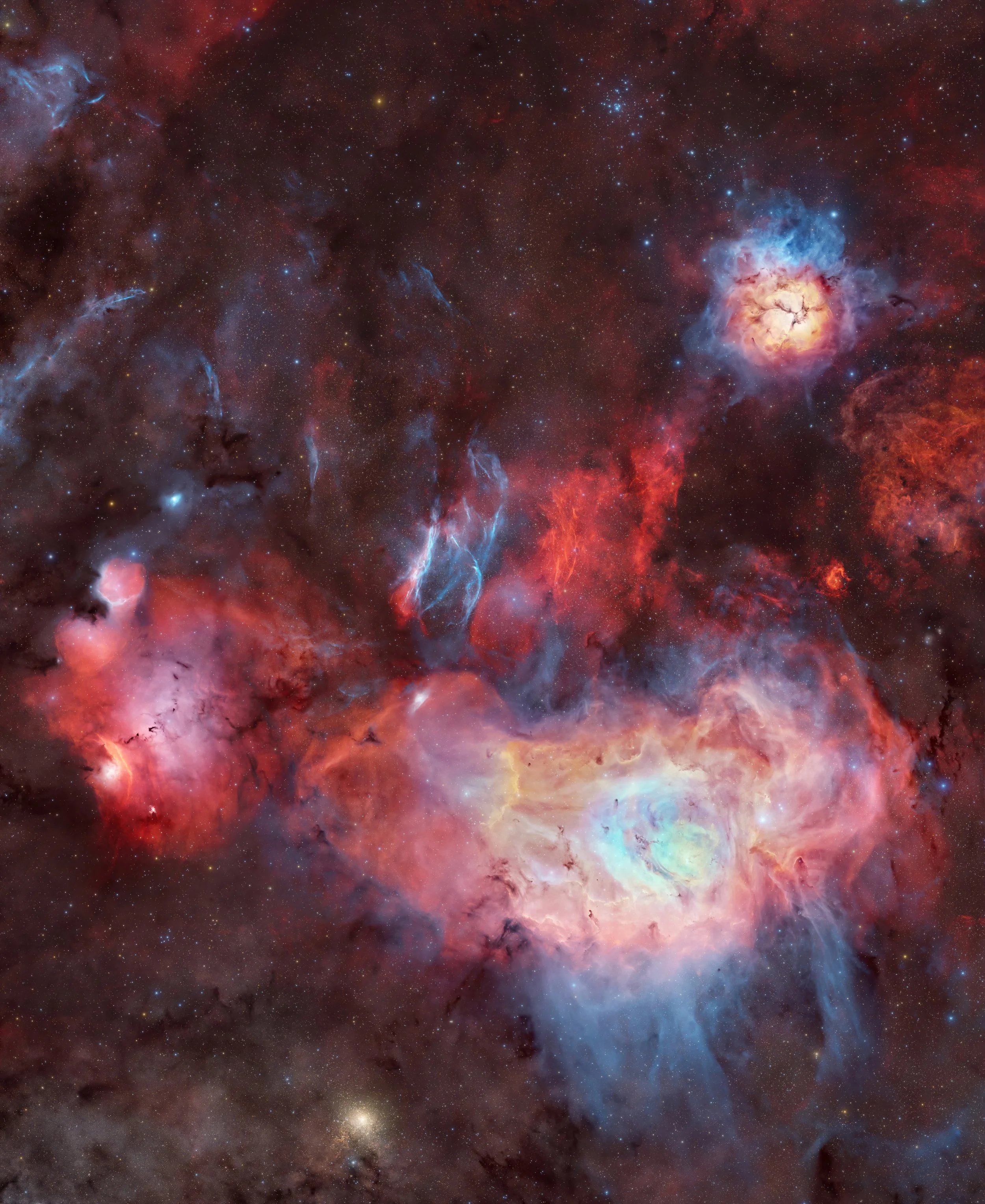
Where Stars Are Born and Die (M8, M20 & SNR G007.5-01.7)
This breathtaking wide-field view brings together two stellar nurseries and the ghost of a dying star. At the bottom right glows the Lagoon Nebula (M8), a massive H II region where new stars form from collapsing clouds of gas and dust. Above it lies the Trifid Nebula (M20), easily recognized by its dark dust lanes that divide its bright blue and red emission. Both regions are among the most active star-forming complexes in the Milky Way, lying some 4,000 to 5,000 light-years away in Sagittarius.
Threaded across the scene are faint, delicate filaments belonging to the supernova remnant SNR G007.5-01.7. Unlike the nebulae forging new suns, these wisps are the expanding remains of a massive star that ended its life in a cataclysmic explosion. This juxtaposition of creation and destruction highlights the cosmic cycle of stellar evolution, where the death of one star enriches the interstellar medium to seed the birth of many more.
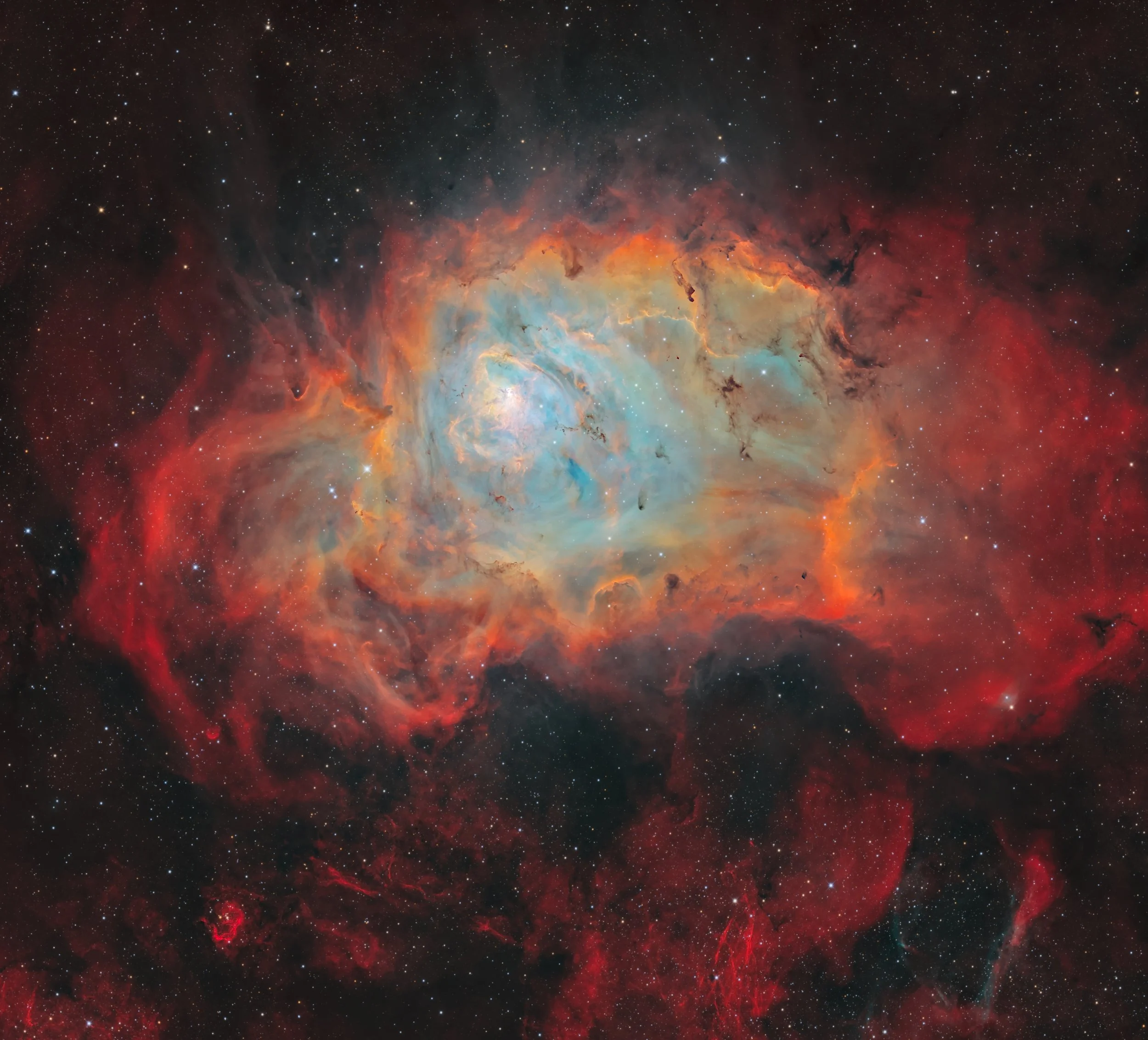
Colors of M8 in SHO: The Lagoon Reimagined
The Lagoon Nebula (Messier 8), a massive star-forming region about 4,000 light-years away in the constellation Sagittarius, comes alive in this striking narrowband SHO palette. Captured from Zapopan, Jalisco, Mexico, the image reinterprets natural colors using mapped emissions from sulfur (SII), hydrogen (Ha), and oxygen (OIII), bringing out fine structures in the gas and complex filaments that are often hidden in visible light views.
At the center, young energetic stars of open cluster NGC 6530 bathe the surrounding nebula in radiation, sculpting clouds and igniting the formation of new stars. The narrowband technique emphasizes the dynamic interplay of stellar winds and ionized gases, transforming this familiar target into a surreal cosmic landscape. The result is a celebration of both scientific precision and visual artistry.

LAGOON NEBULA
Image Description and Details :
Exposition:
30x600 '' with Ha filter (1x1 binning).
24x600 '' with SII filter (2x2 binning).
24x600 '' with OIII filter (2x2 binning).
Equipment: QHY9, TS 65 Quadruplet (f / 6.5), EQ6-R and Lunático autoguiding.
Software: Astrophotography Tools, PHD Guiding 2.6.5, PixInsight 1.8.
Place: Nerpio, Albacete (Spain).
Copyright: ASTROMONOS - ANTONIO SANCHEZ DEL MAZO