

AAPOD2 Image Archives
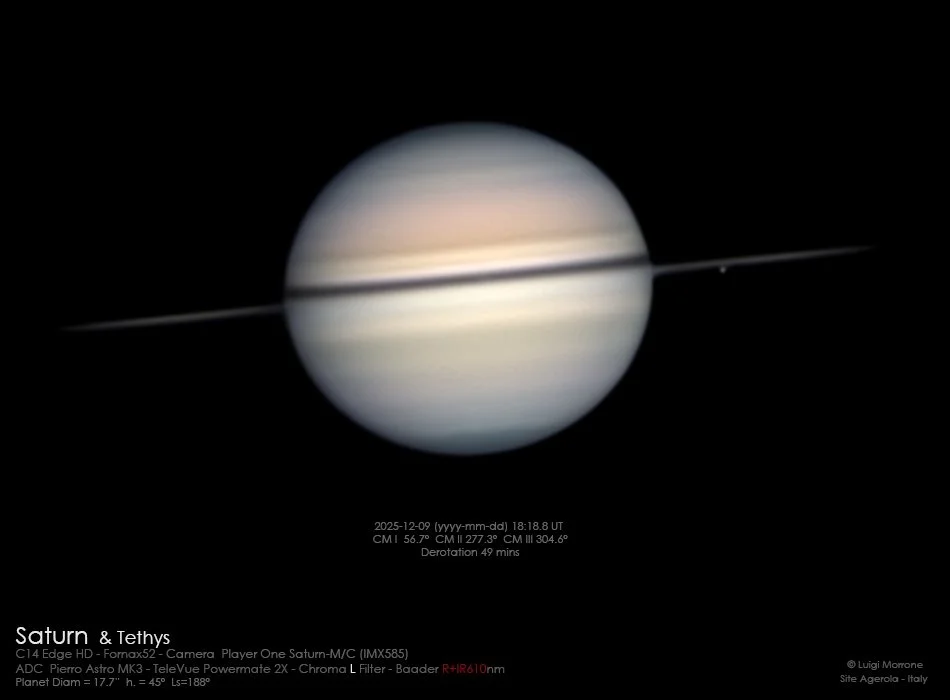
Saturn and Tethys Near Ring Plane
Saturn is captured here under very good seeing conditions, revealing subtle atmospheric banding across the planet’s pale golden disk. At the time of observation, Saturn’s ring system was approaching a ring-plane crossing, causing the normally broad rings to appear exceptionally thin. This geometry emphasizes the dark ring shadow cast across the planet’s equatorial regions, a striking visual marker of the Sun’s low angle relative to the ring plane.
To the right of the planet, the icy moon Tethys appears closely aligned with the narrow rings, creating a compelling sense of depth and scale. With a diameter of about 1,060 kilometers, Tethys orbits Saturn every 1.9 days and is composed largely of water ice. Its proximity to the rings in this view is a line-of-sight effect, but it highlights the intricate and dynamic architecture of the Saturnian system, where moons, rings, and shadows interact in constantly changing configurations.

Saturn and Enceladus under Exceptional Seeing
Captured on the morning of September 18, 2025, this detailed image of Saturn reveals the gas giant at its finest under exceptionally steady skies. Over 75 minutes of data, approximately 70,000 frames, were collected, with the best 30 % stacked and de-rotated to achieve high-resolution clarity.
The icy moon Enceladus appears just to the right of the planet, while Mimas hides behind Saturn’s rings. Subtle atmospheric activity can be seen across the globe, including diffuse bright spots in the southern hemisphere and several storms tracing the equatorial belts. This view captures the dynamism and beauty of Saturn’s ever-changing atmosphere.
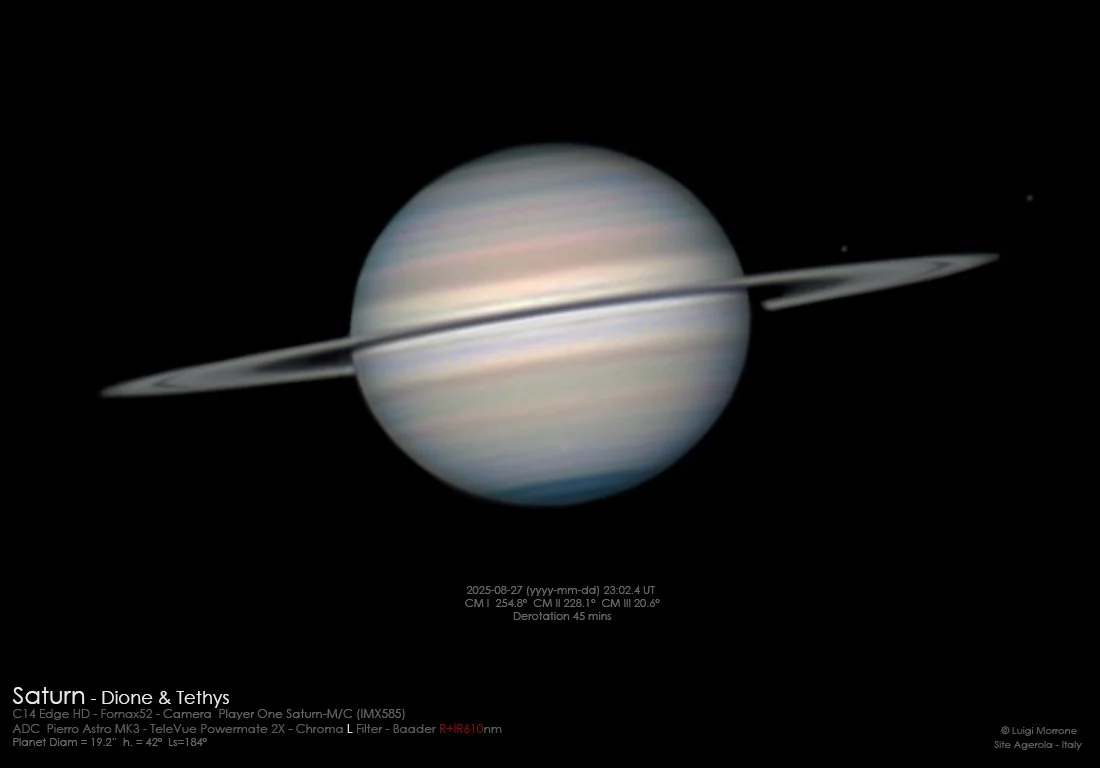
Saturn Dione's & Tethys
Saturn shines here under good seeing conditions, accompanied by its icy moons Dione and Tethys, both visible near the planet’s majestic rings. Careful processing also reveals a diffuse white spot in Saturn’s far southern latitudes. Using WinJupos measurements, the feature is located near System III longitude 20.3° and latitude –49.5°, hinting at atmospheric activity in the gas giant’s turbulent cloud tops.
Captured from Agerola on the Amalfi Coast in Italy, this high-resolution view was made with a C14 Edge HD telescope on a Fornax52 mount, using a Player One Uranus-M/C camera, Chroma L filter, Baader R+IR610, and a 2x Televue Powermate with ADC Pietro Astro MK3. The final image combines LRGB data with detail enhanced from the red and infrared channel.
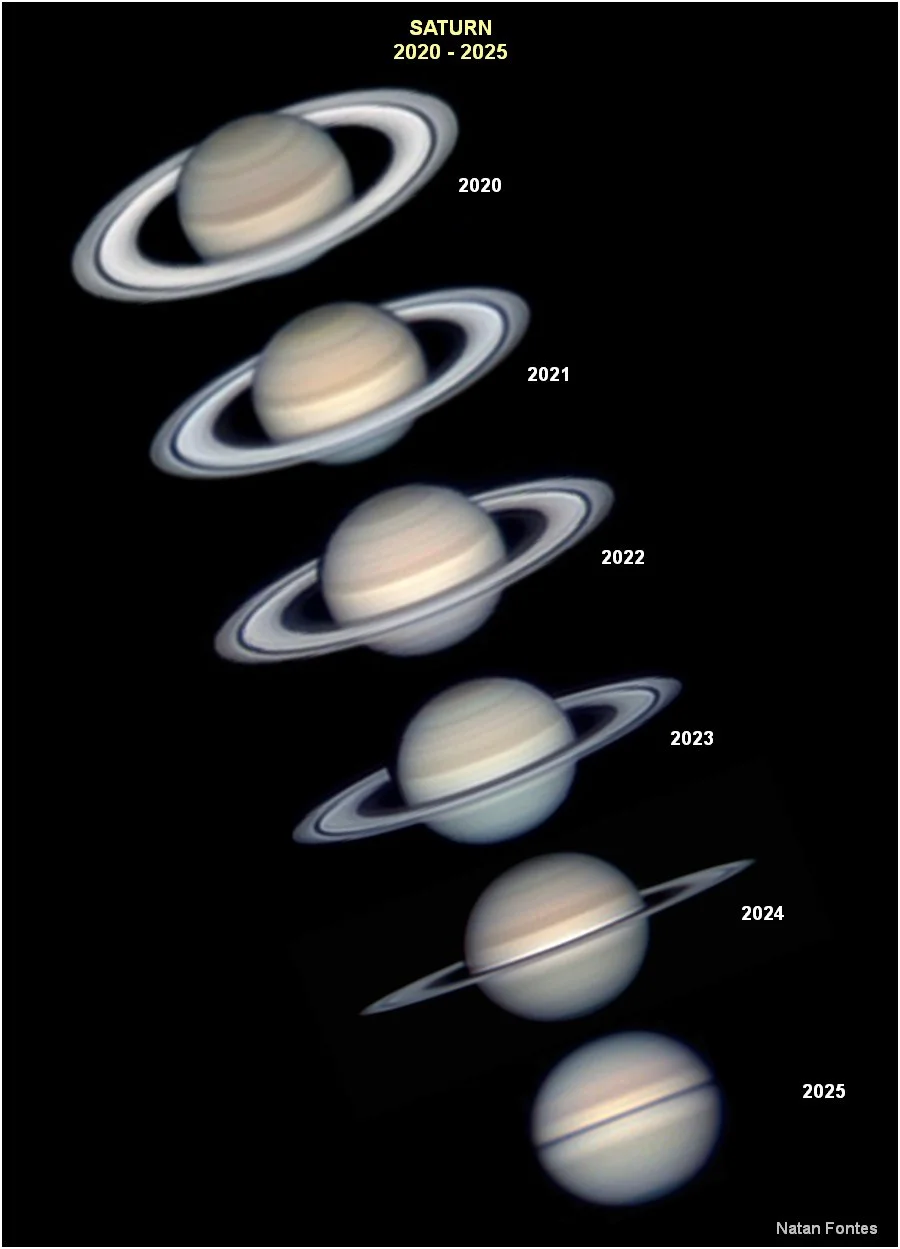
Saturn’s Ring Disappearance — A Dance of Perspective
Between 2020 and 2025, images of Saturn reveal a fascinating celestial ballet: the gradual closing of its iconic rings as seen from Earth. The majestic ring system, usually tilted at a dramatic angle, appears to narrow year by year—an illusion caused by the changing geometry of Saturn’s orbit relative to our line of sight.
By 2025, the rings seem to vanish entirely, aligned nearly edge-on from our perspective. Though still physically present, their thin, flat structure reflects very little light when seen edge-on, rendering them almost invisible through backyard telescopes. These ring plane crossings occur roughly every 15 years, offering a rare opportunity to witness the gas giant in a dramatically different guise.
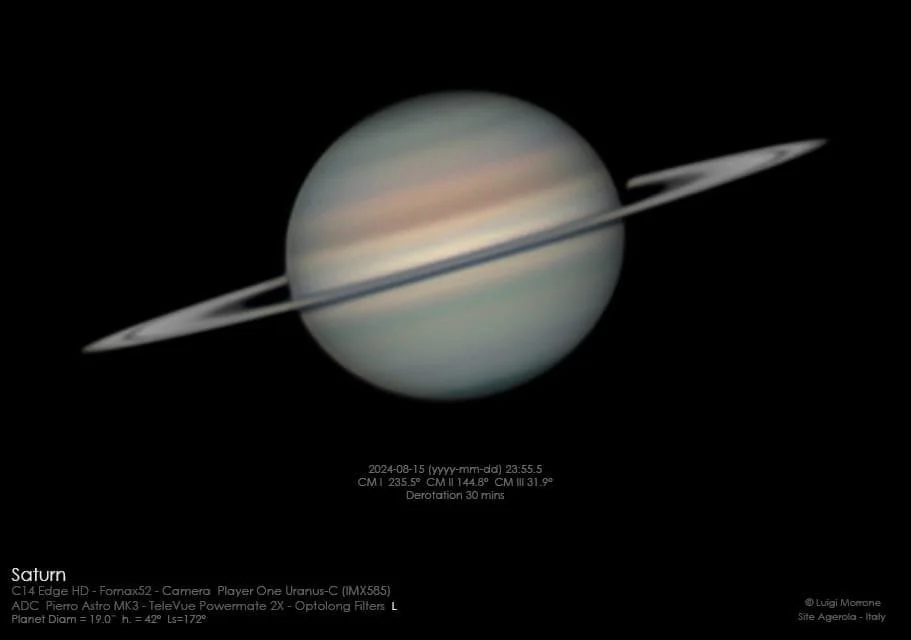

Saturn, Titan & Rhea 16/07/2024 - A magic show in the Sky
This stunning image of Saturn showcases not only the intricate details of the gas giant's rings but also the fascinating dynamics of its moons. You can distinctly see features on Titan, Saturn's largest moon, including some of its surface details. Additionally, the shadow of Rhea is visible transiting across Saturn's disk, adding depth and dimension to the scene.
What makes this image particularly remarkable is the precise moment captured where Titan is transiting within the shadow cast by Saturn's rings. This celestial alignment provides a rare and captivating view, highlighting the intricate dance of Saturn's moons and the complex interplay of light and shadow within this majestic planetary system.

Saturn Tethys & Dione
Saturn's captivating moon system includes Tethys and Dione, two intriguing worlds of icy beauty. Tethys, the fifth-largest moon of Saturn, boasts a diameter of around 1,060 kilometers (660 miles). Named after the Greek Titan Tethys, it features the colossal Odysseus crater, spanning approximately 450 kilometers (280 miles). Tethys is further distinguished by mysterious reddish-brown streaks known as 'tiger stripes' that adorn its surface. Meanwhile, Dione, Saturn's fourth-largest moon, with a diameter of about 1,123 kilometers (698 miles), exhibits striking wispy cliffs, thought to be icy fractures. Discovered by Giovanni Domenico Cassini in 1684 and named after the Titan Dione from Greek mythology, these moons have been the focus of scientific exploration, including missions like Cassini-Huygens, which unraveled their secrets and unveiled their unique features.

Floating beauty
Image Description:
27-8-2021 Moon age: 18.8 days Moon phase: Waning Gibbous LEB - Bortle 7 class -Rig Details: Celestron EdgeHD 9.25 on CGX Baader UV/IR cut filter ZWO asi224mc TV 2.5x powermate SharpCap
Copyright: Omar S. Rajji