
Star Formation and Dust in the Chamaeleon Complex
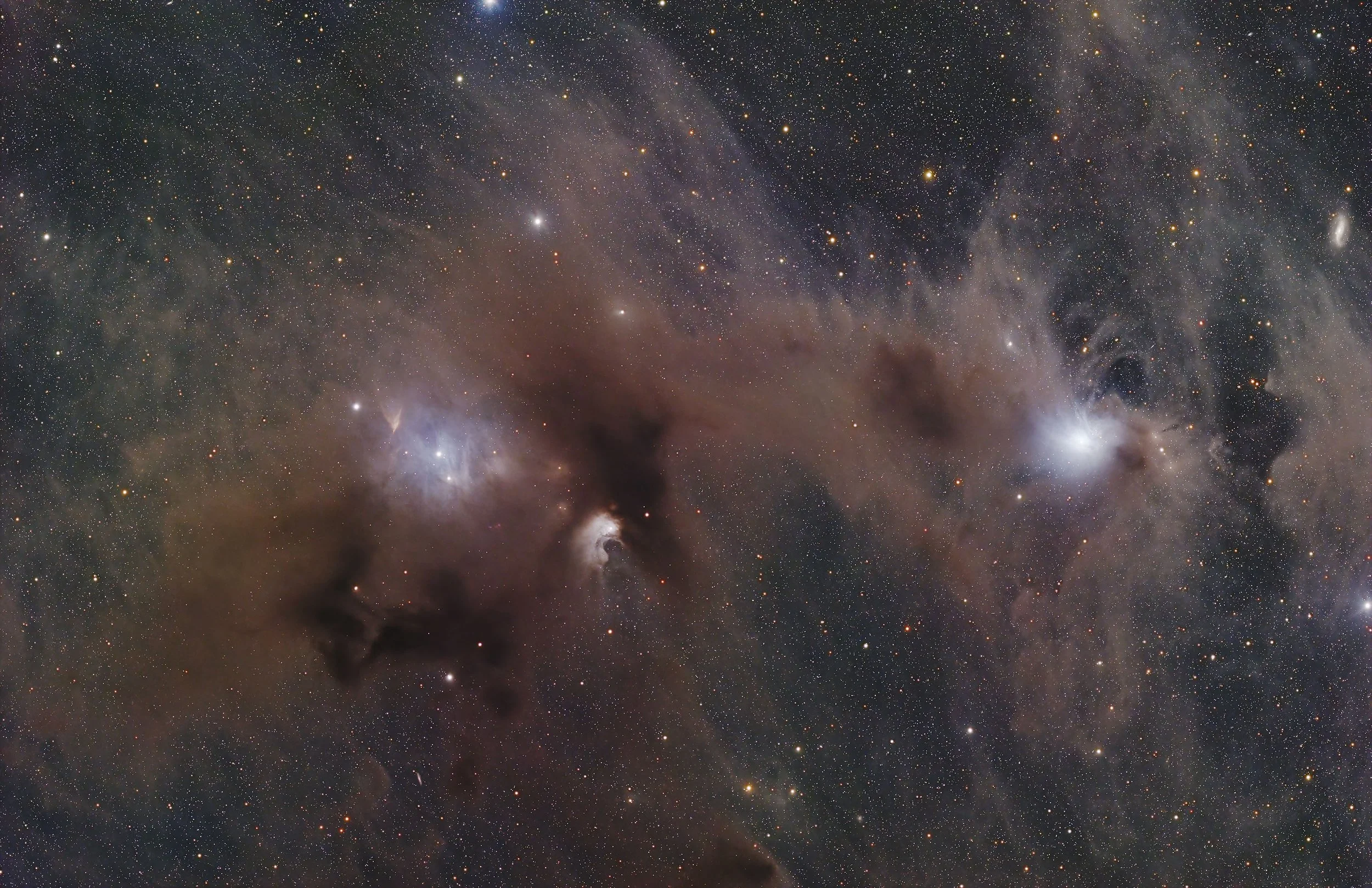
Image Title: Bernes 142 in Chamaeleon complex
Copyright: Copyright: Jean-Yves Beninger
Date image was taken: April 08, 2025
Location: Warrumbungle National Park, Australia
Data Acquisition Method: Personal Telescope Setup
Description and Details: Astro-Physics AP130GTX with QuadTCC 588mm on Mach1 mount.
Camera Zwo ASI2600mm, filtera Antlia L,R,G,B,H,O
L,R,G,B (29, 27. 24, 24) x 300s = 8h 40'
The Chamaeleon Complex is a large, nearby star-forming region located in the southern constellation Chamaeleon. It lies approximately 450 to 650 light-years away from Earth and spans several degrees across the sky. This complex is particularly famous for its dark molecular clouds, young stellar objects and reflection nebulae.
At the extreme right of the image is NGC3620, a barred spiral galaxy, 59 light years distant.
Then to its left is IC 2631, a reflection nebula, illuminated by the massive star HD97300, 630 light years distant.
On the left is Cederblad 111 which shines with a characteristic blue hue, resulting from starlight scattering off fine dust particles. This illumination is primarily due to nearby young stars embedded within the nebula.
Adjacent to Ced 111 are the Herbig-Haro objects HH 49 and HH 50. These are luminous patches formed when narrow jets of gas ejected by newborn stars collide with surrounding interstellar material, creating shock waves that heat the gas and cause it to glow.
Just below Ced 111 is the dark reddish nebula GN 11.07.3, an intriguing feature with no obvious illuminating star.
Name: Jean-Yves Beninger
Website or Facebook Profile: http://www.lesbeninger.com
Share & Credit This AAPOD2 Feature
When you share this image on AstroBin, social media, forums, or your own website, please include a credit to AAPOD2 so viewers can discover where this feature came from.
Support AAPOD2 for free! Use Our AGENA ASTRO Affliate Link
AAPOD2 Title: Star Formation and Dust in the Chamaeleon Complex
AAPOD2 Page Link: https://www.aapod2.com/blog/9pp682r6wnr6n228js2uffego9lns7
Submit Your Photo!