
Jones 1 / PK 104-29.1 HOO
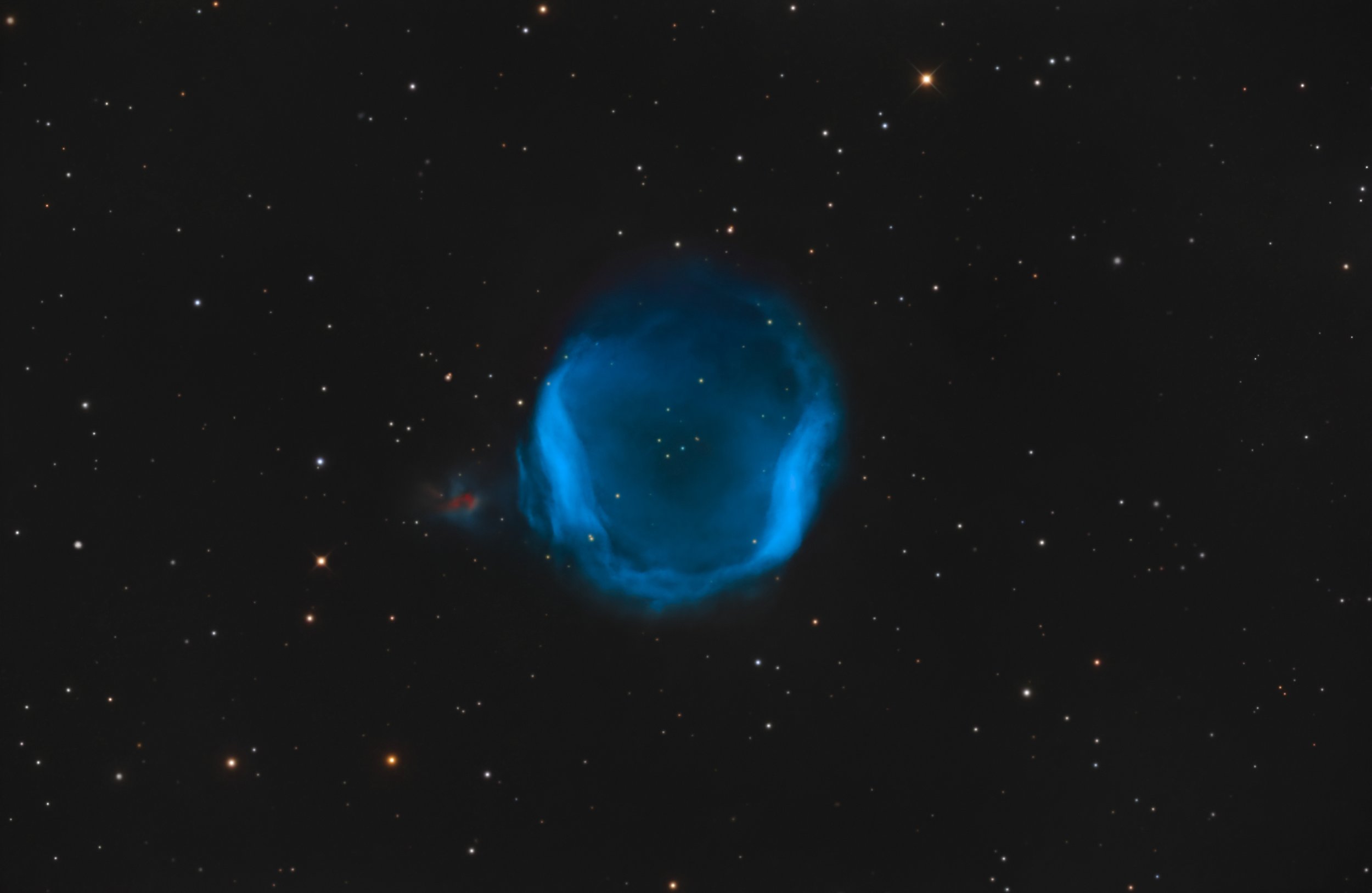
Image Title: Jones 1 / PK 104-29.1 HOO
Copyright: Jose Luis Bedma
Date image was taken: November 27, 2025
Location: Huercal de Almeria, Almeria, España
Data Acquisition Method: Personal Telescope Setup
Description and Details: Exhibitions:
Chroma Blue 36 mm: 25×180.″(1h 15′)
Chroma Green 36 mm: 25×180.″(1h 15′)
Chroma H-alpha 5nm Bandpass 36 mm: 45×300.″(3h 45′)
Chroma OIII 3nm Bandpass 36 mm: 45×300.″(3h 45′)
Chroma Red 36 mm: 25×180.″(1h 15′)
Integration:
11h 15'
Average age of the Moon:
7.62 days
Middle phase of the Moon:
52.46%
A.R. (center): 23h35m53s.5
Dec. (center): +30°28′12″
Pixel scale: 0.389 arcseconds/pixel
Orientation: 279.801 degrees
Field radius: 0.246 degrees
Find images in the same area
Resolution: 3817x2486
File size: 6.5 MB
Location: Huercal de Almeria, Almeria, Spain
Data source: Own remote observatory
Remote source: Independent non-commercial facility
Description
HOO and RGB stars
PK 104-29.1, Jones 1 Nebula is a very faint and extensive planetary nebula.
It is the remnant of a Sun-like star that, at the end of its life, expelled its outer layers. This gas forms a faint, diffuse, almost spherical bubble that slowly expands into space while the remaining stellar core cools and becomes a white dwarf at its center.
Unlike many bright, compact planetary nebulae, Jones 1 is large in apparent size but extremely faint, making it difficult to observe visually and more accessible through long-exposure astronomical photography. It is located a few thousand light-years from Earth.
Something curious and interesting:
It is "ghostly" even to telescopes: Although its apparent diameter in the sky is comparable to or larger than that of the full moon, its surface brightness is so low that it went unnoticed for a long time. It was identified in 1939 by examining photographic plates, not through direct observation.
Studying it helps astronomers understand the final stages of solar-like stars and how the ejected gas enriches the interstellar medium with elements like carbon and oxygen, raw materials for future stars and planets.
Name: Jose Luis Bedmar Rodriguez
Website or Facebook Profile: https://www.astrobin.com/2ekiax/
Share & Credit This AAPOD2 Feature
When you share this image on AstroBin, social media, forums, or your own website, please include a credit to AAPOD2 so viewers can discover where this feature came from.
Support AAPOD2 for free! Use Our AGENA ASTRO Affliate Link
AAPOD2 Title: Jones 1 / PK 104-29.1 HOO
AAPOD2 Page Link: https://www.aapod2.com/blog/jones-1-nebula-pk-104-291-in-hoo
Submit Your Photo!