
The Phoenix rising from its ashes (IC 2177 – The Seagull Nebula)
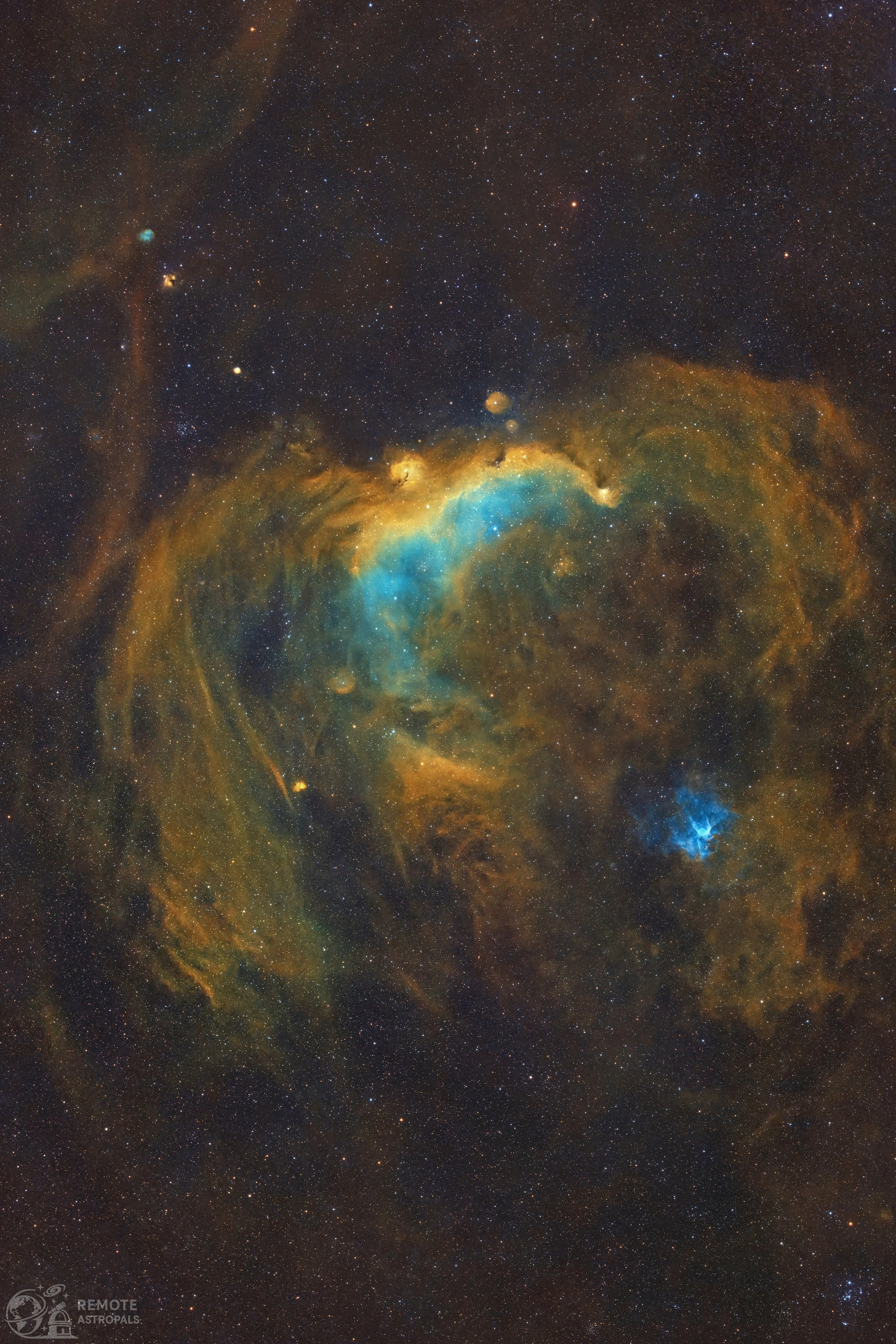
Image Title: The Phoenix rising from its ashes (IC 2177 – The Seagull Nebula)
Copyright: RemoteAstropals
Date image was taken: November 01, 2025
Location: Deep Sky Chile
Data Acquisition Method: Personal Telescope Setup
Description and Details: Remote AstroPals' Project IV – IC 2177, the Seagull Nebula
Participants: Adriano Anfuso, Lino Benz, Massimo Di Fusco, Thiago Gilberto Do Prado, Loïc Hommel, Emma Pezzi, Gowri Visweswaran, Aldo Zanetti.
Remote AstroPals' fourth project turns its attention to IC 2177, the Seagull Nebula, a sprawling H II region on the border between Monoceros and Canis Major. This field combines bright emission nebulosity, reflection regions, and intricate dark dust lanes with several open clusters scattered across the scene – a deceptively delicate but technically demanding target for narrowband imaging.
For this project we used our remote setup at Deep Sky Chile, built around a Takahashi Epsilon 160ED f/3.3 astrograph and a ZWO ASI 6200MM Pro mono camera, riding on a Software Bisque Paramount MX+ mount. Working in SHO narrowband, we assembled a two-panel mosaic with 30 hours of total exposure time, capturing the full sweep of the Seagull’s wings and several nearby clusters in one wide frame.
Each panel was built from 60 × 300 s sub-exposures in SII, Hα, and OIII, repeated for both tiles of the mosaic. At this scale and resolution, the raw data pushed both acquisition and processing to the limit: from precise framing and guiding to maintaining tight focus with the Optec TCF Leo and a carefully tuned narrowband filter set. The PrimaluceLab Eagle 5 Pro computer, together with the Giotto/Alto flat-field system, Ecco environmental sensor and robust power management, kept the system stable during long sequences under the Chilean sky.
Mosaic assembly proved particularly delicate. The Seagull’s wings are defined by very low surface-brightness filaments that blend into the stellar background, and small differences in gradients or colour balance between panels become immediately visible along the overlap. To preserve the faint Hα structures while controlling noise, we calibrated and linear-processed each panel individually before stitching, using the most uniform Hα frame as a reference for alignment and background matching.
Colour mapping was another point of creative discussion. Working in the SHO palette, we experimented with several blends: from a more traditional “Hubble-like” mapping with strong gold–cyan contrast to softer, more pastel interpretations that better reflect the smooth gradients in the wings. In the final composite, we aimed for a balance where Hα outlines the red–orange structure of the head and inner wings, while OIII gently fills the outer regions and SII adds depth to the filaments without overwhelming the star field.
Compared with previous Remote AstroPals projects, this field adds a new challenge: wide-field composition with multiple deep-sky targets. The Seagull itself dominates the frame, but the wide mosaic also includes several open clusters, such as NGC 2323 (Messier 50), NGC 2422 (Messier 47), NGC 2425, NGC 2309, and NGC 2299. Integrating these clusters into the composition without distracting from the main nebula required careful framing and star treatment, especially during the non-linear stretch and star-reduction stages.
The result is an image that feels both structured and organic: the Seagull’s head, with its bright core around HD 53367, anchors the left side of the frame, while the wings arc across the field with delicate filaments and embedded knots of emission. The clusters add small islands of dense starlight, reminding us that we are looking at a busy spiral-arm neighbourhood, not an isolated nebula.
As with earlier projects, data quality from Chile was exceptional, giving every team member the freedom to explore their own processing style: some emphasised the hard, sculpted look of shock fronts and filaments; others preferred a more diffuse, painterly approach highlighting colour transitions and the interplay between gas and stars. These different interpretations ultimately helped refine the final composite, which draws from multiple versions to produce a shared image that is both technically precise and artistically consistent.
Remote AstroPals continues to grow as an international collaboration. With each project, new perspectives and skills join the team, from advanced PixInsight workflows and colour science to scripting and automation. The Seagull Nebula has been a perfect playground for this collective expertise: a field where astrophysics, aesthetics, and patient teamwork come together in equal measure.
We now represent a broad mix of countries and backgrounds, connected by a shared curiosity for the night sky and a taste for ambitious projects that would be difficult to tackle alone. If you enjoy deep-sky imaging, mosaics, and collaborative processing, there is always room for another pair of eyes and another way of seeing the data.
Inside the Seagull Nebula: Wings of Gas, Dust, and Young Stars
The Seagull Nebula is part of a larger star-forming complex on the Monoceros–Canis Major border. The “head” of the bird corresponds to IC 2177, a roughly circular H II region centred on the hot Be-type star HD 53367. This star is around twenty times the mass of the Sun and floods the surrounding gas with ultraviolet radiation, stripping electrons from hydrogen atoms and making the nebula glow strongly in the Hα line. The head region also contains NGC 2327, a compact nebula and embedded cluster that appears as a bright knot in the middle of the bird’s head.
Stretching away from the head are the Seagull’s “wings”, catalogued primarily as Sharpless 2-296. These are long, faint filaments of ionised gas threaded with cold dust. In natural-colour or RGB images, the wings appear deep red due to hydrogen emission, with subtle bluish patches where starlight is scattered by dust. In our narrowband SHO rendering, hydrogen, oxygen, and sulphur are separated into different channels and recombined, making it easier to bring out fine structure in the filaments and shock fronts.
Dust plays a key role in the texture of the scene. Dense dust lanes carve dark channels through the nebula, blocking background starlight and outlining the bird-like shape. Elsewhere, finer dust grains produce a soft blue glow as they preferentially scatter shorter-wavelength light from nearby hot stars. The physics is classic interstellar medium: a mix of emission nebulosity from ionised gas, reflection nebulosity from dust, and dark nebulae where the dust column is thick enough to become opaque at visible wavelengths.
The Seagull Nebula is not just gas and dust; it is also home to a rich young stellar population. The region belongs to the Canis Major OB1 association, a loose grouping of massive O- and B-type stars. These hot, luminous stars are short-lived by stellar standards, living only a few million years before ending their lives as supernovae. Around them, lower-mass stars are forming in clusters and small groups, some still deeply embedded and visible only in infrared or radio observations.
Recent studies of the broader CMa OB1 region suggest that the Seagull Nebula sits on the rim of a large shell or bubble in the interstellar medium. This shell appears to have been carved out by multiple past supernova explosions from an earlier generation of massive stars. As those stars died, their expanding shockwaves swept up gas into a giant arc, compressing parts of it enough to trigger a new wave of star formation. Some of the youngest knots of emission in the wings, along with nearby compact regions such as Sharpless 2-297, may be direct products of this triggered star formation.
The dynamical picture is supported by the presence of runaway stars in the area – massive stars moving at unusually high speeds, likely kicked out of their birth clusters by gravitational encounters or supernova explosions. In wide-field images, one of these stars produces a distinctive bow shock near the Seagull’s wing, a curved arc where the stellar wind ploughs into the surrounding gas. These details remind us that the nebula is not static: it is being continuously shaped and eroded by stellar feedback.
Open Clusters in the Field
One of the pleasures of imaging the Seagull Nebula at this scale is the number of open clusters that share the field. The most prominent is NGC 2323 (Messier 50), a bright open cluster in Monoceros often described as heart-shaped. Sitting roughly 3,000 light-years away and shining at magnitude ~5.9, M 50 is rich in blue-white stars with a sprinkling of warmer, evolved members. In the image it appears as a tight concentration of stars, a stellar island just off the nebulous structures.
Further across the frame, towards the Puppis side of the sky, lies NGC 2422 (Messier 47), a near-naked-eye open cluster about 1,600 light-years from Earth. M 47 is coarse but bright, spanning roughly half a degree with a population of young stars that stand out clearly even in relatively short exposures. Nearby in projection is NGC 2425, a much more distant and older cluster that appears as a subtler, denser knot of faint stars. The contrast between these clusters – one bright and nearby, the other faint and remote – adds depth to the composition.
Closer to the main body of the Seagull, two additional Monoceros clusters, NGC 2309 and NGC 2299, contribute to the feeling of a busy spiral arm. NGC 2309 is a relatively young open cluster several thousand light-years away, compact but rich in stars. NGC 2299 is smaller and fainter, but still noticeable as an overdensity within the broader star field. Together with M 50, these clusters trace the stellar backbone of the region, while the Seagull’s gas and dust reveal where new generations of stars are forming.
Looking Ahead: Evolution and Future of the Seagull
Over the next few million years, the Seagull Nebula will continue to evolve. Massive stars like HD 53367 will eventually exhaust their nuclear fuel and explode as supernovae, injecting fresh energy and heavy elements into the surrounding medium. Their shockwaves will further disrupt the existing gas, potentially compressing some regions into new dense cores while dispersing others into the wider galactic environment. Gradually, as the remaining gas is converted into stars or blown away, the bright emission will fade.
What will remain is a loose association of young stars and clusters – objects like M 50, NGC 2309, NGC 2299 and more recently formed groups within the nebula itself. These stars will slowly drift apart under the influence of the Galaxy’s gravitational field, losing the neat outlines we see today. The Seagull as a recognisable nebula is therefore a transient phase, a snapshot in a much longer story of stellar birth and dispersal in the Milky Way’s spiral arms.
How to Find and Observe IC 2177
To track down the Seagull Nebula in the sky, start with something obvious: Sirius, the brightest star in Canis Major. From Sirius, sweep a few degrees east and slightly north into Monoceros; the Seagull Nebula lies in this area, close to the border between the two constellations. The head region (IC 2177) is centred near right ascension 07h 04m and declination –10°, but because the nebula is so large, low magnification and a wide field are essential for visual work.
For observers at mid-northern latitudes, the Seagull is a winter object, best placed from about December to February when Monoceros and Canis Major ride highest in the southern sky during the late evening. From more southerly sites it climbs higher and becomes easier to observe; from the far south it passes almost overhead in the summer months. A dark sky is critical: even with a nebula filter, only the brightest parts of the head and inner wings are within reach visually, and the full bird shape is more a photographic subject than an eyepiece showpiece.
Astrophotographers will find that short focal lengths work best. A fast wide-field astrograph or telephoto lens will comfortably frame the entire Seagull and the nearby open clusters in a single shot. Narrowband imaging is especially powerful here: Hα emphasises the wings and head, OIII brings out subtle structures and shock fronts, and SII adds tonal variety to the filaments. Long total integration – many hours spread over several nights – is the key to revealing the faint outer wings and the fine dust structures that give the nebula its feathery appearance.
Whether seen visually as a barely perceptible glow near Sirius or as a fully developed SHO mosaic full of structure and colour, the Seagull Nebula offers a beautiful example of a star-forming region in action. It links together everything that makes deep-sky observing so compelling: the physics of gas and dust, the drama of massive stars, the subtlety of low surface brightness features, and the joy of capturing a fleeting galactic moment from our small planet.
Name: Remote Astropals
Website or Facebook Profile: https://app.astrobin.com/u/Gmadkat?i=2wybmf#gallery
Share & Credit This AAPOD2 Feature
When you share this image on AstroBin, social media, forums, or your own website, please include a credit to AAPOD2 so viewers can discover where this feature came from.
Support AAPOD2 for free! Use Our AGENA ASTRO Affliate Link
AAPOD2 Title: The Phoenix rising from its ashes (IC 2177 – The Seagull Nebula)
AAPOD2 Page Link: https://www.aapod2.com/blog/the-phoenix-rising-from-its-ashes-ic-2177-the-seagull-nebula
Submit Your Photo!