M20
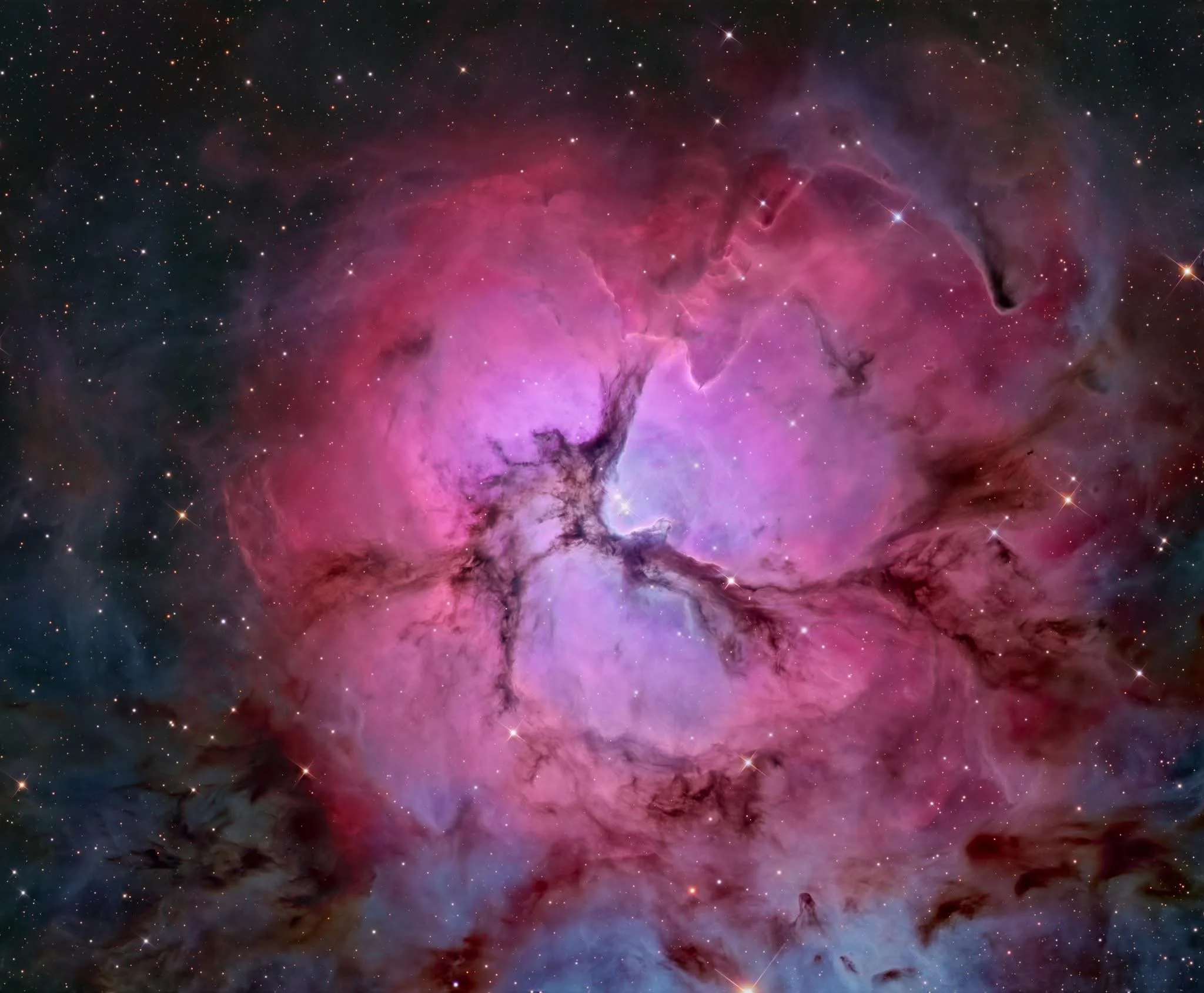
A three-faced nebula — emission, reflection, and dark dust woven into a single stellar nursery
Messier 20, the Trifid Nebula (NGC 6514, Sharpless 30), is an H II region and embedded young stellar cluster in the constellation Sagittarius, lying within the Sagittarius–Carina Arm of the Milky Way along one of the richest star-forming corridors visible from Earth — as one of the most iconic and frequently imaged deep-sky objects in the southern sky, M20 is rarely seen at this scale, and the 9000 mm focal length of the ASA Astrosysteme AZ 1500 brings the nebula into close range, resolving the fine structure of the dust lanes, the texture of the ionisation fronts, and the embedded detail within the bright central cavity that wider-field treatments cannot reach
The nebula lies at an approximate distance of 4,100 light-years, with literature values spanning roughly 2,700 to 5,200 light-years owing to the difficulty of reddening corrections through the dense Sagittarius foreground — its apparent angular size is approximately 28′, corresponding to a physical extent on the order of 40 light-years across the visible emission complex, with an integrated visual magnitude of approximately 6,3
The ionised emission lobes are powered principally by HD 164492A, an O7,5 III star of more than twenty solar masses, the dominant member of a multiple system embedded at the convergence of the dark dust lanes near the geometric centre of the nebula — its ultraviolet output excites the surrounding hydrogen, producing the dominant Hα emission, while OIII traces the hotter inner ionised cavity nearest the exciting cluster — the three-lobed appearance is the signature of Barnard 85, a foreground absorbing dust complex whose lanes silhouette the bright H II region into the divided form for which the nebula was named by John Herschel — the cooler reflection nebula visible toward the southern portion of the field, illuminated by the B-type star HD 164514, is composed of dust scattering blue starlight rather than emitting in its own right, and the cometary globules and bright-rimmed pillars along the periphery mark sites where the O-star radiation field is eroding and compressing the surrounding molecular cloud
The Trifid is one of the youngest known star-forming regions in the local Galaxy, with an estimated age of only a few hundred thousand years — infrared imaging from the Spitzer Space Telescope has revealed more than thirty embryonic protostars and over a hundred newly formed stars deeply embedded in the dust, hidden entirely from optical view, and Hubble observations have resolved evaporating gaseous globules and a stellar jet emerging from a young stellar object near the eastern lobe, evidence of ongoing triggered star formation as ionisation fronts driven by the central O stars compress nearby cloud cores and induce gravitational collapse — the nebula thus offers a simultaneous view of three distinct nebular phenomena — emission, reflection, and absorption — co-located within a single active stellar nursery
Imaged in LRGB, Hα, and OIII on the ASA Astrosysteme AZ 1500,
Camera Moravian C5A 150M, at Observatorio El Sauce, Chile
Image Acquisition Mike Selby and Wolfgang Promper, Processing: Mike Selby
Share & Credit This AAPOD2 Feature
When you share this image on AstroBin, social media, forums, or your own website, please include a credit to AAPOD2 so viewers can discover where this feature came from.
Support AAPOD2 for free! Use Our AGENA ASTRO Affliate Link
AAPOD2 Title: M20
AAPOD2 Page Link: https://www.aapod2.com/blog/m20-1
Submit Your Photo!