
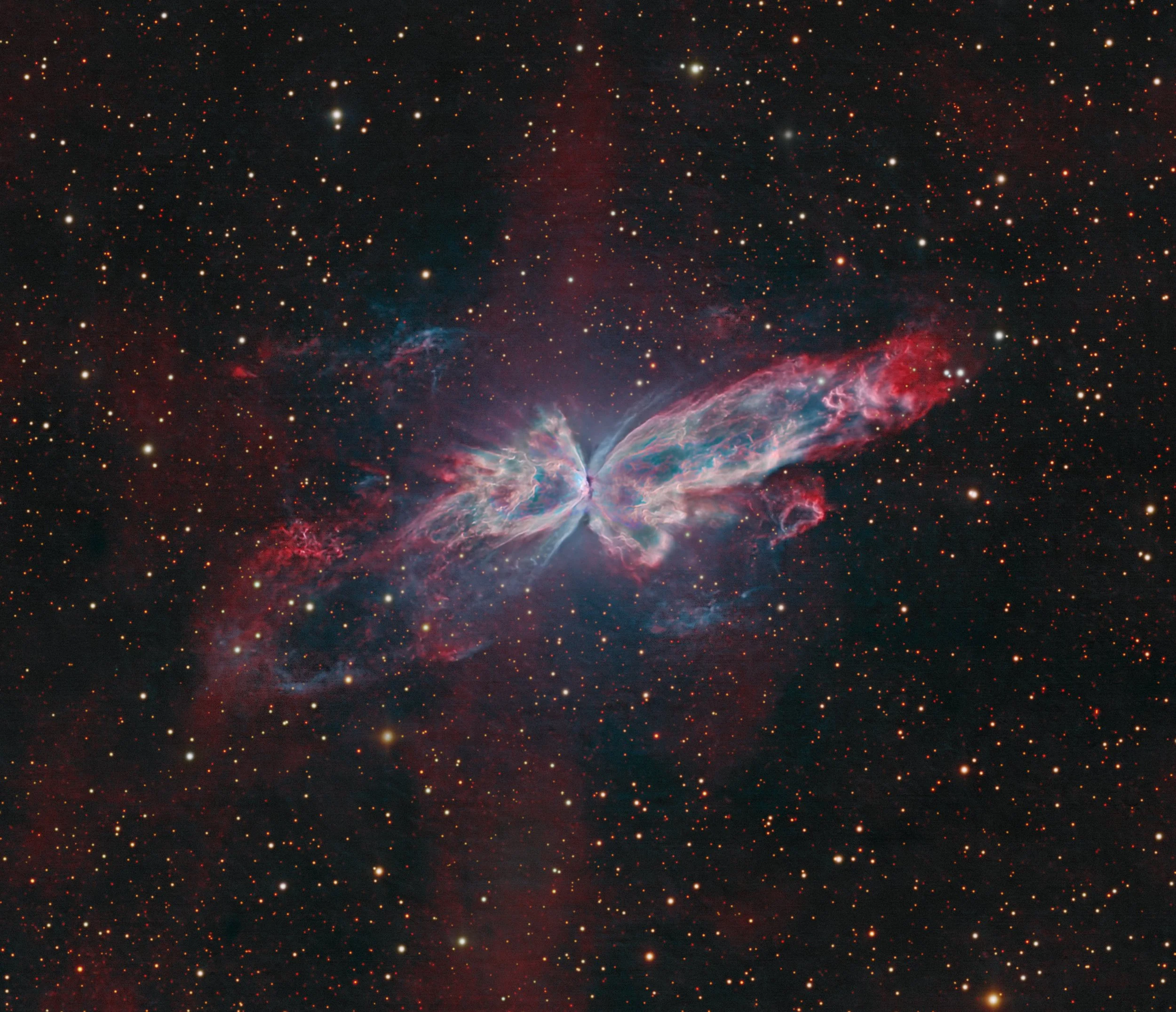
Image Title: NGC 6302
Copyright: Mike Selby
Date image was taken: May 30, 2025
Location: Observatorio El Sauce, Chile
Data Acquisition Method: Personal Telescope Setup
Description and Details: A dying star spreads its wings—NGC 6302, the Butterfly Nebula, shines in the colors of its own unraveling.
Shaped like a vast, glowing butterfly with outstretched wings, NGC 6302, also known as the Butterfly Nebula, is a spectacular bipolar planetary nebula located about 3,400 light-years away in the constellation Scorpius. It spans an incredible 3 light-years from tip to tip, formed from the outer layers of a once Sun-like star violently expelled into space.
The twin lobes arc outward with exquisite complexity—streamers, filaments, and turbulent shock fronts sculpt the structure into one of the most intricate and dynamic planetary nebulae known. The gas glows in vivid shades of Hydrogen-alpha and doubly ionized oxygen (OIII), revealing the layered composition of the stellar ejecta. A dark equatorial dust lane slices through the center, obscuring the dying star at the core and giving the nebula its distinctive butterfly shape.
Hidden behind that dust lane is a white dwarf with a surface temperature exceeding 200,000°C—one of the hottest known. Though invisible in optical wavelengths, its fierce ultraviolet radiation ionizes the surrounding gas, causing it to fluoresce in brilliant reds and electric blues.
NGC 6302 is not just visually dramatic—it is also physically extreme. Its lobes have been hurled outward at speeds approaching 600,000 km/h, shaped perhaps by strong magnetic fields or the gravitational influence of a binary companion.
Planetary nebulae like this one represent a brief but spectacular final act in the lives of intermediate-mass stars. NGC 6302 offers a luminous glimpse into our Sun’s distant future: a moment of explosive beauty before fading into cosmic silence.
Camera Moravian C5A 100, filters Chroma, exposure L 9 hours, Ha and OIII 13 hours each, RGB 8 hours per channel. OTA CDK 1000.
Name: Michael Selby
Website or Facebook Profile: https://throughlightandtime.com