
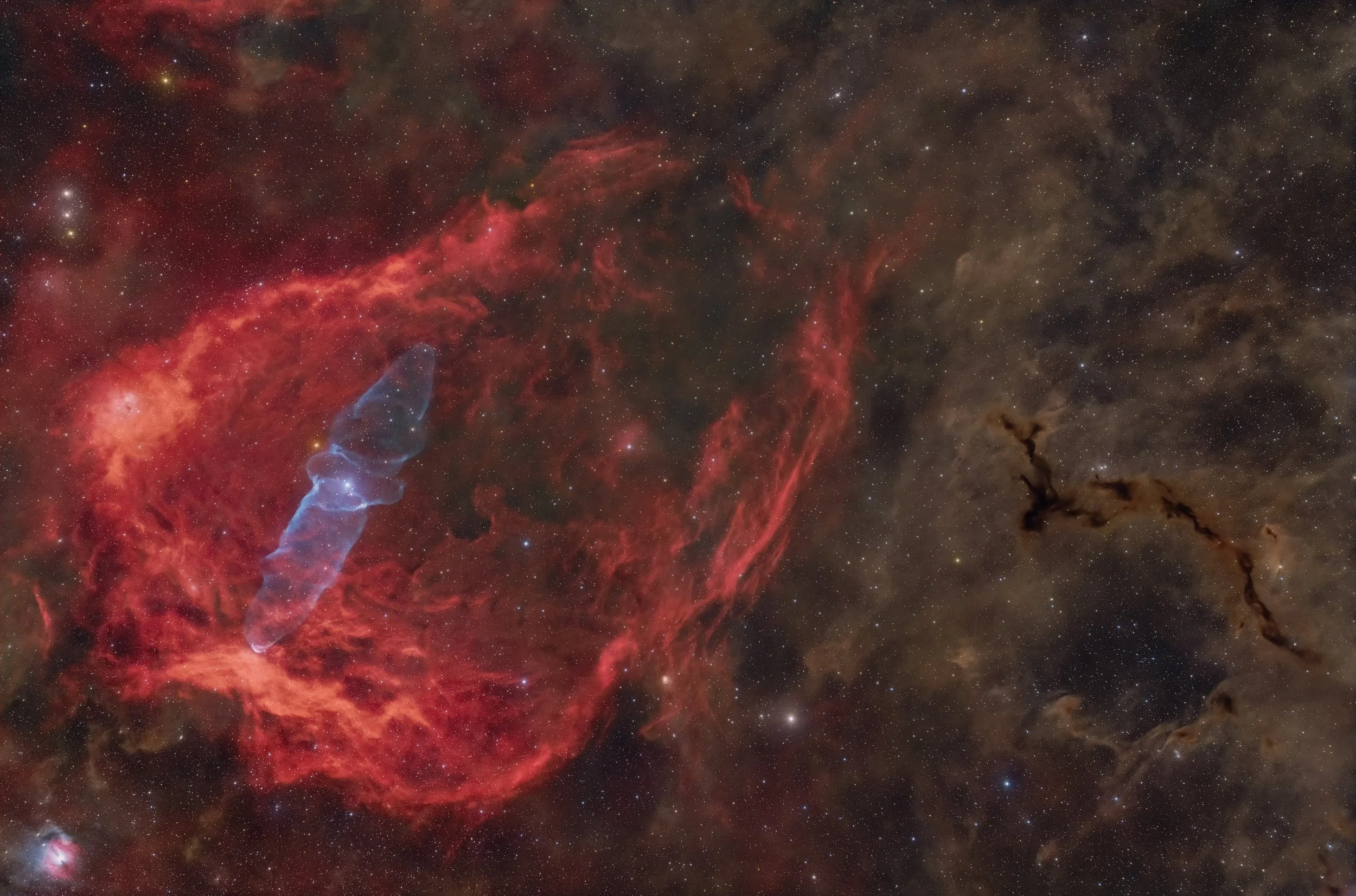
Image Title: When the Wings Meet the Waves: A celestial encounter of the Flying Bat (Sh2-129), the Squid (Ou4) and the Seahorse (Barnard 150)
Copyright: Olympus Mons (Julien De Winter)
Date image was taken: May 24, 2025
Location: Hawk observatory, Oukaïmeden, Morocco
Data Acquisition Method: Other
Description and Details: For several months now, our astronomy club "Olympus Mons," affiliated with the University of Mons (Belgium), has had a setup installed in the Atlas Mountains of Morocco.
Today, we take you to the constellation Cepheus, to explore a fascinating celestial landscape where Earth and Sea seem to meet — at least in appearance. This region is particularly rich in dark and emission nebulae, offering a striking contrast between shadow and light.
At the heart of this image are several iconic objects, each located at impressive distances from Earth:
Barnard 150, also known as the Seahorse Nebula, is a dark nebula located approximately 1,200 light-years away. This column of interstellar dust stands out in silhouette, blocking the starlight behind it. It is also an active star-forming region, where young stars remain deeply embedded in their dusty cocoons.
The Flying Bat Nebula (Sh2-129) lies about 1,300 light-years from us. This large emission nebula, dominated by ionized hydrogen, spans several light-years and reveals delicate, filamentary structures.
Nestled within its glowing red wings is the Squid Nebula (Ou4), an extremely faint bipolar nebula, visible mainly in OIII (doubly ionized oxygen). Its distance is estimated between 2,300 and 2,700 light-years. Its shape resembles a cosmic squid gliding through the hydrogen sea of the Flying Bat.
LBN 446 completes this celestial tableau. It is a reflection nebula interwoven with faint dust structures, located about 1,200 light-years away. It adds a soft, bluish glow to the region, enhancing the feeling of drifting through an ocean of interstellar matter.
Thanks to our setup in Morocco and our full-frame camera, we were able to capture this entire scene in a single tile. Originally planned from Belgium, this composition would have required a mosaic of multiple tiles with our respective gear — along with significantly more imaging time.
We hope this journey into the depths of Cepheus amazes you as much as it did us!
Exifs :
Takahashi FSQ-85EDX
Player One Zeus-M Pro
WarpAstron WD-20
Dates :
27 Mars 2025
16, 19-22, 27 Avril 2025
2 – 3, 7, 15, 17, 20-21, 24 Mai 2025
Images:
Optolong Blue 2": 40×180,″(2h)
Optolong Blue 2": 30×60,″(30′)
Optolong Green 2": 40×180,″(2h)
Optolong Green 2": 30×60,″(30′)
Optolong H-Alpha 3nm 2": 143×600,″(23h 50′)
Optolong Luminance 2": 166×180,″(8h 18′)
Optolong Luminance 2": 60×60,″(1h)
Optolong OIII 3nm 2": 101×600,″(16h 50′)
Optolong Red 2": 40×180,″(2h)
Optolong Red 2": 30×60,″(30′)
Total integration time : 57h 28′
Name: JULIEN DE WINTER
Website or Facebook Profile: https://www.facebook.com/astronomiemons