
AAPOD2 Image Archives
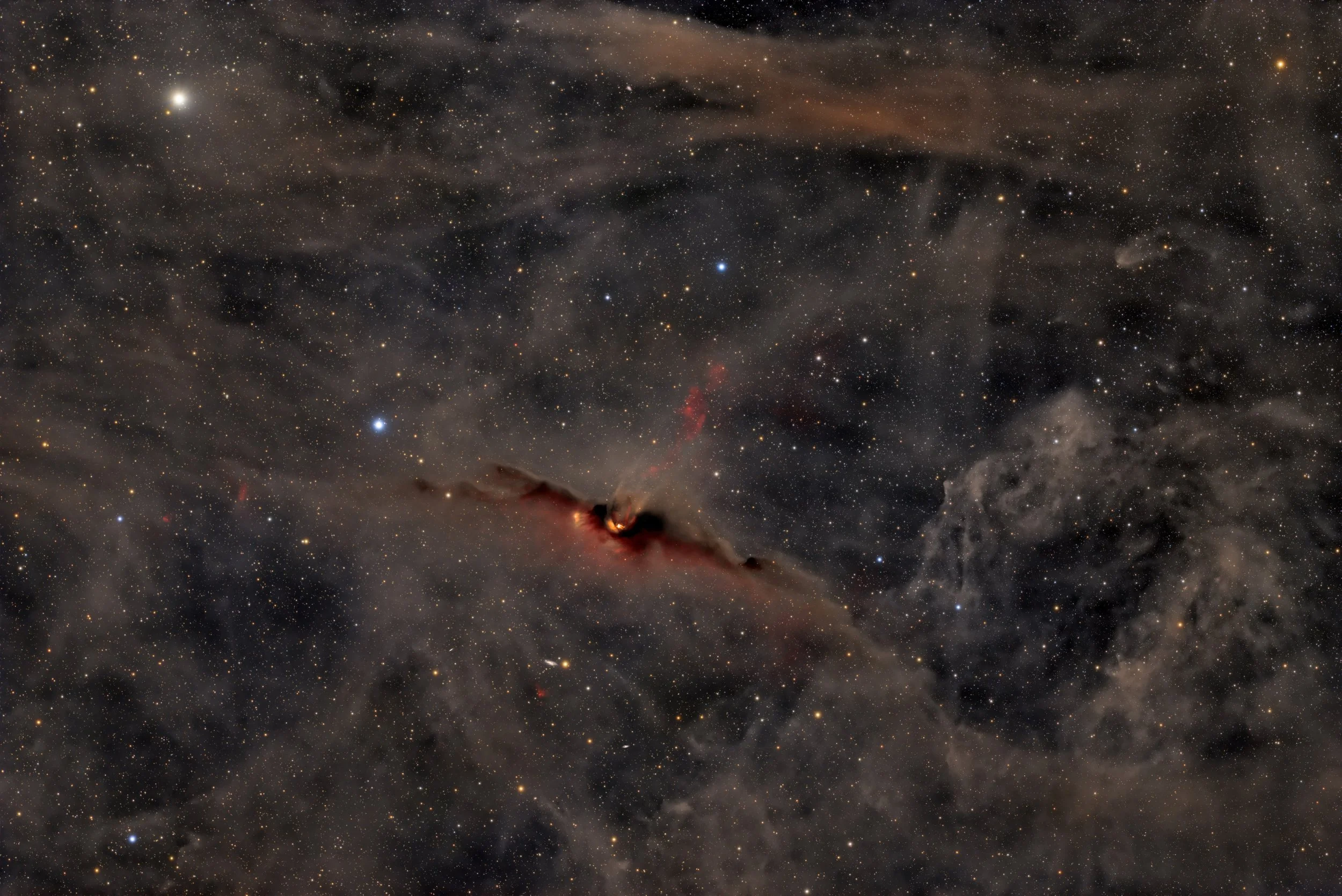
LDN 43 The cosmic bat nebula
Here is an APOD-style description of the image:
LDN 43: The Cosmic Bat Nebula
Hovering like a shadow against the brilliant, star-studded backdrop of the Milky Way, the cosmic bat spreads its dark wings across the constellation Ophiuchus. Cataloged as LDN 43 (Lynds' Dark Nebula 43), this striking silhouette is not an empty void, but a dense, opaque cloud of interstellar dust positioned roughly 1,400 light-years from Earth. By blocking the light of the stars behind it, the cold cosmic dust creates a dramatic, skeletal contrast. Far from being a quiet graveyard, the heart of this dark nebula is an active stellar nursery. Young, newly forming stars—still cocooned in their natal envelopes of gas and dust—locally illuminate their surroundings, while the faint, surrounding reflection nebula (LBN 7) reveals the delicate, intricate structures of this magnificent star-forming region.
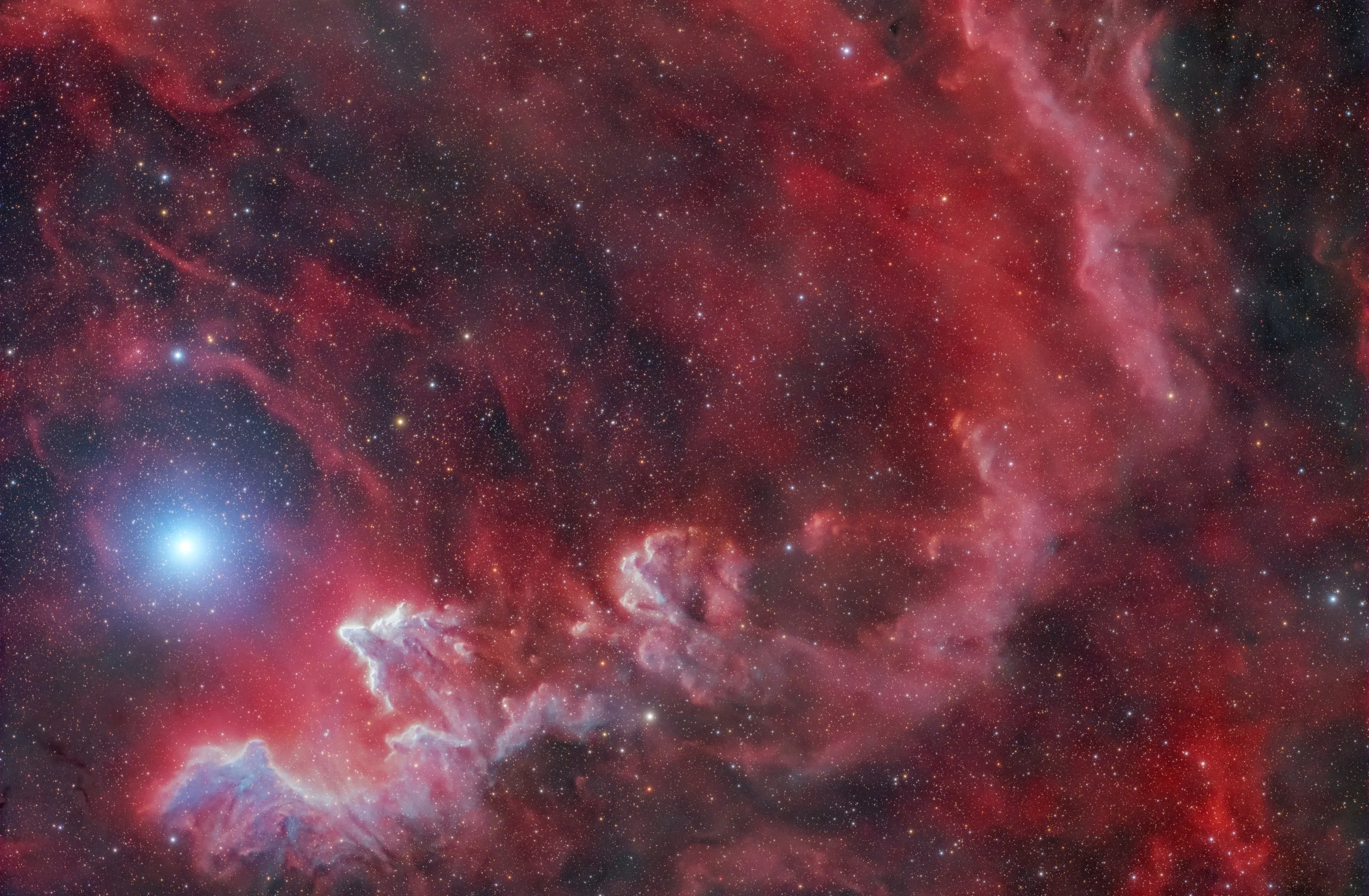
IC 59 and IC 63 - Ghost of Cassiopeia
IC 63, often called the Ghost Nebula, sits about 550 light years away in Cassiopeia and glows under the intense radiation from the nearby bright star Gamma Cassiopeiae. The nebula’s red tones come from hydrogen excited by that ultraviolet light while the delicate blue and lavender highlights mark regions where dust reflects starlight. The sculpted shapes across the frame reveal how Gamma Cas is slowly eroding and reshaping the cloud, creating wispy ridges and curling fronts that seem to billow outward.
This field captures the quiet drama of a photodissociation region where energetic light and cold gas collide. The fine textures drifting through the red emission form a striking backdrop for the bright foreground star, which dominates the scene without overpowering the subtle structure within the nebula. IC 63 is a small and fragile object but it tells a very detailed story about how massive stars influence their surroundings even across great distances.
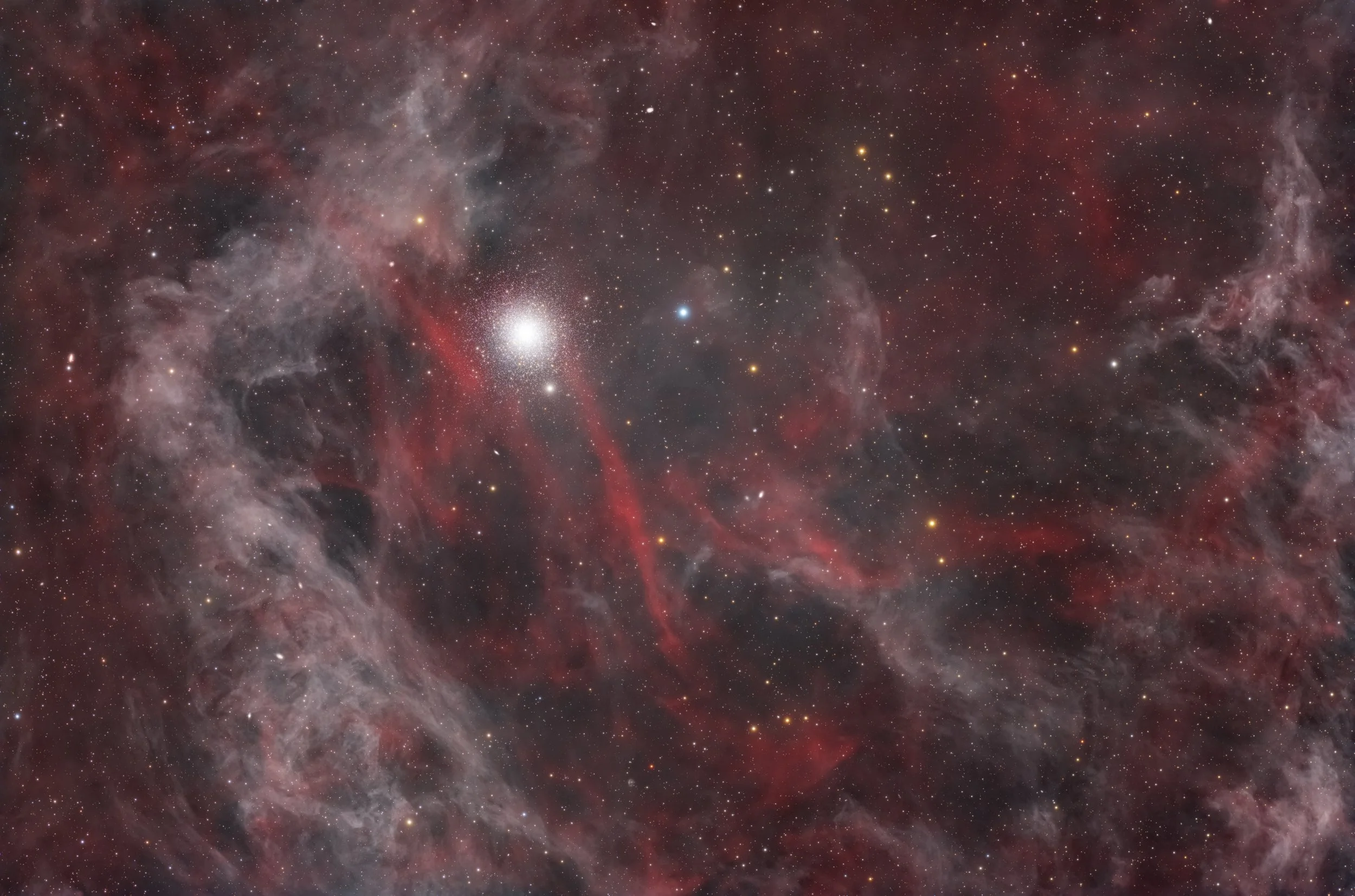
Globular Cluster M15 in a Rich Hydrogen-Alpha Field
This stunning image frames Messier 15, one of the densest globular clusters in the Milky Way, surrounded by faint hydrogen-alpha filaments and integrated flux nebula. Located about 33,000 light-years away in Pegasus, M15 contains over 100,000 stars tightly packed into a sphere just 175 light-years across. Its collapsed core may even harbor a rare intermediate-mass black hole.
The long exposures in H-alpha and broadband filters reveal delicate red and gray wisps of interstellar gas and dust, rarely captured in wide-field images of M15. These structures belong to the faint galactic cirrus that permeates the outer regions of our galaxy, adding an ethereal backdrop to the brilliant, ancient cluster.
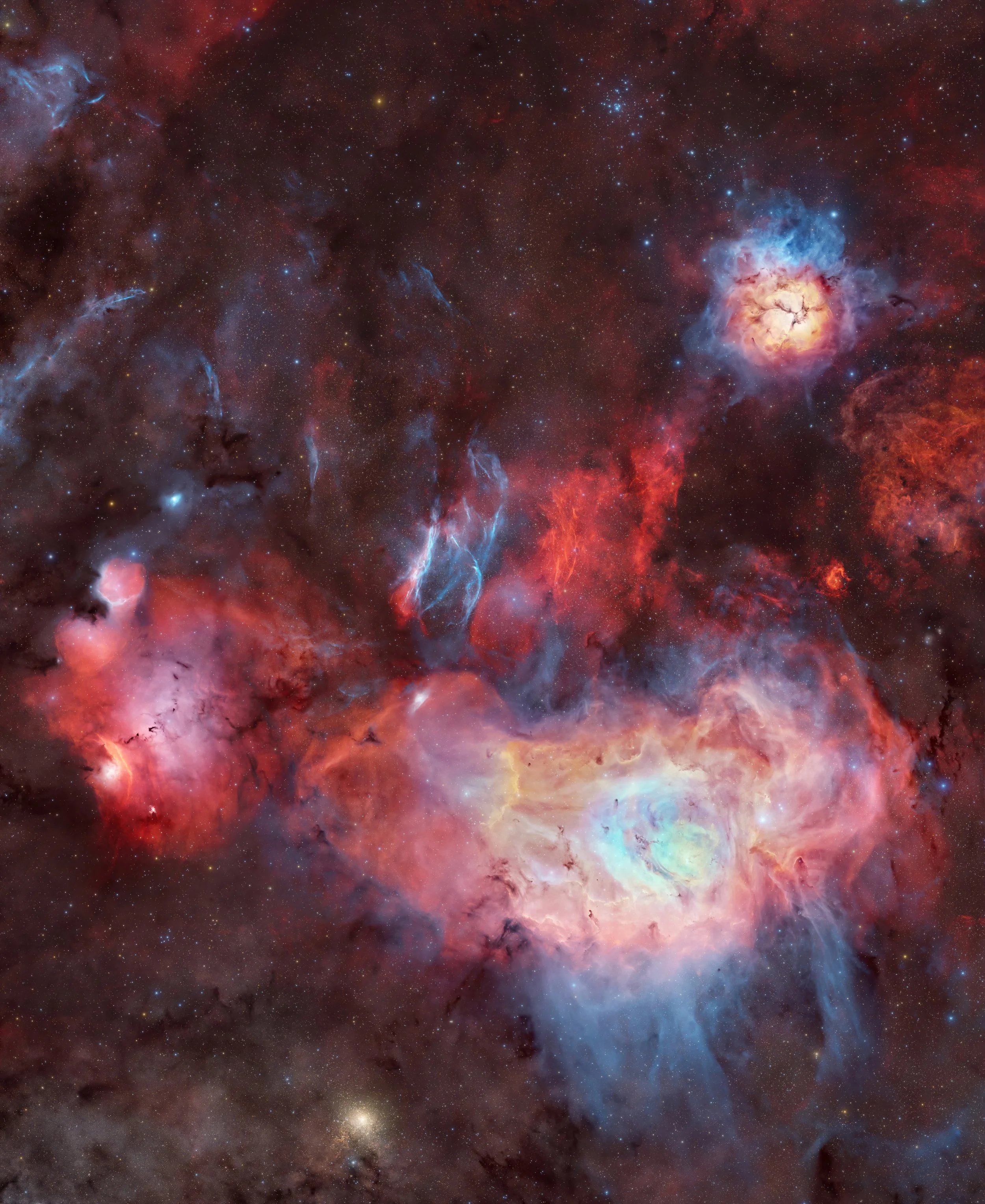
Where Stars Are Born and Die (M8, M20 & SNR G007.5-01.7)
This breathtaking wide-field view brings together two stellar nurseries and the ghost of a dying star. At the bottom right glows the Lagoon Nebula (M8), a massive H II region where new stars form from collapsing clouds of gas and dust. Above it lies the Trifid Nebula (M20), easily recognized by its dark dust lanes that divide its bright blue and red emission. Both regions are among the most active star-forming complexes in the Milky Way, lying some 4,000 to 5,000 light-years away in Sagittarius.
Threaded across the scene are faint, delicate filaments belonging to the supernova remnant SNR G007.5-01.7. Unlike the nebulae forging new suns, these wisps are the expanding remains of a massive star that ended its life in a cataclysmic explosion. This juxtaposition of creation and destruction highlights the cosmic cycle of stellar evolution, where the death of one star enriches the interstellar medium to seed the birth of many more.