

AAPOD2 Image Archives

Sh2-129, Outters 4, Barnard 150, NGC 6946 & NGC 6939
This wide-field image brings together several striking deep-sky objects in the constellation Cepheus. On the left lies Sharpless 2-129, the Flying Bat Nebula, glowing in rich hydrogen emission. Nestled inside it is the elusive Outters 4, or Squid Nebula, a faint oxygen-rich bipolar outflow thought to originate from a hot central star.
To the right, dark dust lanes of Barnard 150, also called the Seahorse Nebula, cut through the glowing background. Further outward, two distant island universes appear: NGC 6946, the Fireworks Galaxy, and the open cluster NGC 6939. Together, this frame captures a tapestry of emission nebulae, dark nebulae, star-forming regions, and galaxies, highlighting the remarkable diversity of structures within a single region of the northern sky.
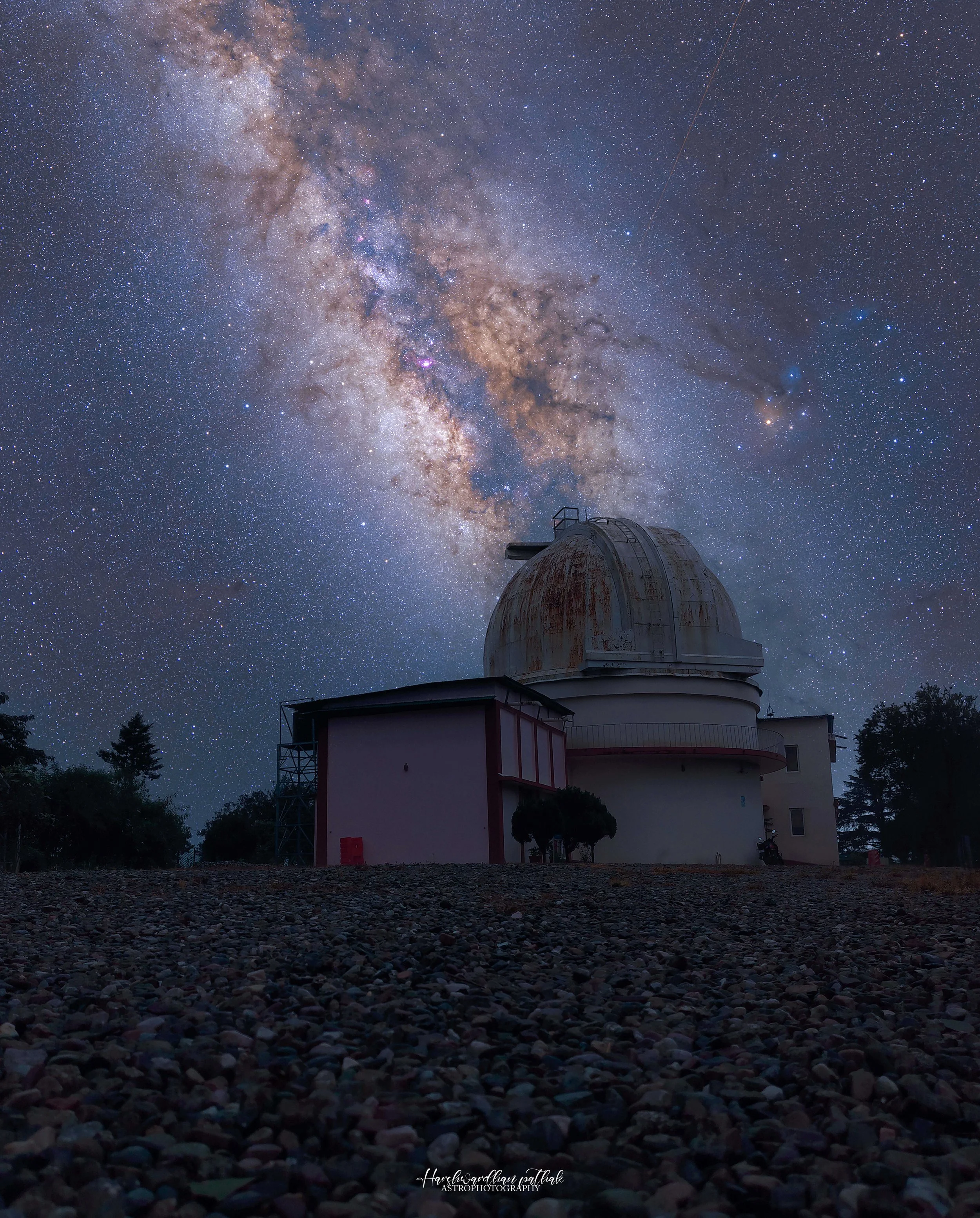
The Galactic Core above India’s Historic Sampurnanand Telescope
he central band of the Milky Way rises brilliantly above the Sampurnanand Telescope at the State Observatory in Nainital, India. The telescope, built in 1954, was once among Asia’s largest and played a key role in early Indian astrophysical research. Its dome, weathered with age, now serves as a reminder of the country’s rich astronomical heritage.
Overhead, the galactic core glows with dark dust lanes, star clouds, and the warm light of countless suns. To the right, the bright yellow star Antares and the Rho Ophiuchi complex add color to the scene, while the dense star fields of Sagittarius and Scorpius trace the heart of our Galaxy. The contrast between human-made history and the timeless night sky speaks to our enduring quest to understand the cosmos.
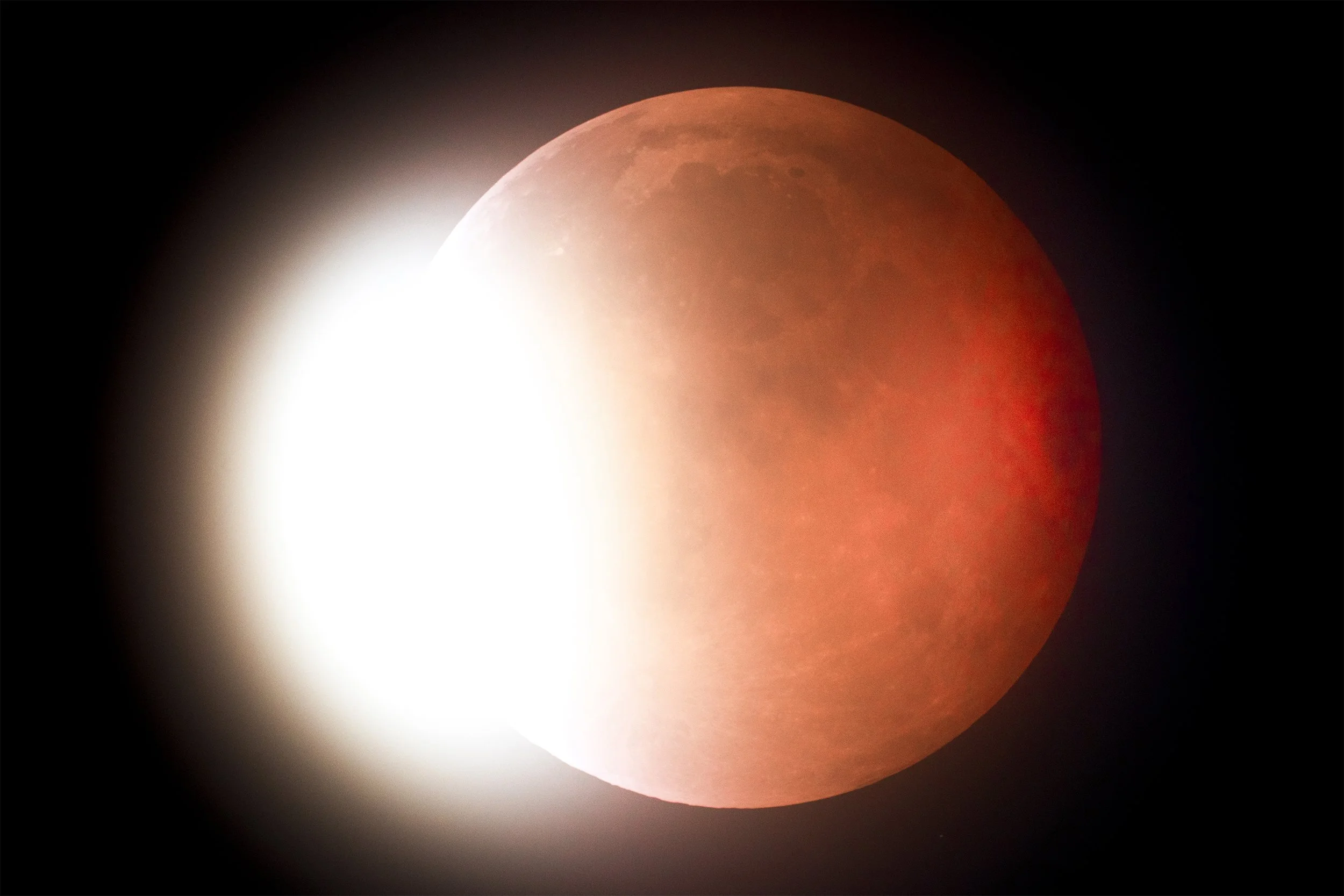
Lunar Eclipse over Mohali, India
This striking image captures the Moon during the September 7th lunar eclipse as seen from Mohali, Punjab, India. The Earth’s shadow paints the lunar surface in deep red hues, a result of sunlight scattering through Earth’s atmosphere and refracting into the umbra. At the same time, the brilliant glare of the uneclipsed portion creates a dramatic contrast, emphasizing the geometry of the event.
Lunar eclipses are visible to anyone on the night side of Earth when they occur, making them one of the most accessible celestial spectacles. Unlike solar eclipses, they can be safely viewed with the naked eye, connecting observers across continents under the same reddish glow of Earth’s shadow.
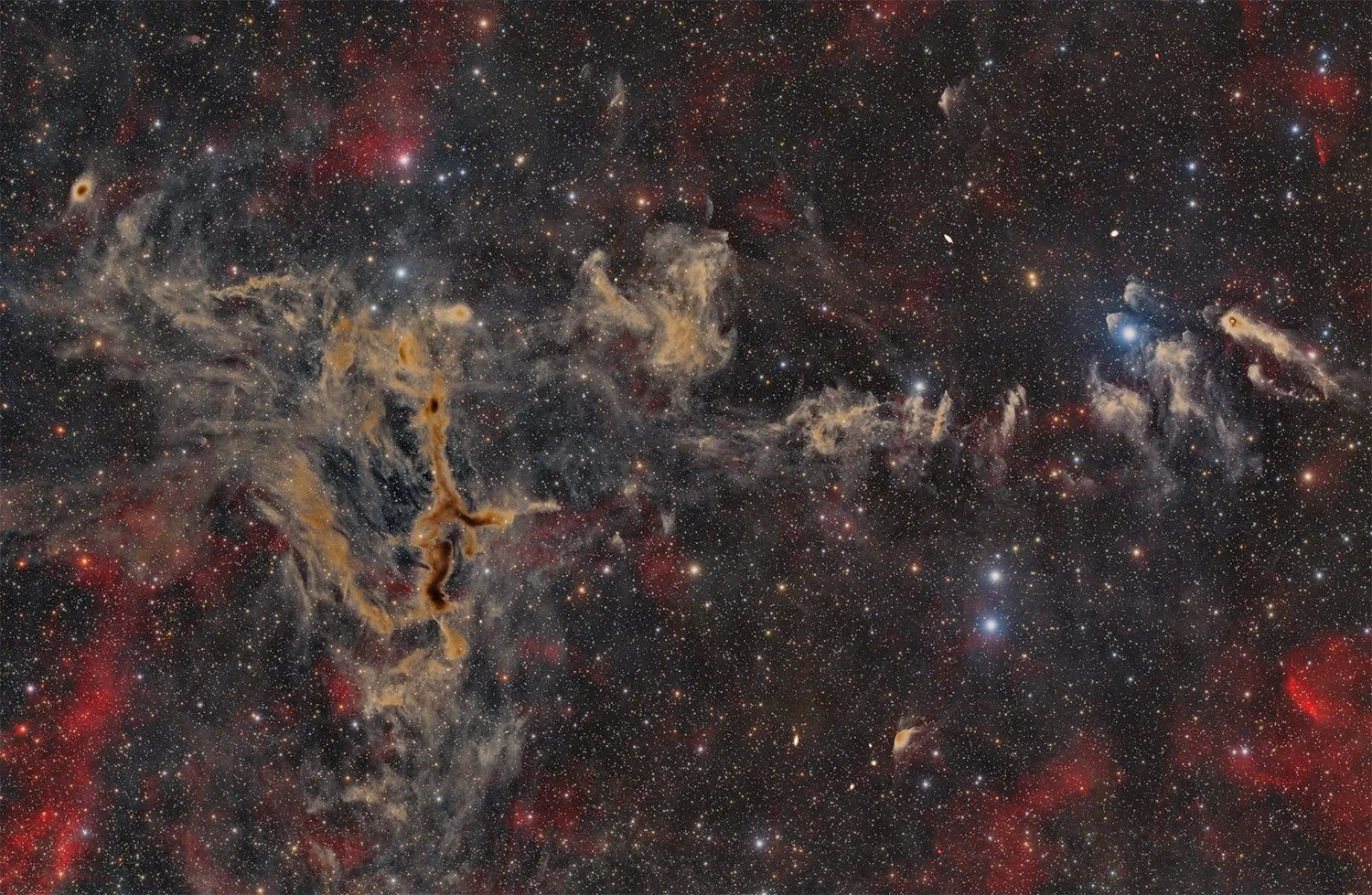
LDN 1295 in Cepheus
This image showcases Lynds Dark Nebula 1295, a complex and textured dust cloud located in the constellation Cepheus. Appearing as dark filaments silhouetted against a rich starfield, LDN 1295 is part of a larger network of interstellar material that stretches across this region of the Milky Way. The dust absorbs and scatters starlight, creating striking contrast between opaque lanes and more tenuous translucent wisps.
Illuminated here in a Ha-LRGB composite, the nebula reveals both its dark molecular core and faint hydrogen emission in the surrounding medium. Such clouds are active stellar nurseries, harboring dense regions where gravity will eventually collapse material into new stars. This view highlights the beauty and complexity of Cepheus, where hidden star formation and cosmic dust sculpt the interstellar canvas.
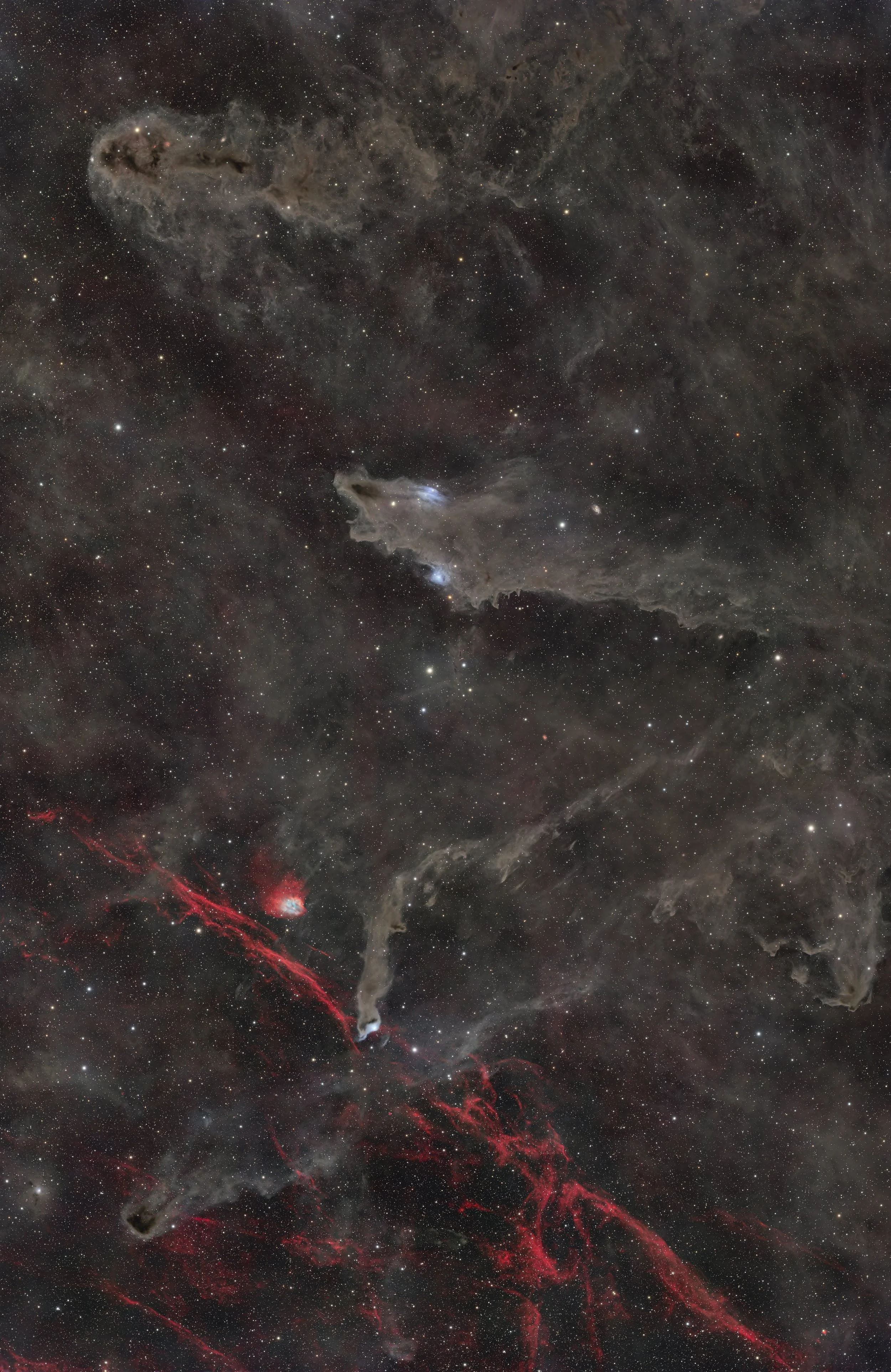
Cepheus Dust – LDN 1251, LDN 1235, and VdB 152
This wide-field view reveals a dark and dusty region in the constellation Cepheus, filled with dense clouds that block background starlight and sculpt striking shapes across the field. The scene includes Lynds Dark Nebulae LDN 1251 and LDN 1235, along with reflection nebula VdB 152, each tracing cold interstellar matter that will one day collapse into new stars. At the lower part of the frame, faint red emission filaments mark regions of shocked gas, remnants of past energetic events.
Such dusty complexes are often overlooked compared to their brighter emission nebula counterparts, yet they play a crucial role in the life cycle of the galaxy. By both obscuring and seeding future stellar nurseries, these clouds act as cosmic incubators. Images like this highlight not only the complexity of Cepheus but also the intricate balance between destruction and creation within the interstellar medium.
Inner core of the Dragon's Egg
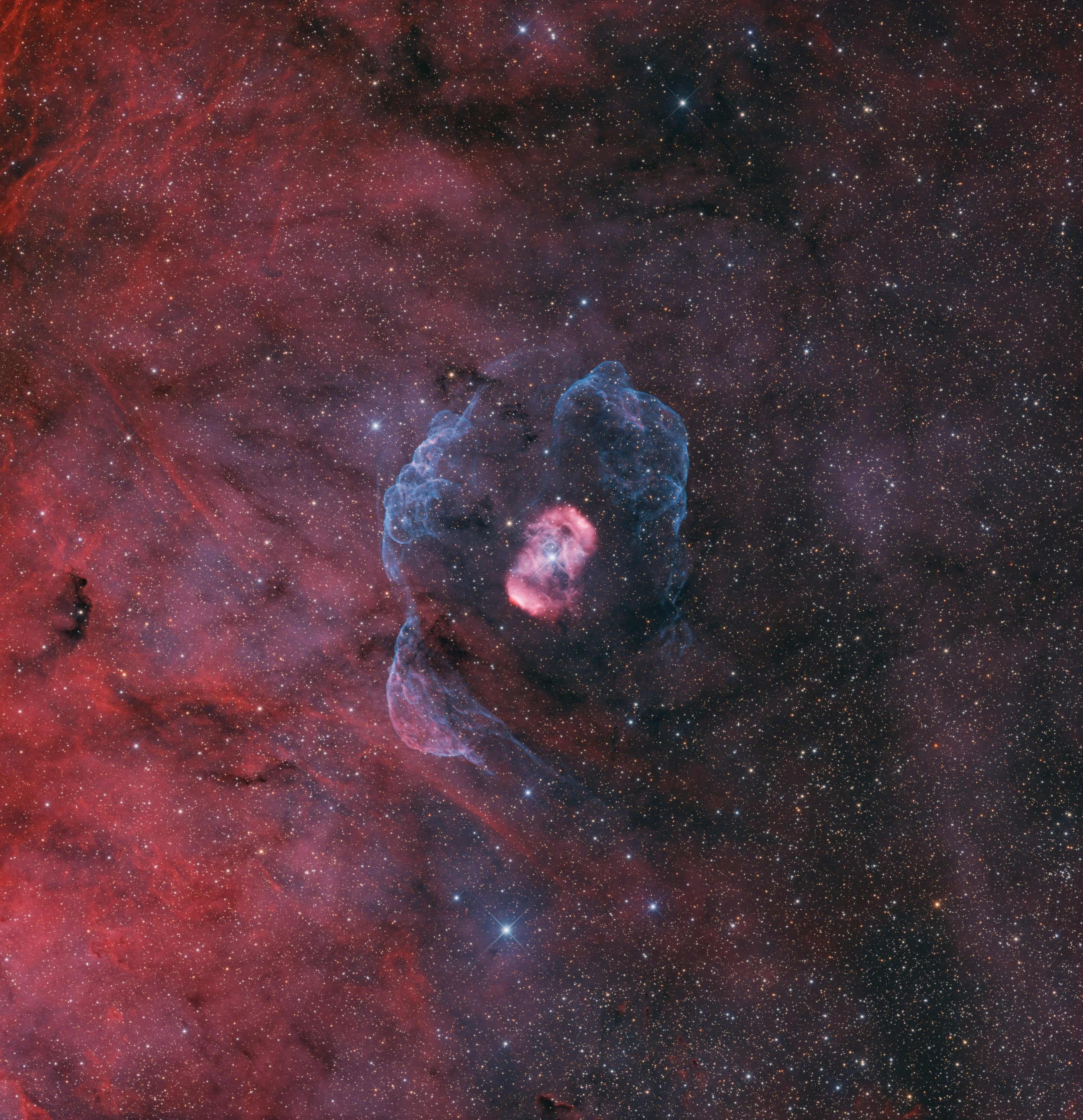
At the heart of the Dragon’s Egg Nebula lies its brilliant core, a striking planetary nebula surrounding a massive O-type star. This luminous star, some 40 times the mass of our Sun, has shed vast amounts of gas into the surrounding region, sculpting a glowing, bubble-like structure seen here in vivid blues and reds. The delicate arcs and filaments trace shock fronts where stellar winds collide with older ejected material.
The Dragon’s Egg is found in the constellation Norma, about 4,200 light-years away. Though it resembles a planetary nebula, it is the product of an enormous, short-lived star rather than a dying Sun-like one. Eventually, this star will end its life in a violent supernova, enriching the interstellar medium even further. Until then, its radiant core continues to shine as the centerpiece of one of the southern sky’s most intricate nebulae.

LDN 204: A Dark Cloud in Ophiuchus
Spanning across the constellation Ophiuchus, LDN 204 is a dense dark nebula silhouetted against the faint glow of background stars and hydrogen gas. These cold clouds of interstellar dust are so thick that they block visible light, appearing as inky rivers winding through the Milky Way. Within such regions, gravity can eventually pull matter together to form new stars, making dark nebulae both obscuring and nurturing.
This image, a 3x1 mosaic captured in June and July by the collaborative team n_kuadra with the contribution of their colleague Soler Grajera, reveals the remarkable texture and contrast of the nebula. The interplay of black dust lanes and the red backdrop of ionized hydrogen creates a dramatic view of one of Ophiuchus’s hidden stellar nurseries.
Where Stars Are Born and Die (M8, M20 & SNR G007.5-01.7)
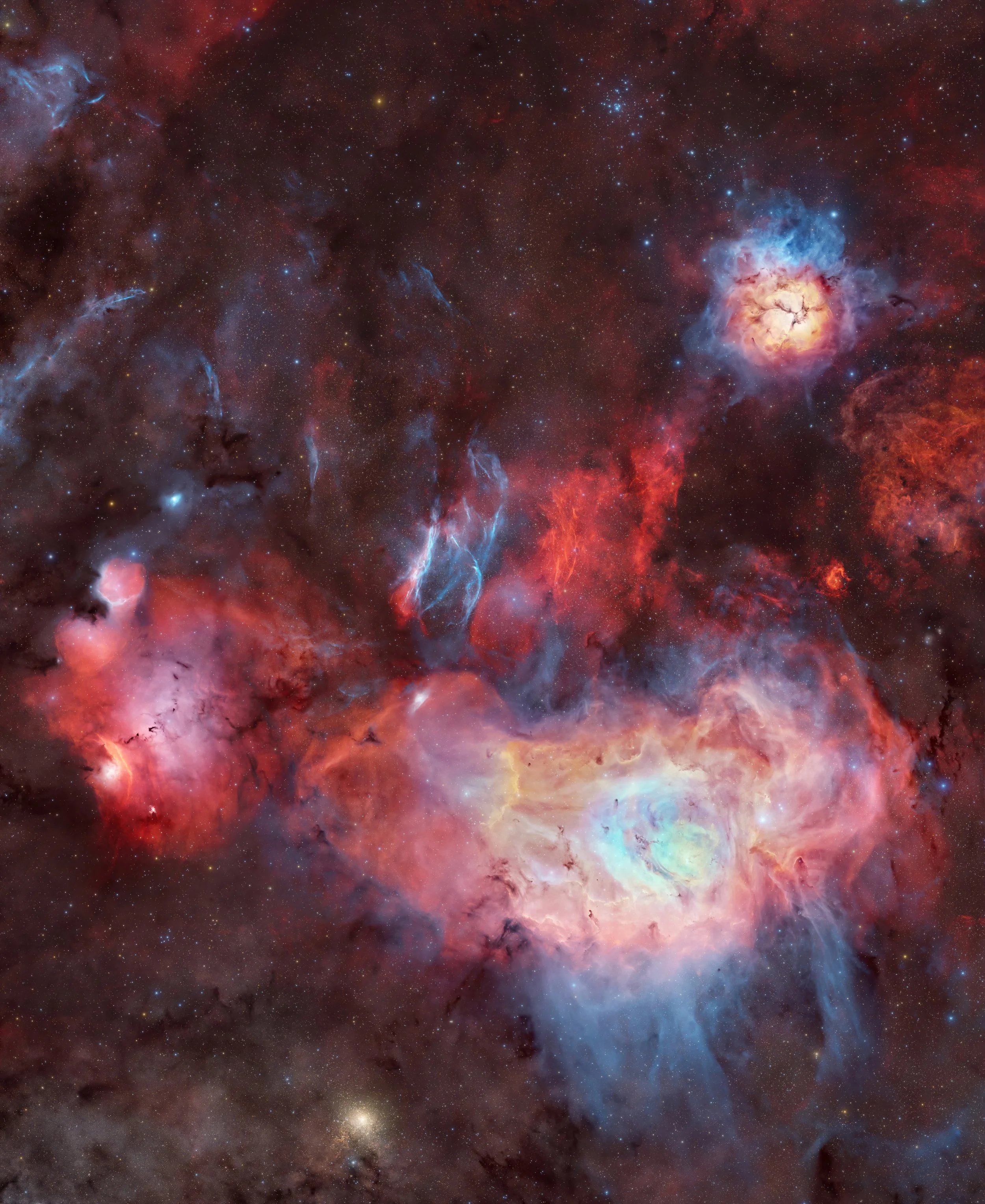
This breathtaking wide-field view brings together two stellar nurseries and the ghost of a dying star. At the bottom right glows the Lagoon Nebula (M8), a massive H II region where new stars form from collapsing clouds of gas and dust. Above it lies the Trifid Nebula (M20), easily recognized by its dark dust lanes that divide its bright blue and red emission. Both regions are among the most active star-forming complexes in the Milky Way, lying some 4,000 to 5,000 light-years away in Sagittarius.
Threaded across the scene are faint, delicate filaments belonging to the supernova remnant SNR G007.5-01.7. Unlike the nebulae forging new suns, these wisps are the expanding remains of a massive star that ended its life in a cataclysmic explosion. This juxtaposition of creation and destruction highlights the cosmic cycle of stellar evolution, where the death of one star enriches the interstellar medium to seed the birth of many more.
LBN 380 - Sh2-115 & 116 - PN Weinberger 1-10
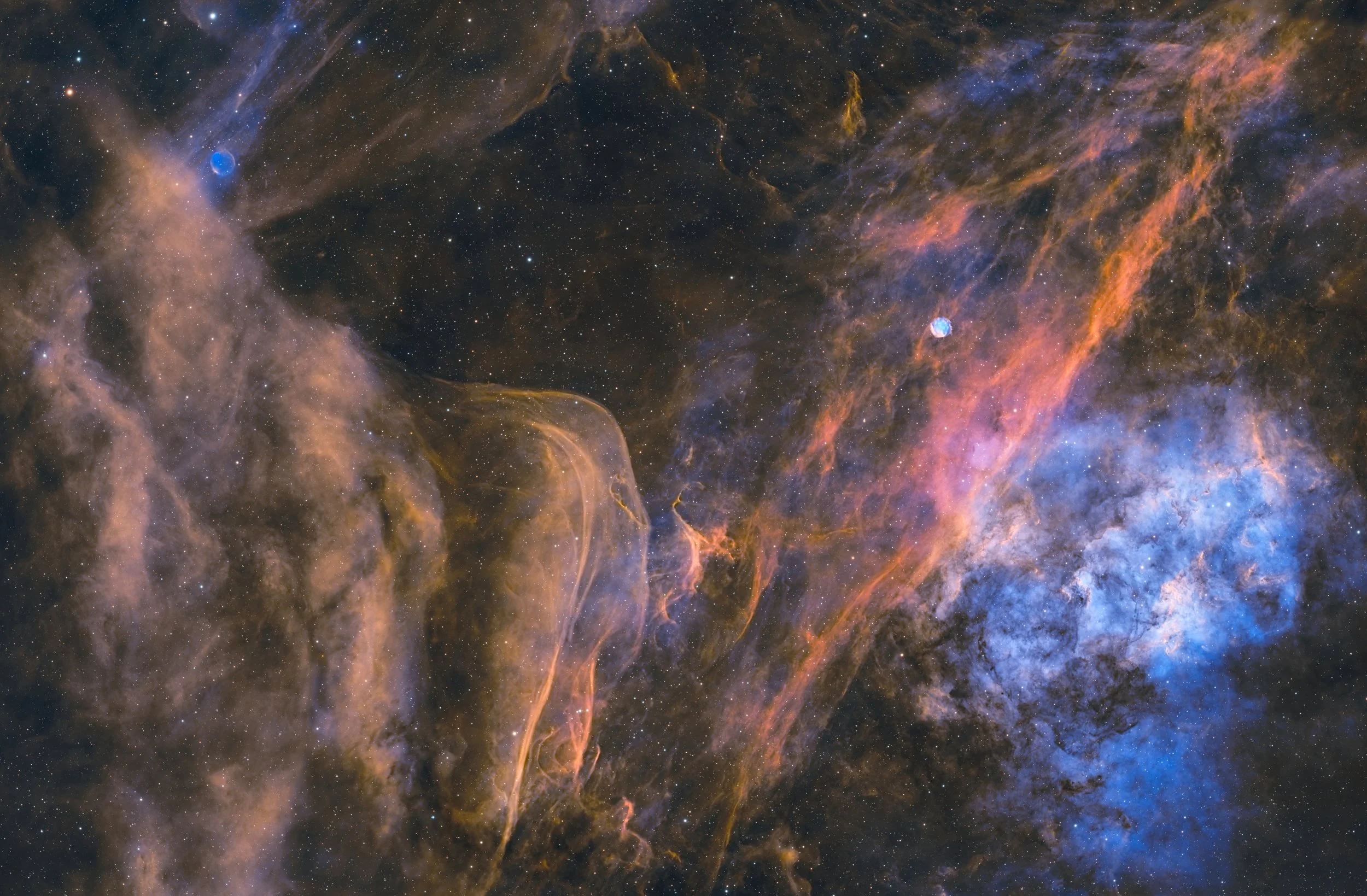
This colorful wide-field view captures a fascinating region in Cygnus, centered on the bright emission nebula LBN 380. The intricate filaments of glowing hydrogen, oxygen, and sulfur are part of the massive H II region cataloged as Sharpless 115, which lies near the bright star Deneb in the rich Cygnus star field. Embedded within this complex is Sharpless 116, also known as Abell 71, a small but distinct emission structure often mistaken for a planetary nebula.
Adding to the scene is the faint, blue planetary nebula Weinberger 1-10, visible near the center-right portion of the image. This stellar remnant, expelled by a dying sun-like star, creates a striking contrast against the reddish hydrogen emission and dusty structures of the surrounding nebulae. The interplay of colors highlights the ionized gases that sculpt this celestial landscape, making it a prime example of the dynamic processes shaping our galaxy’s star-forming regions.
Sh2-63 – A Dark Nebula in Sagittarius
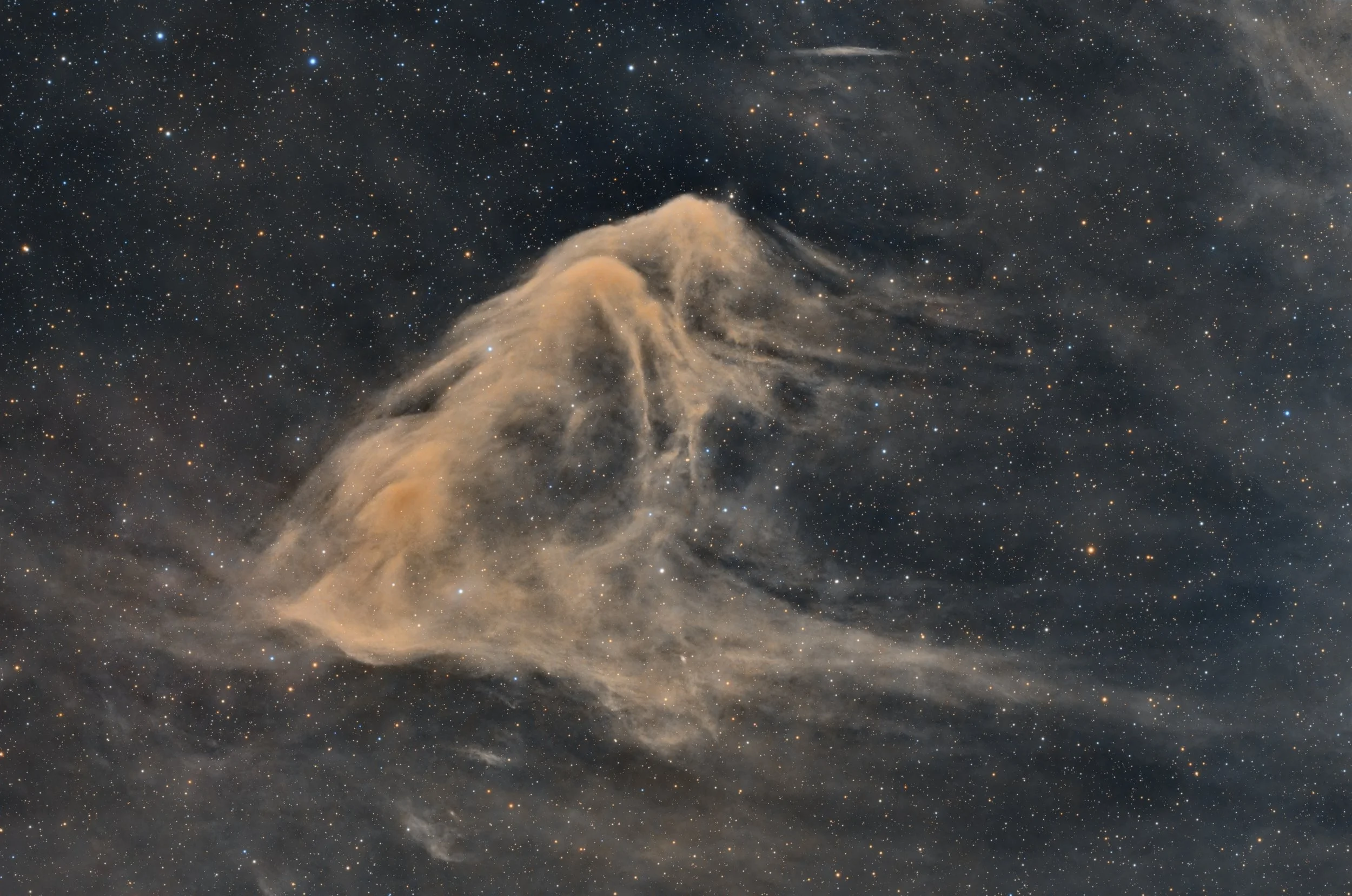
Sh2-63 is a dark nebula in the constellation Sagittarius, located near the dense star fields of the Milky Way’s central region. Unlike bright emission or reflection nebulae, dark nebulae are composed of cold interstellar dust that blocks the light from background stars, creating striking silhouettes against the galactic glow. This object is part of the Sharpless catalog of H II regions, but its opacity indicates an environment dominated by dust rather than active star formation.
In this image, the faint, wispy clouds of Sh2-63 drift through a rich star field, their subtle golden-brown tones contrasting with the dark interstellar medium. The fine filaments and soft gradients are illuminated only by starlight scattered through the dust, making these regions challenging to capture and process. Deep exposures and careful contrast control reveal the delicate structure hidden within the darkness of the galactic plane.

Sh 2-174 – The Valentine Rose NebulaS
Sh 2-174, also known as the Valentine Rose Nebula, is a faint emission and reflection nebula in the constellation Cepheus, about 3.5 degrees from the bright star Polaris. Spanning nearly 10 light-years across, it was once thought to be a planetary nebula, but research suggests it is a dense region of interstellar medium being illuminated by a hot white dwarf star. This interaction creates the glowing ionized gas and subtle shock fronts seen in its structure.
In this image, the nebula’s bright red hydrogen emission blends with faint blue hues of reflected starlight, set against a backdrop of interstellar dust and rich star fields. Captured with over 56 hours of integration, the delicate filaments and soft structures emerge from an otherwise dark region of space, revealing a complex interplay between stellar remnants and their surrounding environment.
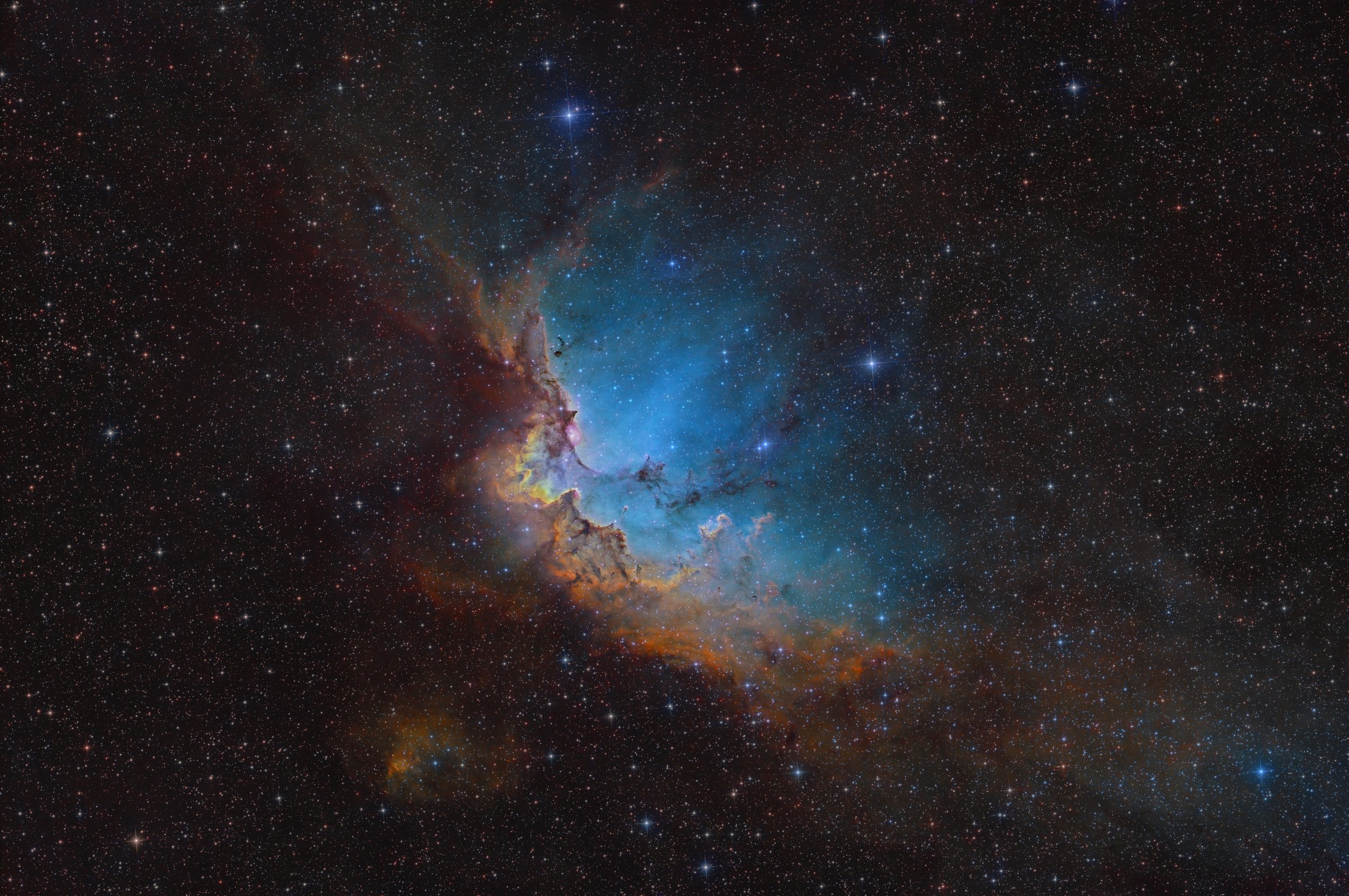
The Wizard Nebula in Narrowband Colors
The Wizard Nebula, cataloged as NGC 7380, is a young open star cluster embedded within a vast emission nebula in the constellation Cepheus. Spanning about 100 light-years, this stellar nursery lies roughly 7,200 light-years from Earth. Its intricate shapes and glowing gas clouds are energized by hot, massive stars at the cluster’s core, sculpting the surrounding hydrogen, sulfur, and oxygen into dramatic forms that resemble the figure of a sorcerer.
Captured in a Hubble-like palette using Ha, SII, and OIII filters, this image reveals striking contrasts between the dominant blue oxygen regions and the golden sulfur-rich filaments along the nebula’s edges. Dark dust lanes snake through the glowing gas, creating sharp boundaries that emphasize the region’s dynamic interplay between star formation and stellar winds. NGC 7380 is a vivid example of how stellar birth both creates and reshapes the interstellar medium.
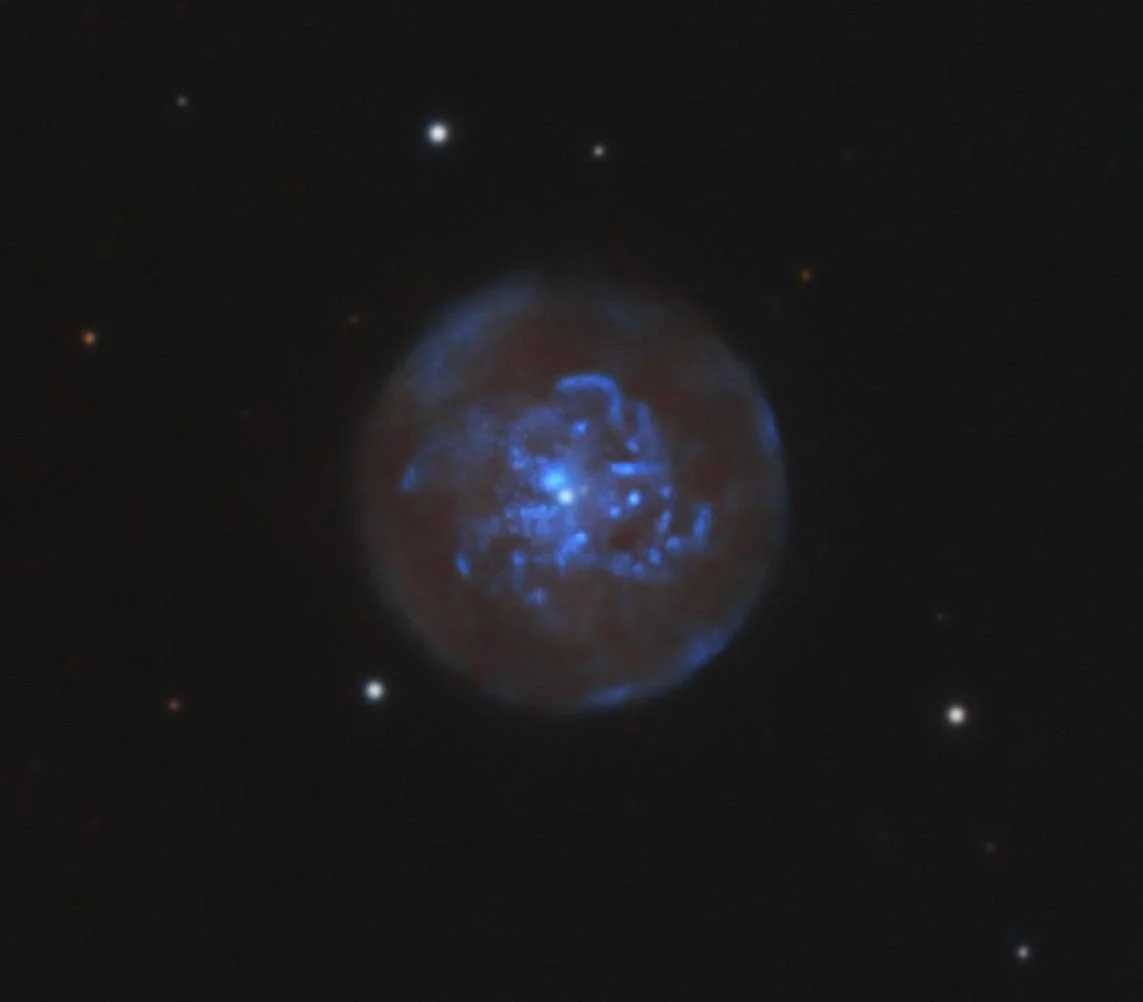
Abell 30 – A Born-Again Planetary Nebula
Abell 30, captured here in a detailed HOO palette with RGB stars, is a fascinating planetary nebula located in the constellation Gemini. Unlike typical planetary nebulae, Abell 30 is a “born-again” object. After shedding its outer layers, the central star underwent a late helium-shell flash, reigniting fusion and ejecting fresh material into space. This dramatic event formed a complex structure: a faint outer halo from the original mass loss and bright blue inner knots of oxygen emission sculpted by high-velocity stellar winds.
This rare evolutionary stage provides astronomers a glimpse into the unpredictable end of stellar life cycles. The contrasting colors in the image highlight hydrogen in soft red and oxygen in luminous blue, emphasizing the turbulent knots and filamentary arcs within the nebula’s core. Objects like Abell 30 play an essential role in enriching the interstellar medium with heavier elements, setting the stage for future generations of stars and planets.
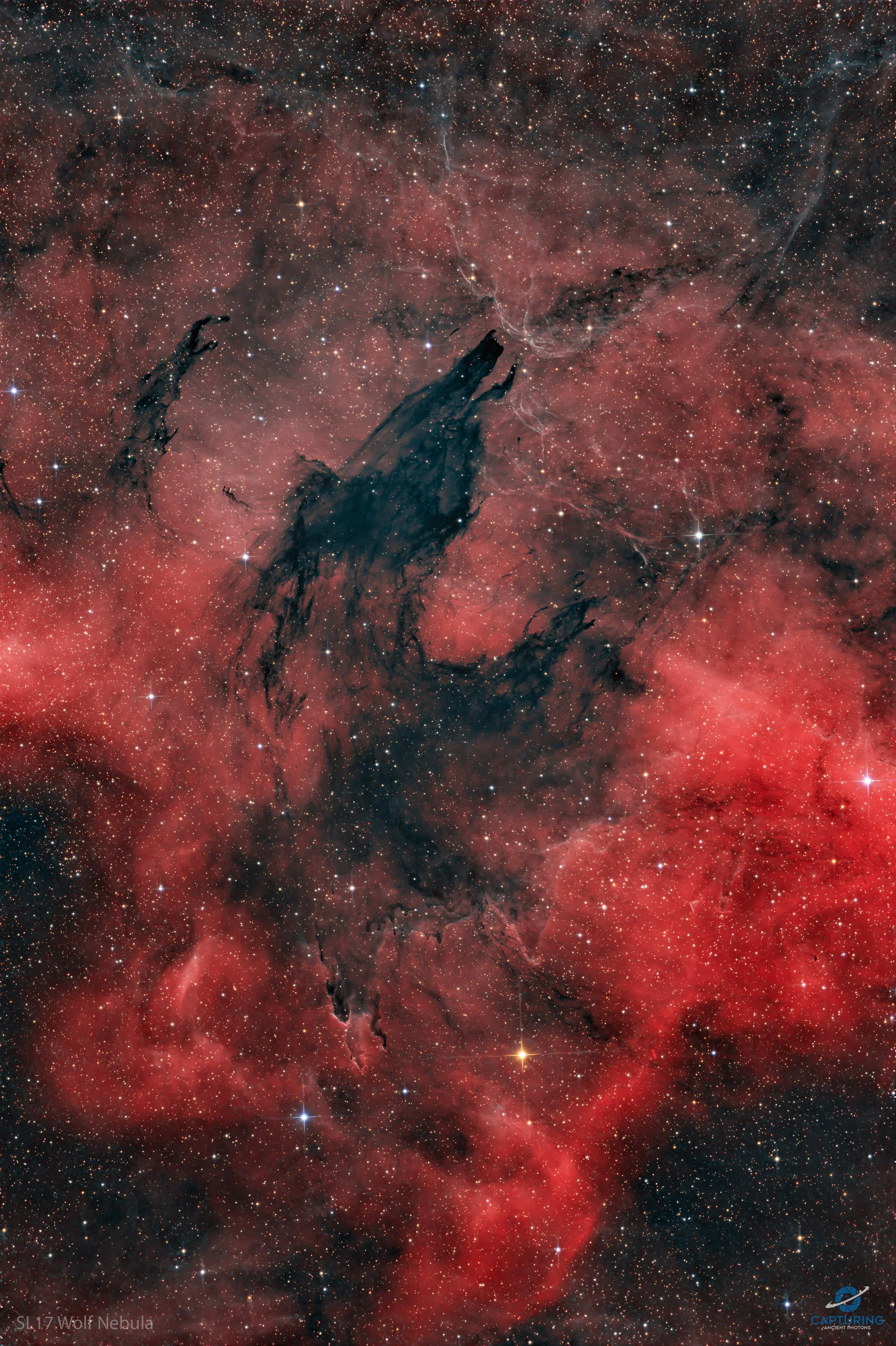
SL 17 – The Dark Wolf Nebula in Narrowband
The Dark Wolf Nebula, cataloged as SL 17, prowls through the constellation of Cepheus, its silhouette etched against a glowing field of ionized gas. The dark shape owes its appearance to dense clouds of interstellar dust that block background starlight, creating the impression of a wolf running through the crimson haze. This region lies within a rich star-forming complex along the Milky Way, where radiation from young stars excites surrounding hydrogen, producing the vivid emission seen here.
Rendered in a narrowband HSS palette, the image reveals intricate filaments of hydrogen and sulfur interwoven with the wolf’s shadowy form. Bright stars pepper the field, contrasting sharply with the deep black tendrils that snake across the nebula. Such dark nebulae not only sculpt dramatic shapes but also harbor the raw material for new stars, hiding stellar nurseries within their cold interiors.
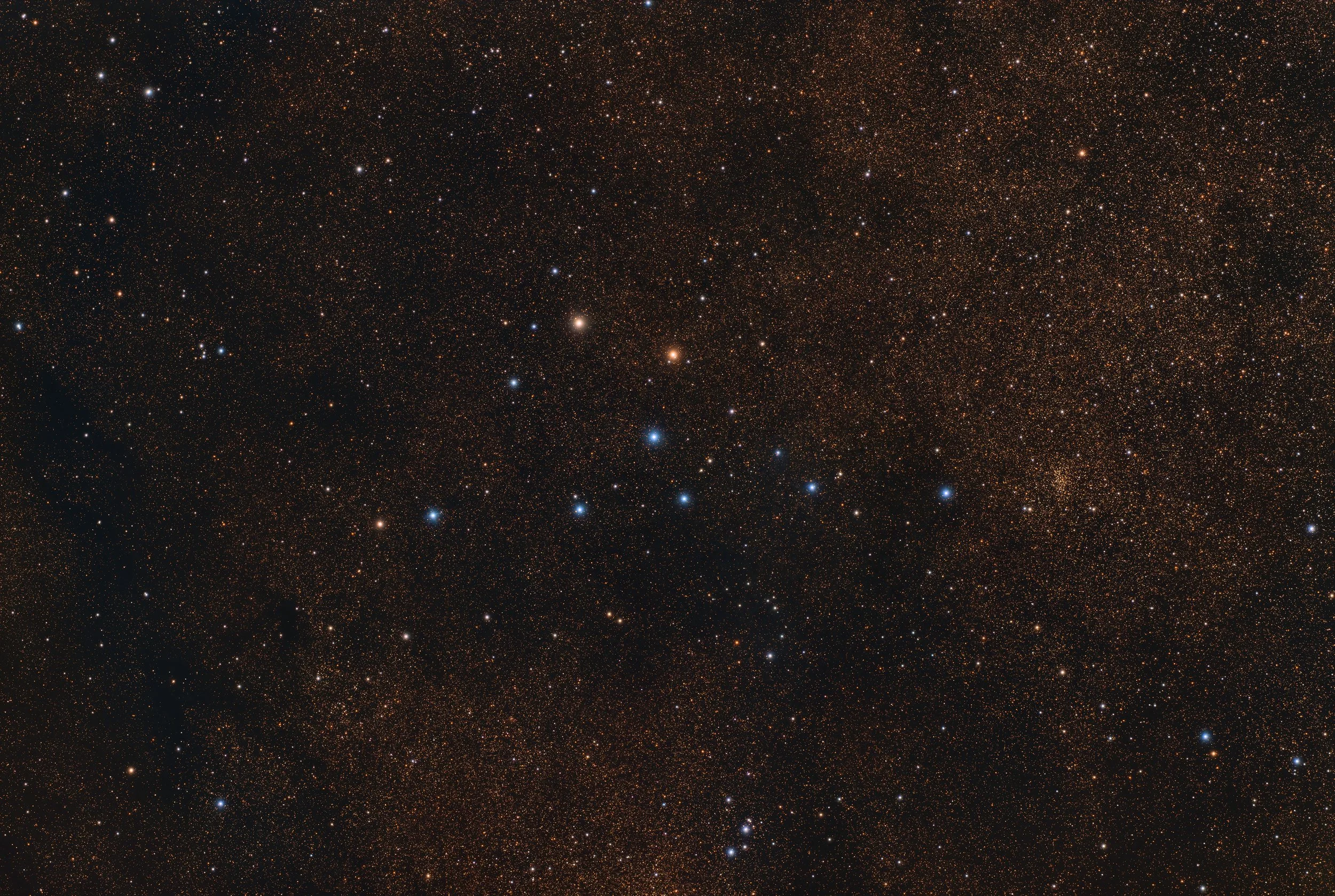
Collinder 399 – The Coathanger Cluster
Collinder 399, widely known as the Coathanger Cluster, is a striking asterism in the constellation Vulpecula. This grouping of stars forms a distinctive pattern resembling an upside-down coat hanger, making it one of the most recognizable star arrangements in the summer Milky Way. Although it appears to be a true cluster, the Coathanger is actually an optical alignment of stars at different distances rather than a gravitationally bound system.
Set against the dense star fields of the Milky Way, the bright blue and orange stars of Collinder 399 stand out prominently in this image. Dark interstellar dust clouds weave through the scene, adding contrast and depth to the golden background of countless distant suns. The composition highlights the simplicity of this naked-eye pattern amid the complexity of the galactic plane.
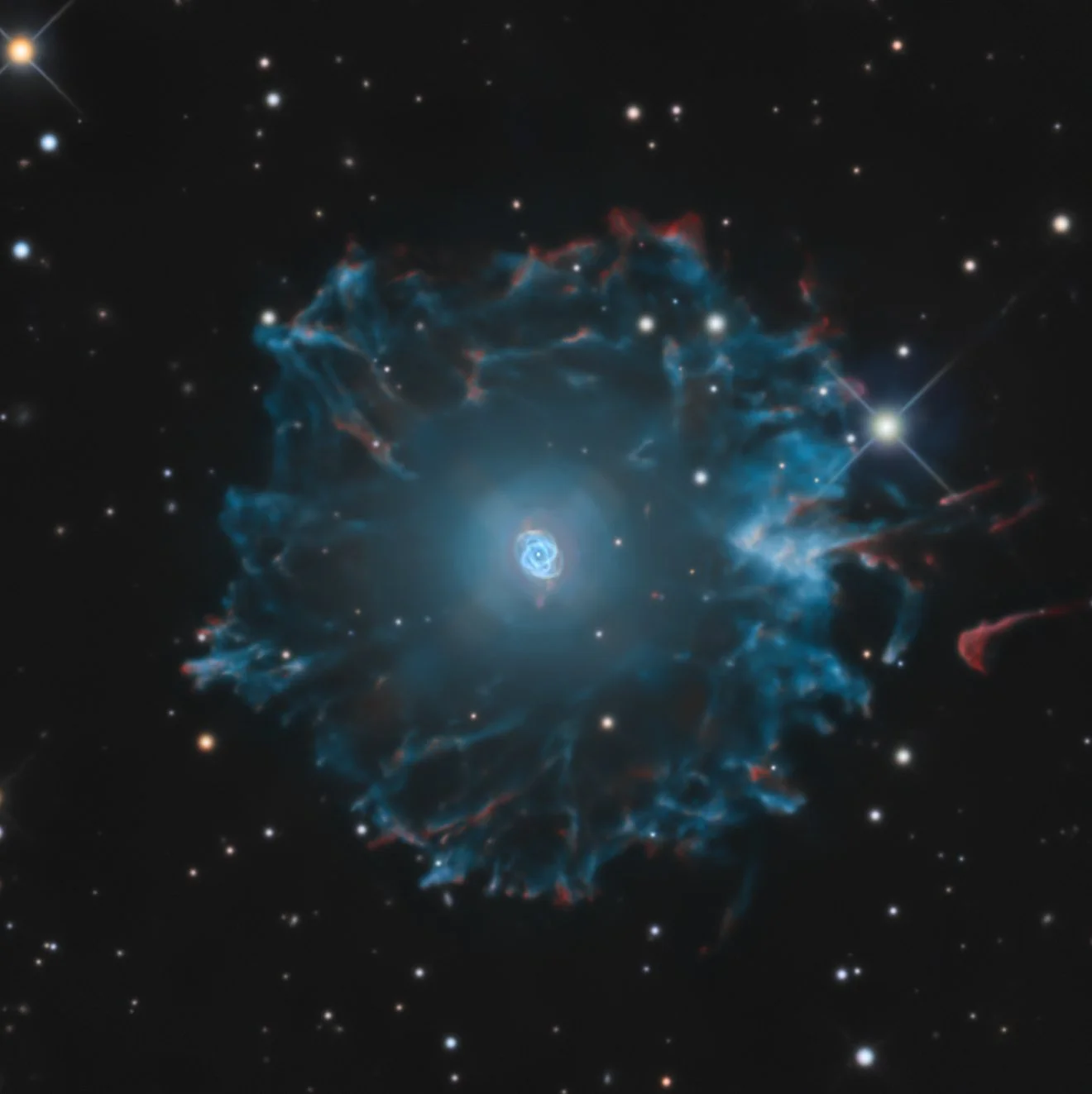
NGC 6543 Cat's eye nebula
NGC 6543, better known as the Cat’s Eye Nebula, is one of the most complex planetary nebulae known. Located about 3,000 light-years away in the constellation Draco, it marks the final evolutionary stage of a Sun-like star. The nebula’s bright inner region, shaped by powerful stellar winds, reveals intricate concentric shells, knots, and jets, all sculpted by the dying central star. Surrounding this core are faint outer halos, remnants of earlier mass ejections stretching across several light-years.
This image captures extraordinary detail in the Cat’s Eye structure, thanks to a combination of long narrowband exposures and high-resolution lucky imaging. Hydrogen-alpha, Oxygen III, and broadband color data reveal the blue-green glow of doubly ionized oxygen and the soft red emission of hydrogen, tracing the nebula’s layered complexity against a field of distant stars.
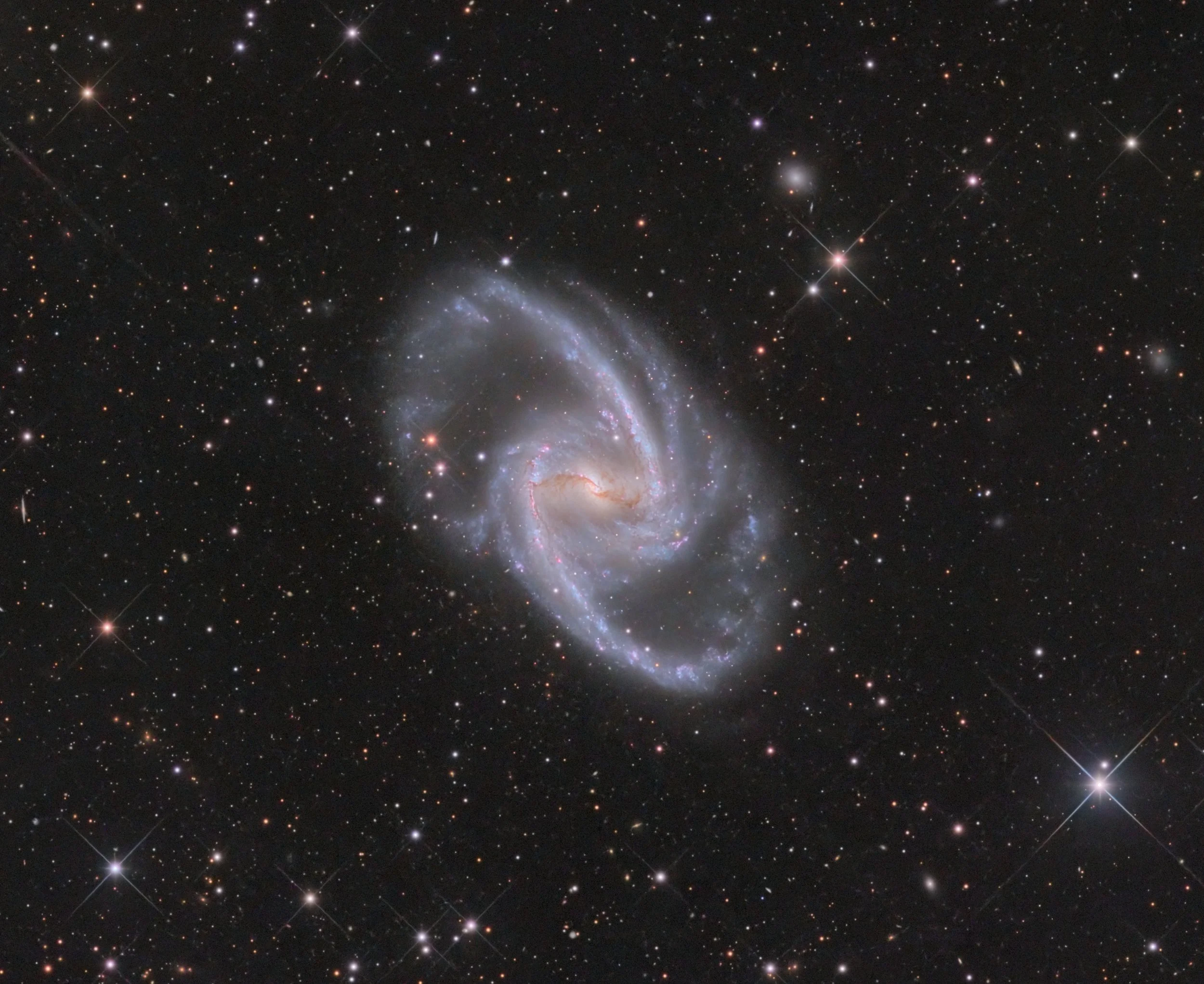
NGC 1365 – The Great Barred Spiral of Fornax
NGC 1365, often called the Great Barred Spiral Galaxy, lies about 56 million light-years away in the constellation Fornax. Spanning over 200,000 light-years, this galaxy is a classic barred spiral, showcasing sweeping arms and a prominent central bar filled with stars and dust lanes. Star-forming regions glow pink along the spiral arms, while young blue star clusters trace the galaxy's graceful curves.
Captured from Tivoli Astrofarm in Namibia, this deep image highlights the galaxy's intricate dust structure and faint outer extensions against a rich background of distant galaxies. NGC 1365 is also an important laboratory for studying galactic dynamics and supermassive black holes, as it hosts an active nucleus at its core. Its stunning symmetry and vivid detail make it one of the most photogenic galaxies in the southern sky.

Mineral Moon
This enhanced view of the Moon reveals its hidden colors, representing subtle variations in the composition of its surface. The reddish-brown hues indicate iron-rich basaltic plains, known as lunar maria, while bluish tones highlight areas with a higher concentration of titanium. These color differences are not visible to the naked eye but can be brought out through careful processing, offering a mineralogical map of Earth's only natural satellite.
The image was captured near first quarter, when the interplay of sunlight and shadow emphasizes the rugged terrain of lunar highlands and cratered regions. The Moon, about 3,474 kilometers across, has been geologically inactive for billions of years, yet its surface preserves the history of impacts and volcanic activity that shaped it. This mineral view gives a scientific twist to a familiar object, showing how much diversity lies within its gray appearance.
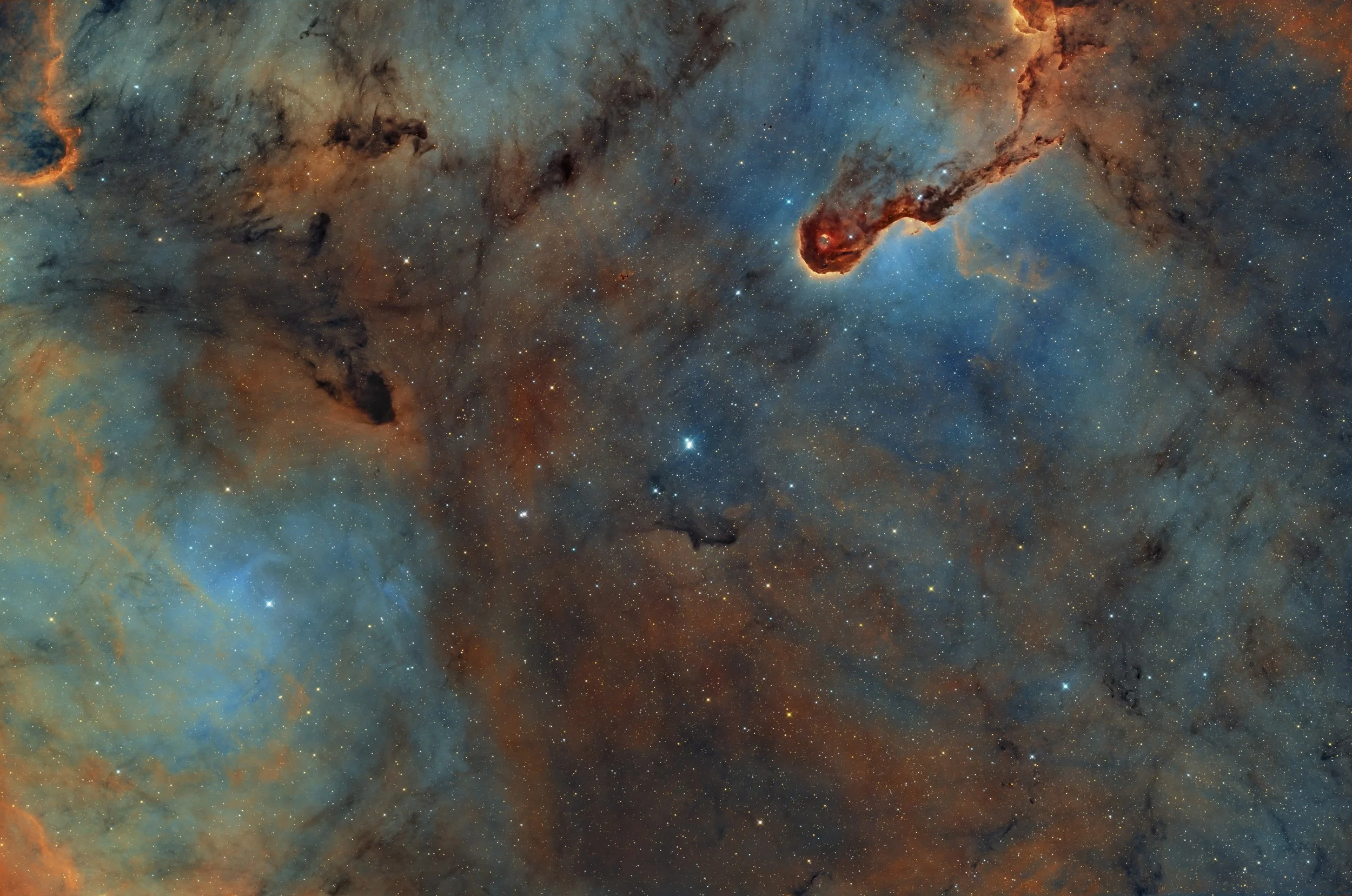
elephants trunk nebula ic 1396
The striking dark column near the top right of this image is known as the Elephant's Trunk Nebula, a dense region of interstellar gas and dust located within the vast emission nebula IC 1396 in the constellation Cepheus. Sculpted by the intense ultraviolet radiation and stellar winds from young, massive stars, this elongated structure is a stellar nursery where new stars are actively forming inside its dusty recesses. The vivid palette highlights sulfur in orange tones, hydrogen in greenish hues, and oxygen in blue, revealing the complex interplay of elements in this dynamic region.
IC 1396 spans over 100 light-years and lies roughly 2,400 light-years from Earth. Despite its immense size, the Elephant's Trunk feature itself measures about 20 light-years long. This image offers a glimpse into the processes of star birth, where collapsing clouds ignite to create new suns, continuing the cosmic cycle of matter and energy.