

AAPOD2 Image Archives
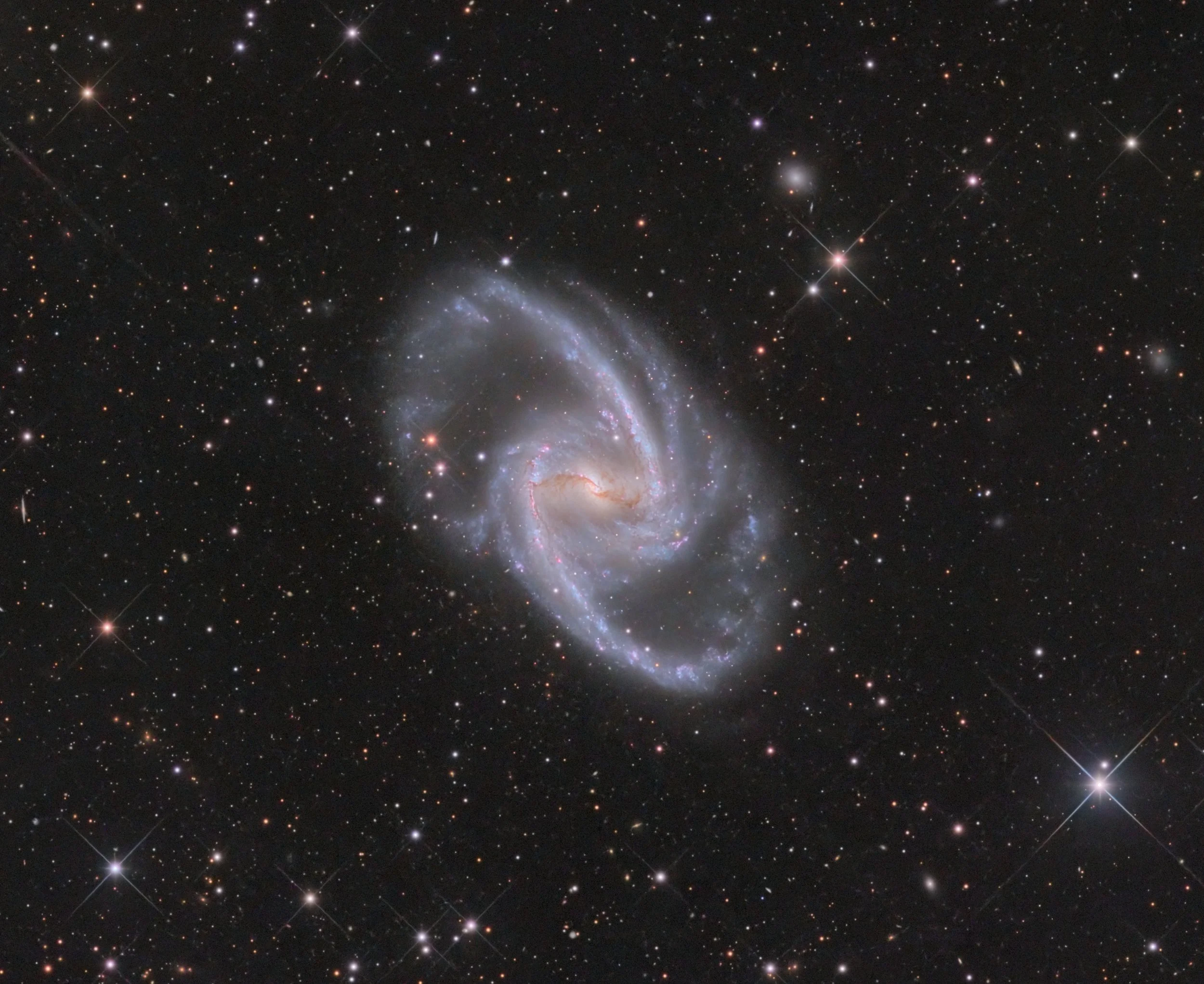
NGC 1365 – The Great Barred Spiral of Fornax
NGC 1365, often called the Great Barred Spiral Galaxy, lies about 56 million light-years away in the constellation Fornax. Spanning over 200,000 light-years, this galaxy is a classic barred spiral, showcasing sweeping arms and a prominent central bar filled with stars and dust lanes. Star-forming regions glow pink along the spiral arms, while young blue star clusters trace the galaxy's graceful curves.
Captured from Tivoli Astrofarm in Namibia, this deep image highlights the galaxy's intricate dust structure and faint outer extensions against a rich background of distant galaxies. NGC 1365 is also an important laboratory for studying galactic dynamics and supermassive black holes, as it hosts an active nucleus at its core. Its stunning symmetry and vivid detail make it one of the most photogenic galaxies in the southern sky.

Mineral Moon
This enhanced view of the Moon reveals its hidden colors, representing subtle variations in the composition of its surface. The reddish-brown hues indicate iron-rich basaltic plains, known as lunar maria, while bluish tones highlight areas with a higher concentration of titanium. These color differences are not visible to the naked eye but can be brought out through careful processing, offering a mineralogical map of Earth's only natural satellite.
The image was captured near first quarter, when the interplay of sunlight and shadow emphasizes the rugged terrain of lunar highlands and cratered regions. The Moon, about 3,474 kilometers across, has been geologically inactive for billions of years, yet its surface preserves the history of impacts and volcanic activity that shaped it. This mineral view gives a scientific twist to a familiar object, showing how much diversity lies within its gray appearance.
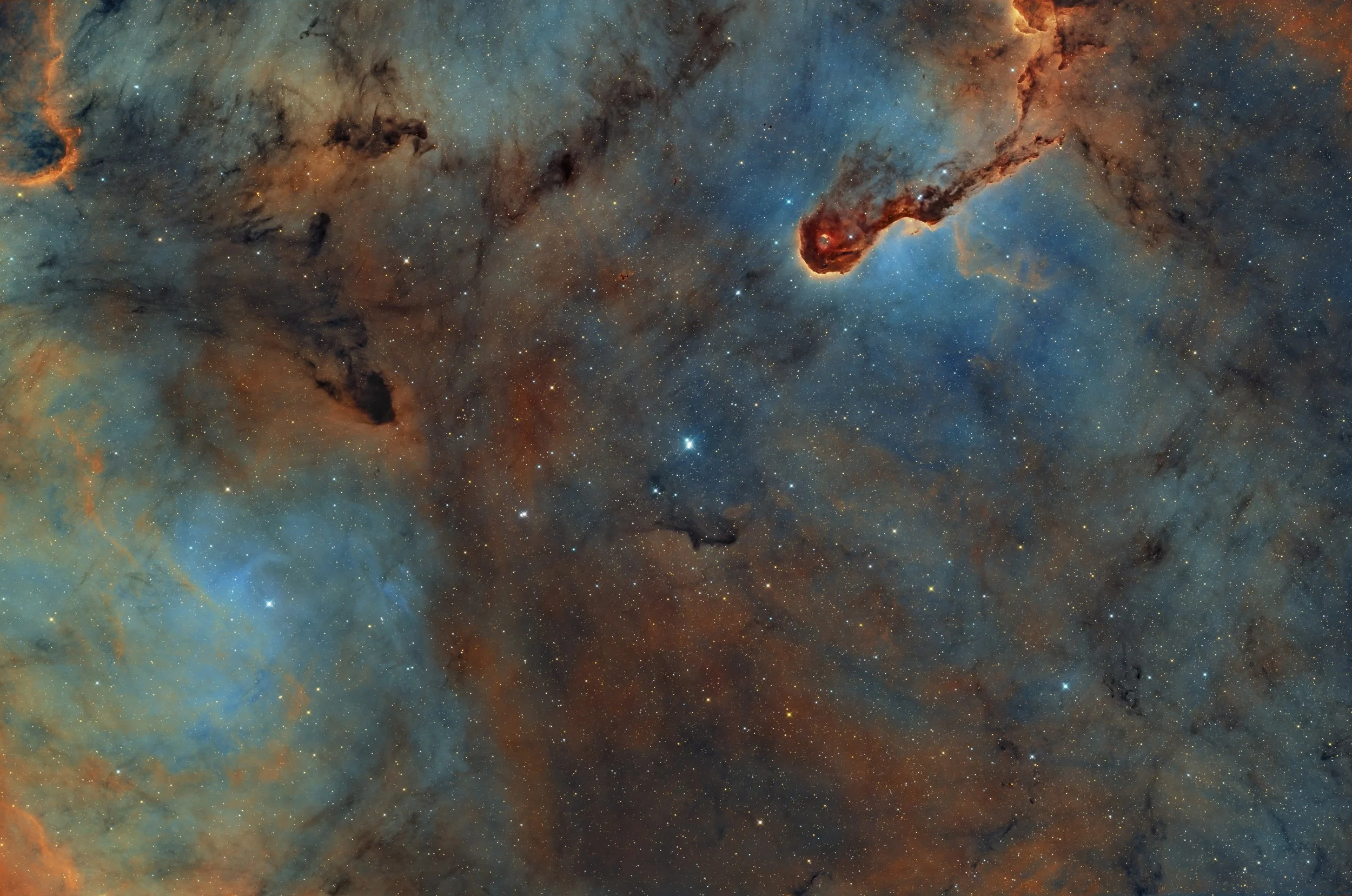
elephants trunk nebula ic 1396
The striking dark column near the top right of this image is known as the Elephant's Trunk Nebula, a dense region of interstellar gas and dust located within the vast emission nebula IC 1396 in the constellation Cepheus. Sculpted by the intense ultraviolet radiation and stellar winds from young, massive stars, this elongated structure is a stellar nursery where new stars are actively forming inside its dusty recesses. The vivid palette highlights sulfur in orange tones, hydrogen in greenish hues, and oxygen in blue, revealing the complex interplay of elements in this dynamic region.
IC 1396 spans over 100 light-years and lies roughly 2,400 light-years from Earth. Despite its immense size, the Elephant's Trunk feature itself measures about 20 light-years long. This image offers a glimpse into the processes of star birth, where collapsing clouds ignite to create new suns, continuing the cosmic cycle of matter and energy.
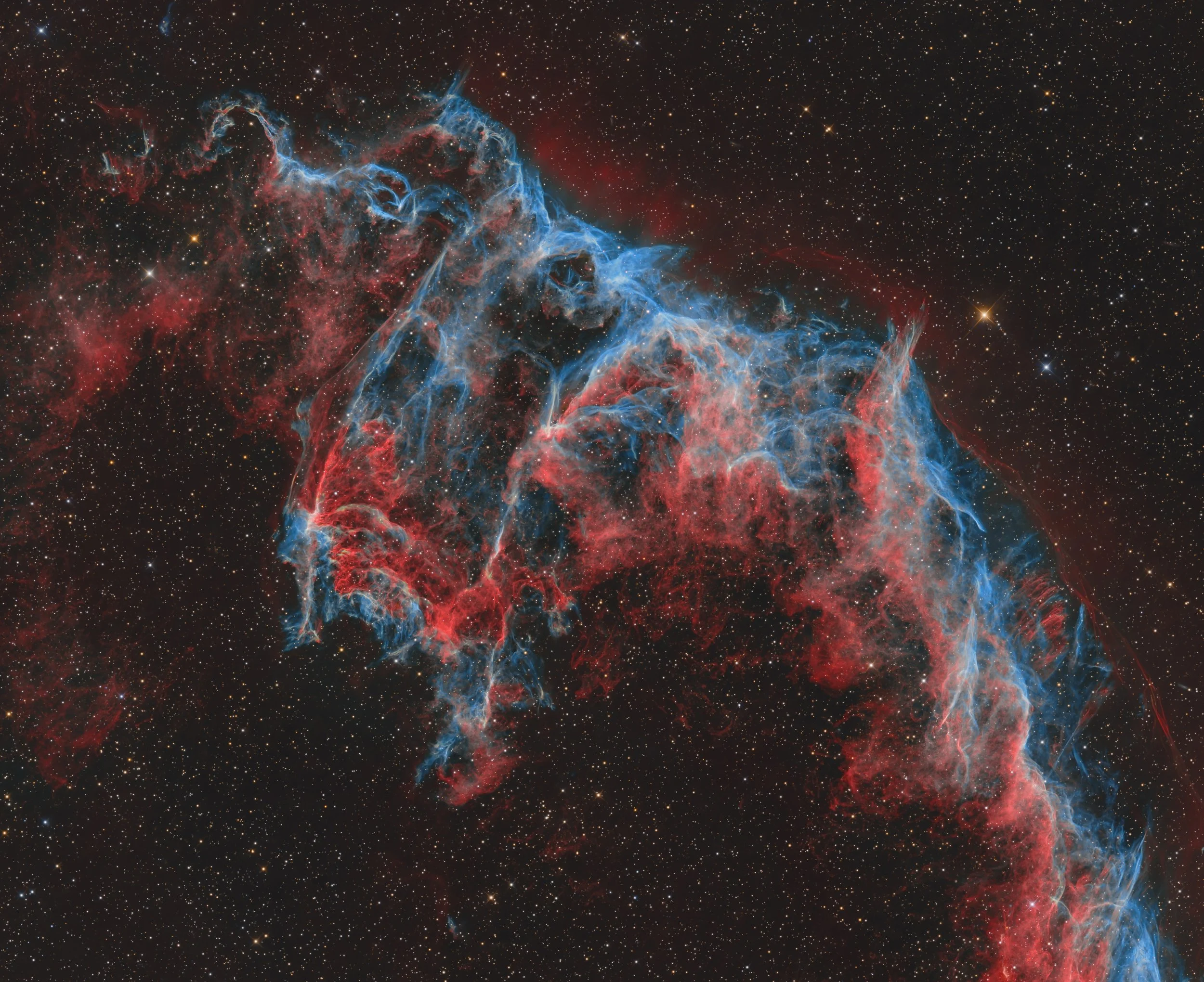
The Eastern Veil Nebula in Cygnus
The bright, filamentary arcs of NGC 6995 form part of the Eastern Veil Nebula, the remnants of a massive star that exploded around 8,000 years ago. The delicate structures of glowing hydrogen and oxygen gas trace shock waves plowing through interstellar space. Captured in rich detail, the red hues highlight ionized hydrogen while the blue tones represent doubly ionized oxygen, creating a vivid portrait of stellar death and rebirth.
This intricate region lies in the constellation Cygnus, along the plane of our Milky Way. Though the star that created this structure is long gone, its expanding debris continues to sculpt the surrounding medium, seeding future generations of stars. The entire Veil Nebula complex spans over 100 light-years and remains one of the most striking examples of a supernova remnant in the night sky.
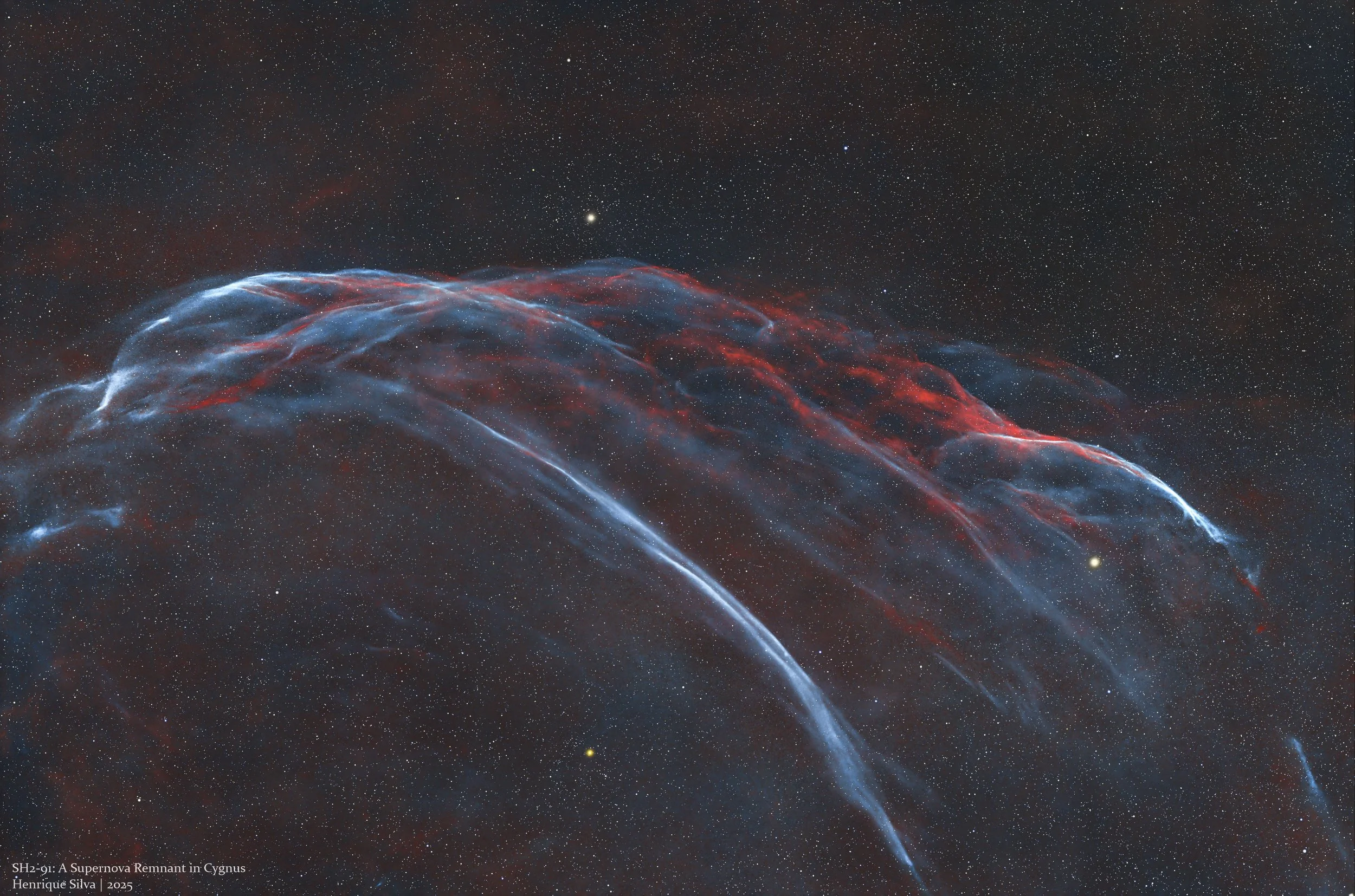
SH2-91: A Supernova Remnant in Cygnus
The faint, filamentary arcs of SH2-91 trace the expanding remains of a massive star that exploded thousands of years ago in the constellation Cygnus. This supernova remnant is part of a larger, diffuse structure of glowing gas that stretches across the star-rich fields of the Milky Way. Delicate tendrils of hydrogen and oxygen emission form the faint ribbons that mark the shock fronts moving through interstellar space.
Although far less well-known than the nearby Veil Nebula, SH2-91 offers a glimpse of the same cosmic process: the recycling of stellar material into the galaxy. The remnants of the long-gone star continue to shape the interstellar medium, seeding it with heavier elements that will one day become part of new stars and planets.
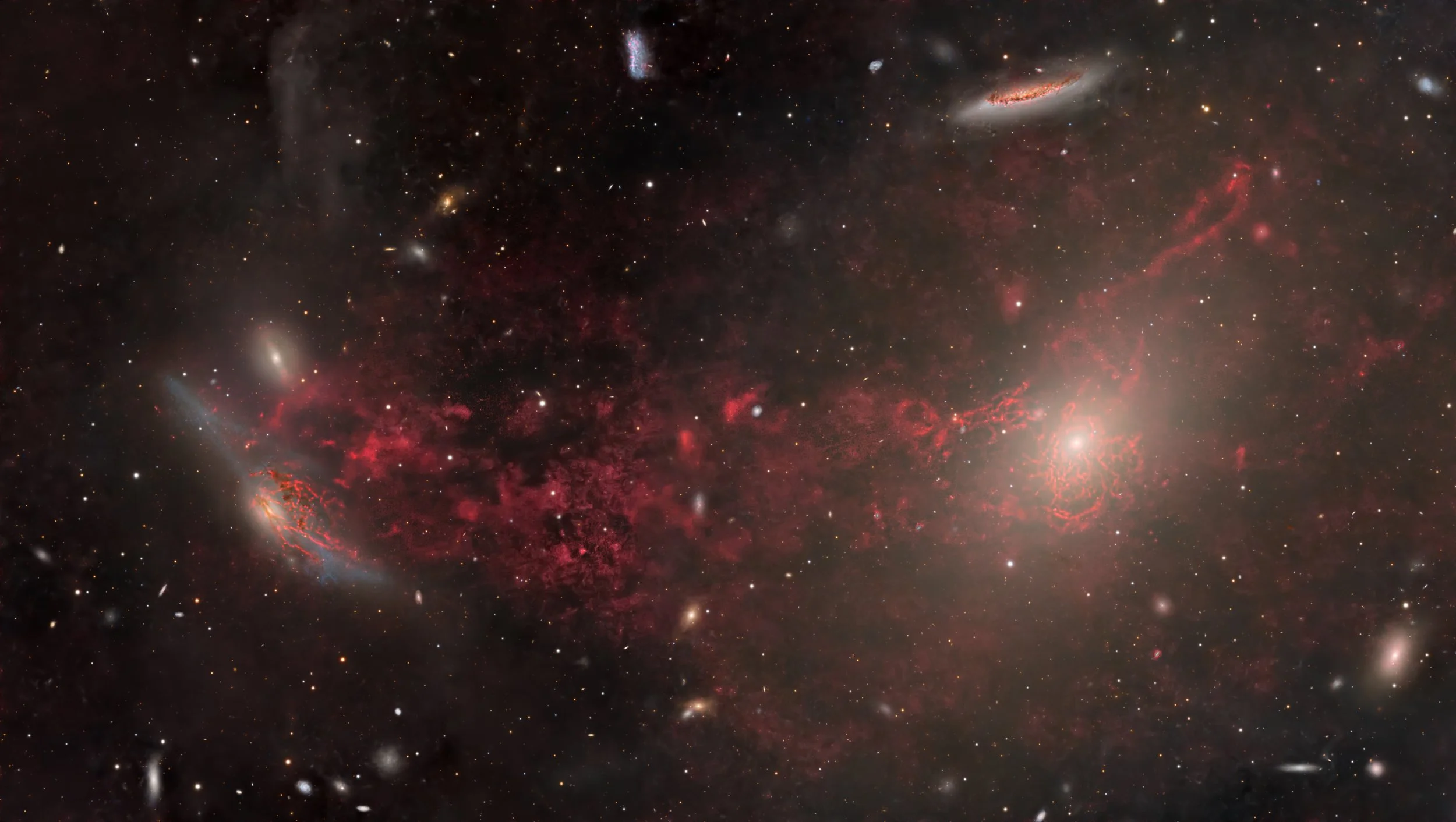
Eyes Wide Shut - The Markarian Bridge Up Close
The Virgo Cluster is home to a remarkable structure of gas and dust: a collision-induced hydrogen bridge connecting the galaxies known as The Eyes (NGC 4435 & NGC 4438) to the giant elliptical galaxy M86. Captured here with more than 400 hours of exposure over two years, including 280 hours through a hydrogen-alpha filter, the image reveals an extraordinary level of faint detail in the vast intergalactic structures.
This delicate bridge is the result of gravitational interactions and past collisions, pulling material out into space and igniting regions of glowing hydrogen. The faint filaments weave across the field in a chaotic tapestry, bearing witness to the ongoing evolution of galaxies within the crowded Virgo Cluster.
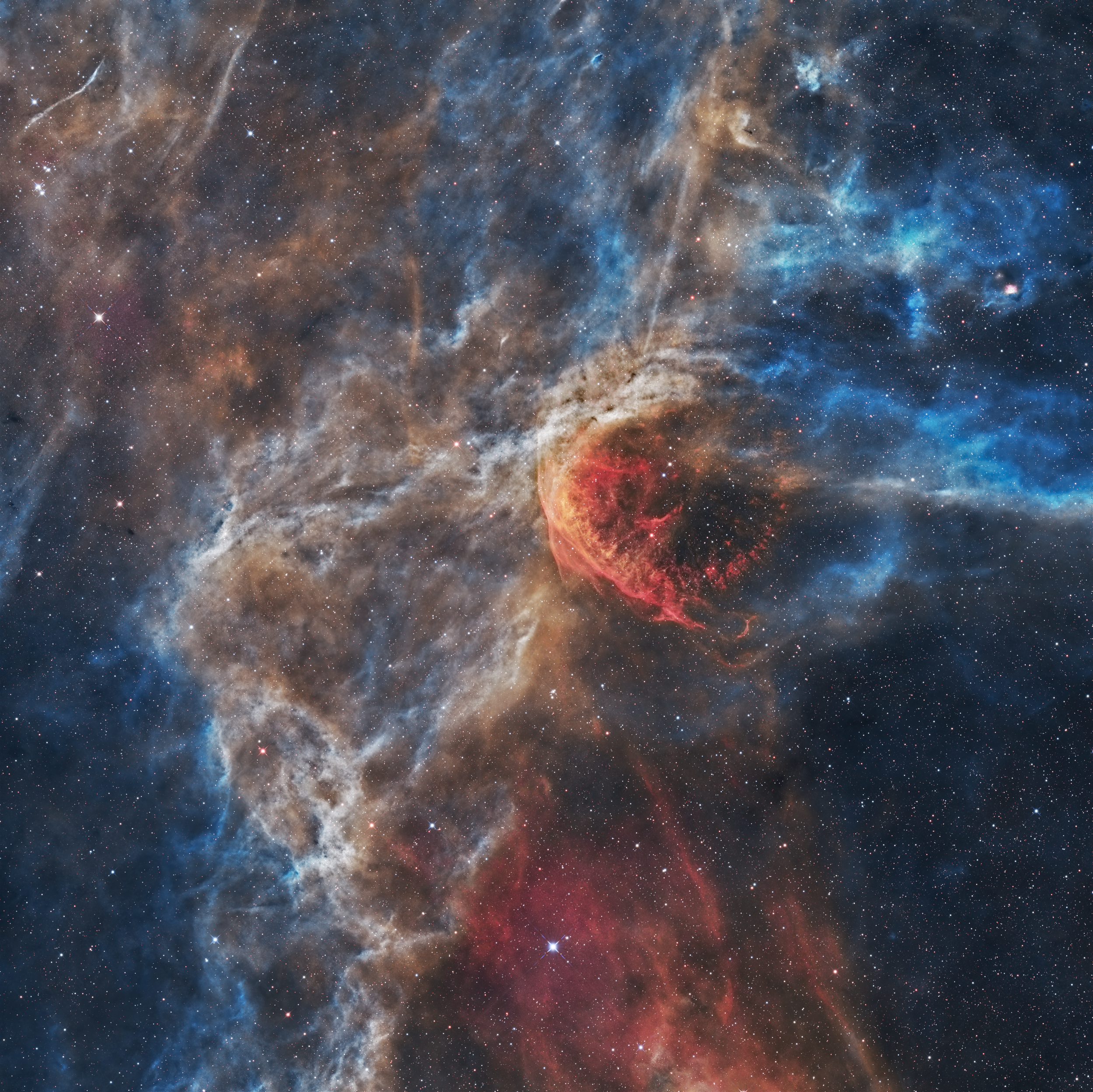
WR 134 – Rise of the Shai-Hulud
The massive Wolf–Rayet star WR 134, located in Cygnus about 6,000 light-years away, is the source of the striking nebula seen here. Intense stellar winds from the hot, unstable star sweep surrounding gas into a luminous bubble, glowing brightly in ionized oxygen (blue) and hydrogen (red). These winds move at thousands of kilometers per second, carrying away much of the star’s mass as it approaches the end of its short life. WR 134 is expected to eventually collapse in a violent supernova, seeding the interstellar medium with heavy elements.
The complex interplay of gas and dust gives the region its sculpted, almost otherworldly appearance. In this image, the bubble seems to rise from the surrounding filaments like a great cosmic sandworm, earning the nickname “Rise of the Shai-Hulud” after the desert creatures of Dune. Deep narrowband imaging reveals the faint arcs and ripples of past ejections, providing insight into the turbulent history of one of the galaxy’s most energetic stellar phases.
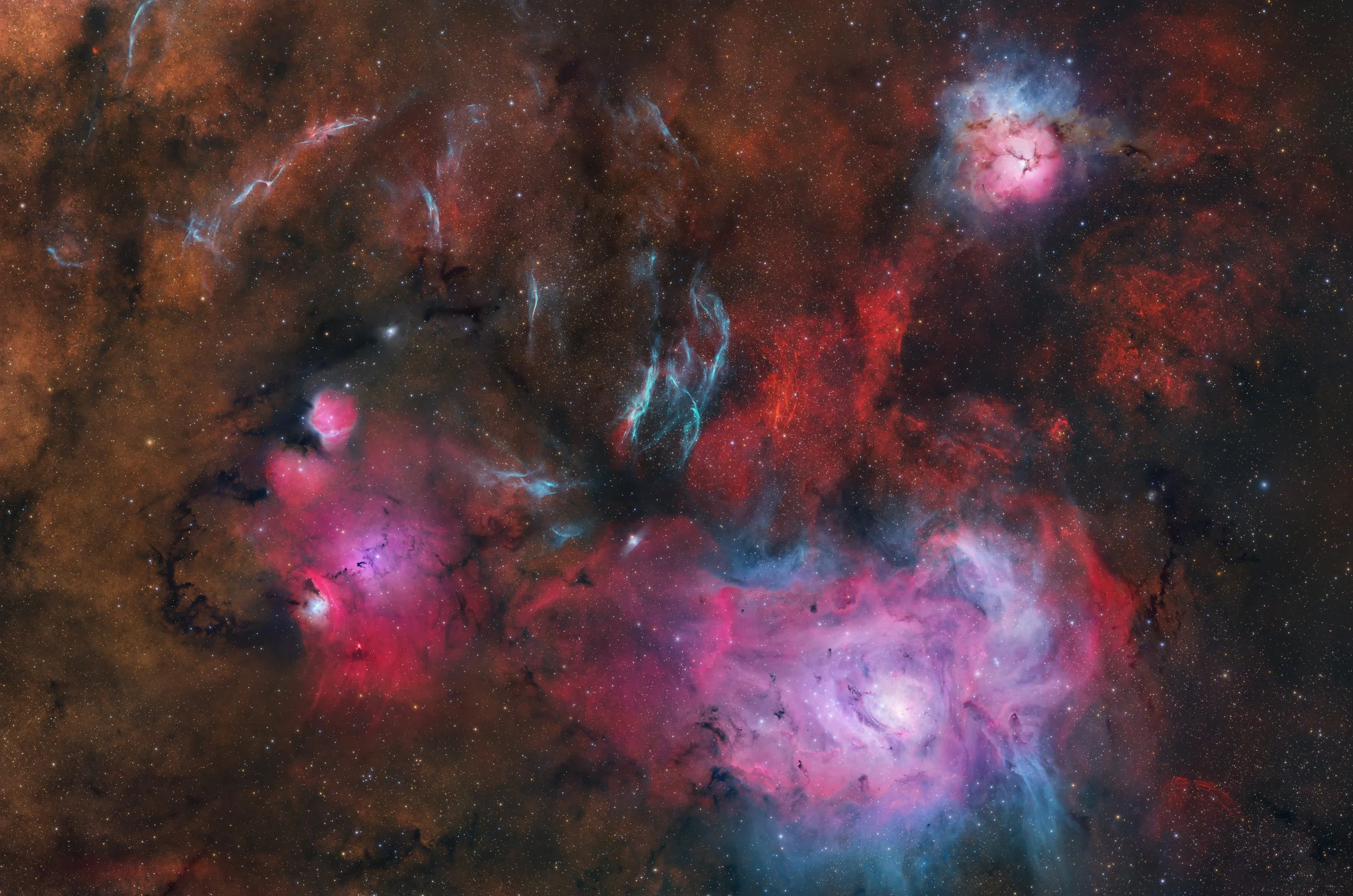
SNR G007.5-01.7 “Taz” Near the Lagoon Nebula
Adjacent to the Lagoon Nebula (M8) lies the faint supernova remnant SNR G007.5-01.7, informally known as “Taz” for its distinctive shape. This remnant consists of delicate O III–rich filaments, the cooling and recombining gas from a massive star’s explosion thousands of years ago. The shock fronts, driven outward into the interstellar medium, excite oxygen atoms, producing the characteristic teal emission captured through narrowband filters. Its low surface brightness and location within a crowded Milky Way field make it a challenging target for deep imaging.
The object’s proximity to the bright emission of M8 often obscures its presence, requiring careful exposure balancing and extended integration time to separate its subtle filaments from background nebulosity. Observations like this provide rare opportunities to study the dynamics of supernova remnants interacting with surrounding molecular clouds in a dense galactic region. Such remnants contribute to the chemical enrichment of the interstellar medium, dispersing heavy elements forged in the progenitor star’s core.
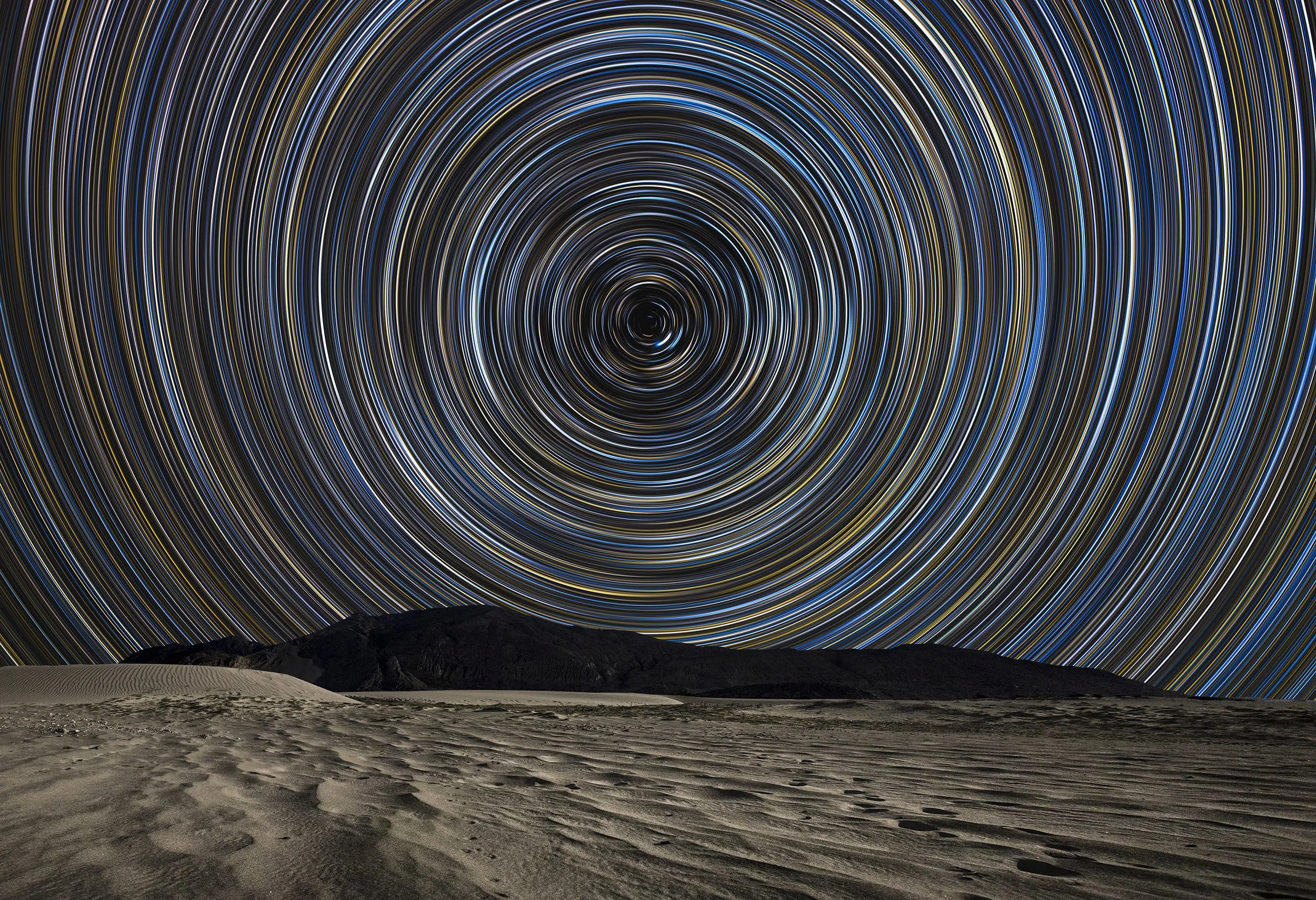
Star Trails Over Hunder Trail, Nubra Valley
In this long-exposure composite from Hunder Trail in the Nubra Valley, hundreds of sequential images capture the apparent motion of stars as Earth rotates. The camera was aimed toward the celestial pole, creating concentric arcs in the sky. The foreground’s still dunes and rugged terrain contrast sharply with the dynamic patterns above, emphasizing the scale and motion of our planet within the cosmos.
The varying colors of the trails arise from differences in stellar temperatures — blue from hotter, more massive stars and orange-red from cooler stars. By stacking shorter exposures rather than taking one extremely long shot, the photographer preserved detail, reduced noise, and revealed a clean, continuous record of the night’s rotation. This method turns hours of movement into a single frame of celestial geometry.
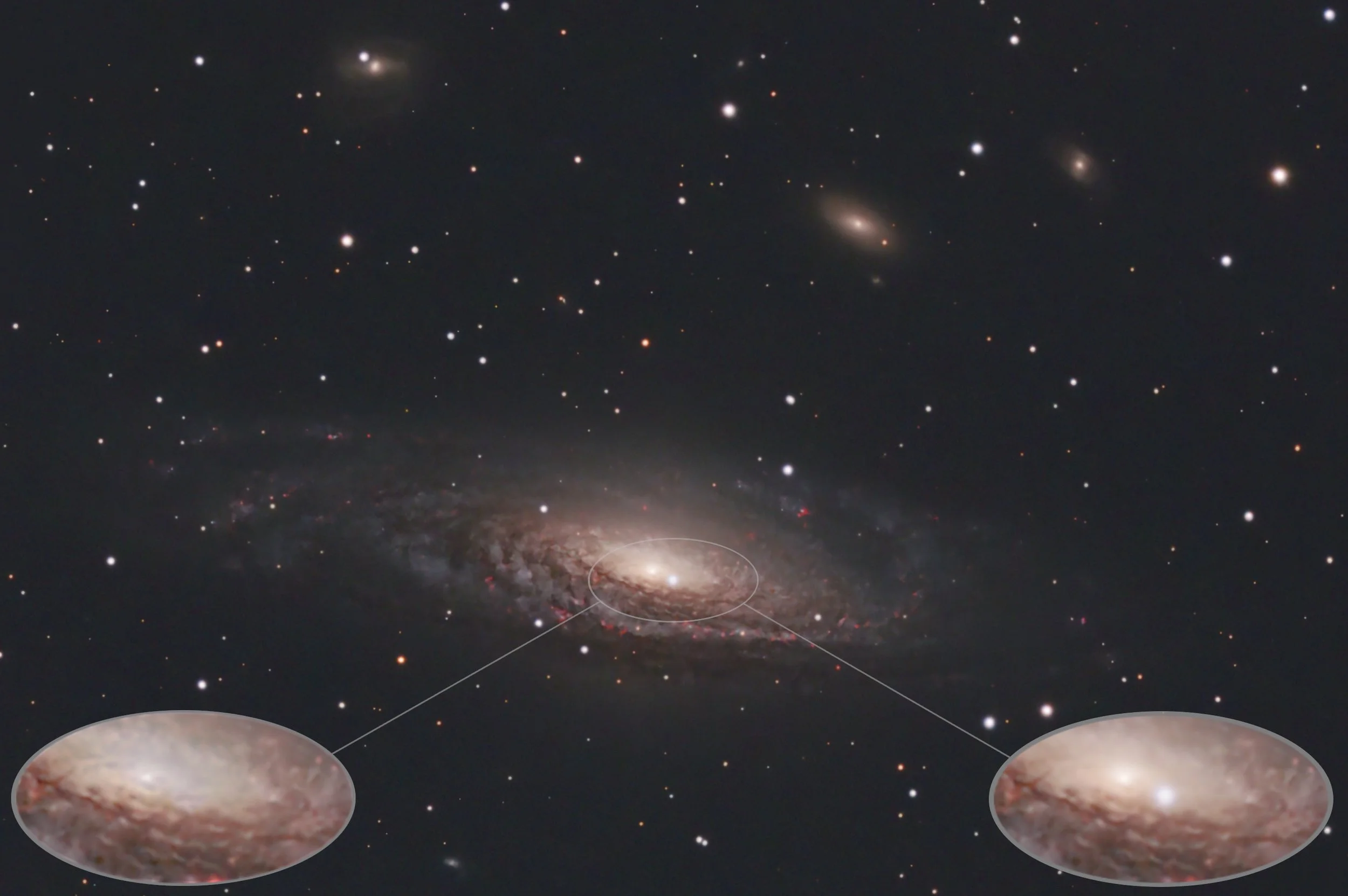
NGC 7331
Nestled within the inclined spiral galaxy NGC 7331—often dubbed our Galaxy’s twin—lies a remarkable transient: SN 2025rbs, a Type Ia supernova first detected on 14 July 2025. Classified soon thereafter, SN 2025rbs emerged from the thermonuclear detonation of a white dwarf in a binary system, the classic mechanism behind Type Ia supernovae. Its proximity to Earth, at about 43–45 million light-years, makes it the brightest Type Ia supernova visible from Earth since SN 2014J, presenting an exceptional opportunity for detailed follow-up studies.
In this image, captured on August 8, 2025, the supernova is marked close to the galaxy’s bright core, highlighted in magnified insets for clarity. Its observed apparent magnitude is near 12, consistent with expectations for a Type Ia event at this distance. Such explosions serve as "standard candles" because their peak luminosities are consistent enough (with minor corrections) to measure cosmic distances accurately.
This portrait not only captures the beauty of a galaxy akin to our own but also the moment a cosmic milestone was recorded—one that will contribute to refining our understanding of the universe’s expansion.
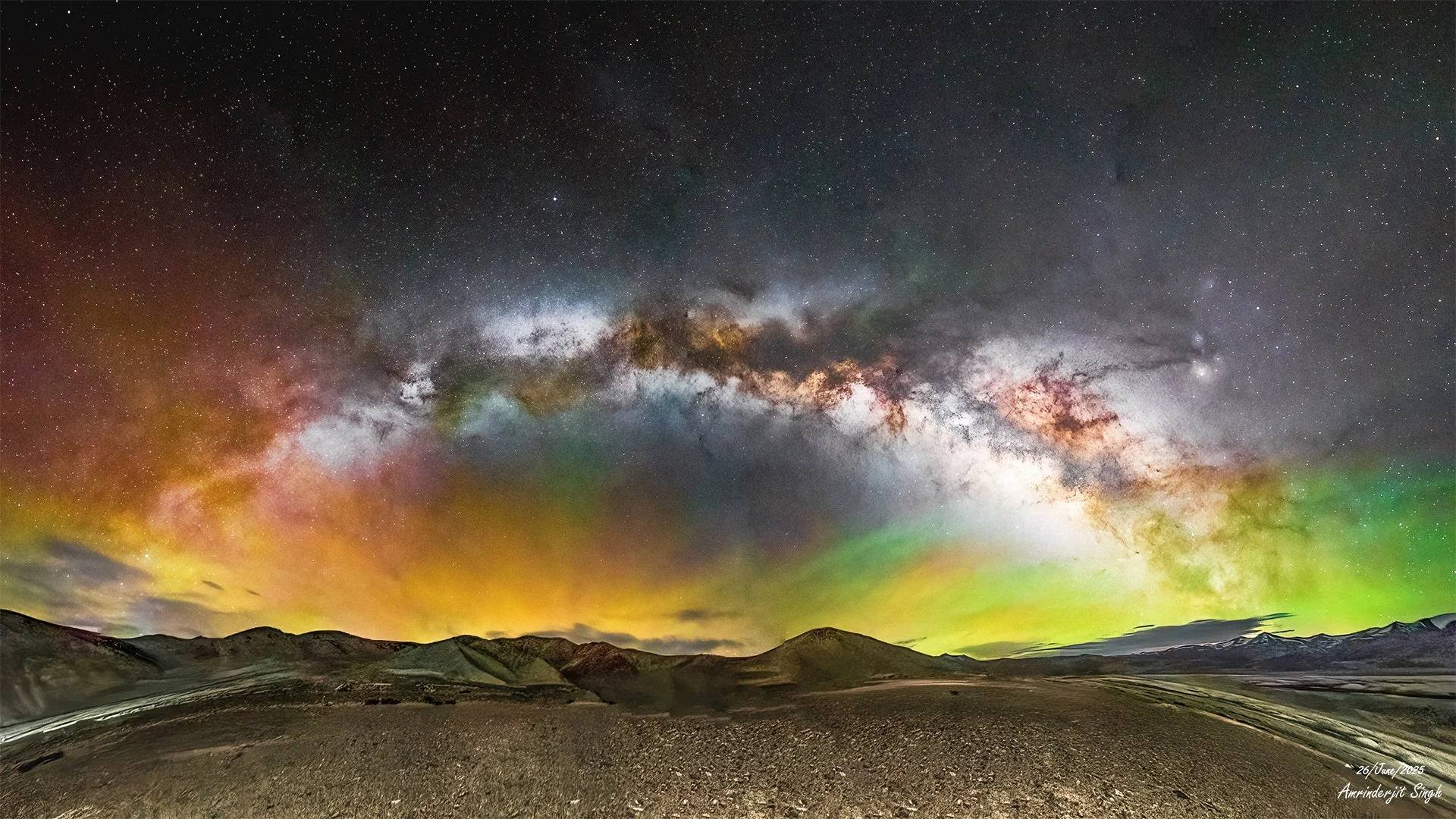
Milky Way Arch Over Tso Kar, Ladakh – Bathed in Airglow
In the rarefied high-altitude air of Ladakh’s Tso Kar region, the winter Milky Way stretches in a dazzling arc across the night sky. Prominent dark dust lanes weave through the galactic bulge, while brilliant star clouds and nebulae mark the dense core. Below, a vivid green and yellow airglow blankets the horizon — a faint, continuous emission from atmospheric oxygen and other molecules energized by solar ultraviolet radiation earlier in the day.
Airglow, unlike aurorae, occurs globally and year-round, its subtle light ensuring that the night sky is never completely dark. This panorama captures both the grandeur of the galaxy and the restless chemistry of Earth’s upper atmosphere in a single frame, revealing a landscape where terrestrial and cosmic phenomena meet.

The Veil Nebula - A Wider Context
In this expansive wide-field portrait, the Veil Nebula’s delicate filaments emerge from the remnants of a massive star that exploded thousands of years ago. Ionized hydrogen glows deep crimson, while oxygen-rich shock fronts appear in cyan, tracing the intricate structure of this ancient supernova remnant. Surrounding the nebula, a rich tapestry of interstellar gas and dust is illuminated, revealing the turbulent environment in the Cygnus constellation.
Captured from Zabriskie Point in Death Valley, the image places the Veil Nebula within its broader cosmic neighborhood, showing how its wispy arcs are embedded in vast clouds of hydrogen that span the region. The combination of high-resolution detail and wide framing offers a rare glimpse of both the remnant’s fine structure and its larger-scale relationship with the Milky Way’s glowing star-forming regions.
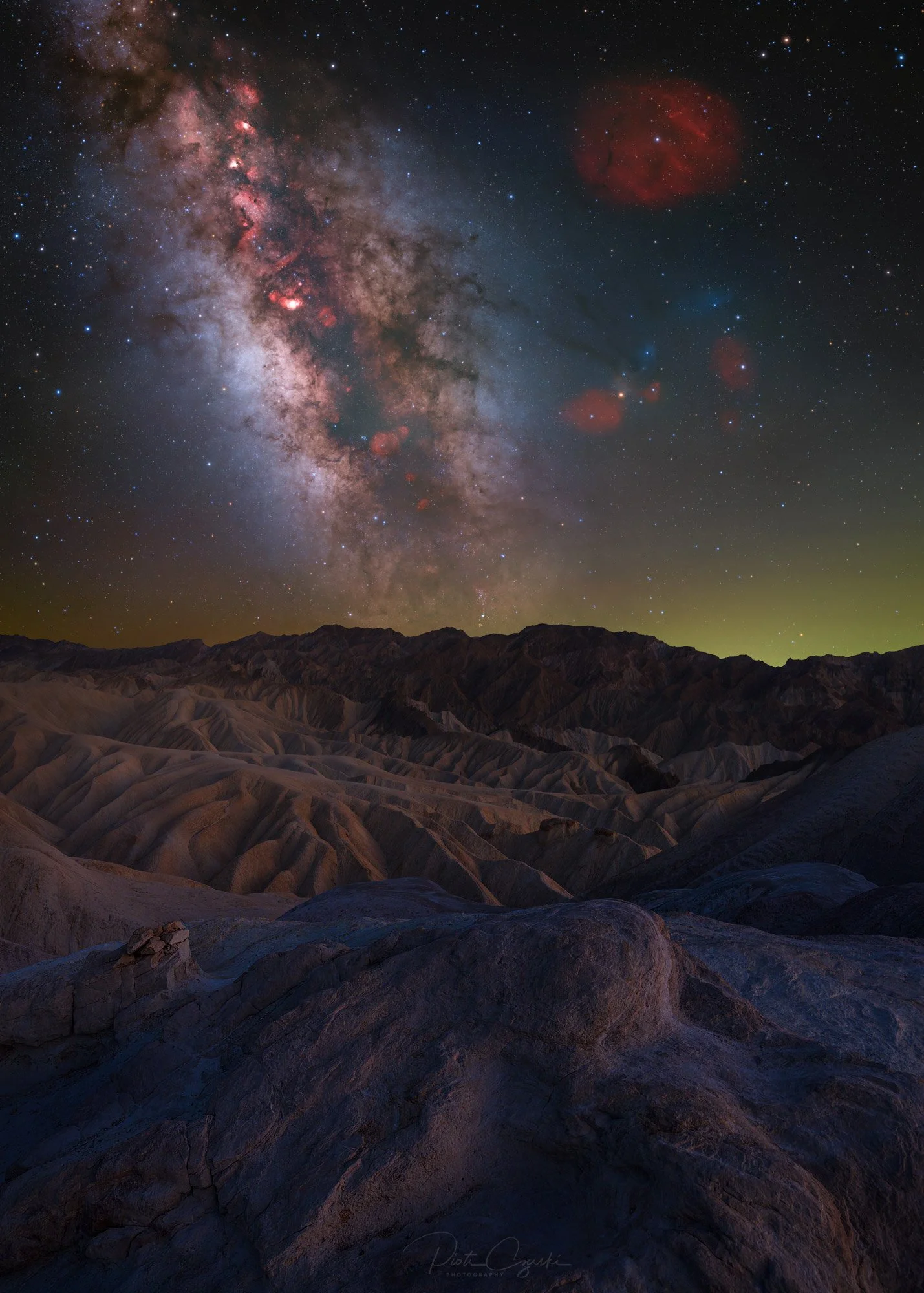
Death Valley Nights: The Milky Way at Zabriskie Point
From the rugged badlands of Zabriskie Point in Death Valley National Park, the central bulge of our Milky Way rises in breathtaking detail. The dense star fields are threaded with dark molecular dust lanes, while pinkish-red hydrogen emission nebulae, including the Lagoon (M8) and Trifid (M20) Nebulae , glow from the ultraviolet light of massive young stars. Higher in the frame, faint extended nebulae appear as red arcs and patches, their delicate structures revealed through long exposure imaging.
Near the horizon, a greenish band of airglow shines from oxygen atoms high in Earth’s atmosphere, contrasting with the cool-toned, shadowed terrain below. Together, the stark geology of the badlands and the rich structure of our galaxy create an image that bridges Earth and cosmos, captured under some of the darkest skies in the continental United States.

Pacman Nebula in LRGB and Narrowband
The Pacman Nebula (NGC 281) emerges from the star-filled Cassiopeia constellation, framed by delicate interstellar dust and glowing gas. Captured through a total of 46 hours of integration, 19 hours in narrowband and 27 hours in LRGB, the image reveals exquisite details in the nebula’s ionized hydrogen, oxygen, and sulfur regions, with intricate dark lanes cutting through the luminous clouds. These dense, dusty structures are active sites of star formation, sculpted by powerful stellar winds and radiation from hot, young stars. The rich colors come from a careful combination of narrowband emission data and natural-color broadband exposures, producing both scientific depth and aesthetic beauty.
![NGC 7094 and the Rarely Imaged “Shenron Nebula” [O III]](https://images.squarespace-cdn.com/content/v1/5debd4b16fcd7b02905712ff/17383bd5-691c-4545-a90a-6b3e1e98a558/NGC+7094+%26+Shenron+Nebula_HQ_WM.jpg)
NGC 7094 and the Rarely Imaged “Shenron Nebula” [O III]
At the center of this richly detailed wide-field view lies NGC 7094, a faint planetary nebula in the constellation Pegasus, showcasing its delicate blue-green glow from doubly ionized oxygen ([O III]). Surrounding it is an intricate tapestry of dusty interstellar cirrus, laced with faint red hydrogen emission. Cutting dramatically across the frame, the shimmering cyan ribbon known as the “Shenron Nebula” [O III] Arc reveals a rarely imaged ionization front, its ethereal form resembling a mythical dragon winding through the cosmic clouds. This combination of a planetary nebula and expansive, unrelated foreground structures creates a striking juxtaposition of astrophysical phenomena within the same celestial canvas.
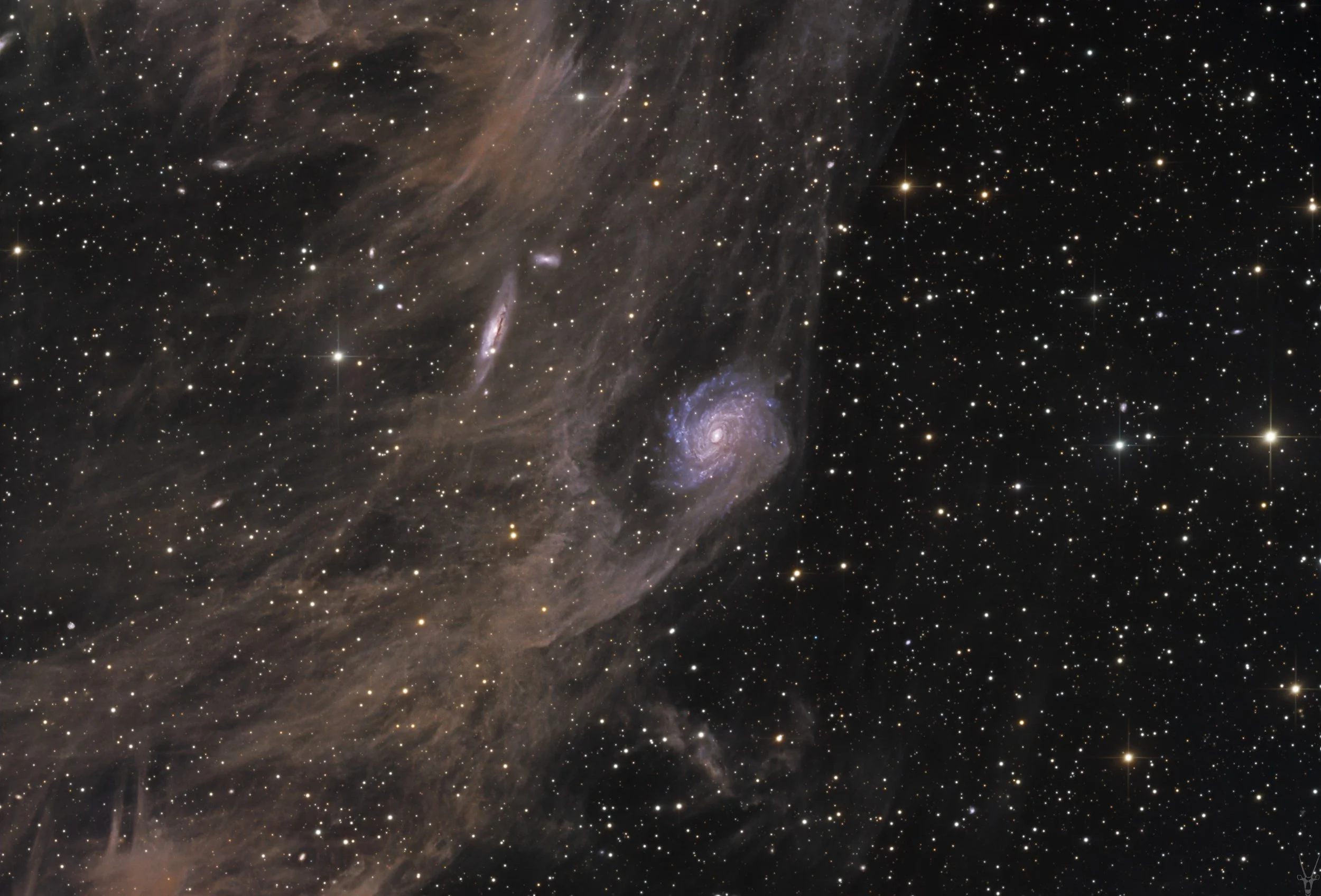
NGC 5907 and the Ghostly Stellar Stream
In this deep-sky portrait, the spiral galaxy IC 4633 emerges from behind a veil of galactic cirrus — faint, dusty clouds within our own Milky Way. These tenuous structures scatter and reflect the combined starlight of the galaxy, giving the scene a soft, ethereal glow. While IC 4633 lies far beyond our own galactic boundaries, the wisps of interstellar dust in the foreground create the illusion of the galaxy peering through a cosmic curtain. The interplay between the sharp, structured spiral arms and the diffuse, flowing dust filaments makes this field a striking example of depth and perspective in astrophotography.
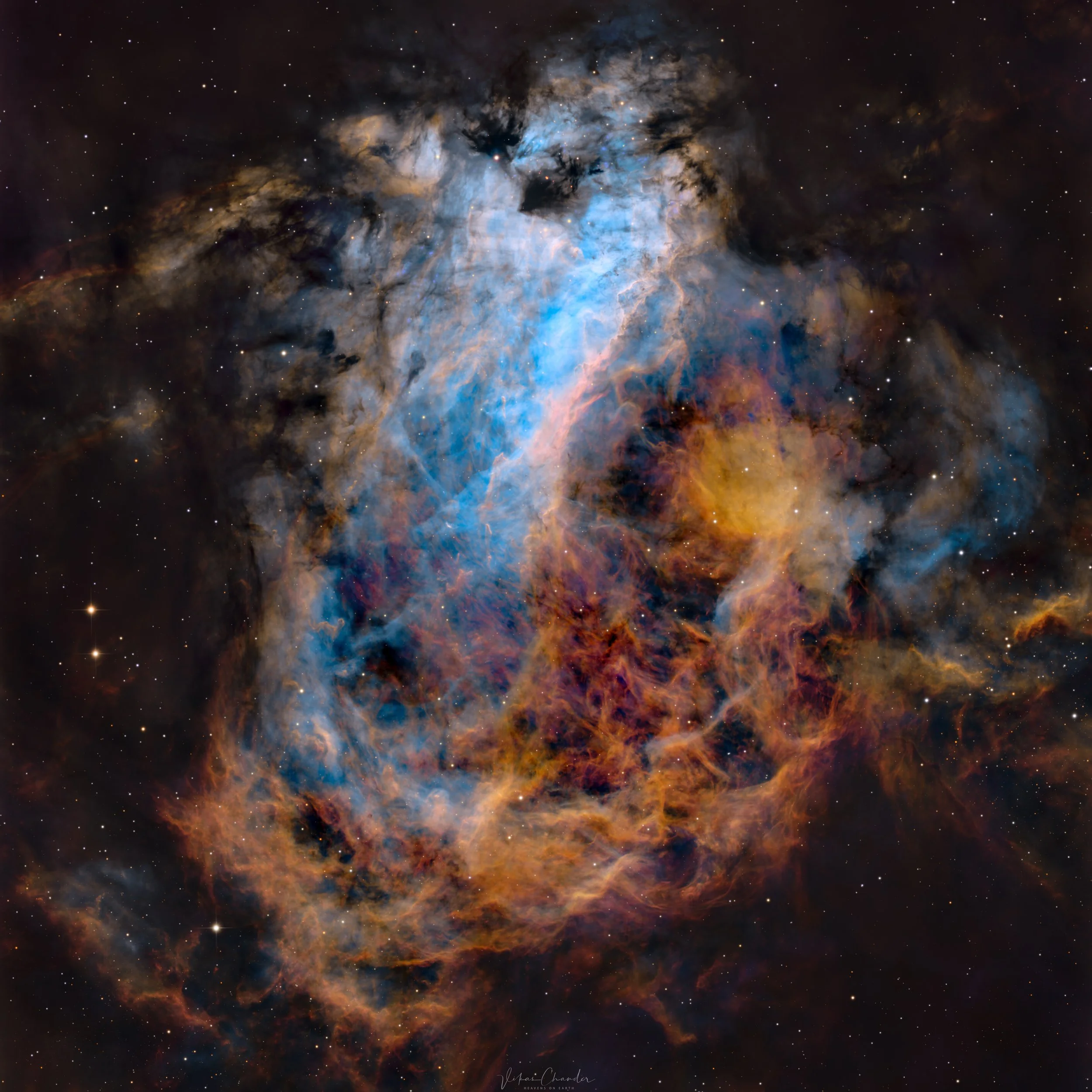
Radiant Wings of the Swan Nebula
The Swan Nebula, also known as M17 or the Omega Nebula, is a massive star-forming region located about 5,000 light-years away in the constellation Sagittarius. This detailed image reveals its turbulent clouds of ionized hydrogen gas, sculpted into intricate filaments and arcs by the intense ultraviolet radiation and stellar winds from newborn massive stars. The bright blue areas trace regions rich in oxygen, while gold and orange hues highlight sulfur and hydrogen emissions, captured here in a narrowband palette that brings out the nebula’s complex structure.
This view showcases M17’s luminous core embedded in vast dark dust lanes that both obscure and shape the surrounding emission. The Swan Nebula spans about 15 light-years across and is one of the brightest and most massive H II regions in our galaxy, making it a favorite target for both professional and amateur astronomers. The interplay of light and shadow within the nebula offers a striking glimpse into the chaotic, beautiful environments where stars are born.
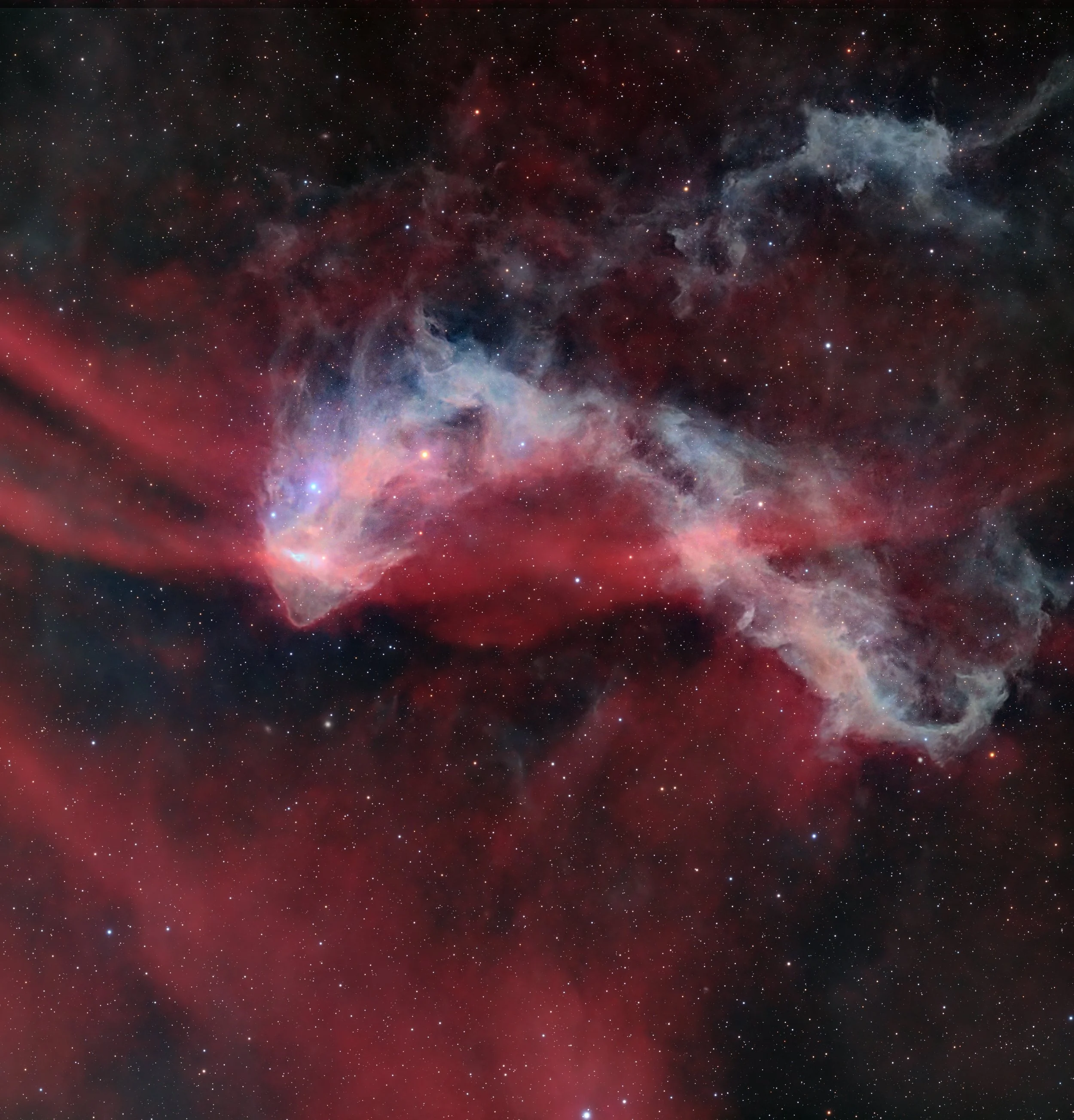
The Gecko Nebula – LBN 437 from Spain
Winding across the stars in ghostly blues and reds, LBN 437 is a dark nebula in the constellation Lacerta that has become affectionately known as the Gecko Nebula due to its striking, reptilian shape. This beautifully composed image from Cinctorres, Valencian County, Spain, captures both the glowing hydrogen emission and delicate reflection nebulae as interstellar dust swirls around young, hot stars embedded in the cloud.
The Gecko’s “head,” illuminated by nearby stars, appears to glow with subtle blue hues while the reddish background is caused by hydrogen-alpha emission. These faint structures are part of the larger Cepheus Flare region, a vast complex of gas and dust in our Milky Way where new stars are forming. Images like this reveal the dynamic sculpting forces of stellar radiation, gravity, and time.
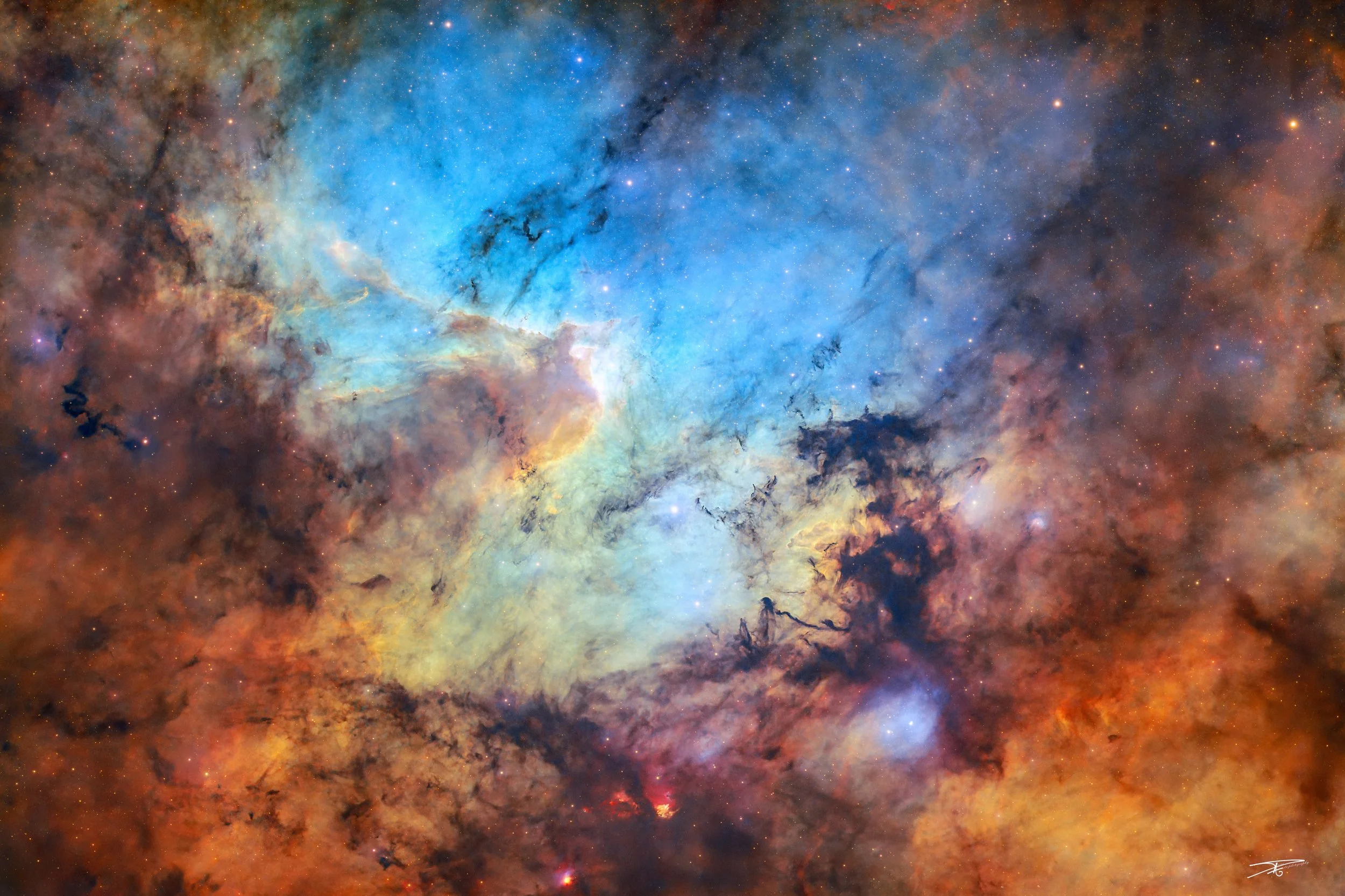
Sharpless 155 – The Cave Nebula in 37 Hours of SHO Color
This brilliant and colorful image of Sharpless 155, also known as the Cave Nebula, reveals a complex region of star formation and glowing gas sculpted by powerful stellar winds and radiation. Captured in the SHO palette (Sulfur, Hydrogen, Oxygen), this narrowband composite highlights the intricate interplay of ionized gases across the emission nebula in vivid contrast: sulfur in red, hydrogen in green, and oxygen in blue.
Located in the constellation Cepheus, the Cave Nebula is a blend of emission, reflection, and dark nebulae. The bright wall of gas seen on the left appears to form a cavern-like hollow, giving this nebula its popular name. This image represents 37 hours of total exposure, allowing for fine detail in the faintest structures of this richly textured cosmic landscape.
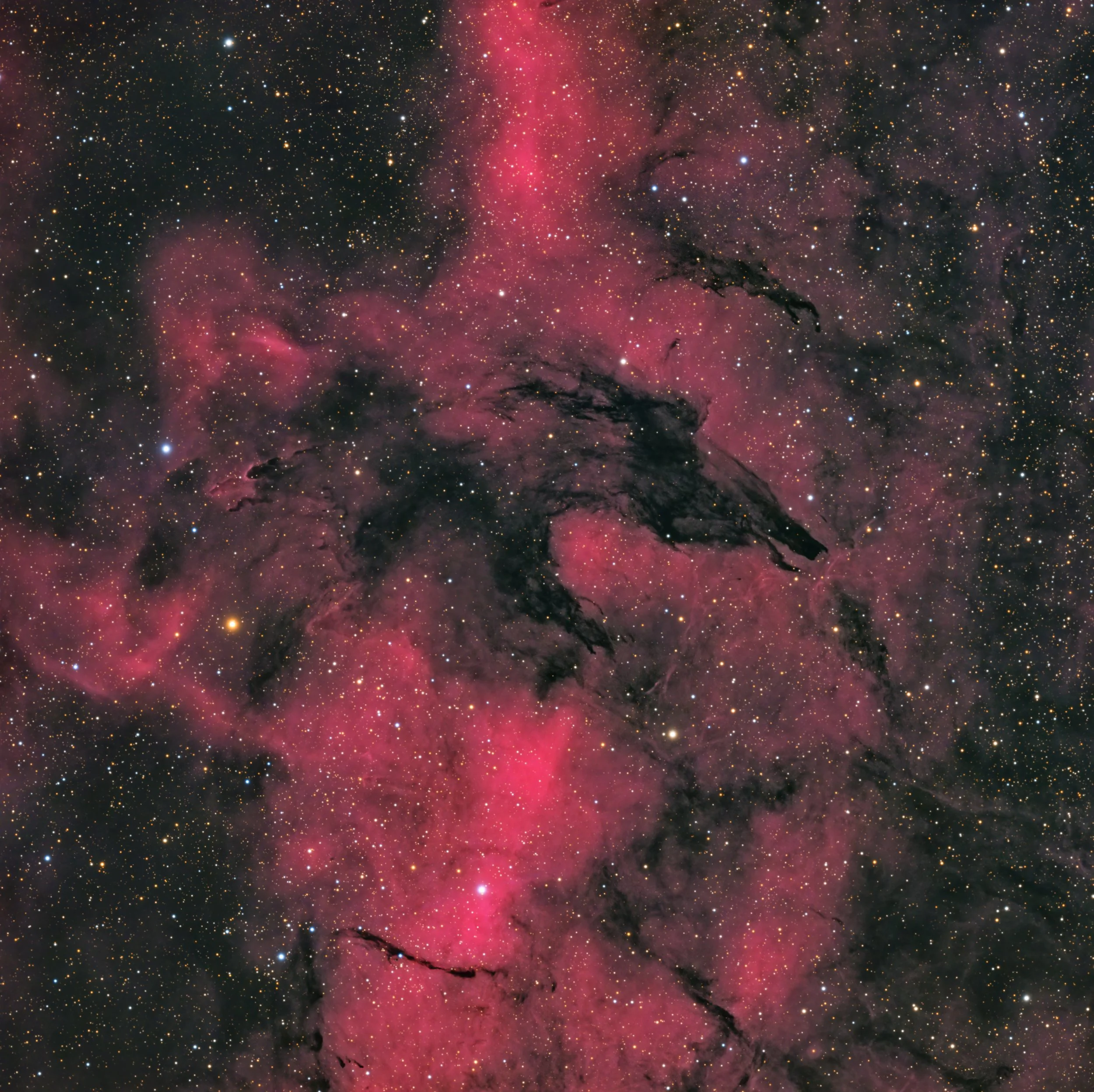
Fenrir the Dark Wolf – A Cosmic Silhouette in Cygnus
Amid the bright hydrogen glow of the Cygnus constellation, a menacing dark nebula takes the shape of a wolf mid-prowl. Known informally as Fenrir the Dark Wolf, this region of the sky is dominated by intricate filaments of ionized hydrogen (Ha) gas, illuminated in vivid red through over 11 hours of narrowband exposure. The dark “wolf” shape is formed by dense dust clouds that obscure the bright emission behind them, creating the illusion of a celestial predator on the hunt.
This HaLRGB composition was captured under Bortle 6 skies with a total integration time exceeding 21 hours, combining deep luminance and RGB channels to balance detail and color. The result is a rich tapestry of contrast and structure, with subtle background stars peppering the cosmic canvas. A haunting example of pareidolia in the interstellar medium, Fenrir waits in the shadows of Cygnus.