

AAPOD2 Image Archives
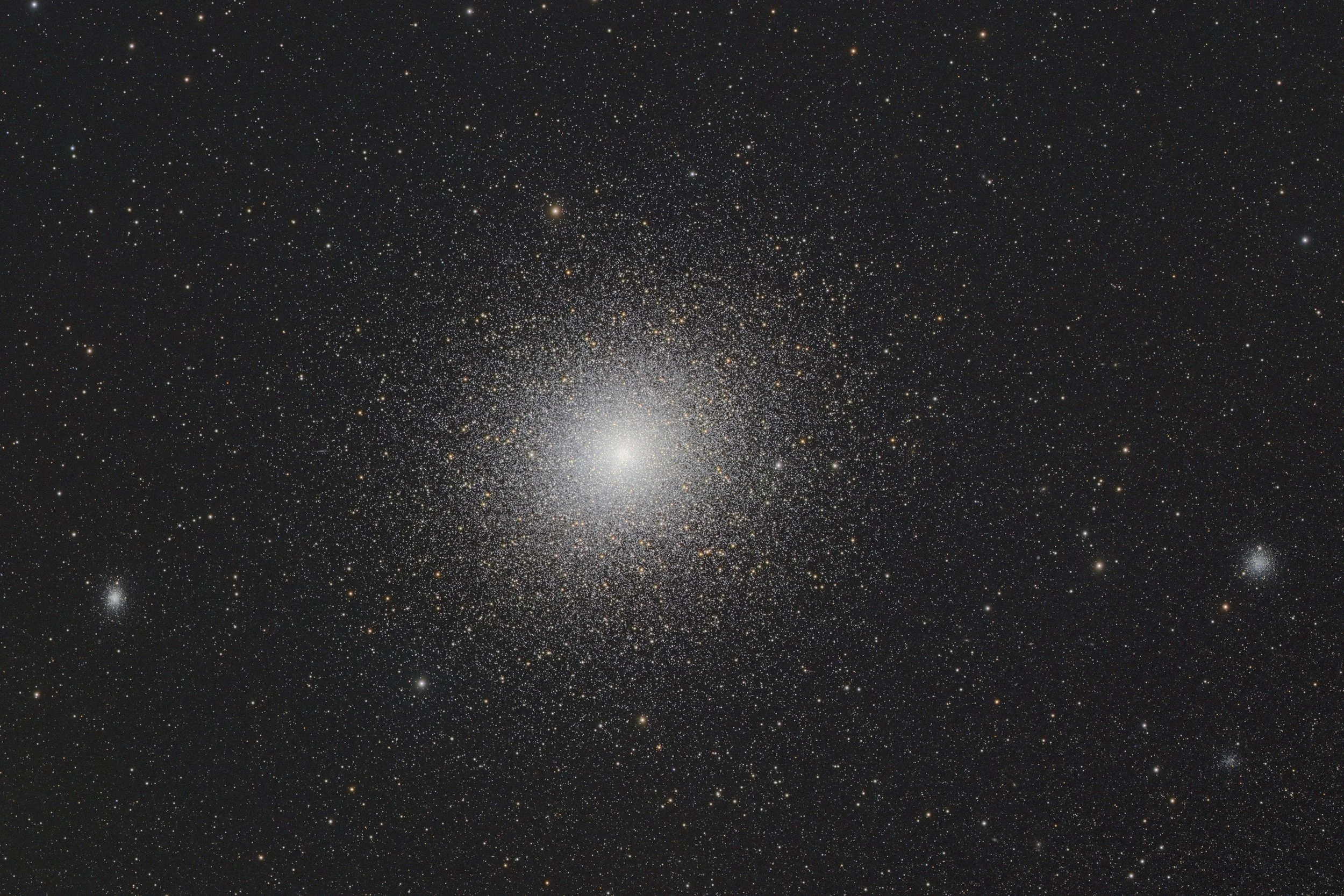
47 Tucanae and Beyond
This wide-field image showcases 47 Tucanae (NGC 104), one of the brightest and most massive globular clusters in the Milky Way, rising over the dark skies of Warrumbungle National Park, Australia. Located about 13,000 light-years away in the constellation Tucana, 47 Tuc contains millions of ancient stars densely packed into a luminous core that shines with a golden hue.
Surrounding the cluster are countless more distant stars and galaxies, offering a striking sense of scale between our galaxy’s halo and the deep cosmic background. The remarkable sharpness of this image reveals faint globulars and background galaxies, hinting at the vast structures that lie far beyond the Milky Way’s stellar outskirts.
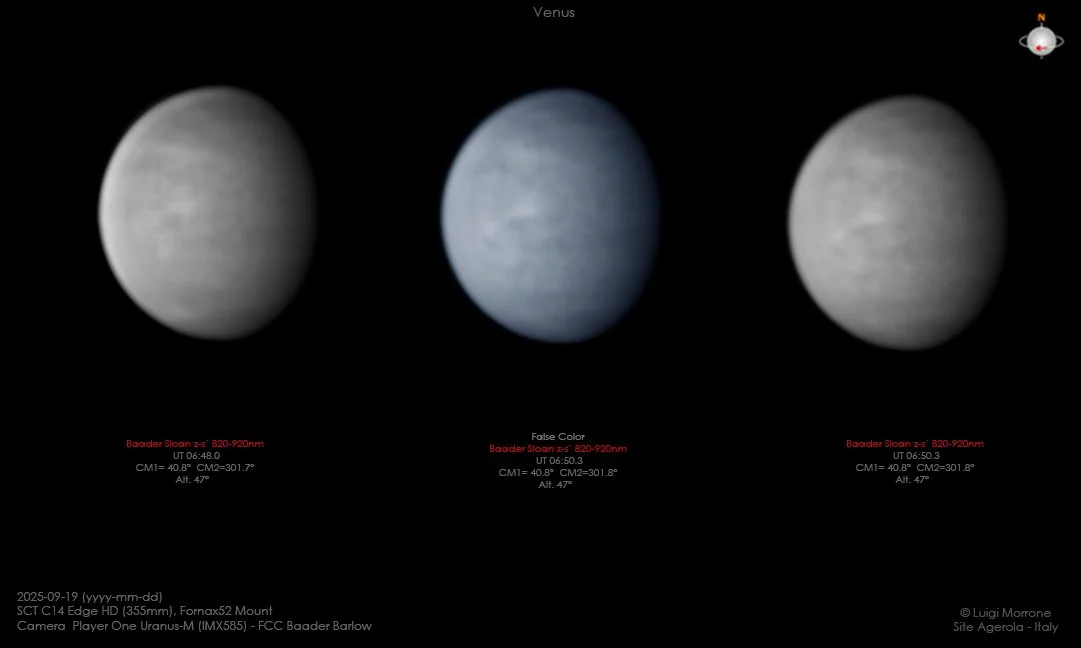
Venus IR
Captured under excellent seeing and transparency from Agerola on Italy’s Amalfi Coast, this composition reveals Venus through three distinct filters, each emphasizing different layers of the planet’s atmosphere. Subtle structures in the middle-altitude cloud decks become visible, shaped by complex winds and photochemical processes in the planet’s dense, reflective atmosphere.
Using a Celestron C14 Edge HD telescope on a Fornax 52 mount, Player One Uranus-M camera with a Baader FFC and Sloan z′ (820–920 nm) filter to record fine near-infrared detail. These stacked views together highlight how multispectral imaging can uncover features invisible to the eye, offering a rare glimpse into Venus’s dynamic cloud systems.

SNR G65.3+5.7 — The Faint Supernova Complex in Cygnus
Spanning nearly three degrees across the constellation Cygnus, SNR G65.3+5.7 is a vast and ancient supernova remnant, the lingering shell of a massive stellar explosion that occurred thousands of years ago. The nebula’s faint, filamentary structures, cataloged in parts as Sharpless 91, 94, and 96—trace the shock fronts of ionized hydrogen and oxygen as the expanding blast wave interacts with the surrounding interstellar medium.
Despite its enormous size, the remnant is extremely dim, requiring long exposures through narrowband filters to reveal its ghostly arcs of red and teal light. These delicate threads of emission offer a glimpse into the slow process of stellar death and dispersal, as the material from the once-brilliant star enriches the galactic environment with heavy elements.
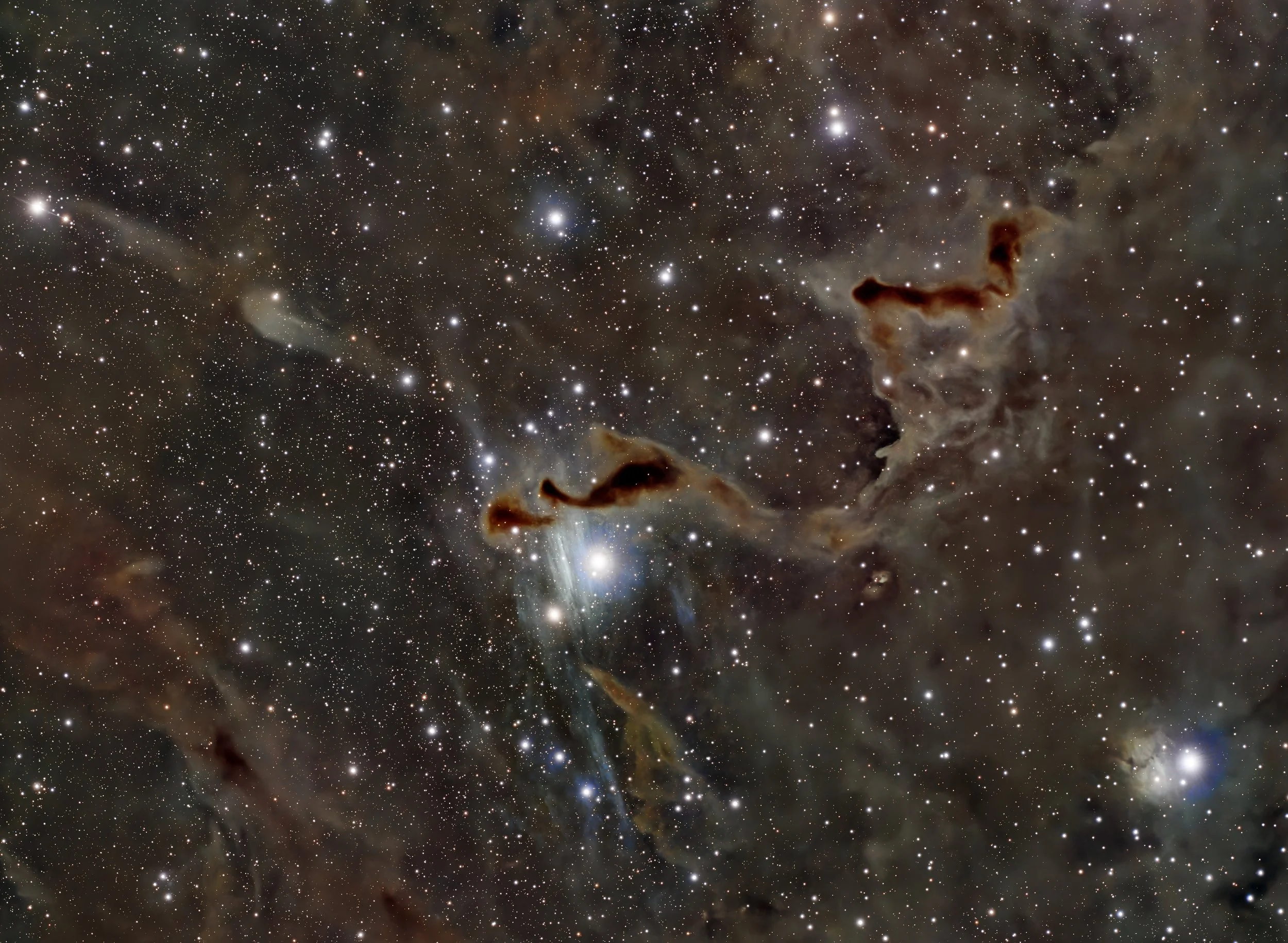
LDN 1355 — The Helping Hand
In the dark clouds of Cepheus, the molecular complex LDN 1355 stretches across space like a cosmic hand reaching through starlight. This dense region of interstellar dust obscures the background stars while faint reflection nebulae shimmer along its edges, illuminated by embedded young stars forming within.
The central reflection area glows in soft blue hues, contrasting against the rich brown and gray filaments of dust that define the dark nebula’s intricate shape. Known as the “Helping Hand,” LDN 1355 beautifully demonstrates the interplay between starlight and the raw material of star formation in one of the Milky Way’s quiet nurseries.
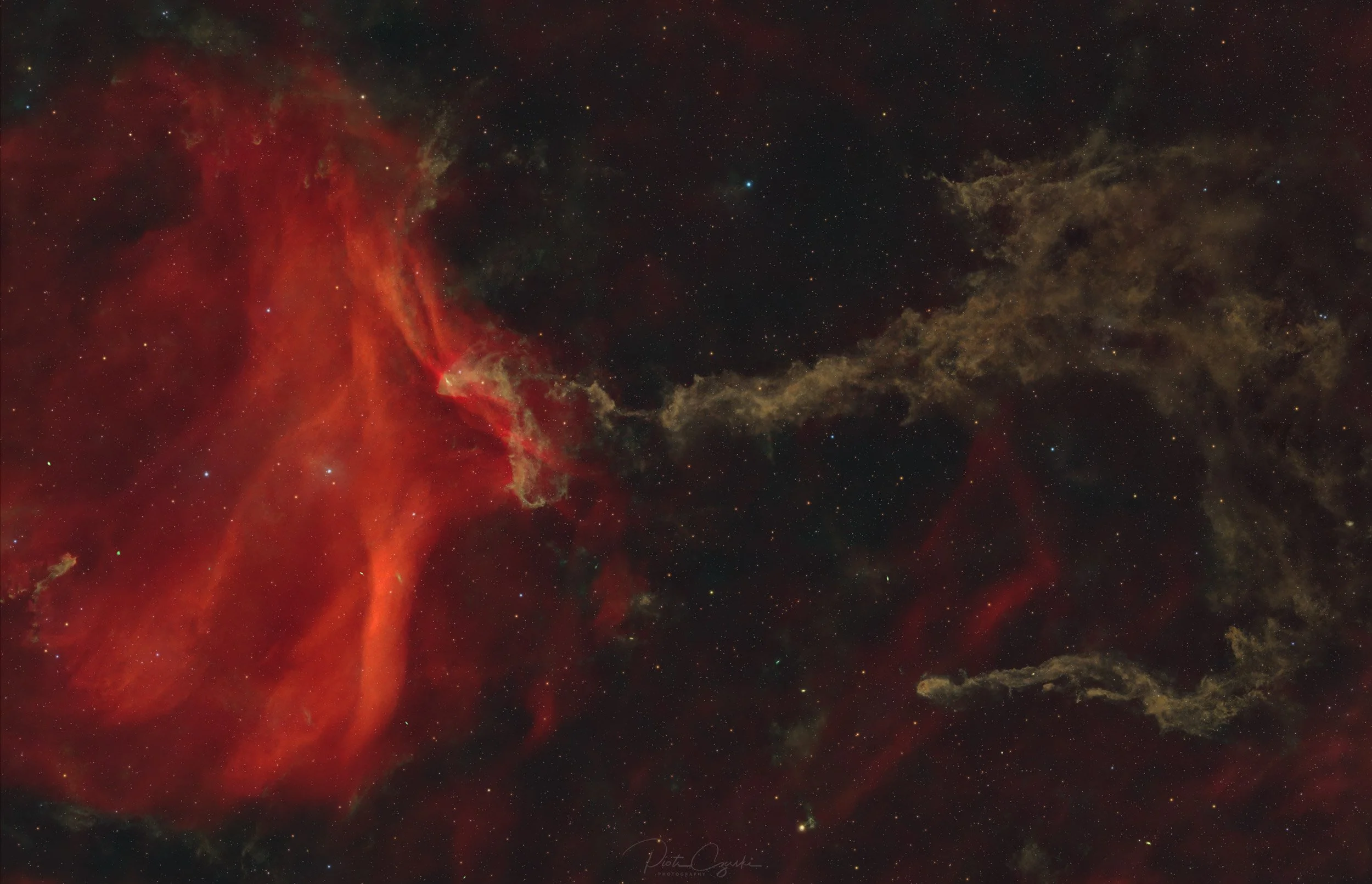
The Great Lacerta Nebula & Dust | HaRGB
The Great Lacerta Nebula lies hidden within a rarely imaged region of the northern sky, where glowing hydrogen clouds meet dense interstellar dust. The vibrant red emission marks zones of ionized hydrogen gas, while the golden-brown filaments trace cold molecular material sculpted by stellar winds and radiation.
This wide-field view, rendered in HaRGB, highlights the complex structure of the nebula’s environment, showing how star formation and interstellar turbulence weave together to create one of Lacerta’s most intricate cosmic landscapes.
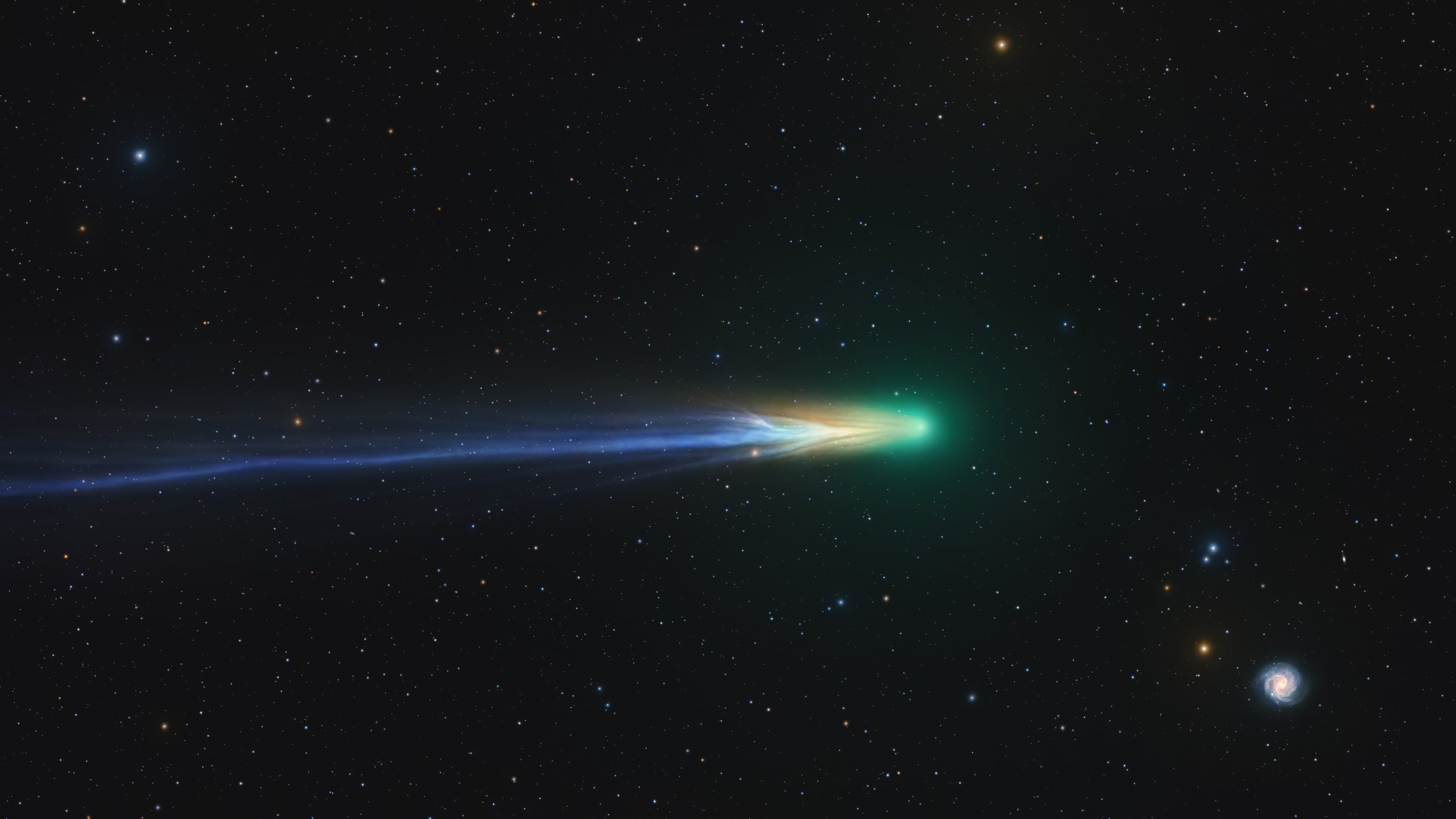
Comet Lemmon Meets NGC 3184
Comet C/2025 A6 (Lemmon) and the spiral galaxy NGC 3184 share this wide-field view captured from Texas. While the comet streaks across the foreground sky, its pale green and blue coma and delicate ion tail trace the effects of solar wind and radiation pressure on volatile gases escaping from its icy nucleus.
In the background, NGC 3184 quietly resides 39.5 million light-years away in Ursa Major. This face-on intermediate spiral galaxy, moving at about 821 km/s relative to the cosmic microwave background, contrasts beautifully with the fleeting visitor from our own Solar System, a rare cosmic alignment of motion and distance captured in a single frame.
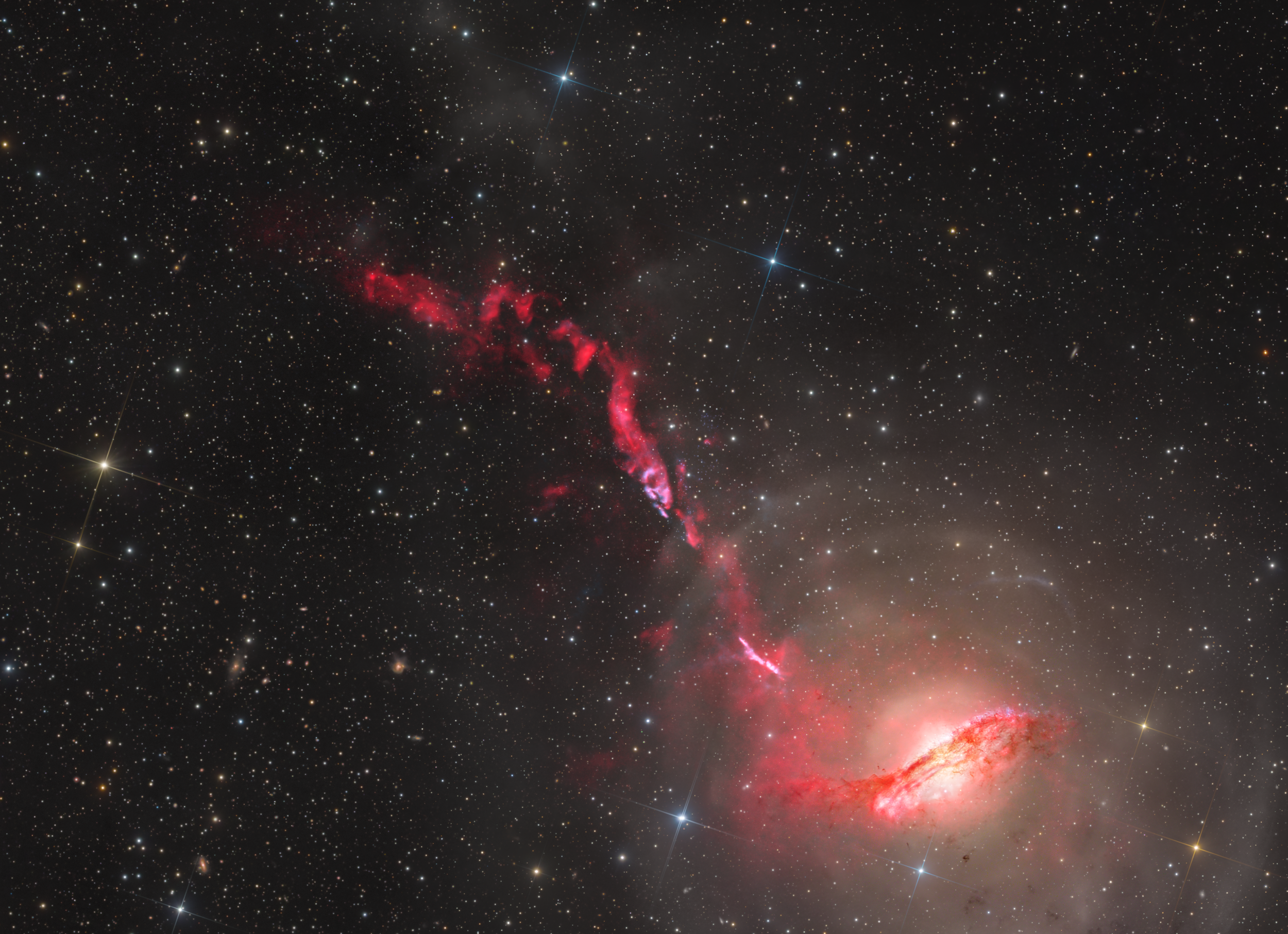
Discovery of Extended Hα Clouds and New Filaments Near Centaurus A
This extraordinary ultra-deep capture of Centaurus A (NGC 5128) reveals intricate hydrogen-alpha structures within the inner 8–10 kiloparsecs of the galaxy, documented in much detail. The glowing emission clouds extend from the galaxy’s core and dust lane into the Northern Transition Region, tracing the same path as Centaurus A’s well-known optical jet filaments.
Located about 12 million light-years away, Centaurus A is one of the nearest active radio galaxies, powered by a supermassive black hole feeding on infalling material. The resulting relativistic jets interact with surrounding gas, igniting vast clouds of hydrogen and oxygen in brilliant shades of red and blue. This image offers a rare glimpse into the dynamic heart of an active galaxy in turmoil.
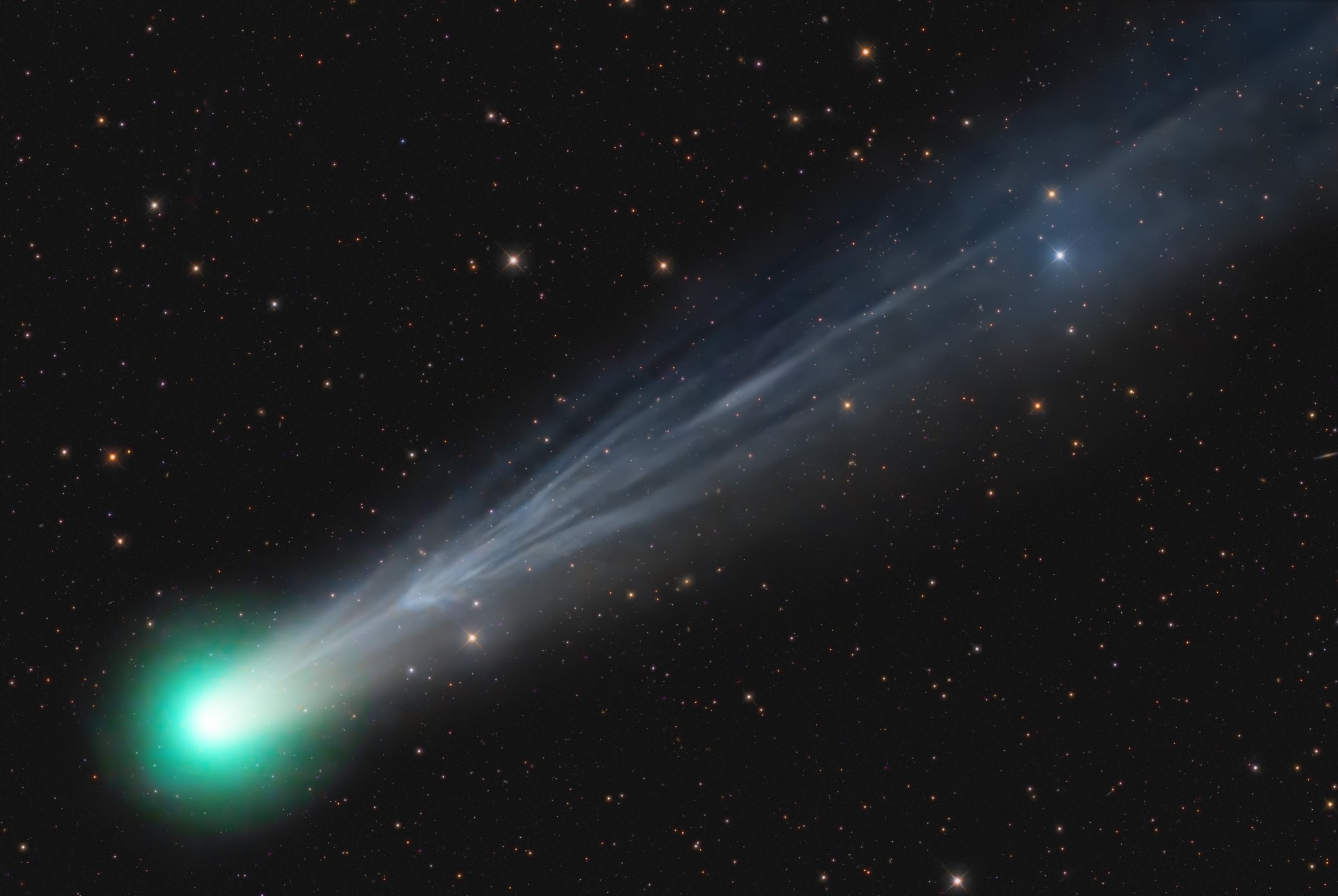
C/2025 A6 Lemmon on September 29, 2025
Comet C/2025 A6 (Lemmon) was imaged on the morning of September 29, 2025, while sweeping across the sky from the Utah Desert Remote Observatory. Even a month before reaching perihelion, the comet displayed a striking appearance with a bright turquoise coma and a remarkably long, filamentary ion tail. Multiple gas jets, sculpted by the pressure of the solar wind, create dynamic structures that extend far into interplanetary space.
This image captures the transient beauty of a comet in motion, offering a rare glimpse into the interaction between a pristine icy body and the Sun’s influence. Technical setup: PlaneWave Delta Rho 500/1500 mm telescope with a ZWO ASI 6200MM camera and Chroma LRGB filters. The final image represents a total of 16 minutes of integration using 2×2 binning.
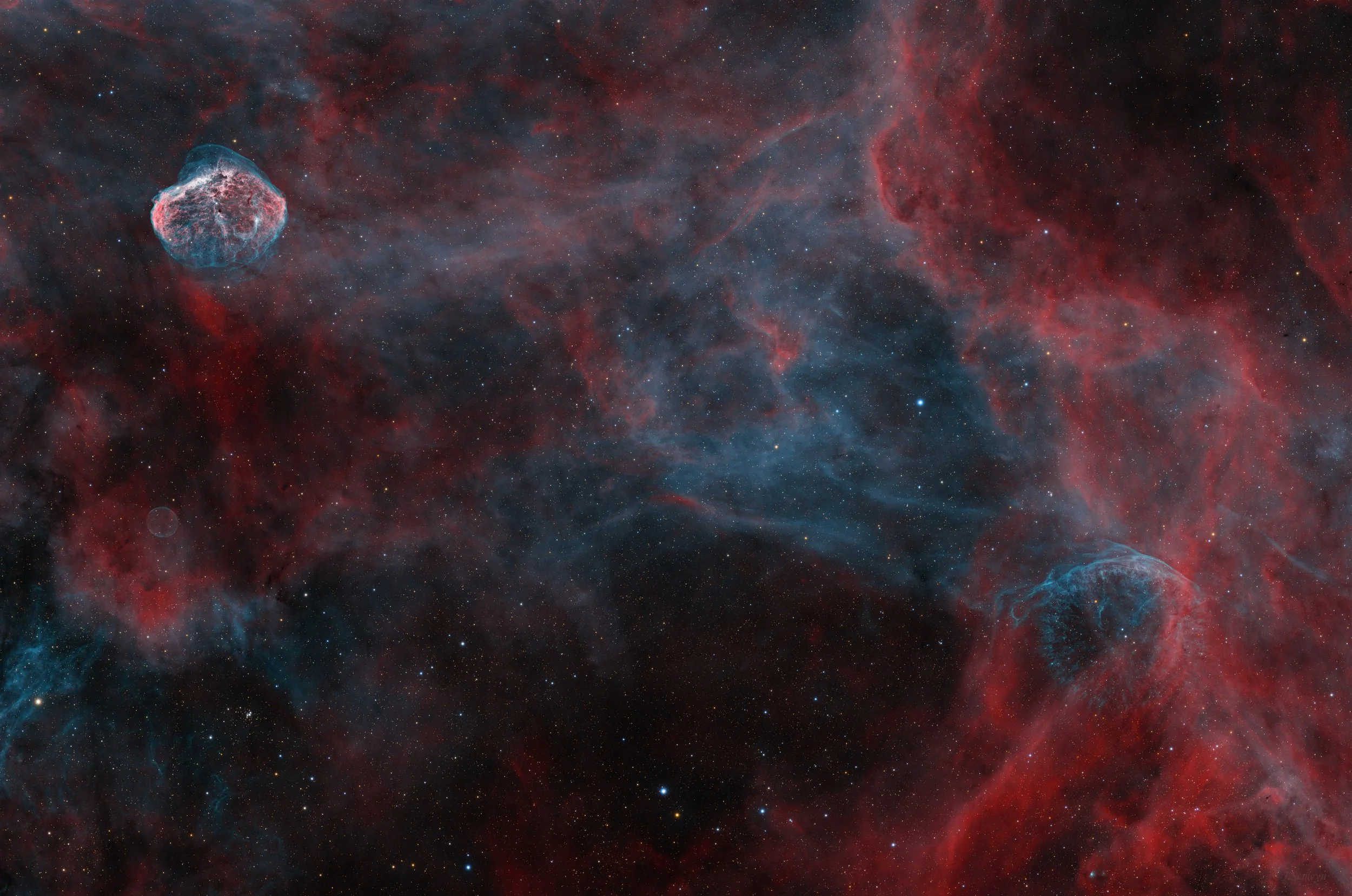
Two Wolf-Rayet Stars in Cygnus
In the rich star fields of Cygnus, two massive stars nearing the end of their lives sculpt the interstellar medium with fierce stellar winds. At left, WR 136 energizes the Crescent Nebula (NGC 6888), its powerful outflows colliding with earlier ejected material to form a glowing shell of hydrogen and oxygen. To the lower right, WR 134 produces its own fainter bubble-like arc, a delicate filamentary structure of ionized gas shaped by intense ultraviolet radiation.
These Wolf-Rayet stars represent a brief and violent stage of stellar evolution, a precursor to their eventual supernova explosions. The image reveals the contrast between the bright, turbulent Crescent Nebula and the more subtle, sprawling arcs of WR 134, both immersed in the broader hydrogen-rich clouds of Cygnus. Together they highlight the transformative power of massive stars and the beauty of their interactions with the galactic environment.
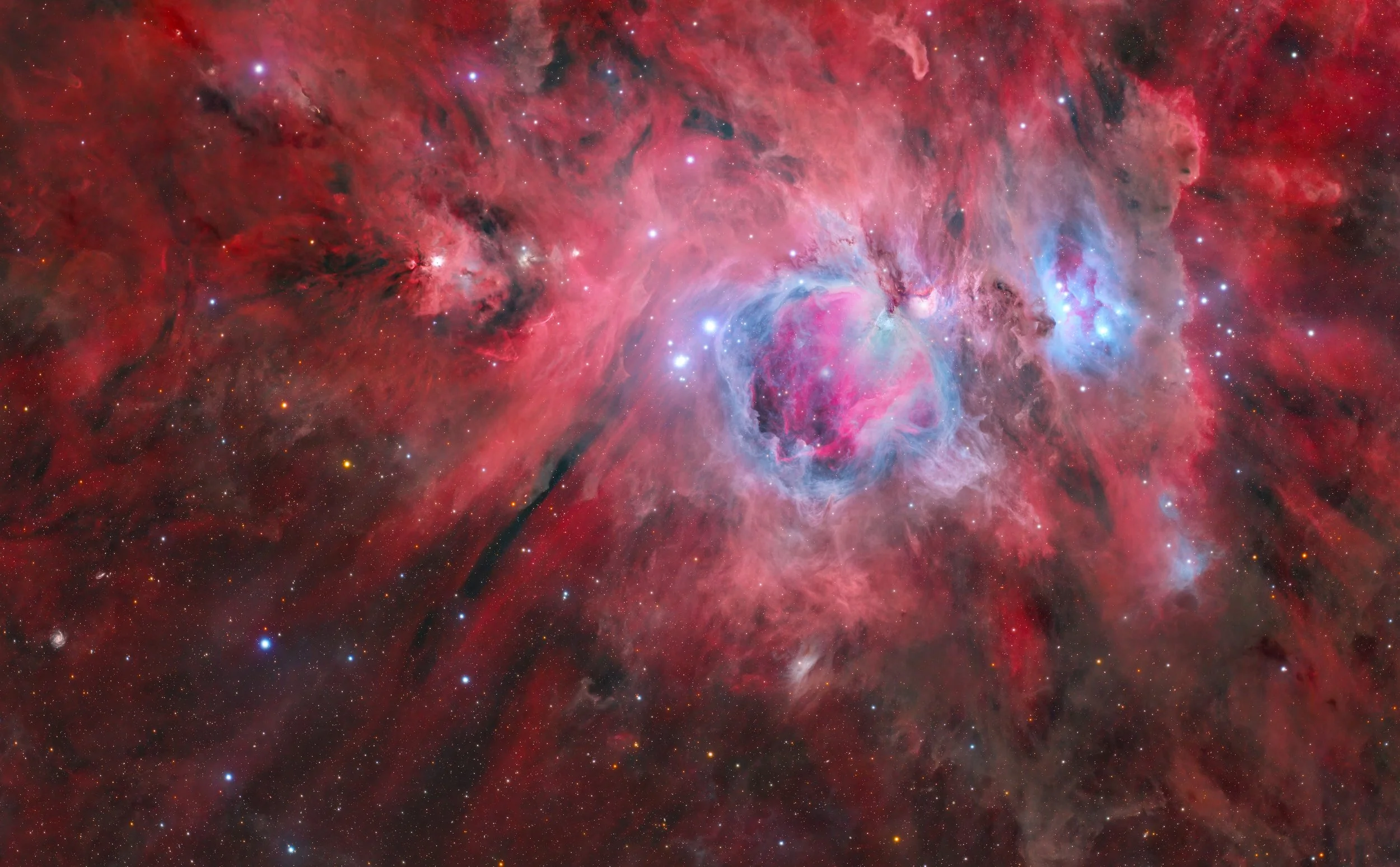
Glowing Dusty Orion Rises
The constellation of Orion dominates the winter sky, but beyond its bright stars lie vast clouds of glowing gas and intricate streams of interstellar dust. This wide-field view reveals the region’s famous nebulae, from the pinkish glow of hydrogen emission to the dark, dusty filaments sculpting the landscape. Orion’s Belt and Sword are immersed in these star-forming clouds, home to stellar nurseries where massive young stars light up their surroundings.
This image was captured from Starfront Observatories, Texas, using a William Optics Redcat 51 III wide-field refractor and a ZWO ASI2600MM camera on a ZWO AM5 mount. A set of ZWO LRGB and Antlia 3nm narrowband filters was employed to reveal both faint dust and ionized gas across the field. The integration time totaled 21.5 hours, recorded over multiple sessions in September 2025, producing a richly detailed portrait of Orion’s rising glow.

The North America Nebula and the Pelican Nebula in SHO
Drifting in the rich star fields of Cygnus, the North America Nebula (NGC 7000, lower left) and the Pelican Nebula (IC 5070, right) form one of the most striking emission complexes in the northern sky. Separated by a dense band of dark dust, these glowing clouds of hydrogen, sulfur, and oxygen stretch across dozens of light-years, sculpted by stellar winds and ultraviolet radiation from massive, young stars hidden within. The familiar continental outline of NGC 7000 is unmistakable, while the Pelican reveals intricate folds of gas and dust resembling its avian namesake.
Captured here in the SHO Hubble Palette, the false-color mapping highlights regions of ionized gases, with hydrogen in green, sulfur in red, and oxygen in blue. The interplay of bright emission and dark lanes demonstrates both the creative and destructive forces at work, where new stars are born even as radiation hollows out great cavities in the nebulae. Together, they showcase the Cygnus region as one of the most photogenic nurseries of the Milky Way.
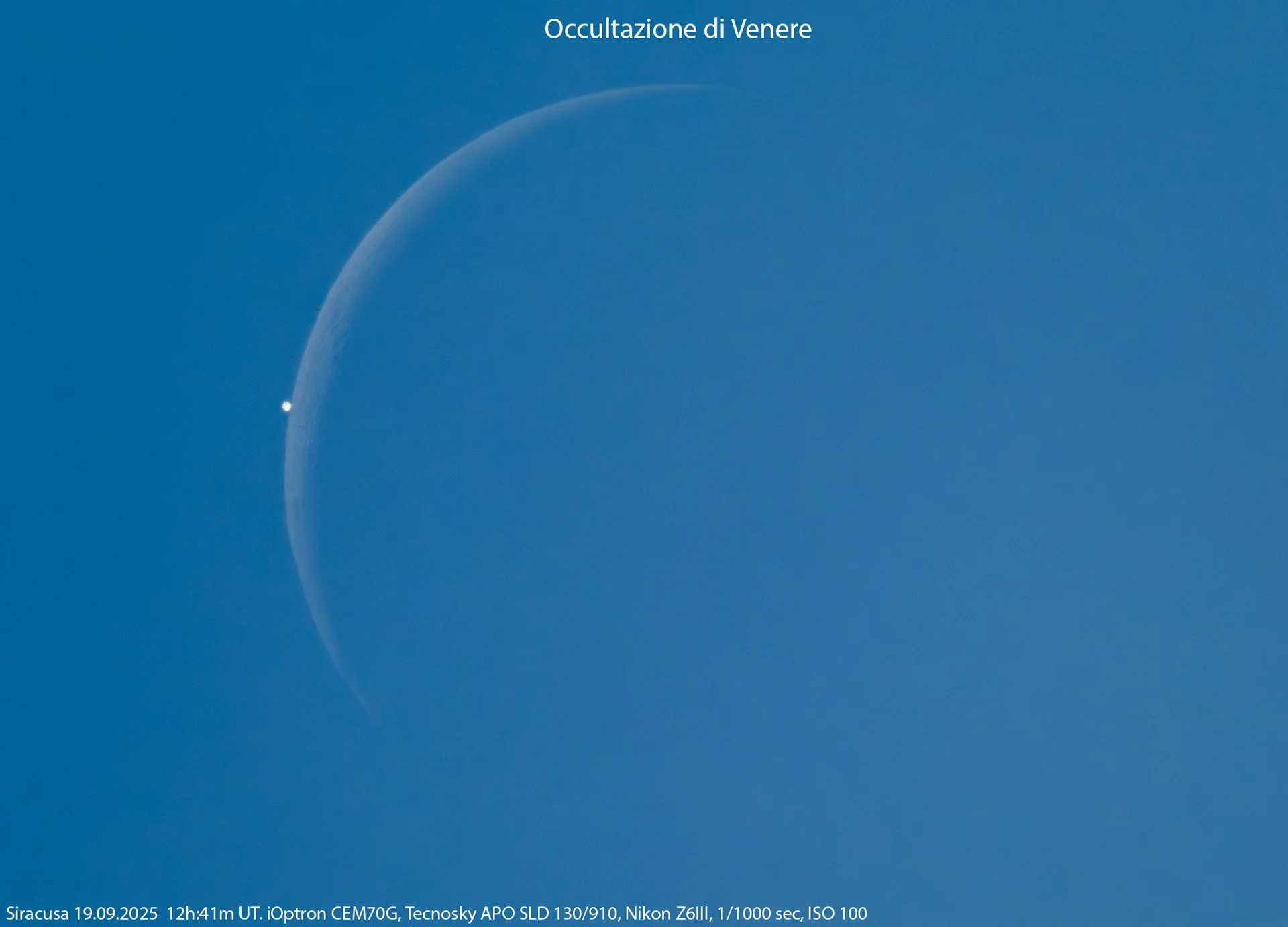
The Moon Occults Venus
In this rare celestial alignment, the Moon passes directly in front of Venus, temporarily hiding the brilliant planet behind its illuminated limb. Such events, known as occultations, are striking both visually and scientifically, as they provide opportunities to study the thin crescent of Venus as it disappears and reappears against the lunar edge. From Earth, the sudden vanishing of a bright planet against the sharp boundary of the Moon’s disk is a dramatic reminder of the constant motions of our solar system’s bodies.
This image was taken from Syracuse, Italy, on September 19, 2025, at 12:41 UT. The setup included an iOptron CEM70G mount paired with a Tecnosky APO SLD 130/910 refractor and a Nikon Z6III camera. A 1/1000-second exposure at ISO 100 captured the delicate balance of brightness between the lunar surface and Venus, preserving both the rugged detail of the Moon’s limb and the dazzling point of the planet.
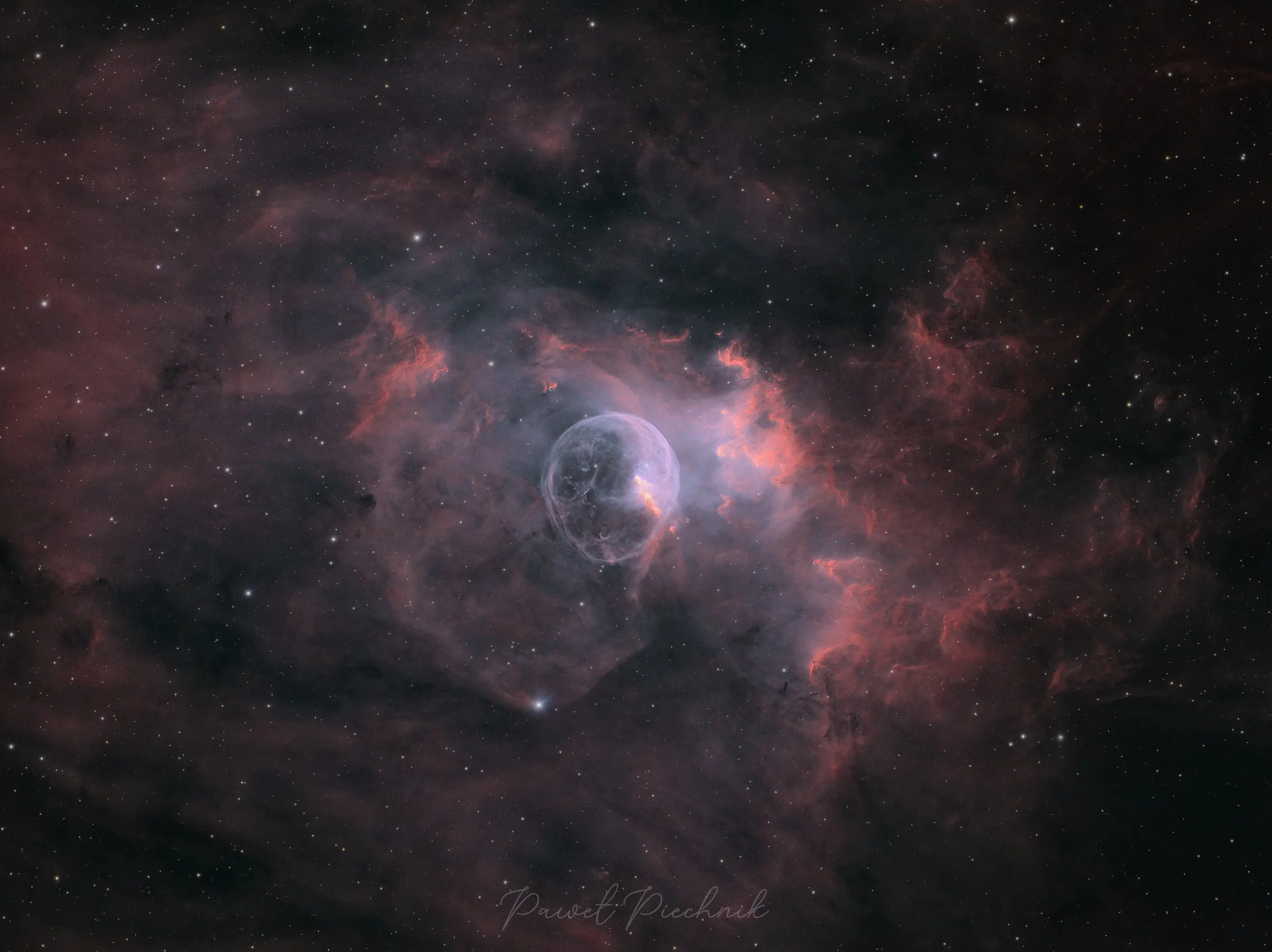
The Bubble Nebula in SHO
This striking portrait of the Bubble Nebula (NGC 7635) was created from 11.5 hours of imaging through narrowband filters in the SHO palette. Located in the constellation Cassiopeia, the nebula is formed by the powerful stellar wind from a massive, hot Wolf–Rayet star, which sculpts the surrounding interstellar gas into its signature spherical shell. The rich interplay of ionized hydrogen, sulfur, and oxygen gases creates a layered appearance, with subtle colors highlighting the structure of this cosmic bubble.
In this view, the central bubble appears to float within a glowing cloud of filaments and dust, surrounded by faint nebulosity that extends well beyond the central shell. The long integration reveals the nebula’s intricate texture and depth, offering a detailed look at the forces shaping star-forming regions in our galaxy.
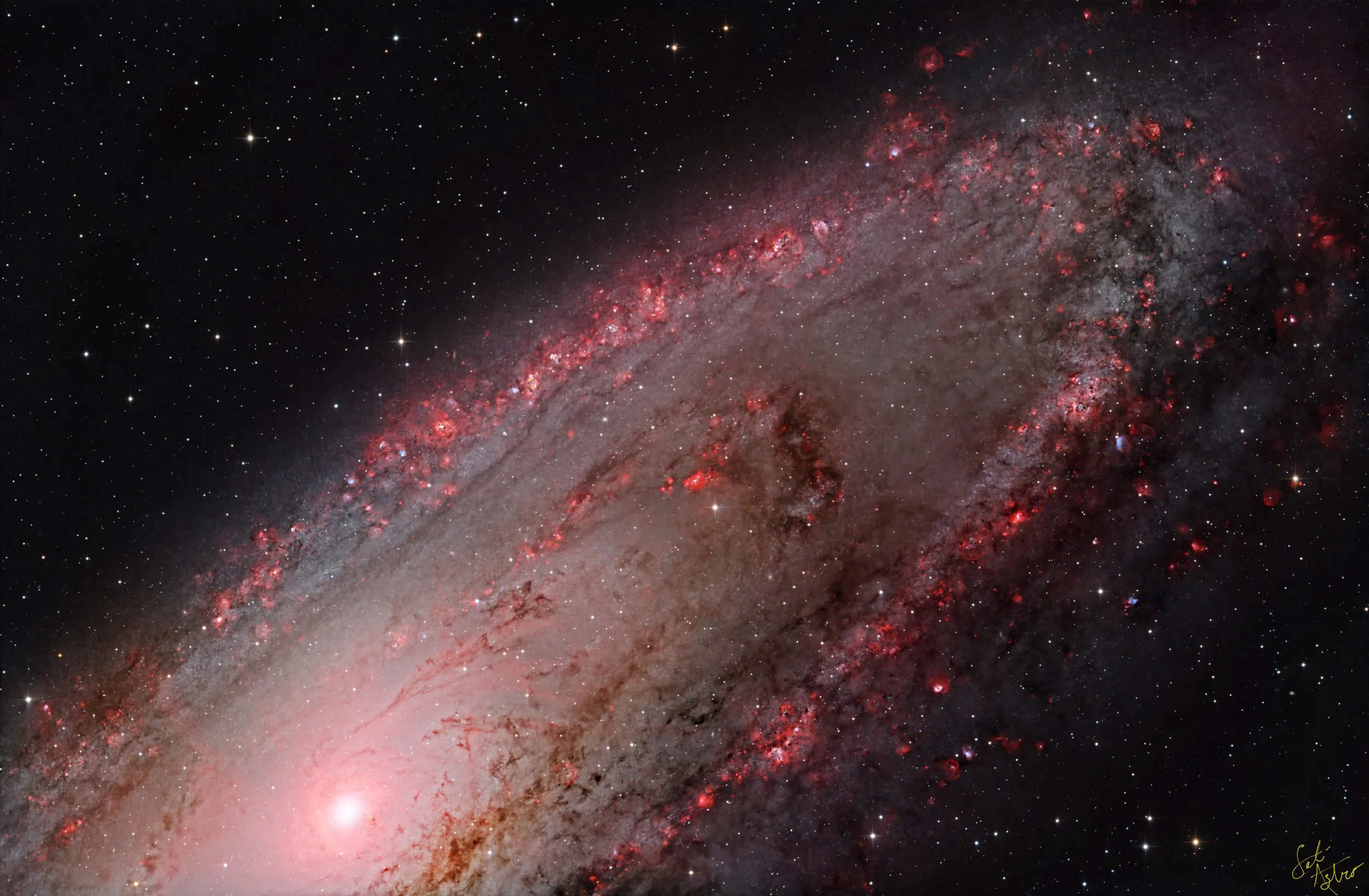
Into The Core of Andromeda: 100hrs on a Familiar Target
This deep exposure reveals the bright core of the Andromeda Galaxy (M31) in exquisite detail. Using a combination of LRGB and narrowband Hα, SII, and OIII data over 100 hours of integration, the image highlights the galaxy’s rich star fields and intricate dust lanes. The core’s golden glow is complemented by faint emission regions scattered throughout the spiral arms, adding subtle color contrasts often missed in shorter integrations.
This long integration pushes well past the typical dynamic range, capturing both the brilliant central bulge and the surrounding faint structures with remarkable balance. The result is a portrait that feels both familiar and entirely new, drawing the viewer into the heart of our nearest major galactic neighbor.
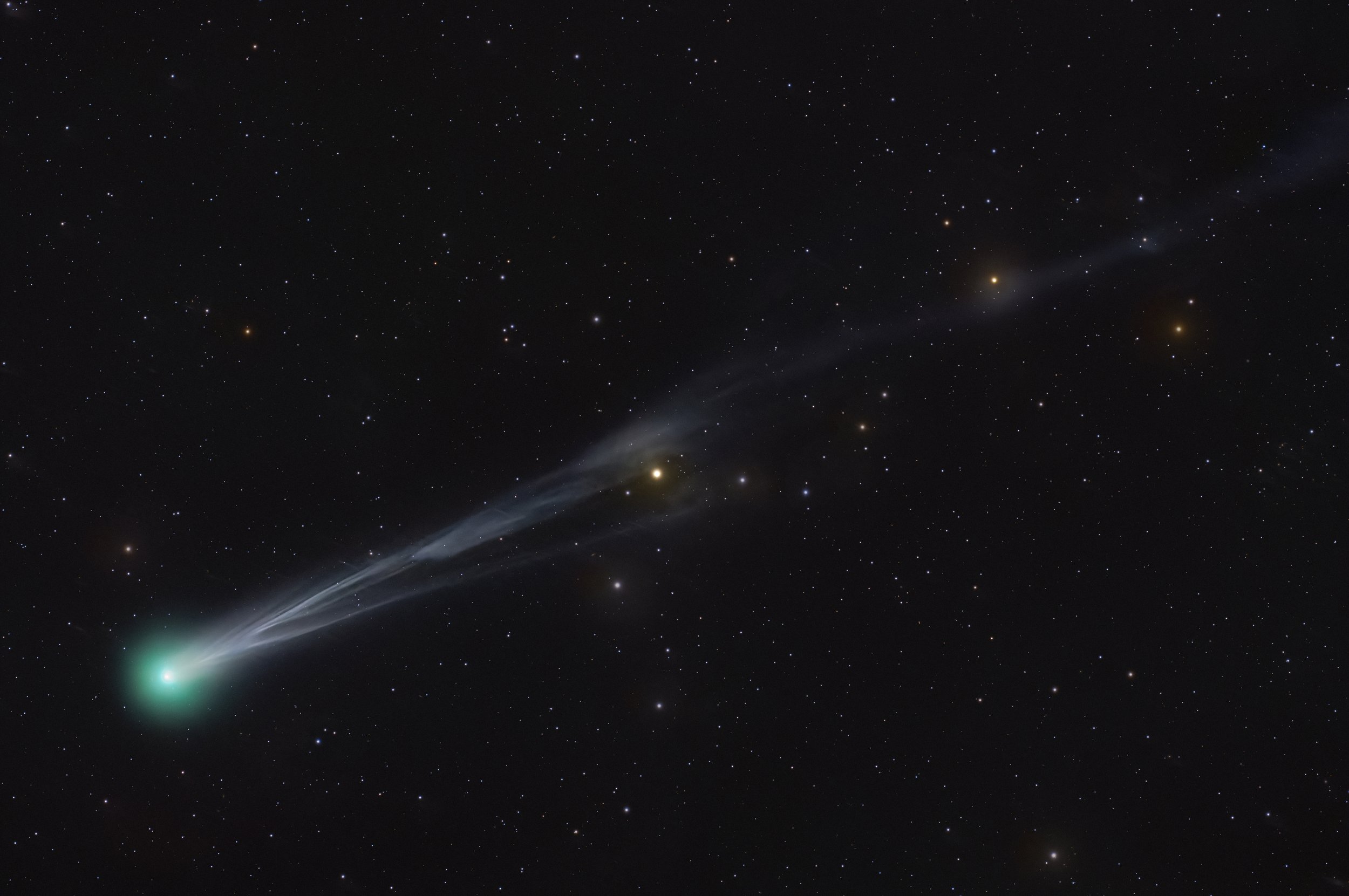
C/2025 A6 (Lemmon) Captured on September 26, 2025
Comet C/2025 A6 (Lemmon) shows off a strikingly green coma and a long, intricate ion tail stretching across the starry background. Captured on September 26, 2025, this image reveals delicate streamers in the tail and subtle interactions with the solar wind, producing a flowing, almost ribbon-like appearance. The contrast between the comet's bright nucleus and the golden foreground stars adds depth to the scene.
This image was made using RGB and luminance exposures totaling just over an hour of integration time, combining 30×30″ frames for each color channel with additional 120″ and 300″ luminance frames to bring out the faintest structures in the tail. C/2025 A6 continues to be a dynamic and visually spectacular visitor to the inner solar system.
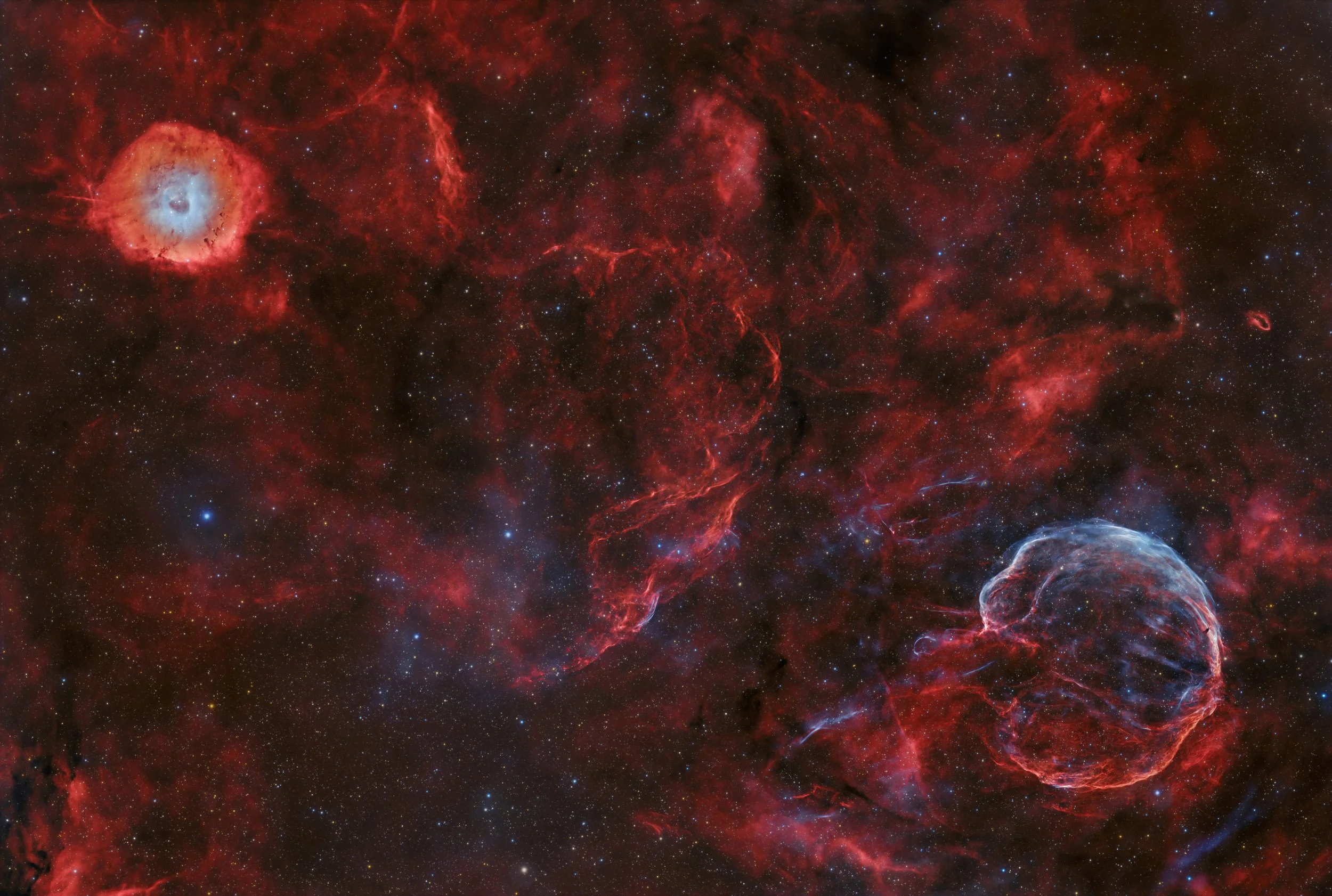
From Bloom (Sh2-170) to Garlic Head (Abell 85)
This sweeping widefield frames two fascinating but very different nebulae: Sh2-170, nicknamed the Little Rosette, and Abell 85 (CTB 1), often called the Garlic Head Nebula. Sh2-170 is an emission nebula whose rosy glow is powered by hot, young stars ionizing the surrounding hydrogen gas. Its compact, circular shape resembles a miniature version of the famous Rosette Nebula.
To its side lies Abell 85, a much older supernova remnant spanning about 100 light-years. Its faint filaments trace the shockwaves from a massive star that exploded thousands of years ago, leaving behind this ghostly bubble of energized gas. Capturing both objects in a single frame highlights the dramatic contrast between stellar birth and death in our galaxy.
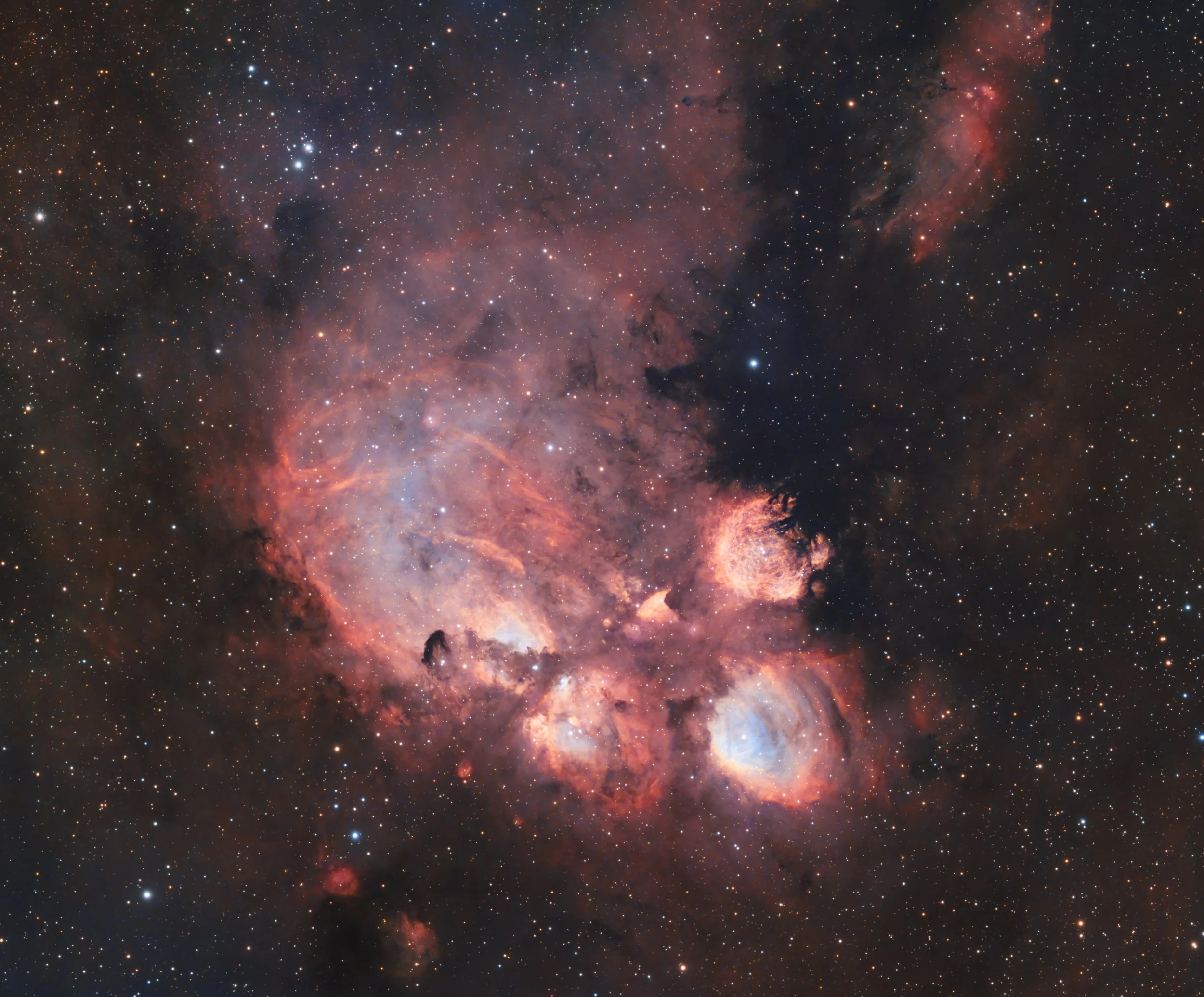
NGC 6334 – The Cat’s Paw Nebula in SHO
This dramatic false-color view captures NGC 6334, the Cat’s Paw Nebula, in the Hubble SHO palette. Glowing hydrogen, oxygen, and sulfur trace vast regions of star formation nearly 5,500 light-years away in the constellation Scorpius. The nebula’s intricate structure and emission arcs give it its distinctive paw-like appearance, with several embedded star-forming regions illuminating the surrounding gas and dust.
Narrowband data isolates the emission from hydrogen-alpha, doubly ionized oxygen, and singly ionized sulfur, revealing fine filaments and shock fronts that are nearly invisible in broadband light. This composite highlights the violent, dynamic processes sculpting the nebula as young stars continue to form within its molecular clouds.
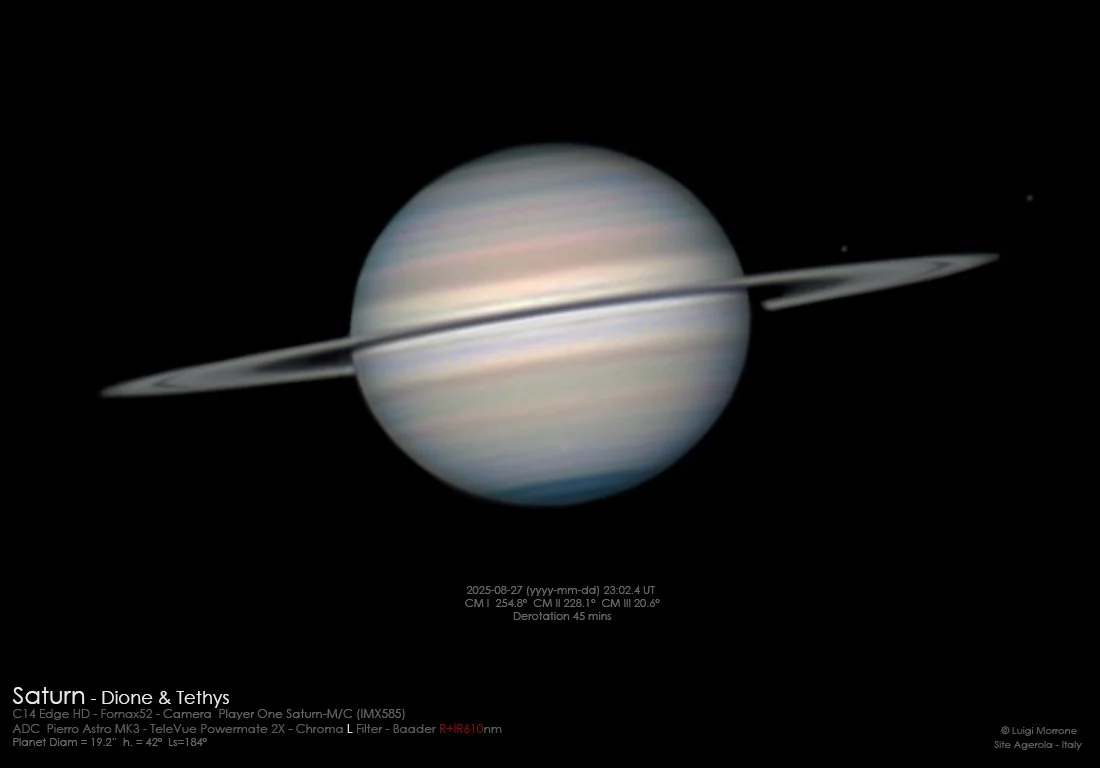
Saturn Dione's & Tethys
Saturn shines here under good seeing conditions, accompanied by its icy moons Dione and Tethys, both visible near the planet’s majestic rings. Careful processing also reveals a diffuse white spot in Saturn’s far southern latitudes. Using WinJupos measurements, the feature is located near System III longitude 20.3° and latitude –49.5°, hinting at atmospheric activity in the gas giant’s turbulent cloud tops.
Captured from Agerola on the Amalfi Coast in Italy, this high-resolution view was made with a C14 Edge HD telescope on a Fornax52 mount, using a Player One Uranus-M/C camera, Chroma L filter, Baader R+IR610, and a 2x Televue Powermate with ADC Pietro Astro MK3. The final image combines LRGB data with detail enhanced from the red and infrared channel.
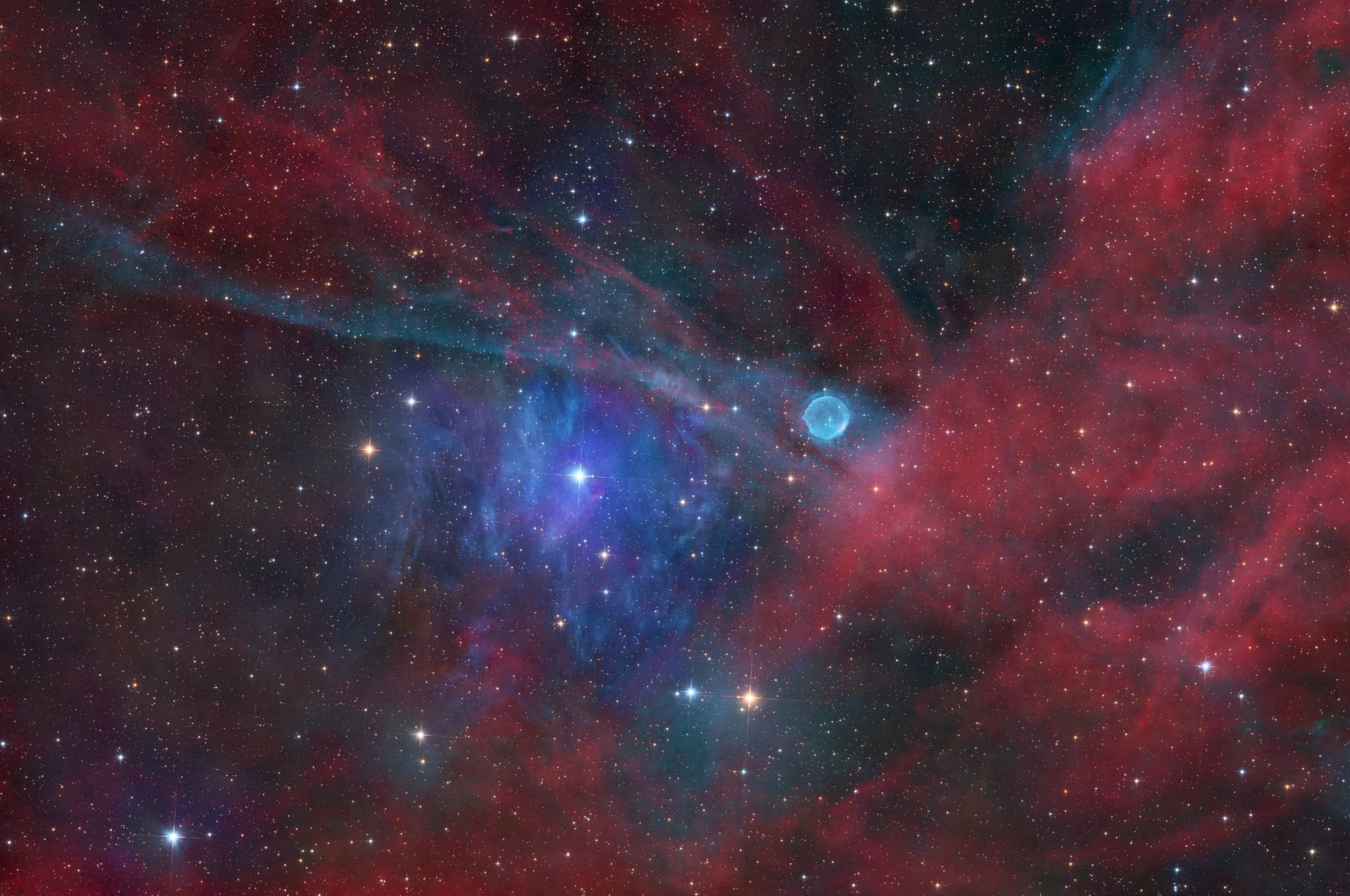
VdB 134 and PN 86+05.1
This wide-field image captures the striking blue reflection nebula VdB 134 in Lacerta, glowing from starlight scattered by cosmic dust. The scene is made even more dramatic by the presence of the faint red hydrogen emission that threads the surrounding interstellar medium. At right, the small, perfect blue bubble is the planetary nebula PN G086.9+05.1, a remnant of a dying star’s outer layers now glowing in ionized gas.
The contrast between the dusty reflection nebula, the faint emission filaments, and the compact planetary nebula makes this field a remarkable example of the diversity of nebular structures found within the Milky Way. The interplay of reflection, emission, and ionization showcases a rich tapestry of stellar evolution, from the birth clouds of stars to their final stages.
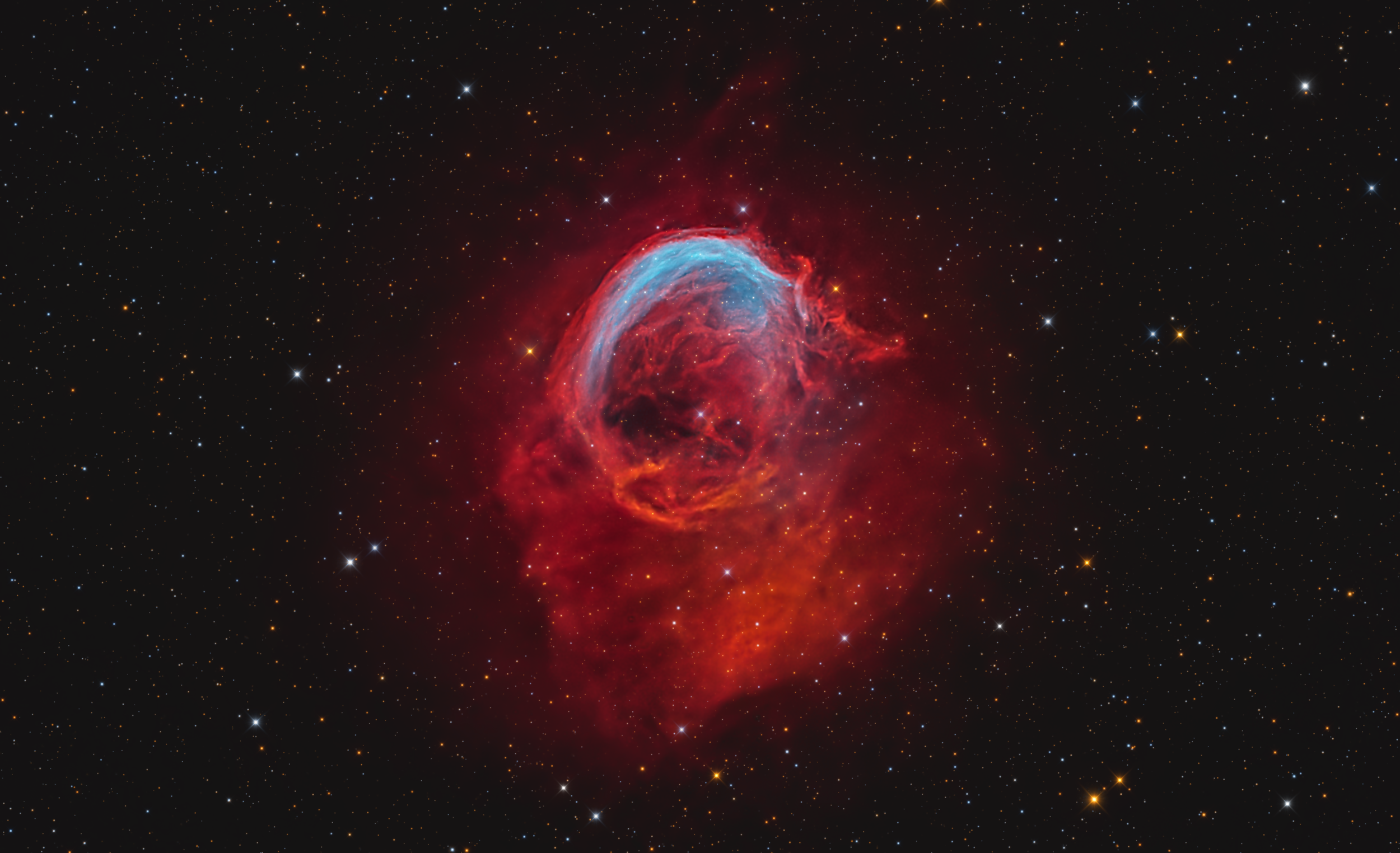
Sh2-188: The Dolphin Nebula
Sh2-188, often called the Dolphin Nebula, is a planetary nebula in Cassiopeia about 850 light-years away. Its distinct crescent shape comes from a bow shock as the nebula plows through the interstellar medium at high speed. The leading edge glows with bright hydrogen-alpha and oxygen-III emission, while fainter filaments trail behind, outlining its extended structure.
This deep image combines Ha, OIII, and SII data for over 20 hours of total exposure, revealing delicate filaments and subtle color contrasts across the nebula. The mix of short and long exposures preserves both the bright rim and the faint outer shell, capturing the nebula’s interaction with surrounding space in remarkable detail.