

AAPOD2 Image Archives
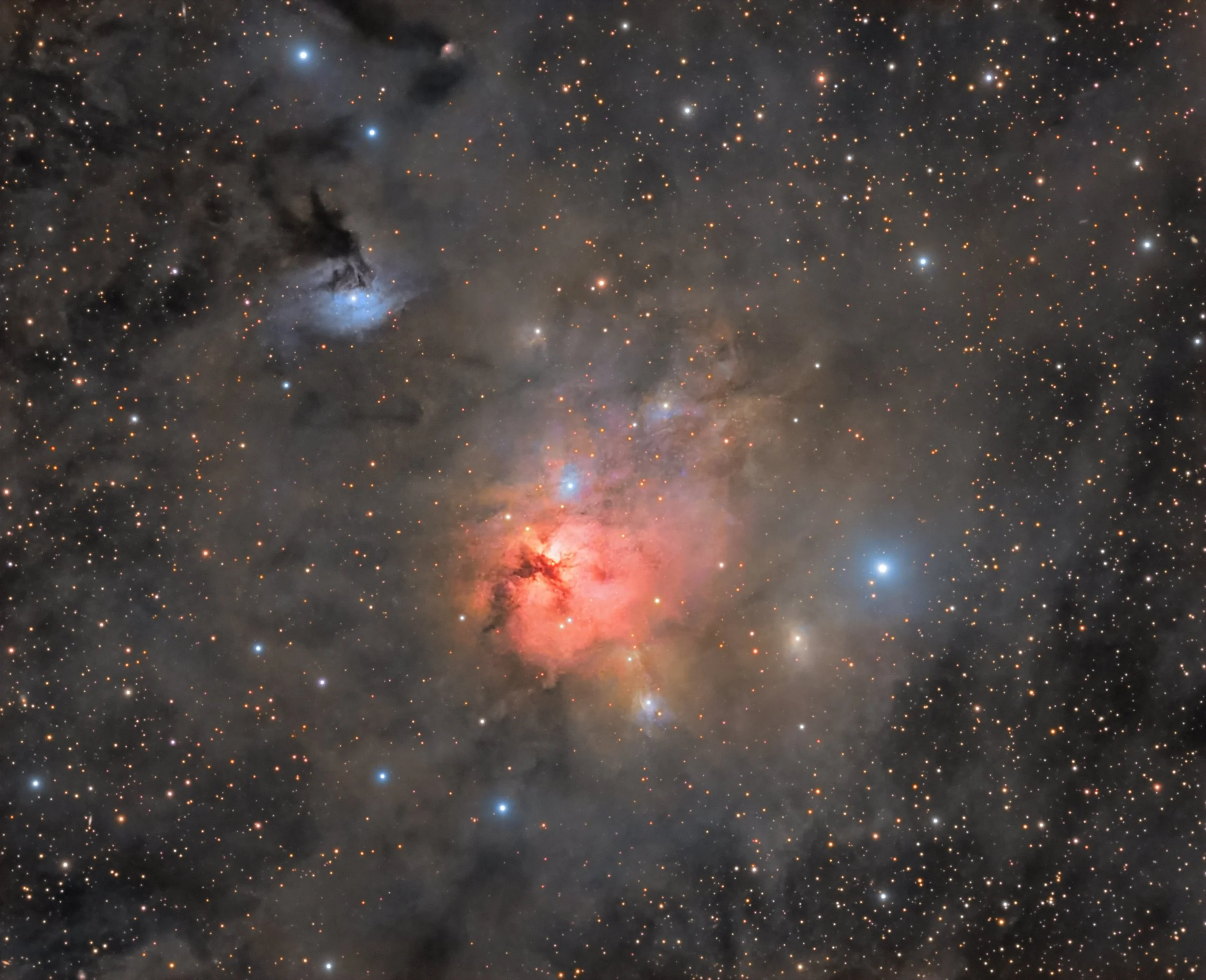
The Northern Trifid Nebula
Located in the constellation Taurus, NGC 1579 is a striking but lesser-known star-forming region sometimes called the Northern Trifid Nebula. Its nickname comes from the dark dust lanes that appear to divide the glowing cloud into several sections, reminiscent of the famous Trifid Nebula. The nebula lies embedded within a complex of interstellar gas and dust where new stars are actively forming. Bright blue reflection light from young stars mixes with faint red emission from energized hydrogen, while thick filaments of dark dust carve dramatic shapes across the glowing cloud.
At the heart of NGC 1579, energetic young stars illuminate and sculpt their dusty surroundings, creating a layered tapestry of reflection nebulae, emission regions, and opaque molecular clouds. These dark lanes are not empty space but dense concentrations of cold dust that obscure the light behind them while providing the raw material for future stellar systems. Though far less famous than its southern namesake, NGC 1579 offers a vivid glimpse into the chaotic environments where stars are born—where gravity, radiation, and turbulence slowly transform cold cosmic clouds into new suns.
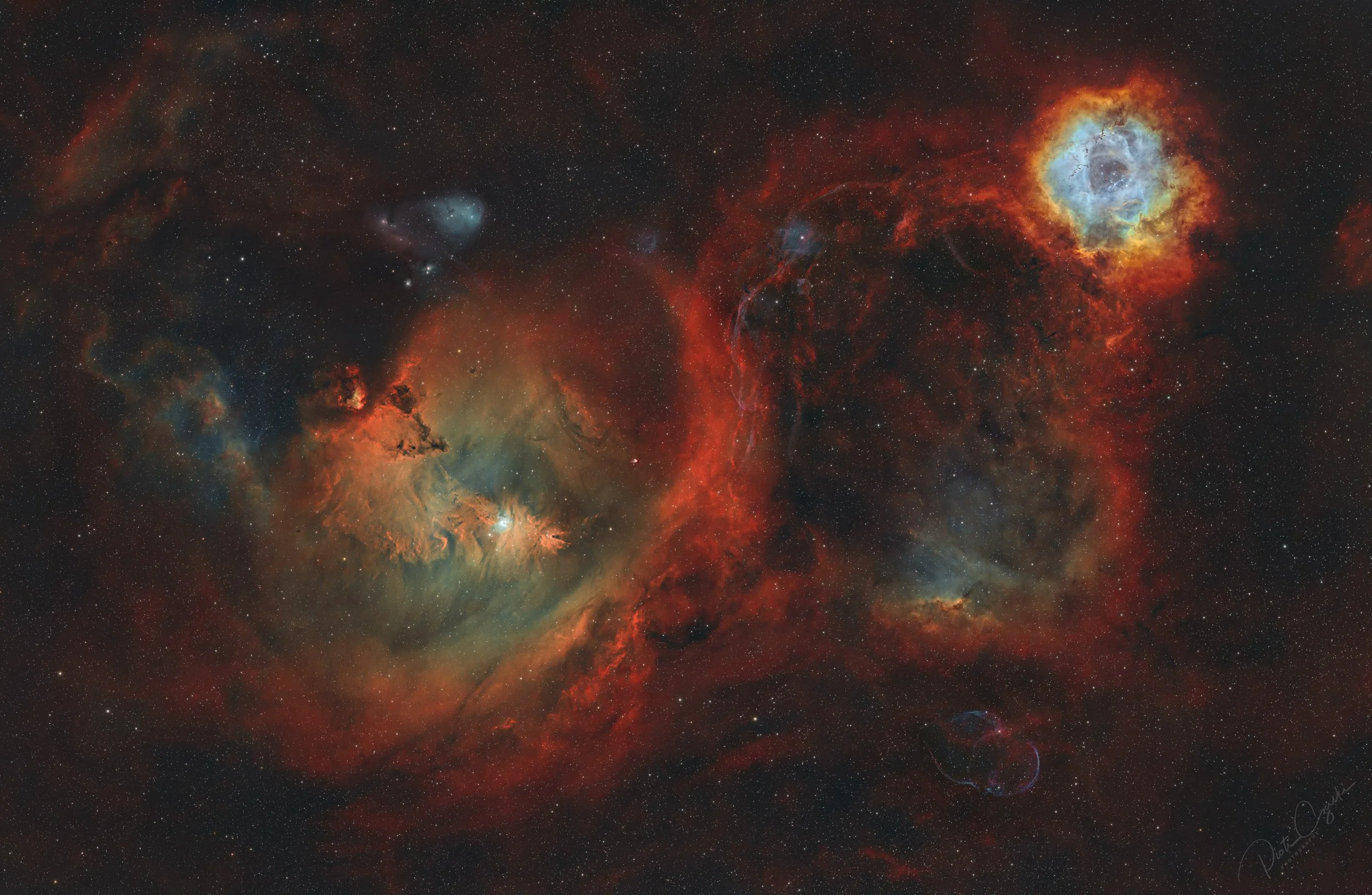
Hydrogen Symphony in Monoceros
This wide-field image captures the intricate interplay between stellar birth and stellar death in the Monoceros constellation. At upper right glows the Rosette Nebula, a stellar nursery energized by young massive stars. Left of center, the Cone Nebula and the Christmas Tree Cluster mark another active star-forming complex embedded in turbulent gas and dust. Together, these structures span hundreds of light-years, illustrating the cosmic cycle: massive stars form within molecular clouds, live briefly, and end violently — enriching and reshaping the very material from which new stars will emerge.
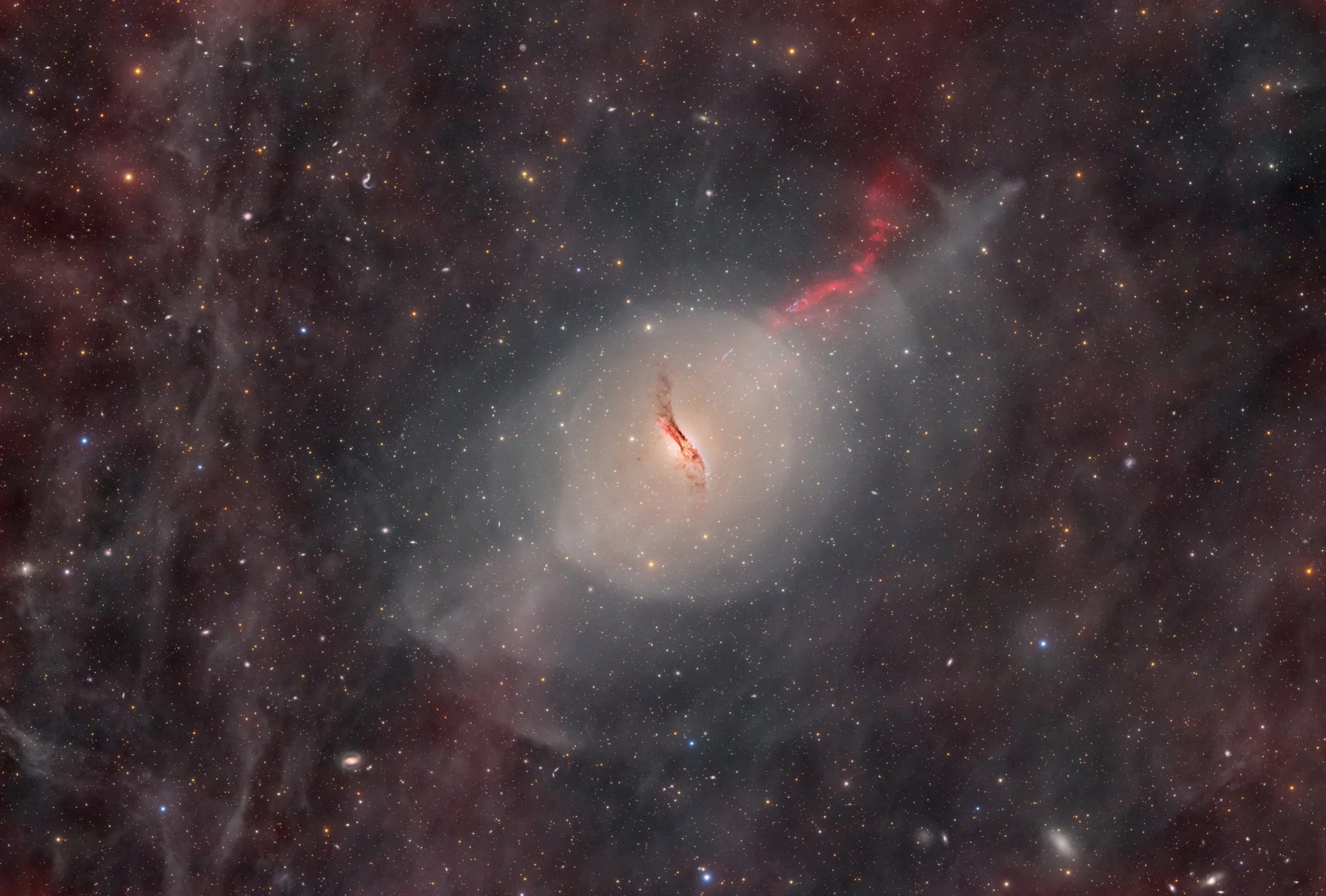
NGC 5128, Centaurus A
The galaxy NGC 5128, more commonly known as Centaurus A, is one of the closest and most striking active galaxies in the sky. Located about 12 million light-years away in the southern constellation Centaurus, it appears as a bright elliptical galaxy dramatically split by a thick, dark lane of dust. This unusual appearance is thought to be the result of a past collision and merger with a smaller spiral galaxy. The interaction stirred vast clouds of gas and dust, forming the prominent band that slices across the galaxy’s glowing core and fueling new bursts of star formation within the otherwise older elliptical system.
At the center of NGC 5128 lies a supermassive black hole millions of times the mass of the Sun, which powers the galaxy’s intense activity. As matter spirals toward the black hole, enormous jets of high-energy particles are launched outward, producing powerful radio emissions that extend far beyond the visible galaxy. Because of this, Centaurus A is classified as one of the nearest radio galaxies, making it a key target for astronomers studying black holes, galaxy mergers, and energetic cosmic jets. Its combination of bright starlight, dark dust structures, and energetic outflows makes NGC 5128 both visually dramatic and scientifically important.
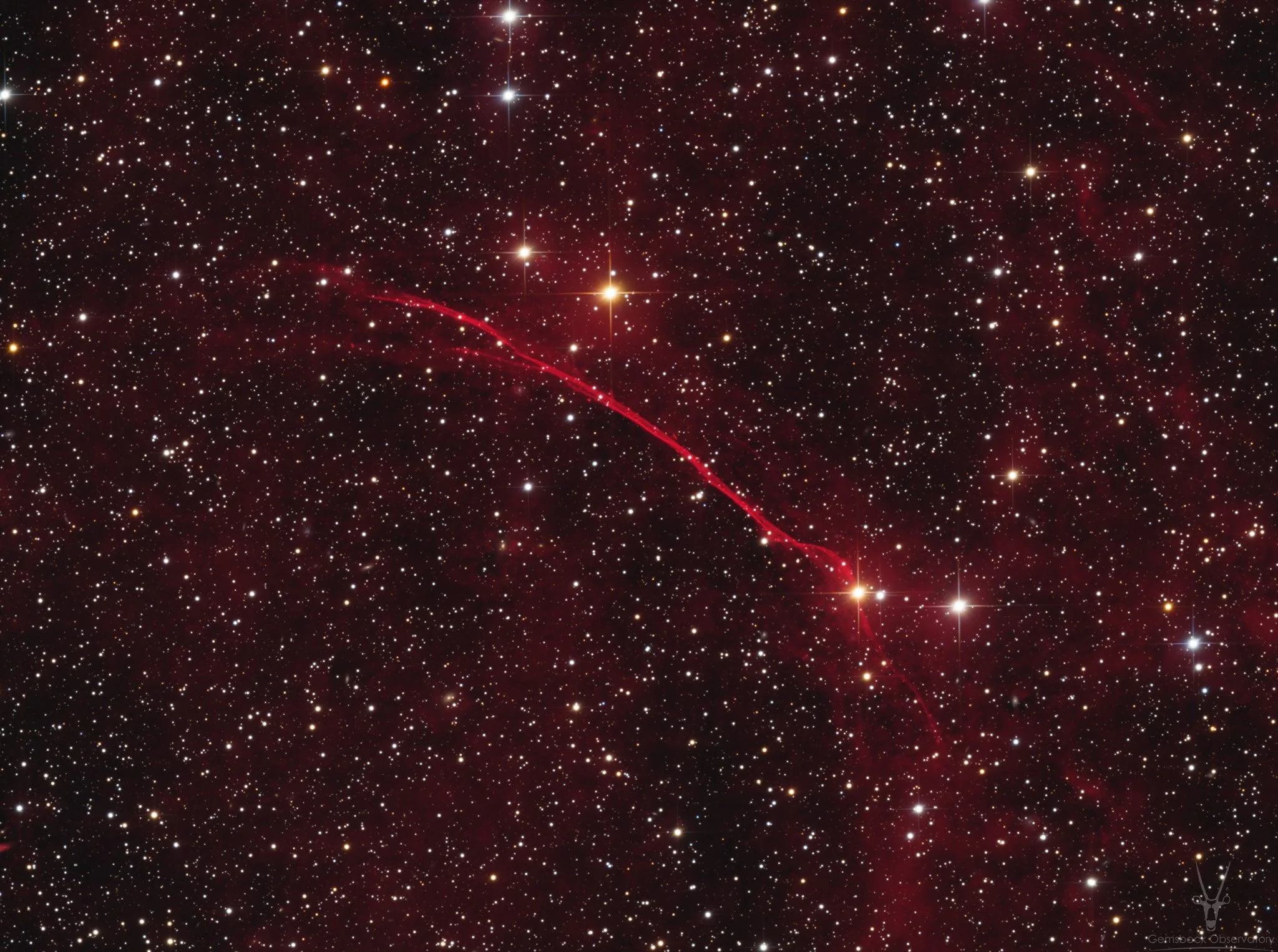
SN 1006 in Lupus
The supernova remnant of SN 1006 marks the aftermath of one of the brightest stellar explosions ever recorded in human history. First witnessed in the year 1006 by observers across Asia, the Middle East, and Europe, the star briefly outshone every object in the night sky except the Moon. Today, its expanding shell of debris lies roughly 7,000 light-years away near the southern constellation Lupus. What remains is a vast, faint ring of energized gas—known as the SN 1006 Supernova Remnant—stretching about 60 light-years across as shockwaves from the ancient explosion continue to sweep through interstellar space.
The remnant shines most strongly in X-ray and radio wavelengths, where astronomers can see the high-energy particles accelerated by the expanding shock front. These powerful shocks race outward at thousands of kilometers per second, heating surrounding gas to millions of degrees and generating delicate arcs and filaments that trace the blast’s expanding boundary. SN 1006 is believed to have been a Type Ia supernova, caused when a white dwarf star accumulated too much material and detonated in a runaway thermonuclear reaction. More than a millennium later, the faint glowing shell drifting through Lupus still carries the energy of that ancient outburst, offering astronomers a nearby laboratory for studying how supernovae shape and enrich the galaxy.
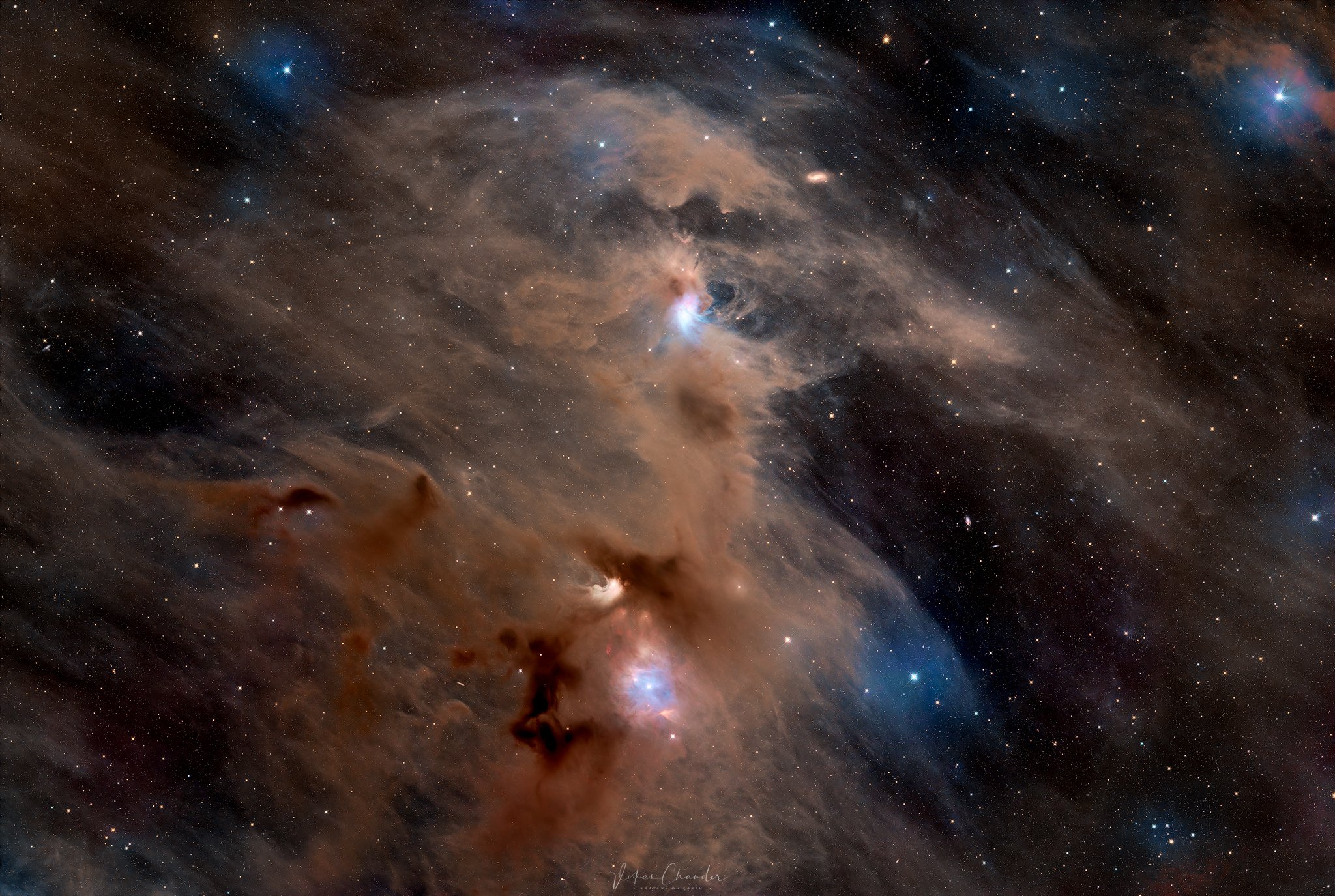
A woodpecker in Chameleon
The dark dust clouds of the Chamaeleon Molecular Cloud Complex are among the nearest stellar nurseries to Earth, lying roughly 500 light-years away in the southern constellation Chamaeleon. These clouds—especially the regions known as Chamaeleon I, Chamaeleon II, and Chamaeleon III—are composed of extremely cold gas and microscopic dust grains that block visible starlight, giving them their striking appearance as inky patches against the background of the Milky Way. Within these opaque filaments, gravity slowly gathers material into dense knots where new stars begin to form. Because the complex is relatively close to our solar system, astronomers study it carefully to better understand the earliest stages of stellar birth.
Inside these dusty clouds, young stars are often hidden from view, still wrapped in cocoons of gas and dust that absorb visible light but glow faintly in infrared wavelengths. Observations from infrared telescopes have revealed hundreds of newborn stars and protostellar disks embedded within the clouds, many only a few million years old. The dust itself plays a crucial role: it shields fragile molecules from harsh radiation, cools the gas so it can collapse under gravity, and eventually becomes part of the disks that may form planets. In this way, the dark dust clouds of the Chamaeleon region represent not emptiness, but the quiet beginnings of future stars and planetary systems.
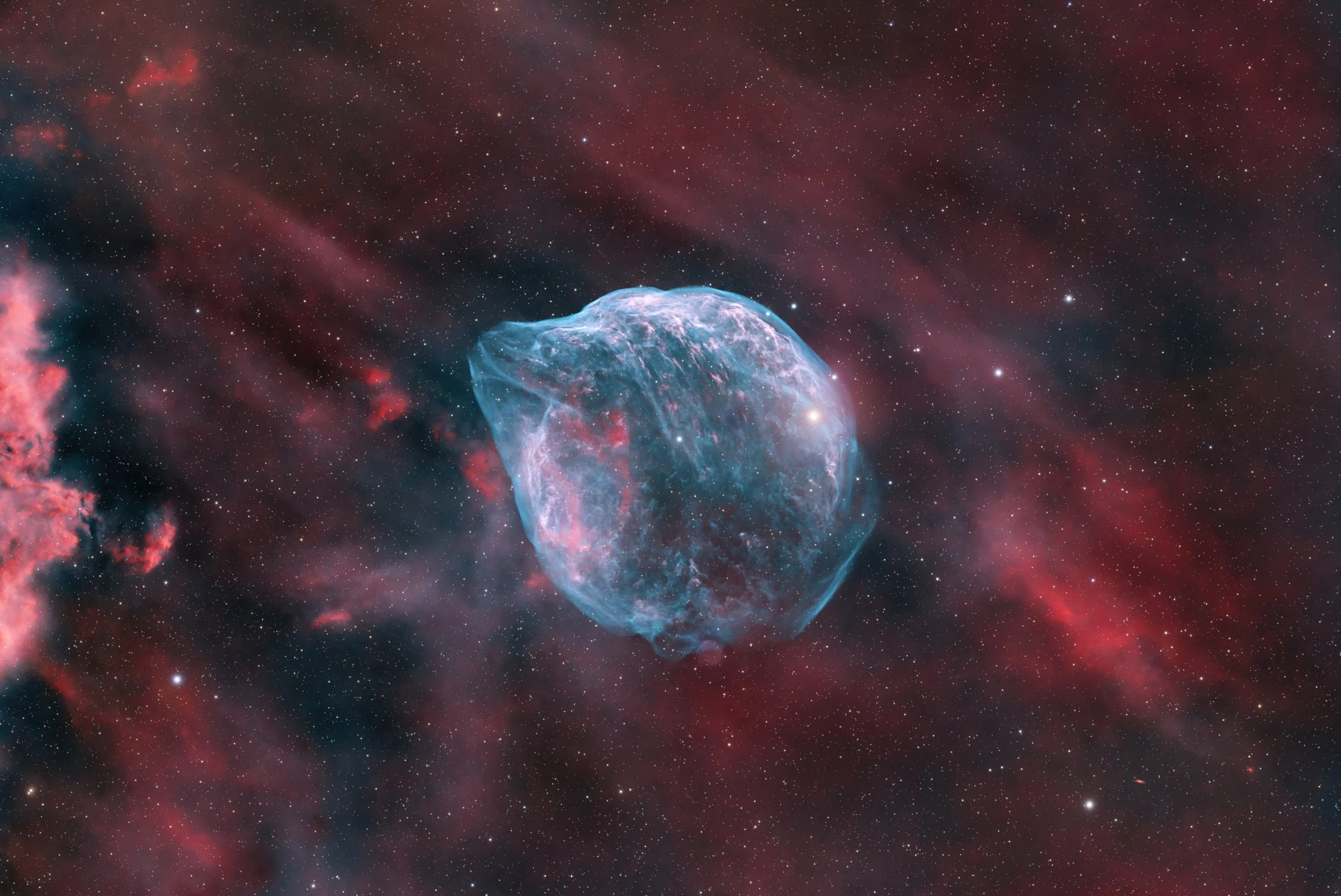
SH2-308 The Dolphin Nebula
The Dolphin Nebula (Sharpless 2-308) is a vast bubble of glowing gas located about 5,200 light-years away in the constellation Canis Major. Spanning nearly 60 light-years across, the nebula was formed by the powerful stellar winds of a massive Wolf–Rayet star, which has blown material outward to create a huge shell of ionized oxygen. When imaged through specialized filters, the nebula shines with a distinctive soft blue glow, giving it the appearance of a cosmic bubble drifting through space.
Often nicknamed the “Dolphin Nebula” because of its curved structure that can resemble a leaping dolphin in wide-field images, Sh2-308 is a challenging but rewarding target for astrophotographers. Its faint emission requires long exposures and narrowband imaging to reveal the delicate arcs of gas surrounding the central star. The nebula represents a late stage in the life of a massive star, as intense stellar winds sculpt the surrounding interstellar material before the star eventually ends its life in a supernova explosion.
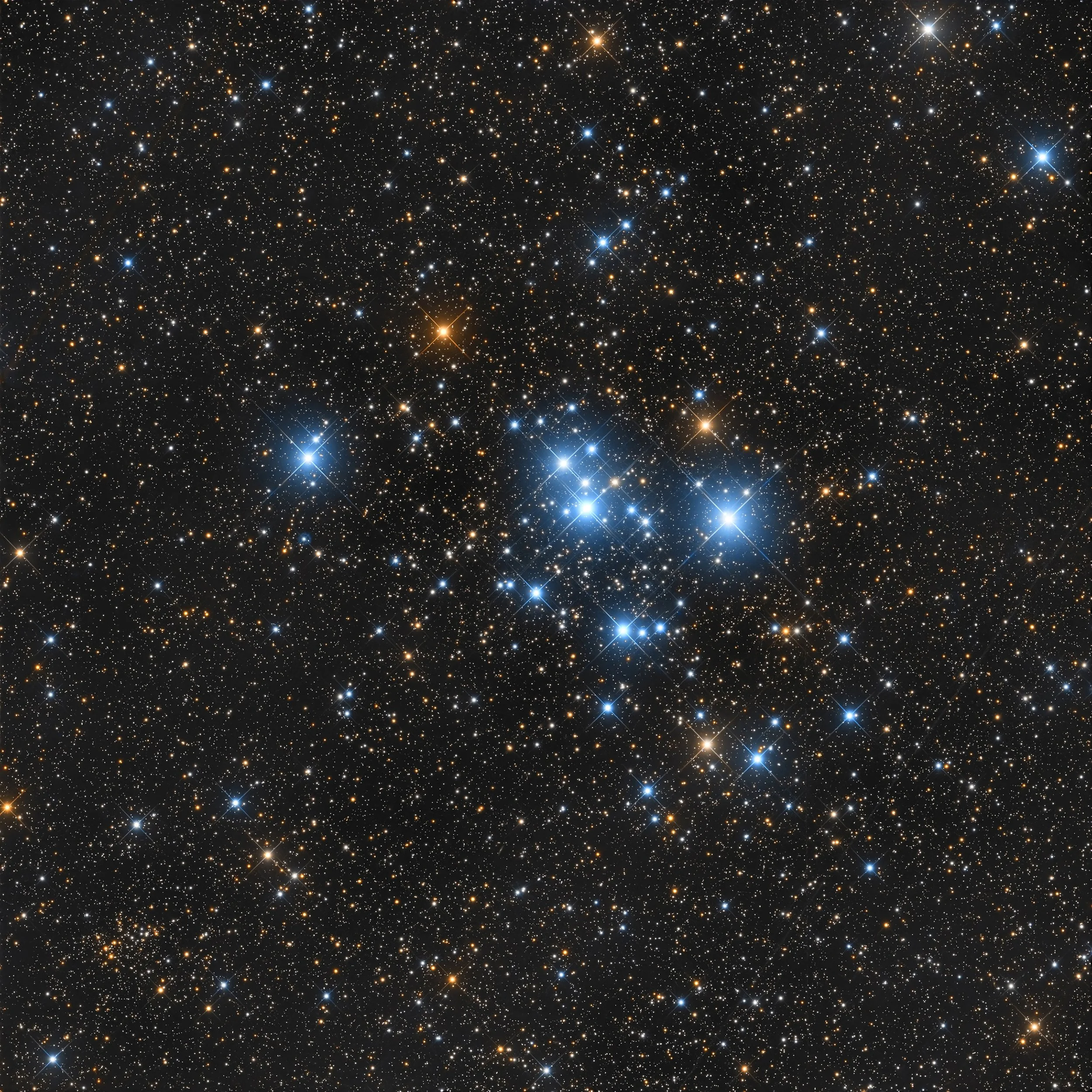
Messier 47
Messier 47 (M47) is a bright open star cluster located about 1,600 light-years away in the constellation Puppis. Containing several dozen easily visible stars and many fainter members, the cluster spans roughly 12 light-years across and shines at about magnitude 4.4, making it visible to the naked eye under dark skies. The stars of M47 are relatively young—around 78 million years old—and many of its brightest members are hot, blue stars that illuminate the surrounding star field.
Discovered by Charles Messier in 1771, M47 stands out for its loose structure and striking brightness compared to many other open clusters. Through binoculars or a small telescope, it appears as a rich scattering of sparkling stars, often contrasted with the nearby but dimmer open cluster M46, which lies just a degree away in the sky. Together they form a beautiful deep-sky pairing for observers exploring this region of the winter Milky Way.
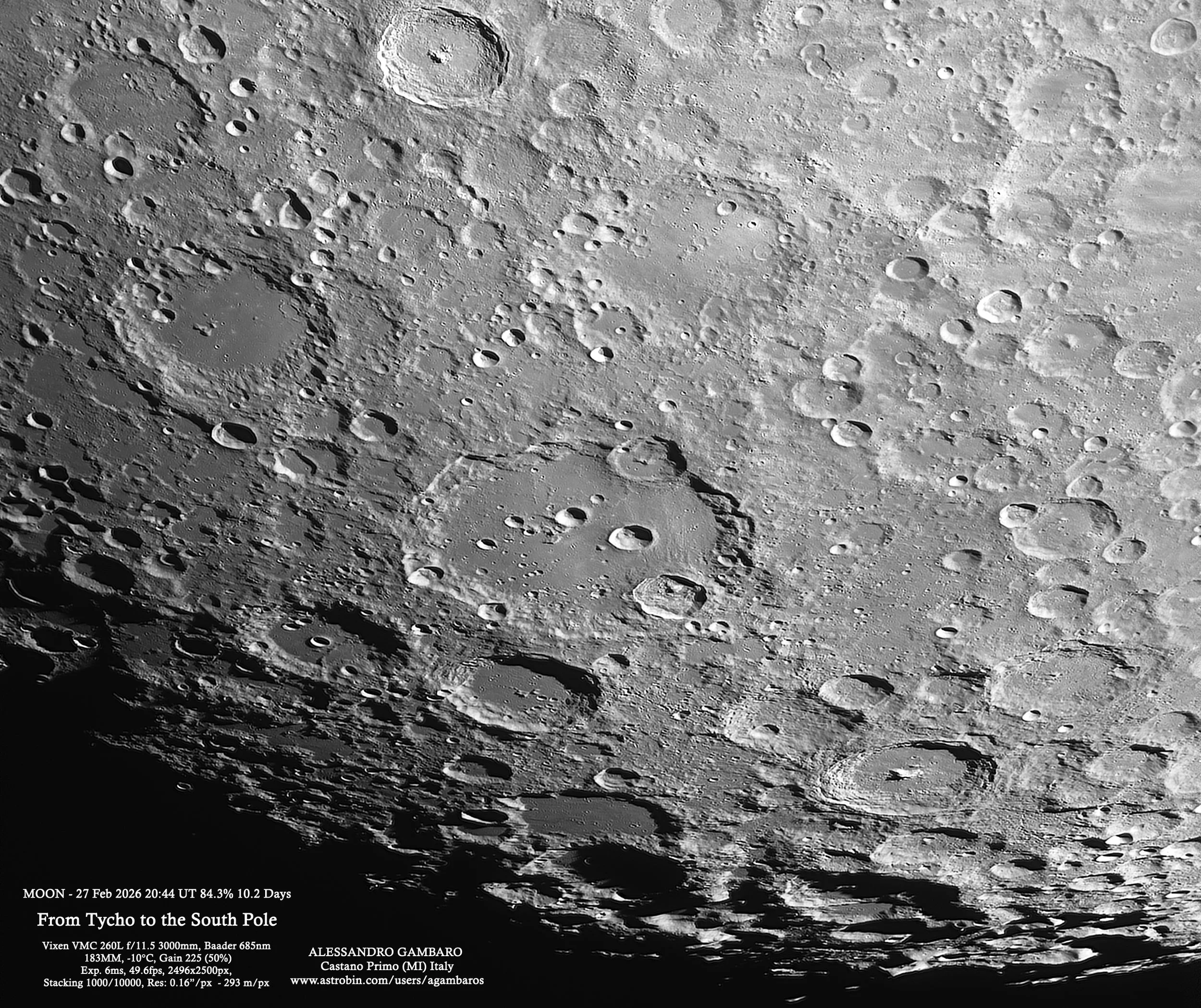
From Tycho to the South Pole
Tycho Crater is one of the most prominent impact craters on Earth’s Moon, located in the southern lunar highlands. It spans about 85 kilometers (53 miles) in diameter and was formed roughly 108 million years ago when a large asteroid struck the lunar surface. The impact created a deep crater with steep walls, terraced edges, and a dramatic central peak that rises about 2 kilometers (1.2 miles) above the crater floor.
Tycho is especially famous for its bright ray system—long streaks of ejected material that radiate outward across the Moon’s surface for over 1,500 kilometers (930 miles). These rays make Tycho easily visible from Earth with even small telescopes and are best seen during a full Moon, when the sunlight reflects strongly off the relatively young, bright material blasted out during the impact.
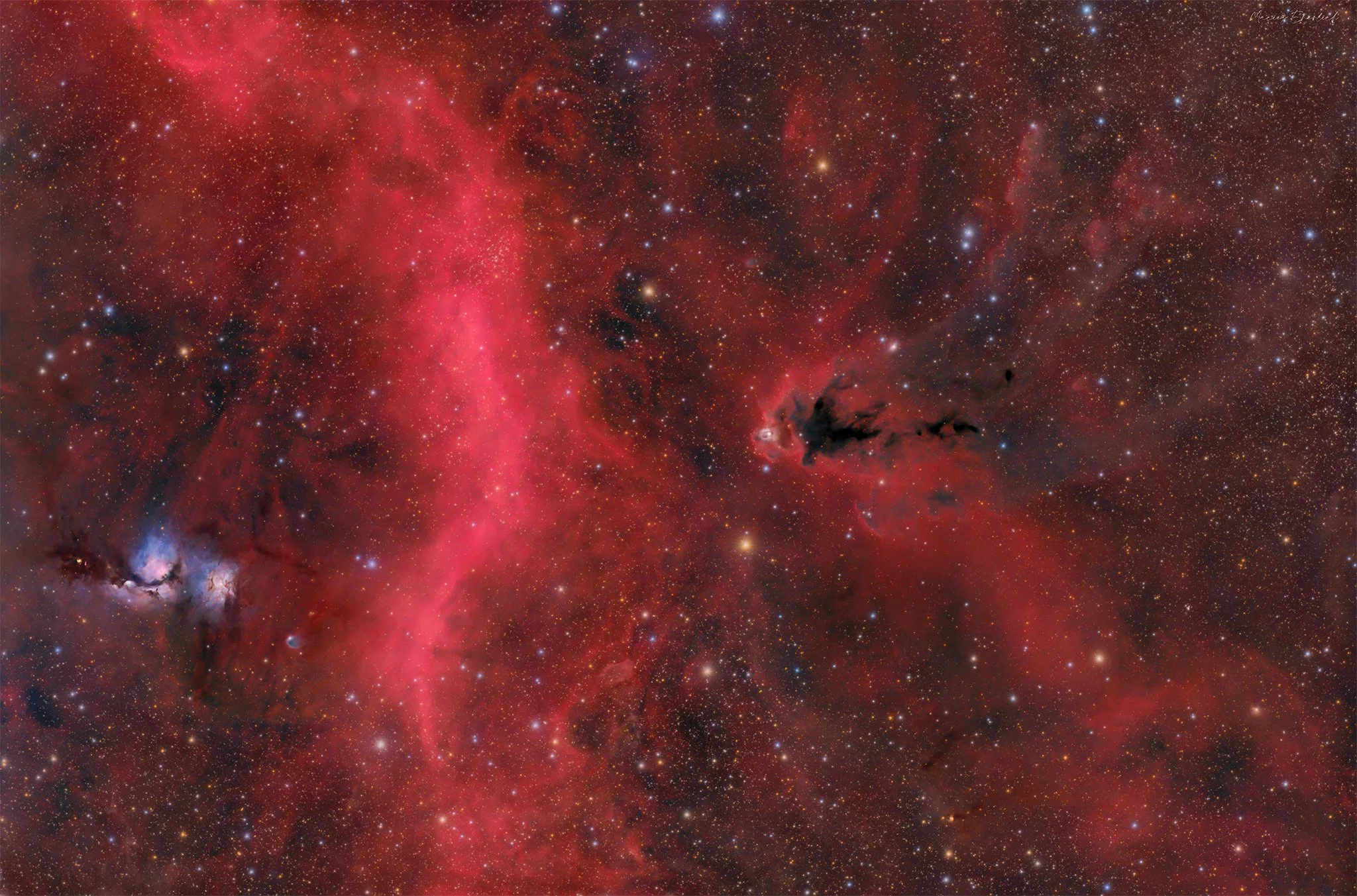
Boogyman and M78 swimming in hydrogen sea
The Boogeyman Nebula, formally known as LDN 43, is a dark nebula located roughly 1,400 light-years away in the constellation Serpens Cauda. Unlike glowing emission nebulae that shine brightly with energized gas, this object appears as an eerie silhouette against the star-filled background of the Milky Way. Thick clouds of interstellar dust block visible light from stars behind it, creating the striking illusion of a shadowy, ghost-like figure—hence its haunting nickname. The nebula’s sinuous, curved shape resembles a cloaked creature looming through space, which has made it a favorite target for astrophotographers seeking dramatic cosmic imagery.
Despite its ominous appearance, the Boogeyman Nebula is actually a stellar nursery in the early stages of star formation. Inside the dense dust clouds lies a young protostar known as RNO 91, which is actively gathering material from its surrounding environment. Powerful outflows from this newborn star carve cavities through the dark cloud, gradually dispersing the dust and shaping the nebula over time. Over millions of years, this hidden region will likely evolve into a small cluster of young stars, transforming the once-shadowy nebula into a brighter and more active region of space.
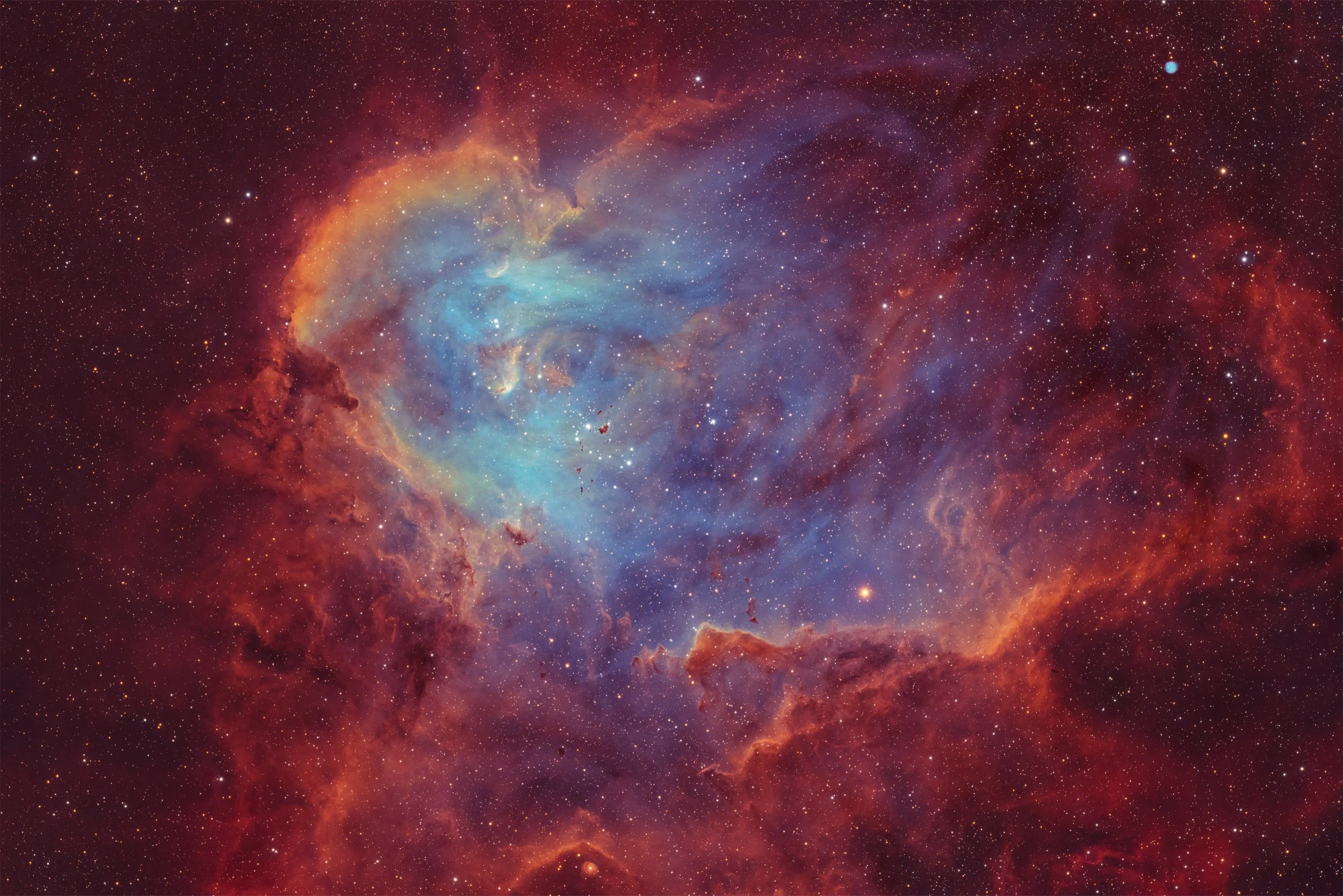
IC2944 - The Running Chicken Nebula
IC 2944 is a large emission nebula located about 6,500 light-years from Earth in the constellation Centaurus. It is sometimes called the Running Chicken Nebula because the brightest part of the gas clouds forms a shape that resembles a running chicken in photographs. The nebula glows red because young, hot stars inside it emit strong ultraviolet radiation that ionizes the surrounding hydrogen gas. When the electrons in the hydrogen recombine, they release energy as visible red light, which is why many star-forming nebulae like IC 2944 appear bright in long-exposure images.
One of the most interesting features of IC 2944 is a set of dark clouds known as Thackeray’s Globules. These small, dense pockets of gas and dust appear as black silhouettes against the bright nebula. Astronomers once thought they might be forming new stars, but studies suggest many of them may actually be evaporating under the intense radiation from nearby massive stars. IC 2944 is therefore an important region for studying how massive stars interact with and shape the gas clouds where stars are born.
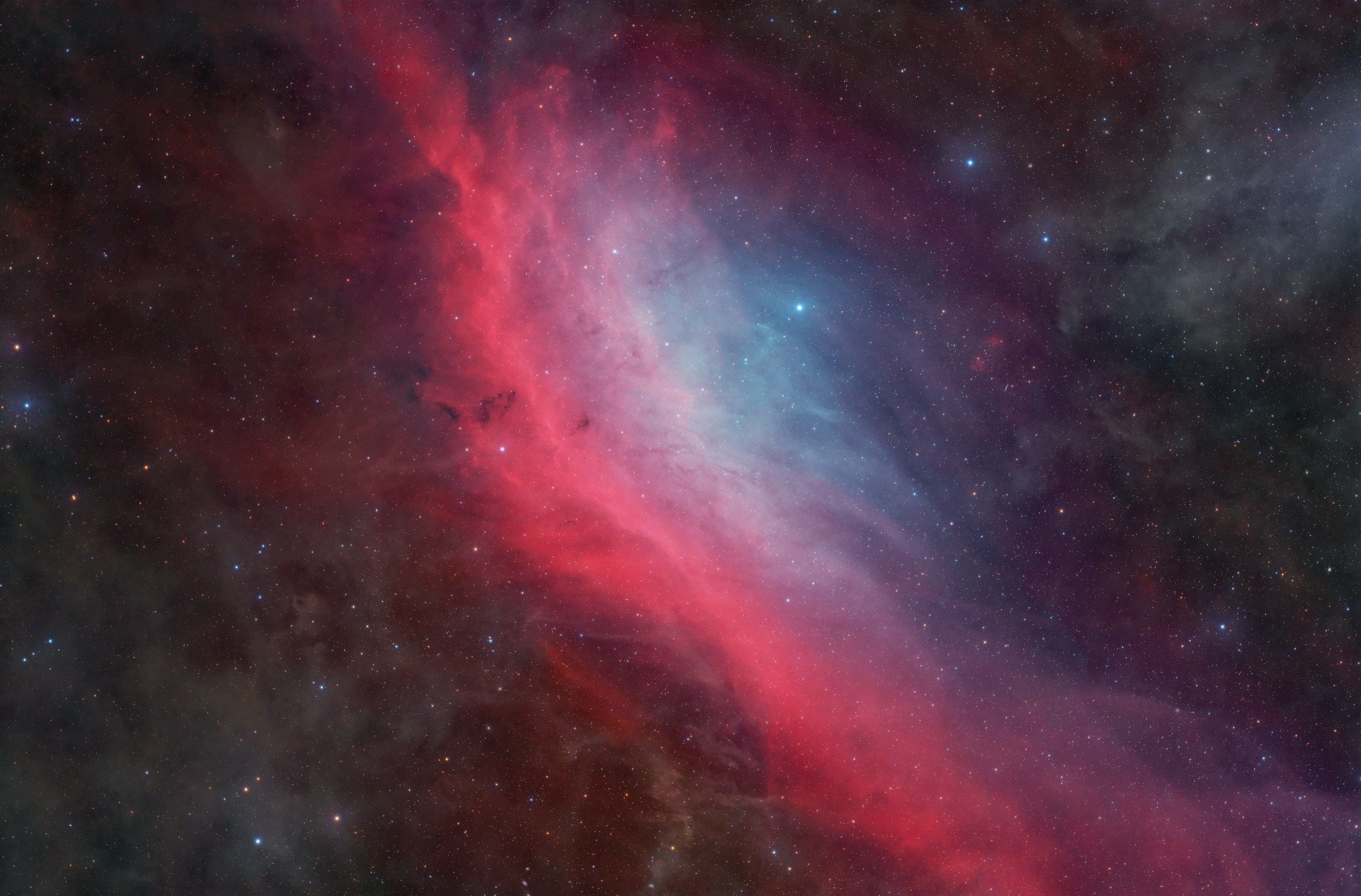
The California Nebula (NGC 1499)
Stretching across space like a glowing cosmic coastline, the California Nebula (NGC 1499) is a vast emission nebula located about 1,000 light-years away in the constellation Perseus. Its elongated shape gives it a striking resemblance to the outline of the U.S. state of California, which is how it earned its popular name. Spanning roughly 100 light-years in length, the nebula shines primarily in deep red hydrogen-alpha light as energetic radiation from the nearby hot star Xi Persei excites the surrounding hydrogen gas.
Despite its large size, the California Nebula is relatively faint and difficult to see visually, even with telescopes. Long-exposure astrophotography reveals its intricate glowing clouds, dark dust structures, and subtle blue reflections embedded within the surrounding Milky Way star fields. The nebula is part of a much larger complex of gas and dust where new stars are slowly forming, offering a vivid reminder that our galaxy remains an active and evolving stellar nursery.
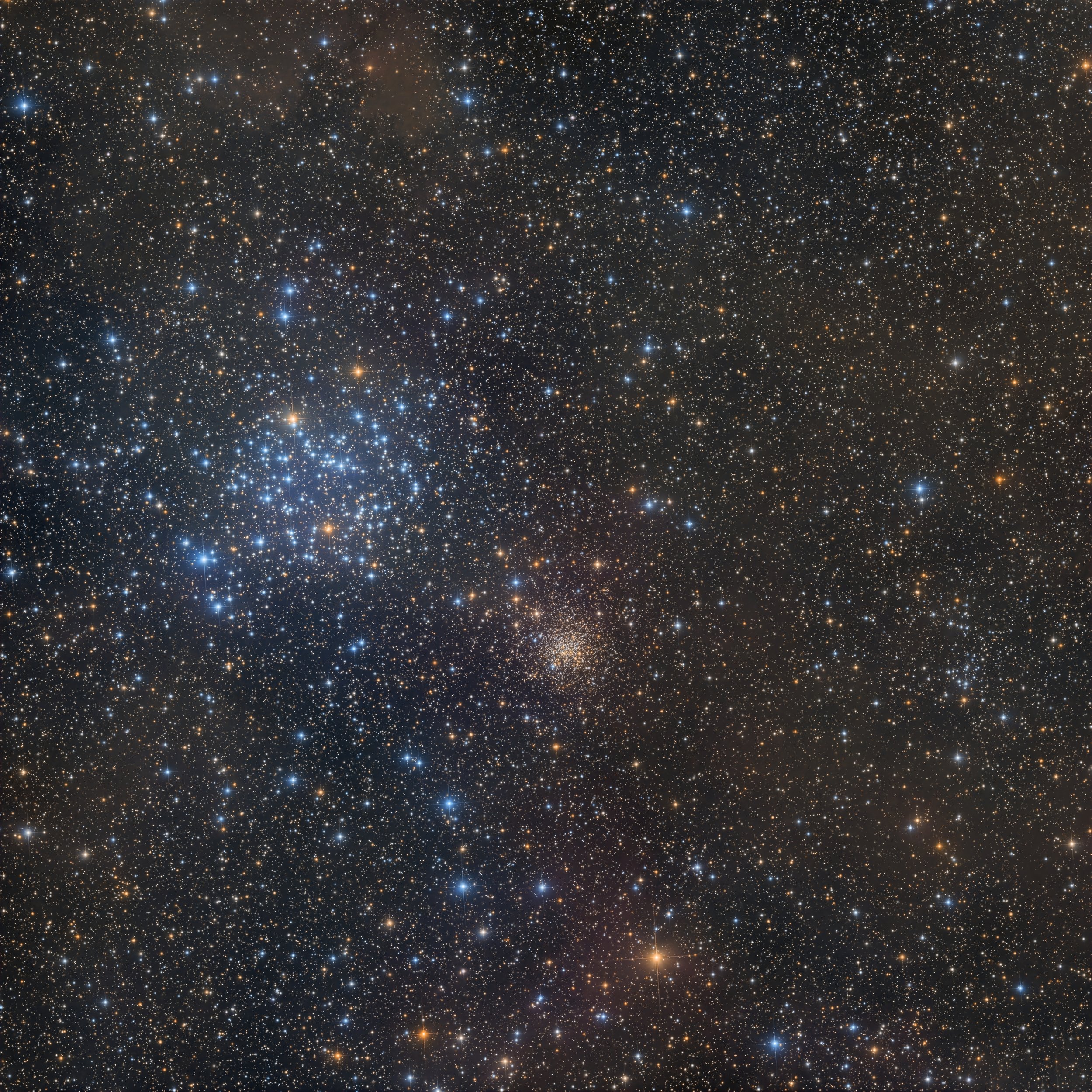
Messier 35 and Neighbor NGC 2158
The rich star field of the constellation Gemini is home to the beautiful open cluster Messier 35 (M35), seen here as the large scattering of bright blue-white stars toward the left side of the image. M35 lies about 2,800 light-years from Earth and contains several hundred young stars that formed together from the same giant molecular cloud roughly 150 million years ago. Open clusters like M35 are loosely bound groups of stars that gradually disperse over time as gravitational interactions slowly pull them apart.
Sharing the same field of view is the much smaller and more distant cluster NGC 2158, visible near the center as a dense, golden knot of stars. Though it appears close to M35 in the sky, NGC 2158 is actually far more distant at about 16,000 light-years away and is nearly ten times older. This contrast between a young, nearby open cluster and an older, tightly packed one provides a striking reminder that objects appearing close together in the night sky can in fact be separated by vast distances across our Milky Way galaxy.
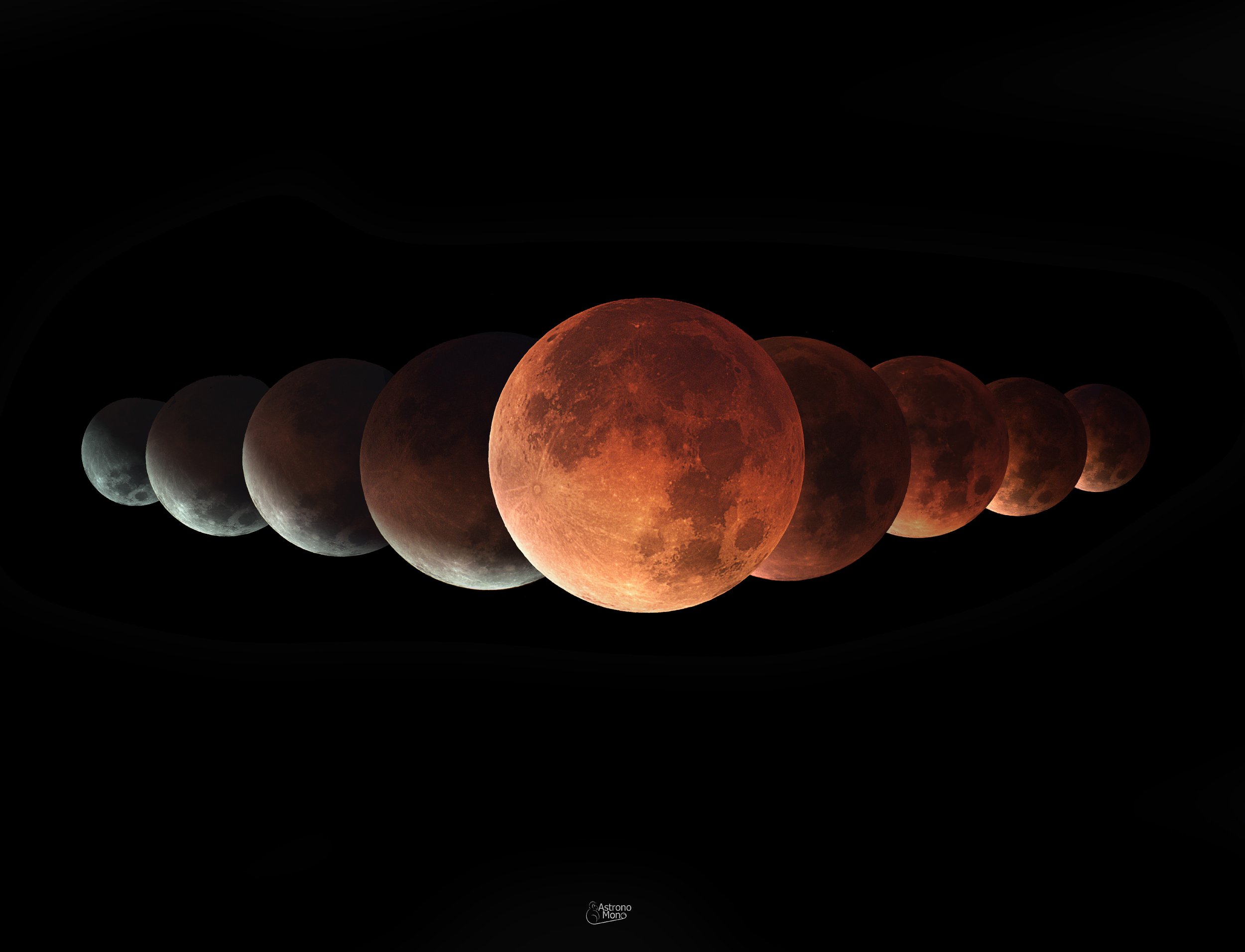
A Blood Moon Sequence
his composite shows the progression of a recent total lunar eclipse as Earth’s shadow slowly moved across the full Moon. Beginning at left, the Moon enters the dark inner shadow of Earth (the umbra), gradually dimming until totality occurs near the center of the sequence, when the Moon glows a deep copper-red. The curved edge of Earth’s shadow reveals the round shape of our planet, a fact that helped early astronomers understand that Earth is spherical.
Total lunar eclipses occur when the Sun, Earth, and Moon align with Earth positioned directly between the Sun and the full Moon. Even during totality the Moon does not disappear; instead it turns red because sunlight passing through Earth’s atmosphere is filtered and bent into the shadow, allowing mostly red wavelengths to reach the lunar surface. The recent eclipse was visible across much of the Americas and lasted several hours from beginning to end, offering skywatchers a slow and dramatic celestial event.
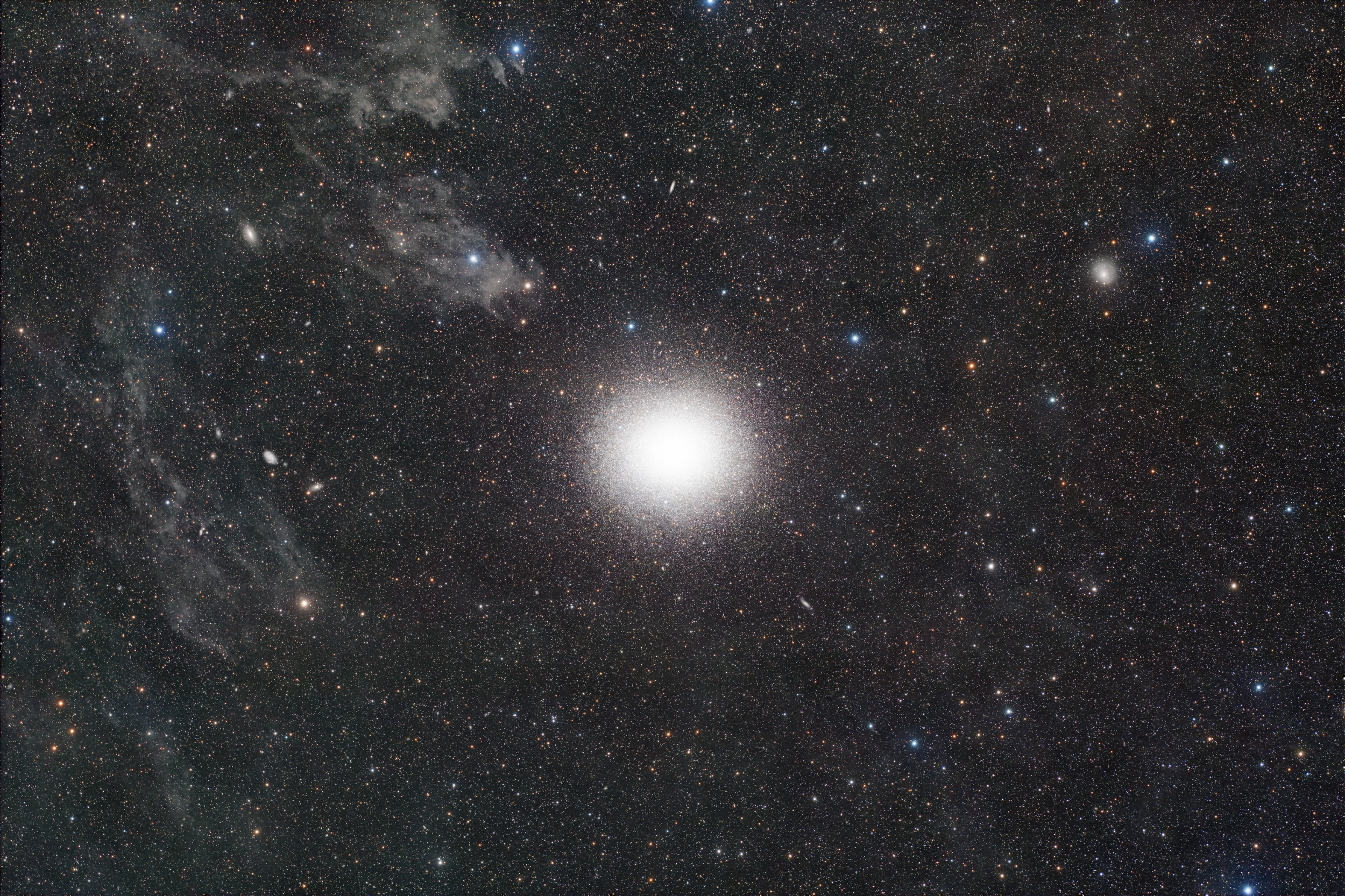
Omega Centauri
Shining like a dense stellar lantern in the southern sky, NGC 5139, better known as Omega Centauri, is the largest and most massive globular cluster associated with the Milky Way. Containing an estimated ten million stars packed into a sphere about 150 light years across, the cluster lies roughly 15,800 light years from Earth in the constellation Centaurus. Its intense central brightness is created by an extraordinary concentration of ancient stars gravitationally bound together, forming a brilliant core surrounded by a vast halo of progressively fainter members.
Unlike typical globular clusters, Omega Centauri shows evidence of multiple stellar populations with different ages and chemical compositions. This unusual complexity has led astronomers to suspect it may be the remnant core of a dwarf galaxy that was captured and stripped apart by the Milky Way long ago. Surrounding the blazing cluster core, the deep field reveals countless foreground stars of our own galaxy along with distant background galaxies scattered across the frame, highlighting the immense scale and layered structure of the universe.
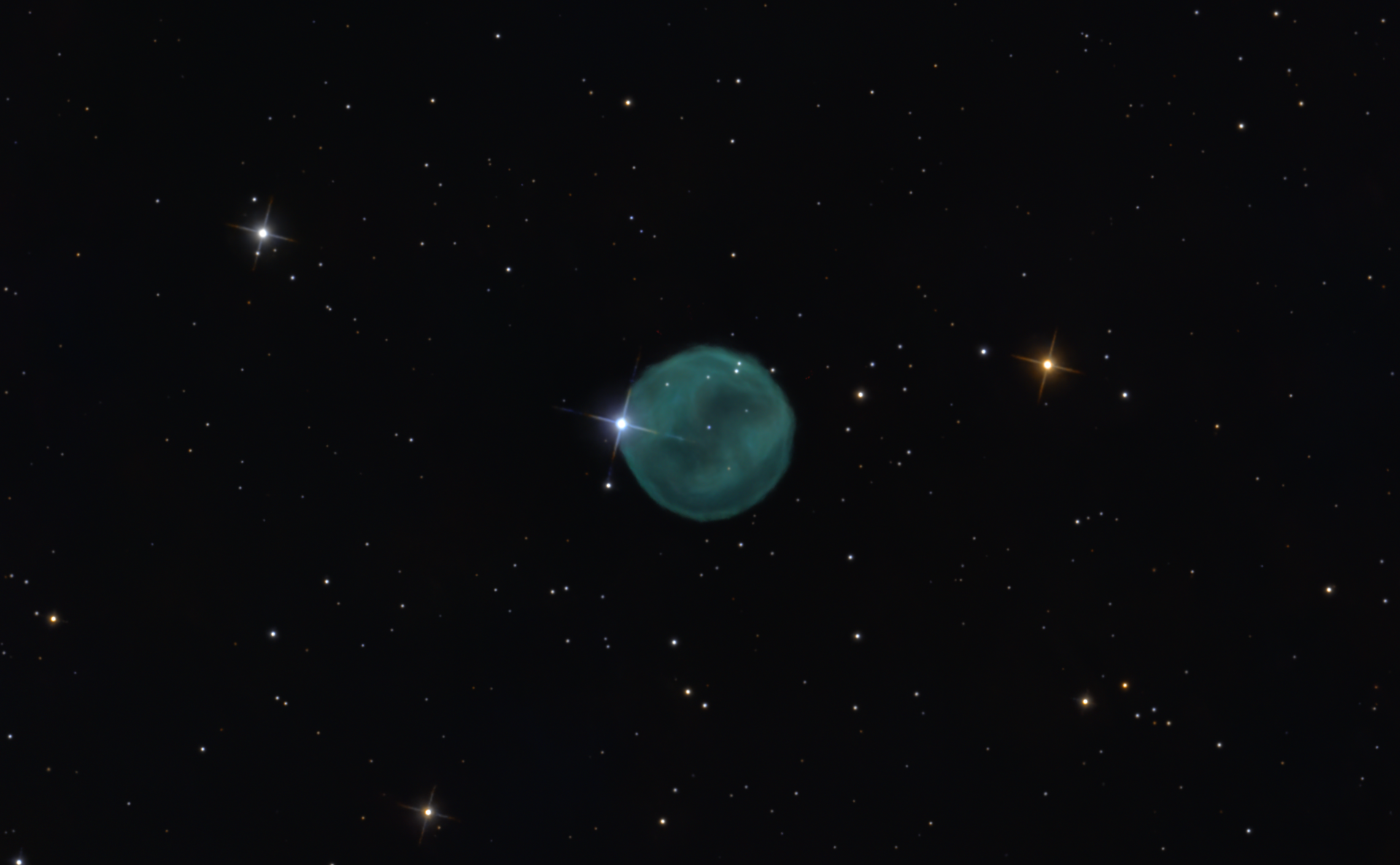
Abell 33: The Diamond Ring Nebula
In the constellation of Hydra lies the delicate planetary nebula Abell 33, a nearly perfect cosmic bubble formed when a Sun-like star shed its outer layers near the end of its life. The expanding shell of ionized oxygen glows with a soft teal hue, giving the nebula its translucent, spherical appearance. Its symmetry suggests a relatively undisturbed evolution, with the gas dispersing evenly into surrounding interstellar space over tens of thousands of years.
The striking “diamond ring” effect is created by the bright foreground star HD 83535, which happens to align almost perfectly along the nebula’s rim. Though unrelated physically, the chance alignment enhances the illusion of a celestial jewel suspended in space. Subtle internal variations within the nebular shell hint at complex stellar winds and layered mass loss from the dying central star, while distant background galaxies faintly pepper the surrounding star field, emphasizing the vast depth of the scene.
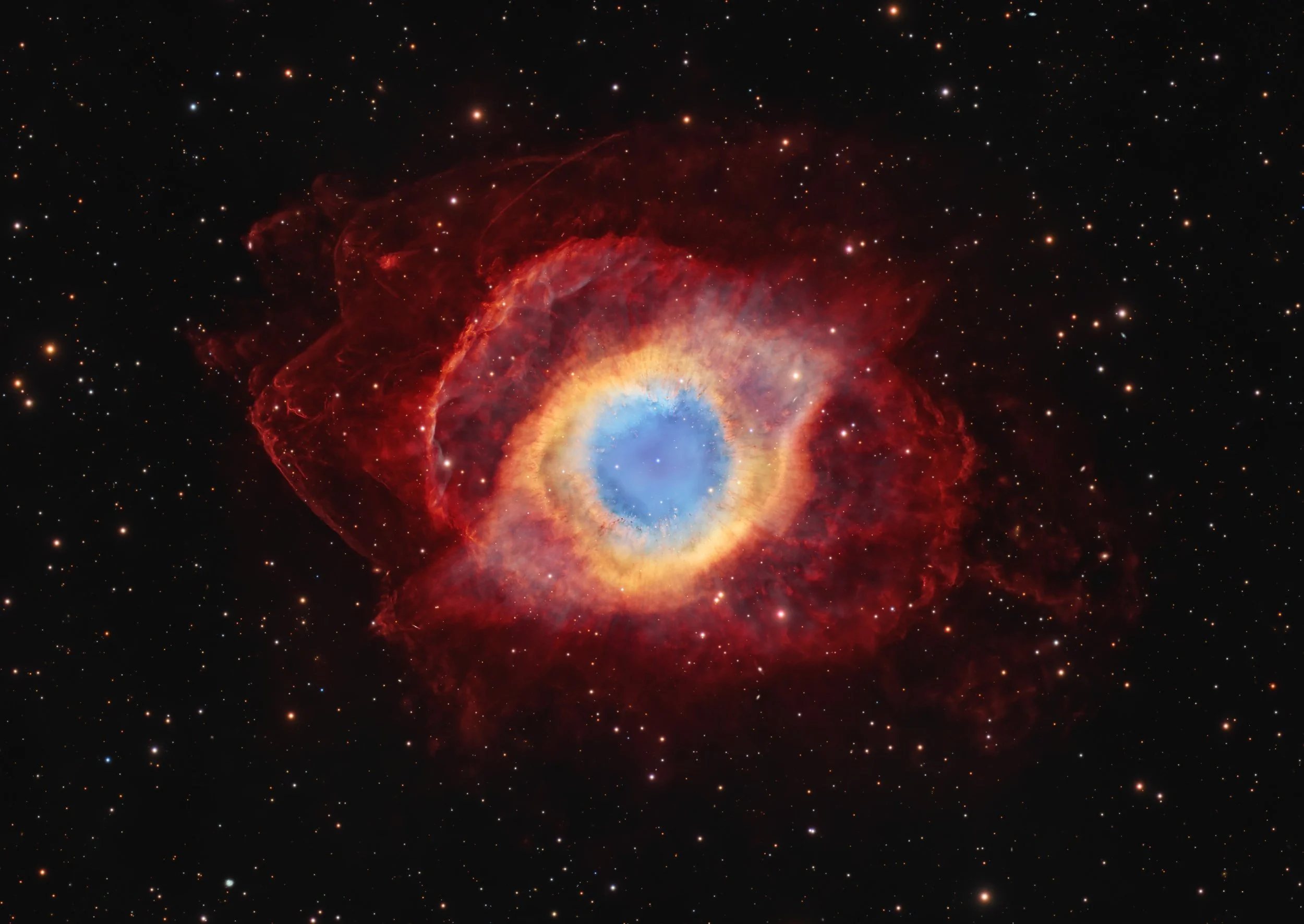
the Helix Nebula in Unprecedented Depth
This extraordinary 670-hour integration of the Helix Nebula reveals the full complexity of one of the closest known planetary nebulae to Earth. Located about 650 light-years away in the constellation Aquarius, the Helix is the expanding outer envelope of a Sun-like star in its final stages of evolution. The luminous blue core traces highly ionized oxygen gas energized by the hot central white dwarf, while the golden inner ring and surrounding crimson structures highlight hydrogen and sulfur emissions sculpted by stellar winds and radiation.
The exceptional depth of this integration exposes extremely faint outer extensions rarely recorded in such clarity, including wispy filaments and asymmetric halos that map the nebula’s interaction with the surrounding interstellar medium. RGB data were carefully processed to preserve natural star colors and reveal background galaxies scattered across the field, while narrowband data were layered in a custom SHO palette inspired by the Hubble Space Telescope image of the Helix. The result is both scientifically revealing and visually immersive, capturing the fragile, expanding remains of a star not unlike our own Sun’s distant future.
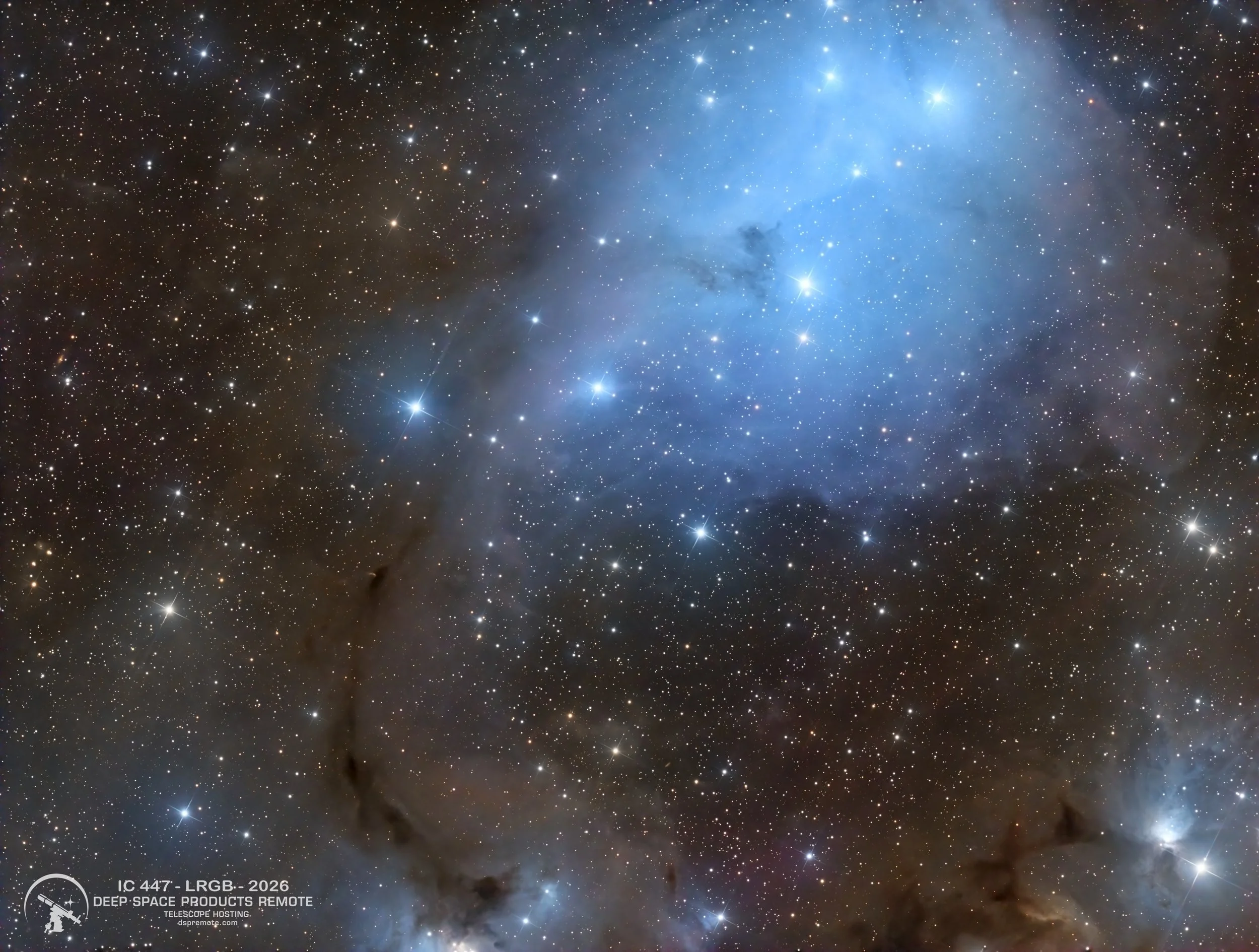
IC 447 – Blue Reflection in Monoceros
IC 447 is a delicate reflection nebula embedded within the vast molecular clouds of the constellation Monoceros. Its luminous blue glow is created as starlight from nearby young stars scatters off fine interstellar dust particles, much like Earth’s sky appears blue due to atmospheric scattering. Unlike emission nebulae, IC 447 does not shine from ionized gas but instead reflects light, revealing intricate gradients of color and texture shaped by the surrounding dust.
Dark filaments snake through the field, part of the larger Monoceros molecular cloud complex, where gravity continues to sculpt dense regions that may eventually collapse into new stars. The contrast between the cool blue reflection nebula and the warmer background dust highlights the layered structure of the Milky Way in this direction. Rich star fields punctuate the scene, emphasizing both the depth and the active star-forming environment that defines this region of our galaxy.
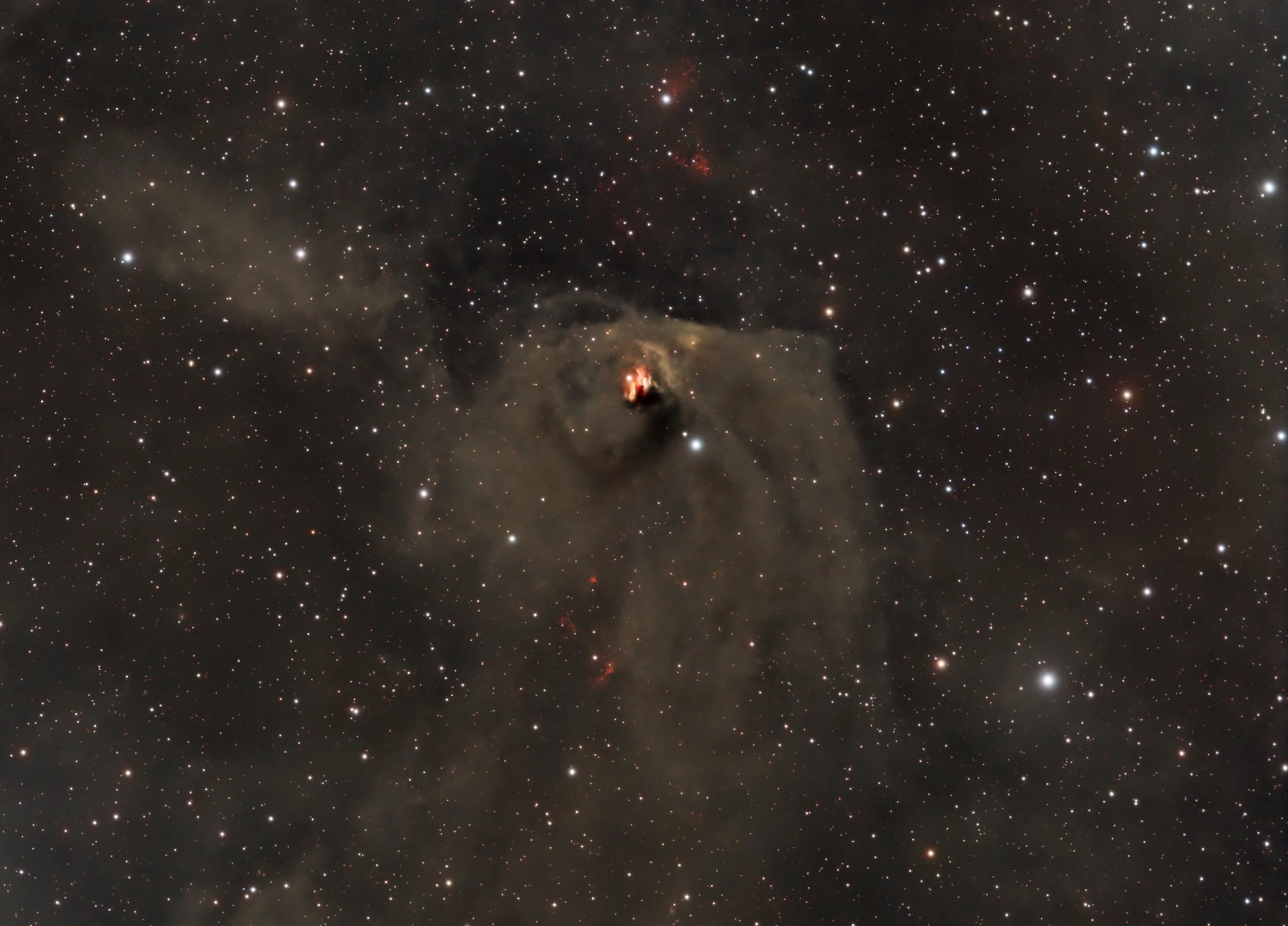
NGC 1555 – Hind’s Variable Nebula
The delicate glow of NGC 1555, better known as Hind’s Variable Nebula, lies embedded in the dusty molecular clouds of Taurus, just beyond the foreground stars of the Hyades. This reflection nebula is illuminated by the young variable star T Tauri, a prototypical pre–main sequence star still accreting material from its surrounding disk. The nebula’s brightness and shape subtly change over time as shifting dust structures scatter and obscure the star’s light, giving rise to its historic designation as a variable nebula.
Imaged from Wunstorf, Germany, with 13 hours and 28 minutes of HaLRGB integration, the fan-shaped blue glow stands out against a complex web of dark dust lanes. These obscuring clouds are part of the Taurus-Auriga star-forming region, one of the nearest stellar nurseries to Earth. The wide, flat field of the FSQ106 reveals both the intimate structure of the illuminated dust and its broader galactic environment, capturing a dynamic scene where newborn stars actively reshape their natal surroundings.
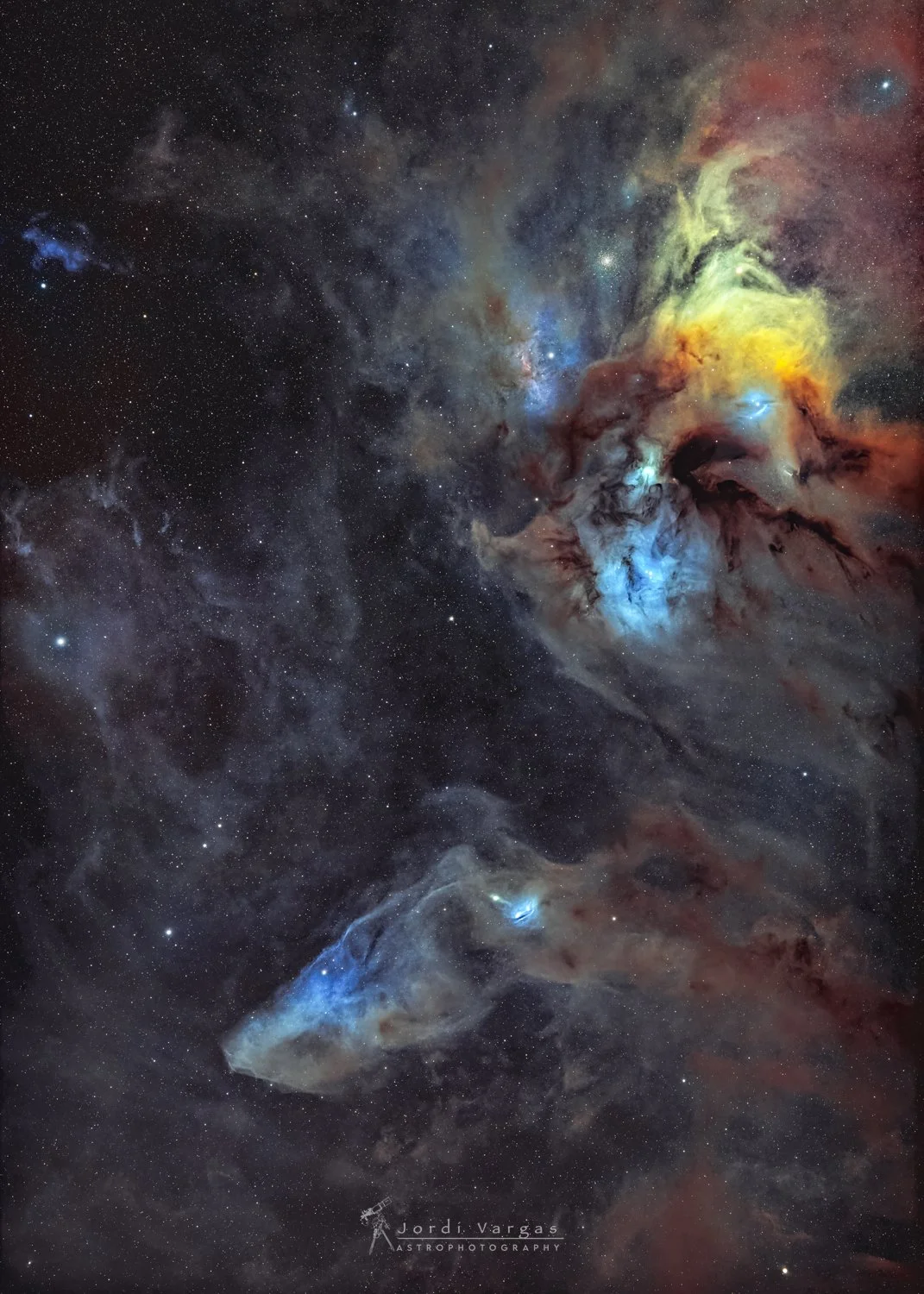
Rho Ophiuchi in Natural Color
The vibrant star-forming complex surrounding Rho Ophiuchi lies about 460 light years away in the constellation Scorpius. This wide-field RGB image reveals the striking interplay of blue reflection nebulae illuminated by hot young stars, golden-brown interstellar dust lanes, and patches of faint red hydrogen emission. The region is part of one of the closest stellar nurseries to Earth, where dense molecular clouds are actively collapsing to form new stars embedded within the dusty folds.
Captured from Tivoli Astro Farm in Namibia with 5 hours and 6 minutes of total integration, the natural color palette highlights subtle gradients in dust density and starlight scattering. The bright core of Rho Ophiuchi contrasts against the surrounding dark nebulae, whose opaque filaments trace cold concentrations of gas and dust. Wide-field optics at 135mm preserve the sweeping context of this complex region, emphasizing both its intricate internal structure and its place along the rich Milky Way star fields of the southern sky.
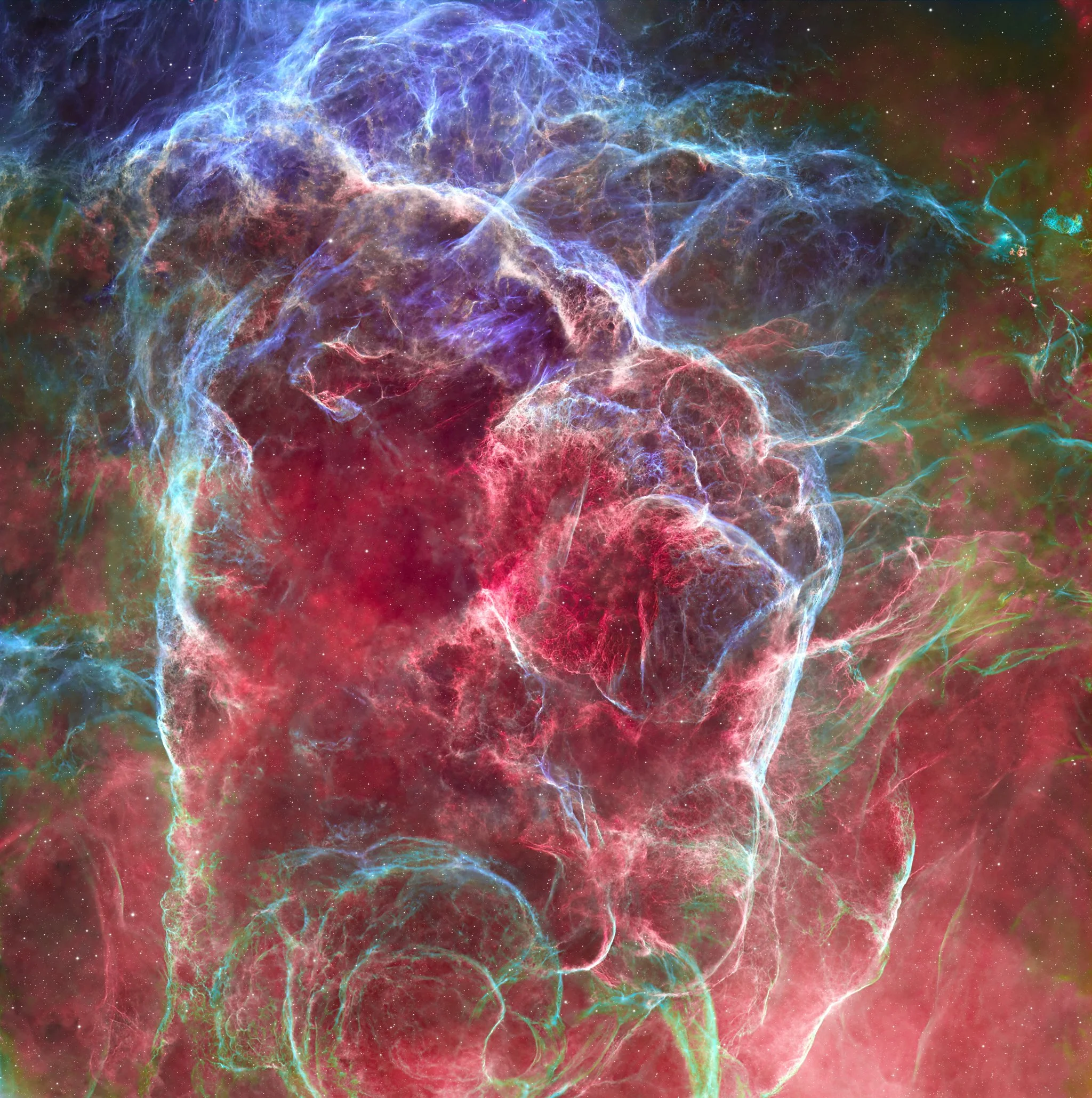
Vela SNR Tri-color Narrowband
The Vela Supernova Remnant is the expanding debris field of a massive star that ended its life in a supernova explosion roughly 11,000 years ago. Located about 800 light-years away in the southern constellation Vela, this remnant spans an immense region of sky, its delicate filaments tracing the outward-moving shock waves plowing through interstellar space. As the blast wave collides with surrounding gas, it heats and ionizes the material, causing it to glow in distinct emission lines.
This tri-color narrowband image maps those emissions into vivid contrast: hydrogen alpha highlights vast clouds of energized hydrogen, oxygen III reveals intricate blue and cyan shock fronts, and sulfur II accents subtle structural boundaries. The tangled network of wisps and arcs records the chaotic interaction between stellar ejecta and the interstellar medium, offering a dynamic portrait of stellar death and the ongoing recycling of matter that seeds future generations of stars.