AAPOD2 Image Archives
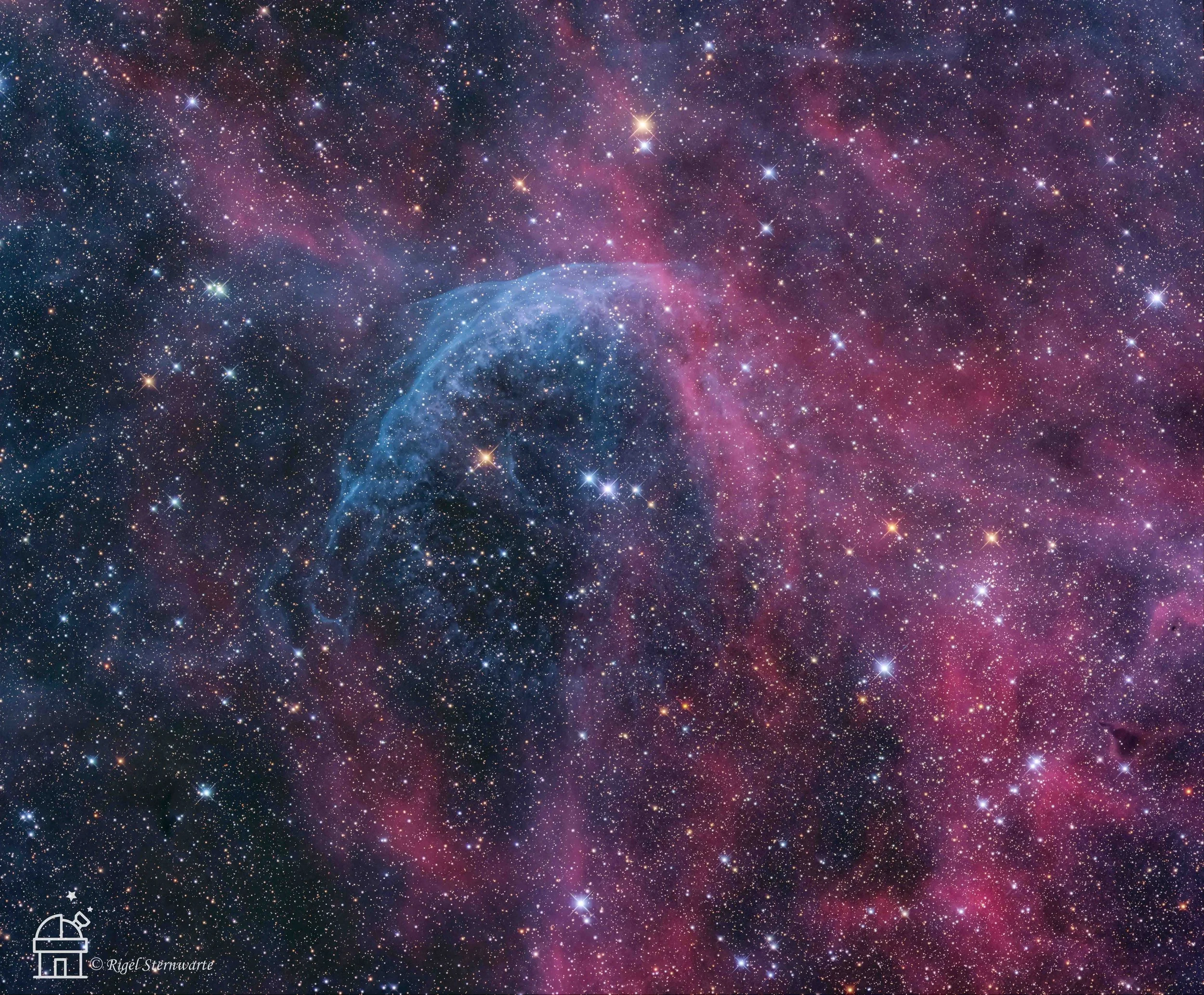
The Bubble Nebula and Its Stellar Neighborhood
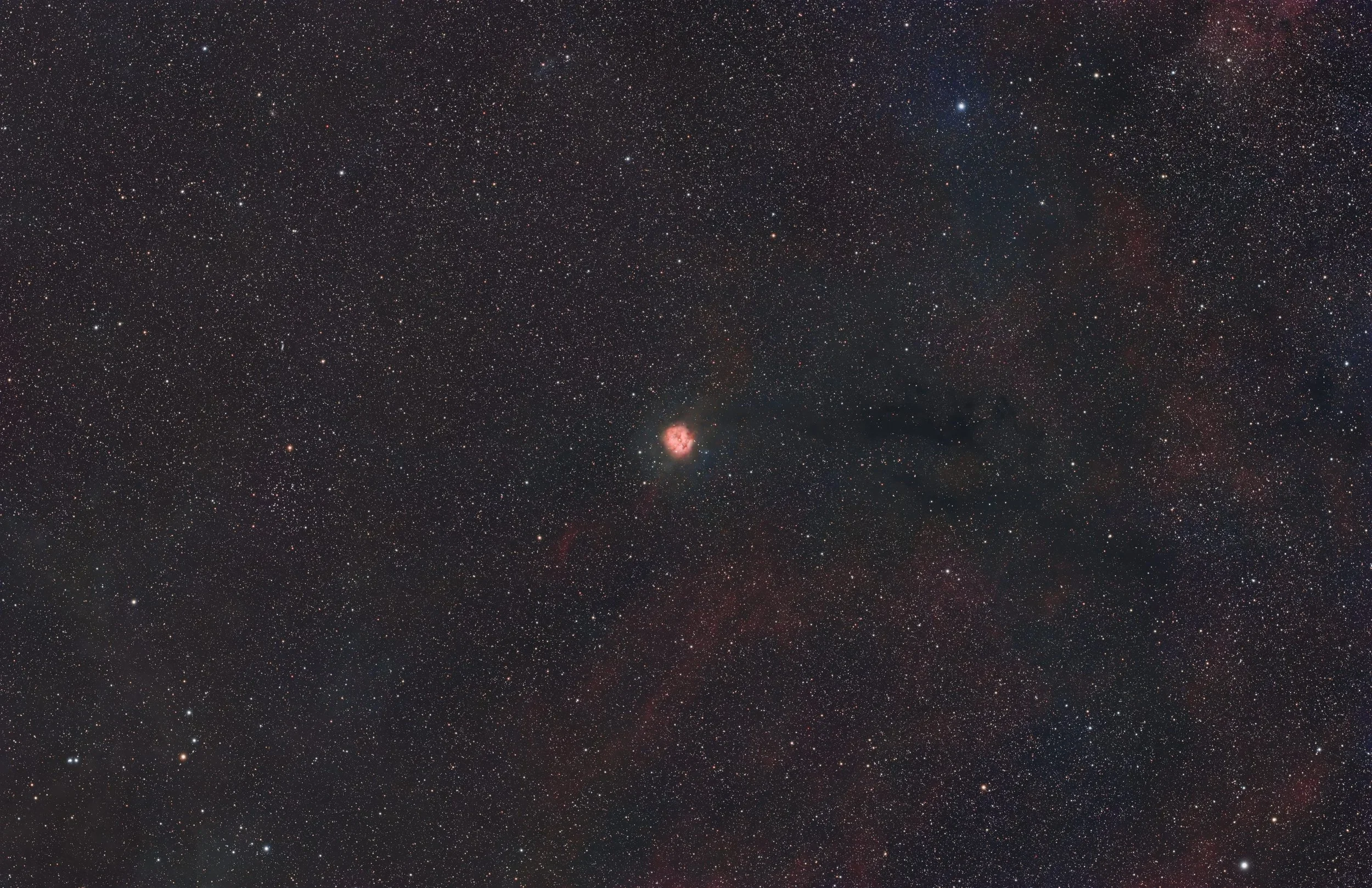
The region around NGC 7635, the Bubble Nebula, is a rich and energetic pocket of Cassiopeia filled with star forming activity and sculpted gas. The Bubble itself is created by the fierce stellar wind from the massive O type star BD+60 2522, which sweeps surrounding hydrogen into a nearly spherical shell. Nearby lies the sprawling emission complex Sh2 157, often called the Lobster Claw Nebula, where ultraviolet radiation from young stars excites clouds of hydrogen and sulfur. The contrast between the smooth bubble and the intricate filaments of Sh2 157 highlights the different ways massive stars shape their environments.
Sharing the same cosmic neighborhood are the open cluster M52 and the star forming region NGC 7538. M52 provides a dense field of young, hot stars that glitter against the nebular backdrop. NGC 7538 hosts some of the largest known protostellar objects in the Milky Way and continues to give birth to new stars within heavily obscured molecular clouds. Together these objects form a vibrant landscape that demonstrates how stellar winds, radiation, and gravity interact to carve the structure of the galactic plane.
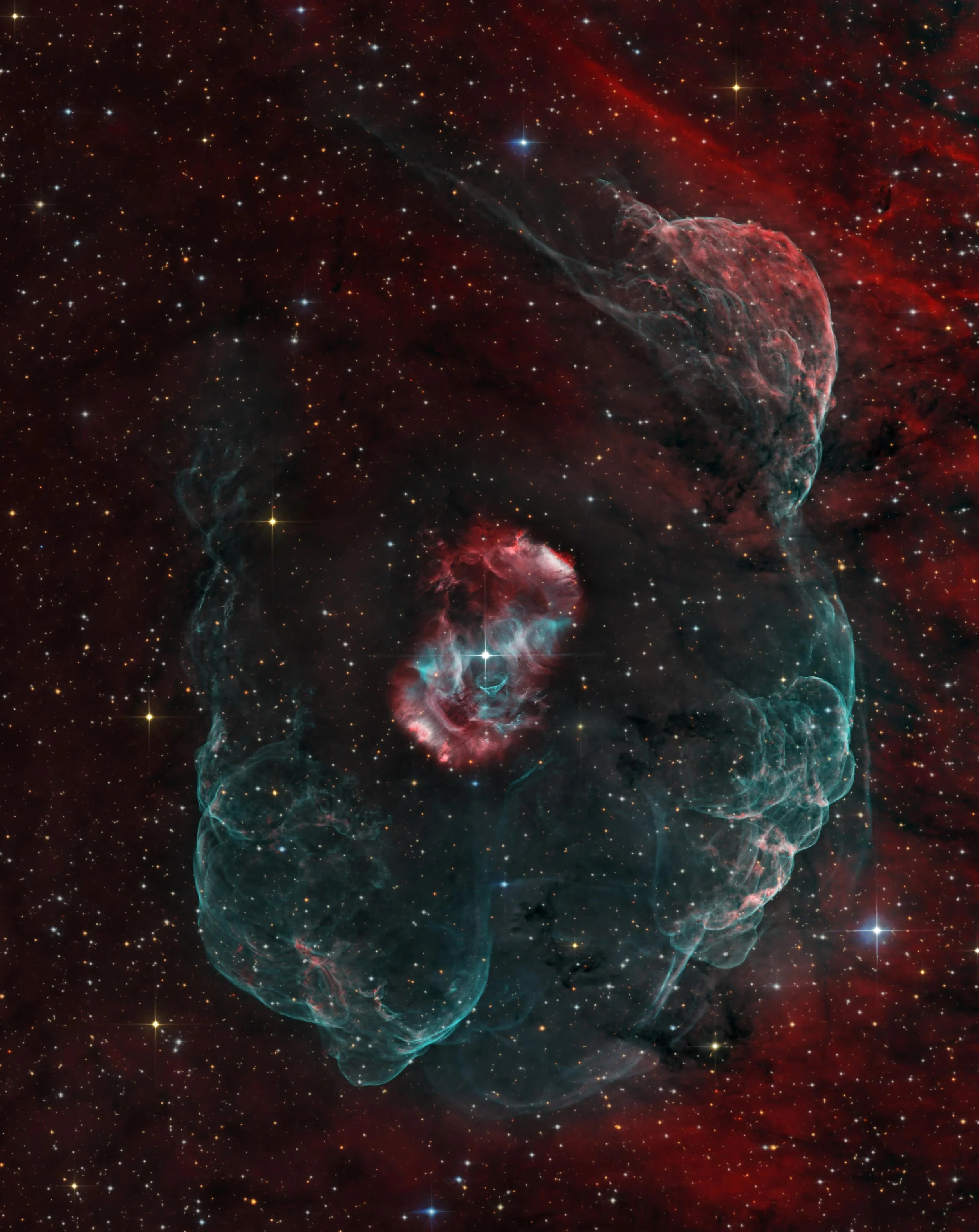
The Crescent and Soap Bubble Nebulae; Two Paths of Stellar Death
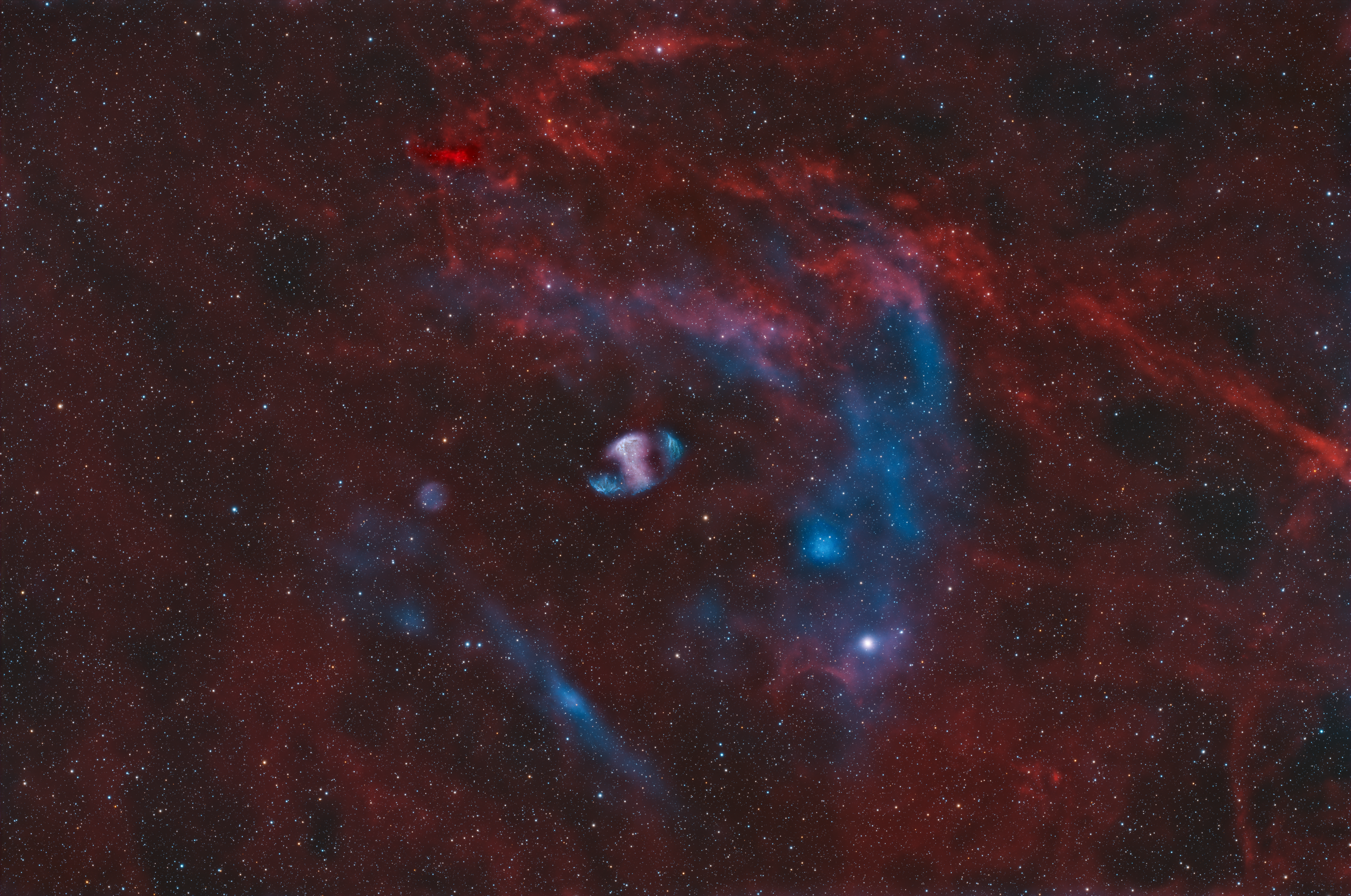
This narrowband portrait captures the Crescent Nebula and the elusive Soap Bubble Nebula suspended in the rich emission fields of Cygnus. The Crescent forms where a fast stellar wind from its Wolf Rayet star collides with slower material ejected in an earlier phase, sculpting a glowing shell of ionized hydrogen and oxygen. Nearby, the faint Soap Bubble reveals a nearly perfect sphere, a rare planetary nebula whose razor thin shell becomes visible only under deep integration.
Captured with the remote dual FF130 setup at Pixelskies in Southern Spain, this dataset blends contributions from both telescopes to resolve the intricate shock fronts and delicate filaments. The combination of careful acquisition by Jamie and Phil, meticulous pre-processing by Phil, and refined post-processing by Jamie brings forward subtle structures that are often hidden, including the Soap Bubble’s extremely low surface brightness envelope floating within the surrounding HII region.
IC 405 and IC 410 in Auriga
The Flaming Star Nebula (IC 405, left) and the Tadpole Nebula (IC 410, right) form one of Auriga’s most dynamic emission-reflection pairings. IC 405 glows in deep hydrogen emission shaped by the powerful ultraviolet radiation of the runaway O-type star AE Aurigae. Its delicate blue tones come from reflected starlight scattering off fine dust, while the surrounding crimson gas creates sweeping filaments that look almost fluid as they drift across the field. To the right, IC 410 reveals a brighter, more compact core where newly formed stars energize surrounding hydrogen. Embedded dark lanes and sculpted billows of gas give the nebula its textured appearance.
Across the frame, both nebulae are set inside a richly glowing hydrogen complex threaded with faint dust. The contrast between the soft, wispy emission of IC 405 and the denser, more structured glow of IC 410 highlights two different stages of stellar feedback shaping the same interstellar cloud. Together they form a dramatic portrait of star formation, radiation, and the turbulent processes that continually reshape the Milky Way’s nearby star-forming regions.
NGC 55 Star Halo in Sculptor
Captured from Wattle Flat in New South Wales, this view of NGC 55 reveals the galaxy almost perfectly edge-on, allowing its elongated stellar disk and extended halo to stand out with remarkable clarity. NGC 55 lies about 6.5 million light years away in the Sculptor Group and is often compared to the Large Magellanic Cloud in both mass and morphology. Seen from this angle, subtle knots of star formation, dust lanes, and pockets of young blue stars thread through the flattened disk while the halo rises above and below it as a faint but structured envelope of ancient stars.
The surrounding star field adds depth to the image by contrasting the warmer foreground stars of the Milky Way with the cool, diffuse glow of the galaxy's outskirts. The halo itself is an important region for studying how galaxies evolve, since it retains clues about past mergers, star formation bursts, and the gravitational shaping of the Sculptor Group. This deep exposure highlights the delicate gradients and faint extensions of NGC 55, turning a modest edge-on spiral into a rich study of galactic structure.
M33 The Triangulum Galaxy
The Triangulum Galaxy, or M33, unfolds here as a loosely wound spiral set roughly 2.7 million light years away in the Local Group. Rich blue star-forming regions trace its arms, where clusters of massive young stars illuminate clouds of hydrogen that glow in soft pink. Unlike grand-design spirals, M33 lacks a dominant central bar, giving its structure a more open and irregular feel shaped by gravitational interactions and internal turbulence. The yellowish core marks an older stellar population that provides contrast to the active, dynamic arms.
This wide field view reveals not only the galaxy itself but also the faint, dusty background of the Milky Way through which we observe it. Subtle gradients and scattered interstellar material highlight just how much foreground structure lies between us and our neighboring galaxies. M33 remains one of the closest and most detailed external spirals available to amateur and professional astrophotographers, offering a deep look into ongoing stellar evolution across an entire galactic disk.
NGC 253 The Silver Coin Galaxy
NGC 253, often called the Silver Coin Galaxy, is one of the brightest and dustiest spiral galaxies in the nearby universe. Seen here almost edge-on, its tilted disc reveals a turbulent star forming environment packed with glowing hydrogen regions, dense dust lanes, and clusters of young blue stars. The warm golden core shines through a veil of foreground dust where intense starburst activity is underway and driving powerful outflows that help shape the galaxy’s structure.
Located about 11 million light years away in Sculptor, NGC 253 anchors the Sculptor Group, one of the closest collections of galaxies to the Milky Way. Its proximity, brightness, and dramatic star forming regions have made it a favorite target for both astrophotographers and professional astronomers. Even in this deep image, the galaxy’s outer halo gently fades into the surrounding star field, hinting at its dynamic history of interactions and ongoing evolution.
The Pleiades in Dust and Hydrogen Light
The Pleiades star cluster rises from a field of soft interstellar dust, and this deep collaboration from Texas and Morocco reveals just how complex that surrounding medium truly is. Long exposures in luminance highlight the delicate filaments of the Taurus Molecular Cloud, whose faint reflection material glows as starlight from the hot blue cluster members scatters across it. Although M45 is best known as a reflection nebula, the field contains surprising pockets of hydrogen gas that emerge only with significant integration time. This image brings that faint Hα emission to the forefront, showing that even the region around a bright, familiar cluster holds intricate structure shaped by stellar winds and ancient motions through the interstellar medium.
A secondary objective was to search for O III emission across the field, but results were minimal except for one small and intriguing exception. Off to the right of the cluster sits the galaxy UGC 2816 (LEDA 13557), a faint system that displays trace amounts of both Hα and O III. Its presence adds a subtle extragalactic layer to the composition, contrasting the youthful hot stars of the Pleiades with the quiet glow of a distant galaxy. Combined, these data sets reveal a region far richer and more complex than its naked-eye appearance suggests, blending dust, gas, and starlight into a sweeping portrait of this iconic cluster.
Natural Colors of the Lunar Surface
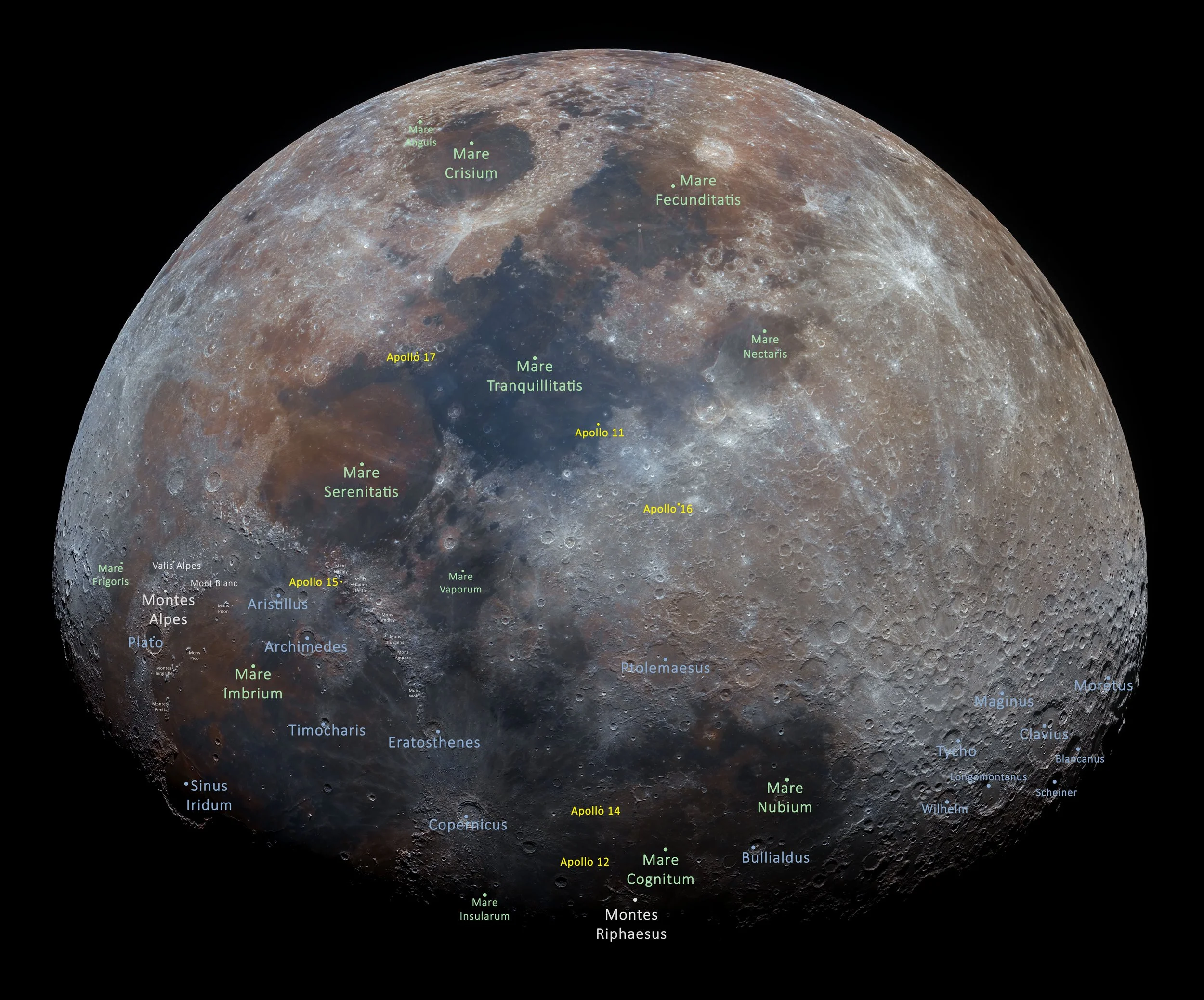
Although the Moon appears gray to the unaided eye, its surface contains subtle but genuine color variations that reveal the mineral composition of the lunar crust. Basaltic maria rich in iron and titanium take on cool blue hues, while highland regions dominated by anorthosite and iron oxides lean toward warmer browns and golds. These colors become visible when carefully enhanced from stacked, calibrated frames, allowing the mineral map of our nearest celestial neighbor to emerge with scientific clarity.
In this image, the interplay of lunar geology becomes strikingly apparent. Titanium-rich basalt flows trace ancient lava plains, while ejecta from long-ago impacts paints surrounding terrain with distinct mineral signatures. By bringing out these natural colors, the image turns the Moon from a seemingly monochrome world into a complex and dynamic record of volcanic activity, impact history, and surface evolution spanning billions of years.
IC 1359 and the HB3 Supernova Remnant
IC 1359 appears here as a luminous knot along the western edge of the Heart Nebula, a region dominated by ionized hydrogen shaped by stellar winds from the massive stars of Melotte 15. The surrounding emission is part of the larger IC 1805 complex, where young, energetic O and B stars carve out cavities and illuminate the surrounding gas. In this frame the nebular folds, filaments, and faint dust lanes reveal the turbulent environment in which new stars continue to form.
Off to the side of IC 1359 lies SNR 132.7+1.3, also known as HB3, a huge and ancient supernova remnant spanning nearly one and a half degrees on the sky. HB3 is believed to be thousands of years old, its blast wave now stretched into faint shells and fractured arcs that blend into the surrounding hydrogen glow. This pairing places active star formation right beside the long-faded echo of a stellar death, creating a striking look at the life cycle of massive stars in a single field of view.
The Lacerta and the Gecko Nebulae
Sweeping across the constellation Lacerta, this delicate complex of hydrogen emission and faint dust is part of the Sh2-126 region, a large and diffuse nebula illuminated by the ultraviolet radiation of nearby hot stars. The deep red glow is produced by ionized hydrogen, while the pale filaments and soft blue-gray textures trace cooler interstellar dust drifting through the field. These overlapping structures create an intricate tapestry that hints at the slow turbulence shaping the outer layers of our local spiral arm.
Captured from Arcadia, Indiana, this wide field reveals subtle transitions between bright emission, translucent dust, and nearly invisible molecular wisps that are difficult to register under typical midwestern skies. The shapes that resemble a leaping lizard and a curling gecko emerge naturally from the interplay of ionized gas and reflective dust, showing how sculpted and dynamic even faint regions of the Milky Way can be when given enough exposure time and careful processing.
NGC 474 and Its Ghostly Shells
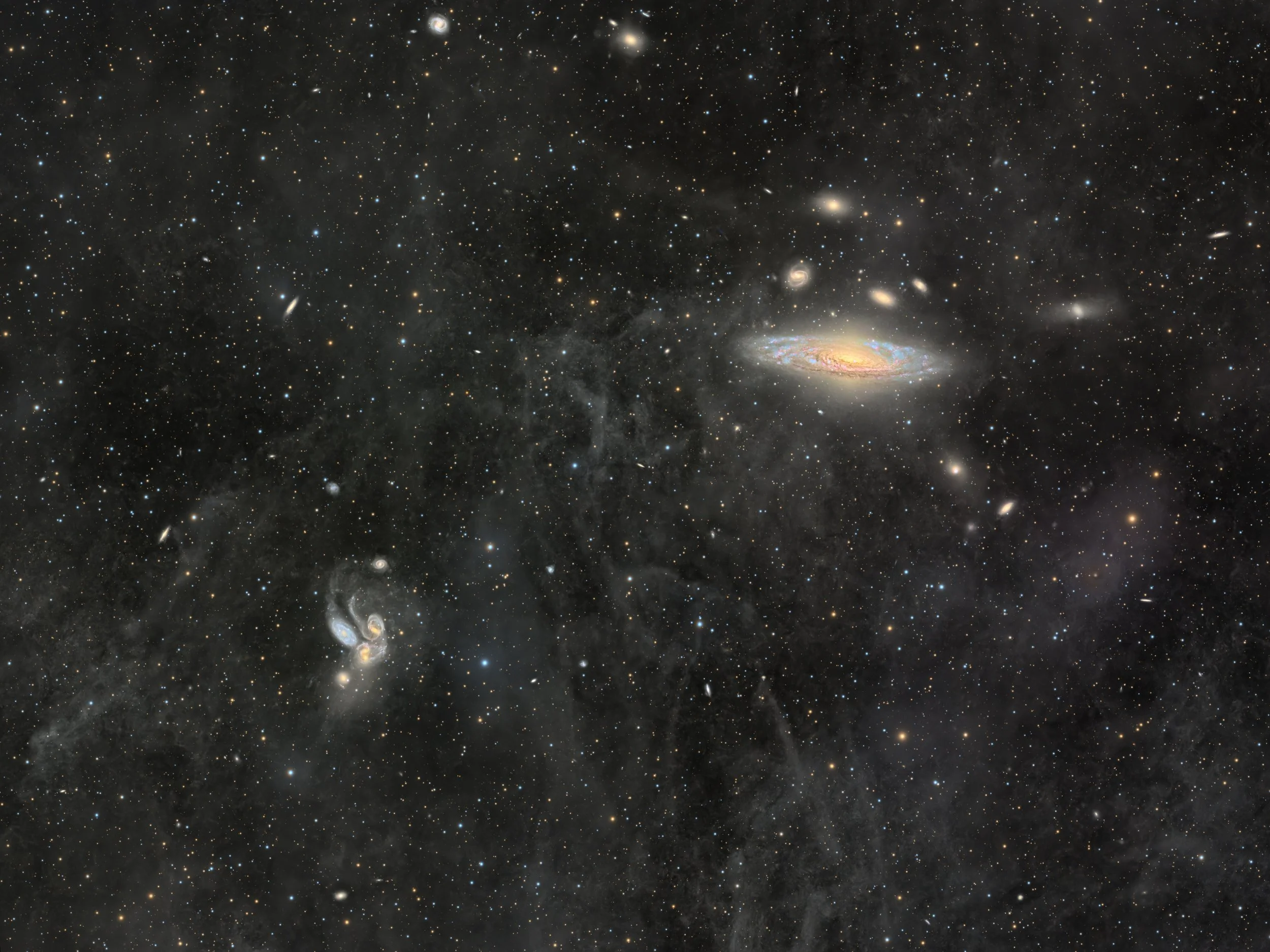
NGC 474 is a lenticular galaxy about 100 million light-years away in Pisces, but it doesn’t behave like the quiet, orderly systems lenticulars are known for. Instead, it wears a stunning set of tidal shells that ripple outward like expanding rings in a pond. These faint, overlapping arcs are the fossil signatures of past galactic encounters, most likely involving its spiral neighbor, NGC 470. Each shell marks a moment when a smaller galaxy was torn apart and its stars were deposited into gently curving layers, giving NGC 474 its strangely hypnotic, almost fluid appearance.
In deep exposures, those shells stretch far beyond the galaxy’s bright core, revealing an evolutionary history shaped by repeated mergers and billions of years of gravitational sculpting. The outer layers are so delicate that they only appear under long integration times, making them a favorite target for astrophotographers who love chasing faint structures. Images like this one highlight the quiet violence of galactic evolution: collisions that happened long before humanity existed, still written in starlight across the cosmos.
Fire Shrimp nebula Sh2-204
Sh2-204 is a compact emission nebula in Camelopardalis, glowing primarily in hydrogen alpha and sculpted by the intense radiation of nearby massive stars. Its curved, asymmetric form is created by the pressure of stellar winds sweeping through the cloud, compressing the gas into this distinctive shrimp-like arc. The region sits along the outer Milky Way and is often overlooked because of its faint surface brightness, but long integrations reveal complex filaments and a surprisingly rich ionization front.
The blue accents often seen in images come from oxygen emission that outlines parts of the shock front, while the deeper reds trace hydrogen heated by ultraviolet light. Sh2-204 is part of a larger network of clouds in the Camelopardalis OB1 association, an area filled with young, energetic stars that continue to shape the surrounding gas. Capturing it cleanly requires both dark skies and patience, but when it comes together, the structure is one of the more unusual forms in the northern sky.
Breakup of Comet C/2025 K1 (ATLAS)
Comet C/2025 K1 (ATLAS) dramatically revealed its fragile nature when it fragmented in late November, splitting into multiple bright components that now drift together inside a fading envelope of dust. This luminance image, built from 140 twenty-second exposures taken on November 21, 2025, captures the comet at the moment its nucleus was visibly separating. The twin points of light at the head are the individual fragments, each shedding material as solar heating pulled the comet apart from within.
Trailing behind the breakup is a broad, soft dust tail stretched by the solar wind into a smooth gradient of scattered sunlight. The surrounding starfield offers a stark contrast to the comet’s disrupted core, emphasizing how quickly the structure of a seemingly solid nucleus can collapse when exposed to the stresses of a close approach to the Sun. Breakup events like this offer a rare chance to study the internal weakness, composition, and thermal response of dynamically young comets from the outer solar system.
Perfect Circles Above Kyzylkyp Tiramisu Canyon
This long-exposure star trail composition from the vibrant Kyzylkyp Tiramisu Canyon reveals an extraordinary display of concentric circular arcs centered on the north celestial pole. The near-mathematical precision of these rings comes from the steady rotation of Earth, which causes the stars to trace out perfectly nested circles across the sky. The result is a powerful reminder of the exactness of our universe. Even across hours of exposure, the sky maintains a level of consistency and stability that allows these seamless and almost mechanical patterns to emerge.
The rich palette of colors in the trails is produced by the stars themselves. Blue and white arcs originate from hotter young stars, while yellow and amber streaks come from cooler, older stars burning at lower temperatures. Together they form a natural spectrum that sweeps across the sky, surrounding the towering canyon monolith and creating a vivid contrast between our rotating heavens and the ancient rock below.
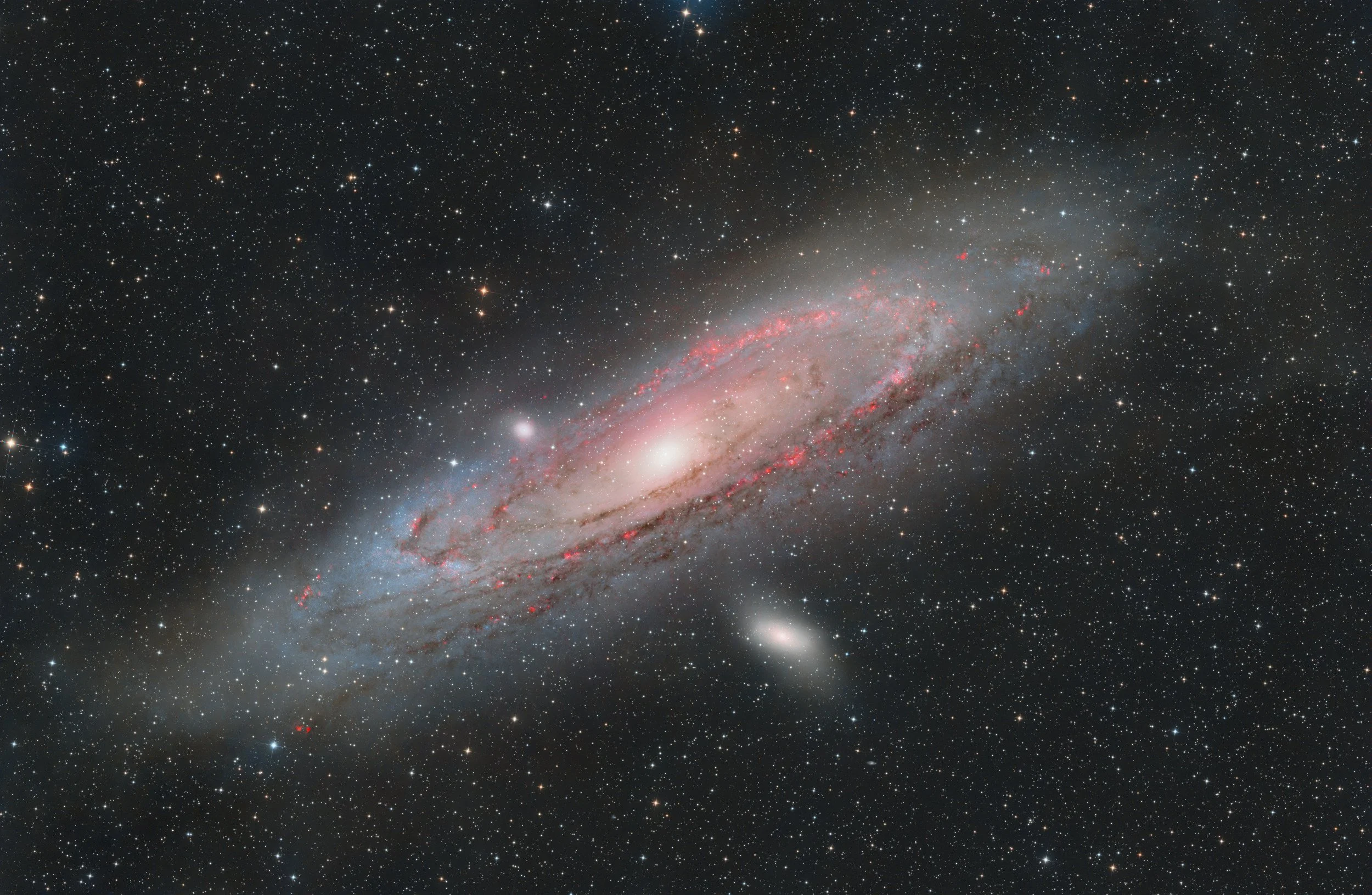
The Andromeda Galaxy: Extended Dust and Hα Emission
The Andromeda Galaxy, cataloged as M31, stretches across this wide field along with its companions M32 and M110. The long dust lanes that cut through its disk appear sharply defined, while an extended halo of faint particulate material surrounds the galaxy and blends into the background. Careful processing brings out subtle hydrogen alpha regions that trace knots of star formation and hint at the dynamic activity within Andromeda’s spiral arms.
Combining broadband and narrowband data reveals both the classic structure of M31 and the diffuse outer features that are often lost in shorter exposures. The satellite galaxies stand out with their own distinct profiles, adding depth and balance to the frame. This view offers a detailed look at our nearest major galactic neighbor and the complex environment that surrounds it.
A deep dive into the Soul Nebula: 234h 55m
The Soul Nebula, cataloged as IC 1848, spreads across a rich star forming complex in Cassiopeia about 6,000 light years from Earth. This field highlights long ribbons of hydrogen emission, windswept cavities carved by young clusters, and faint dust channels that become visible only after long integration. Captured from a Bortle 8.5 backyard in Nashville, the data pushes deep enough to show the layered structure of the nebula and the delicate interplay between ionizing radiation and the surrounding gas.
Across 34 nights and 235 hours of exposure, this result is a remarkably clean and detailed look at a target that is notoriously difficult from heavy light pollution. The depth here makes the Soul feel almost sculpted, with subtle gradients and transitions that rarely show up outside of remote dark sky imagery.
Goodbye Lemmon
Between September 25 and October 30, 2025, this sequence of thirteen images follows the week by week transformation of comet C/2025 A6 Lemmon as it moved deeper into the inner solar system. Each frame captures the growing brightness of the coma along with dramatic changes in the tail as sunlight and the solar wind stripped gas and dust from the nucleus. Subtle streamers early in the series gave way to long, sharply defined ion structures and broader dust fans. The shifting colors across the dates reflect a mix of carbon dominated green emission from the coma and the blue glow of ionized gases driven outward at high speed.
This kind of single frame time lapse is rare because most comets simply do not show so much structural variation over such a short period. Lemmon surprised observers with recurring outbursts that fed new material into the tail and produced those twisting filaments and forked jets seen toward the end of the series. Watching these changes across a month offers a front row view of how dynamic cometary physics can be when a fresh nucleus interacts with the solar wind. It also helps researchers refine dust release models for a comet that has only recently been characterized and continues to deliver surprises.
CTB-1 - Abell 85 - Garlic nebula
CTB 1, also known as Abell 85 or the Garlic Nebula, is a supernova remnant about ten thousand light years away in Cassiopeia. What you are seeing is the expanding shell of gas left behind after a massive star exploded thousands of years ago. The blue structures trace oxygen rich filaments while the red reveals glowing hydrogen shaped by shock fronts racing through the surrounding interstellar medium. The asymmetric bubble and the long trailing filament suggest the original blast expanded into a lopsided environment where dense clouds slowed one side of the shock while the other burst freely into space.
Captured from Nerpio, Spain at the AstroCamp hosting facility, this field shows just how intricate a supernova remnant can be on large scales. The surrounding hydrogen landscape forms a deep red canvas where faint tendrils and rippling waves continue to drift outward. CTB 1 is relatively faint compared to iconic remnants, but its complex structure has made it a favorite for astrophotographers who want to reveal the fine turbulence left behind after a star’s final act.
IC 59 and IC 63 - Ghost of Cassiopeia
IC 63, often called the Ghost Nebula, sits about 550 light years away in Cassiopeia and glows under the intense radiation from the nearby bright star Gamma Cassiopeiae. The nebula’s red tones come from hydrogen excited by that ultraviolet light while the delicate blue and lavender highlights mark regions where dust reflects starlight. The sculpted shapes across the frame reveal how Gamma Cas is slowly eroding and reshaping the cloud, creating wispy ridges and curling fronts that seem to billow outward.
This field captures the quiet drama of a photodissociation region where energetic light and cold gas collide. The fine textures drifting through the red emission form a striking backdrop for the bright foreground star, which dominates the scene without overpowering the subtle structure within the nebula. IC 63 is a small and fragile object but it tells a very detailed story about how massive stars influence their surroundings even across great distances.
NGC 6357 Lobster Nebula in Narrowband SHO
NGC 6357, the Lobster Nebula, glows with a mix of sculpted ionized gas and newborn stars in the constellation Scorpius. This massive star forming complex contains several young open clusters whose radiation carves the surrounding clouds into intricate cavities and filaments. The brilliant blue regions correspond to doubly ionized oxygen while the warmer gold and copper tones reveal the distributions of hydrogen and sulfur captured in narrowband SHO. These processes highlight the turbulent interplay between stellar winds, radiation pressure, and gravity in one of the Milky Way’s most active nurseries.
Captured from Perth, Western Australia, this field exposes the vast reach of the nebula’s outer tendrils which extend far beyond its bright central cavities. The combination of detailed structure and extreme color contrast gives viewers a clear look at the dynamic environment shaping early stellar evolution. With its dramatic textures and luminous knots, the Lobster Nebula remains one of the most compelling examples of how massive stars reshape the interstellar medium around them.