

AAPOD2 Image Archives
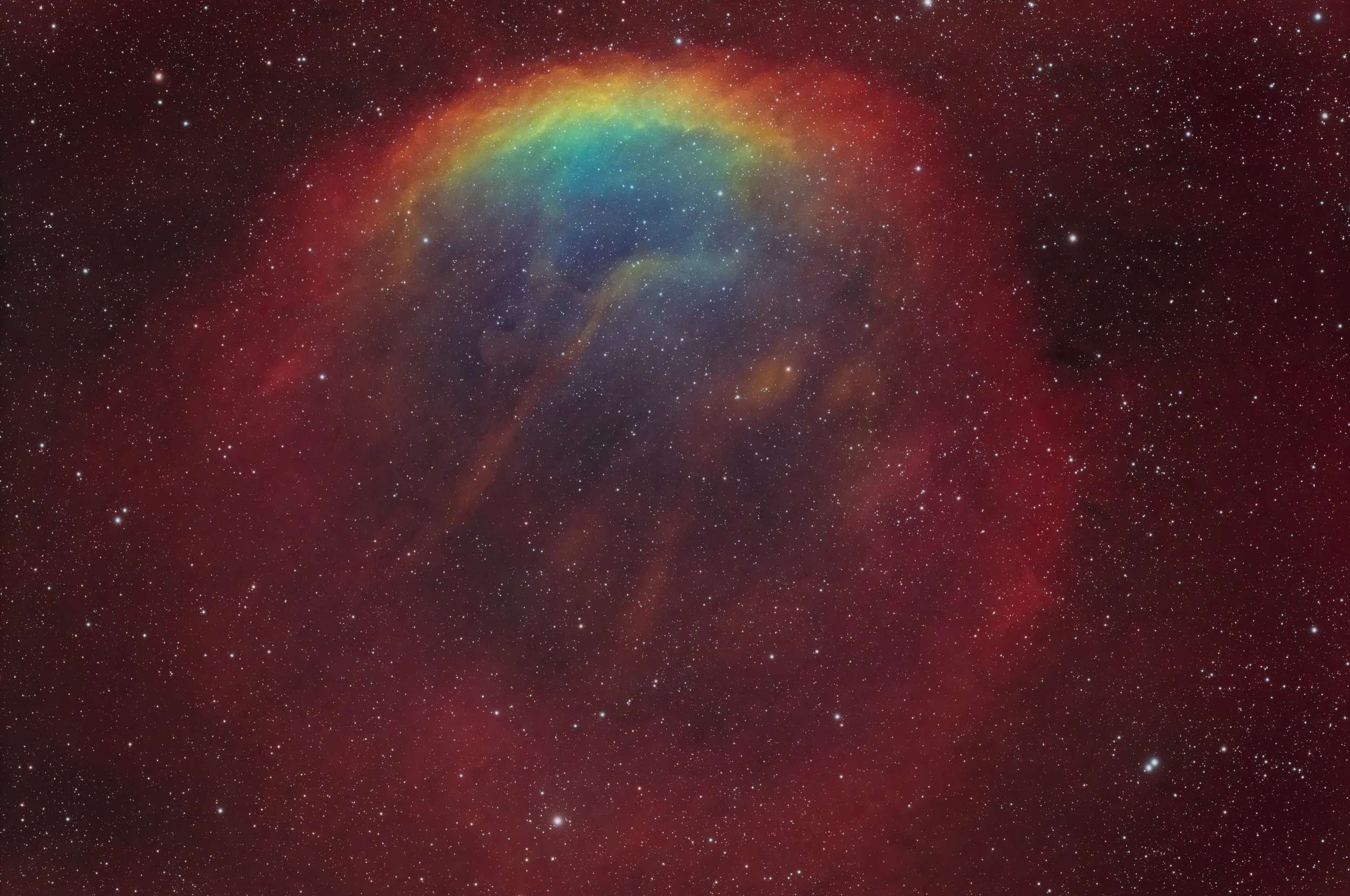
SH2-216
Description and Details:
Sh2-216 is a planetary nebula visible in the constellation of Perseus.
It is located in the easternmost part of the constellation, about 5° west of the bright Capella. It appears as a tenuous gaseous filament difficult to observe because of its low light. Its observation requires powerful and sensitive tools and in long-exposure photos, it barely emerges from the star field in the background. Its declination is moderately northern, so its observation is considerably facilitated for observers placed at the boreal latitudes. To the south of the equator, on the other hand, it can only easily be seen up to the lower temperate regions.
With a distance of only 420 light-years, it is the planetary nebula closest to the solar system. The great dispersion of its gases, which also makes it the greatest observable planetary nebula in the celestial vault, is due to the great age of the cloud, estimated at about 600 000 years. It was initially catalogued as an H II region, although the star responsible for gas ionization was not identified. Later, thanks to spectrometric studies, the hypothesis was advanced that the cloud could be the rest of an ancient planetary nebula with an extremely low rate of expansion[, a hypothesis confirmed later thanks to the discovery of the central star, a white dwarf cataloged like LSV+46°21. The surface temperature of the white dwarf is between 50 000 and 90 000 Kelvin.
Materials :
ASKAR FRA500 Bezel
Camera Altair Hypercam 26M
Filters Antlia 3nm
Gemini G53F Mount @ Onstep
HA : 231 x 300s (19H15)
O3 : 152 x 300s (12H40)
Total integration : 31H55
Copyright: frederic lamagat
Title: Earth’s Crescent at the Edge of Light
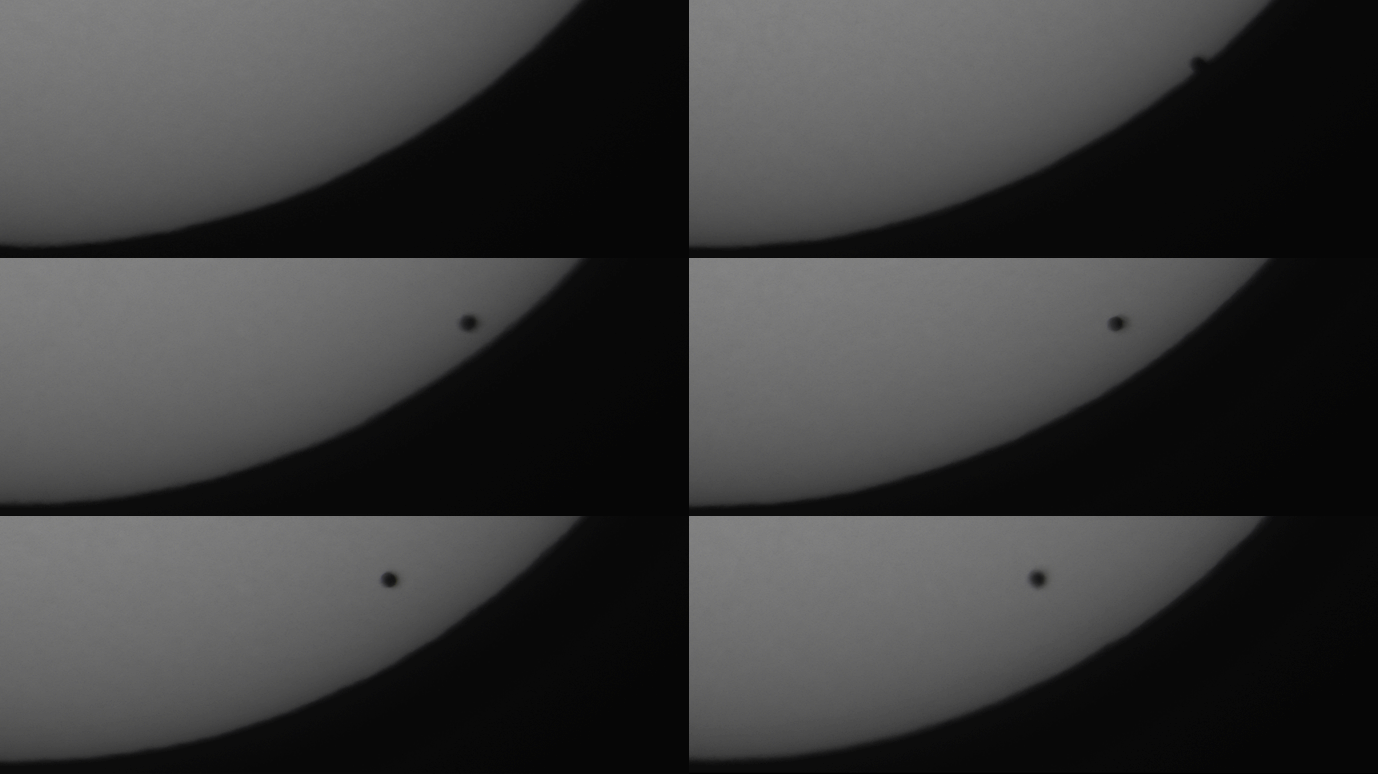
Only a slender arc of our planet is illuminated here, revealing the graceful curvature of Earth as it catches sunlight from an oblique angle. The bright crescent marks the day side, while the majority of the globe remains in darkness, emphasizing the thinness of the atmosphere as a faint, smooth gradient along the limb. Such views are typically captured when a spacecraft observes Earth from a position nearly aligned with the Sun, creating a dramatic phase similar to a crescent Moon.
Images like this highlight the geometry of planetary illumination and orbital mechanics. From deep space, Earth displays phases just as the Moon does when seen from our planet. The sharp boundary between light and shadow, known as the terminator, traces the line between day and night, constantly shifting as Earth rotates beneath the Sun.
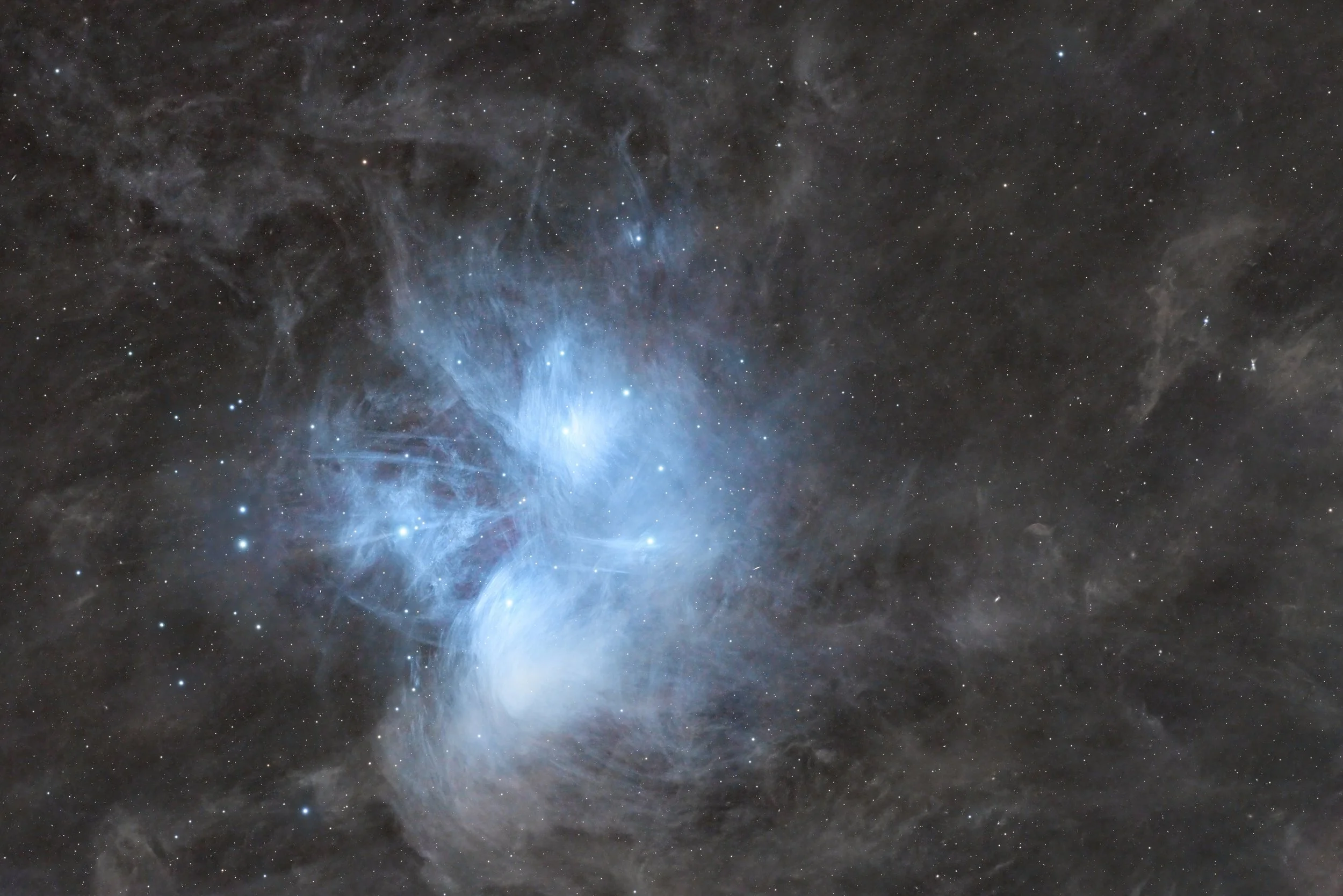
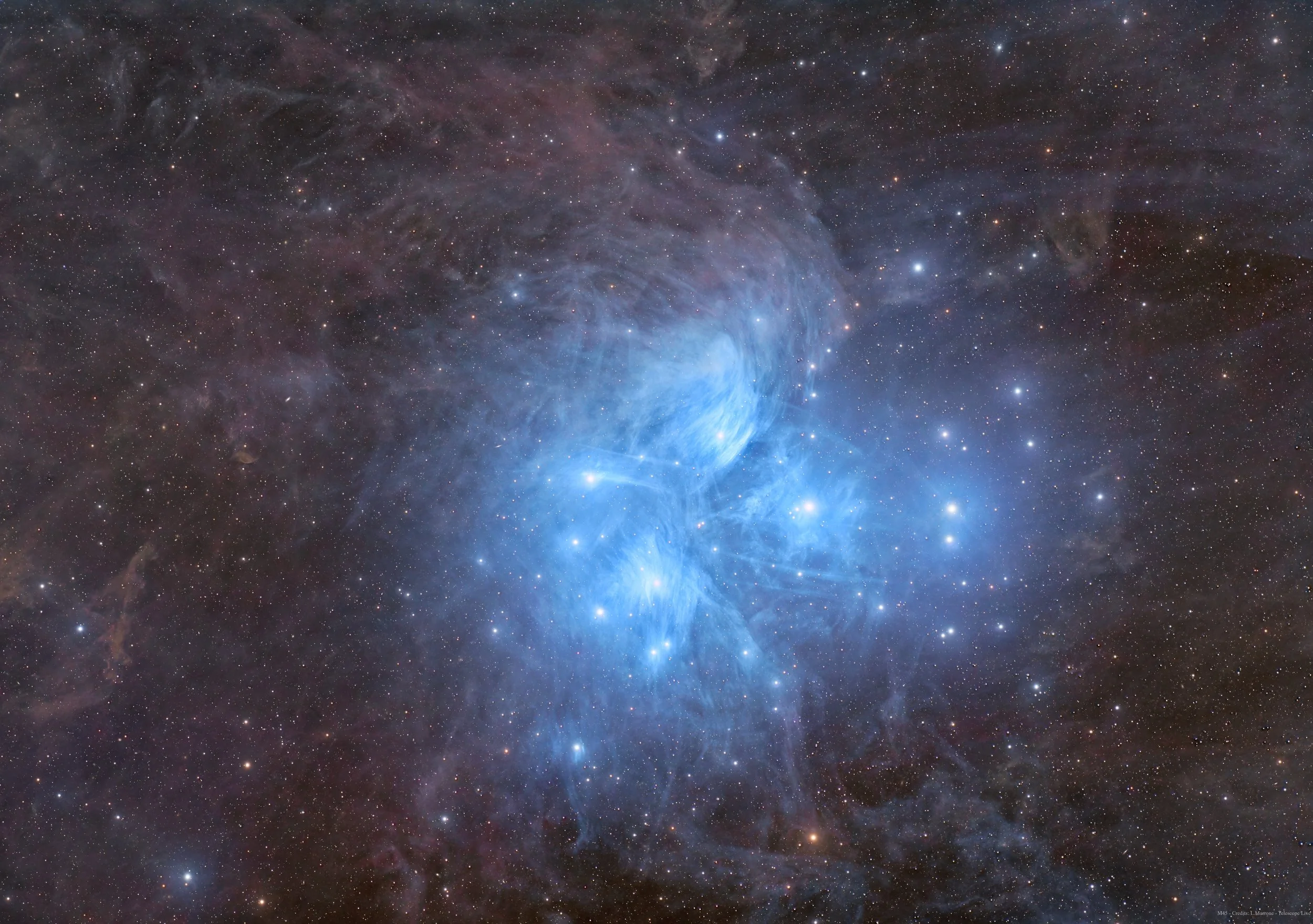
The 7 Sisters Who Don't Know the Night
The Pleiades star cluster, often called the Seven Sisters, glows in delicate shades of electric blue against a backdrop of drifting interstellar dust. This image captures the intricate reflection nebula surrounding the hot, young stars of the cluster. Their intense starlight illuminates nearby dust clouds, causing them to shine with a soft blue hue rather than the red tones typical of emission nebulae.
Beyond the bright core, faint brown and gray dust lanes swirl through the frame, revealing the complex structure of the Taurus Molecular Cloud region. Subtle wisps stretch outward like cosmic breath, hinting at the dynamic environment through which the cluster is currently passing.
Though the Pleiades formed roughly 100 million years ago, the glowing dust seen here is not leftover material from their birth. Instead, the cluster is traveling through a separate interstellar cloud, briefly lighting it up in a stunning and temporary celestial encounter.
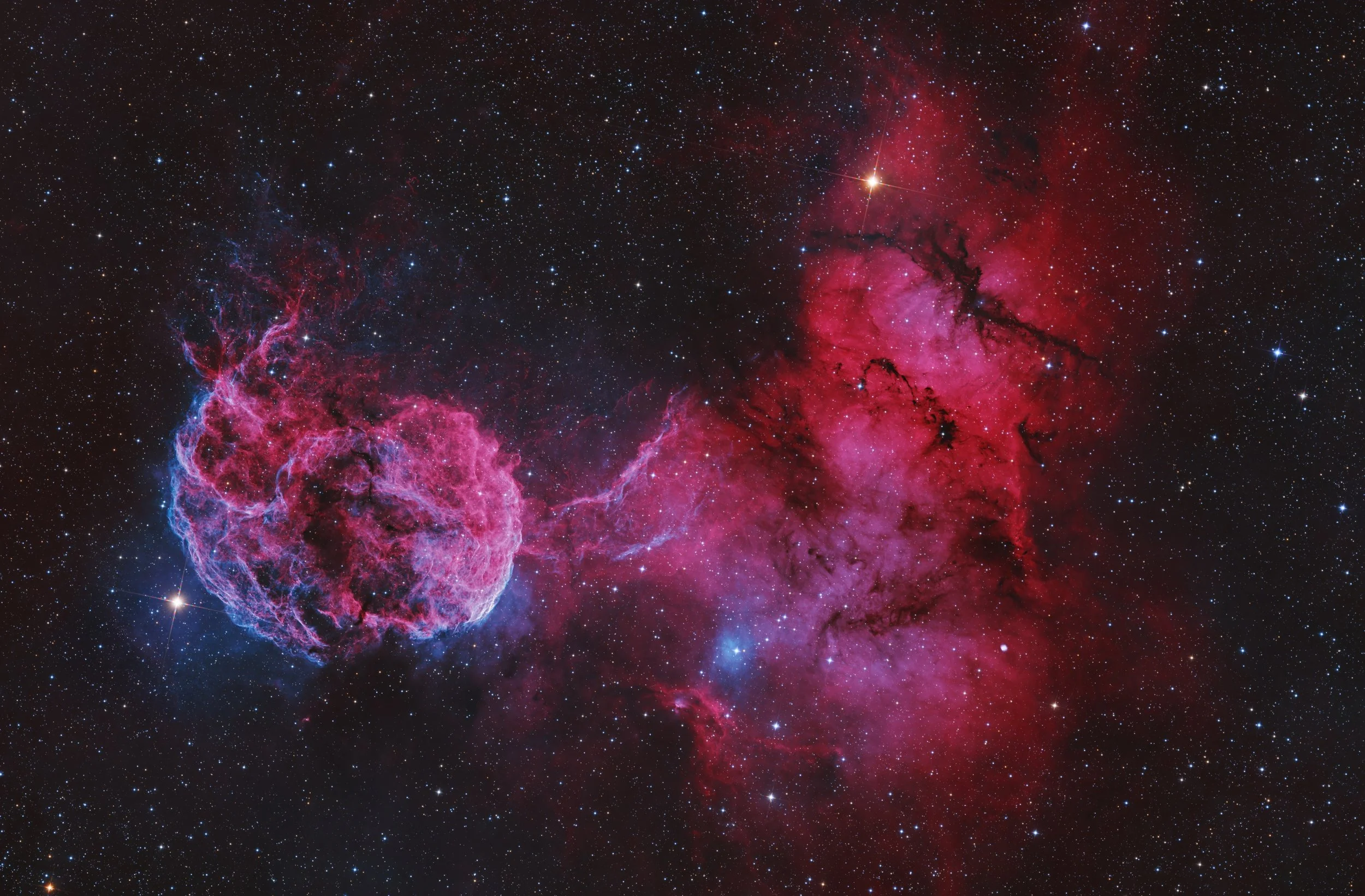
IC 443 and the Jellyfish Nebula
In the constellation Gemini, about 5,000 light years from Earth, lies IC 443, a complex supernova remnant often called the Jellyfish Nebula. This intricate web of filaments marks the expanding shockwave of a massive star that ended its life tens of thousands of years ago. The glowing red structures trace hydrogen gas energized by the blast, while bluish filaments reveal regions where high energy shock fronts excite oxygen atoms. The remnant’s distorted, asymmetric shape results from its collision with surrounding molecular clouds, which slow and sculpt the expanding debris.
IC 443 is believed to be associated with a neutron star left behind by the explosion, now speeding through space and continuing to energize the surrounding material. The interaction between the supernova shockwave and dense interstellar gas makes this object a valuable laboratory for studying stellar death and cosmic ray acceleration. Captured from Osnabrück, Germany, this deep exposure highlights the delicate filamentary structure and the dramatic contrast between hot ionized gas and the dark, obscuring dust that threads through this turbulent region of our galaxy.
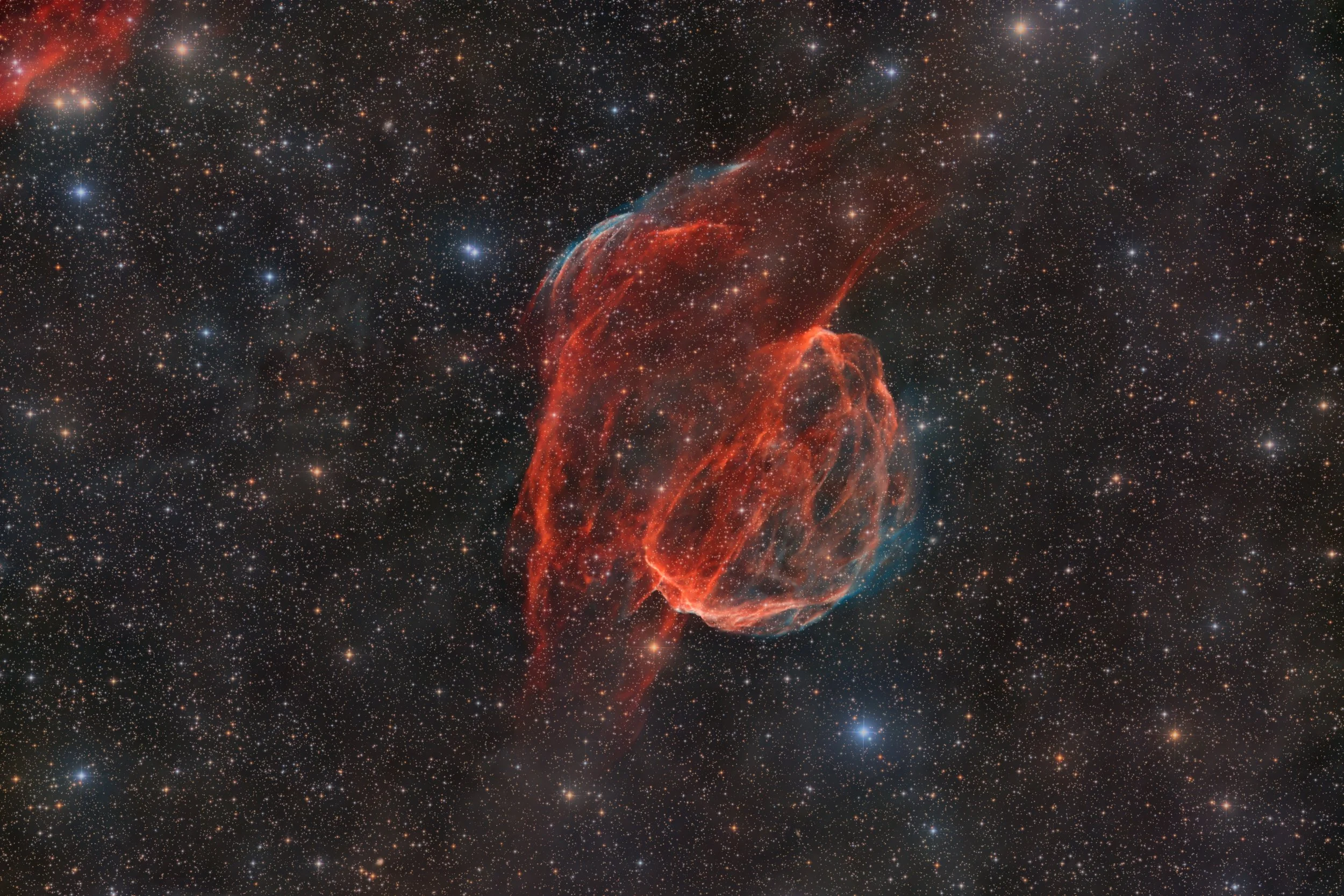
Sh2-224: A Supernova Relic in Auriga
This image captures Sh2-224, a faint emission nebula formed from the expanding shock front of an ancient supernova remnant in the constellation Auriga. The delicate filaments trace ionized hydrogen and oxygen energized by the original stellar explosion, now dispersed into the surrounding interstellar medium. What appears as a translucent crimson shell is actually a complex network of swept-up gas and magnetic structures, revealing how massive stars recycle material back into the galaxy and help seed future generations of stars.
Recorded over four full nights from Bürmoos (Salzburg, Austria), this 40-hour integration blends LRGB with SHO to emphasize both stellar color and the nebula’s subtle ionized layers. The fine arcs and wisps visible throughout the field highlight the turbulent interaction between the remnant and nearby molecular clouds, while the dense star background underscores how quietly this relic drifts within the Milky Way. Stacking the best 80% of the data preserves faint outer tendrils, giving a rare, high-contrast view of a structure that is usually lost in the noise.
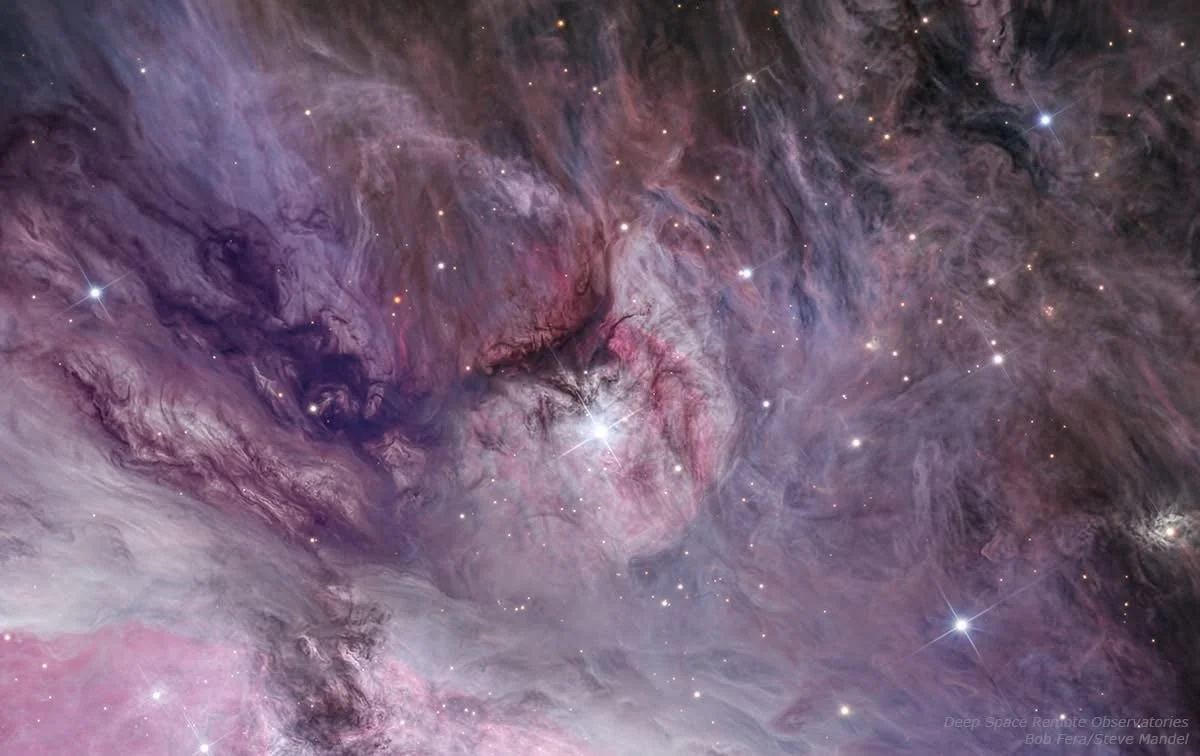
M43
M43 - Emission Nebula in Orion
The Orion Nebula, M42, is one of the classic showpieces of the night sky, but people often don't realize that there's another Messier object, M43, in the field that's beautiful on its own. While working on my recent mosaic of the region I decided that M43 deserved some love, too, so here it is. I cropped this field from the mosaic and tweaked a few things.
Equipment:
PlaneWave CDK17 17" f/6.8 Astrograph
10Micron GM4000 mount
Moravian C3-61000 Pro CMOS Camera
Total exposure: RGB 2 hours
Deep Space Remote Observatories - South at ObsTech El Sauce Observatory in Chile
November, December 2025
Data acquisition by Bob Fera and Steve Mandel
Image processing by Bob Fera
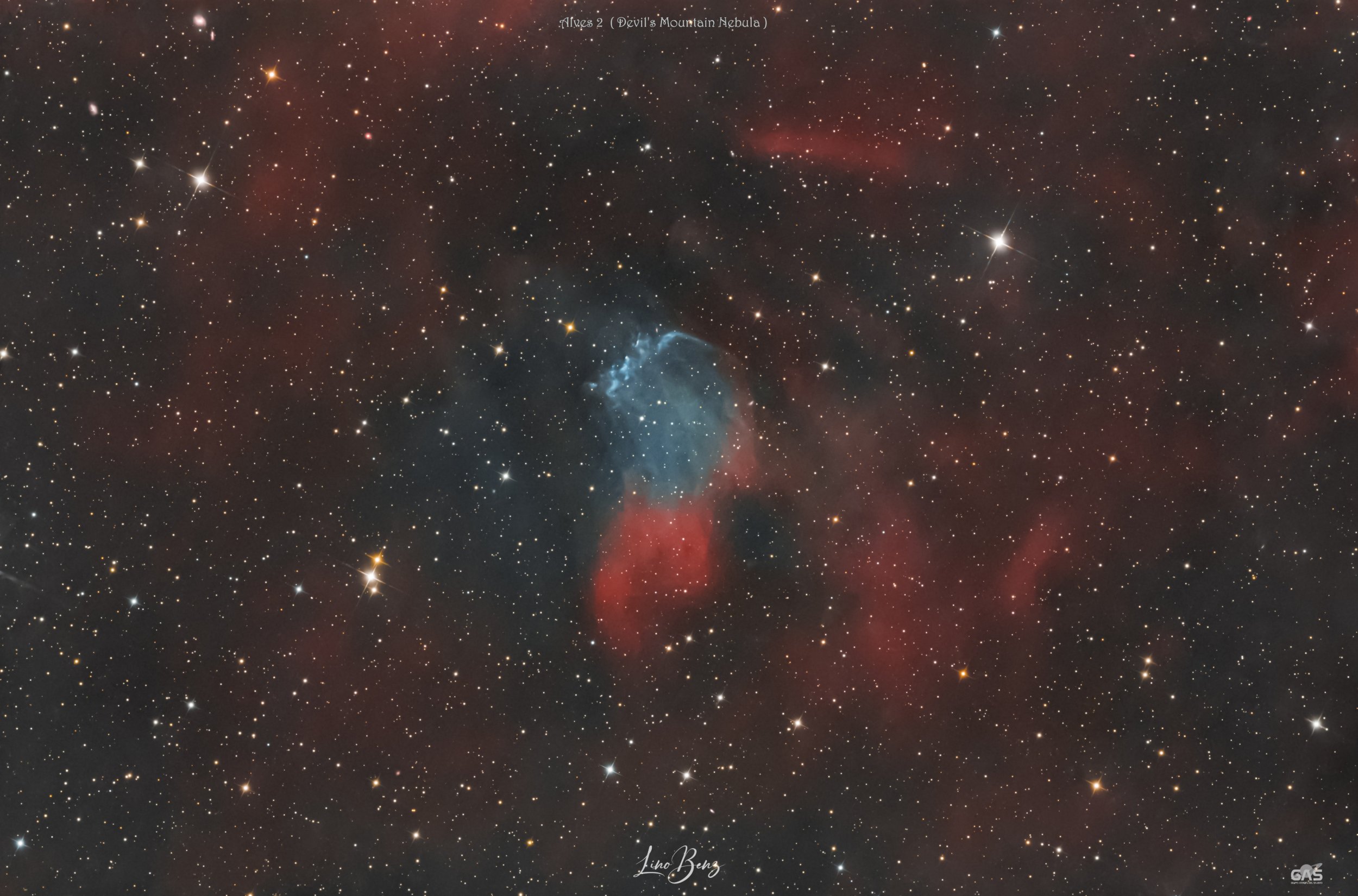
Alves 2 (Devil’s Mountain Nebula)
Alves 2, also known as the Devil’s Mountain Nebula, is a small and rarely imaged nebular complex where cold interstellar dust meets newly energized gas. At its heart lies a compact blue reflection region, created as nearby stars scatter their light off microscopic dust grains, while the deeper red structures trace hydrogen gas glowing under stellar radiation. These contrasting colors reveal an active environment shaped by both illumination and ionization, offering a close-up look at how young stars interact with their natal clouds. Surrounding the core, faint brown and crimson dust lanes weave through the field, hinting at a much larger molecular structure extending beyond the bright central region.
Captured on January 13, 2026 from Sannicola in southern Italy, this image highlights the delicate balance between darkness and light inside our Milky Way. The rich background star field adds depth and scale, emphasizing how compact Alves 2 is compared to the vast tapestry of dust and gas around it. Subtle gradients in the surrounding clouds suggest ongoing evolution, where gravity, radiation, and turbulence continue to sculpt this remote pocket of the interstellar medium into future generations of stars.
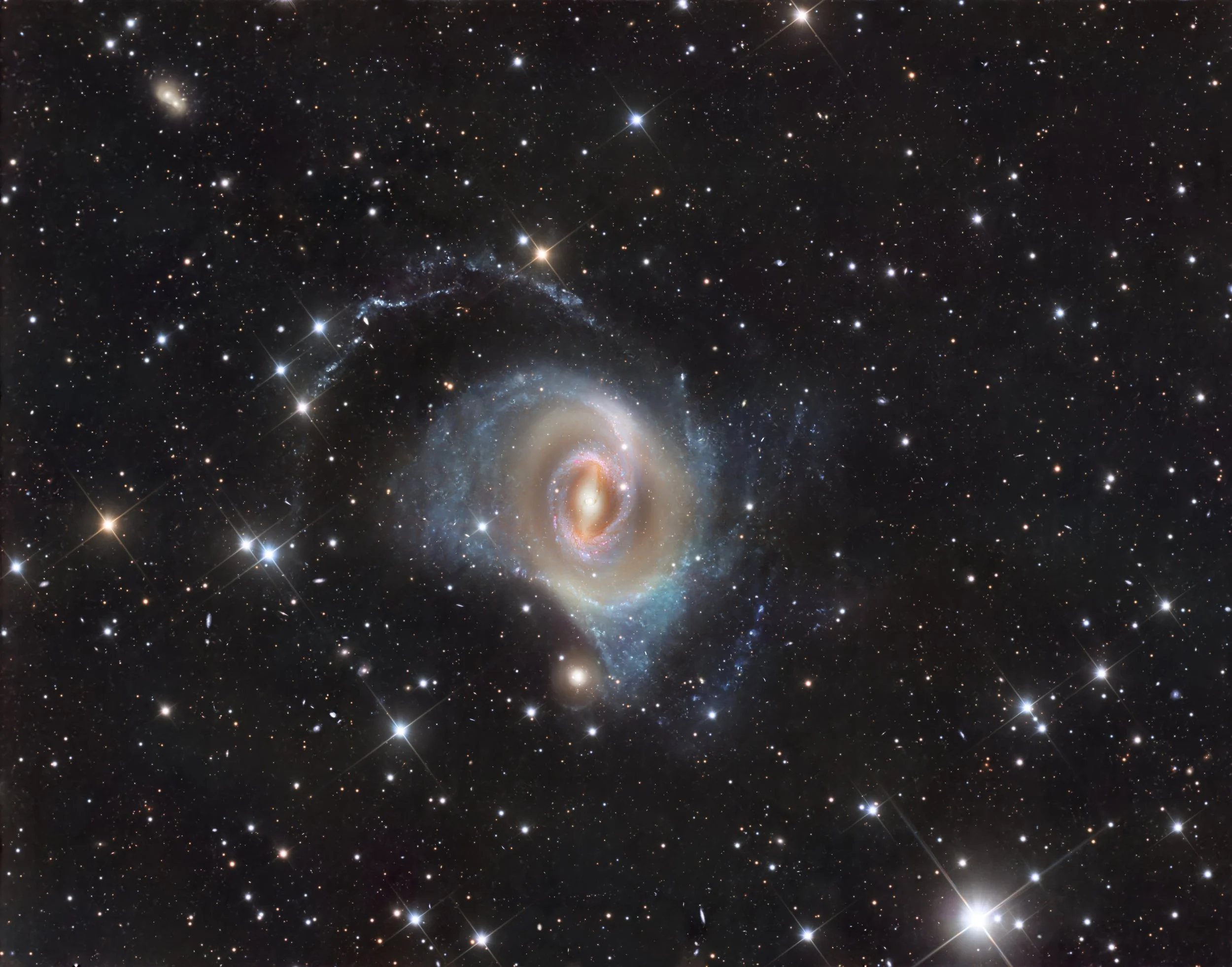
NGC 1512 and Companion Galaxy NGC 1510
NGC 1512 is a nearby barred spiral galaxy whose bright central core feeds a wide ring of active star formation, visible here as pink H-alpha knots embedded in sweeping blue spiral arms. The galaxy’s prominent bar channels gas inward, helping sustain ongoing stellar birth in its nucleus, while the faint outer arms reveal delicate dust lanes and clusters of young, hot stars. Just below the main galaxy sits its compact companion, NGC 1510, whose gravitational influence is helping to trigger and reshape this extended star-forming structure.
Captured on January 17, 2026 from Rio Hurtado, Chile, this image highlights both the scientific and aesthetic beauty of galactic interaction. The surrounding star field adds depth and scale, emphasizing how these two galaxies are caught in a slow cosmic dance that unfolds over hundreds of millions of years. Subtle tidal features and asymmetries hint at past encounters, offering a snapshot of how gravity sculpts galaxies and sparks new generations of stars.
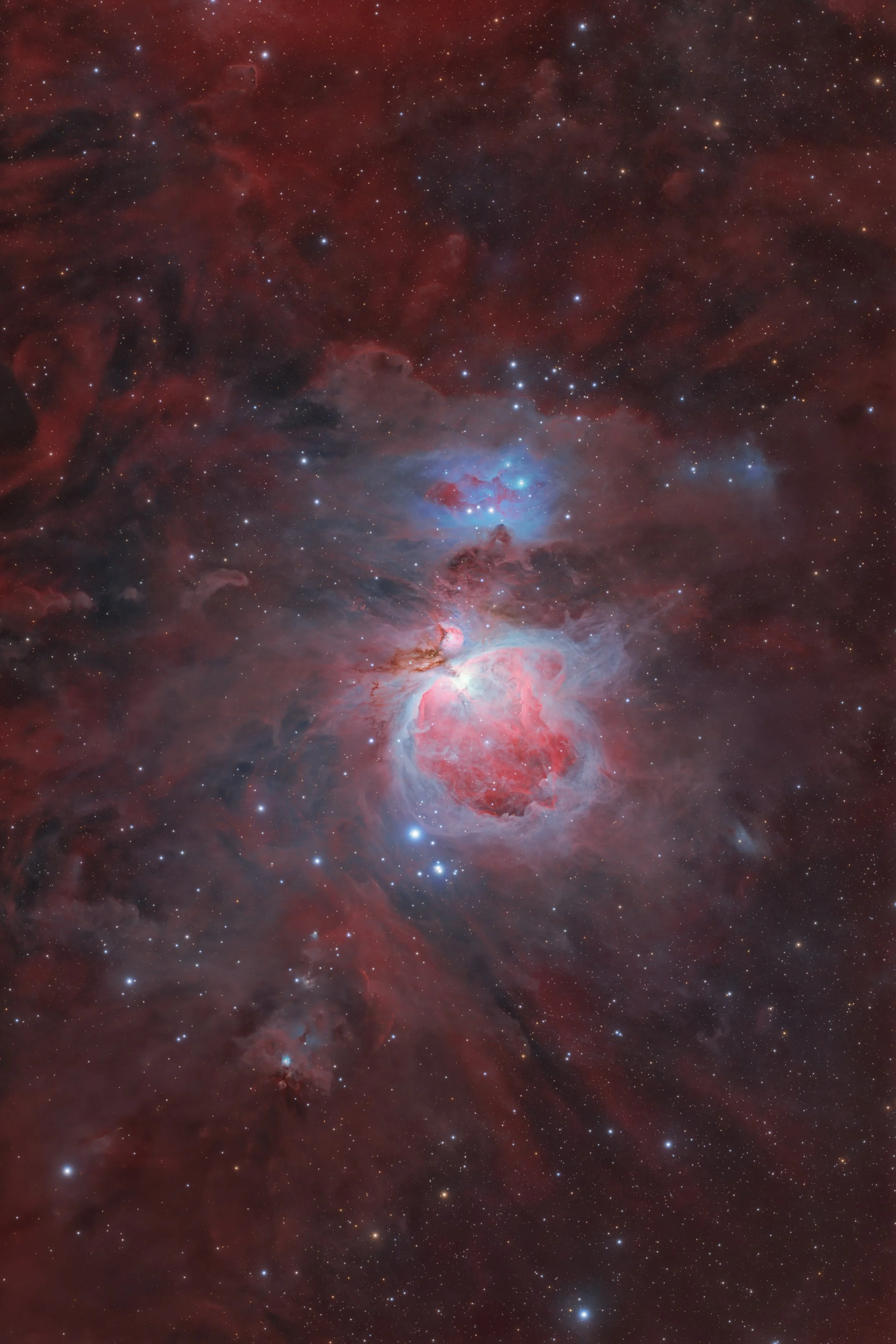
M42, The Orion Nebula in HaRGB
Rising from the heart of the Orion Molecular Cloud, this image centers on M42, one of the nearest and most active stellar nurseries in our galaxy. The bright core is powered by the Trapezium Cluster, whose intense ultraviolet radiation excites surrounding hydrogen gas, producing the rich crimson H alpha emission seen throughout the frame. Pale blue regions trace reflected starlight off fine dust, while darker lanes mark cold molecular material that continues to collapse into future generations of stars. The subtle gradients and filamentary textures reveal shock fronts and ionization boundaries sculpted by stellar winds.
This 36 hour integration blends broadband data for natural star color and dusty structures with narrowband exposures to isolate ionized gas, creating a balanced HaRGB presentation that highlights both scientific detail and visual depth. Captured from Lanciano, the long exposure brings out faint outer nebulosity and delicate background clouds, emphasizing the vast scale of this region where newborn stars illuminate and reshape their birthplace.
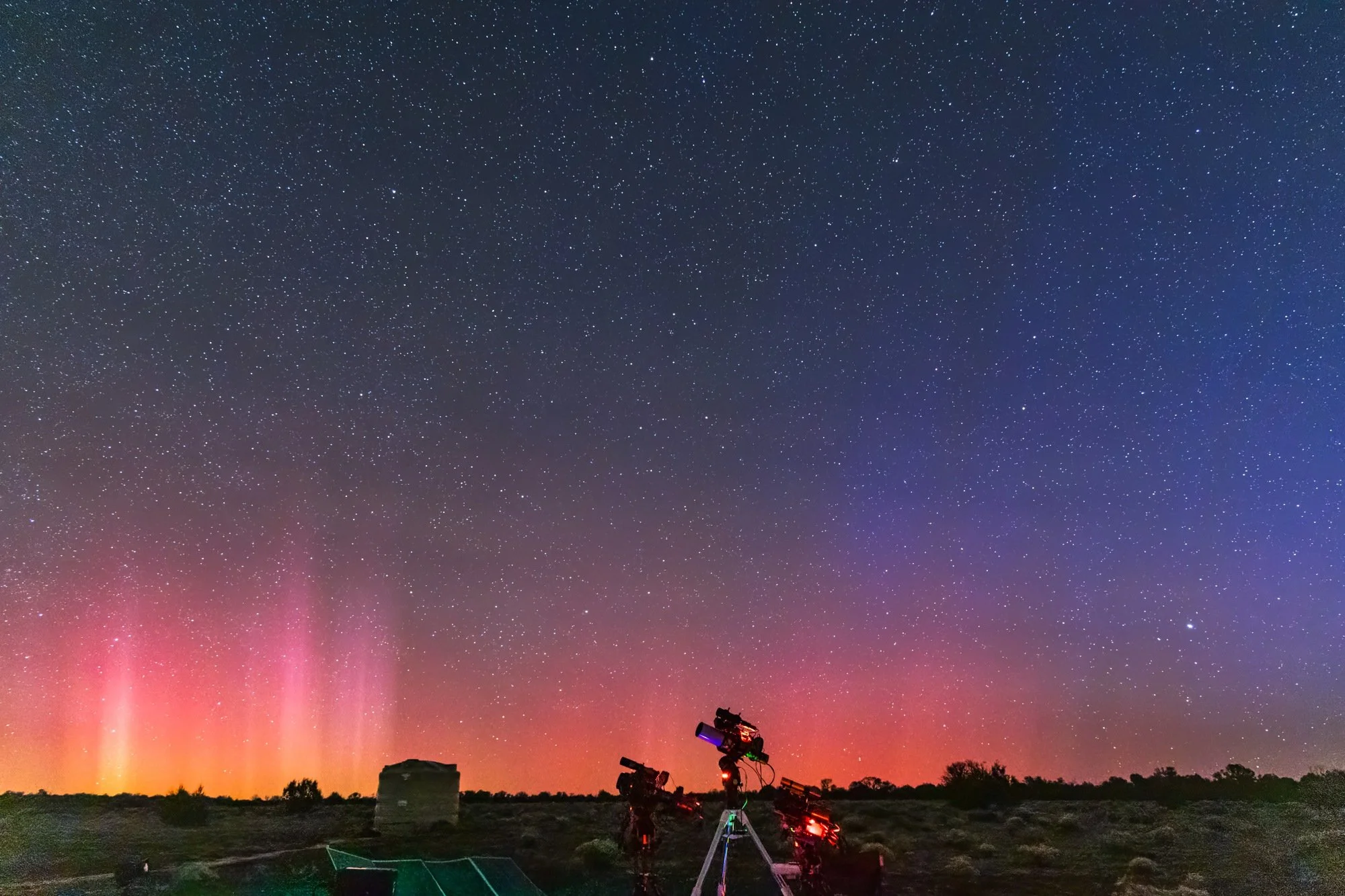
Arizona Aurora Before Dawn
From a dark-sky site in Arizona (Bortle 1), this pre-dawn capture records a rare southern reach of the aurora at about 4:30 a.m. on January 20, 2026. What began earlier in the night as a faint red horizon glow intensified before sunrise into soft vertical pillars and a broader crimson wash, set against a dense star field. The scene reflects heightened geomagnetic activity that briefly pushed auroral emissions far from their usual polar domains, allowing observers in the American Southwest to witness oxygen-driven red airglow and subtle auroral structures normally reserved for much higher latitudes.
Photographed from Westwood Ranch in northern Arizona using a Canon R6 astro-modified camera at 24 mm, f/4, ISO 12800, with 10-second exposures, the image blends astrophotography and space weather into a single frame. The silhouetted telescope rigs anchor the foreground while the aurora paints the lower sky, a reminder that solar activity can briefly transform even the quietest desert skies into a dynamic canvas of charged particles and atmospheric light.
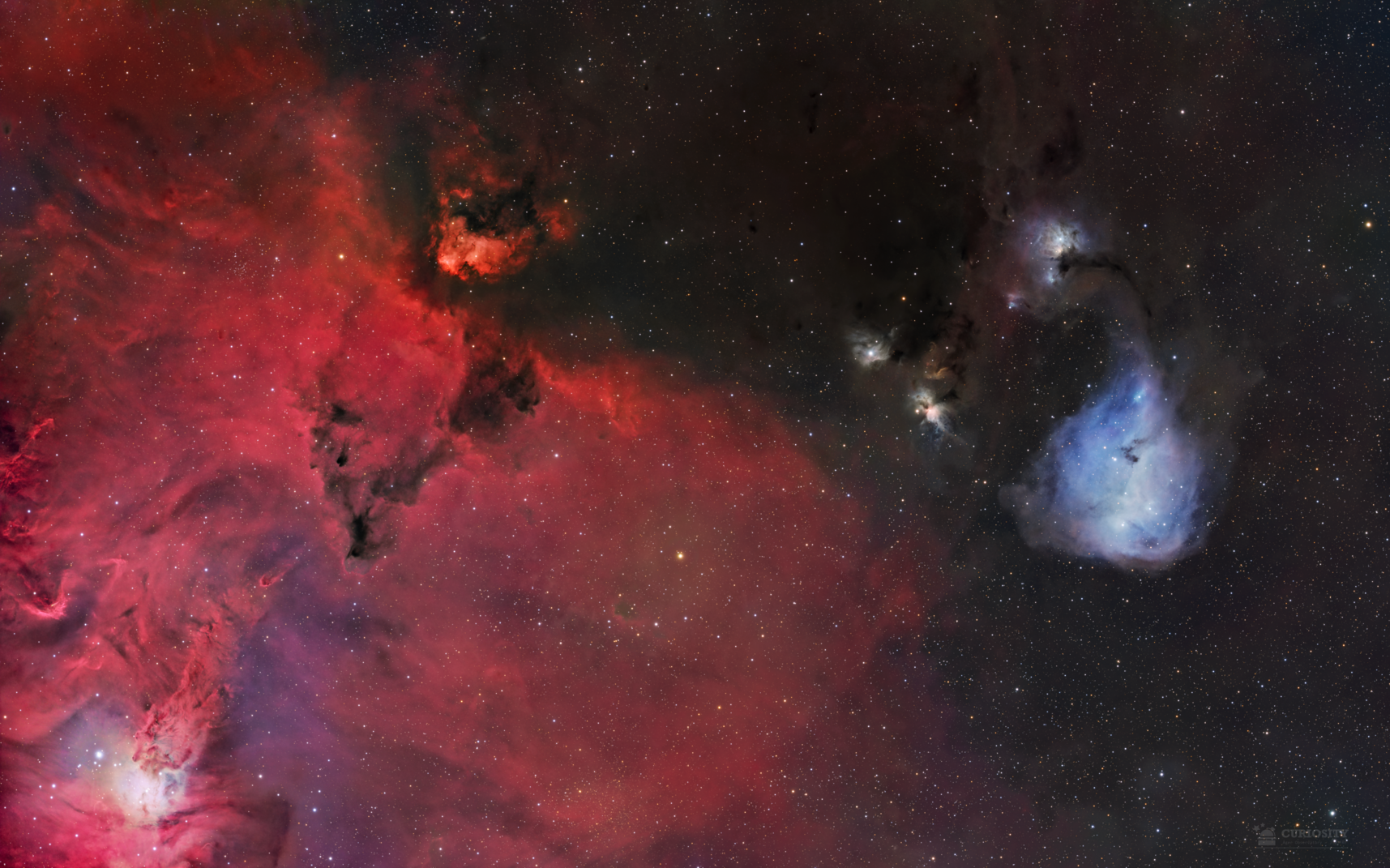
IC 2169 in the Abyss of the Orion–Monoceros Molecular Cloud
IC 2169 is a compact emission nebula embedded within the vast Orion–Monoceros Molecular Cloud Complex, one of the nearest and most active star-forming regions to Earth at roughly 2,000 light-years away. Bathed in hydrogen-alpha light, the crimson clouds on the left reveal ionized gas sculpted by young, massive stars, while intricate lanes of cold dust carve dramatic silhouettes across the scene. To the right, bluish reflection nebulae glow softly as starlight scatters off interstellar dust grains, marking regions where newborn stars illuminate their natal environment rather than energize it.
Captured from Àger, Catalonia, this wide-field composition highlights the striking contrast between emission and reflection nebulae, showcasing multiple stages of stellar evolution within a single frame. Dark molecular filaments thread through glowing gas, hinting at future star formation, while delicate gradients of color reveal the complex chemistry and structure of the interstellar medium. The result is both a scientific portrait of an active Galactic nursery and an aesthetic exploration of light emerging from cosmic shadow.
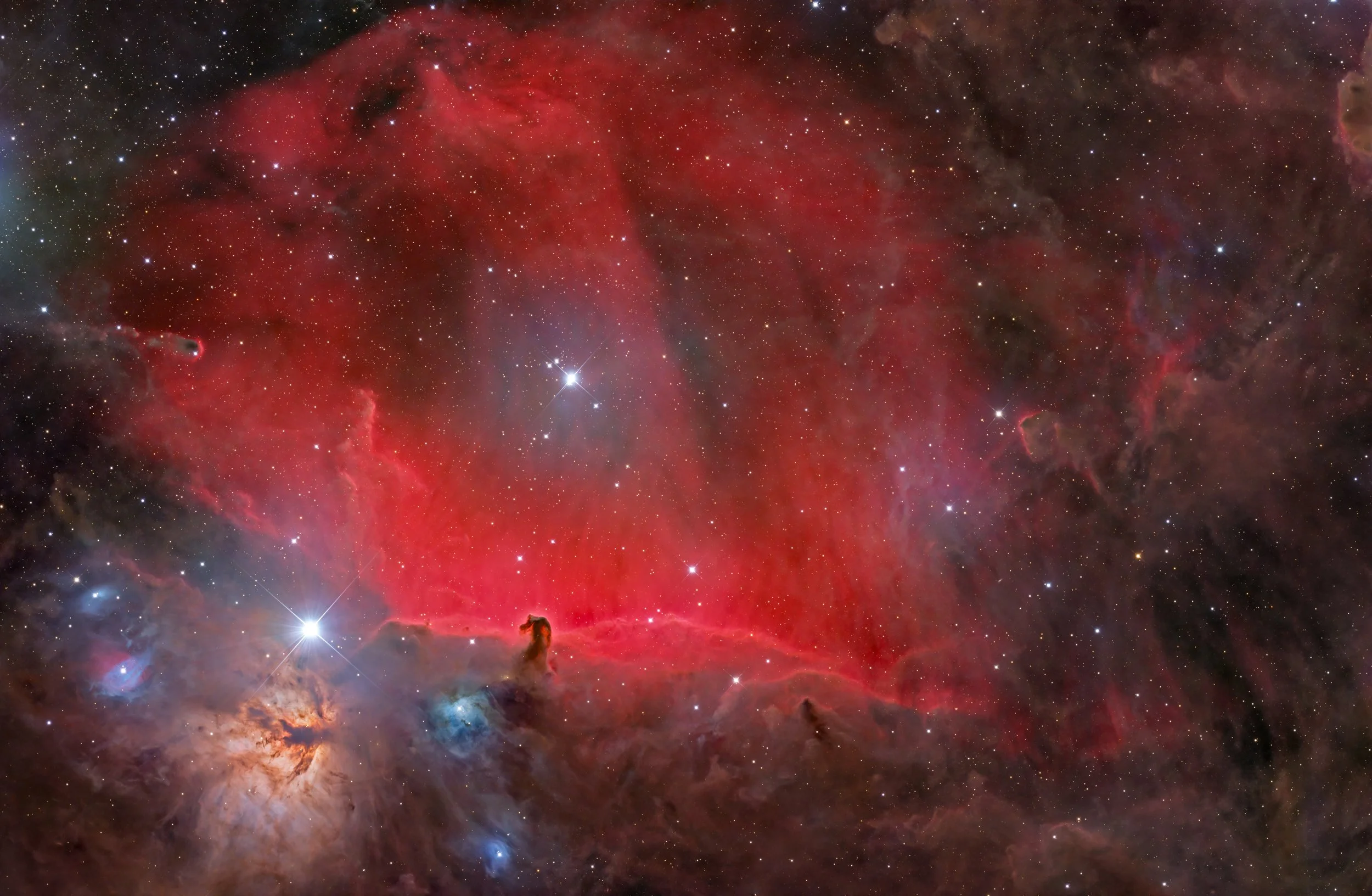
The Horsehead in Hydrogen Light (IC 434)
Rising from the glowing curtain of IC 434, the iconic Horsehead Nebula (Barnard 33) appears here in a detailed Ha-RGB composition that blends narrowband hydrogen-alpha with natural color stars and dust. Located about 1,300 light-years away in Orion, this dense knot of cold molecular gas is silhouetted against the ionized hydrogen emission behind it, creating one of the most recognizable profiles in the night sky. The bright star Sigma Orionis, part of a young OB association, provides much of the ultraviolet radiation that excites the surrounding hydrogen, causing the deep crimson glow that defines this vast emission region.
Beneath the Horsehead lies NGC 2023, a luminous blue reflection nebula powered by the hot star HD 37903, while intricate lanes of interstellar dust weave through the wider field. The Ha-RGB approach enhances faint hydrogen structures while preserving stellar color, revealing delicate shock fronts, wispy filaments, and subtle gradients within the nebula. Together, these elements showcase an active stellar nursery where radiation, gravity, and dust interact to sculpt the cloud, offering both a scientifically rich and visually striking portrait of ongoing star formation.
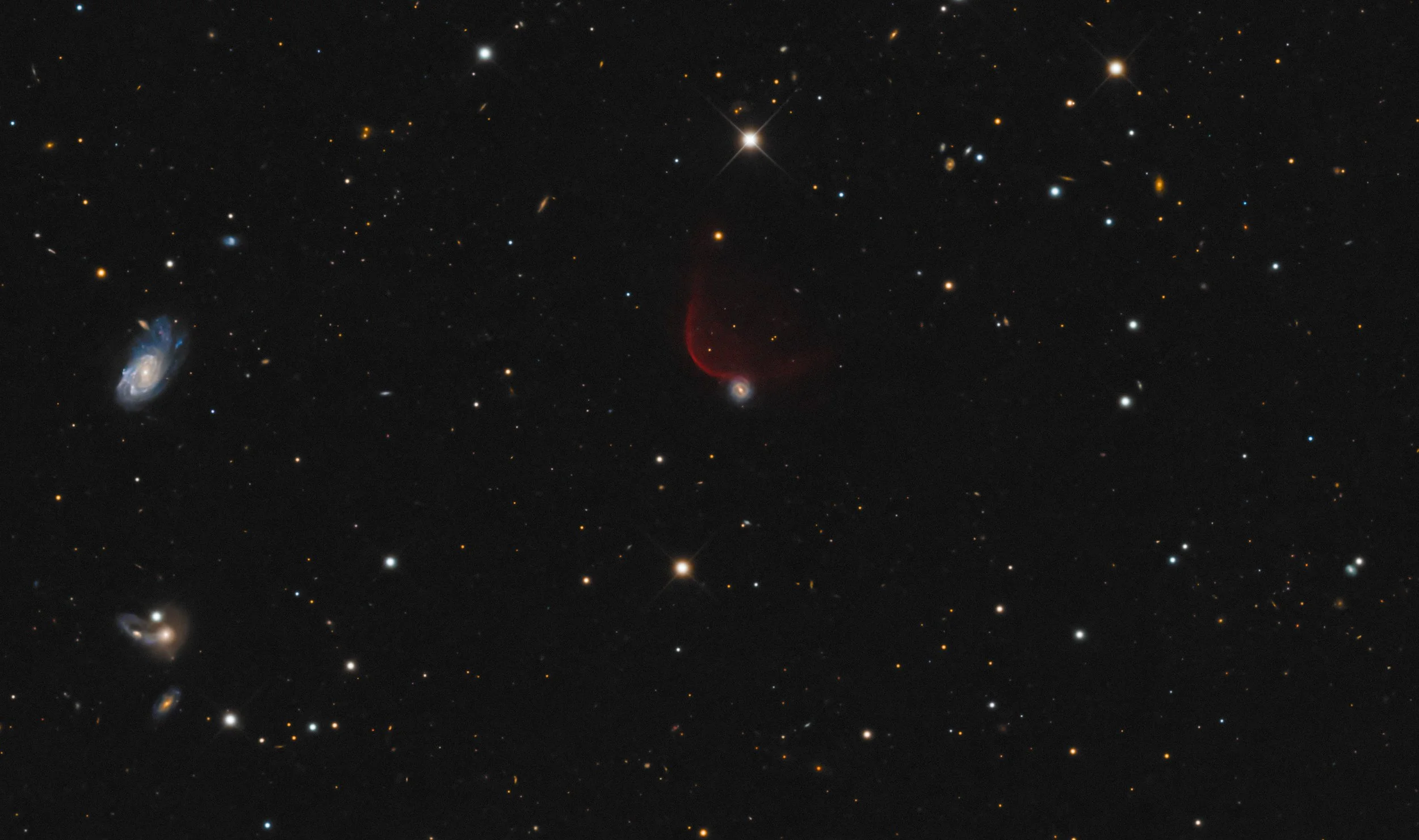
Pulsar J0437-4715 with Bow Shock
Racing through interstellar space at hundreds of kilometers per second, PSR J0437-4715 is one of the nearest known millisecond pulsars to Earth, located about 500 light-years away in the constellation Pavo. This rapidly spinning neutron star, the dense remnant of a supernova explosion, emits powerful winds of charged particles. As it plows through the thin gas between stars, those winds collide with the surrounding medium, creating the faint red arc seen here: a hydrogen bow shock formed where the pulsar’s particle outflow compresses and excites interstellar hydrogen.
Beyond the pulsar itself, this deep-field image reveals a rich background of distant galaxies scattered across the frame, emphasizing both the local and extragalactic scales captured in a single exposure. The contrast between the delicate bow shock and the myriad galaxies highlights the dynamic nature of our Milky Way’s stellar remnants against the vast, static backdrop of the universe. This image was captured from ObsTech in Chile using the RCOS 24" f/7.8 Ritchey-Chrétien telescope, showcasing how high-resolution ground-based imaging can trace the subtle interactions between extreme stellar objects and their cosmic environment.
Location: ObsTech, Chile
Credit: Adam Block, Optics RCOS 24" f/7.8 Carbon Truss Ritchey-Chrétien (Harris Telescope)Racing through interstellar space at hundreds of kilometers per second, PSR J0437-4715 is one of the nearest known millisecond pulsars to Earth, located about 500 light-years away in the constellation Pavo. This rapidly spinning neutron star, the dense remnant of a supernova explosion, emits powerful winds of charged particles. As it plows through the thin gas between stars, those winds collide with the surrounding medium, creating the faint red arc seen here: a hydrogen bow shock formed where the pulsar’s particle outflow compresses and excites interstellar hydrogen.
Beyond the pulsar itself, this deep-field image reveals a rich background of distant galaxies scattered across the frame, emphasizing both the local and extragalactic scales captured in a single exposure. The contrast between the delicate bow shock and the myriad galaxies highlights the dynamic nature of our Milky Way’s stellar remnants against the vast, static backdrop of the universe. This image was captured from ObsTech in Chile using the RCOS 24" f/7.8 Ritchey-Chrétien telescope, showcasing how high-resolution ground-based imaging can trace the subtle interactions between extreme stellar objects and their cosmic environment.
Location: ObsTech, Chile
Credit: Adam Block, and the Harris Telescope
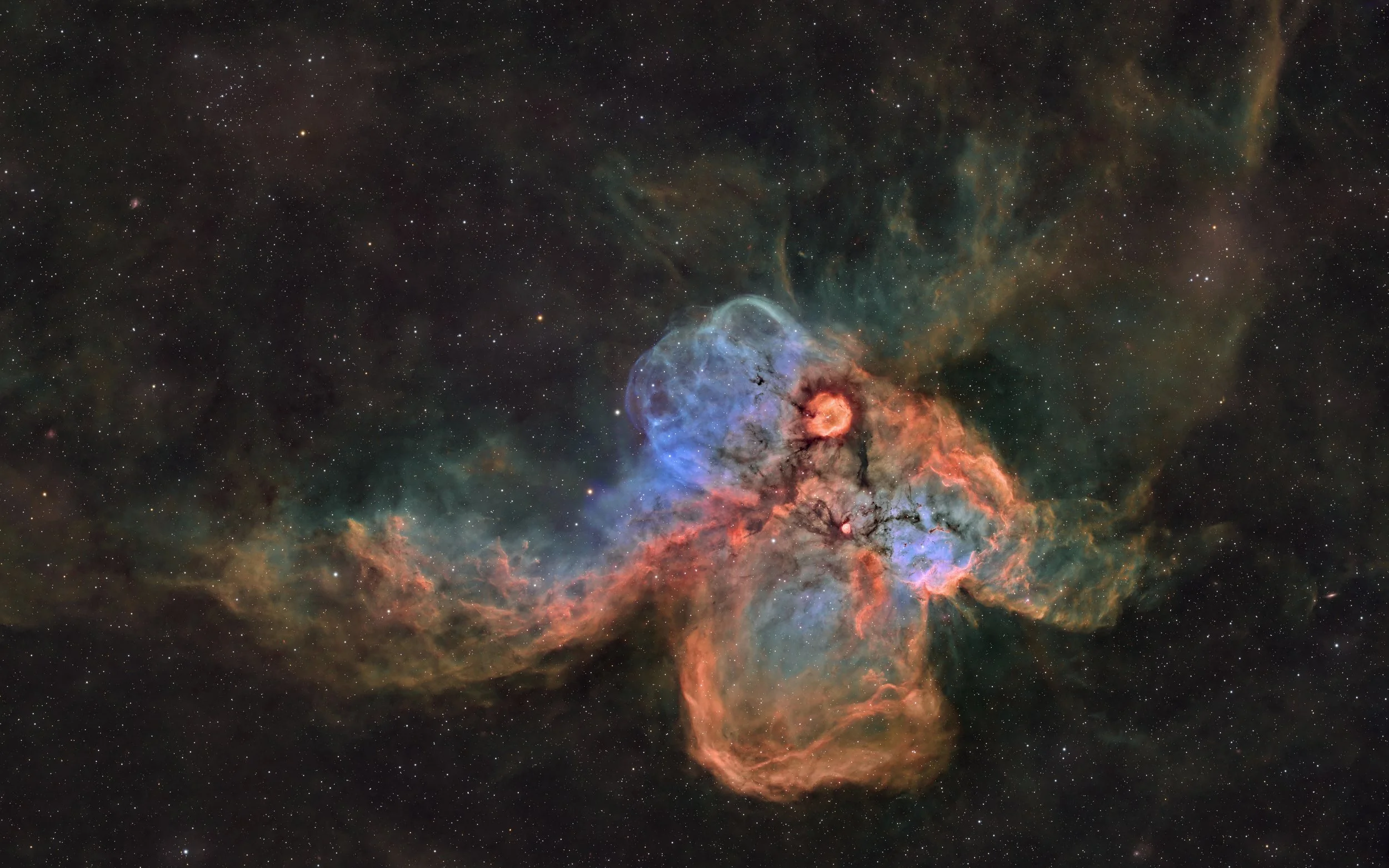
NGC2467 - Skull and Crossbones Nebula
NGC 2467, often called the Skull and Crossbones Nebula, is a dynamic star-forming region located roughly 13,000 light-years away in the constellation Puppis. This complex emission nebula is part of a larger molecular cloud where intense ultraviolet radiation from young, massive stars ionizes surrounding hydrogen gas, producing the glowing red structures seen throughout the field. Embedded clusters sculpt the nebula’s shape through stellar winds and radiation pressure, carving cavities and bright rims while triggering new generations of star formation along compressed gas fronts.
Rendered here in a narrowband palette, the image highlights ionized hydrogen, oxygen, and sulfur, revealing intricate filaments, shock fronts, and dense dust lanes that give rise to the nebula’s skull-like appearance. Blue tones trace energized oxygen near the hottest stars, while warmer reds and golds map hydrogen-rich regions and expanding shells. Against a backdrop of faint Milky Way star fields, NGC 2467 appears as a turbulent crossroads of creation, where stellar feedback continuously reshapes the surrounding interstellar medium.
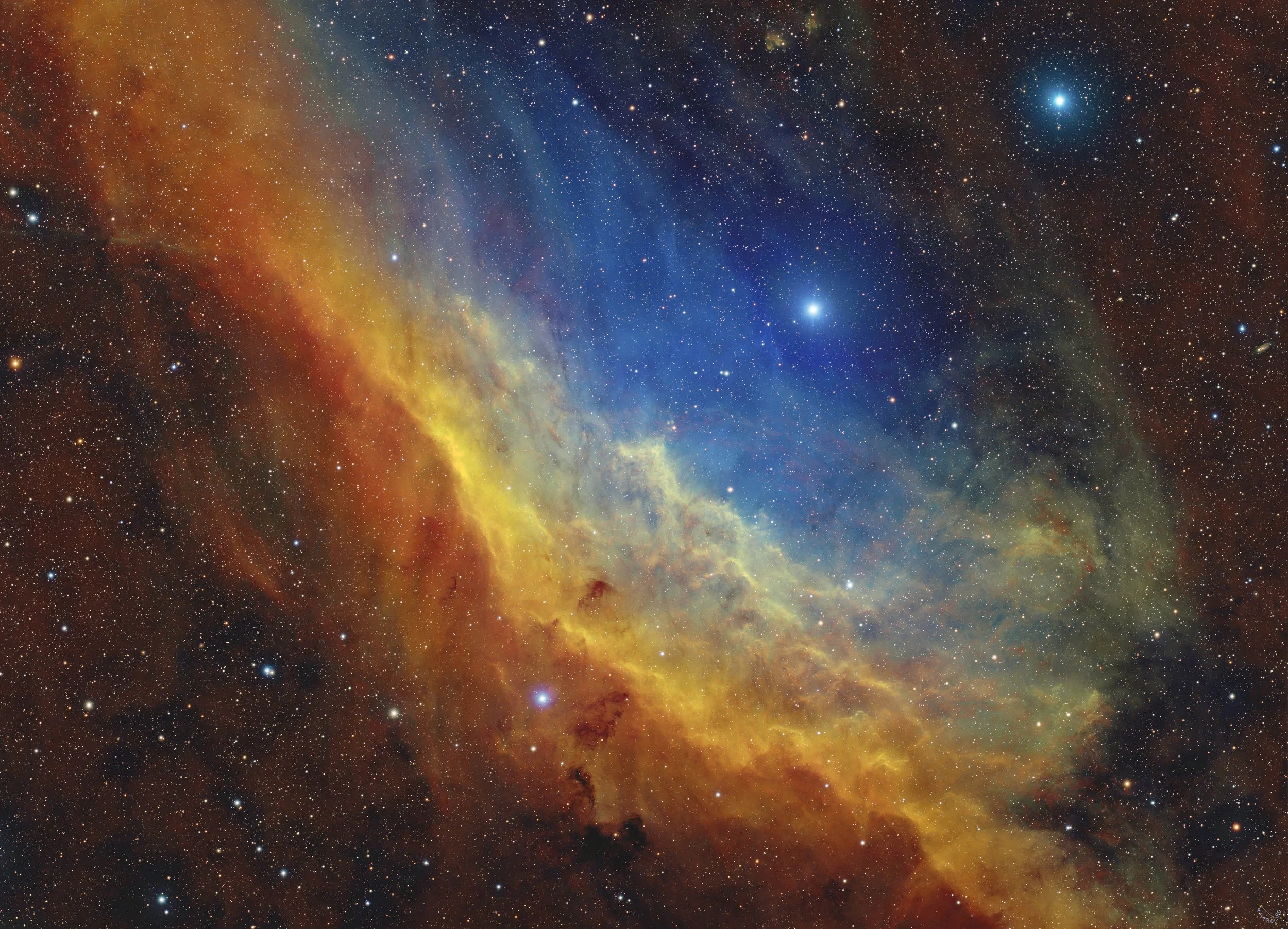
NGC 1499 in SHO | The California Nebula
NGC 1499, commonly known as the California Nebula, is a vast emission nebula stretching nearly 100 light-years across the constellation Perseus, located roughly 1,000 light-years from Earth. Its hydrogen-rich clouds glow intensely under ultraviolet radiation from the nearby hot O-type star Xi Persei, which energizes the surrounding gas and drives ongoing star formation. In this SHO presentation, sulfur, hydrogen, and oxygen emissions are mapped to gold, green, and blue tones, revealing the nebula’s layered ionization structure and highlighting the boundary where stellar radiation meets dense interstellar material.
The image showcases delicate shock fronts, filamentary ridges, and dark dust intrusions embedded within luminous hydrogen arcs, offering a detailed view of how massive stars sculpt their environments. Oxygen-rich regions trace the more diffuse outer envelope, while sulfur emphasizes denser, cooler pockets along the bright emission edge. Together, these elements form a sweeping cosmic shoreline, where turbulence, radiation, and gravity interact to shape one of Perseus’s most striking stellar nurseries.
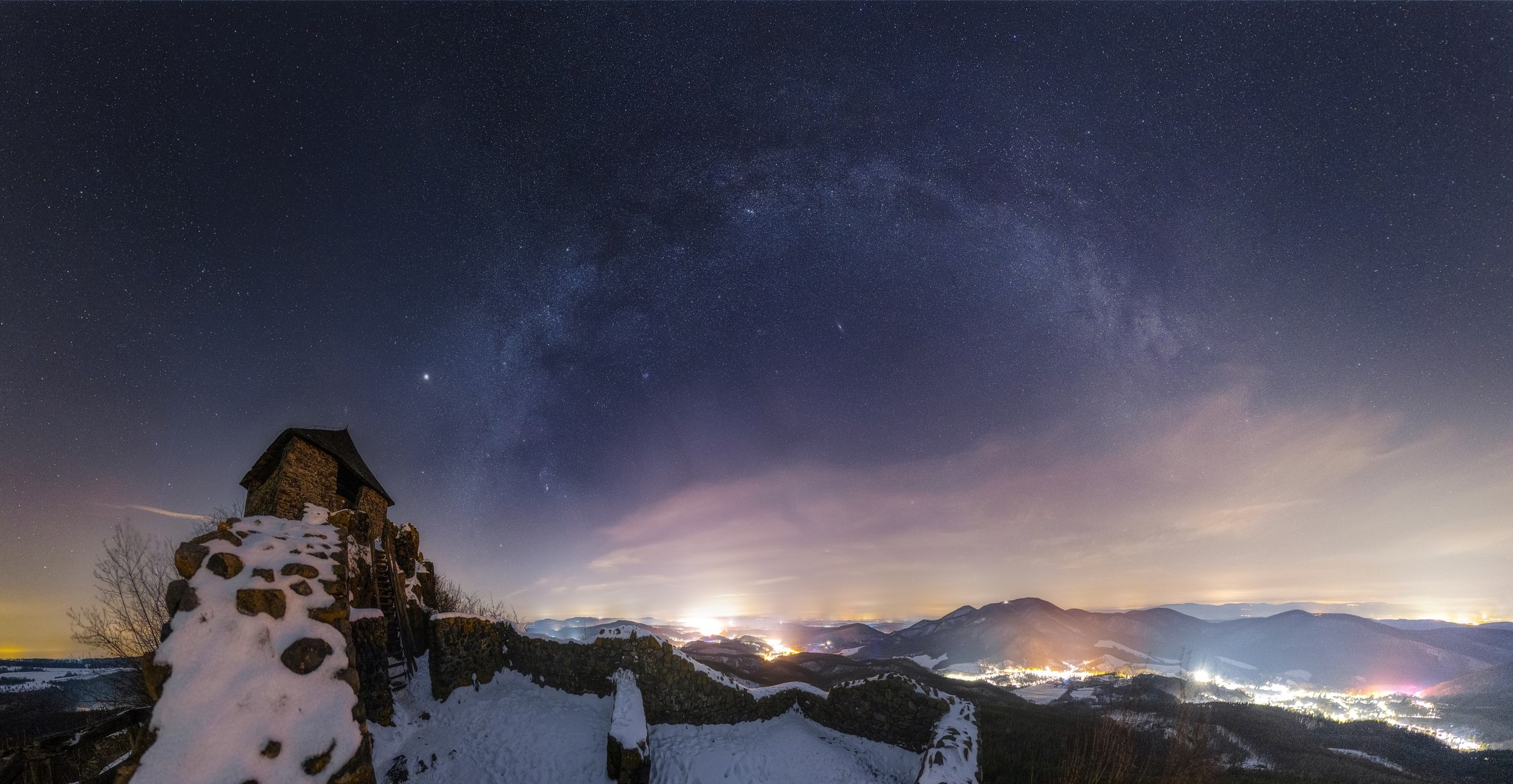
Winter Milky Way in Salgó castle
Rising in a graceful arc above the snow-covered ruins of Salgó Castle in northern Hungary, the winter Milky Way reveals our galaxy’s outer spiral structure, where starlight is softer and more diffuse than the bright summer core. This region of the sky is rich in nearby star fields and faint molecular dust clouds, with constellations such as Orion, Taurus, and Auriga contributing prominent features including emission nebulae, reflection nebulae, and young stellar clusters embedded in the galactic plane.
The medieval stone walls in the foreground provide a striking contrast between human history and cosmic scale, while distant town lights illuminate the surrounding mountain ridges beneath a calm winter atmosphere. Subtle airglow and thin cloud layers add pastel tones near the horizon, emphasizing the transition from Earth’s landscape to deep space. Together, the scene captures both the quiet beauty of a frozen night and the immense structure of our home galaxy stretching across the sky.
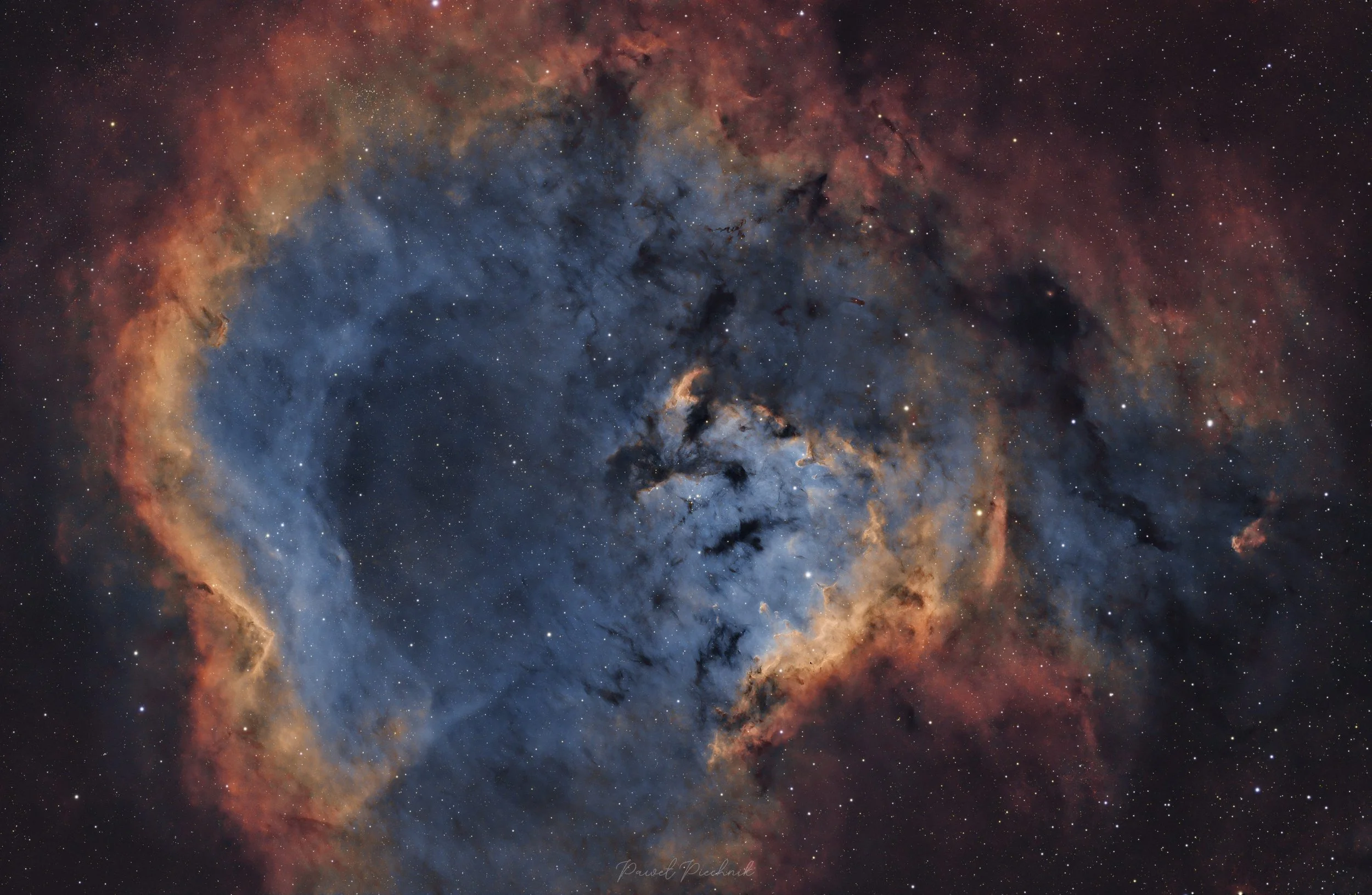
SH2-171 – The Teddy Bear Nebula in Cepheus
Located in the constellation Cepheus, SH2-171, commonly known as the Teddy Bear Nebula, is a complex region of ionized hydrogen, reflection nebulosity, and dense interstellar dust situated roughly 1,400 light-years from Earth. This area combines emission from energized hydrogen gas with soft blue reflection nebulae illuminated by nearby young stars. Dark molecular clouds weave through the scene, absorbing background starlight and outlining the nebula’s distinctive shape while highlighting zones where star formation is actively reshaping the surrounding medium.
Visually, the composition showcases a dramatic interplay between cool blue reflections, warm red hydrogen emission, and intricate black dust filaments that add depth and structure across the frame. Subtle gradients of light reveal turbulent gas flows and layered clouds, while countless faint stars pierce through translucent veils of cosmic material. The familiar teddy bear silhouette emerges organically from these interacting elements, creating a captivating blend of scientific insight and aesthetic beauty.
Artistically, the image reveals a striking contrast between the soft, luminous blues of reflected starlight and the warm, filamentary reds of hydrogen emission in the surrounding gas. Intricate dust structures thread through the scene, creating depth and motion across the frame, while countless faint stars sparkle through translucent veils of cosmic material. The nebula’s whimsical outline, reminiscent of a teddy bear, emerges naturally from these interacting clouds, making this both a scientifically rich and visually enchanting portrait of a quiet stellar nursery.
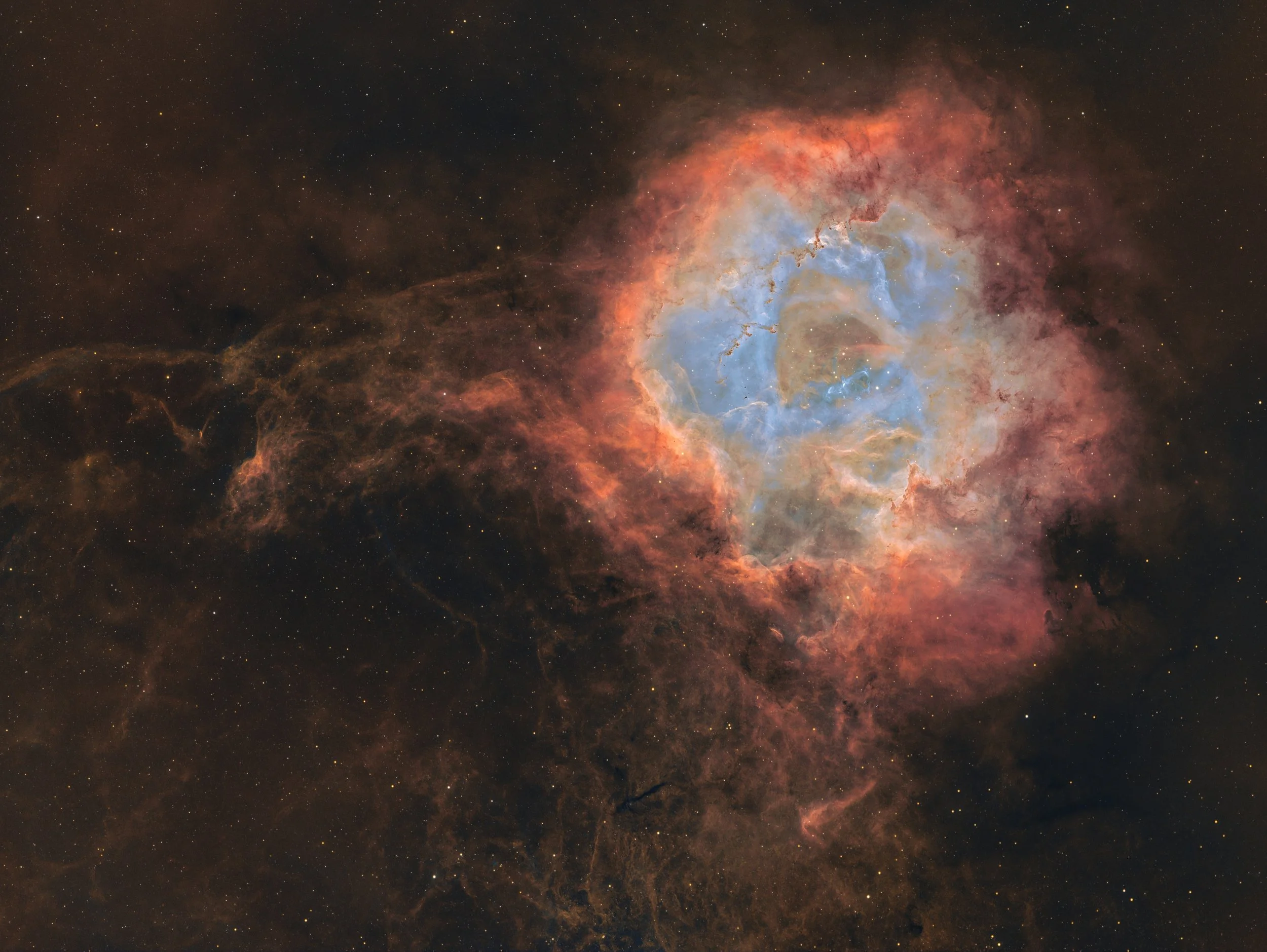
Rosette Nebula with Sulfur Extensions from Nyon
Captured from a rooftop in Nyon, Switzerland, this 25-hour deep integration reveals the Rosette Nebula (NGC 2237–9), a vast star-forming region about 5,200 light-years away in the constellation Monoceros. At its heart lies the young open cluster NGC 2244, whose hot, massive stars carve a hollowed cavity in the surrounding gas. The blue tones trace oxygen-rich regions, while the warm reds highlight hydrogen emission, outlining the nebula’s iconic rose-like structure. Faint sulfur extensions stretch outward, exposing shock fronts and tenuous filaments that mark the ongoing interaction between stellar radiation and the parent molecular cloud.
Aesthetically, the image balances a luminous central bubble with delicate, wind-swept tendrils that fade into the surrounding darkness, giving a strong sense of depth and scale. The added SII data enriches the outer shells and subtle streamers, emphasizing the nebula’s dynamic edges and revealing fragile structures often lost in shorter exposures. Against a finely resolved star field, the Rosette appears both serene and powerful, a cosmic bloom shaped by light, gravity, and time.
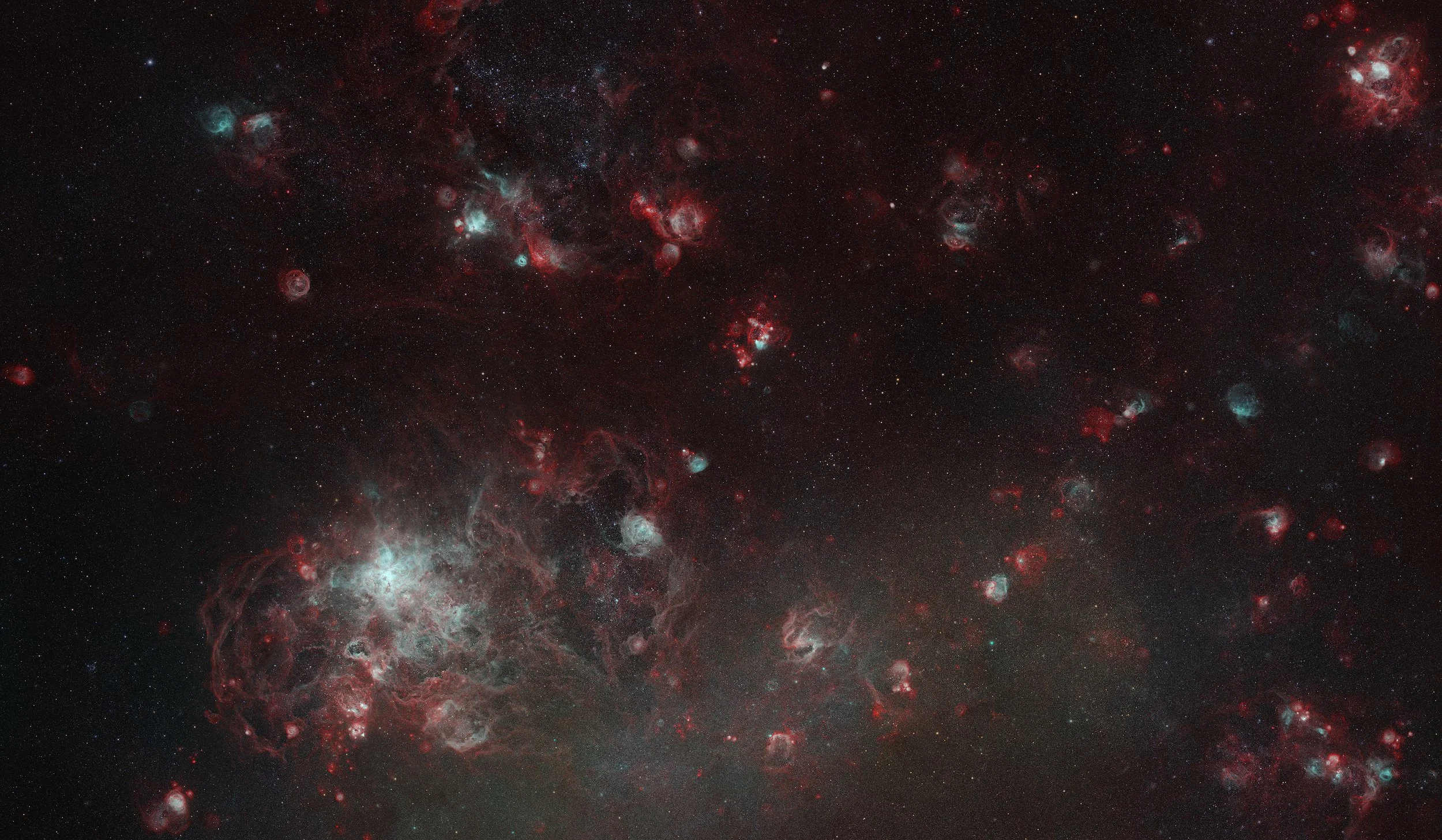
Starbirth and Shockwaves in the Large Magellanic Cloud
This expansive mosaic reveals a rich tapestry of nebulae scattered across the Large Magellanic Cloud, a satellite galaxy of the Milky Way located about 160,000 light years away. Dominated by glowing hydrogen emission in red and oxygen emission in cyan, the scene highlights vast star forming complexes, filamentary shells, and compact knots sculpted by intense ultraviolet radiation and stellar winds. Many of these structures trace the life cycles of massive stars, from deeply embedded nurseries to energized bubbles carved by young star clusters and supernova activity.
Captured as a 10 panel mosaic, the image combines deep narrowband and broadband data to balance scientific detail with natural star color. The strong H alpha signal maps ionized hydrogen gas heated by newborn stars, while OIII emphasizes regions of higher excitation shaped by powerful radiation and shocks. Together, these layers offer a wide field view of the dynamic interstellar medium within the Large Magellanic Cloud, showcasing how gravity, radiation, and stellar feedback continuously reshape this neighboring galaxy.