

AAPOD2 Image Archives
B228 - Wolfs Dark Nebula
Silhouetted against a rich, fiery tapestry of glowing interstellar gas and a glittering field of background stars, Barnard 228—famously known as Wolf's Dark Nebula—stretches across the constellation Lupus like a smoky, cosmic tear. Part of the sprawling Lupus molecular cloud complex located roughly 500 light-years away, this dense, opaque corridor of cosmic dust and cold gas completely absorbs the light of the stars behind it, creating a dramatic and moody contrast. Within these twisting, skeletal tendrils, gravity is quietly at work, condensing pockets of cold matter into the dense stellar embryos that will eventually ignite to become the next generation of stars. This striking view beautifully captures the eternal, silent dance between light and shadow in the deep trenches of our Milky Way galaxy.
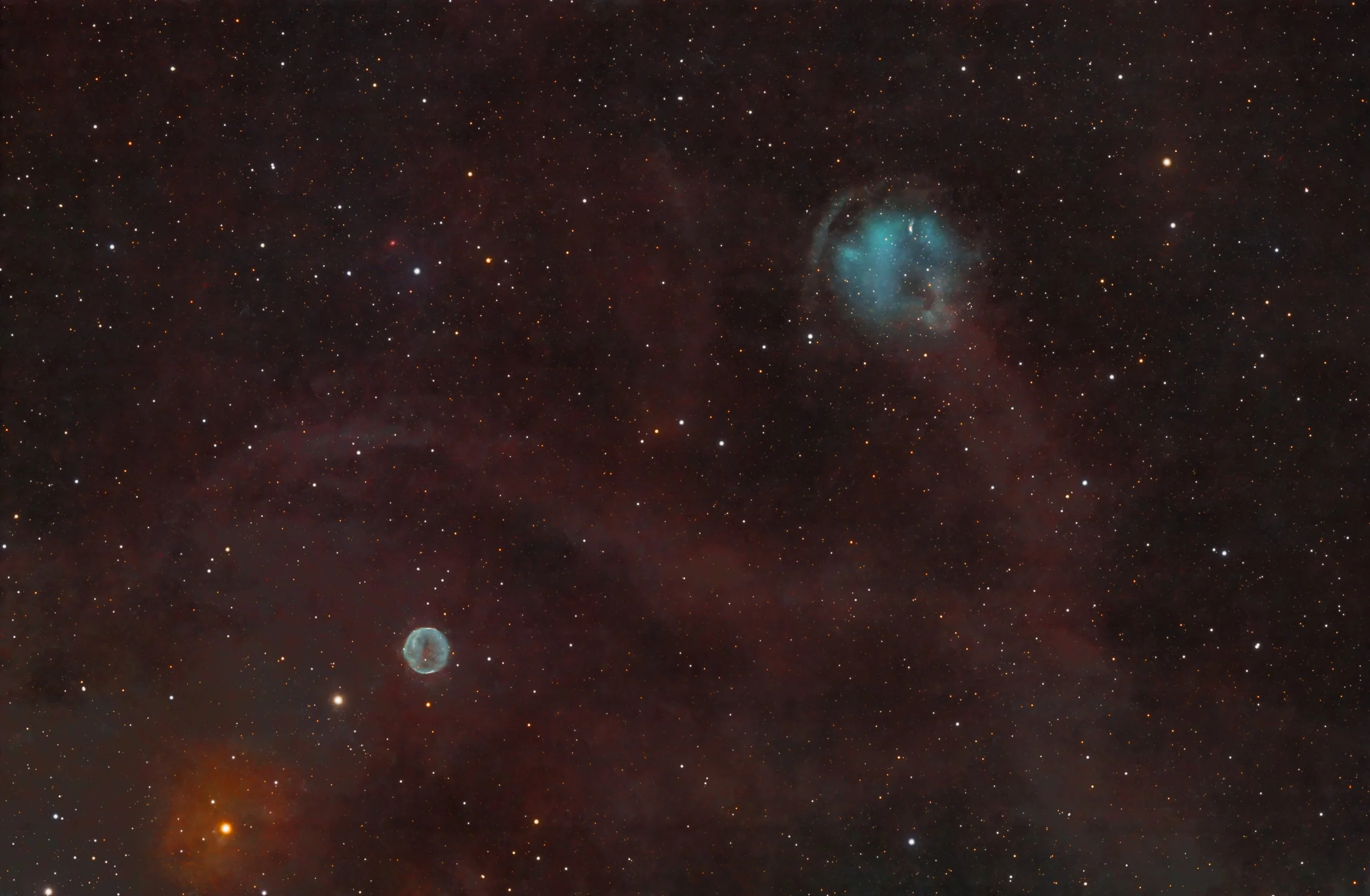
Abell 6 and HFG 1
This deep-field image captures a fascinating pairing of two distinct planetary nebulae within the constellation Camelopardalis (the Giraffe): HFG1 and Abell 6.
Dominating a significant portion of the field is HFG1, a faint and ancient planetary nebula. Spanning an expansive diameter of over one light-year, HFG1 represents the gaseous shroud shed by a dying star thousands of years ago. Because of its advanced age, the nebula has become highly diffuse and subtle. At its core lies a binary system consisting of a white dwarf and a companion star; as this system plows through the interstellar medium, it produces a prominent, dramatic wake in its trail.
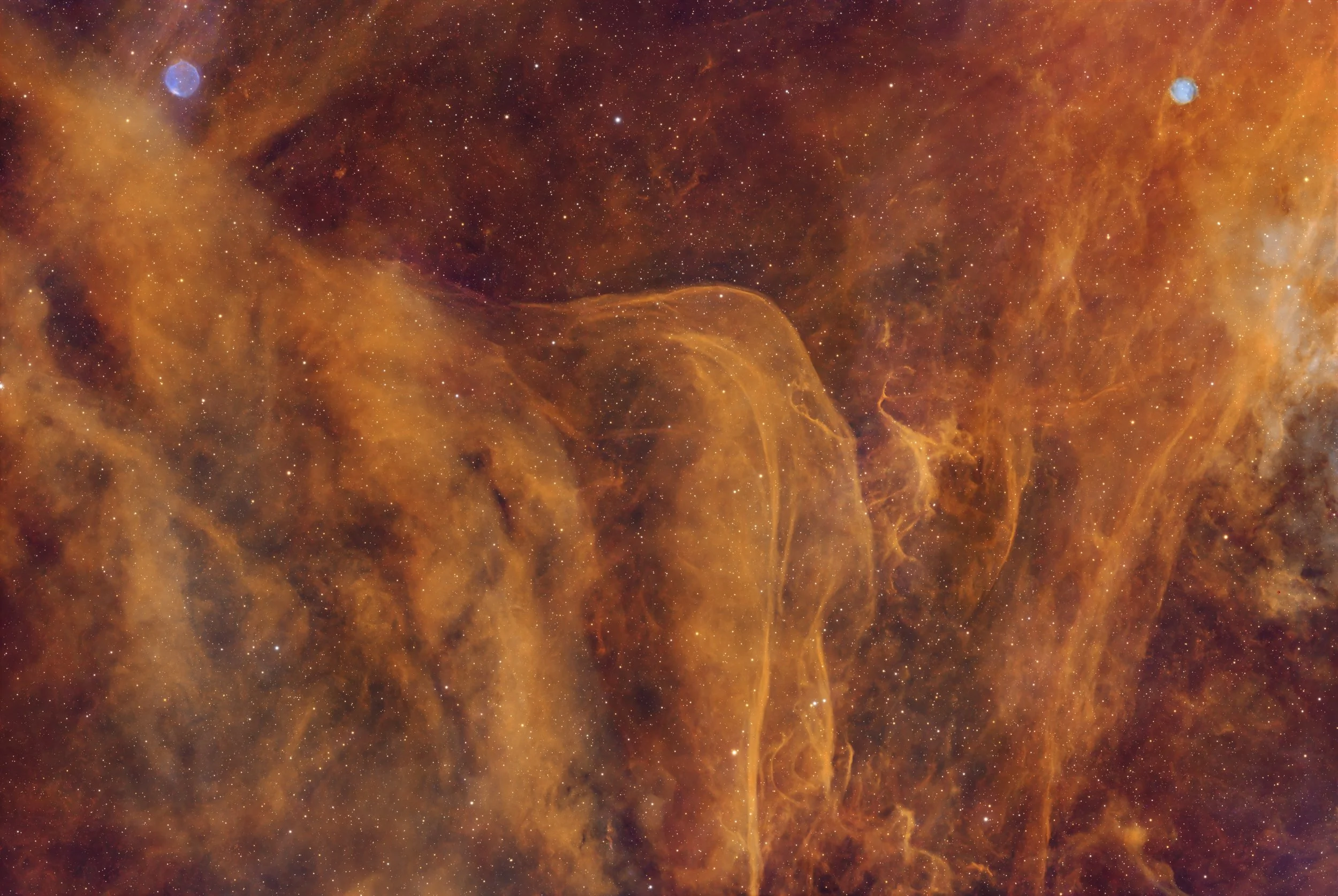
SH2-115 / PN G086.1+05.4 / PN G084.9+04.4
An ethereal tapestry of cosmic gas and dust, this breathtaking view captures the glowing emission nebula Sharpless 115 (Sh2-115) drifting through the rich starfields of the constellation Cygnus. Bathed in warm, golden hues, the interstellar clouds reveal complex, turbulent filaments sculpted by the fierce stellar winds and intense radiation of nearby hot, massive stars. A striking highlight of the scene is the distinct, spherical blue planetary nebula Abell 71 (also known as PK 085+04.1) nestled near the upper left corner, offering a beautiful color contrast and showcasing a completely different stage of stellar evolution against the sweeping canvas of active star formation.
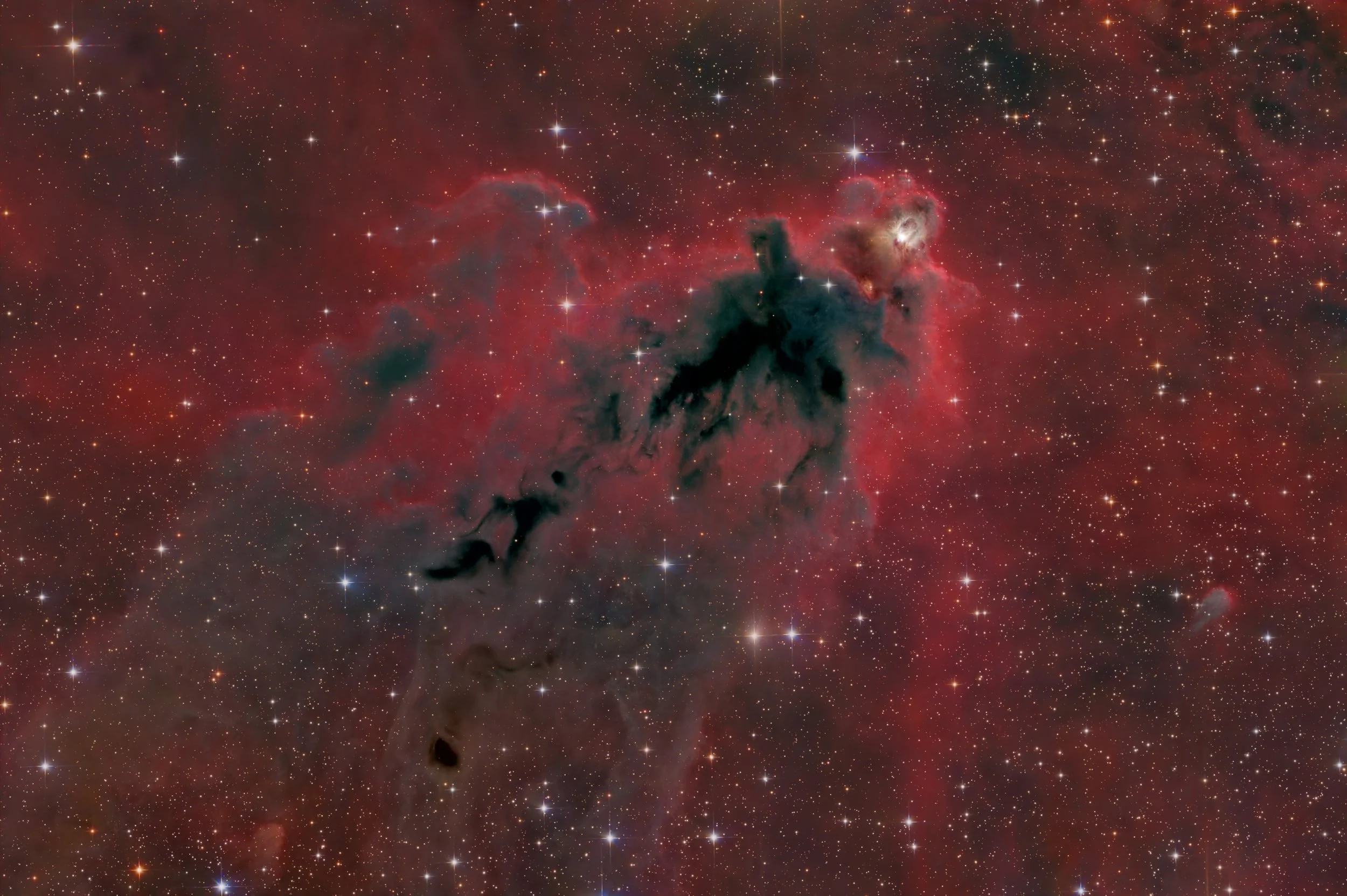
Boogeyman nebula LDN162
Hovering like an eerie silhouette against a rich, glowing backdrop of cosmic hydrogen, the Boogeyman Nebula (LDN 162) reveals its hauntingly beautiful structure in this magnificent deep-sky portrait. Captured by astrophotographer Jesus Juarez over 13 hours of exposure from the dark skies of the Wirikuta Desert in Mexico, the dark molecular cloud appears to reach out into a crowded field of glittering stars and vibrant red emission nebulae. The meticulous integration of HaLRGB data through a Sky-Watcher 150P telescope brings out the intricate, dusty tendrils of this interstellar phantom, showcasing the dramatic contrast between opaque cosmic dust and the brilliant stellar nursery surrounding it.
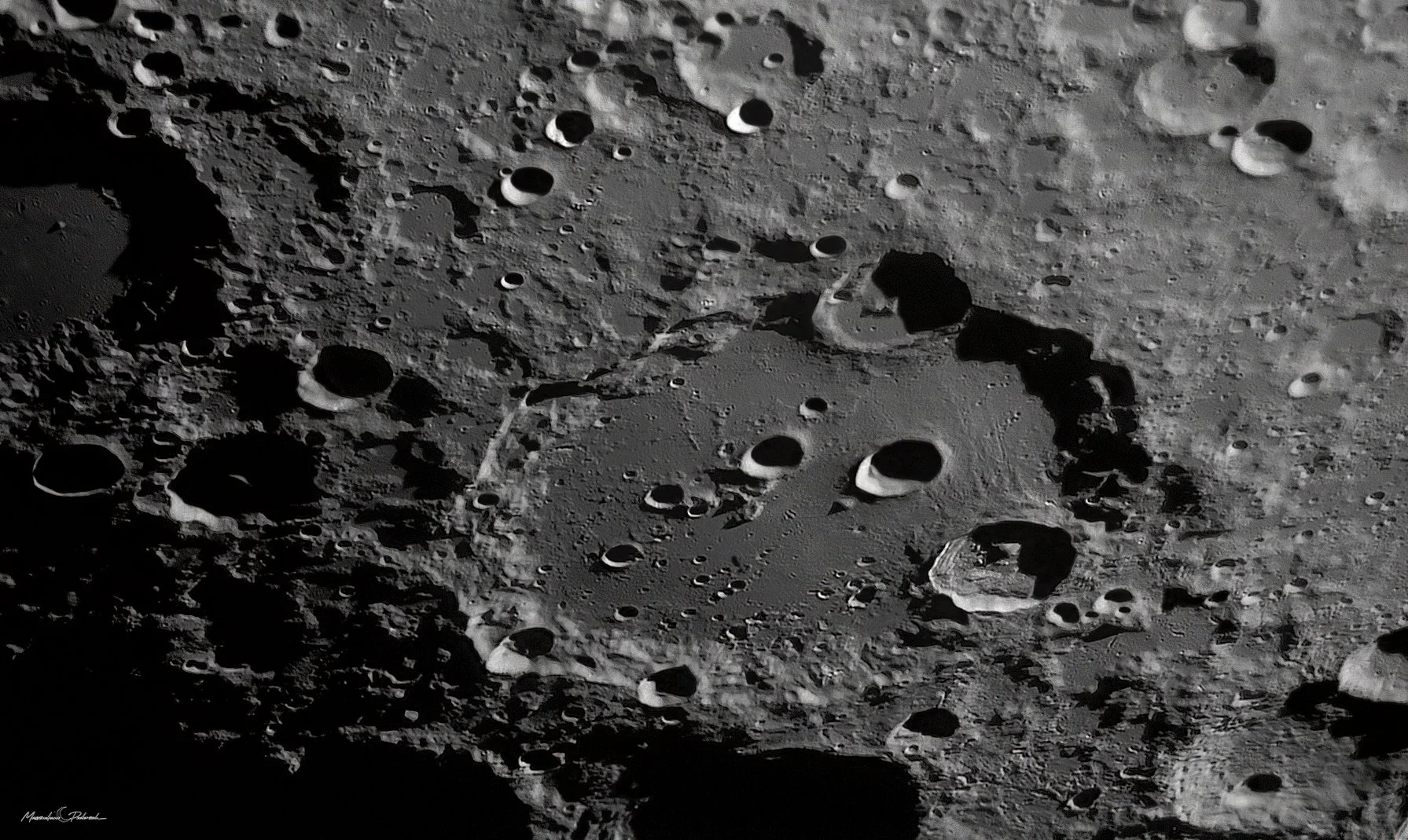
Clavius crater
Dominating the rugged southern highlands of the Moon, the ancient impact structure Clavius—beautifully captured here by astrophotographer Massimiliano Pedersoli—stands as one of the most spectacular craters visible from Earth. Spanning an impressive 230 kilometers in diameter and plunging 3.5 kilometers deep, this Nectarian-era giant dates back roughly 4 billion years and is so vast that its curvature would hide the rim from an observer standing at its center. Beyond its sheer visual grandeur, which features a cascading arc of tapering sub-craters across its floor, Clavius holds immense scientific importance; in 2020, NASA's airborne SOFIA telescope detected molecular water trapped within its sunlit soil, transforming it into a crucial strategic focal point for future human exploration under the Artemis program. To resolve this incredible level of detail from Montecampione, Italy, Pedersoli masterfully paired a Sky-Watcher 355/1650 GoTo Dobsonian telescope with a ToupTek G3M662M camera, an Artesky 3x Barlow lens, and a 685nm IR-pass filter to cut through atmospheric turbulence and bring the lunar landscape into razor-sharp focus.
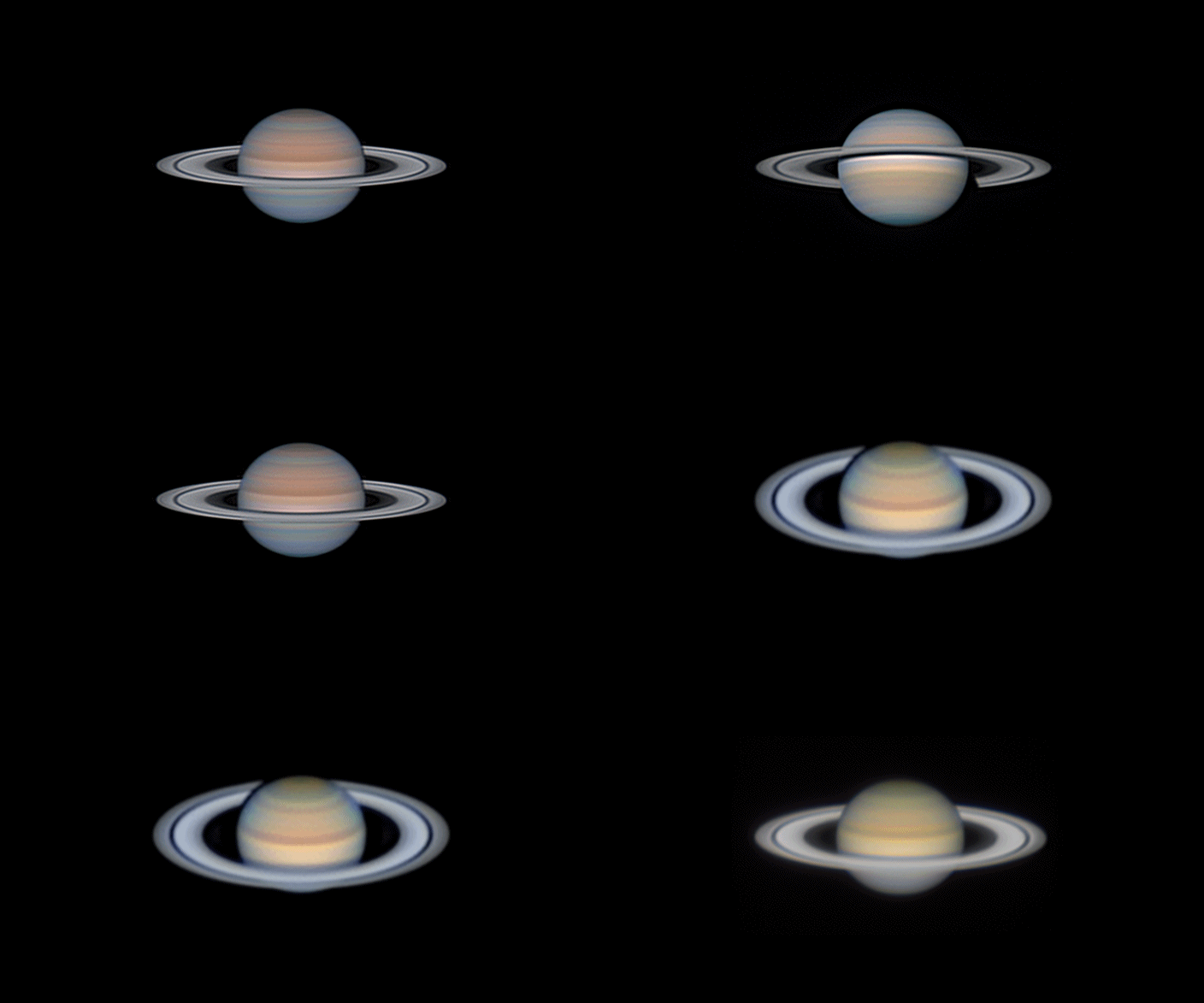
Saturn's dance
Like a spinning top tilted on a cosmic tabletop, Saturn puts on a graceful, decades-long performance for observers on Earth, as captured in this looping animation showing the changing perspective of the ringed planet over its 29.5-year orbit around the Sun. Because Saturn's equator is tilted by 27 degrees relative to its orbital plane, its magnificent ring system shifts dramatically from our point of view, transitioning from wide-open orientations to edge-on alignments roughly every 15 years. During these ring-plane crossings, the rings—which are usually only about 10 meters thick—seem to vanish entirely from view in a striking celestial vanishing act. This rhythmic, dynamic shifting not only dictates how much of the rings we can observe but also constantly alters the sweeping shadows cast by the rings onto Saturn's golden, band-swept cloud tops.
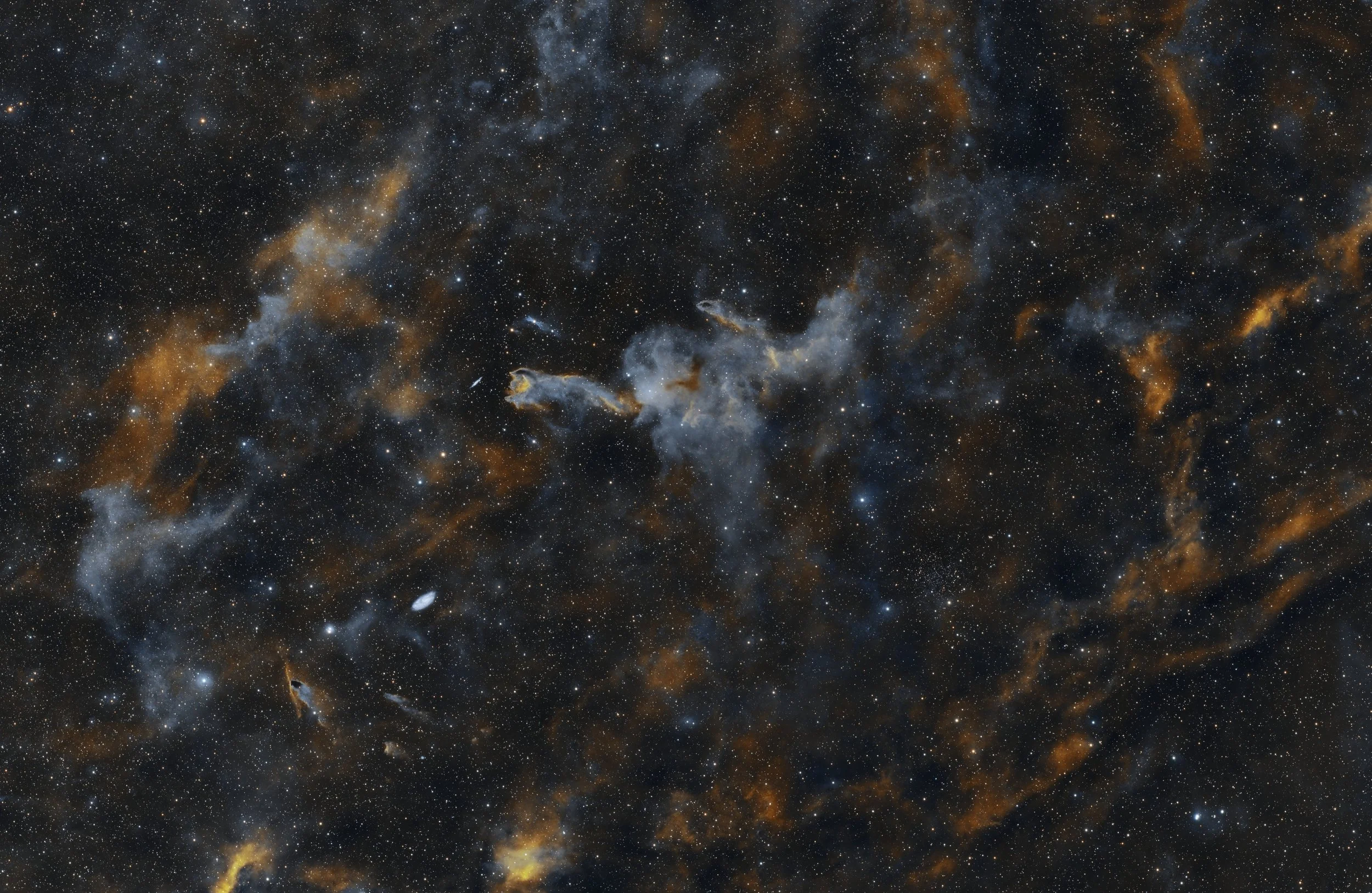
CG4 – Cometary Globule (The Hand of God) – Gum Nebula
G4 (often nicknamed "God's Hand" or the "Mouth of the Beast") is a visually striking and scientifically fascinating deep-sky object located about 1,300 light-years away in the constellation Puppis.
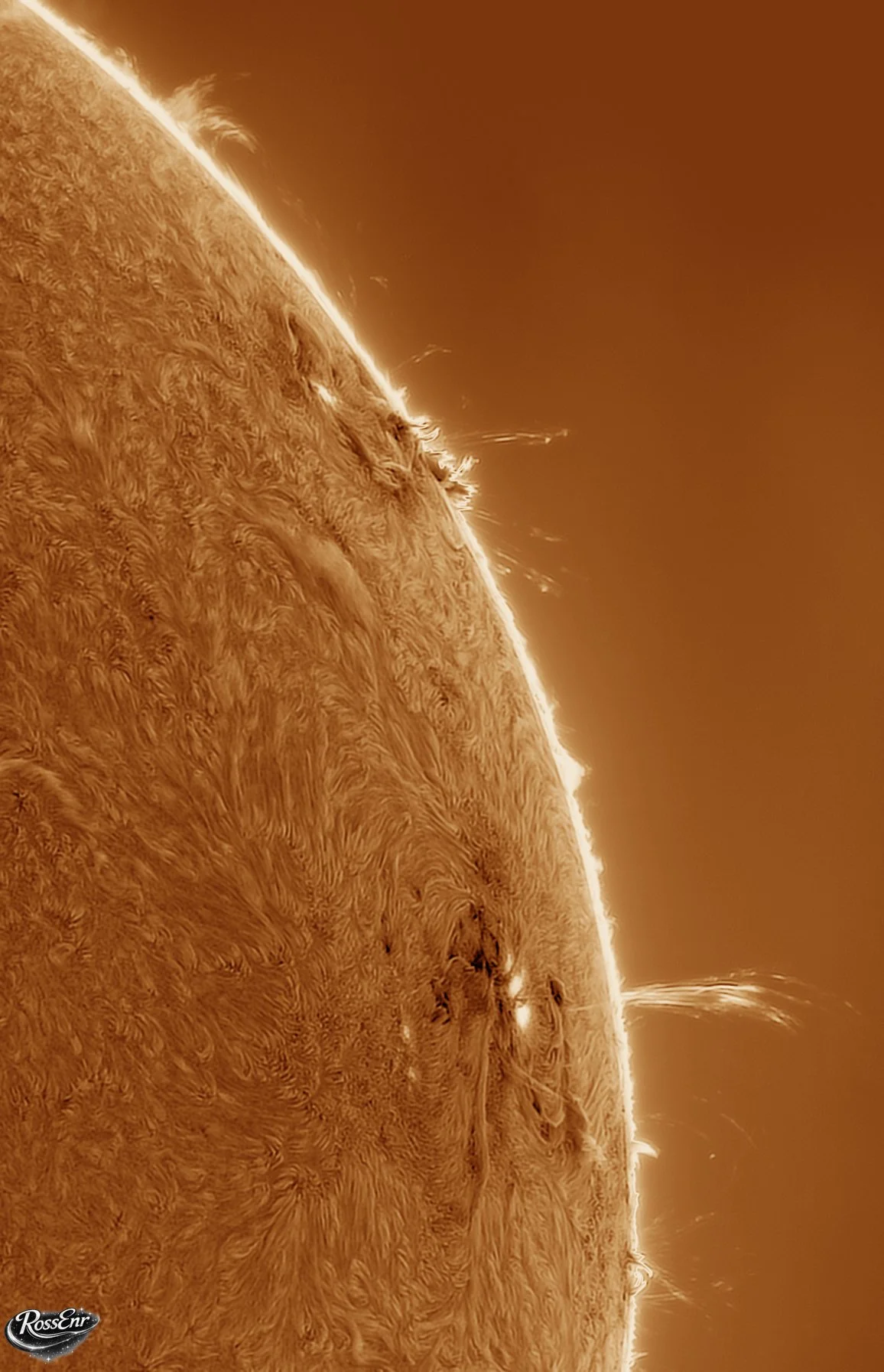
The Sun July 5 2026
This submission features a solar astrophotography image titled "Sole del 05 luglio 2026" ("Sun of July 05, 2026"), captured by photographer Rossana Miani from Villa del Bosco in Correzzola, Italy. Taken using a specialized personal telescope setup—including a Skywatcher 80ED telescope, a Daystar Quark chromosphere filter, an Energy Rejection Filter (ERF), and a ZWO ASI174MM monochrome camera—the image focuses on the detailed structure of the Sun's chromosphere. The final result was processed using specialized astronomical software (SharpCap, AutoStakkert!, and ImPPG) to highlight sharp, intricate features of solar activity.

NGC 6888 • Crescent Nebula
What resembles a glowing cosmic brain floating through the dark voids of space is actually a massive interstellar bubble known as the Crescent Nebula (NGC 6888), located roughly 5,000 light-years away in the constellation Cygnus. This striking portrait captures a massive Wolf-Rayet star, WR 136, casting off its outer layers in a powerful stellar wind as it nears the end of its life cycle. As this high-velocity gas collides with slower-moving material from a previous phase of the star's evolution, it compresses into an intricate shell of shockwaves and glowing filaments spanning 25 light-years across. In this vivid narrowband image, dense inner networks of hydrogen gas burn in fiery reds and pinks, while a delicate, translucent blue-green veil of ionized oxygen enshrouds the nebula, mapping the intense shock fronts heating the surrounding interstellar medium.
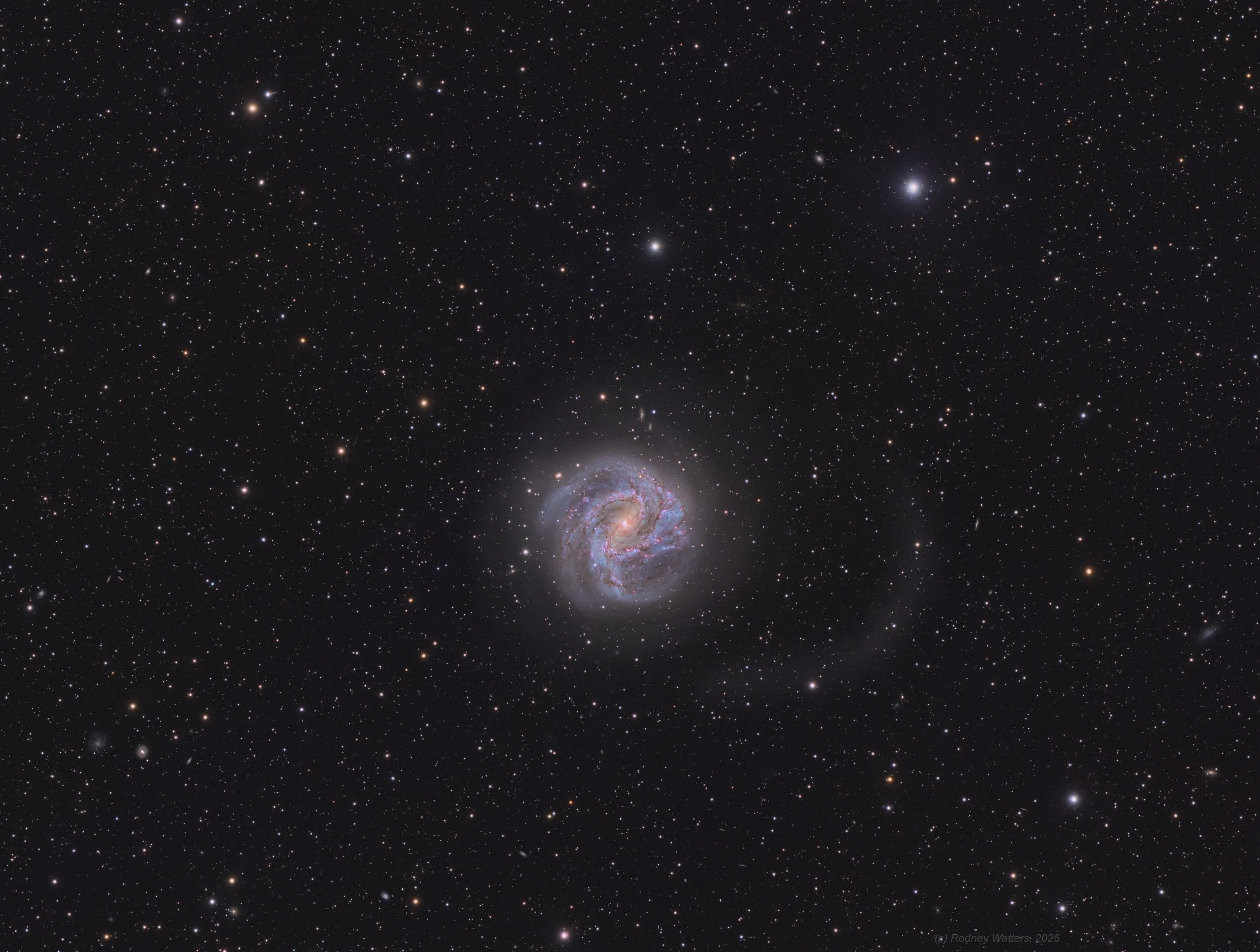
The Southern Pinwheel Galaxy
A brilliant swirl of starfire spinning in the southern sky. Located 15 million light-years away on the border of Hydra and Centaurus, Messier 83—the Southern Pinwheel Galaxy—spans a majestic 50,000 light-years across. Captured beautifully by astrophotographer Rodney Watters from the Glanmire Observatory in Australia, this deep, 24-hour exposure sequence reveals the barred spiral's vibrant lanes of cosmic dust, ruby-red hydrogen star-forming regions, and thousands of young, blue star clusters sprawling across its winding arms.
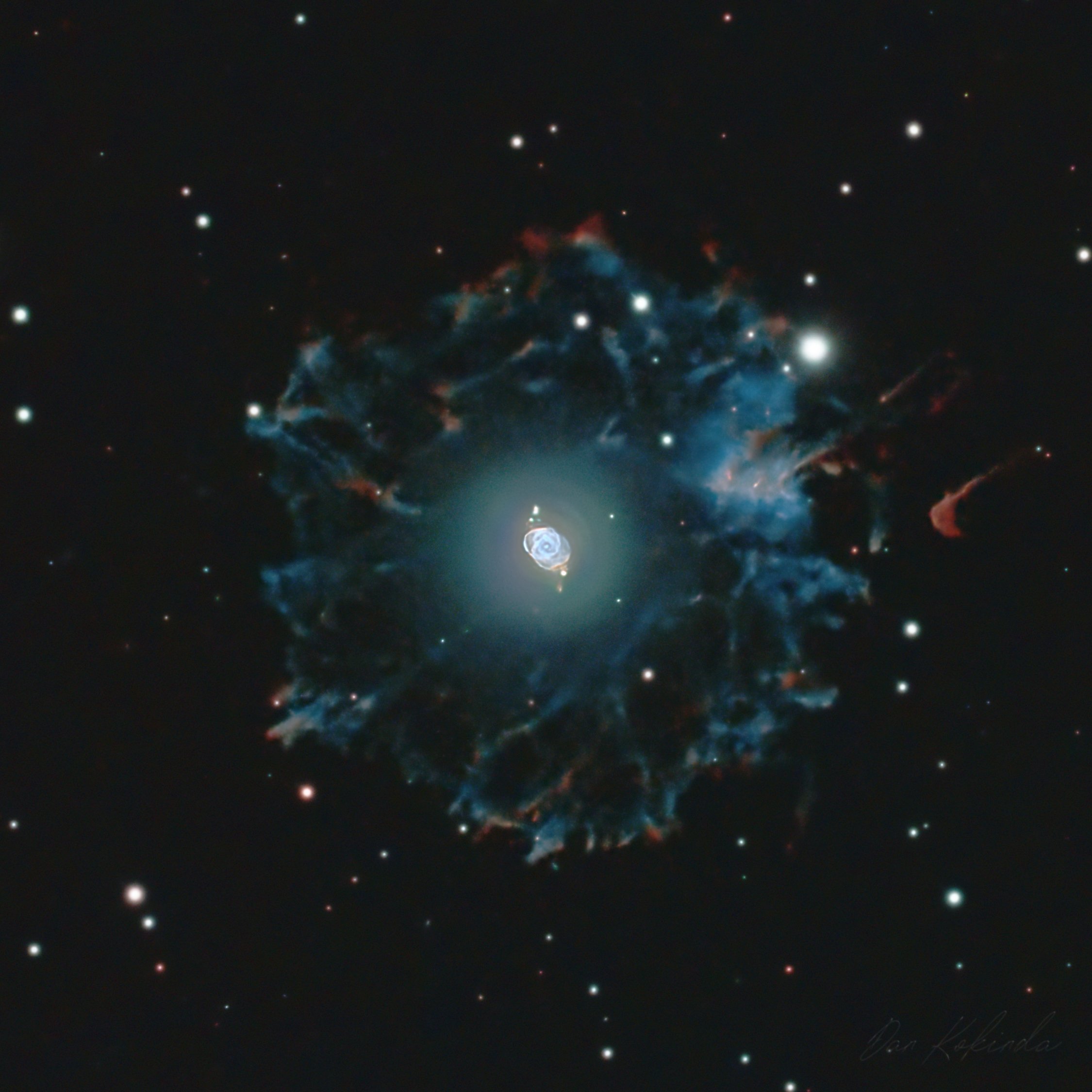
Cat's Eye Nebula
A celestial eye piercing through the cosmic dark. Glistening in the northern constellation of Draco, the Cat's Eye Nebula (NGC 6543) represents one of the most complex planetary nebulae ever discovered. This striking image captures the final, brilliant gasp of a dying solar-mass star shedding its outer layers into space. Photographed by astrophotographer Dan Kokinda over a painstaking 32-hour exposure sequence from Indiana, this remarkable single-exposure-length composition brilliantly balances the blindingly intense, intricate central core with the incredibly faint, surrounding concentric shells of glowing gas.
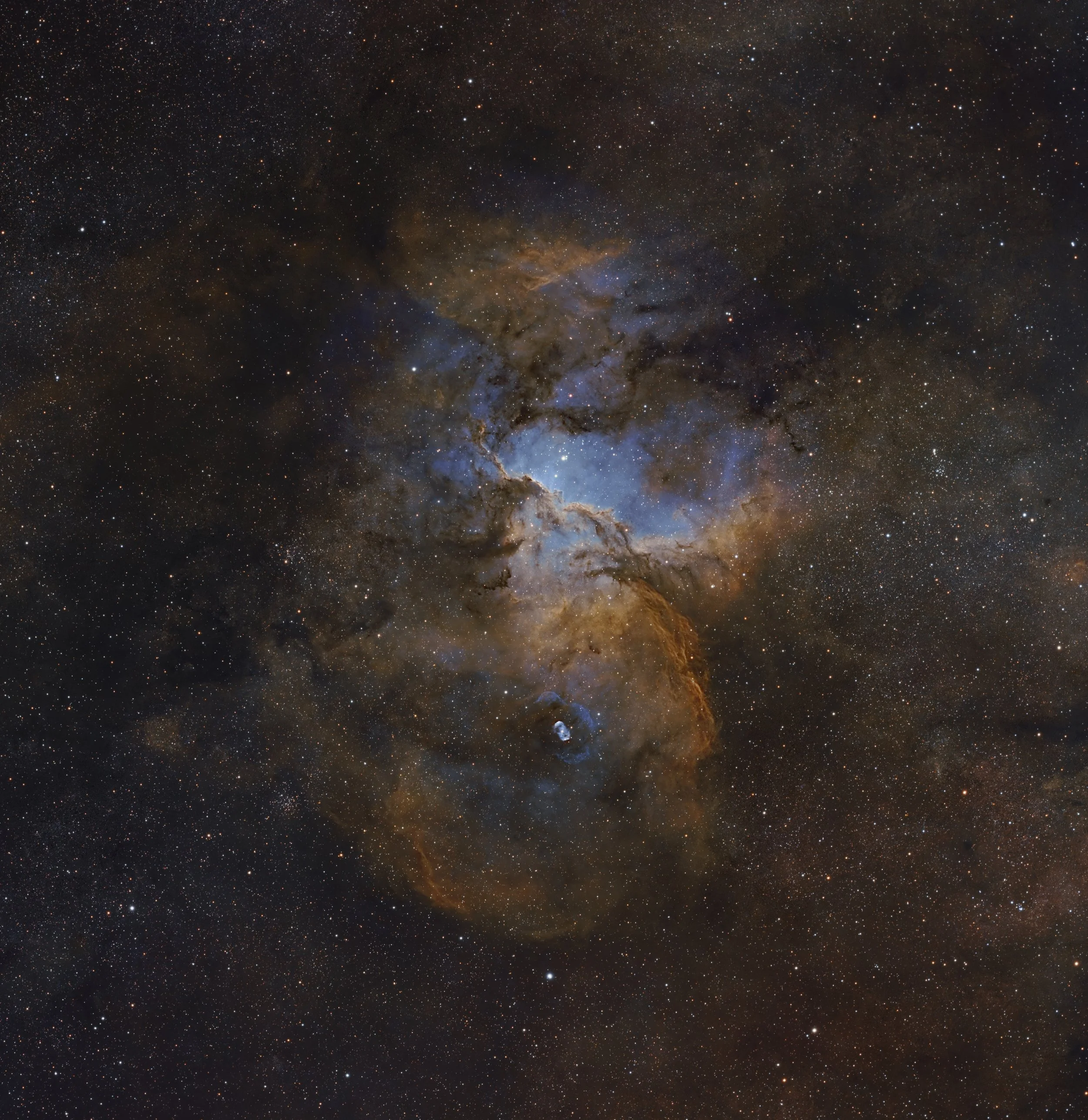
The Fighting Dragons of Ara - NGC 6188
A cosmic battle forged in a sea of starfire. Rising from the southern constellation Ara, the immense emission nebula NGC 6188 reveals dark molecular clouds and glowing gas structures that closely resemble two colossal dragons locked in combat. This striking cosmic tapestry is sculpted by the fierce ultraviolet radiation and intense stellar winds of young, massive stars. Captured brilliantly by astrophotographer Erly Alexandrino da Silva Neto under challenging Bortle 9 skies in Brazil, this personalized narrowband composition uncovers the turbulent, hidden beauty of an active stellar nursery.
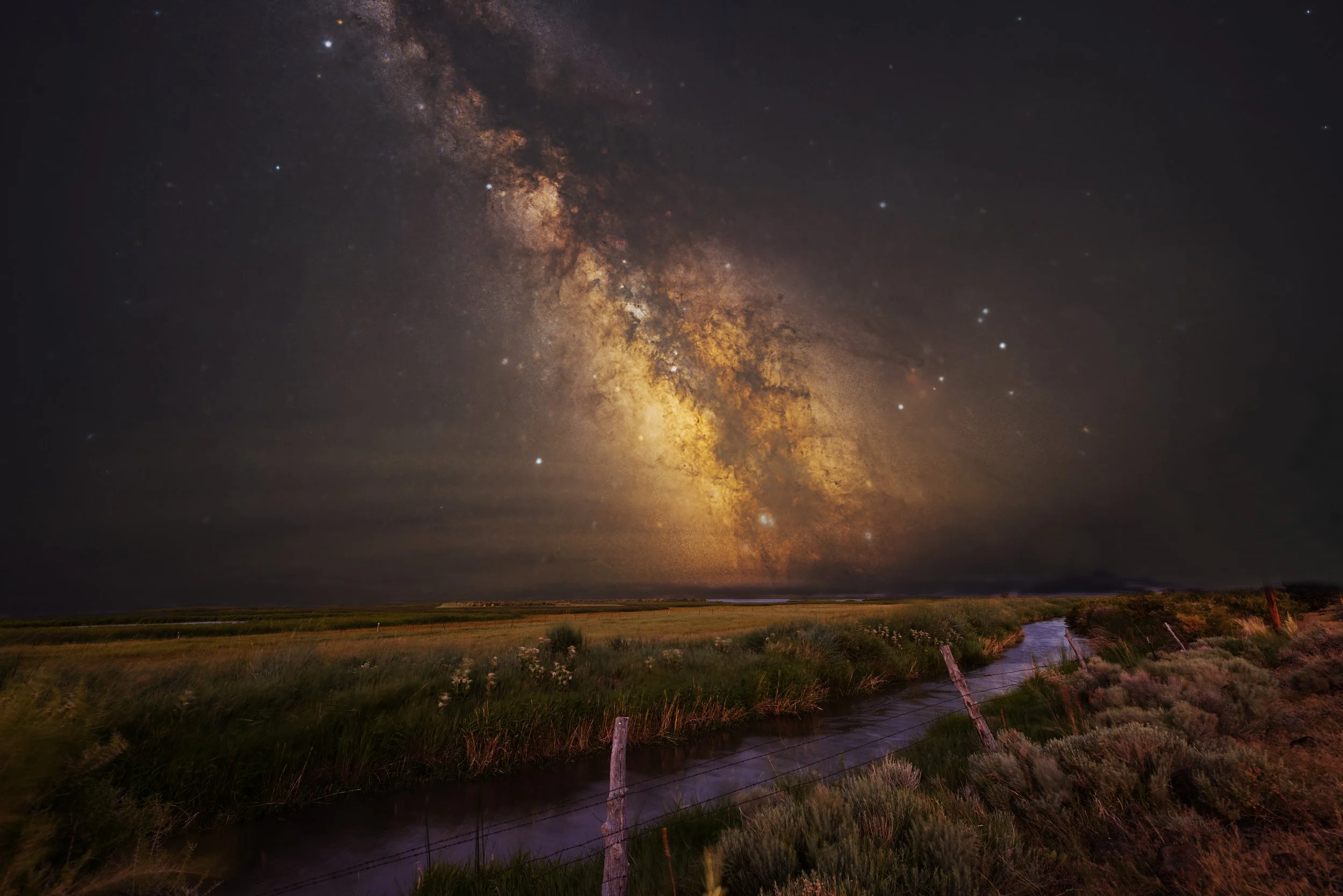
Milky Way core from the Oregon Outback
Captured from the pristine shores of Crump Lake near Plush, Oregon, this striking image showcases the brilliant, structure-rich core of our Milky Way galaxy slicing through the night sky. The horizon glows faintly against the 2.5 million acres of the Oregon Outback—the largest contiguous Dark Sky Sanctuary in the lower 48 states. Using a tracked, multi-exposure sequence, astrophotographer Dave Doctor beautifully reveals the intricate lanes of cosmic dust and distant starlight that are perfectly preserved by some of the darkest, most pristine night skies left on Earth.
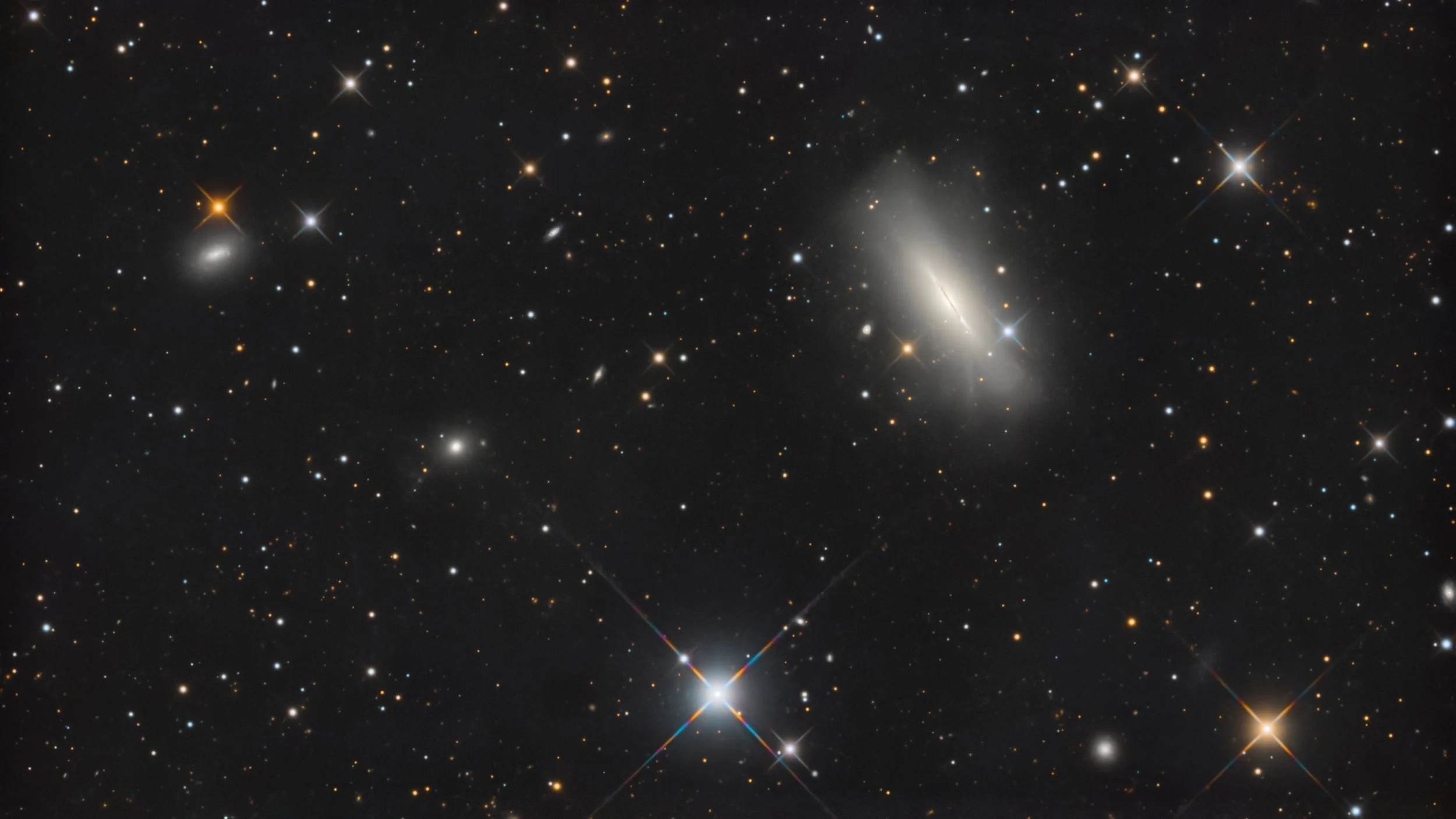
NGC 5866 - Dust and Light
Often referred to as the Spindle Galaxy (and historically associated with the catalog designation Messier 102), this striking lenticular galaxy lies roughly 44 million light-years away in the northern constellation Draco, viewed nearly exactly edge-on from our perspective.
Lenticular galaxies represent a transitional phase in galactic evolution, possessing a disk like a spiral galaxy but lacking the prominent, star-forming spiral arms. Instead, NGC 5866 features a vast, complex dust disk that divides its bright stellar populations. This 13.8-hour total integration capture reveals not only the intricate details of that bisecting dust lane but also hints at the galaxy’s faint outer halo and a scattering of much more distant, background galaxies drifting in the deep cosmos beyond.
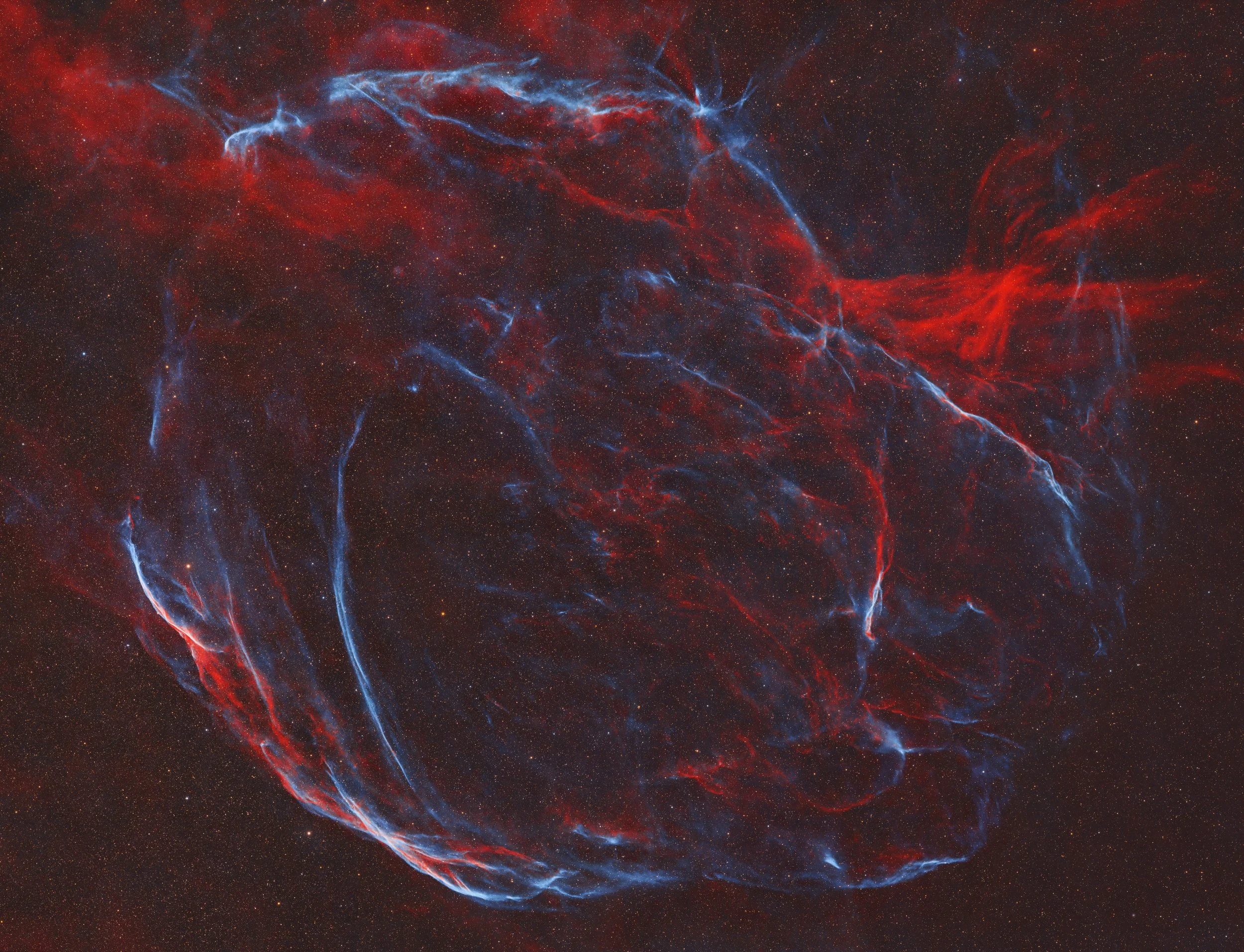
SNR G65.3+5.7 (Little Veil Nebula)
This high-resolution HOO narrowband composite maps the low-surface-brightness filaments of the Galactic supernova remnant SNR G65.3+5.7 in the constellation Cygnus. Captured from Huércal de Almería, Spain, the sprawling structure required a demanding 2 x 4 spatial mosaic (8 tiles total) integrated under highly variable atmospheric conditions. Due to the exceptionally low photon flux of the target, data acquisition was executed using 2×2 binning to optimize the signal-to-noise ratio SNR, accumulating 50 exposures in Hydrogen-Alpha and 50 exposures in Oxygen-III per individual tile.
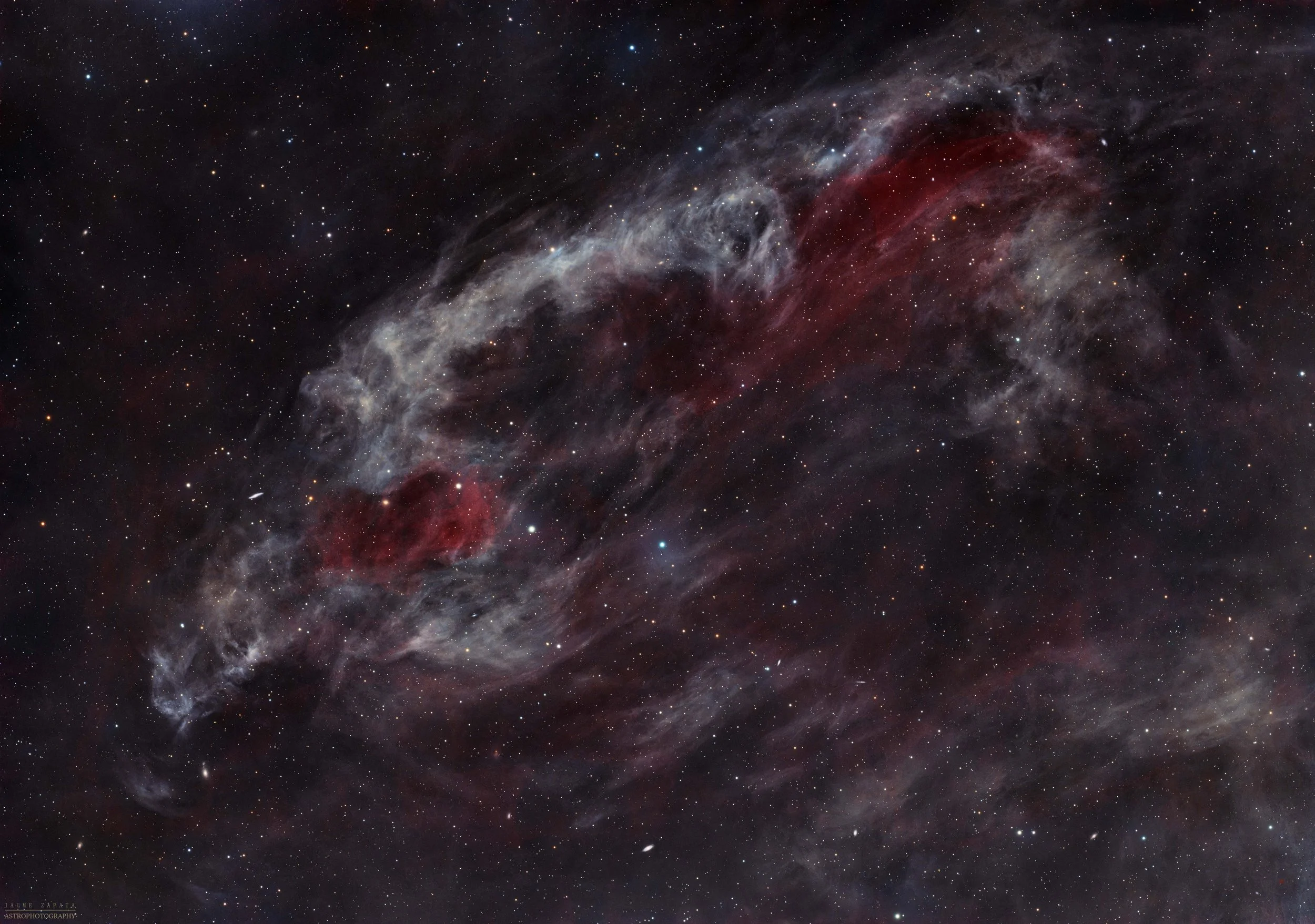
Mandel-Wilson 5 - The Hook Nebula
Mandel-Wilson 5 (The Hook Nebula) is a faint, rarely imaged reflection and emission nebula complex situated within a highly obscured region of the interstellar medium (ISM). To delineate its diffuse structures from the overwhelming cosmic background, this dataset combines broad-band LRGB data with narrow-band Hydrogen-alpha filtering. The addition of the narrow-band data successfully maps the delicate ionization fronts and localized excitation of atomic hydrogen, revealing a complex network of gas filaments weaving through the embedded interstellar dust clouds.
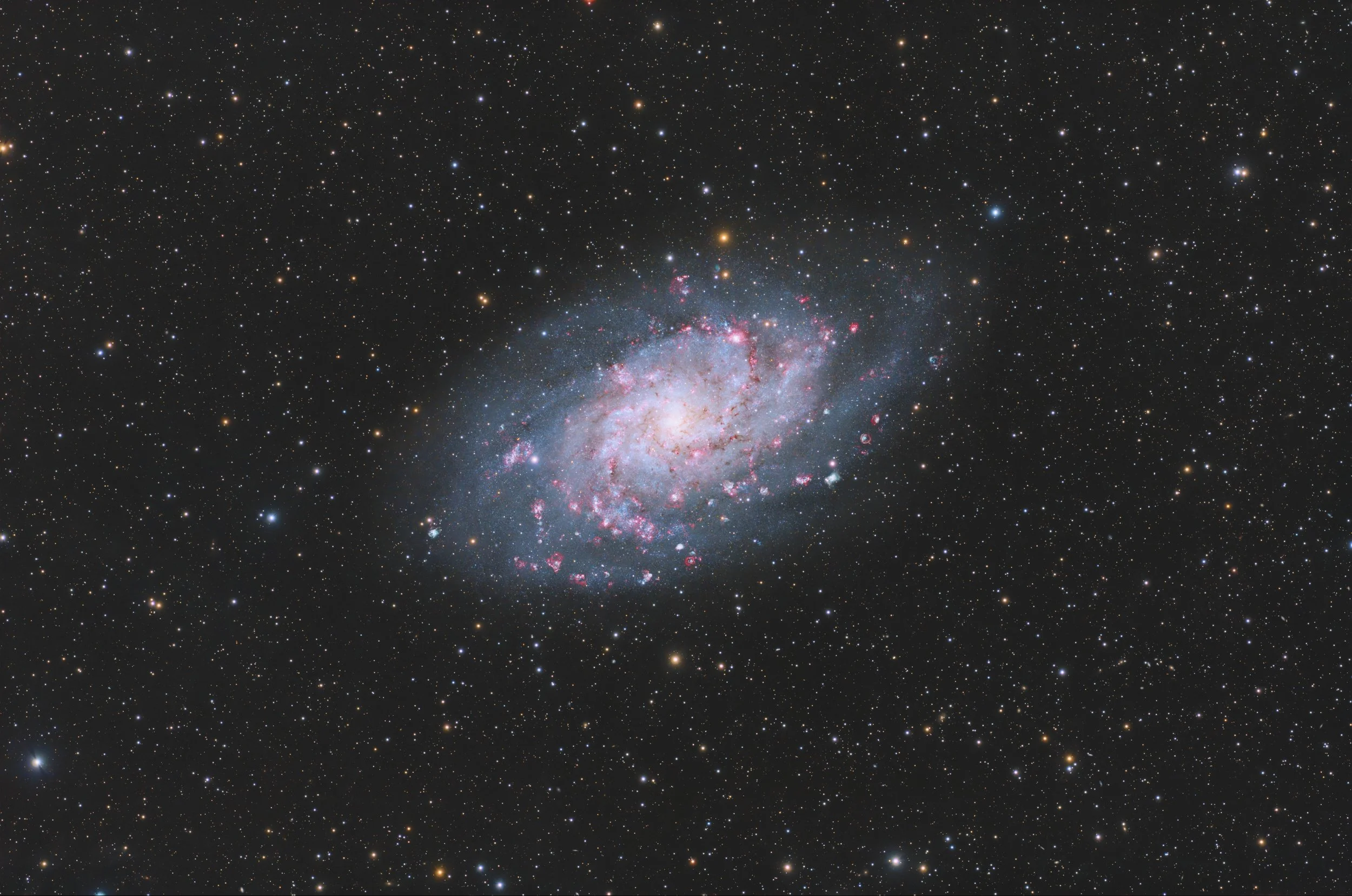
M33, the Triangulum Galaxy
Sprawling across the northern constellation Triangulum, Messier 33 is the third-largest member of our Local Group of galaxies, situated roughly 2.9 million light-years from Earth. Famously known as the Triangulum Galaxy, it holds the distinction of being one of the most distant celestial objects visible to the unaided eye under exceptionally dark skies. This deep 22.3-hour composite telescopic exposure reveals the galaxy's internal structure and high rate of star formation by blending broadband RGB data with specialized narrowband filtration. The resulting image highlights a magnificent abundance of glowing emission nebulae and HII regions, which are massive stellar nurseries rich in ionized hydrogen gas that trace M33's loosely wound spiral arms and showcase the raw materials fueling its next generation of stars.
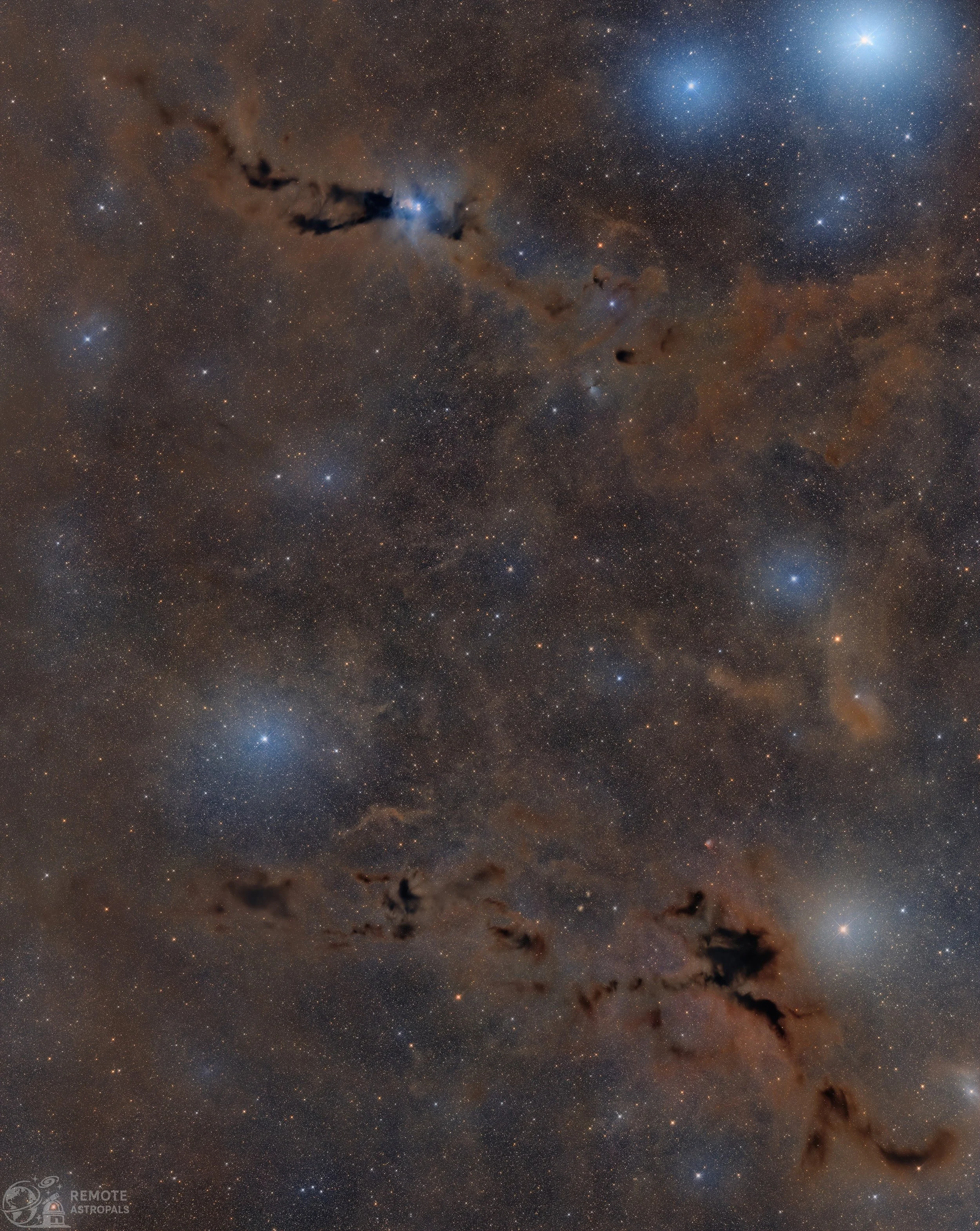
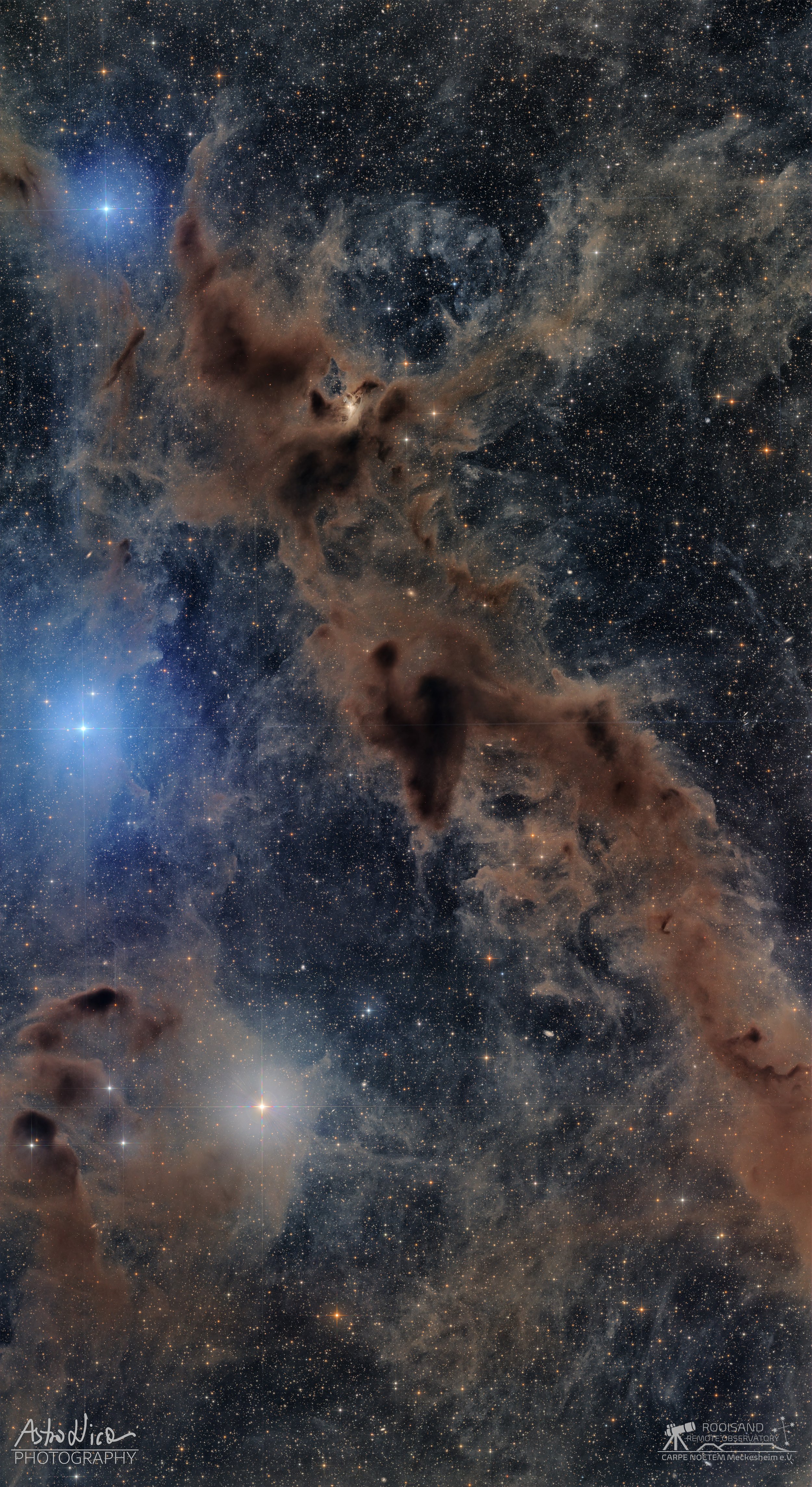
Bernes 149 and surrounding - Molecular cloud Lupus 3
Moving away from bright emission structures, this field enters a quieter deep-sky landscape defined by the subtle interaction between starlight and cosmic dust. At its heart lies Bernes 149, a delicate blue reflection nebula illuminated by the hot, young stars HR 5999 and HR 6000, whose energetic light scatters off fine interstellar grains. However, the true depth of the image is revealed in the surrounding Lupus 3 molecular cloud, a vast stellar nursery of brown, grey, and near-opaque black dust lanes cutting sharply across a dense background of Milky Way stars. Capturing this broadband target requires a delicate processing touch to balance the low-contrast, three-dimensional dusty veils against a crowded star field without letting bright stellar halos overwhelm the scene.
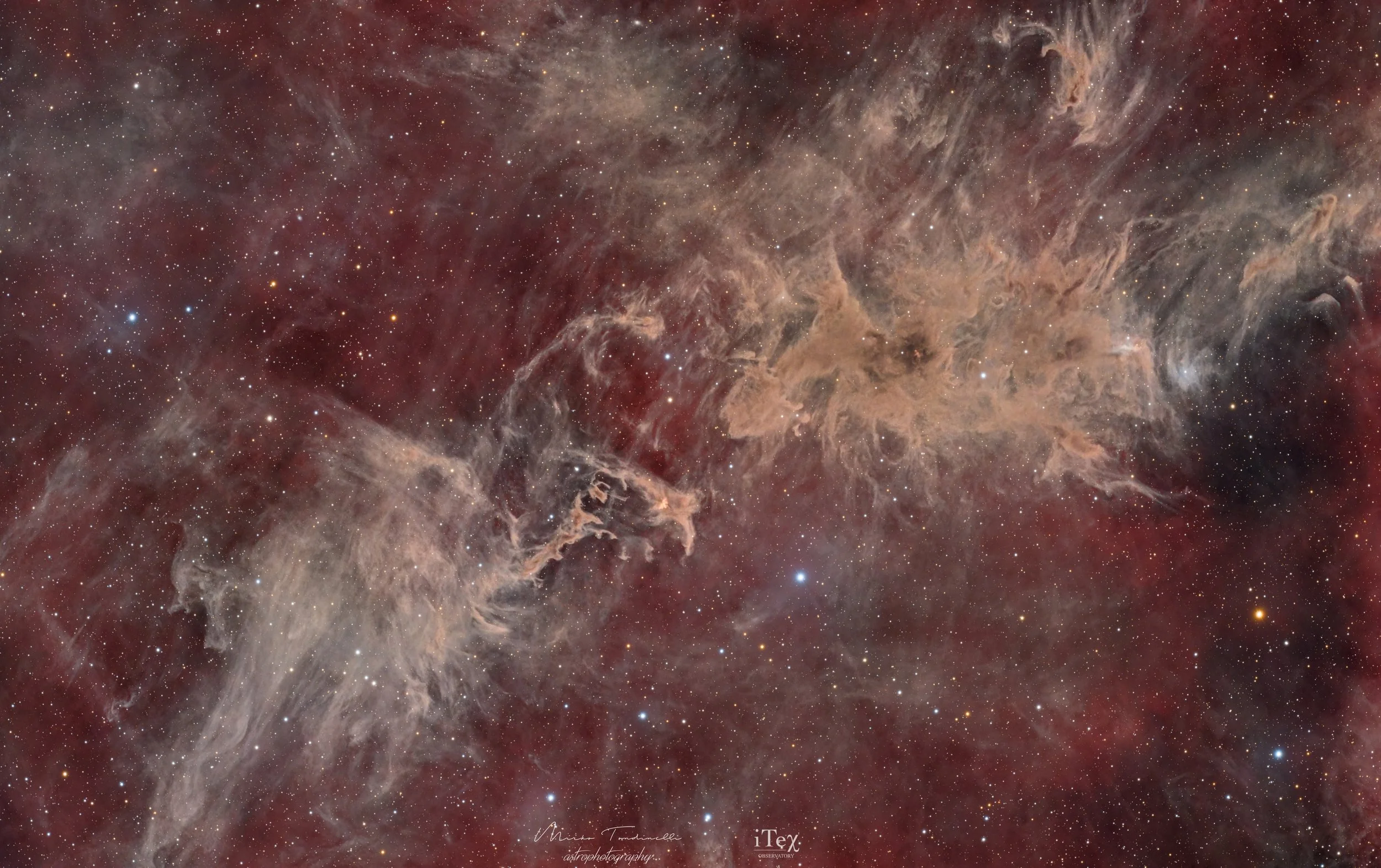
LDN 1228 Lrgb & HaLrgb
LDN 1228 (Lynds Dark Nebula 1228) is a complex and fascinating dark nebula located within the constellation Cepheus. This intricate system of interstellar dust and molecular gas is located approximately 600 light-years from Earth and is positioned in the immediate vicinity of the north celestial pole, just 11 degrees from Polaris.
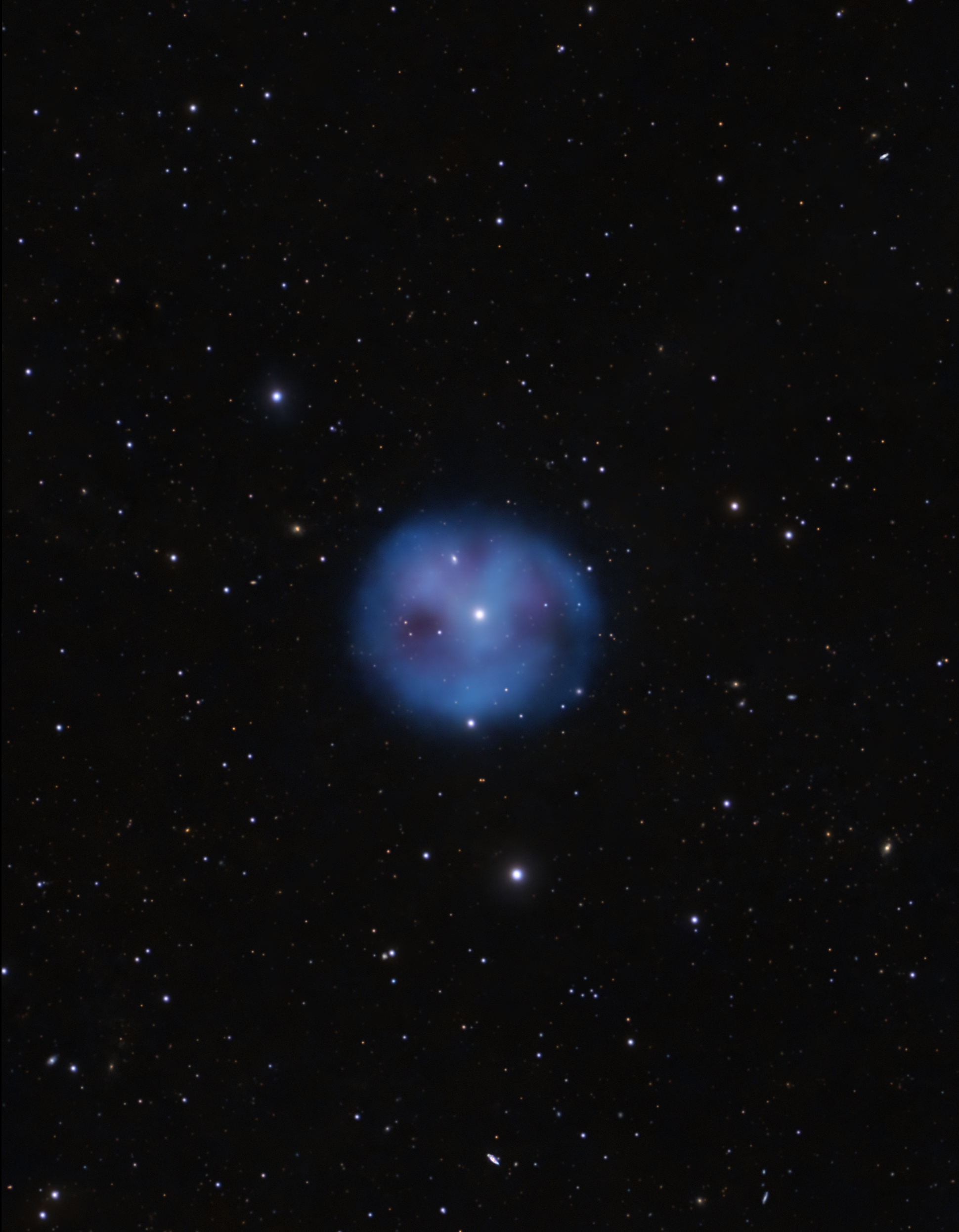
PN LoTR 5 in Coma Berenices
A stunning 40-hour deep-sky capture of the planetary nebula LoTr 5 in the constellation Coma Berenices, captured by Stefan Thrun from the North Sea coast of Germany. This impressive image combines data from 2023 with freshly gathered $OIII$ details from the spring of 2026, utilizing a 130 mm Triplet Apo and a ZWO ASI2600MM Pro camera to reveal the delicate, glowing structures of this elusive cosmic target.