
AAPOD2 Image Archives

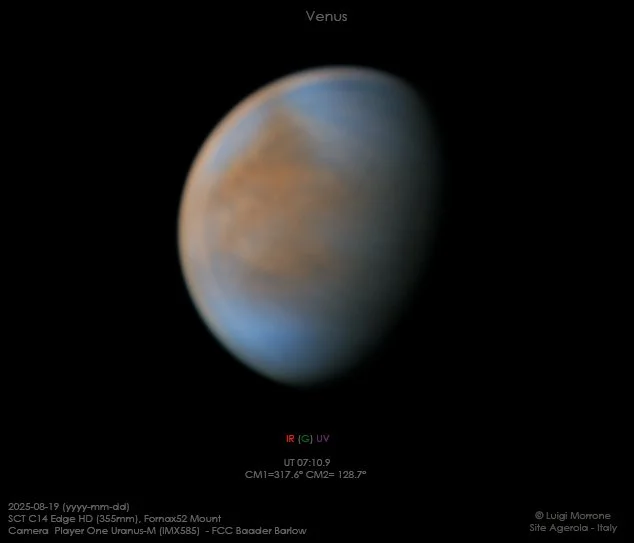
Venus in IR-UV False Color
Venus reveals its cloud structure in this striking false-color image captured under excellent seeing and transparency. The view was produced using a combination of infrared, green, and ultraviolet filters to bring out details at multiple atmospheric levels. The bright cloud features trace high-altitude haze, while darker bands hint at lower-level cloud formations.
This image was taken with a 14-inch Schmidt-Cassegrain telescope on a precision Fornax52 mount, using a Player One Uranus-M camera with a Baader FFC Barlow. The IR and UV wavelengths used (820–920 nm and 350 nm) penetrate and highlight different cloud layers, offering a glimpse of the planet’s dynamic atmosphere.
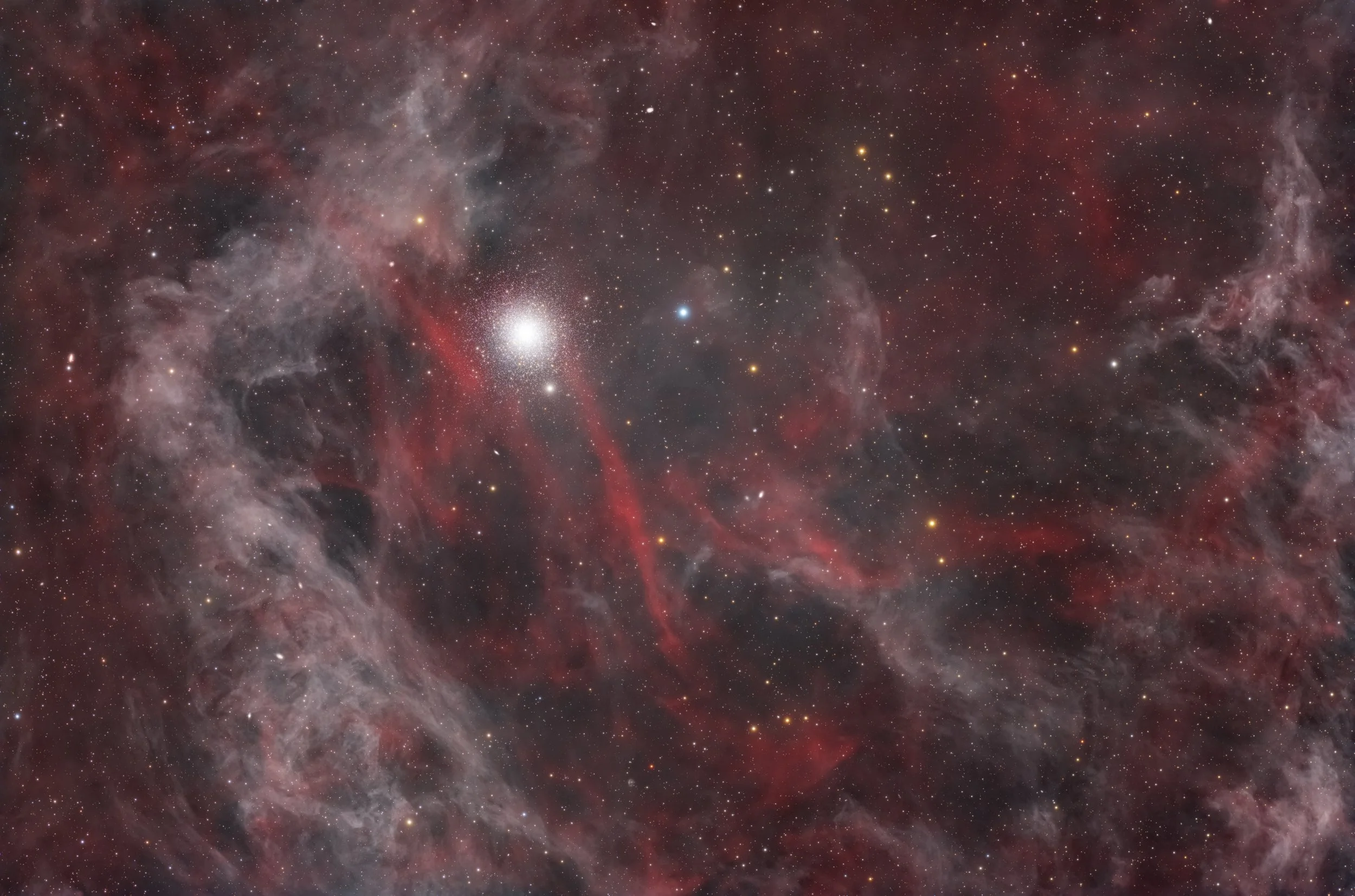
Globular Cluster M15 in a Rich Hydrogen-Alpha Field
This stunning image frames Messier 15, one of the densest globular clusters in the Milky Way, surrounded by faint hydrogen-alpha filaments and integrated flux nebula. Located about 33,000 light-years away in Pegasus, M15 contains over 100,000 stars tightly packed into a sphere just 175 light-years across. Its collapsed core may even harbor a rare intermediate-mass black hole.
The long exposures in H-alpha and broadband filters reveal delicate red and gray wisps of interstellar gas and dust, rarely captured in wide-field images of M15. These structures belong to the faint galactic cirrus that permeates the outer regions of our galaxy, adding an ethereal backdrop to the brilliant, ancient cluster.

The Soul Nebula (IC 1848)
This wide-field view captures the Soul Nebula, also cataloged as IC 1848, a sprawling emission nebula located about 6,500 light-years away in the constellation Cassiopeia. Dominated by glowing hydrogen gas, the nebula is energized by young, massive stars embedded within its central cluster. These stars carve out bright ridges and sculpt dark dust lanes, creating the nebula’s intricate, soul-like shape.
The image highlights the nebula’s characteristic red emission, a result of ionized hydrogen recombining with electrons. Subtle blue hues mark regions of reflection nebulae where dust scatters starlight. The Soul Nebula is often imaged together with its neighbor IC 1805, the Heart Nebula, forming a celestial “Heart and Soul” pair. This detailed portrait isolates the Soul itself, revealing the star-forming activity and sweeping structures that make it a favorite target for astrophotographers.
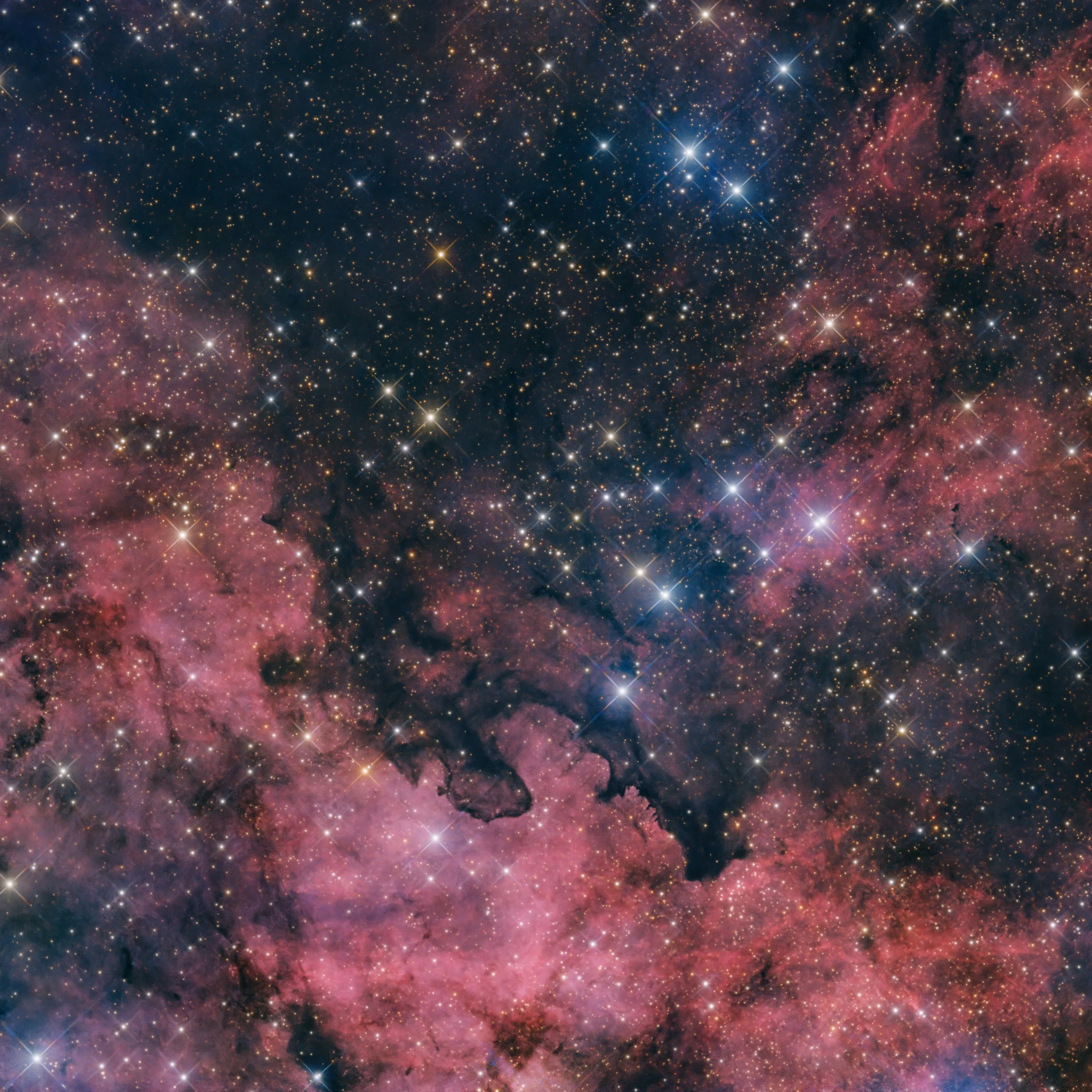
LDN 881 – A Dark Nebula in Cygnus
This cosmic cloudscape highlights LDN 881, a dark nebula silhouetted against the bright emission region in Cygnus. The dusty filaments weave through a glowing backdrop of hydrogen gas, their opaque tendrils blocking the light of countless background stars. Embedded within are young stellar objects still cocooned in their natal clouds, evidence that this is an active site of star formation.
The surrounding emission is rich in ionized hydrogen, giving the nebula its pink glow. Nearby, bright blue stars illuminate parts of the dust, creating subtle reflection features that contrast with the dark lanes. This intricate interplay of light and shadow makes LDN 881 a favorite target for deep-sky imagers exploring the Northern Cross region.
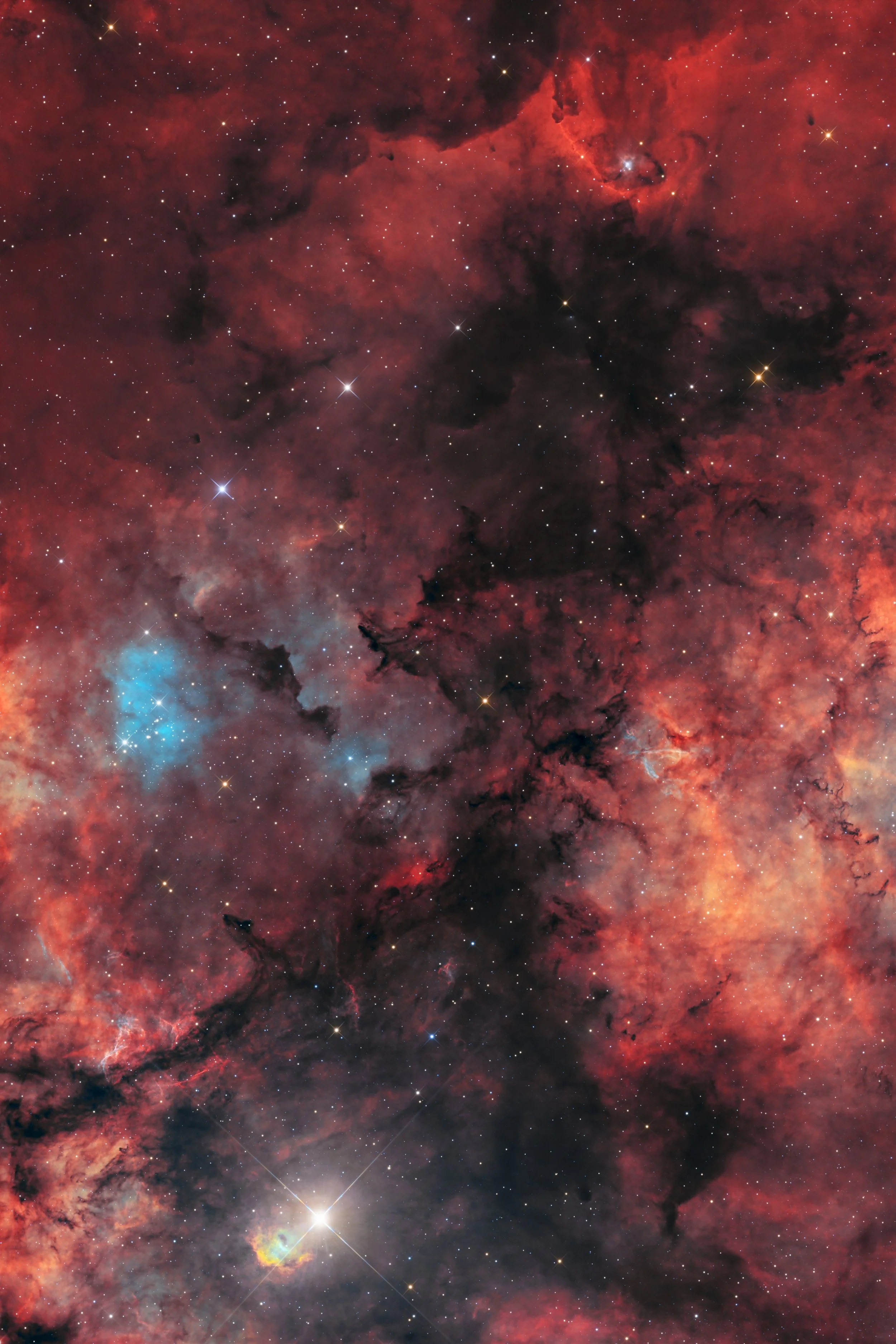
The Black River of Sadr
This striking view flows through the heart of the constellation Cygnus, centered near the bright star Gamma Cygni, also known as Sadr. Dark dust lanes carve a "black river" through glowing hydrogen clouds, creating a dramatic contrast against the starry background. The central blue patch highlights emission from doubly ionized oxygen, while the deep red glow is dominated by hydrogen-alpha light.
Visible in this field are several cataloged objects, including the open cluster NGC 6910 near the top and the faint emission nebula Sharpless 2-108. Together, they form part of the rich star-forming complex that fills the Northern Cross region of the Milky Way, a favorite target for astrophotographers exploring the cosmic river of Cygnus.
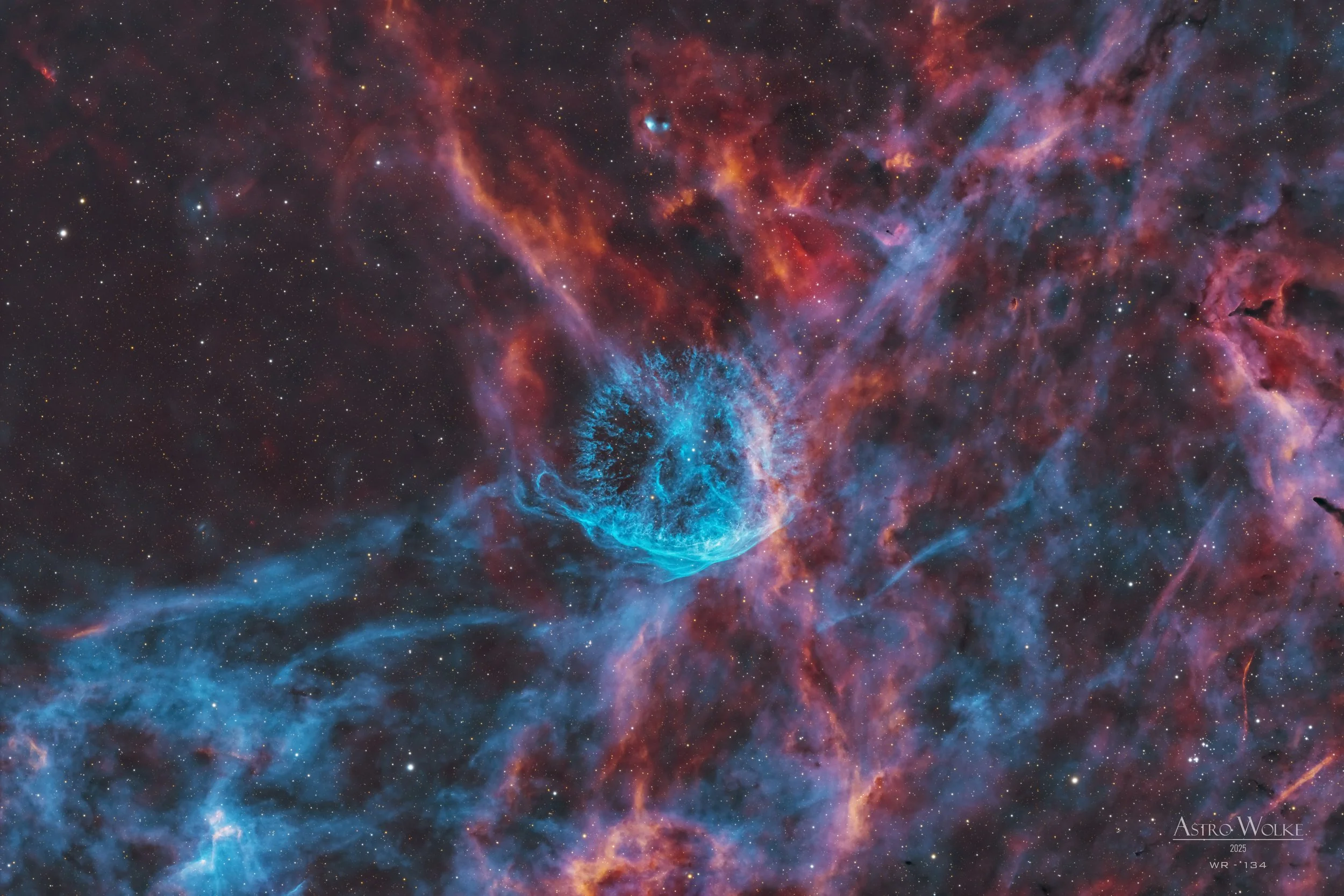
WR 134
eld reveals even more treasures: the dark tendrils of Barnard 150, also called the Seahorse Nebula, weave through the Milky Way’s star clouds, while the Fireworks Galaxy (NGC 6946) and star cluster NGC 6939 shine beyond our galaxy’s edge. Together, they form a portrait of cosmic contrast, from stellar death and rebirth to galaxies far in the background.

Sh2-129, Outters 4, Barnard 150, NGC 6946 & NGC 6939
This wide-field image brings together several striking deep-sky objects in the constellation Cepheus. On the left lies Sharpless 2-129, the Flying Bat Nebula, glowing in rich hydrogen emission. Nestled inside it is the elusive Outters 4, or Squid Nebula, a faint oxygen-rich bipolar outflow thought to originate from a hot central star.
To the right, dark dust lanes of Barnard 150, also called the Seahorse Nebula, cut through the glowing background. Further outward, two distant island universes appear: NGC 6946, the Fireworks Galaxy, and the open cluster NGC 6939. Together, this frame captures a tapestry of emission nebulae, dark nebulae, star-forming regions, and galaxies, highlighting the remarkable diversity of structures within a single region of the northern sky.
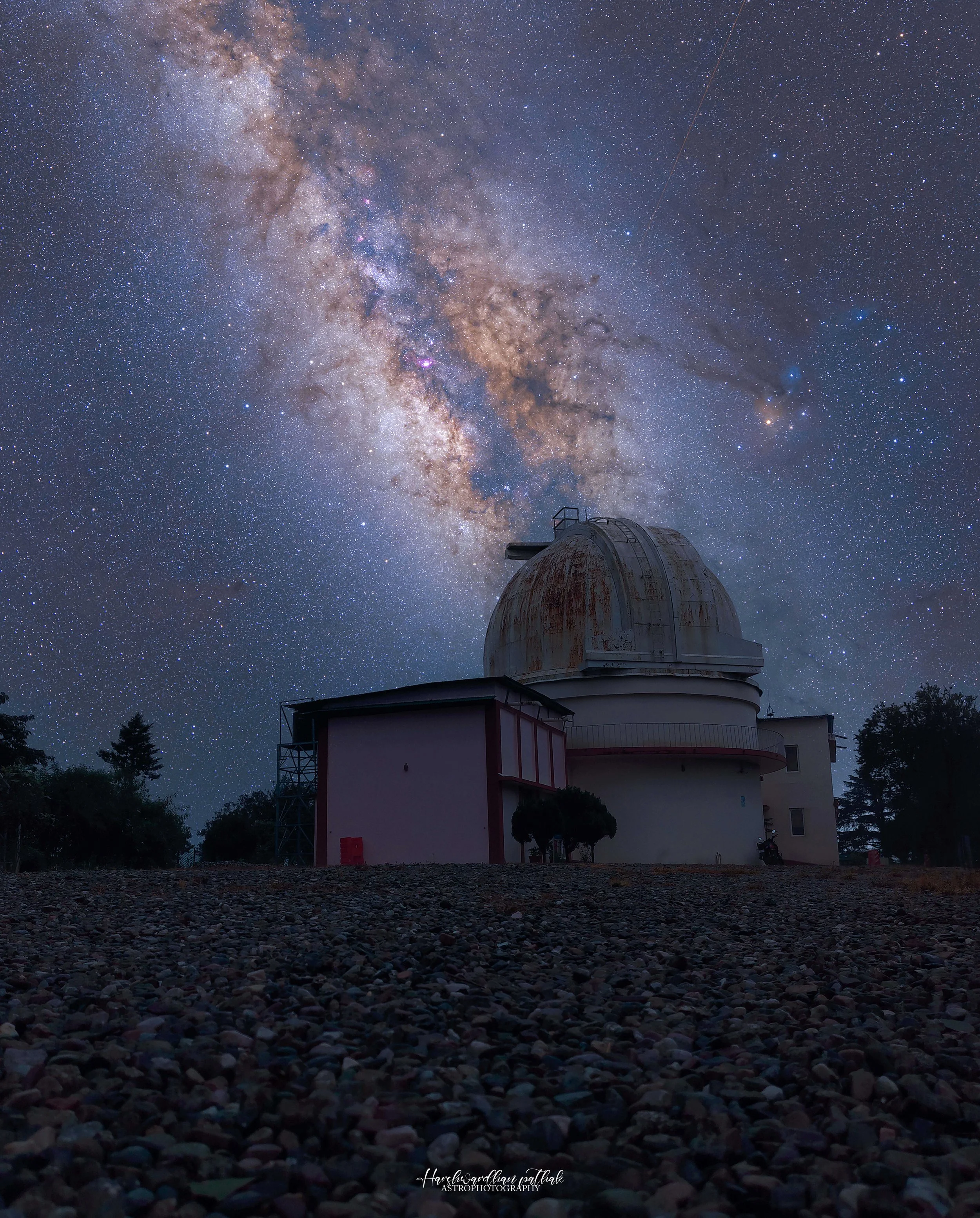
The Galactic Core above India’s Historic Sampurnanand Telescope
he central band of the Milky Way rises brilliantly above the Sampurnanand Telescope at the State Observatory in Nainital, India. The telescope, built in 1954, was once among Asia’s largest and played a key role in early Indian astrophysical research. Its dome, weathered with age, now serves as a reminder of the country’s rich astronomical heritage.
Overhead, the galactic core glows with dark dust lanes, star clouds, and the warm light of countless suns. To the right, the bright yellow star Antares and the Rho Ophiuchi complex add color to the scene, while the dense star fields of Sagittarius and Scorpius trace the heart of our Galaxy. The contrast between human-made history and the timeless night sky speaks to our enduring quest to understand the cosmos.
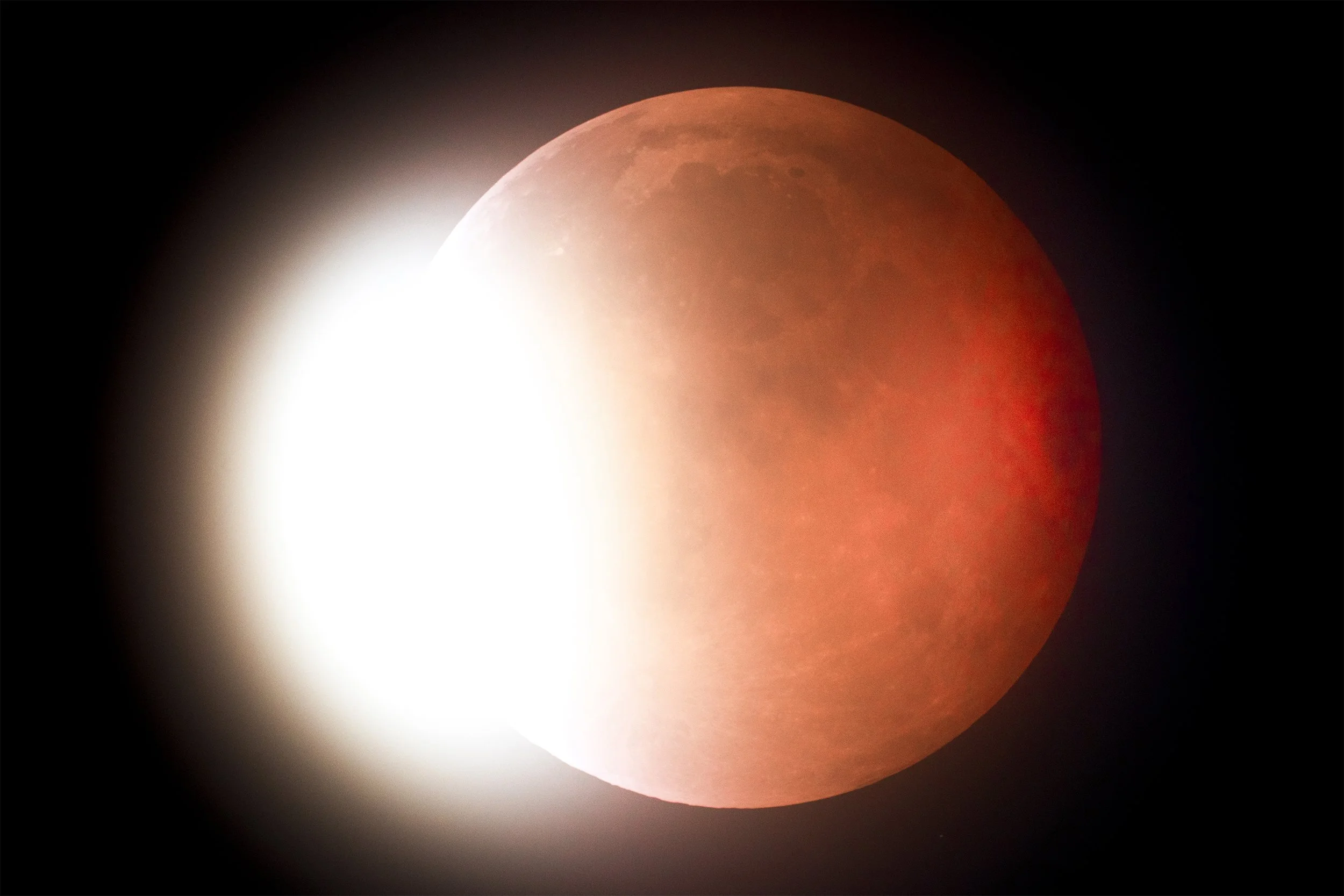
Lunar Eclipse over Mohali, India
This striking image captures the Moon during the September 7th lunar eclipse as seen from Mohali, Punjab, India. The Earth’s shadow paints the lunar surface in deep red hues, a result of sunlight scattering through Earth’s atmosphere and refracting into the umbra. At the same time, the brilliant glare of the uneclipsed portion creates a dramatic contrast, emphasizing the geometry of the event.
Lunar eclipses are visible to anyone on the night side of Earth when they occur, making them one of the most accessible celestial spectacles. Unlike solar eclipses, they can be safely viewed with the naked eye, connecting observers across continents under the same reddish glow of Earth’s shadow.
LDN 1295 in Cepheus
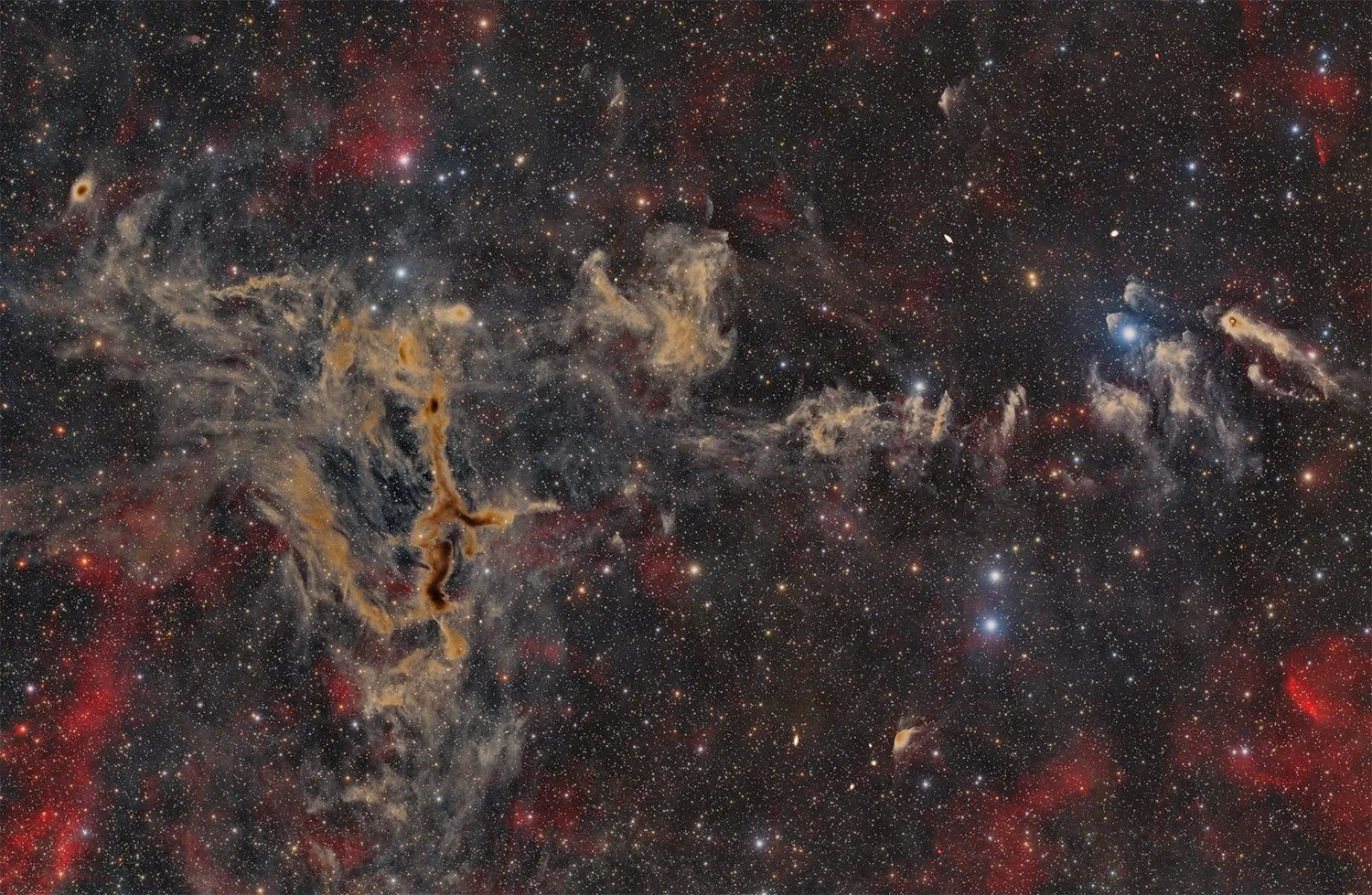
This image showcases Lynds Dark Nebula 1295, a complex and textured dust cloud located in the constellation Cepheus. Appearing as dark filaments silhouetted against a rich starfield, LDN 1295 is part of a larger network of interstellar material that stretches across this region of the Milky Way. The dust absorbs and scatters starlight, creating striking contrast between opaque lanes and more tenuous translucent wisps.
Illuminated here in a Ha-LRGB composite, the nebula reveals both its dark molecular core and faint hydrogen emission in the surrounding medium. Such clouds are active stellar nurseries, harboring dense regions where gravity will eventually collapse material into new stars. This view highlights the beauty and complexity of Cepheus, where hidden star formation and cosmic dust sculpt the interstellar canvas.
Cepheus Dust – LDN 1251, LDN 1235, and VdB 152
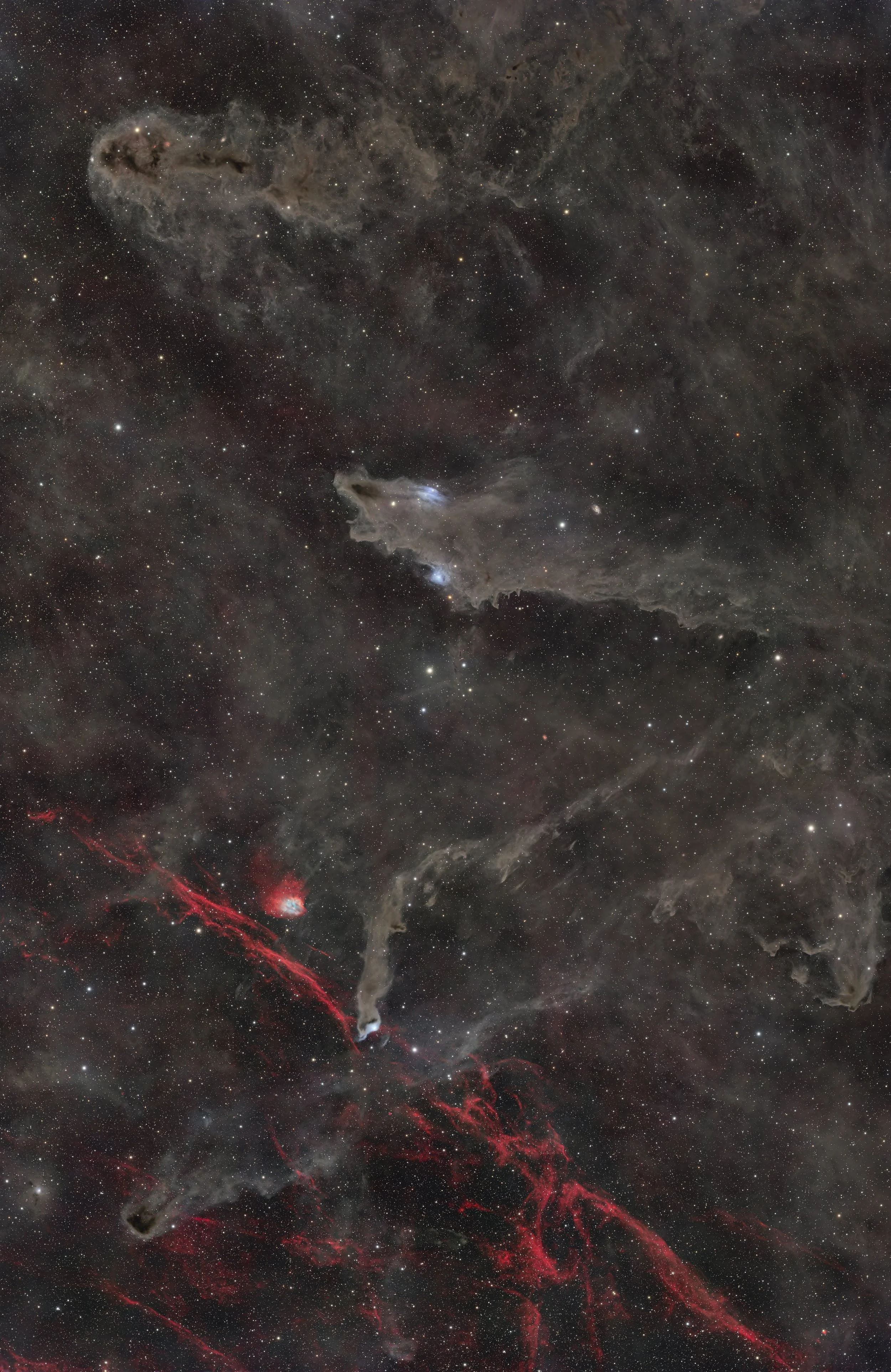
This wide-field view reveals a dark and dusty region in the constellation Cepheus, filled with dense clouds that block background starlight and sculpt striking shapes across the field. The scene includes Lynds Dark Nebulae LDN 1251 and LDN 1235, along with reflection nebula VdB 152, each tracing cold interstellar matter that will one day collapse into new stars. At the lower part of the frame, faint red emission filaments mark regions of shocked gas, remnants of past energetic events.
Such dusty complexes are often overlooked compared to their brighter emission nebula counterparts, yet they play a crucial role in the life cycle of the galaxy. By both obscuring and seeding future stellar nurseries, these clouds act as cosmic incubators. Images like this highlight not only the complexity of Cepheus but also the intricate balance between destruction and creation within the interstellar medium.
Inner core of the Dragon's Egg
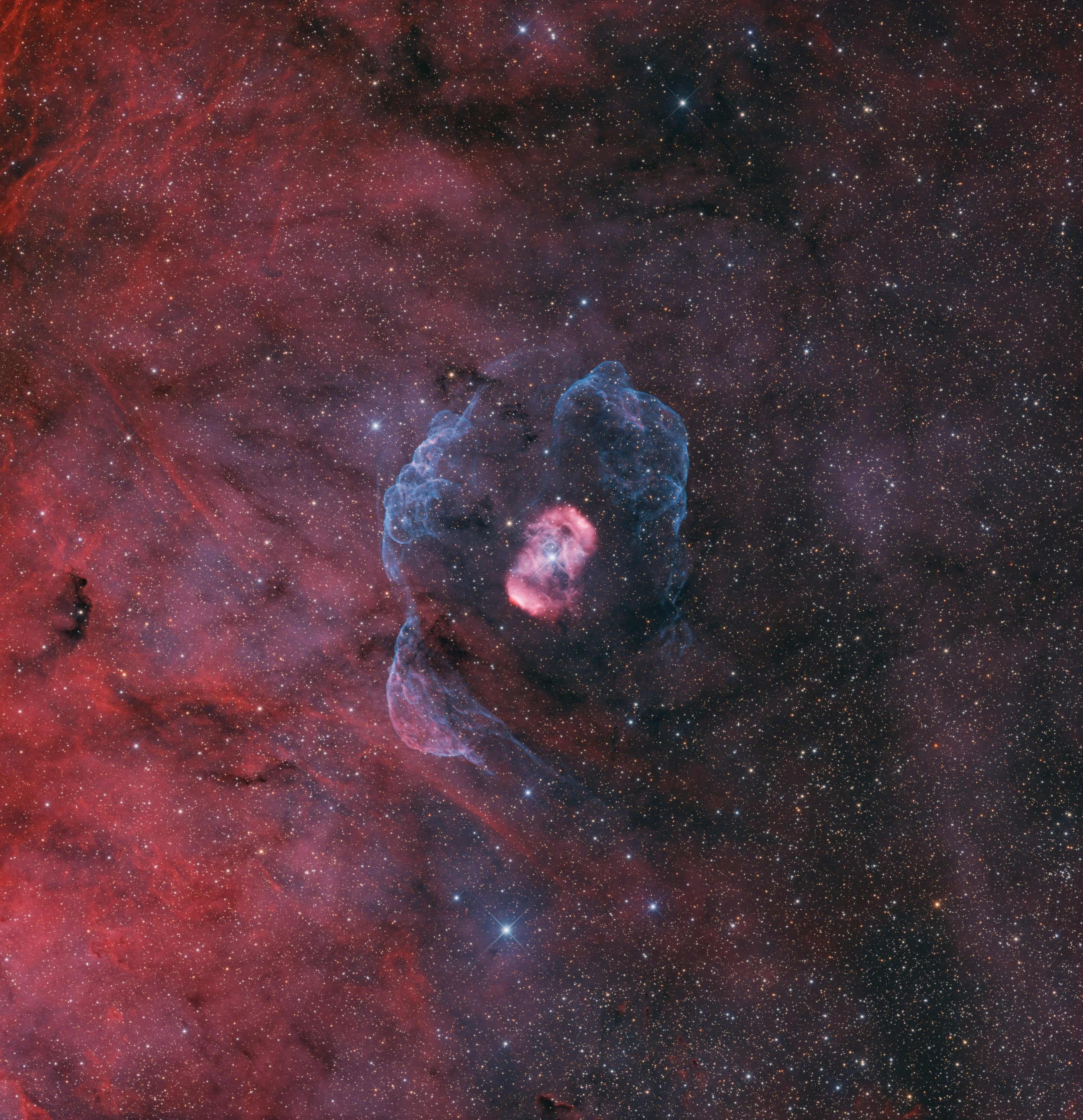
At the heart of the Dragon’s Egg Nebula lies its brilliant core, a striking planetary nebula surrounding a massive O-type star. This luminous star, some 40 times the mass of our Sun, has shed vast amounts of gas into the surrounding region, sculpting a glowing, bubble-like structure seen here in vivid blues and reds. The delicate arcs and filaments trace shock fronts where stellar winds collide with older ejected material.
The Dragon’s Egg is found in the constellation Norma, about 4,200 light-years away. Though it resembles a planetary nebula, it is the product of an enormous, short-lived star rather than a dying Sun-like one. Eventually, this star will end its life in a violent supernova, enriching the interstellar medium even further. Until then, its radiant core continues to shine as the centerpiece of one of the southern sky’s most intricate nebulae.

LDN 204: A Dark Cloud in Ophiuchus
Spanning across the constellation Ophiuchus, LDN 204 is a dense dark nebula silhouetted against the faint glow of background stars and hydrogen gas. These cold clouds of interstellar dust are so thick that they block visible light, appearing as inky rivers winding through the Milky Way. Within such regions, gravity can eventually pull matter together to form new stars, making dark nebulae both obscuring and nurturing.
This image, a 3x1 mosaic captured in June and July by the collaborative team n_kuadra with the contribution of their colleague Soler Grajera, reveals the remarkable texture and contrast of the nebula. The interplay of black dust lanes and the red backdrop of ionized hydrogen creates a dramatic view of one of Ophiuchus’s hidden stellar nurseries.
Where Stars Are Born and Die (M8, M20 & SNR G007.5-01.7)
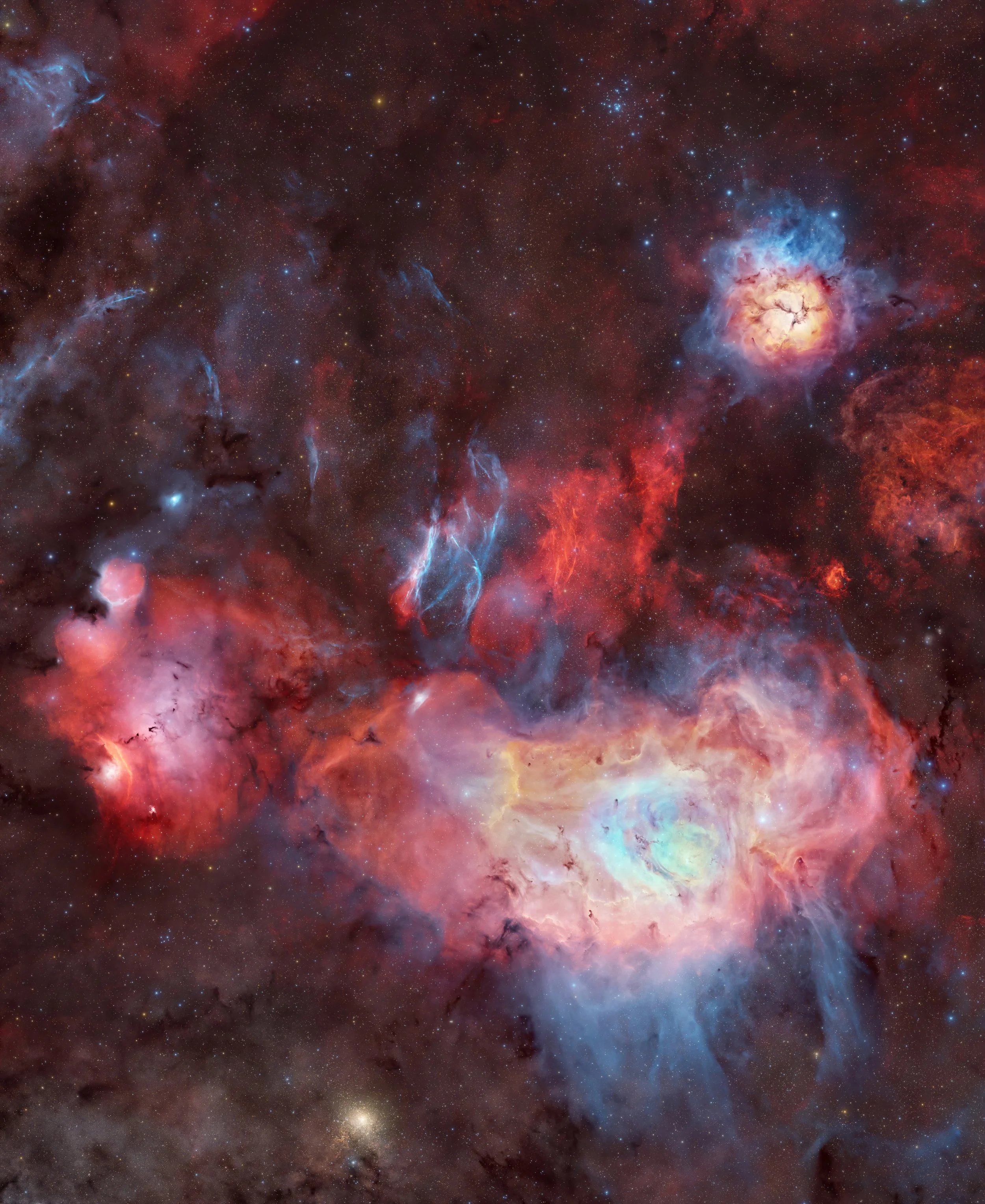
This breathtaking wide-field view brings together two stellar nurseries and the ghost of a dying star. At the bottom right glows the Lagoon Nebula (M8), a massive H II region where new stars form from collapsing clouds of gas and dust. Above it lies the Trifid Nebula (M20), easily recognized by its dark dust lanes that divide its bright blue and red emission. Both regions are among the most active star-forming complexes in the Milky Way, lying some 4,000 to 5,000 light-years away in Sagittarius.
Threaded across the scene are faint, delicate filaments belonging to the supernova remnant SNR G007.5-01.7. Unlike the nebulae forging new suns, these wisps are the expanding remains of a massive star that ended its life in a cataclysmic explosion. This juxtaposition of creation and destruction highlights the cosmic cycle of stellar evolution, where the death of one star enriches the interstellar medium to seed the birth of many more.
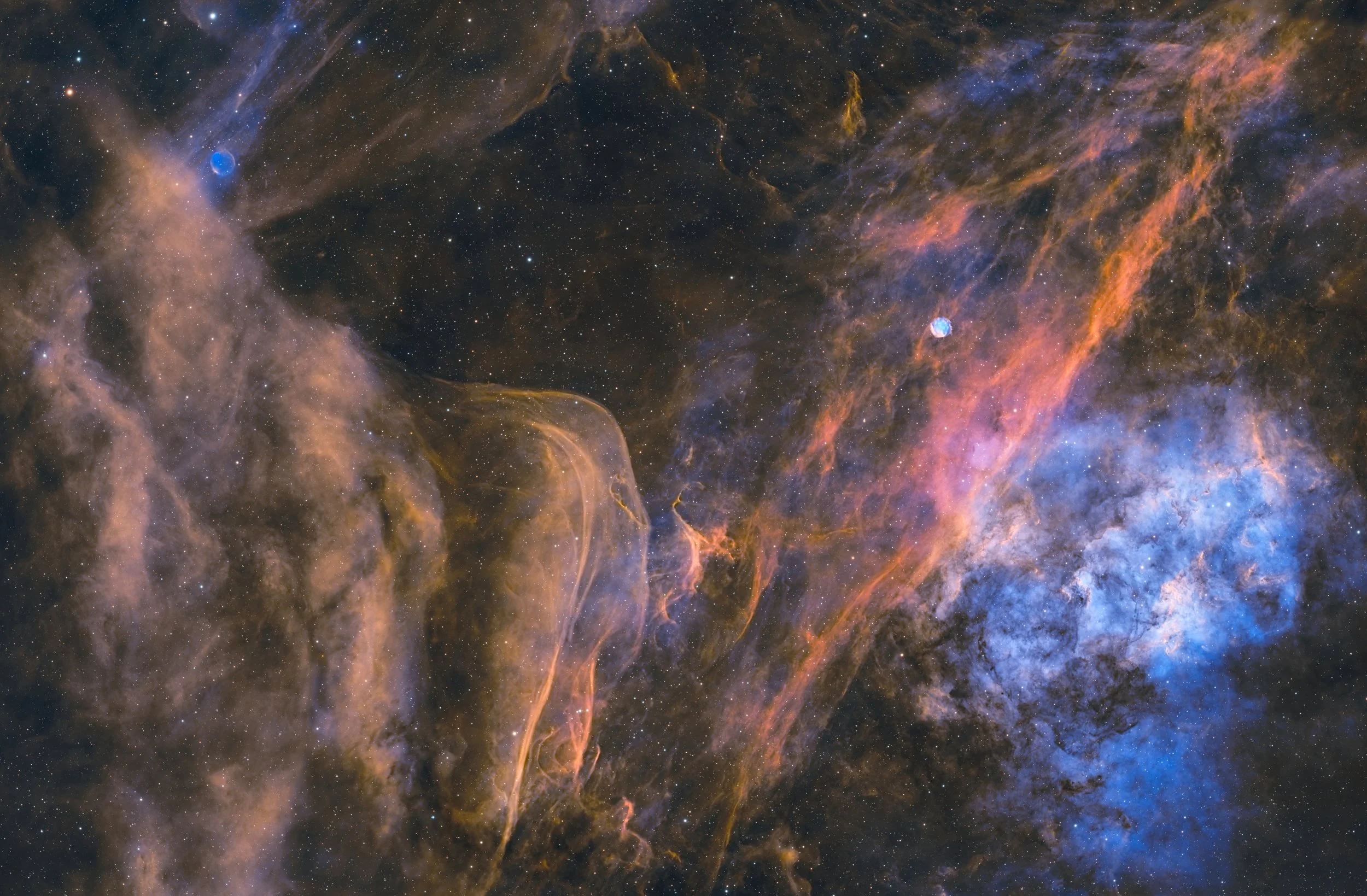
LBN 380 - Sh2-115 & 116 - PN Weinberger 1-10
This colorful wide-field view captures a fascinating region in Cygnus, centered on the bright emission nebula LBN 380. The intricate filaments of glowing hydrogen, oxygen, and sulfur are part of the massive H II region cataloged as Sharpless 115, which lies near the bright star Deneb in the rich Cygnus star field. Embedded within this complex is Sharpless 116, also known as Abell 71, a small but distinct emission structure often mistaken for a planetary nebula.
Adding to the scene is the faint, blue planetary nebula Weinberger 1-10, visible near the center-right portion of the image. This stellar remnant, expelled by a dying sun-like star, creates a striking contrast against the reddish hydrogen emission and dusty structures of the surrounding nebulae. The interplay of colors highlights the ionized gases that sculpt this celestial landscape, making it a prime example of the dynamic processes shaping our galaxy’s star-forming regions.
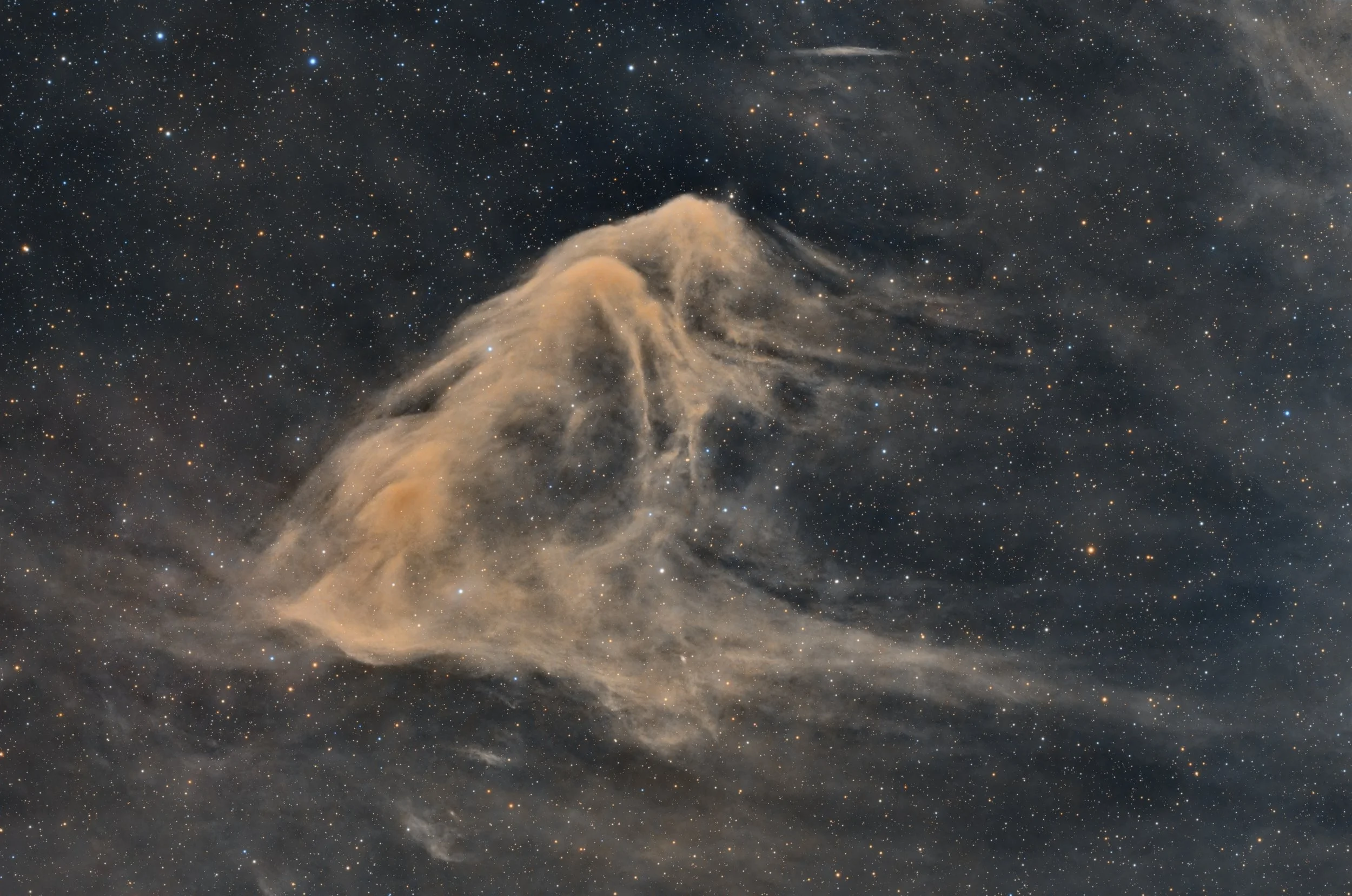
Sh2-63 – A Dark Nebula in Sagittarius
Sh2-63 is a dark nebula in the constellation Sagittarius, located near the dense star fields of the Milky Way’s central region. Unlike bright emission or reflection nebulae, dark nebulae are composed of cold interstellar dust that blocks the light from background stars, creating striking silhouettes against the galactic glow. This object is part of the Sharpless catalog of H II regions, but its opacity indicates an environment dominated by dust rather than active star formation.
In this image, the faint, wispy clouds of Sh2-63 drift through a rich star field, their subtle golden-brown tones contrasting with the dark interstellar medium. The fine filaments and soft gradients are illuminated only by starlight scattered through the dust, making these regions challenging to capture and process. Deep exposures and careful contrast control reveal the delicate structure hidden within the darkness of the galactic plane.

Sh 2-174 – The Valentine Rose NebulaS
Sh 2-174, also known as the Valentine Rose Nebula, is a faint emission and reflection nebula in the constellation Cepheus, about 3.5 degrees from the bright star Polaris. Spanning nearly 10 light-years across, it was once thought to be a planetary nebula, but research suggests it is a dense region of interstellar medium being illuminated by a hot white dwarf star. This interaction creates the glowing ionized gas and subtle shock fronts seen in its structure.
In this image, the nebula’s bright red hydrogen emission blends with faint blue hues of reflected starlight, set against a backdrop of interstellar dust and rich star fields. Captured with over 56 hours of integration, the delicate filaments and soft structures emerge from an otherwise dark region of space, revealing a complex interplay between stellar remnants and their surrounding environment.
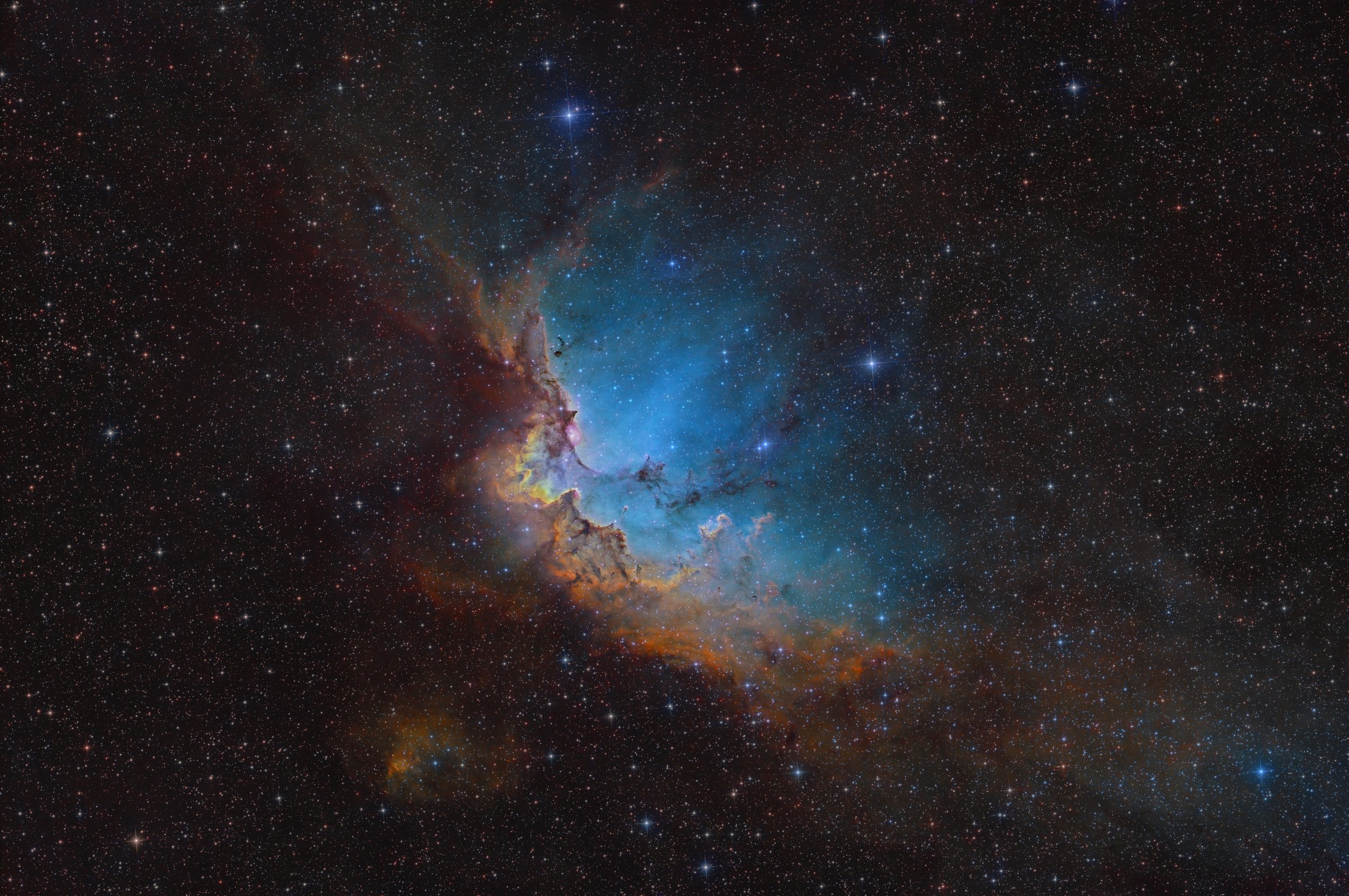
The Wizard Nebula in Narrowband Colors
The Wizard Nebula, cataloged as NGC 7380, is a young open star cluster embedded within a vast emission nebula in the constellation Cepheus. Spanning about 100 light-years, this stellar nursery lies roughly 7,200 light-years from Earth. Its intricate shapes and glowing gas clouds are energized by hot, massive stars at the cluster’s core, sculpting the surrounding hydrogen, sulfur, and oxygen into dramatic forms that resemble the figure of a sorcerer.
Captured in a Hubble-like palette using Ha, SII, and OIII filters, this image reveals striking contrasts between the dominant blue oxygen regions and the golden sulfur-rich filaments along the nebula’s edges. Dark dust lanes snake through the glowing gas, creating sharp boundaries that emphasize the region’s dynamic interplay between star formation and stellar winds. NGC 7380 is a vivid example of how stellar birth both creates and reshapes the interstellar medium.